BDO vs Boutique CPA Firm: Which is Right for Your Canadian Business?

What if the "brand insurance" of a global accounting giant is actually the very thing preventing your business from receiving the proactive tax planning it deserves? Many Canadian entrepreneurs believe that a mid-tier powerhouse is the only way to handle complex CRA compliance or cross-border IRS requirements. You likely want the security of a household name when the stakes involve international tax law, yet you may find yourself paying premium rates for the work of junior associates who don't fully understand your specific industry.
We understand the frustration of feeling like a low-priority client in a vast institutional machine. This guide breaks down the critical differences in service, expertise, and value to help you decide between BDO vs boutique CPA firm for your specific organizational goals. You'll discover how partner-led attention and transparent pricing can provide a more seamless experience for your Canadian and U.S. tax filings. We will compare the specialized agility of a boutique team against the scale of a global firm, ensuring you have the clarity to choose a partner that acts as a proactive guardian for your business's financial future.
Key Takeaways
- Understand how the flatter organizational structure of a boutique firm ensures you receive consistent partner-level attention rather than being delegated to junior associates.
- Evaluate the true cost of your accounting spend by comparing traditional hourly billing against the transparent, value-based fee models that help eliminate overhead creep.
- Discover how specialized firms manage complex cross-border obligations, including the specific requirements for 1040-NR filings under IRS rules for Canadian residents.
- Analyze the strategic trade-offs of BDO vs boutique CPA firm to find the right balance between global brand recognition and the personalized agility your business requires.
- Learn to identify a "proactive guardian" who looks beyond basic CRA compliance to secure better long-term financial outcomes for your enterprise.
The Global Network Model of BDO
The BDO Global network is an expansive structure of independent member firms spanning the globe. This model offers a significant advantage in "brand recognition," which can be a vital asset when dealing with major Canadian banks or international investors. Their typical client profile includes large-scale private companies that need standardized reporting across multiple provinces or countries. While the infrastructure is impressive, it often relies on a "pyramid" staffing model. This means your day-to-day contact might be a junior staff member, while the partners remain reserved for the highest-level consultations. For some, the prestige of the name justifies the premium, but for others, it feels like paying for a global engine when you only need to drive across town.
The Specialized Agility of Boutique Firms
Boutique firms thrive on specialized agility and the promise of a long-term, stable partnership. Unlike the revolving door of staff often found at larger institutions, a boutique firm offers a steady hand at the helm. These practices often specialize in specific Canadian industries, allowing them to provide insights that go far beyond basic bookkeeping. For example, a boutique firm with decades of experience can offer "Big Firm Expertise" without the institutional layers that slow down decision-making. This intimacy is particularly valuable when managing cross-border tax issues. Whether you are filing for CRA filers at home or navigating the complexities of U.S. income reporting under IRS rules, having a dedicated partner who understands your entire history ensures nothing falls through the cracks. This continuity builds a sense of deep-seated reliability that a larger, more transient team simply cannot replicate.
Service Delivery Models: Global Infrastructure vs. Personalized Expertise
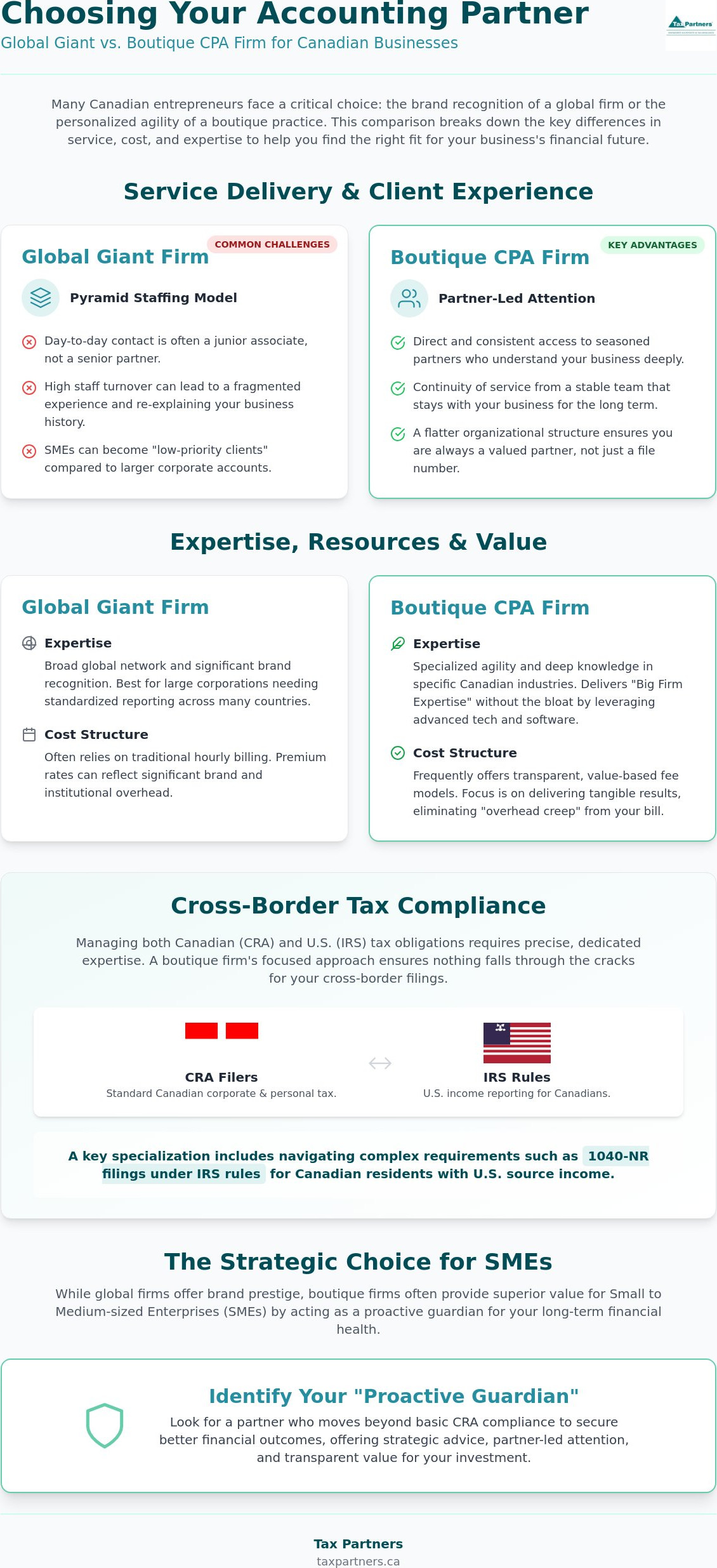
Large accounting firms traditionally operate on a pyramid staffing structure. At the peak sit the partners, supported by a broad base of junior associates and managers. For a multi-national corporation, this scale is essential for processing massive volumes of data. For a Canadian SME, however, this model often results in a fragmented experience. When evaluating a BDO vs boutique CPA firm, the most immediate difference is who actually manages your account day-to-day. In a large firm, your file might pass through several hands during a single tax season. This often leaves you re-explaining your business history to a new junior associate every few months.
The Small Fish in a Big Pond Syndrome
Large firms with multi-billion dollar revenues naturally focus their primary attention on their largest corporate accounts. If your business doesn't meet a certain revenue threshold, you risk becoming a low-priority client. High staff turnover at these institutions further erodes the relationship, often driven by a competitive hiring market where top talent is sought after on niche platforms like taxjobs.ai. It's difficult to find a "proactive guardian" when your primary contact changes annually. Boutique firms provide a refreshing alternative with a flatter organizational structure. You receive direct, consistent access to seasoned partners who stay with your business for the long haul. This continuity is a hallmark of the boutique experience, ensuring that your strategic tax planning is never lost in translation.
Resource Access and Depth of Knowledge
A common myth suggests that only global giants have the resources to handle complex financial matters. While large firms do have massive internal networks, boutique firms have closed this gap by leveraging advanced technology and CPA Canada business resources. In the modern AI era, specialized practices use the same sophisticated auditing and tax software as their larger competitors. This allows them to deliver expert tax advisory services without the institutional bloat that drives up costs.
Expertise is not defined by the number of employees in a building. It's defined by the precision of the advice given to your specific case. Whether you're navigating a complex audit for CRA filers or managing cross-border reporting requirements for the IRS, a boutique firm offers a focused intensity. You aren't just another file; you're a partner. If you feel your current firm treats your business as a secondary concern, it may be time to discuss a more personalized service model with an expert who values your growth.
Cost-Benefit Analysis: Realizing Value for Your Accounting Spend
Your accounting budget isn't just an expense; it's a strategic investment in your company's stability. When comparing a BDO vs boutique CPA firm, the price tag often reflects more than just the expertise of the accountant. Large mid-tier firms maintain significant global infrastructure, including expensive urban office spaces and massive administrative departments. These costs inevitably trickle down into your hourly rate. You aren't just paying for tax advice; you're subsidizing a global network.
Fee Transparency and Overhead
Boutique firms typically operate with leaner structures. This allows them to offer more competitive rates for Canadian corporate tax compliance while maintaining higher levels of partner involvement. Another hidden cost at large firms is staff turnover. Every time a new associate is assigned to your file for CRA filers, you pay for their learning curve as they familiarize themselves with your history. Value-based pricing is a model where fees are determined by the complexity and importance of the work to the client, rather than simply tracking minutes on a clock. This transparency ensures you know exactly what you're paying for before the work begins.
Direct Comparison: Firm Features
When choosing the right accountant, you must weigh the ROI of proactive planning against the cost of basic compliance. A boutique mentor often identifies tax-saving opportunities that a high-volume firm might overlook. Operational excellence also depends on professional bookkeeping services that provide real-time data for decision-making. Below is a breakdown of how these firm models typically compare for a Canadian SME:
| Feature | Global Mid-Tier (BDO) | Boutique CPA Firm |
|---|---|---|
| Partner Access | Reserved for major issues | Direct and consistent |
| Fee Flexibility | Rigid hourly structures | High (Value-based/Fixed) |
| Niche Specialization | Broad industry coverage | Deep, industry-specific focus |
| Global Reach | Expansive internal network | Strategic, targeted partnerships |
For most Canadian business owners, the choice between BDO vs boutique CPA firm comes down to the definition of value. If you require the "boardroom comfort" of a global brand to satisfy international stakeholders, a large firm may be necessary. However, if you want a proactive guardian who understands the nuances of your specific industry and offers transparent billing, the boutique model often provides a superior return on investment. The goal is to move from a state of uncertainty toward a feeling of total control over your financial obligations.
Jurisdictional Expertise: CRA and IRS Cross-Border Compliance
There is a persistent myth that international tax complexity requires a global institution. Many entrepreneurs assume that only a mid-tier giant can navigate the friction between Canadian and American tax authorities. When comparing a BDO vs boutique CPA firm, however, the real differentiator is the depth of the specialized cross-border department. A boutique firm with a dedicated focus on North American integration often provides more cohesive strategies than a global network where the Canadian and U.S. teams operate as entirely separate entities. This integration ensures that a decision made for CRA filers doesn't create an accidental tax liability under IRS rules.
For Canadians with southern interests, compliance is a multi-front battle. This includes the necessity of 1040-NR filing for Canadians who earn effectively connected income in the United States. Beyond simple income reporting, specialized boutiques manage the rigorous disclosure requirements of FBAR and FATCA for dual citizens. These filings are mandatory under IRS rules; failure to comply can lead to severe penalties that far outweigh the cost of professional advice. Having one team manage both jurisdictions provides a "proactive guardian" effect, where every move is calculated to protect your global net worth.
Navigating U.S. and Canadian Tax Treaties
The U.S.-Canada tax treaty is a vital tool for avoiding double taxation, yet its application requires surgical precision. Boutique firms excel at creating tailored strategies for cross-border real estate and private equity investments. They ensure that foreign tax credits are maximized for CRA filers while meeting all reporting thresholds under IRS rules. Because these thresholds and regulations can change, it's essential to verify current filing requirements directly with the IRS or CRA. A seasoned mentor will look ahead to these shifts, ensuring your investment structure remains efficient as your portfolio grows.
Audit Defense and CRA Mediation
As the Canada Revenue Agency intensifies its use of AI-driven audits in 2026, the value of experienced representation cannot be overstated. Large firms often treat audit defense as a procedural task. In contrast, a firm with a 40-year history brings institutional wisdom to CRA audit help, understanding the nuances of mediation and dispute resolution. This expertise is particularly critical for holding company tax planning, where the intersection of corporate and personal tax must be managed with absolute transparency. If you are facing a complex cross-border challenge, you should reach out to a specialist who can provide the steady hand needed to resolve jurisdictional disputes efficiently.
The Strategic Choice: Why Boutique Often Wins for SMEs
Choosing between a BDO vs boutique CPA firm is a decision that defines your company's trajectory. While large mid-tier firms offer a sense of institutional security, the boutique model often aligns more naturally with the entrepreneurial spirit of a growing Canadian business. Success in the SME sector requires agility, rapid response times, and a partner who views your success as their own. A boutique practice acts as a proactive guardian, moving beyond the reactive nature of annual filings to anticipate regulatory shifts before they impact your bottom line.
Decision Framework for Business Owners
The right choice depends entirely on your current scale and future objectives. You might choose a global network like BDO if your enterprise is preparing for a public listing on a major exchange or navigating massive global M&A transactions that require a "Big Name" audit for international stakeholders. However, a boutique firm is often the superior choice for SMEs focused on growth, complex cross-border tax optimization, and consistent partner access. This personalized approach is also essential for tax-efficient wealth management, where your business and family financial goals must be integrated into a single, cohesive strategy for CRA filers.
To ensure you find the right fit, use this checklist during your initial interviews:
- Direct Access: Will a partner be my primary point of contact, or will my file be delegated to junior associates?
- Jurisdictional Clarity: Does the firm have a dedicated department for U.S. reporting under IRS rules and Canadian compliance for CRA filers?
- Fee Transparency: Does the firm offer value-based or fixed-fee models, or am I billed for every minute of staff training?
- Continuity: What is the firm's staff turnover rate, and can they guarantee relationship stability?
Next Steps: Securing Your Financial Future
Your accounting relationship should provide a sense of total control and understanding, not a monthly bill for junior-level work. If you feel like a low-priority client in a vast institutional machine, it's time to evaluate the boutique difference. Tax Partners combines the institutional wisdom gained from over 40 years in business with the personalized care of a specialized practice. With over 495,000 returns filed and a specialized department for U.S. and Canadian cross-border tax, we provide the "Big Firm Expertise" your business needs without the institutional bloat.
A steady hand at the helm can make the difference between simple compliance and true financial empowerment. Don't leave your cross-border obligations or domestic growth to chance. Take the first step toward a more proactive partnership and schedule a consultation with Tax Partners today to realize the full potential of your Canadian enterprise.
Secure Your Financial Future with a Proactive Partner
Finding the right balance between global reach and personalized care is the key to securing your enterprise's long-term stability. While the debate of BDO vs boutique CPA firm often centers on firm size, the real value lies in finding a mentor who understands your specific industry. You now have the framework to evaluate whether you need the global infrastructure of a mid-tier giant or the specialized agility of a boutique team. Boutique firms provide the partner-level attention necessary to manage complex U.S. reporting under IRS rules while ensuring domestic filings remain perfectly optimized for CRA filers.
Tax Partners brings over 40 years of Canadian tax expertise and a dedicated cross-border department to every engagement. With 1,390+ five-star Google reviews, we've built a reputation for reliability and deep-seated technical proficiency. We don't just react to requirements; we look ahead to secure better outcomes for your business and your family. Keep more of what you earn—connect with Tax Partners today. We are ready to help you navigate the complexities of modern tax law with confidence and clarity.
Frequently Asked Questions
Is a boutique CPA firm as reliable as a large firm like BDO for CRA audits?
Boutique firms are often more reliable for CRA audits because they provide direct partner oversight throughout the entire process. While large firms have vast departments, a boutique firm with decades of experience offers a steady hand during mediation. This ensures that your specific business history is defended with precision rather than being treated as just another file in a high-volume system.
Can a boutique firm handle complex U.S. cross-border tax issues like FBAR?
Specialized boutique firms often have dedicated cross-border departments that manage FBAR and FATCA reporting under IRS rules. These firms ensure that your U.S. disclosure requirements are integrated with your Canadian filings. This prevents the jurisdictional confusion that can occur when different teams handle your CRA and IRS obligations separately.
Will I save money on accounting fees by switching to a boutique firm?
You often realize significant value when choosing a BDO vs boutique CPA firm because boutiques maintain lower overhead costs. Large firms frequently bill for the learning curves of junior associates and global infrastructure. In contrast, many boutique practices utilize value-based pricing models that provide total transparency and eliminate "overhead creep."
What industries do boutique CPA firms typically specialize in?
Boutique firms typically focus on niche Canadian sectors such as real estate, healthcare, professional services, and ecommerce. This specialization allows them to act as proactive guardians, offering industry-specific insights that a generalist firm might overlook. They understand the unique CRA compliance challenges and tax-saving opportunities specific to your field.
Do boutique firms have the same level of technology as mid-tier giants?
Modern boutique firms utilize the same cloud-based accounting platforms and AI-driven auditing tools as mid-tier giants. Technology has leveled the playing field, allowing smaller practices to provide real-time data and sophisticated analysis. You don't need a global network to access high-level automation or secure digital document management.
How do I know if my business has outgrown a solo accountant but isn't ready for a big firm?
You've likely outgrown a solo accountant if you require complex cross-border planning or have multiple corporate entities. If your current accountant only reacts to deadlines rather than providing foresight, it's time to move up. A boutique firm offers the "Big Firm Expertise" needed for scaling without the impersonal nature of a massive institution.
What should I look for in a boutique CPA firm's track record?
Look for a firm with a stable history, such as 40 or more years in business, and a high volume of successfully filed returns. Client reviews and a proven history of managing CRA mediation are essential indicators of reliability. A strong track record in both Canadian and U.S. tax jurisdictions demonstrates the versatility required for modern business owners.
Does a boutique firm offer the same range of services as BDO, such as payroll and wealth management?
Many boutique firms offer a comprehensive suite of services including payroll, bookkeeping, and wealth management. This integrated approach ensures that your personal financial planning and business operations are aligned. You can receive the same end-to-end support found at a large firm but with a more personalized, attentive register.

Article by
Mahad Mohamed
Mahad Mohamed is an accountant and the CEO of Tax Partners, with over 26+ years of Canadian and international tax and accounting experience. His expertise includes corporate reorganization, cross-border tax structuring (Canada & US), tax disputes, CRA audits, and tax planning for small owner-managed private corporations. Most recently, Mahad is a pioneer in Canadian crypto taxation and founded Block3 Finance.
Previously, Mahad worked for the Canada Revenue Agency (CRA), Big4 accounting firms, and served as a Rulings Officer for the Federal Tax Authority of the UAE before acquiring Tax Partners in 2014.
Tax Partners has 44 full-time accountants and over 18,400+ clients.
Disclaimer
This article provides general information only and is current as of its publication date. It has not been updated and may be out of date. It does not constitute legal advice and should not be relied upon as such. Every tax situation is unique and may differ from the examples discussed in this article. If you have specific questions, you should seek the advice of our accountants for your unique circumstances. Book a FREE Initial Consultation Today!
Frequently Asked Questions
Is a boutique CPA firm as reliable as a large firm like BDO for CRA audits?
Boutique firms are often more reliable for CRA audits because they provide direct partner oversight throughout the entire process. While large firms have vast departments, a boutique firm with decades of experience offers a steady hand during mediation. This ensures that your specific business history is defended with precision rather than being treated as just another file in a high-volume system.
Can a boutique firm handle complex U.S. cross-border tax issues like FBAR?
Specialized boutique firms often have dedicated cross-border departments that manage FBAR and FATCA reporting under IRS rules. These firms ensure that your U.S. disclosure requirements are integrated with your Canadian filings. This prevents the jurisdictional confusion that can occur when different teams handle your CRA and IRS obligations separately.
Will I save money on accounting fees by switching to a boutique firm?
You often realize significant value when choosing a BDO vs boutique CPA firm because boutiques maintain lower overhead costs. Large firms frequently bill for the learning curves of junior associates and global infrastructure. In contrast, many boutique practices utilize value-based pricing models that provide total transparency and eliminate "overhead creep."
What industries do boutique CPA firms typically specialize in?
Boutique firms typically focus on niche Canadian sectors such as real estate, healthcare, professional services, and ecommerce. This specialization allows them to act as proactive guardians, offering industry-specific insights that a generalist firm might overlook. They understand the unique CRA compliance challenges and tax-saving opportunities specific to your field.
Do boutique firms have the same level of technology as mid-tier giants?
Modern boutique firms utilize the same cloud-based accounting platforms and AI-driven auditing tools as mid-tier giants. Technology has leveled the playing field, allowing smaller practices to provide real-time data and sophisticated analysis. You don't need a global network to access high-level automation or secure digital document management.
How do I know if my business has outgrown a solo accountant but isn't ready for a big firm?
You've likely outgrown a solo accountant if you require complex cross-border planning or have multiple corporate entities. If your current accountant only reacts to deadlines rather than providing foresight, it's time to move up. A boutique firm offers the "Big Firm Expertise" needed for scaling without the impersonal nature of a massive institution.
What should I look for in a boutique CPA firm's track record?
Look for a firm with a stable history, such as 40 or more years in business, and a high volume of successfully filed returns. Client reviews and a proven history of managing CRA mediation are essential indicators of reliability. A strong track record in both Canadian and U.S. tax jurisdictions demonstrates the versatility required for modern business owners.
Does a boutique firm offer the same range of services as BDO, such as payroll and wealth management?
Many boutique firms offer a comprehensive suite of services including payroll, bookkeeping, and wealth management. This integrated approach ensures that your personal financial planning and business operations are aligned. You can receive the same end-to-end support found at a large firm but with a more personalized, attentive register.