Tax Planning for Retirees in Canada: Strategic Trends and Insights for 2026

What if the very strategies that helped you build your wealth are now the greatest threats to your retirement security? For many Canadians, the transition from saving to spending is fraught with the fear that Old Age Security (OAS) clawbacks or shifting CRA regulations will quietly drain their hard-earned nest egg. It's a valid concern; seeing your benefits reduced because you've been "too successful" at saving feels inherently unfair. You've worked hard for your stability, and you shouldn't have to worry about the rules changing mid-game.
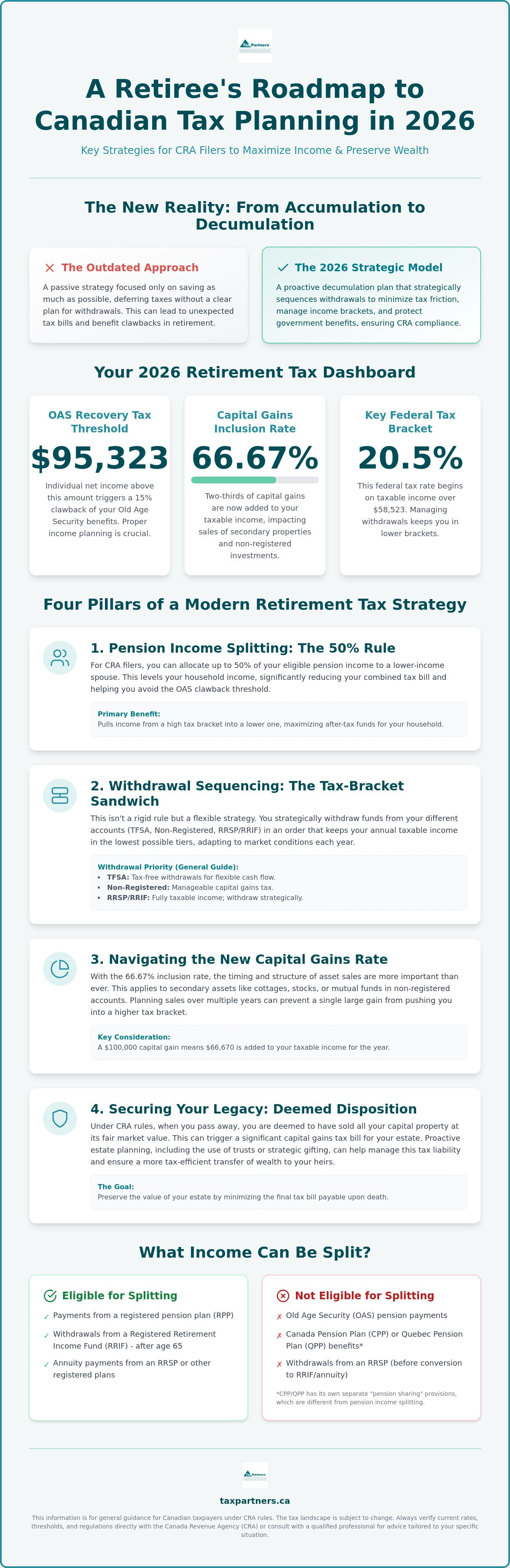
Effective tax planning for retirees in 2026 requires a shift from simple accumulation to sophisticated decumulation. You can protect your income and maximize your after-tax estate value by using modern, CRA-approved techniques. This article provides a clear roadmap to help you organize your withdrawal sequence and understand the new 66.67% capital gains inclusion rate. We'll examine the critical 2026 thresholds, such as the $95,323 OAS recovery tax trigger, to ensure you stay in total control of your financial future.
Key Takeaways
- Master the "50% Rule" for pension income splitting to significantly reduce your household’s collective tax burden for CRA filers.
- Implement the "Tax-Bracket Sandwich" withdrawal sequence to access your savings while remaining in the lowest possible tax tiers.
- Navigate the 2026 capital gains inclusion rate changes with precision, ensuring the sale of secondary assets doesn't trigger excessive tax liabilities.
- Secure your estate by understanding the "Deemed Disposition" rules under CRA guidelines and exploring tax-efficient ways to transfer wealth to the next generation.
- Establish a clear, multi-year roadmap for tax planning for retirees that prioritizes both current income stability and the long-term value of your legacy.
The Evolving Landscape of Canadian Retirement Taxation in 2026
The financial world you entered at the start of your career looks nothing like the one you're navigating today. For decades, the standard advice was simple: save as much as possible and defer taxes for as long as you can. However, the economic realities of 2026 have fundamentally challenged these traditional models. With the Canadian tax system undergoing significant structural shifts, including a higher capital gains inclusion rate and evolving bracket thresholds, a passive approach to your finances is no longer viable. You need a proactive guardian to help you anticipate these changes before they impact your lifestyle.
Inflation-adjusted tax brackets are a primary concern for retirees on fixed or semi-fixed incomes. While the CRA adjusts these brackets annually to prevent "bracket creep," the 2026 federal tiers, such as the 20.5% rate starting at $58,523, require precise income management. If your withdrawal strategy isn't calibrated to these specific levels, you may find yourself pushed into a higher tax bracket simply because your RRIF or pension income kept pace with the cost of living. This creates a delicate balancing act where you must generate enough cash flow to maintain your standard of living without triggering unnecessary tax liabilities.
Moving Beyond Simple Savings to Strategic Decumulation
Success in retirement is defined by decumulation, which is the art of spending down your various asset classes with the least amount of tax friction possible. In 2026, market volatility has made rigid withdrawal rules obsolete. You need a flexible plan that allows you to pivot between your RRSP, TFSA, and non-registered accounts based on current market performance and your total taxable income. This guide focuses exclusively on the rules for CRA filers, ensuring that your wealth management and financial planning strategy remains compliant with domestic regulations while protecting your after-tax income.
Why CRA Compliance is More Critical for Retirees Today
The CRA has significantly enhanced its digital reporting and transparency measures for the 2026 tax year. Gone are the days of manual oversight; modern systems now track income streams with incredible precision, from traditional dividends to digital asset transactions. For retirees, this means that even small errors in reporting pension income or capital gains can lead to long-term audit risks and costly reassessments. Tax planning is a year-round foresight exercise rather than a seasonal task. By adopting a "proactive guardian" mindset, you ensure that every financial move you make is documented correctly and optimized to pay the absolute minimum required under the law. This steady hand at the helm provides the stability you need to enjoy your retirement without the looming stress of regulatory uncertainty.
Maximizing Income Splitting and Spousal Strategies for CRA Filers
For Canadian couples, the tax system offers a powerful mechanism to lower the collective household bill: pension income splitting. By shifting up to 50% of eligible pension income to a spouse in a lower tax bracket, you can effectively level your income and reduce your combined marginal tax rate. This isn't just about saving a few dollars. It's a critical component of tax planning for retirees that helps prevent one partner from inadvertently triggering the OAS recovery tax. When one spouse’s income crosses the $95,323 threshold in 2026, the 15% clawback begins, making strategic allocation essential for preserving your government benefits.
Income levelling works best when it's proactive. Instead of waiting for tax season to see where the numbers land, you should project your combined income early in the year. This allows you to adjust your voluntary tax withholdings or instalment payments accordingly. Under CRA rules, this strategy is particularly effective for couples with a significant disparity in their retirement income streams, as it effectively pulls income from a high tax tier into a much lower one, keeping more money in your joint account.
Eligible Pension Income vs. Government Benefits
Not all retirement income is treated equally for splitting purposes. Eligible income typically includes private pension payments, RRIF withdrawals, and certain life annuities. However, the age 65 threshold is a vital milestone. Before you turn 65, only specific employer-sponsored pension income is usually eligible. After 65, the definition expands to include RRIF and annuity payments. It's important to recognize that Old Age Security (OAS) and Canada Pension Plan (CPP) benefits cannot be split using the same 50% rule. While you can apply to share CPP benefits through Service Canada, the rules and calculations differ significantly from private pension splitting.
Spousal RRSPs as a Long-term Levelling Tool
While pension splitting is a year-to-year decision made on your tax return, spousal RRSPs are a proactive tool for long-term equalization. By contributing to a spousal plan, the higher-earning partner receives the immediate tax deduction, but the future withdrawals are taxed in the hands of the lower-earning spouse. You must be mindful of the three-year attribution rule; if funds are withdrawn within three calendar years of a contribution, the income may be taxed back to the contributor. Mastering RRSP withdrawal strategies is key to avoiding these traps. For a deeper look at integrated strategies, you can explore our resources on Tax-Efficient Wealth Management for CRA Filers to see how these tools fit your broader estate goals. If you're unsure how to balance your spousal accounts, speaking with a tax professional can provide the clarity you need to move forward with confidence.
Strategic Withdrawal Sequencing: The 2026 Decumulation Model
The transition from saving to spending requires a fundamental shift in how you view your assets. While the accumulation phase was about growth, the decumulation phase is about precision. Many Canadians fall into the trap of the "RRSP first" mantra, assuming they should exhaust their registered savings before touching anything else. In 2026, this rigid approach often leads to a "tax spike" in later years, where mandatory withdrawals collide with other income sources to create an avoidable tax burden. A more sophisticated method is the "Tax-Bracket Sandwich." This involves blending withdrawals from RRSPs, TFSAs, and non-registered accounts to fill your lowest tax brackets while keeping your total taxable income below the next tier.
Strategic tax planning for retirees also requires careful timing of the mandatory transition from an RRSP to a Registered Retirement Income Fund (RRIF). You must complete this conversion by December 31 of the year you turn 71. While you can start earlier, the goal is to manage the mandatory minimum withdrawals that begin the following year. If these minimums are too high, they can push you into a higher marginal bracket or trigger benefit reductions. By viewing your non-registered accounts not as a last resort, but as a flexible tool to manage your annual taxable income, you maintain a steady hand over your financial trajectory.
Minimizing the Impact of OAS Recovery Tax (Clawbacks)
For the 2026 income year, the CRA begins the Old Age Security (OAS) recovery tax, commonly known as a clawback, once your net income exceeds $95,323. For every dollar you earn above this threshold, you must repay 15 cents of your OAS benefit. This effectively creates an additional 15% tax on that slice of your income. Using Tax-Free Savings Account (TFSA) withdrawals to supplement your lifestyle is an excellent way to access cash without increasing your net income on paper. RRIF minimums can inadvertently push retirees into clawback territory by forcing taxable income into their hands regardless of their actual spending needs.
The TFSA Advantage in Late-Stage Retirement
The TFSA remains the ultimate hedge against future tax rate increases because every dollar withdrawn is entirely tax-exempt under CRA rules. In your 70s and 80s, the TFSA offers unparalleled flexibility for large, one-time expenses like home renovations or medical costs. If you have extra cash from a RRIF withdrawal that you don't need for daily living, re-contributing it to your TFSA (up to your available limit) allows that capital to continue growing tax-free. Integrating professional personal income tax preparation with your multi-year withdrawal plan ensures you're maximizing every dollar of contribution room. This proactive approach keeps you in total control, ensuring your savings last as long as you do.
Modern Trends: Capital Gains and Digital Asset Integration
The 2026 tax landscape has introduced a significant shift for retirees who own more than just their primary residence. While the rules surrounding these changes originated in 2024, the CRA has now fully implemented the dual-rate inclusion system for capital gains. For individuals, the first $250,000 in annual net capital gains continues to be taxed at a 50% inclusion rate. However, any gains realized above that $250,000 threshold are now subject to a 66.67% inclusion rate. This makes proactive tax planning for retirees more vital than ever. Simply holding an asset until a single "big sale" year could result in a much larger portion of your wealth being directed to the government rather than your heirs.
Proactive management means looking ahead to your expected life events and asset liquidations. For many, "holding" was once seen as the ultimate passive strategy, but in this new regulatory environment, passivity can be expensive. By strategically realizing gains in smaller increments over several years, you can often keep your annual totals below the $250,000 trigger. This allows you to maintain the lower 50% inclusion rate and preserve more of your capital for your retirement needs.
Capital Gains Management for Secondary Properties
The sale of a family cottage or a rental property often represents a significant portion of a retiree's net worth. In 2026, the 66.67% inclusion rate for gains over the $250,000 threshold means that the timing of these sales requires surgical precision. You might consider an "estate freeze," which locks in the current value of the property for tax purposes and allows future growth to accrue to your beneficiaries. Alternatively, multi-year sales strategies can help manage the tax hit and protect your eligibility for other benefits. For a detailed breakdown of these rules, you should consult our Capital Gains Tax in Canada Guide to ensure your property transition is as efficient as possible.
Cryptocurrency and Digital Assets in Retirement
Digital assets are no longer just for the younger generation; they've become a staple in many modern retirement portfolios. The CRA treats cryptocurrency gains as either capital gains or business income, depending on the frequency and nature of your trading activity. For most retirees, these are capital gains, meaning they also count toward your annual $250,000 threshold. Leaving digital assets "hidden" or undocumented is a major risk in estate planning, as it can lead to complex legal and tax hurdles for your executors. Our specialized cryptocurrency tax services help you navigate these reporting requirements with total transparency. If you're concerned about how your diverse portfolio will be taxed, reach out to our team today for a comprehensive review of your 2026 strategy.
Securing Your Legacy: Estate Planning and Wealth Preservation
Your legacy represents a lifetime of hard work and disciplined saving. However, without a precise strategy, a significant portion of that wealth could be diverted to the CRA through the "Deemed Disposition" rule. In the eyes of the Canadian tax authority, you're treated as having sold all your capital assets at fair market value on the date of your passing. This triggers capital gains taxes on everything from your stock portfolio to your family cottage. Given the 2026 inclusion rate of 66.67% for gains exceeding the annual threshold, this "final sale" can result in a tax bill that catches many families off guard. This is where tax planning for retirees shifts from income management to legacy protection.
A proactive guardian approach involves looking beyond your own retirement needs to the needs of the next generation. Trusts and holding companies can offer sophisticated layers of protection for complex estates, allowing you to maintain control over asset distribution while minimizing the immediate tax impact on your heirs. These structures require careful setup to remain compliant with CRA regulations; they serve as a steady hand at the helm for your family's financial future. By addressing these matters now, you ensure that your assets provide the maximum possible benefit to your loved ones.
Tax-Efficient Wealth Transfer Strategies
Moving assets to the next generation while you're still living is often more efficient than leaving everything to be handled through a Will. Gifting cash or assets can reduce the total value of your estate subject to the deemed disposition, though you must remain mindful of attribution rules for certain types of property. When the time comes, your executors must file a terminal return that maximizes all available credits and deductions to preserve the estate's value. For those with corporate holdings, our guide on Estate Planning for Business Owners provides a strategic framework for transitioning a company without losing its value to excessive taxation.
Professional Guidance for Complex Portfolios
DIY tax software often lacks the foresight needed to capture multi-year decumulation and estate opportunities. It's designed for the "now," whereas your legacy requires a plan for the "next." A boutique CPA firm provides more than just calculations; it offers the mentor-like guidance necessary to navigate shifting regulations and personal family dynamics. We act as your proactive partner, ensuring that every detail is handled with precision and care. To secure your financial future and protect your heirs, contact Tax Partners today to begin your 2026 retirement tax strategy. Let's work together to ensure your hard-earned wealth stays where it belongs.
Take Command of Your 2026 Financial Future
Success in your golden years isn't just about how much you've saved; it's about how much you keep. By mastering withdrawal sequencing and staying ahead of the 66.67% capital gains inclusion rate, you protect your lifestyle from unnecessary erosion. Effective tax planning for retirees serves as your proactive guardian, ensuring that CRA thresholds like the $95,323 OAS clawback don't derail your financial stability. You've spent a lifetime building your wealth, and you deserve a strategy that respects that effort.
With over 40 years of specialized Canadian tax expertise and more than 1,390 five-star Google reviews, our team has saved clients over $87M in tax liabilities. We provide the steady hand you need to navigate these complex regulatory shifts with total confidence. Your legacy is too important to leave to chance or generic software. Secure your retirement future with a custom tax plan from Tax Partners and enjoy the peace of mind that comes with professional oversight. It's time to move from uncertainty to total control.
Frequently Asked Questions
At what age should I start tax planning for my retirement in Canada?
Ideally, you should begin the process at least five to ten years before your planned retirement date. This lead time allows you to optimize your RRSP contributions and build a substantial TFSA cushion while you're still in your peak earning years. Early tax planning for retirees ensures you have enough time to adjust your asset mix and prepare for the complex decumulation phase before mandatory RRIF rules take effect at age 71.
How does pension income splitting work with the CRA?
Under CRA rules, you can allocate up to 50% of your eligible pension income to your spouse or common-law partner when filing your annual return. This strategy is designed to lower the overall household tax bill by shifting income from a higher-earning partner to a lower-earning one. You should verify specific eligibility requirements for different types of income, such as RRIF payments or private annuities, directly with the CRA to ensure compliance.
Will the CRA claw back my OAS if my income is too high in 2026?
Yes, the CRA applies a recovery tax if your net world income exceeds $95,323 for the 2026 tax year. For every dollar earned over this threshold, you're required to repay 15 cents of your Old Age Security (OAS) benefit. Managing your income streams through a balanced withdrawal approach can help you stay below this trigger and preserve your government benefits for as long as possible.
Which should I withdraw from first: my RRSP or my TFSA?
There is no single answer, but a common strategy involves withdrawing from RRSPs or RRIFs first to fill up your lowest tax brackets while leaving the TFSA to grow tax-free. However, if your income is approaching the OAS clawback threshold, switching to TFSA withdrawals can provide tax-free cash without increasing your reported income to the CRA. A customized plan often involves blending these sources to maintain tax efficiency.
How are capital gains on a second home taxed for retirees under the 2024 rules?
For CRA filers, the first $250,000 of annual net capital gains is subject to a 50% inclusion rate. Any gains realized above that $250,000 threshold are now subject to a higher 66.67% inclusion rate. If you plan to sell a cottage or rental property in 2026, you should explore multi-year sale strategies or estate freezes to manage this higher tax tier and protect your equity.
Do I need to pay tax on my US Social Security benefits as a Canadian resident?
Yes, under the Canada-US Tax Treaty, 85% of your US Social Security benefits are taxable in Canada for CRA filers. While the US doesn't typically withhold tax on these payments for Canadian residents, you must report the full amount and claim the 15% deduction on your Canadian return. If you have cross-border assets, it's essential to ensure your filings remain compliant with both jurisdictions.
Can I still contribute to an RRSP after I retire?
You can continue to contribute to an RRSP as long as you have available contribution room and haven't reached the end of the year in which you turn 71. Even in retirement, earned income from a part-time job or rental property can generate new contribution room. After you turn 71, you may still be able to contribute to a spousal RRSP if your spouse is younger than 71.
How does the CRA treat cryptocurrency held in a retirement portfolio?
The CRA generally treats cryptocurrency as a commodity, which means most transactions result in capital gains or losses rather than business income for retirees. If you hold digital assets in a non-registered account, you must report the capital gain whenever you sell, trade, or gift the asset. Professional tax planning for retirees is vital here to ensure these digital holdings are correctly documented and integrated into your broader estate plan.

Article by
Mahad Mohamed
Mahad Mohamed is an accountant and the CEO of Tax Partners, with over 26+ years of Canadian and international tax and accounting experience. His expertise includes corporate reorganization, cross-border tax structuring (Canada & US), tax disputes, CRA audits, and tax planning for small owner-managed private corporations. Most recently, Mahad is a pioneer in Canadian crypto taxation and founded Block3 Finance. Previously, Mahad worked for the Canada Revenue Agency (CRA), Big4 accounting firms, and served as a Rulings Officer for the Federal Tax Authority of the UAE before acquiring Tax Partners in 2014. Tax Partners has 44 full-time accountants and over 18,400+ clients.
Disclaimer
This article provides general information only and is current as of its publication date. It has not been updated and may be out of date. It does not constitute legal advice and should not be relied upon as such. Every tax situation is unique and may differ from the examples discussed in this article. If you have specific questions, you should seek the advice of our accountants for your unique circumstances. Book a FREE Initial Consultation Today!
Frequently Asked Questions
At what age should I start tax planning for my retirement in Canada?
Ideally, you should begin the process at least five to ten years before your planned retirement date. This lead time allows you to optimize your RRSP contributions and build a substantial TFSA cushion while you're still in your peak earning years. Early tax planning for retirees ensures you have enough time to adjust your asset mix and prepare for the complex decumulation phase before mandatory RRIF rules take effect at age 71.
How does pension income splitting work with the CRA?
Under CRA rules, you can allocate up to 50% of your eligible pension income to your spouse or common-law partner when filing your annual return. This strategy is designed to lower the overall household tax bill by shifting income from a higher-earning partner to a lower-earning one. You should verify specific eligibility requirements for different types of income, such as RRIF payments or private annuities, directly with the CRA to ensure compliance.
Will the CRA claw back my OAS if my income is too high in 2026?
Yes, the CRA applies a recovery tax if your net world income exceeds $95,323 for the 2026 tax year. For every dollar earned over this threshold, you're required to repay 15 cents of your Old Age Security (OAS) benefit. Managing your income streams through a balanced withdrawal approach can help you stay below this trigger and preserve your government benefits for as long as possible.
Which should I withdraw from first: my RRSP or my TFSA?
There is no single answer, but a common strategy involves withdrawing from RRSPs or RRIFs first to fill up your lowest tax brackets while leaving the TFSA to grow tax-free. However, if your income is approaching the OAS clawback threshold, switching to TFSA withdrawals can provide tax-free cash without increasing your reported income to the CRA. A customized plan often involves blending these sources to maintain tax efficiency.
How are capital gains on a second home taxed for retirees under the 2024 rules?
For CRA filers, the first $250,000 of annual net capital gains is subject to a 50% inclusion rate. Any gains realized above that $250,000 threshold are now subject to a higher 66.67% inclusion rate. If you plan to sell a cottage or rental property in 2026, you should explore multi-year sale strategies or estate freezes to manage this higher tax tier and protect your equity.
Do I need to pay tax on my US Social Security benefits as a Canadian resident?
Yes, under the Canada-US Tax Treaty, 85% of your US Social Security benefits are taxable in Canada for CRA filers. While the US doesn't typically withhold tax on these payments for Canadian residents, you must report the full amount and claim the 15% deduction on your Canadian return. If you have cross-border assets, it's essential to ensure your filings remain compliant with both jurisdictions.
Can I still contribute to an RRSP after I retire?
You can continue to contribute to an RRSP as long as you have available contribution room and haven't reached the end of the year in which you turn 71. Even in retirement, earned income from a part-time job or rental property can generate new contribution room. After you turn 71, you may still be able to contribute to a spousal RRSP if your spouse is younger than 71.
How does the CRA treat cryptocurrency held in a retirement portfolio?
The CRA generally treats cryptocurrency as a commodity, which means most transactions result in capital gains or losses rather than business income for retirees. If you hold digital assets in a non-registered account, you must report the capital gain whenever you sell, trade, or gift the asset. Professional tax planning for retirees is vital here to ensure these digital holdings are correctly documented and integrated into your broader estate plan.