GST HST Filing Services: A Comprehensive Guide for Canadian SMEs

Are you certain that your business isn't leaving thousands of dollars in unclaimed Input Tax Credits (ITCs), which are the sales taxes you've already paid on business expenses, on the table every single year? For many Canadian entrepreneurs, the reporting cycle with the Canada Revenue Agency feels more like a minefield than a routine administrative task. Between the stress of potential audits and the complexity of mandatory electronic filing rules, it's easy to feel overwhelmed. Utilizing professional GST HST filing services ensures that you remain fully compliant under CRA rules while protecting your hard-earned cash flow. It's about moving from a state of uncertainty to a position of total control over your business finances.
We understand that managing sales tax is often the most taxing part of running an SME. You've likely worried about missing a deadline or making a calculation error that triggers a formal review. This guide will show you how to master the complexities of GST/HST compliance so you can stop overpaying taxes and start reclaiming every cent you're owed through ITCs. We'll walk through the specific requirements for CRA filers, the benefits of expert oversight, and how to stay ahead of evolving regulations to ensure your business remains a model of stability and precision.
Key Takeaways
- Identify the specific CRA registration thresholds that apply to your business and understand the strategic advantages of voluntary registration for recovering early expenses.
- Master the transition to mandatory electronic filing via GST/HST NETFILE to ensure your business remains compliant with the latest CRA reporting standards.
- Maximize your bottom line by utilizing professional GST HST filing services to accurately capture every eligible Input Tax Credit (ITC) on your commercial purchases.
- Learn how integrated oversight between your sales tax filings and payroll management can shield your business from the stress of a CRA post-assessment review.
- Gain peace of mind by shifting from reactive filing to a proactive, expert-led approach that prioritizes precision and long-term financial stability.
Understanding GST/HST Filing Obligations for Canadian Businesses
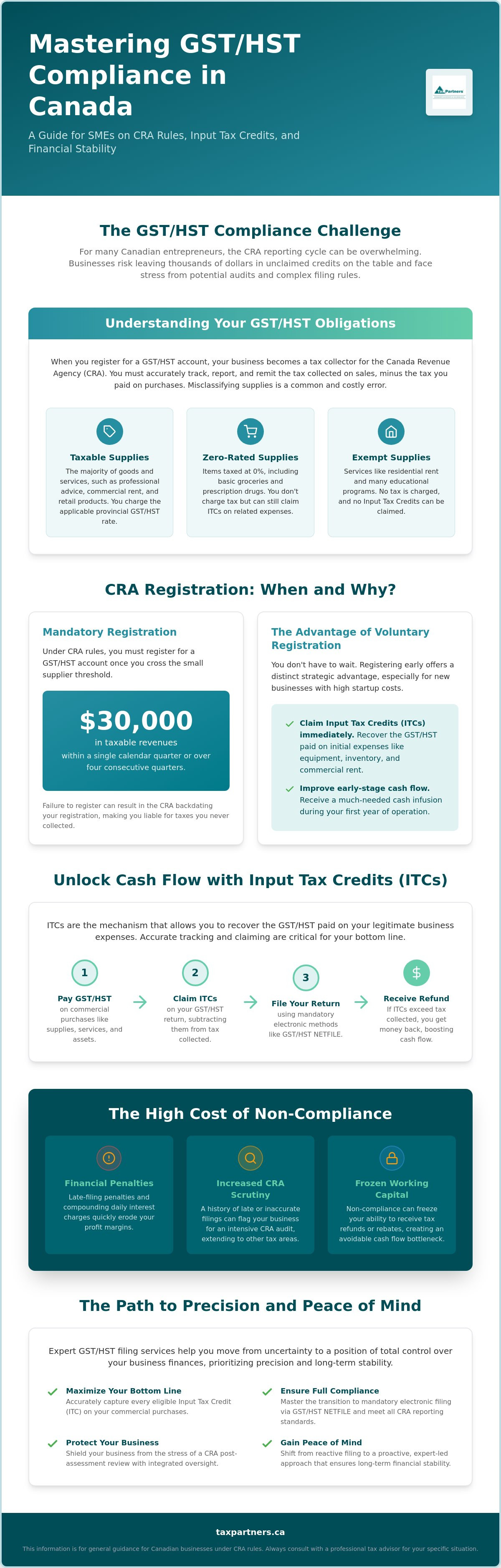
Every Canadian entrepreneur quickly learns that the relationship with the Canada Revenue Agency (CRA) is a two-way street. When you register for a GST/HST account, you effectively become a tax collector for the federal government. The Goods and Services Tax (GST/HST) in Canada is a multi-stage value-added tax. This means that while you collect tax on your sales, you also pay it on your purchases. Your responsibility is to track these amounts with precision and remit the difference to the CRA during your assigned reporting period. Maintaining "good standing" isn't just about paying what you owe; it's about demonstrating consistent, transparent record-keeping that aligns with federal expectations.
Clarity begins with understanding exactly what you're selling. The CRA divides supplies into three distinct categories:
- Taxable supplies: Most goods and services, such as professional advice or retail products, where you charge the applicable provincial rate.
- Zero-rated supplies: Items taxed at 0%, including basic groceries and prescription drugs. You don't charge tax, but you can still claim credits for the tax you paid to produce them.
- Exempt supplies: Services like residential rent or many educational programs where no tax is charged and no credits can be claimed.
Misclassifying these can lead to significant errors in your filings. Many SMEs rely on professional GST HST filing services to ensure these distinctions are applied correctly, protecting the business from future reassessments.
The Purpose of Sales Tax Reporting
The CRA uses your GST/HST returns as a primary tool to monitor the health and activity of your business. By comparing your reported revenue with the sales tax you've collected, the agency ensures that the numbers remain consistent across different tax filings. A GST/HST return is essentially a summary of the tax you collected from customers minus the tax you paid to suppliers. This reporting process isn't just a chore; it's the mechanism that allows you to recover the sales tax you've spent on business operations, directly impacting your cash flow.
Consequences of Non-Compliance
Missing a filing deadline or failing to remit tax on time triggers immediate consequences. The CRA applies late-filing penalties and interest charges that compound daily, which can quickly erode your profit margins. Beyond the financial cost, a history of late or inaccurate filings can flag your business for a more intensive CRA audit. This scrutiny often extends to other areas, such as corporate income tax or payroll. Furthermore, non-compliance can freeze your ability to receive tax refunds or rebates, creating a bottleneck in your working capital that is entirely avoidable with proactive oversight.
CRA Registration Requirements and Reporting Periods
Growth brings new responsibilities. For Canadian SMEs, the transition from a small venture to a registered entity is a significant milestone. Under CRA rules, you must register for a GST/HST account once your taxable revenues exceed the small supplier threshold of $30,000 within a single calendar quarter or over four consecutive quarters. Once you cross this line, you're legally required to collect and remit sales tax. It's vital to monitor your revenue closely; if you surpass the threshold and fail to register, the CRA may backdate your registration, leaving you liable for taxes you never collected from your customers. For a deeper look at these requirements, you can consult the CRA's General Information for GST/HST Registrants.
Voluntary vs. Mandatory Registration
You don't always have to wait for the $30,000 mark to take action. Many new businesses realize that voluntary registration offers a distinct strategic advantage. If your startup faces high initial costs for equipment, inventory, or commercial rent, registering early allows you to claim Input Tax Credits (ITCs) and recover the GST/HST paid on those expenses. This can provide a much-needed cash infusion during your first year of operation. You can explore more about these strategic choices in our overview of Tax in Canada. However, remember that once you register voluntarily, you're bound by the same filing and remittance rules as any other registrant.
Determining Your Filing Frequency
The CRA assigns your reporting period based on your total annual taxable supplies. Most small businesses with revenues under $1.5 million are assigned an annual reporting period, which simplifies administration. As your revenue climbs toward the $6 million mark, the CRA typically mandates quarterly filing. For businesses exceeding $6 million in annual taxable supplies, monthly reporting becomes the standard.
Your filing frequency directly impacts your administrative workload and your cash flow. Annual filers enjoy less frequent paperwork but must often manage quarterly tax instalments. Conversely, monthly filers deal with more frequent deadlines but can receive their tax refunds much faster. If you realize your current frequency is hindering your operations, you can often request a change to better suit your business cycle. Professional GST HST filing services provide the foresight needed to track these thresholds in real-time, ensuring you never miss a transition. If you're unsure which period best serves your goals, feel free to speak with our team for personalized guidance.
Navigating Mandatory Electronic Filing Methods
The Canada Revenue Agency has fundamentally changed how businesses interact with the sales tax system. For reporting periods beginning in 2024 and later, electronic filing is no longer just a convenience; it's a mandatory requirement for the vast majority of GST/HST registrants. This shift aims to improve data accuracy and speed up processing times across the country. Paper returns have effectively been phased out for Canadian corporations, and continuing to use them can lead to unnecessary penalties. To stay informed on these evolving requirements, businesses should regularly review the Canada Revenue Agency GST/HST Information portal for the latest digital standards.
The primary gateway for this digital transition is the GST/HST NETFILE system. This platform allows you to transmit your return data directly to the CRA over a secure internet connection. For more comprehensive oversight, many SMEs utilize the CRA's "My Business Account" portal. This service acts as a centralized hub where you can view your account balances, manage direct deposit information, and track the status of your filings in real-time. It provides a level of transparency and organized record-keeping that was simply impossible with traditional paper-based methods.
Common Electronic Filing Options
Modern businesses have several paths to digital compliance. Many choose to use third-party accounting software that integrates directly with CRA systems, allowing for a seamless filing experience. Financial institutions also play a role, as most offer services to facilitate the payment of sales tax remitted through your online banking portal. However, the most robust approach often involves integrating your tax obligations with professional bookkeeping services. This ensures that the data being transmitted is accurate from the start, reducing the risk of discrepancies that could trigger a review. Professional GST HST filing services provide the necessary bridge between these complex digital mandates and your daily operations.
Security and Access Codes
Security is a paramount concern when handling sensitive financial data online. To file via NETFILE, you generally need a unique four-digit access code provided by the CRA. You'll realize you need a new code if you've misplaced your previous one or if your business details have changed significantly. Protecting your CRA login credentials is just as critical as securing your bank account information. Professional filers, such as the team at Taxxpress Inc., use authorized representative access to ensure your data remains secure while maintaining full compliance. Utilizing expert GST HST filing services means you don't have to manage these security protocols alone, as your representative handles the technical transmission through verified, secure channels.
Maximizing Recoveries with Input Tax Credits (ITCs)
Input Tax Credits, or ITCs, represent the mechanism through which your business recovers the sales tax paid on legitimate commercial expenses. For CRA filers, these credits are not just a line item; they are a vital component of your cash flow. When you purchase equipment, pay for commercial rent, or engage professional consultants, you're paying GST/HST that can often be reclaimed in full. Under CRA rules, you generally have up to four years to claim these credits from the end of the reporting period in which the tax was first paid. However, the agency maintains strict documentation requirements. You must hold valid receipts or invoices that clearly display the vendor's name, the date, and their specific GST/HST registration number to support every claim you make. Without this specific data, the CRA can disallow your credits during a subsequent review.
The Calculation Framework
The fundamental formula used by the CRA is straightforward: take the total sales tax you collected from customers and subtract your eligible ITCs. The resulting figure is your net tax, which is the amount you actually remit. Precise bookkeeping serves as the foundation for this calculation, ensuring that every taxable purchase is accounted for and categorized correctly. Integrating your tax reporting with comprehensive Accounting Services allows you to maintain this level of precision throughout the fiscal year. This proactive approach ensures that your net tax remitted is as low as legally possible while keeping you in full compliance with federal standards.
Common Mistakes in ITC Claims
Errors in ITC claims often lead to unwanted scrutiny from the CRA. One frequent mistake is attempting to claim credits on exempt supplies, such as residential rent, or on personal expenses that don't relate to your commercial activity. Disorganized receipt management is another common pitfall. If you cannot produce the physical or digital documentation during a review, the CRA will likely disallow the credit and apply interest to the resulting balance. Professional GST HST filing services act as a proactive guardian for your business by identifying missed recovery opportunities that might otherwise go unnoticed. By reviewing your ledgers with a seasoned eye, experts ensure that you aren't overpaying the government due to simple administrative oversights. If you want to ensure your business is capturing every available credit without risking a penalty, contact our tax specialists today to review your filing strategy.
The Value of Professional GST/HST Filing Services
Choosing professional GST HST filing services is about more than just outsourcing paperwork. It's an investment in the long-term stability of your enterprise. When a seasoned expert oversees your filings, the risk of a CRA post-assessment review drops significantly because accuracy is built into the process from day one. At Tax Partners, we act as a proactive guardian of your compliance status. We ensure that every return is a reflection of precision rather than a liability waiting to be discovered. This level of oversight provides a protective barrier between your business and the stress of regulatory scrutiny.
Integrating your sales tax obligations with other business functions creates a seamless administrative environment. For instance, combining your GST/HST reporting with payroll management ensures that your financial data remains consistent across all CRA accounts. This holistic approach prevents the common discrepancies that often attract unwanted attention from auditors. Unlike the distant, institutional feel of "Big Four" firms, our boutique approach prioritizes personalized attention. We don't just process your numbers; we understand the unique pulse of your business and provide the tailored support that larger corporations often overlook.
Beyond Data Entry: Strategic Advice
Expertise allows you to see beyond the immediate deadline. In complex sectors like ecommerce or real estate, professionals help you realize tax-saving opportunities that might be buried in the fine print of CRA regulations. Whether you're managing cross-border digital sales or complex property developments, having a steady hand at the helm during CRA interactions is invaluable. You gain the profound peace of mind that comes from over 40 years of institutional wisdom and a track record of filing more than 495,000 returns for Canadian businesses. We move you from a state of uncertainty to a position of total control.
Getting Started with Tax Partners
Transitioning to professional oversight is a straightforward process designed to minimize disruption. We begin by organizing your records for a comprehensive review, identifying any historical gaps that need addressing. Our team guides you through the necessary authorizations, allowing us to act as your authorized representative with the CRA. This shift allows you to focus on growth while we handle the technical rigour of compliance. We've spent decades refining our process to ensure it is as responsive and transparent as possible. To secure your business's financial future and maximize your tax recoveries, contact Tax Partners for a consultation today.
Securing Your Business's Financial Future
Managing sales tax shouldn't be a source of constant anxiety for your SME. By mastering the shift to mandatory electronic filing and capturing every eligible Input Tax Credit, you transform a complex compliance chore into a strategic cash flow advantage. It's about ensuring your records are audit-ready under CRA rules while keeping more of your hard-earned revenue where it belongs. Our professional GST HST filing services provide the precision and foresight needed to navigate these regulatory waters with total confidence.
With over 40 years of Canadian tax expertise and more than 1,390 five-star Google reviews, Tax Partners offers the proactive CRA audit support you need to remain resilient in a shifting landscape. We're here to act as your dedicated guardian, ensuring that your filings are accurate and your business is protected from unnecessary penalties. Secure your business compliance with professional GST HST filing services. You've worked hard to build your business; let's work together to protect its legacy and ensure its continued growth.
Frequently Asked Questions
What is the deadline for filing my GST/HST return under CRA rules?
Your deadline depends on your assigned reporting period. For annual filers with a December 31 year-end, the filing deadline is June 15, while the payment deadline for any tax owing is April 30. Monthly and quarterly filers must file and remit their tax within one month after the end of their reporting period. You should always verify your specific dates through the CRA's online portal to ensure you don't miss a critical cutoff.
What happens if I forget to file my GST/HST return on time?
The CRA applies immediate late-filing penalties and interest charges if you miss your deadline. These costs are calculated based on a percentage of the tax owing plus an additional charge for each month the return remains overdue. Even if you don't owe any tax, failing to file can flag your account for an audit. This oversight can also delay your ability to receive other federal tax rebates or credits you're entitled to.
Can I claim ITCs if I am not registered for GST/HST?
You're only eligible to claim Input Tax Credits (ITCs) if you're a registered GST/HST registrant. Businesses that haven't registered cannot recover the sales tax paid on their commercial expenses. If your startup has high initial costs, you might realize the benefit of registering voluntarily before reaching the $30,000 revenue threshold. This allows you to claim ITCs and improve your cash flow during the critical early stages of your business operation.
Is it mandatory to file my GST/HST return electronically in 2026?
Electronic filing is now mandatory for almost all businesses for reporting periods that began in 2024 and later. The CRA has phased out paper returns for the vast majority of corporations and small businesses across Canada. Using professional GST HST filing services helps you navigate this digital requirement through secure platforms like GST/HST NETFILE. Failing to file electronically when required can lead to specific penalties that are easily avoided with the right digital tools.
How long should I keep my records and receipts for GST/HST purposes?
You must keep your business records and supporting receipts for at least six years following the end of the tax year they cover. These documents must be legible and provide enough information to verify the tax you collected and the ITCs you claimed. The CRA may request these documents during a review or audit to ensure your filings align with your actual business activity. Digital record-keeping is often the most reliable method for long-term storage.
What is the difference between zero-rated and exempt supplies?
Zero-rated supplies are goods taxed at 0%, meaning you don't collect tax but can still claim ITCs on your related expenses. This category includes items like basic groceries and prescription drugs. Exempt supplies are different because no tax is charged, and you cannot claim any ITCs for the tax you paid to provide them. Common exempt supplies include residential rent and many educational services. Understanding this distinction is crucial for accurate and compliant reporting.
Can I file a nil return if my business had no activity this period?
You're still required to file a return even if you had no business activity or sales tax to report during the period. This is referred to as a nil return. Filing this return tells the CRA that your account is still active and that you're meeting your legal obligations. If you skip a filing because there was no activity, the CRA may estimate your tax owing, which can lead to unnecessary administrative hurdles and potential interest charges.
How do I change my GST/HST reporting period with the CRA?
You can change your reporting period by using the CRA's "My Business Account" online service or by submitting a formal request. Your eligibility to switch between monthly, quarterly, or annual filing depends on your total annual taxable supplies. Professional GST HST filing services can review your revenue levels to see if a change would benefit your cash flow. Making this adjustment can help you receive tax refunds more frequently or reduce your annual administrative paperwork.

Article by
Mahad Mohamed
Mahad Mohamed is an accountant and the CEO of Tax Partners, with over 26+ years of Canadian and international tax and accounting experience. His expertise includes corporate reorganization, cross-border tax structuring (Canada & US), tax disputes, CRA audits, and tax planning for small owner-managed private corporations. Most recently, Mahad is a pioneer in Canadian crypto taxation and founded Block3 Finance.
Previously, Mahad worked for the Canada Revenue Agency (CRA), Big4 accounting firms, and served as a Rulings Officer for the Federal Tax Authority of the UAE before acquiring Tax Partners in 2014.
Tax Partners has 44 full-time accountants and over 18,400+ clients.
Disclaimer
This article provides general information only and is current as of its publication date. It has not been updated and may be out of date. It does not constitute legal advice and should not be relied upon as such. Every tax situation is unique and may differ from the examples discussed in this article. If you have specific questions, you should seek the advice of our accountants for your unique circumstances. Book a FREE Initial Consultation Today!
Frequently Asked Questions
The Purpose of Sales Tax Reporting
The CRA uses your GST/HST returns as a primary tool to monitor the health and activity of your business. By comparing your reported revenue with the sales tax you've collected, the agency ensures that the numbers remain consistent across different tax filings. A GST/HST return is essentially a summary of the tax you collected from customers minus the tax you paid to suppliers. This reporting process isn't just a chore; it's the mechanism that allows you to recover the sales tax you've spent on business operations, directly impacting your cash flow.
Consequences of Non-Compliance
Missing a filing deadline or failing to remit tax on time triggers immediate consequences. The CRA applies late-filing penalties and interest charges that compound daily, which can quickly erode your profit margins. Beyond the financial cost, a history of late or inaccurate filings can flag your business for a more intensive CRA audit. This scrutiny often extends to other areas, such as corporate income tax or payroll. Furthermore, non-compliance can freeze your ability to receive tax refunds or rebates, creating a bottleneck in your working capital that is entirely avoidable with proactive oversight. Growth brings new responsibilities. For Canadian SMEs, the transition from a small venture to a registered entity is a significant milestone. Under CRA rules, you must register for a GST/HST account once your taxable revenues exceed the small supplier threshold of $30,000 within a single calendar quarter or over four consecutive quarters. Once you cross this line, you're legally required to collect and remit sales tax. It's vital to monitor your revenue closely; if you surpass the threshold and fail to register, the CRA may backdate your registration, leaving you liable for taxes you never collected from your customers. For a deeper look at these requirements, you can consult the CRA's General Information for GST/HST Registrants.
Voluntary vs. Mandatory Registration
You don't always have to wait for the $30,000 mark to take action. Many new businesses realize that voluntary registration offers a distinct strategic advantage. If your startup faces high initial costs for equipment, inventory, or commercial rent, registering early allows you to claim Input Tax Credits (ITCs) and recover the GST/HST paid on those expenses. This can provide a much-needed cash infusion during your first year of operation. You can explore more about these strategic choices in our overview of Tax in Canada. However, remember that once you register voluntarily, you're bound by the same filing and remittance rules as any other registrant.
Determining Your Filing Frequency
The CRA assigns your reporting period based on your total annual taxable supplies. Most small businesses with revenues under $1.5 million are assigned an annual reporting period, which simplifies administration. As your revenue climbs toward the $6 million mark, the CRA typically mandates quarterly filing. For businesses exceeding $6 million in annual taxable supplies, monthly reporting becomes the standard. Your filing frequency directly impacts your administrative workload and your cash flow. Annual filers enjoy less frequent paperwork but must often manage quarterly tax instalments. Conversely, monthly filers deal with more frequent deadlines but can receive their tax refunds much faster. If you realize your current frequency is hindering your operations, you can often request a change to better suit your business cycle. Professional GST HST filing services provide the foresight needed to track these thresholds in real-time, ensuring you never miss a transition. If you're unsure which period best serves your goals, feel free to speak with our team for personalized guidance. The Canada Revenue Agency has fundamentally changed how businesses interact with the sales tax system. For reporting periods beginning in 2024 and later, electronic filing is no longer just a convenience; it's a mandatory requirement for the vast majority of GST/HST registrants. This shift aims to improve data accuracy and speed up processing times across the country. Paper returns have effectively been phased out for Canadian corporations, and continuing to use them can lead to unnecessary penalties. To stay informed on these evolving requirements, businesses should regularly review the Canada Revenue Agency GST/HST Information portal for the latest digital standards. The primary gateway for this digital transition is the GST/HST NETFILE system. This platform allows you to transmit your return data directly to the CRA over a secure internet connection. For more comprehensive oversight, many SMEs utilize the CRA's "My Business Account" portal. This service acts as a centralized hub where you can view your account balances, manage direct deposit information, and track the status of your filings in real-time. It provides a level of transparency and organized record-keeping that was simply impossible with traditional paper-based methods.
Common Electronic Filing Options
Modern businesses have several paths to digital compliance. Many choose to use third-party accounting software that integrates directly with CRA systems, allowing for a seamless filing experience. Financial institutions also play a role, as most offer services to facilitate the payment of sales tax remitted through your online banking portal. However, the most robust approach often involves integrating your tax obligations with professional bookkeeping services. This ensures that the data being transmitted is accurate from the start, reducing the risk of discrepancies that could trigger a review. Professional GST HST filing services provide the necessary bridge between these complex digital mandates and your daily operations.
Security and Access Codes
Security is a paramount concern when handling sensitive financial data online. To file via NETFILE, you generally need a unique four-digit access code provided by the CRA. You'll realize you need a new code if you've misplaced your previous one or if your business details have changed significantly. Protecting your CRA login credentials is just as critical as securing your bank account information. Professional filers use authorized representative access to ensure your data remains secure while maintaining full compliance. Utilizing expert GST HST filing services means you don't have to manage these security protocols alone, as your representative handles the technical transmission through verified, secure channels. Input Tax Credits, or ITCs, represent the mechanism through which your business recovers the sales tax paid on legitimate commercial expenses. For CRA filers, these credits are not just a line item; they are a vital component of your cash flow. When you purchase equipment, pay for commercial rent, or engage professional consultants, you're paying GST/HST that can often be reclaimed in full. Under CRA rules, you generally have up to four years to claim these credits from the end of the reporting period in which the tax was first paid. However, the agency maintains strict documentation requirements. You must hold valid receipts or invoices that clearly display the vendor's name, the date, and their specific GST/HST registration number to support every claim you make. Without this specific data, the CRA can disallow your credits during a subsequent review.
The Calculation Framework
The fundamental formula used by the CRA is straightforward: take the total sales tax you collected from customers and subtract your eligible ITCs. The resulting figure is your net tax, which is the amount you actually remit. Precise bookkeeping serves as the foundation for this calculation, ensuring that every taxable purchase is accounted for and categorized correctly. Integrating your tax reporting with comprehensive Accounting Services allows you to maintain this level of precision throughout the fiscal year. This proactive approach ensures that your net tax remitted is as low as legally possible while keeping you in full compliance with federal standards.
Common Mistakes in ITC Claims
Errors in ITC claims often lead to unwanted scrutiny from the CRA. One frequent mistake is attempting to claim credits on exempt supplies, such as residential rent, or on personal expenses that don't relate to your commercial activity. Disorganized receipt management is another common pitfall. If you cannot produce the physical or digital documentation during a review, the CRA will likely disallow the credit and apply interest to the resulting balance. Professional GST HST filing services act as a proactive guardian for your business by identifying missed recovery opportunities that might otherwise go unnoticed. By reviewing your ledgers with a seasoned eye, experts ensure that you aren't overpaying the government due to simple administrative oversights. If you want to ensure your business is capturing every available credit without risking a penalty, contact our tax specialists today to review your filing strategy. Choosing professional GST HST filing services is about more than just outsourcing paperwork. It's an investment in the long-term stability of your enterprise. When a seasoned expert oversees your filings, the risk of a CRA post-assessment review drops significantly because accuracy is built into the process from day one. At Tax Partners, we act as a proactive guardian of your compliance status. We ensure that every return is a reflection of precision rather than a liability waiting to be discovered. This level of oversight provides a protective barrier between your business and the stress of regulatory scrutiny. Integrating your sales tax obligations with other business functions creates a seamless administrative environment. For instance, combining your GST/HST reporting with payroll management ensures that your financial data remains consistent across all CRA accounts. This holistic approach prevents the common discrepancies that often attract unwanted attention from auditors. Unlike the distant, institutional feel of "Big Four" firms, our boutique approach prioritizes personalized attention. We don't just process your numbers; we understand the unique pulse of your business and provide the tailored support that larger corporations often overlook.
Beyond Data Entry: Strategic Advice
Expertise allows you to see beyond the immediate deadline. In complex sectors like ecommerce or real estate, professionals help you realize tax-saving opportunities that might be buried in the fine print of CRA regulations. Whether you're managing cross-border digital sales or complex property developments, having a steady hand at the helm during CRA interactions is invaluable. You gain the profound peace of mind that comes from over 40 years of institutional wisdom and a track record of filing more than 495,000 returns for Canadian businesses. We move you from a state of uncertainty to a position of total control.
Getting Started with Tax Partners
Transitioning to professional oversight is a straightforward process designed to minimize disruption. We begin by organizing your records for a comprehensive review, identifying any historical gaps that need addressing. Our team guides you through the necessary authorizations, allowing us to act as your authorized representative with the CRA. This shift allows you to focus on growth while we handle the technical rigour of compliance. We've spent decades refining our process to ensure it is as responsive and transparent as possible. To secure your business's financial future and maximize your tax recoveries, contact Tax Partners for a consultation today. Managing sales tax shouldn't be a source of constant anxiety for your SME. By mastering the shift to mandatory electronic filing and capturing every eligible Input Tax Credit, you transform a complex compliance chore into a strategic cash flow advantage. It's about ensuring your records are audit-ready under CRA rules while keeping more of your hard-earned revenue where it belongs. Our professional GST HST filing services provide the precision and foresight needed to navigate these regulatory waters with total confidence. With over 40 years of Canadian tax expertise and more than 1,390 five-star Google reviews, Tax Partners offers the proactive CRA audit support you need to remain resilient in a shifting landscape. We're here to act as your dedicated guardian, ensuring that your filings are accurate and your business is protected from unnecessary penalties. Secure your business compliance with professional GST HST filing services. You've worked hard to build your business; let's work together to protect its legacy and ensure its continued growth.
What is the deadline for filing my GST/HST return under CRA rules?
Your deadline depends on your assigned reporting period. For annual filers with a December 31 year-end, the filing deadline is June 15, while the payment deadline for any tax owing is April 30. Monthly and quarterly filers must file and remit their tax within one month after the end of their reporting period. You should always verify your specific dates through the CRA's online portal to ensure you don't miss a critical cutoff.
What happens if I forget to file my GST/HST return on time?
The CRA applies immediate late-filing penalties and interest charges if you miss your deadline. These costs are calculated based on a percentage of the tax owing plus an additional charge for each month the return remains overdue. Even if you don't owe any tax, failing to file can flag your account for an audit. This oversight can also delay your ability to receive other federal tax rebates or credits you're entitled to.
Can I claim ITCs if I am not registered for GST/HST?
You're only eligible to claim Input Tax Credits (ITCs) if you're a registered GST/HST registrant. Businesses that haven't registered cannot recover the sales tax paid on their commercial expenses. If your startup has high initial costs, you might realize the benefit of registering voluntarily before reaching the $30,000 revenue threshold. This allows you to claim ITCs and improve your cash flow during the critical early stages of your business operation.
Is it mandatory to file my GST/HST return electronically in 2026?
Electronic filing is now mandatory for almost all businesses for reporting periods that began in 2024 and later. The CRA has phased out paper returns for the vast majority of corporations and small businesses across Canada. Using professional GST HST filing services helps you navigate this digital requirement through secure platforms like GST/HST NETFILE. Failing to file electronically when required can lead to specific penalties that are easily avoided with the right digital tools.
How long should I keep my records and receipts for GST/HST purposes?
You must keep your business records and supporting receipts for at least six years following the end of the tax year they cover. These documents must be legible and provide enough information to verify the tax you collected and the ITCs you claimed. The CRA may request these documents during a review or audit to ensure your filings align with your actual business activity. Digital record-keeping is often the most reliable method for long-term storage.
What is the difference between zero-rated and exempt supplies?
Zero-rated supplies are goods taxed at 0%, meaning you don't collect tax but can still claim ITCs on your related expenses. This category includes items like basic groceries and prescription drugs. Exempt supplies are different because no tax is charged, and you cannot claim any ITCs for the tax you paid to provide them. Common exempt supplies include residential rent and many educational services. Understanding this distinction is crucial for accurate and compliant reporting.
Can I file a nil return if my business had no activity this period?
You're still required to file a return even if you had no business activity or sales tax to report during the period. This is referred to as a nil return. Filing this return tells the CRA that your account is still active and that you're meeting your legal obligations. If you skip a filing because there was no activity, the CRA may estimate your tax owing, which can lead to unnecessary administrative hurdles and potential interest charges.
How do I change my GST/HST reporting period with the CRA?
You can change your reporting period by using the CRA's "My Business Account" online service or by submitting a formal request. Your eligibility to switch between monthly, quarterly, or annual filing depends on your total annual taxable supplies. Professional GST HST filing services can review your revenue levels to see if a change would benefit your cash flow. Making this adjustment can help you receive tax refunds more frequently or reduce your annual administrative paperwork.