Streamlining Payroll Management Services in Oshawa and Across Canada: A Business Guide

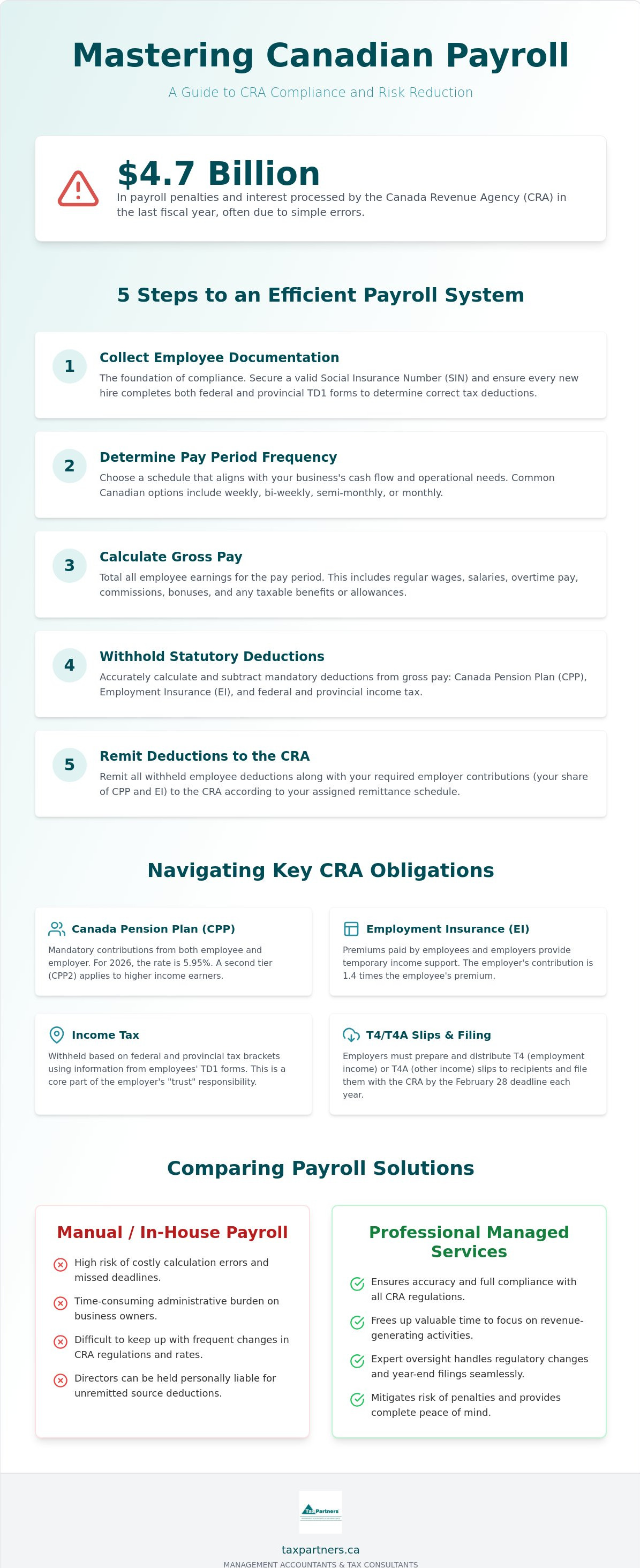
Did you know the Canada Revenue Agency (CRA) processed $4.7 billion in payroll penalties and interest in the last fiscal year? This staggering figure, often driven by simple calculation errors, highlights how easily a manual system can put your business at risk. Many owners seeking payroll management services Oshawa or elsewhere in Canada share the same fear of a surprise audit. It's completely natural to feel overwhelmed by the shifting landscape of Canadian tax law, especially when you're trying to balance growth with the precision required for government remittances.
We'll show you how to transform this administrative burden into a streamlined, "set it and forget it" workflow that guarantees peace of mind. You'll learn how to organize a system that remains fully compliant with CRA regulations, from the 2026 CPP contribution rates of 5.95% to the latest Employment Insurance premiums. This guide previews the essential steps to automate your filings and secure more time for revenue-generating activities. We'll walk you through current remittance deadlines and filing requirements to ensure your business remains a model of regulatory health.
Key Takeaways
- Recognize that effective payroll management serves as both a commitment to your team and a vital compliance shield against CRA penalties.
- Master the foundational steps of a compliant system, including the proper collection of TD1 forms and the selection of a sustainable pay frequency.
- Gain clarity on statutory obligations such as CPP, EI, and income tax, ensuring you accurately calculate and remit the required employer share.
- Evaluate the security of professional payroll management services Oshawa compared to manual tracking to reduce the risk of costly calculation errors.
- Learn how leveraging decades of accounting expertise can help you foresee regulatory changes and maintain a "set it and forget it" workflow.
Understanding Payroll Management Services for Canadian Businesses
Payroll management isn't just about printing cheques or setting up direct deposits. It's a comprehensive, end-to-end cycle that involves calculating gross earnings, withholding precise statutory deductions, and ensuring those funds reach the federal government on time. For a deeper look at the foundational components of this process, Understanding Payroll helps clarify how these systems operate. In Canada, this process has a dual nature. It serves as the primary method for compensating your team while simultaneously acting as a critical compliance mechanism for the Canada Revenue Agency (CRA).
The term "remittance" is central to this responsibility. It refers to the employer's obligation to send the withheld taxes, along with the employer's own contributions, to the CRA. This isn't optional. It's a fundamental duty that requires meticulous record-keeping and a deep understanding of current tax brackets. When business owners seek payroll management services Oshawa, they're often looking for a way to manage this burden without the constant fear of missing a deadline or miscalculating a rate. Professional oversight is vital because the CRA can be unforgiving with interest and penalties when errors occur.
The Role of the Canada Revenue Agency (CRA)
The Canadian payroll system operates on a trust-based model. As an employer, you're essentially acting as a collection agent for the federal government. You hold funds "in trust" until they're remitted. Under CRA rules, this responsibility is significant. If source deductions aren't remitted, the CRA can hold directors of a corporation personally liable for the debt. To begin this process, every business needs a federal Business Number (BN). You must then register a specific payroll program account, usually identified by the "RP" program identifier, to track your remittances and filings accurately.
Why Small Businesses Outsource Payroll
Calculating deductions like the Canada Pension Plan (CPP) and Employment Insurance (EI) has become increasingly complex. With the introduction of the second additional CPP contribution (CPP2) for earnings between $71,300 and $81,200, manual spreadsheets often fail to capture the nuances. Professional payroll management services Oshawa provide a steady hand, ensuring that your business remains compliant even as rates shift. Beyond simple math, outsourcing offers robust risk mitigation. It recovers valuable hours that you can reinvest into growth, while ensuring that year-end requirements, like filing T4 and T4A slips by the February 28 deadline, are handled with precision.
How to Organize an Efficient Payroll System: A Step-by-Step Guide
Building a reliable payroll system requires more than just a calculator and a calendar. It demands a structured approach that satisfies both your staff and the federal government. For CRA filers, the goal is to create a repeatable cycle that minimizes manual data entry while maximizing accuracy. A well-organized workflow acts as a safeguard, ensuring that your business never misses a deadline or miscalculates a deduction. If you find the setup process daunting, seeking professional payroll management services Oshawa can provide the necessary framework to get your operations running smoothly from day one.
- Step 1: Collect employee documentation. Secure a Social Insurance Number (SIN) and have every new hire complete federal and provincial TD1 forms.
- Step 2: Determine the pay period frequency. Decide whether a weekly, bi-weekly, or semi-monthly schedule best suits your cash flow and labour requirements.
- Step 3: Calculate gross pay. Total all earnings, including regular wages, overtime pay, and any taxable benefits provided to the employee.
- Step 4: Withhold statutory deductions. Calculate and subtract CPP, EI, and income tax while also accounting for the employer-paid portions of CPP and EI.
- Step 5: Remit deductions to the CRA. Send the withheld funds and your employer contributions to the government based on your assigned remittance schedule.
Onboarding Employees Correctly
The foundation of a compliant system starts with the Social Insurance Number (SIN) verification process. You must ask to see the employee's SIN card or official letter within three days of their start date to ensure the number is valid. Following this, the TD1 Personal Tax Credits Return form is essential. This document determines exactly how much federal and provincial income tax you should withhold from each paycheque. Because provincial tax credits vary significantly, you must ensure employees complete the specific form for their province of employment. If you are unsure about which forms apply to your specific situation, you can connect with our team for personalized guidance.
Establishing Clear Pay Cycles
Consistency is the bedrock of employee trust and provincial labour law compliance. Whether you choose a bi-weekly or semi-monthly cycle, sticking to that schedule helps you realize a predictable cash flow pattern. This consistency also makes it easier to plan for CRA remittance deadlines, which typically fall on the 15th of the month following the pay period for regular remitters. When choosing between different methods, consulting a Payroll Management Guide can help you compare how different frequencies impact your administrative workload. A fixed schedule allows you to focus on growth rather than constantly reacting to upcoming pay dates. Using payroll management services Oshawa ensures that these cycles are managed with professional precision, leaving no room for late-filing penalties.
Navigating CRA Compliance: Deductions, Remittances, and Deadlines
Compliance is the heartbeat of a sustainable business. It's a commitment to your team and a necessary alignment with federal requirements. For CRA filers, the margin for error remains razor-thin. Miscalculating a single rate or missing a filing window can trigger a chain reaction of audits and financial stress. Many local businesses utilize payroll management services Oshawa to ensure these technical details are handled with absolute precision. By delegating these complexities, you transform a potential source of anxiety into a reliable, automated process.
The CRA assigns every employer a specific remittance frequency, which dictates when you must send withheld funds to the government. Regular remitters typically face a deadline on the 15th of the month following the pay period. However, if your average monthly withholding is higher, you might be classified as an accelerated remitter, requiring payments multiple times per month. Quarterly remitting is sometimes available for small employers with stellar compliance histories. Timeliness is critical. Missing these dates results in immediate penalties ranging from 3% for payments one to three days late, up to 10% for those more than seven days late. For a comprehensive deep dive into these obligations, the CRA Employers' Guide to Payroll serves as the definitive technical manual for business owners.
Statutory Deductions Explained
Under CRA rules, three primary statutory deductions define every paycheque: Canada Pension Plan (CPP), Employment Insurance (EI), and income tax. For 2026, the employee CPP contribution rate is 5.95% on earnings up to the Year's Maximum Pensionable Earnings (YMPE) of $71,300. A second additional CPP contribution (CPP2) of 4% applies to earnings between $71,300 and $81,200. Employers must match these CPP contributions dollar-for-dollar. EI premiums are set at 1.66% for employees, but the employer share is 1.4 times that amount, or approximately 2.324%. This "employer share" significantly impacts your total cost of labour. You must also include taxable benefits, such as health premiums or company car allowances, in your gross income calculations to ensure the correct tax is withheld. Using payroll management services Oshawa helps you track these shifting rates without manual effort.
Year-End Reporting and T4 Slips
The payroll cycle culminates in year-end reporting, a period that demands high attention to detail. You're responsible for generating T4 slips for employees and T4A slips for contractors to report their annual income and deductions. The deadline for filing the T4 Summary and distributing these slips is February 28, 2026. Failing to meet this deadline or filing more than five slips on paper instead of electronically can lead to significant administrative penalties. It's best practice to reconcile your records monthly to ensure the final T4 filing is a smooth, stress-free event rather than a frantic scramble.
Comparing Payroll Solutions: In-House vs. Managed Services
Choosing the right path for your payroll depends on the complexity of your team and your tolerance for regulatory risk. For many startups, the manual spreadsheet method seems like a cost-effective starting point. However, this approach carries the highest risk of human error and CRA non-compliance. Given that calculation errors contribute significantly to billions in annual penalties, the "savings" of a manual system are often illusory. As your business scales, the time required to track changing CPP and EI rates manually becomes a significant drain on your productivity.
Payroll software offers a middle ground, automating calculations and providing basic reporting. While efficient for simple needs, software is only as good as the data entered and the settings selected. Under CRA rules, the business owner remains the responsible party for ensuring tax law changes are correctly implemented. If you miss a setting for a new taxable benefit or fail to update a provincial tax rate, the software won't necessarily catch the mistake. This is why many growing firms transition to payroll management services Oshawa, where professional oversight replaces software-only reliance.
Managed payroll services provide the highest level of security and professional advisory. These solutions integrate seamlessly with broader bookkeeping and tax optimization strategies, ensuring your financial data is unified. Instead of reacting to payroll as an isolated task, you can view it as a strategic component of your cash flow management. If you're ready to move away from manual tracking and embrace a more secure model, reach out to our specialists today to discuss a tailored managed solution.
Evaluating Your Internal Capacity
Take a moment to realize exactly how many hours your team spends on payroll administration each month. For a business with 15 employees, this can easily consume ten to fifteen hours of high-level management time. This "opportunity cost" is often the strongest argument for outsourcing. Those hours could be spent on revenue-generating activities or strategic planning. As your team grows, the complexity of managing vacation pay, sick leaves, and varied deductions often outpaces the capabilities of DIY software, making professional payroll management services Oshawa a more sustainable choice.
The Security and Privacy Advantage
Professional firms protect sensitive employee data through encrypted portals, reducing the risk of identity theft or data breaches. Beyond technical security, there's a significant benefit to having an arms-length third party handle salary disputes or sensitive financial information. This distance maintains a professional atmosphere and ensures that compensation remains confidential. Perhaps most importantly, professional firms provide a steady hand during CRA audits. Having a proactive guardian who understands your records from top to bottom ensures that compliance reviews are handled with confidence rather than panic.
Optimizing Your Business Operations with Professional Payroll Support
Choosing Tax Partners means moving beyond a simple transaction. We act as a proactive guardian of your financial health, leveraging over 40 years of institutional wisdom to secure better outcomes for your firm. This deep-seated reliability allows us to foresee and mitigate compliance risks before they ever reach your desk. For CRA filers, this level of meticulous oversight provides a sense of stability that manual systems simply cannot offer. By utilizing our payroll management services Oshawa, you gain a partner who is genuinely attentive to your individual concerns and invested in your long-term success. It's about having a steady hand at the helm while you navigate the complexities of Canadian regulation, much like how drivers rely on Traffic Ticket Defence and Administrative Representation Fees to manage legal challenges and protect their records.
We see the numbers as a map for your future. Payroll data provides vital insights into your business's efficiency and scaling potential. Our role is to help you interpret these figures, connecting them to broader wealth management and corporate tax planning. This foresight ensures that your payroll strategy isn't just about meeting immediate obligations; it's about building a foundation for future prosperity. We look for patterns that others might miss, ensuring your compensation structures are both competitive and tax-efficient. This strategic alignment helps you maintain a lean, compliant, and motivated workforce.
Integrated Financial Oversight
Effective payroll management doesn't exist in a vacuum. It integrates seamlessly with our Professional Bookkeeping Services to provide a crystal-clear picture of your total labour costs. When your payroll and books are synchronized, you can realize the true impact of staffing on your bottom line. Accurate records also simplify the corporate tax preparation process at year-end, as all necessary data is already organized and verified. Our team ensures that every deduction is optimized, helping you keep more of what you earn while maintaining total integrity in your reporting. This holistic view allows for better cash flow forecasting and more informed hiring decisions.
Taking the Next Step Toward Efficiency
We invite you to experience the reassurance that comes with professional oversight. Our boutique approach offers personalized care and responsive support, moving you from a state of potential uncertainty toward total control. We don't just react to requirements; we actively look ahead to secure better outcomes for your business and your employees. This partnership is characterized by a lack of pretension and a high degree of responsiveness. You deserve a system that works as hard as you do, and our payroll management services Oshawa provide the clarity you need to scale with confidence. Contact Tax Partners today to streamline your payroll and focus on your business growth.
Secure Your Future with Professional Payroll Precision
Building a resilient Canadian business requires more than just hard work; it demands a structured approach to compliance and administration. You've seen how a meticulous payroll system, from correctly onboarding staff to meeting monthly CRA remittance deadlines, serves as a vital shield against audits. By choosing expert payroll management services Oshawa, you place the technical burden of evolving CPP rates and EI premiums into the hands of a proactive guardian. This transition allows you to reclaim valuable hours and reinvest them into the revenue-generating activities that drive your long-term success.
Our firm brings over 40 years of Canadian tax and accounting experience to every partnership. We've earned more than 1,390 five-star Google reviews by providing the approachable warmth and professional authority your business deserves. Our team has saved clients over $87M through strategic tax planning, ensuring that every financial decision strengthens your bottom line. We don't just process numbers; we provide the foresight needed to handle a changing regulatory environment with total confidence.
Let Tax Partners manage your payroll and compliance so you can focus on growth. It's time to move from administrative uncertainty toward total operational clarity. We're here to help you build a stronger, more efficient future for your team and your company.
Frequently Asked Questions
What are the penalties for late payroll remittances to the CRA?
The CRA applies late-remittance penalties immediately to any business that misses their assigned deadline. These penalties start at 3% for payments that are one to three days late and rise to 10% if the delay exceeds seven days. If a business repeatedly fails to remit on time, the CRA may apply even higher surcharges and daily interest, making it vital to stick to your schedule.
Do I need a separate bank account for payroll deductions?
While the CRA doesn't mandate a dedicated payroll bank account, it's a best practice that provides significant financial clarity. Segregating these funds ensures that source deductions held in trust aren't accidentally used for daily operational expenses. This separation simplifies your internal bookkeeping and provides a transparent audit trail, which acts as a reassuring safeguard during any future regulatory reviews.
How long must I keep payroll records for CRA purposes?
Under CRA rules, you must retain all payroll records for six years following the end of the tax year to which they relate. This requirement includes time sheets, completed TD1 forms, and records of all remittances. Maintaining these files in a secure, organized digital format ensures your business is always prepared to demonstrate its historical compliance without the stress of a last-minute scramble.
What is the difference between a T4 and a T4A slip?
A T4 slip reports employment income, commissions, and taxable benefits paid to employees. In contrast, a T4A slip is used for "Statement of Pension, Retirement, Annuity, and Other Income," which often covers payments made to independent contractors. Distinguishing correctly between these forms is a critical step in year-end reporting to ensure every worker's income is categorized accurately under federal guidelines.
Can I pay my employees in cash under CRA rules?
You can pay employees in cash, but you must still comply with all CRA withholding and remittance requirements. It's essential to maintain detailed records of every transaction and issue proper pay stubs that clearly show gross pay and all statutory deductions. Paying in cash doesn't exempt a business from its trust-fund obligations or the requirement to file annual T4 slips.
How do I calculate the employer portion of CPP and EI?
For the Canada Pension Plan, you must match the employee's contribution dollar-for-dollar. For Employment Insurance, the employer's share is 1.4 times the amount withheld from the employee's pay. Utilizing payroll management services Oshawa ensures these specific ratios are applied correctly to every paycheque, protecting your business from the calculation errors that often lead to costly CRA interest charges.
What should I do if an employee does not have a Social Insurance Number (SIN)?
If a new hire lacks a SIN, they must apply for one at a Service Canada office immediately. You're required to ask for their SIN within three days of their start date and document your efforts to obtain it. While you can't withhold their pay while they wait for the number, you must ensure the SIN is recorded as soon as it's issued for CRA compliance.
Is payroll software enough to ensure CRA compliance for my business?
Payroll software is an efficient tool for basic calculations, but it's rarely enough to ensure total compliance on its own. Software doesn't always account for nuanced taxable benefits or shifting provincial labour laws. Comprehensive payroll management services Oshawa provide the professional oversight necessary to catch subtle errors and provide the strategic advice that automated systems simply cannot offer.

Article by
Mahad Mohamed
Mahad Mohamed is an accountant and the CEO of Tax Partners, with over 26 years of Canadian and international tax and accounting experience. His expertise includes corporate reorganization, cross-border tax structuring (Canada & US), tax disputes, CRA audits, and tax planning for small owner-managed private corporations. Most recently, Mahad is a pioneer in Canadian crypto taxation and founded Block3 Finance. Previously, Mahad worked for the Canada Revenue Agency (CRA), Big4 accounting firms, and served as a Rulings Officer for the Federal Tax Authority of the UAE before acquiring Tax Partners in 2014. Tax Partners has 44 full-time accountants and over 18,400 clients.
Disclaimer
This article provides general information only and is current as of its publication date. It has not been updated and may be out of date. It does not constitute legal advice and should not be relied upon as such. Every tax situation is unique and may differ from the examples discussed in this article. If you have specific questions, you should seek the advice of our accountants for your unique circumstances. Book a FREE Initial Consultation Today!
Frequently Asked Questions
The Role of the Canada Revenue Agency (CRA)
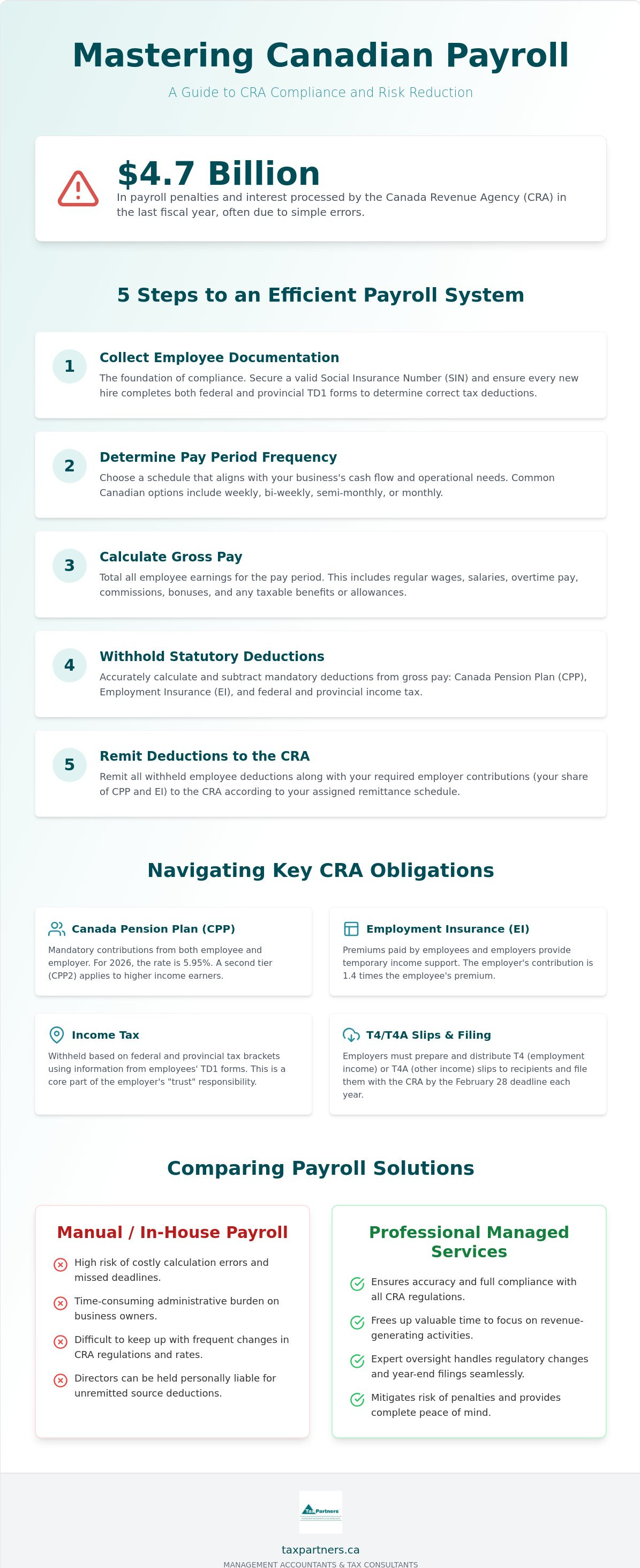
The Canadian payroll system operates on a trust-based model. As an employer, you're essentially acting as a collection agent for the federal government. You hold funds "in trust" until they're remitted. Under CRA rules, this responsibility is significant. If source deductions aren't remitted, the CRA can hold directors of a corporation personally liable for the debt. To begin this process, every business needs a federal Business Number (BN). You must then register a specific payroll program account, usually identified by the "RP" program identifier, to track your remittances and filings accurately.
Why Small Businesses Outsource Payroll
Calculating deductions like the Canada Pension Plan (CPP) and Employment Insurance (EI) has become increasingly complex. With the introduction of the second additional CPP contribution (CPP2) for earnings between $71,300 and $81,200, manual spreadsheets often fail to capture the nuances. Professional payroll management services Oshawa provide a steady hand, ensuring that your business remains compliant even as rates shift. Beyond simple math, outsourcing offers robust risk mitigation. It recovers valuable hours that you can reinvest into growth, while ensuring that year-end requirements, like filing T4 and T4A slips by the February 28 deadline, are handled with precision. Building a reliable payroll system requires more than just a calculator and a calendar. It demands a structured approach that satisfies both your staff and the federal government. For CRA filers, the goal is to create a repeatable cycle that minimizes manual data entry while maximizing accuracy. A well-organized workflow acts as a safeguard, ensuring that your business never misses a deadline or miscalculates a deduction. If you find the setup process daunting, seeking professional payroll management services Oshawa can provide the necessary framework to get your operations running smoothly from day one.
Onboarding Employees Correctly
The foundation of a compliant system starts with the Social Insurance Number (SIN) verification process. You must ask to see the employee's SIN card or official letter within three days of their start date to ensure the number is valid. Following this, the TD1 Personal Tax Credits Return form is essential. This document determines exactly how much federal and provincial income tax you should withhold from each paycheque. Because provincial tax credits vary significantly, you must ensure employees complete the specific form for their province of employment. If you are unsure about which forms apply to your specific situation, you can connect with our team for personalized guidance.
Establishing Clear Pay Cycles
Consistency is the bedrock of employee trust and provincial labour law compliance. Whether you choose a bi-weekly or semi-monthly cycle, sticking to that schedule helps you realize a predictable cash flow pattern. This consistency also makes it easier to plan for CRA remittance deadlines, which typically fall on the 15th of the month following the pay period for regular remitters. When choosing between different methods, consulting a Payroll Management Guide can help you compare how different frequencies impact your administrative workload. A fixed schedule allows you to focus on growth rather than constantly reacting to upcoming pay dates. Using payroll management services Oshawa ensures that these cycles are managed with professional precision, leaving no room for late-filing penalties. Compliance is the heartbeat of a sustainable business. It's a commitment to your team and a necessary alignment with federal requirements. For CRA filers, the margin for error remains razor-thin. Miscalculating a single rate or missing a filing window can trigger a chain reaction of audits and financial stress. Many local businesses utilize payroll management services Oshawa to ensure these technical details are handled with absolute precision. By delegating these complexities, you transform a potential source of anxiety into a reliable, automated process. The CRA assigns every employer a specific remittance frequency, which dictates when you must send withheld funds to the government. Regular remitters typically face a deadline on the 15th of the month following the pay period. However, if your average monthly withholding is higher, you might be classified as an accelerated remitter, requiring payments multiple times per month. Quarterly remitting is sometimes available for small employers with stellar compliance histories. Timeliness is critical. Missing these dates results in immediate penalties ranging from 3% for payments one to three days late, up to 10% for those more than seven days late. For a comprehensive deep dive into these obligations, the CRA Employers' Guide to Payroll serves as the definitive technical manual for business owners.
Statutory Deductions Explained
Under CRA rules, three primary statutory deductions define every paycheque: Canada Pension Plan (CPP), Employment Insurance (EI), and income tax. For 2026, the employee CPP contribution rate is 5.95% on earnings up to the Year's Maximum Pensionable Earnings (YMPE) of $71,300. A second additional CPP contribution (CPP2) of 4% applies to earnings between $71,300 and $81,200. Employers must match these CPP contributions dollar-for-dollar. EI premiums are set at 1.66% for employees, but the employer share is 1.4 times that amount, or approximately 2.324%. This "employer share" significantly impacts your total cost of labour. You must also include taxable benefits, such as health premiums or company car allowances, in your gross income calculations to ensure the correct tax is withheld. Using payroll management services Oshawa helps you track these shifting rates without manual effort.
Year-End Reporting and T4 Slips
The payroll cycle culminates in year-end reporting, a period that demands high attention to detail. You're responsible for generating T4 slips for employees and T4A slips for contractors to report their annual income and deductions. The deadline for filing the T4 Summary and distributing these slips is February 28, 2026. Failing to meet this deadline or filing more than five slips on paper instead of electronically can lead to significant administrative penalties. It's best practice to reconcile your records monthly to ensure the final T4 filing is a smooth, stress-free event rather than a frantic scramble. Choosing the right path for your payroll depends on the complexity of your team and your tolerance for regulatory risk. For many startups, the manual spreadsheet method seems like a cost-effective starting point. However, this approach carries the highest risk of human error and CRA non-compliance. Given that calculation errors contribute significantly to billions in annual penalties, the "savings" of a manual system are often illusory. As your business scales, the time required to track changing CPP and EI rates manually becomes a significant drain on your productivity. Payroll software offers a middle ground, automating calculations and providing basic reporting. While efficient for simple needs, software is only as good as the data entered and the settings selected. Under CRA rules, the business owner remains the responsible party for ensuring tax law changes are correctly implemented. If you miss a setting for a new taxable benefit or fail to update a provincial tax rate, the software won't necessarily catch the mistake. This is why many growing firms transition to payroll management services Oshawa, where professional oversight replaces software-only reliance. Managed payroll services provide the highest level of security and professional advisory. These solutions integrate seamlessly with broader bookkeeping and tax optimization strategies, ensuring your financial data is unified. Instead of reacting to payroll as an isolated task, you can view it as a strategic component of your cash flow management. If you're ready to move away from manual tracking and embrace a more secure model, reach out to our specialists today to discuss a tailored managed solution.
Evaluating Your Internal Capacity
Take a moment to realize exactly how many hours your team spends on payroll administration each month. For a business with 15 employees, this can easily consume ten to fifteen hours of high-level management time. This "opportunity cost" is often the strongest argument for outsourcing. Those hours could be spent on revenue-generating activities or strategic planning. As your team grows, the complexity of managing vacation pay, sick leaves, and varied deductions often outpaces the capabilities of DIY software, making professional payroll management services Oshawa a more sustainable choice.
The Security and Privacy Advantage
Professional firms protect sensitive employee data through encrypted portals, reducing the risk of identity theft or data breaches. Beyond technical security, there's a significant benefit to having an arms-length third party handle salary disputes or sensitive financial information. This distance maintains a professional atmosphere and ensures that compensation remains confidential. Perhaps most importantly, professional firms provide a steady hand during CRA audits. Having a proactive guardian who understands your records from top to bottom ensures that compliance reviews are handled with confidence rather than panic. Choosing Tax Partners means moving beyond a simple transaction. We act as a proactive guardian of your financial health, leveraging over 40 years of institutional wisdom to secure better outcomes for your firm. This deep-seated reliability allows us to foresee and mitigate compliance risks before they ever reach your desk. For CRA filers, this level of meticulous oversight provides a sense of stability that manual systems simply cannot offer. By utilizing our payroll management services Oshawa, you gain a partner who is genuinely attentive to your individual concerns and invested in your long-term success. It's about having a steady hand at the helm while you navigate the complexities of Canadian regulation. We see the numbers as a map for your future. Payroll data provides vital insights into your business's efficiency and scaling potential. Our role is to help you interpret these figures, connecting them to broader wealth management and corporate tax planning. This foresight ensures that your payroll strategy isn't just about meeting immediate obligations; it's about building a foundation for future prosperity. We look for patterns that others might miss, ensuring your compensation structures are both competitive and tax-efficient. This strategic alignment helps you maintain a lean, compliant, and motivated workforce.
Integrated Financial Oversight
Effective payroll management doesn't exist in a vacuum. It integrates seamlessly with our Professional Bookkeeping Services to provide a crystal-clear picture of your total labour costs. When your payroll and books are synchronized, you can realize the true impact of staffing on your bottom line. Accurate records also simplify the corporate tax preparation process at year-end, as all necessary data is already organized and verified. Our team ensures that every deduction is optimized, helping you keep more of what you earn while maintaining total integrity in your reporting. This holistic view allows for better cash flow forecasting and more informed hiring decisions.
Taking the Next Step Toward Efficiency
We invite you to experience the reassurance that comes with professional oversight. Our boutique approach offers personalized care and responsive support, moving you from a state of potential uncertainty toward total control. We don't just react to requirements; we actively look ahead to secure better outcomes for your business and your employees. This partnership is characterized by a lack of pretension and a high degree of responsiveness. You deserve a system that works as hard as you do, and our payroll management services Oshawa provide the clarity you need to scale with confidence. Contact Tax Partners today to streamline your payroll and focus on your business growth. Building a resilient Canadian business requires more than just hard work; it demands a structured approach to compliance and administration. You've seen how a meticulous payroll system, from correctly onboarding staff to meeting monthly CRA remittance deadlines, serves as a vital shield against audits. By choosing expert payroll management services Oshawa, you place the technical burden of evolving CPP rates and EI premiums into the hands of a proactive guardian. This transition allows you to reclaim valuable hours and reinvest them into the revenue-generating activities that drive your long-term success. Our firm brings over 40 years of Canadian tax and accounting experience to every partnership. We've earned more than 1,390 five-star Google reviews by providing the approachable warmth and professional authority your business deserves. Our team has saved clients over $87M through strategic tax planning, ensuring that every financial decision strengthens your bottom line. We don't just process numbers; we provide the foresight needed to handle a changing regulatory environment with total confidence. Let Tax Partners manage your payroll and compliance so you can focus on growth. It's time to move from administrative uncertainty toward total operational clarity. We're here to help you build a stronger, more efficient future for your team and your company.
What are the penalties for late payroll remittances to the CRA?
The CRA applies late-remittance penalties immediately to any business that misses their assigned deadline. These penalties start at 3% for payments that are one to three days late and rise to 10% if the delay exceeds seven days. If a business repeatedly fails to remit on time, the CRA may apply even higher surcharges and daily interest, making it vital to stick to your schedule.
Do I need a separate bank account for payroll deductions?
While the CRA doesn't mandate a dedicated payroll bank account, it's a best practice that provides significant financial clarity. Segregating these funds ensures that source deductions held in trust aren't accidentally used for daily operational expenses. This separation simplifies your internal bookkeeping and provides a transparent audit trail, which acts as a reassuring safeguard during any future regulatory reviews.
How long must I keep payroll records for CRA purposes?
Under CRA rules, you must retain all payroll records for six years following the end of the tax year to which they relate. This requirement includes time sheets, completed TD1 forms, and records of all remittances. Maintaining these files in a secure, organized digital format ensures your business is always prepared to demonstrate its historical compliance without the stress of a last-minute scramble.
What is the difference between a T4 and a T4A slip?
A T4 slip reports employment income, commissions, and taxable benefits paid to employees. In contrast, a T4A slip is used for "Statement of Pension, Retirement, Annuity, and Other Income," which often covers payments made to independent contractors. Distinguishing correctly between these forms is a critical step in year-end reporting to ensure every worker's income is categorized accurately under federal guidelines.
Can I pay my employees in cash under CRA rules?
You can pay employees in cash, but you must still comply with all CRA withholding and remittance requirements. It's essential to maintain detailed records of every transaction and issue proper pay stubs that clearly show gross pay and all statutory deductions. Paying in cash doesn't exempt a business from its trust-fund obligations or the requirement to file annual T4 slips.
How do I calculate the employer portion of CPP and EI?
For the Canada Pension Plan, you must match the employee's contribution dollar-for-dollar. For Employment Insurance, the employer's share is 1.4 times the amount withheld from the employee's pay. Utilizing payroll management services Oshawa ensures these specific ratios are applied correctly to every paycheque, protecting your business from the calculation errors that often lead to costly CRA interest charges.
What should I do if an employee does not have a Social Insurance Number (SIN)?
If a new hire lacks a SIN, they must apply for one at a Service Canada office immediately. You're required to ask for their SIN within three days of their start date and document your efforts to obtain it. While you can't withhold their pay while they wait for the number, you must ensure the SIN is recorded as soon as it's issued for CRA compliance.
Is payroll software enough to ensure CRA compliance for my business?
Payroll software is an efficient tool for basic calculations, but it's rarely enough to ensure total compliance on its own. Software doesn't always account for nuanced taxable benefits or shifting provincial labour laws. Comprehensive payroll management services Oshawa provide the professional oversight necessary to catch subtle errors and provide the strategic advice that automated systems simply cannot offer.