Advice for First Time Business Owners in Canada: 2026 Guide

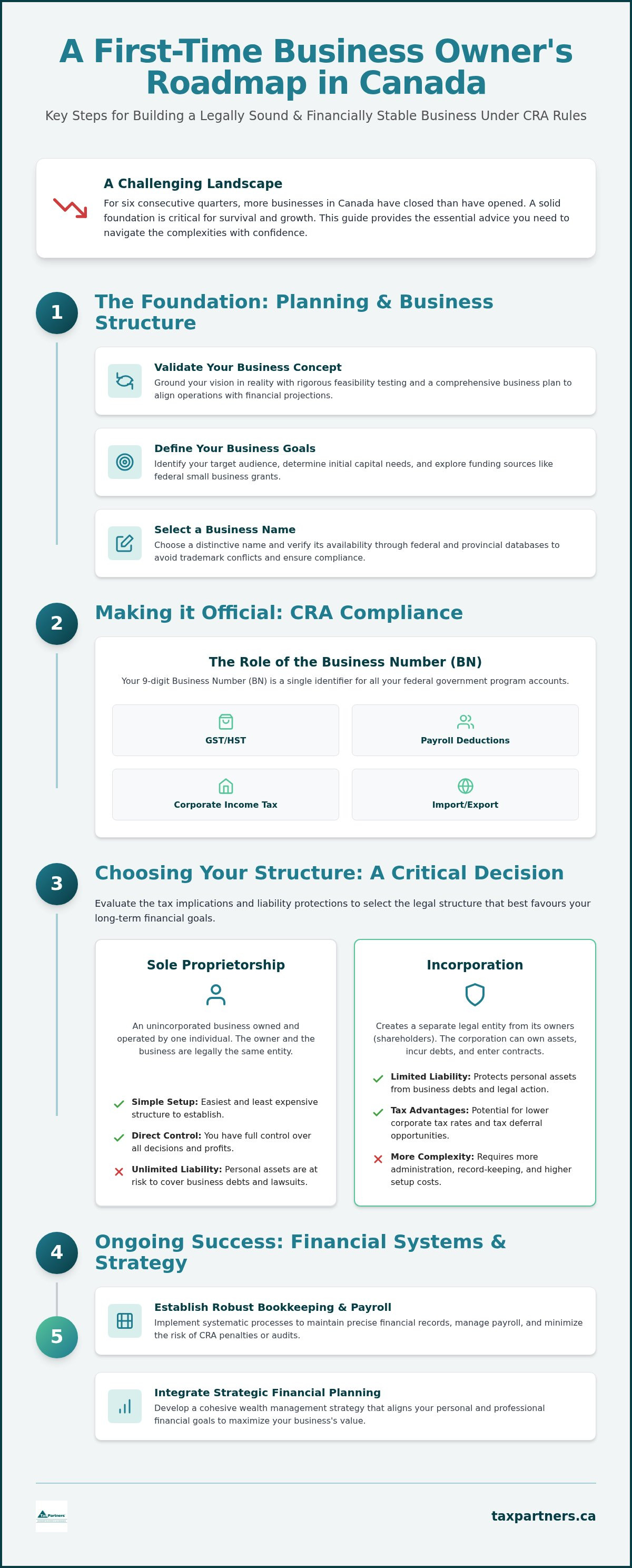
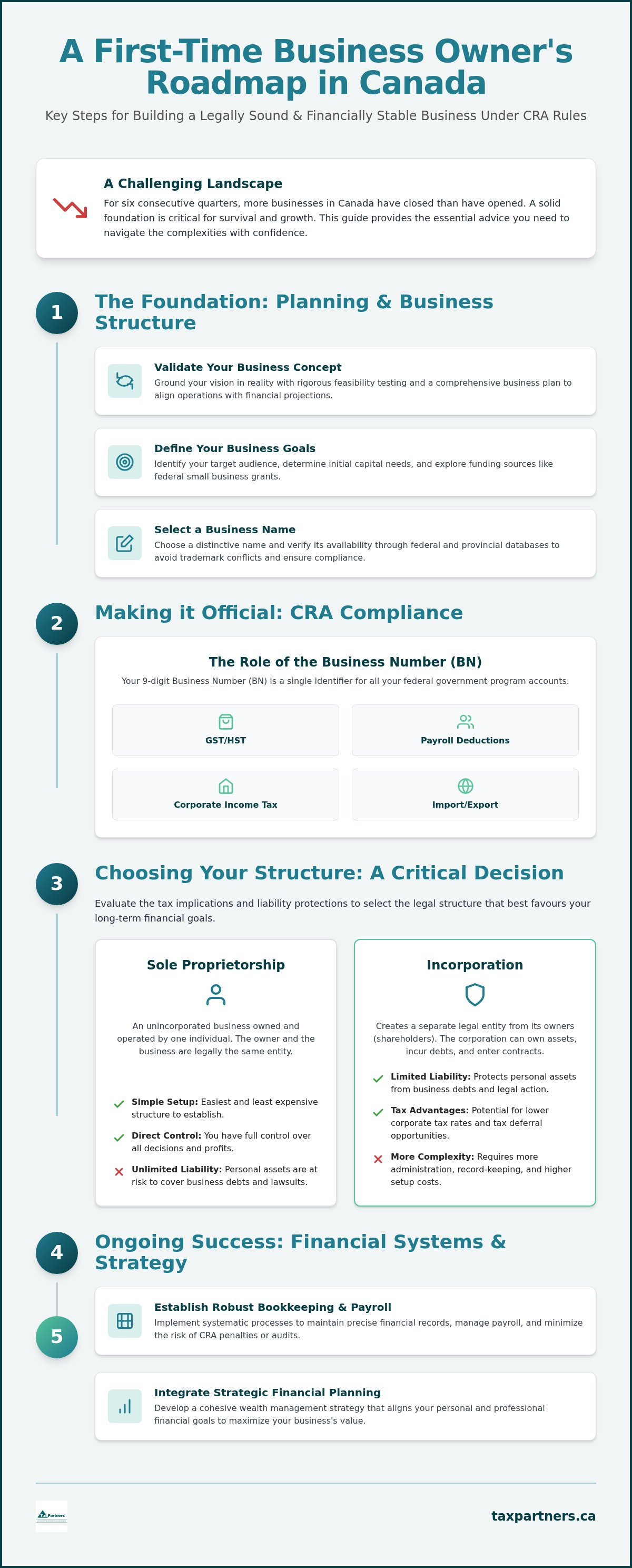
For six consecutive quarters leading up to April 2026, more businesses in Canada have closed than have opened. It's a startling statistic that reflects the immense pressure you feel as you seek reliable advice for first time business owners Canada entrepreneurs can trust. You're likely focused on your vision, yet the persistent worry of a CRA audit or a missed filing deadline often sits at the back of your mind.
We understand that the transition from an idea to a legal entity is often clouded by complex regulations and financial jargon. This guide offers the definitive roadmap you require to move forward with absolute certainty and professional poise. We'll help you transform that initial stress into a clear plan for long-term stability and financial growth.
You'll discover how to choose between incorporating or remaining a sole proprietor, which is an unincorporated business owned by one individual. We'll also clarify how to manage GST/HST (Goods and Services Tax and Harmonized Sales Tax) requirements without the fear of penalties. We'll explore proactive strategies to minimize your tax liability under CRA rules so you can build a legally sound foundation.
Key Takeaways
- Validate your business concept through rigorous feasibility testing and a comprehensive business plan to ensure your operational goals are grounded in reality.
- Gain essential advice for first time business owners Canada by learning how to register for a Business Number and organize your GST/HST obligations under CRA rules.
- Evaluate the tax implications and liability protections of sole proprietorships versus incorporation to select the legal structure that will best favour your long-term financial goals.
- Implement systematic bookkeeping and payroll processes to maintain precise financial records and minimize the risk of penalties or audits.
- Integrate your personal and professional financial goals into a cohesive wealth management strategy designed to maximize the value of your business at every stage.
Navigating Your First Steps: Planning and Business Structure
The journey of entrepreneurship begins with a clear-eyed assessment of your vision. While passion fuels the start, rigorous market research and feasibility testing ensure your concept can survive the competitive Canadian economy. With forecasted GDP growth of 1% for 2026, the most valuable advice for first time business owners Canada can offer is to build on a foundation of data rather than just intuition. We often see owners rush into the market without a comprehensive business plan, which leads to avoidable friction during the first year of operations.
A solid business plan does more than just outline your operational goals; it serves as a living document that aligns your daily actions with your financial projections. It's your primary tool for securing capital and staying on track when the initial excitement of a launch begins to settle into a routine. By establishing these structures early, you position your firm as a reliable entity in the eyes of lenders and potential partners. For entrepreneurs who are also navigating the immigration process, you can visit CanadaPathway to explore self-service options for your permanent residence application.
Defining Your Business Goals
Identifying your primary revenue drivers and target audience within the Canadian market is the first step toward sustainable growth. You must realize who your customers are and what specific problems you're solving for them. Setting realistic short-term milestones allows you to celebrate small wins and adjust your strategy based on real-world feedback. Consider these essential planning elements:
- Determine your initial capital requirements to avoid cash flow shortages in the first six months.
- Explore potential sources of funding, such as federal small business grants or private investment.
- Identify the specific demographics and geographic regions you intend to serve.
As you define your operational goals, remember that logistical readiness—such as ensuring your team is fully licensed for business travel—is crucial; for entrepreneurs in Ontario, Book Your Road Test can help simplify the process of scheduling driver examinations.
Establishing these goals early helps you maintain focus as you work through the complexities of business solutions and initial setup.
Selecting a Business Name under Canadian Rules
Choosing a name is a blend of creative branding and regulatory compliance. You must choose a name that is distinctive and clearly identifies your business activities while ensuring it doesn't conflict with existing trademarks. Before you print business cards or register a domain, verify name availability through federal and provincial databases to avoid costly legal disputes.
Registration requirements vary depending on your specific jurisdiction. Most provinces require you to register your name if it's different from your own legal name. This process provides transparency for the public and ensures you're operating legally within your province or territory. We recommend consulting with a professional through our accounting services to ensure your initial planning aligns with long-term tax efficiency and regulatory standards from day one.
Understanding CRA Compliance and Your Tax Obligations
Compliance isn't just about following rules; it's about protecting your hard-earned equity and building a reputation for reliability. For those seeking advice for first time business owners Canada, the Canada Revenue Agency (CRA) is your most significant regulatory partner. Establishing a transparent relationship with the CRA from day one prevents the stress of future audits and unexpected penalties. Use the Government of Canada business guide to understand the basic administrative requirements before diving into the specifics of tax accounts.
The Role of the Business Number
Your Business Number (BN) acts as a single identifier for all federal government dealings. It's a nine-digit number that remains constant across various tax accounts. You'll use this BN to register for specific programs including:
- GST/HST accounts for sales tax collection and recovery.
- Payroll deductions for your staff and yourself if you're a salaried employee of your corporation.
- Corporate income tax if you've chosen to incorporate your entity.
- Import-export accounts for international trade and customs.
Accuracy during this registration process is vital. If your information is incorrect, you might miss essential government notices or face delays in receiving tax refunds. It's a simple step that forms the backbone of your professional identity.
GST/HST Registration for CRA Filers
You must monitor your worldwide taxable revenue to know when registration becomes mandatory. For most businesses, this happens when taxable supplies exceed $30,000 over four consecutive calendar quarters. Even if you haven't reached this threshold, voluntary registration often makes sense. It allows you to recover Input Tax Credits (ITCs), which are the taxes you pay on business-related expenses. Stay updated on tax in Canada to understand how different provinces apply HST or PST (Provincial Sales Tax).
If you're selling services or products to customers in the US, these sales are often "zero-rated." This means you don't charge GST/HST to your American clients, yet you remain eligible to claim ITCs on the costs incurred to provide those services. This nuance is vital for Canadian startups looking to scale globally while maintaining a lean tax profile. If these requirements feel overwhelming, our team can help you organize your tax strategy to ensure total compliance and peace of mind.
If you plan to hire employees in 2026, you're responsible for withholding and remitting payroll deductions. The CPP (Canada Pension Plan) contribution rate for 2026 is 5.95% for both employers and employees. Additionally, the EI (Employment Insurance) premium rate is $1.63 per $100 of insurable earnings for workers. Sole proprietors report business income on their personal T1 return, while corporations file a separate T2 return within six months of their fiscal year-end.
Choosing Your Structure: Sole Proprietorship vs. Incorporation
Selecting the legal framework for your venture is a pivotal decision that dictates your tax obligations and personal risk. For those seeking advice for first time business owners Canada, the choice usually lands between a sole proprietorship and incorporation. While one offers simplicity, the other provides a strategic shield for your wealth. BDC's guide to starting a business emphasizes that your structure should reflect both your current scale and your future ambitions.
The Simplicity of Sole Proprietorship
Operating as a sole proprietor is the most straightforward path for many new entrepreneurs. It involves fewer initial legal formalities and significantly lower setup costs than a corporation. For CRA filers, you report your business income directly on your personal T1 income tax and benefit return. This means your business profits are taxed at your personal marginal rate, which can be advantageous if your initial earnings are modest.
However, this simplicity comes with a significant trade-off. You and your business are legally the same entity. You remain personally liable for all business debts and obligations; this means your personal assets, such as your home or savings, could be at risk if the business faces legal action or financial trouble. It's a structure that suits low-risk, small-scale operations but often lacks the foresight required for rapid growth.
The Strategic Advantages of Incorporation
This is particularly true for trades-based businesses; for example, a company offering torch on roofing vancouver faces unique operational risks that make the legal separation of a corporation almost essential.
Incorporation transforms your business into a separate legal entity. This structure provides a vital layer of protection for your personal assets, as the corporation's liabilities generally don't extend to the shareholders. From a tax perspective, the benefits are compelling for those looking to scale. Under CRA rules, Canadian-Controlled Private Corporations (CCPCs) can access the Small Business Deduction. In 2026, this reduces the federal tax rate to 9% on the first $500,000 of active business income.
This lower rate allows you to keep more capital within the business for reinvestment or future expansion. You can also explore income splitting or tax deferral strategies by choosing when to pay yourself dividends or a salary. These options provide a level of financial customization that a sole proprietorship cannot match. For a deeper look at these requirements, read our guide to Canadian corporate tax compliance.
If you're launching with associates, a partnership might be the right fit. This structure allows for shared resources and expertise, though it requires a robust partnership agreement to define responsibilities and profit sharing. Regardless of your choice, the administrative costs of incorporation, such as annual filings and separate tax returns, are often outweighed by the long-term tax savings and liability protection it offers.
Establishing Robust Bookkeeping and Payroll Systems
Precision in your financial records is the difference between a thriving enterprise and a regulatory nightmare. For CRA filers, bookkeeping isn't just about balance sheets; it's a legal requirement to maintain records for at least six years. This is a core piece of advice for first time business owners Canada entrepreneurs should take to heart.
Maintaining these records ensures you're prepared if the CRA ever requests a review of your filings. You need to choose an accounting method that fits your scale. Cash-basis accounting records income when you receive it and expenses when you pay them.
Accrual-basis accounting records transactions when they occur, regardless of when the cash moves. Most corporations are required to use the accrual method. This provides a clearer picture of long-term financial health and operational performance. For startups looking for similar expert guidance in other regions, proledger.co.nz provides specialized accounting and tax compliance services.
Beyond organizing your files, maintaining the integrity of your digital records requires robust cybersecurity; to explore how managed IT services can protect your growing firm, visit Trinity Networx, LLC.
The first rule of fiscal management is separation. Open a dedicated business bank account immediately to ensure personal and professional expenses never mingle. This simple step simplifies your tax filings and provides a clear audit trail for the CRA.
Use modern digital tools or professional accounting services to categorize your spending accurately. Preparing monthly financial statements allows you to monitor your profit margins and operational health in real-time. You can't manage what you don't measure.
Managing Payroll and Remittances
Hiring your first employee is a significant milestone, but it introduces complex obligations. You must calculate and withhold Canada Pension Plan (CPP) and Employment Insurance (EI) premiums from every cheque. For 2026, the CPP contribution rate is 5.95% for both employers and employees on earnings up to the Year's Maximum Pensionable Earnings (YMPE) of $74,600.
On earnings between $74,600 and $85,000, a second additional CPP (CPP2) rate of 4.00% applies. The EI premium rate for workers is $1.63 per $100 of insurable earnings, while employers pay 1.4 times that amount. Ensure these remittances reach the CRA by the specified due dates to avoid hefty penalties.
At year-end, you must issue T4 slips, which are statements of remuneration paid, to your staff. You also need to file the annual information return correctly to stay in good standing. If you're unsure about your specific filing deadlines or contribution calculations, contact our team today to set up a compliant payroll system.
Strategic Financial Planning for Long-Term Success
Success is rarely accidental. It requires a proactive strategy that bridges the gap between your corporate achievements and your personal financial freedom. The most effective advice for first time business owners Canada offers is to treat your business as a vehicle for wealth, not just a source of income.
You should explore tax-efficient investment options within your corporation to grow surplus cash. This approach allows you to defer personal taxes while your capital continues to grow within the entity. Protecting your family through appropriate insurance and estate planning ensures your legacy remains intact regardless of market volatility.
Wealth Preservation for Business Owners
Integrating your business and personal goals requires sophisticated wealth management and financial planning. One of the most significant benefits for Canadian entrepreneurs is the Lifetime Capital Gains Exemption (LCGE). This can potentially shield a substantial portion of your capital gains from tax when you eventually sell qualifying small business corporation shares.
You also need to balance your salary and dividend mix to optimize your personal tax bracket. Salaried income allows you to contribute to your RRSP (Registered Retirement Savings Plan), while dividends can sometimes be more tax-efficient depending on your total income. Choosing the right balance is a precision task that adapts as your business matures.
Preparing for Future Growth
Strategic reinvestment of profits is the key to scaling your operations and increasing your market share. However, you must also be prepared for economic shifts. With 34.1% of small businesses expecting a decrease in profitability in the second quarter of 2026, a robust contingency fund is essential for survival.
Review your financial plan annually with a professional advisor to adapt to market changes. This proactive approach ensures you're not just reacting to requirements but are actively looking ahead to secure a better outcome. Planning for business succession or an eventual exit now will maximize the value of your hard work when the time comes to step away.
Secure Your Professional Legacy
As your business expands, maintaining operational efficiency becomes even more critical, particularly when managing a team of drivers; you can learn more about simplifying the road test booking process for your employees.
Building a successful enterprise in 2026 requires more than just a great product; it demands a foundation of legal and financial precision. You've seen how selecting the right structure, such as a Canadian-Controlled Private Corporation, can provide essential liability protection and significant tax advantages. By establishing robust bookkeeping and payroll systems from day one, you ensure your business remains compliant with all CRA requirements while protecting your personal assets from unnecessary risk.
This guide provides the definitive advice for first time business owners Canada entrepreneurs require to navigate a complex regulatory environment with poise. With over 40 years of Canadian tax experience and more than 495,000 returns filed accurately, Tax Partners is trusted by owners across 20 different industries. We act as your proactive guardian, helping you look ahead to secure the best possible financial outcome for your venture.
Don't leave your financial future to chance. Book a consultation with Tax Partners to secure your business future and gain the confidence that comes with seasoned expert guidance. Your journey as a business owner is just beginning, and we're here to ensure every step you take is a confident and informed one.
Frequently Asked Questions
Do I need a lawyer to start a business in Canada?
You aren't legally required to hire a lawyer to start a business in Canada, especially for a sole proprietorship. However, for CRA filers choosing to incorporate, a lawyer helps draft essential documents like shareholder agreements. These agreements protect your interests if disputes arise between partners. Seeking professional advice for first time business owners Canada entrepreneurs ensures your legal foundation is as strong as your financial one.
What is the difference between a Business Number and a GST/HST account?
A Business Number is a nine-digit identifier that the federal government uses to track your entity. Under CRA rules, a GST/HST account is a specific program account added to that base number. You'll use your Business Number for all interactions with the CRA, while the GST/HST account specifically tracks the sales tax you collect and the credits you claim on business expenses.
How much should I set aside for taxes in my first year?
Setting aside 25% to 30% of your gross income is a prudent strategy for your first year. This amount helps cover your personal or corporate income tax and the GST/HST you've collected from customers. Since you don't have a prior year's tax history, you won't likely pay in instalments yet. This practice ensures you have the necessary liquidity when your balance becomes due under CRA rules.
Can I deduct my home office expenses as a new business owner?
For CRA filers, you can deduct home office expenses if the space is your principal place of business. You can also claim these if you use the space exclusively to earn business income and meet clients regularly. Eligible costs include a portion of your utilities, home insurance, and rent. You must calculate the deduction based on the square footage of your office relative to your entire home. For entrepreneurs looking to further professionalize their home office with advanced security and automation, FoxyHome by PCMNow provides expert installation services to keep your residential workspace safe and efficient.
Choosing between a salary and dividends depends on your need for RRSP contribution room and your personal tax bracket. A salary requires you to make CPP (Canada Pension Plan) contributions, which build your future pension. Dividends are often simpler to administer and don't require payroll remittances. We recommend reviewing your specific goals to find the most tax-efficient balance for your Canadian corporation.
What happens if I forget to register for GST/HST on time?
If you miss the registration deadline, the CRA may backdate your registration to when you were no longer a small supplier. You'll be liable for all the GST/HST you should've collected from that date, even if you didn't charge your customers. Penalties and interest will also apply to the unremitted amounts. It's vital to monitor your revenue closely to avoid these unexpected costs.
How long do I need to keep my business receipts and records?
Under CRA rules, you must keep all business receipts, invoices, and financial records for six years. This period starts from the end of the last tax year to which the records relate. Maintaining organized digital or physical copies ensures you can support your claims during a potential review. If you're involved in an ongoing appeal, you should retain these documents even longer until the matter is resolved.
Do I need to register my business in every province where I have customers?
You generally need to register your business in each province where you carry on business or have a physical presence. For CRA filers, the rules for GST/HST are federal, but provinces like British Columbia, Saskatchewan, and Manitoba have separate Provincial Sales Tax (PST) systems. If you sell goods to customers in those provinces, you may need to register for and collect PST based on their specific provincial thresholds.

Article by
Mahad Mohamed
Mahad Mohamed is an accountant and the CEO of Tax Partners, with over 26+ years of Canadian and international tax and accounting experience. His expertise includes corporate reorganization, cross-border tax structuring (Canada & US), tax disputes, CRA audits, and tax planning for small owner-managed private corporations. Most recently, Mahad is a pioneer in Canadian crypto taxation and founded Block3 Finance.
Previously, Mahad worked for the Canada Revenue Agency (CRA), Big4 accounting firms, and served as a Rulings Officer for the Federal Tax Authority of the UAE before acquiring Tax Partners in 2014.
Tax Partners has 44 full-time accountants and over 18,400+ clients.
Disclaimer
This article provides general information only and is current as of its publication date. It has not been updated and may be out of date. It does not constitute legal advice and should not be relied upon as such. Every tax situation is unique and may differ from the examples discussed in this article. If you have specific questions, you should seek the advice of our accountants for your unique circumstances. Book a FREE Initial Consultation Today!
Frequently Asked Questions
Do I need a lawyer to start a business in Canada?
You aren't legally required to hire a lawyer to start a business in Canada, especially for a sole proprietorship. However, for CRA filers choosing to incorporate, a lawyer helps draft essential documents like shareholder agreements. These agreements protect your interests if disputes arise between partners. Seeking professional advice for first time business owners Canada entrepreneurs ensures your legal foundation is as strong as your financial one.
What is the difference between a Business Number and a GST/HST account?
A Business Number is a nine-digit identifier that the federal government uses to track your entity. Under CRA rules, a GST/HST account is a specific program account added to that base number. You'll use your Business Number for all interactions with the CRA, while the GST/HST account specifically tracks the sales tax you collect and the credits you claim on business expenses.
How much should I set aside for taxes in my first year?
Setting aside 25% to 30% of your gross income is a prudent strategy for your first year. This amount helps cover your personal or corporate income tax and the GST/HST you've collected from customers. Since you don't have a prior year's tax history, you won't likely pay in instalments yet. This practice ensures you have the necessary liquidity when your balance becomes due under CRA rules.
Can I deduct my home office expenses as a new business owner?
For CRA filers, you can deduct home office expenses if the space is your principal place of business. You can also claim these if you use the space exclusively to earn business income and meet clients regularly. Eligible costs include a portion of your utilities, home insurance, and rent. You must calculate the deduction based on the square footage of your office relative to your entire home.
Is it better to pay myself a salary or dividends from my corporation?
Choosing between a salary and dividends depends on your need for RRSP contribution room and your personal tax bracket. A salary requires you to make CPP (Canada Pension Plan) contributions, which build your future pension. Dividends are often simpler to administer and don't require payroll remittances. We recommend reviewing your specific goals to find the most tax-efficient balance for your Canadian corporation.
What happens if I forget to register for GST/HST on time?
If you miss the registration deadline, the CRA may backdate your registration to when you were no longer a small supplier. You'll be liable for all the GST/HST you should've collected from that date, even if you didn't charge your customers. Penalties and interest will also apply to the unremitted amounts. It's vital to monitor your revenue closely to avoid these unexpected costs.
How long do I need to keep my business receipts and records?
Under CRA rules, you must keep all business receipts, invoices, and financial records for six years. This period starts from the end of the last tax year to which the records relate. Maintaining organized digital or physical copies ensures you can support your claims during a potential review. If you're involved in an ongoing appeal, you should retain these documents even longer until the matter is resolved.
Do I need to register my business in every province where I have customers?
You generally need to register your business in each province where you carry on business or have a physical presence. For CRA filers, the rules for GST/HST are federal, but provinces like British Columbia, Saskatchewan, and Manitoba have separate Provincial Sales Tax (PST) systems. If you sell goods to customers in those provinces, you may need to register for and collect PST based on their specific provincial thresholds.