T2 Corporate Tax Return Ontario: 2026 Guide

What if your T2 filing is less about filling in forms and more about understanding what your records say? For an Ontario corporation, the T2 corporate tax return is part of Canada’s federal filing process, with Ontario tax treatment also affecting the calculation. The right preparation depends on your corporation’s financial activity and circumstances, not just a generic checklist.
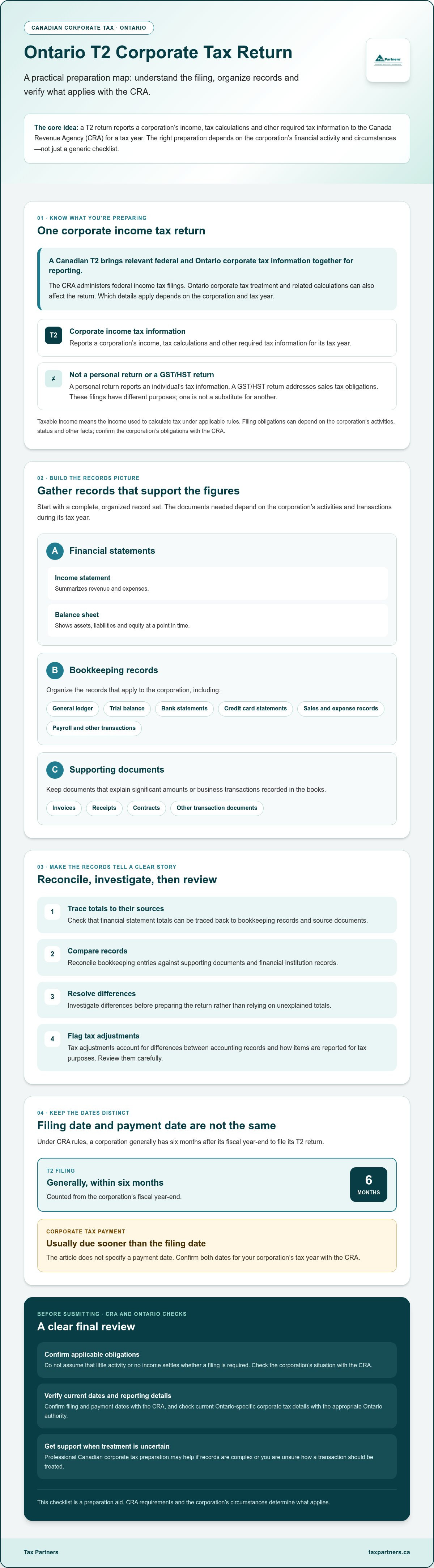
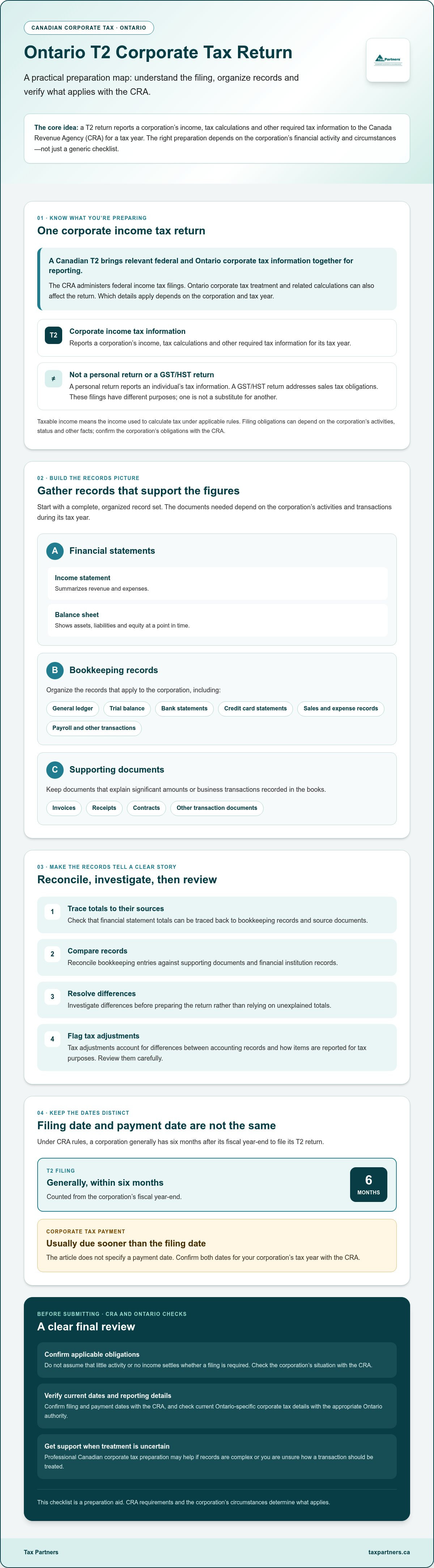
It’s understandable to worry about missing a deadline or overlooking an adjustment. Under CRA rules, a corporation generally has six months after its fiscal year-end to file its T2 return, but its tax payment is usually due sooner. Confirm both dates for your corporation’s tax year with the CRA.
This guide explains what an Ontario T2 return covers, which bookkeeping records and financial statement details to gather, and what to verify with the CRA before submitting. You’ll also learn how to flag tax adjustments and choose a filing approach that fits your corporation, so you can prepare with greater clarity and fewer avoidable surprises.
Key Takeaways
- Understand how a Canadian T2 return reports your corporation’s income and how Ontario tax treatment fits into the CRA filing process.
- Use your financial statements, bookkeeping records, and transaction documents to build a records checklist suited to your corporation.
- For your T2 corporate tax return Ontario, confirm the filing and payment dates that apply to your corporation’s tax year with the CRA.
- Review tax adjustments carefully: they account for differences between your accounting records and how items are reported for tax purposes.
- Consider professional Canadian corporate tax preparation if your records are complex or you’re unsure how a transaction should be treated.
What Is an Ontario T2 Corporate Tax Return?
A Canadian T2 Corporation Income Tax Return is the return a corporation uses to report its income, tax calculations and other required tax information to the Canada Revenue Agency (CRA) for a tax year. The T2 Corporation Income Tax Return is distinct from an individual’s personal income tax return: the corporation reports its own tax information, separate from the personal filings of its owners.
For an Ontario corporation, the T2 process remains within Canada’s CRA tax system, while Ontario’s corporate tax rules and related calculations can also affect the return. In practical terms, a T2 corporate tax return Ontario filing brings the corporation’s relevant federal and Ontario tax information together for reporting. It isn’t a personal return, and it isn’t a GST/HST return, which deals with sales tax rather than corporate income tax.
Who uses a Canadian T2 return?
Corporations with Canadian tax filing responsibilities use the T2 to report information for their tax year. That may include a corporation’s revenue, expenses and other details needed to determine its taxable income, meaning the income used to calculate tax under applicable rules.
The precise filing obligations can depend on the corporation’s activities, status and other facts. Don’t assume that having little activity or no income settles the question; confirm the corporation’s obligations with the CRA based on its situation.
How does Ontario fit into a Canadian corporate return?
The CRA is the federal agency responsible for administering Canadian income tax filings. Ontario context matters because provincial corporate tax treatment may affect the corporation’s tax calculation alongside federal rules. Which details apply depends on the corporation and tax year, so check current reporting and administration requirements with the CRA and Ontario authorities.
This guide focuses on Ontario corporations and Canadian tax considerations only. It doesn’t cover another country’s corporate tax system. If you want help understanding the Canadian corporate tax preparation process, see Tax Partners’ corporate income tax services.
Keep the filing categories clear as you prepare: a T2 reports corporate income tax information, a personal return reports an individual’s tax information, and a GST/HST return addresses sales tax obligations. These filings serve different purposes, and one shouldn’t be treated as a substitute for another. Confirm which obligations apply to your corporation directly with the CRA and, for Ontario-specific corporate tax details, the appropriate Ontario authority.
What Records Help Prepare an Ontario T2 Return?
A useful starting point is a complete, organized record set, not a one-size-fits-all checklist. The documents needed for a T2 corporate tax return Ontario filing depend on the corporation’s activities and transactions during its tax year. Clear records help show how figures were calculated and flag items that may need tax-specific review.
Gather financial statements and bookkeeping records
Collect the corporation’s year-end financial statements and bookkeeping records, then check that the totals can be traced back to source documents. Tax Partners’ corporate income tax services can help with corporate tax preparation when you’d like professional support.
- Financial statements: Gather the income statement, which summarizes revenue and expenses, and the balance sheet, which shows assets, liabilities and equity at a point in time.
- Bookkeeping records: Organize the general ledger, trial balance, bank and credit card statements, and records of sales, expenses, payroll and other transactions, as applicable.
- Supporting documents: Keep invoices, receipts, contracts and other documents that explain significant amounts or business transactions recorded in the books.
Reconcile bookkeeping entries against the supporting documents and financial institution records. Investigate differences before preparing the return, rather than relying on unexplained totals. For general filing mechanics and CRA guidance, consult the Canada Revenue Agency T2 filing requirements; this checklist is a preparation aid, not a substitute for current CRA instructions.
Collect information about changes and unusual transactions
Set aside records for transactions or business changes that may need closer review. Their tax treatment depends on the facts, so don’t assume that a bookkeeping label alone determines how an item should be reported.
- Asset purchases or sales: Keep purchase or sale documents, invoices and related payment records for significant equipment or other business assets.
- Financing: Gather loan agreements, statements and records of repayments or interest charged.
- Ownership or business changes: Note changes in ownership, business activities or structure, with relevant agreements and dates.
- Unusual transactions: Flag one-time, complex or unclear entries and include the documents that explain what happened.
A short note explaining why an unusual transaction occurred can make it easier to ask focused questions during preparation. If you’d like to discuss your corporation’s records and Canadian tax preparation needs, contact Tax Partners.
Ontario T2 Filing: Deadlines, Tax Owed, and Common Misconceptions
For an Ontario corporation, filing its Canadian T2 return and paying any tax owing are separate responsibilities under Canada Revenue Agency (CRA) rules. The dates can depend on the corporation’s tax year and circumstances, so confirm the current requirements for that specific year rather than relying on a general calendar reminder.
How should a corporation confirm its filing and payment dates?
Under CRA rules, a corporation’s T2 filing deadline is generally six months after its fiscal year-end. Payment may be due earlier: for most corporations, the balance-due day is generally two months after year-end, while eligible Canadian-controlled private corporations claiming the small business deduction may have a later payment deadline. Confirm which rules apply and the exact dates directly with the CRA.
Keep the two dates separate in your records. Filing the return reports the corporation’s tax information; paying settles tax owing. Submitting the return on time doesn’t necessarily mean the payment deadline has also been met. Check the CRA’s current corporation income tax filing guidance for the applicable requirements.
Does an inactive corporation automatically avoid filing?
Misconception: “The corporation had little or no activity, so it doesn’t need to file.”
Reality: Inactivity alone isn’t proof that a Canadian corporation has no T2 filing obligation. CRA filing requirements can depend on the corporation’s status and circumstances, not simply whether it earned income or made sales during the year. Confirm the corporation’s situation with the CRA before deciding that no return is required.
This distinction matters for an Ontario corporation with no operating revenue but continuing records, assets or changes in status. Those details don’t establish a filing outcome by themselves, but they’re useful context when checking CRA requirements. If the corporation’s status is unclear, gather its relevant records and ask the CRA or a qualified tax professional to help determine what applies.
Misconception: “If the return is filed, the corporation has taken care of any tax owing.”
Reality: Filing and payment are distinct under Canadian CRA rules. A corporation may need to meet a payment date even if its return is not yet ready to submit, so track both obligations and verify the applicable dates for the corporation’s tax year. For a T2 corporate tax return Ontario filing, a tailored check is safer than assuming one deadline covers everything.
How to Prepare and Review an Ontario T2 Return
A reliable preparation process turns a year of business activity into records that can be checked, explained and reported. For a T2 corporate tax return Ontario filing, work from the corporation’s books and supporting documents, and use current Canada Revenue Agency (CRA) instructions to confirm how information should be reported.
Follow a practical preparation sequence
Move through the work in order rather than trying to resolve every tax question while closing the books. This helps separate bookkeeping gaps from items that need tax analysis.
- Close and organize the records. Bring bookkeeping up to date, reconcile account balances and identify missing invoices, statements or other supporting documents.
- Review the financial statements. Check that key totals agree with the underlying records. Note unusual transactions, major purchases, financing activity or business changes for further review.
- Identify tax adjustments. A tax adjustment is a change made because an item may be treated differently for accounting purposes and tax reporting. For example, a book expense may need a separate tax review before deciding how it should be reported. Don’t assume every accounting entry automatically receives the same treatment on the return.
- Prepare using current guidance. Follow the CRA’s current instructions for the corporation’s tax year, or work with a qualified tax professional if the reporting questions require expertise. Tax Partners’ Canadian corporate tax services can provide support with corporate tax preparation and related reporting considerations.
Review the return before submitting it
Before submission, trace reported amounts back to the financial statements and source records. Check that the corporation’s identifying and tax-year information is consistent across the return and supporting workpapers, and confirm that required schedules or information have been considered under current CRA instructions.
- Compare income and expense totals with the finalized books, and investigate differences.
- Check asset, liability and financing information against relevant statements and agreements.
- Revisit tax adjustments and confirm that each has a clear explanation and supporting documents.
- List any unresolved questions and obtain an answer rather than guessing at the tax treatment.
Keep a note of decisions and outstanding items so the review process remains clear, particularly if more than one person is involved. Organized bookkeeping also makes it easier to prepare future Canadian corporate filings; for broader context, review the CRA’s current guidance and Tax Partners’ information on tax in Canada.
If complex records or uncertain tax treatment are making the return difficult to complete, contact Tax Partners to discuss corporate tax preparation support.
Get Support with Your Ontario T2 Corporate Tax Return
Professional preparation may be helpful when bookkeeping records are incomplete, the corporation has unusual transactions, or you're unsure how an item should be treated for Canadian tax reporting. A preparer can review the information, identify questions that need follow-up and help organize the return process. The corporation's circumstances still determine the treatment, and no preparer can promise a particular tax outcome.
Tax Partners provides Canadian corporate tax preparation and related accounting services. If you're considering support for a T2 corporate tax return Ontario filing, you can review the firm's corporate income tax services and consider whether they fit your needs.
What should a business ask a tax preparer?
A clear conversation at the outset helps both sides understand the work involved. Before engaging a preparer, ask how they review records, flag missing information and handle questions about transactions that may need further tax analysis.
- What records should I gather for the corporation's tax year, and how should I organize them?
- How will you identify missing documents or information that needs clarification?
- What details do you need about the corporation's tax year, bookkeeping status and unusual transactions?
- How will you raise questions when the available information doesn't establish a clear tax treatment?
Before reaching out, collect the corporation's financial statements, bookkeeping records and supporting documents. Make a short list of unclear entries or changes in the business, and note any questions you want addressed. This gives the preparer useful context to assess what information may be needed and whether professional support is appropriate.
Take the next step with Tax Partners
Tax Partners serves individuals and SMEs with Canadian accounting and tax services, including corporate tax preparation. The firm reports decades of combined experience, extensive tax filings, and a strong track record of client satisfaction. To ensure absolute accuracy, clients are encouraged to verify current firm statistics directly.
Every corporation's records and reporting questions are different. If you'd like to discuss your corporation's Canadian filing needs and what documents to prepare, contact Tax Partners to start the conversation.
Prepare Your T2 Filing with Greater Confidence
A sound T2 corporate tax return Ontario process begins with records that are complete, organized and supported by source documents. Review transactions that may need tax-specific analysis, and confirm filing and payment requirements for the corporation’s tax year directly with the CRA. Filing a return and paying any amount owing are separate steps, so track both.
If the corporation’s bookkeeping is complex or a transaction’s tax treatment is unclear, professional preparation can help you identify questions and organize the reporting process. Gather your financial statements, bookkeeping records and a list of uncertainties before discussing the corporation’s Canadian filing needs.
Tax Partners provides Canadian corporate tax preparation and related accounting services. Contact Tax Partners to discuss your Canadian corporate tax return and the records you have ready. With a clear plan and the right support, you can take the next step with greater confidence.
Frequently Asked Questions
What is a T2 corporate tax return in Ontario?
A T2 corporate tax return is the Canadian return a corporation uses to report its income and other required tax information to the Canada Revenue Agency (CRA). For an Ontario corporation, the return addresses federal tax reporting and applicable Ontario corporate tax considerations within Canada’s T2 process. It’s separate from an owner’s personal income tax return and from a GST/HST return, which reports sales tax information.
Does an Ontario corporation have to file a T2 if it had no income?
No income doesn’t automatically mean an Ontario corporation can skip filing a T2. Canadian corporate filing obligations depend on the corporation’s circumstances and status, not only whether it earned revenue. Check current CRA requirements for the corporation’s specific situation before deciding that no return is needed. If its status or filing obligation is unclear, contact the CRA or ask a qualified Canadian tax professional for guidance.
When is an Ontario T2 corporate tax return due?
Under Canadian CRA rules, a corporation’s T2 return is generally due within six months after its fiscal year-end. The exact calendar date depends on that year-end and should be confirmed using current CRA guidance. Payment of any tax owing is a separate responsibility and may be due before the return filing deadline. Confirm both dates for the corporation’s tax year rather than relying on one deadline.
What records do I need to prepare an Ontario T2 return?
Gather the corporation’s financial statements, bookkeeping records and supporting documents for its tax-year transactions. Useful records may include an income statement, balance sheet, general ledger, bank and credit card statements, invoices, receipts, contracts and financing documents. The exact list depends on the corporation’s activities. Reconcile bookkeeping totals to source documents and flag unusual transactions or missing information for follow-up under current CRA instructions.
Is an Ontario T2 return different from a federal corporate tax return?
For an Ontario corporation, the T2 is the Canadian corporate income tax return filed with the CRA, and the reporting may include applicable Ontario corporate tax information. Ontario tax considerations can affect the corporation’s calculation, but that doesn’t necessarily mean preparing an entirely separate provincial return. Requirements can depend on the corporation’s circumstances and current rules, so confirm filing and reporting details with the CRA and Ontario authorities.
Can I prepare an Ontario T2 corporate tax return myself?
Yes, you may prepare the return yourself if you can organize the corporation’s records, understand the applicable Canadian CRA instructions and address any tax adjustments. Most corporations are required to file electronically under current CRA rules, and electronic filing requires CRA-certified software. Confirm the current filing method that applies to your corporation. If transactions or tax treatment are uncertain, consider professional preparation rather than guessing.
How do I find help preparing an Ontario T2 return?
Look for a provider offering Canadian corporate tax preparation and ask how they review records, identify missing information and resolve tax questions. Tax Partners provides Canadian accounting and tax services, including corporate tax preparation. Before contacting a preparer, gather the corporation’s financial statements, bookkeeping records, details of its tax year and a list of unusual transactions or unresolved questions. This helps you discuss the corporation’s filing needs clearly.

Article by
Mahad Mohamed
Mahad Mohamed is an accountant and the CEO of Tax Partners, with over 26+ years of Canadian and international tax and accounting experience. His expertise includes corporate reorganization, cross-border tax structuring (Canada & US), tax disputes, CRA audits, and tax planning for small owner-managed private corporations. Most recently, Mahad is a pioneer in Canadian crypto taxation and founded Block3 Finance.
Previously, Mahad worked for the Canada Revenue Agency (CRA), Big4 accounting firms, and served as a Rulings Officer for the Federal Tax Authority of the UAE before acquiring Tax Partners in 2014.
Tax Partners has 44 full-time accountants and over 18,400+ clients.
Disclaimer
This article provides general information only and is current as of its publication date. It has not been updated and may be out of date. It does not constitute legal advice and should not be relied upon as such. Every tax situation is unique and may differ from the examples discussed in this article. If you have specific questions, you should seek the advice of our accountants for your unique circumstances. Book a FREE Initial Consultation Today!
Frequently Asked Questions
Who uses a Canadian T2 return?
Corporations with Canadian tax filing responsibilities use the T2 to report information for their tax year. That may include a corporation’s revenue, expenses and other details needed to determine its taxable income, meaning the income used to calculate tax under applicable rules. The precise filing obligations can depend on the corporation’s activities, status and other facts. Don’t assume that having little activity or no income settles the question; confirm the corporation’s obligations with the CRA based on its situation.
How does Ontario fit into a Canadian corporate return?
The CRA is the federal agency responsible for administering Canadian income tax filings. Ontario context matters because provincial corporate tax treatment may affect the corporation’s tax calculation alongside federal rules. Which details apply depends on the corporation and tax year, so check current reporting and administration requirements with the CRA and Ontario authorities. This guide focuses on Ontario corporations and Canadian tax considerations only. It doesn’t cover another country’s corporate tax system. If you want help understanding the Canadian corporate tax preparation process, see Tax Partners’ corporate income tax services. Keep the filing categories clear as you prepare: a T2 reports corporate income tax information, a personal return reports an individual’s tax information, and a GST/HST return addresses sales tax obligations. These filings serve different purposes, and one shouldn’t be treated as a substitute for another. Confirm which obligations apply to your corporation directly with the CRA and, for Ontario-specific corporate tax details, the appropriate Ontario authority. A useful starting point is a complete, organized record set, not a one-size-fits-all checklist. The documents needed for a T2 corporate tax return Ontario filing depend on the corporation’s activities and transactions during its tax year. Clear records help show how figures were calculated and flag items that may need tax-specific review.
How should a corporation confirm its filing and payment dates?
Under CRA rules, a corporation’s T2 filing deadline is generally six months after its fiscal year-end. Payment may be due earlier: for most corporations, the balance-due day is generally two months after year-end, while eligible Canadian-controlled private corporations claiming the small business deduction may have a later payment deadline. Confirm which rules apply and the exact dates directly with the CRA. Keep the two dates separate in your records. Filing the return reports the corporation’s tax information; paying settles tax owing. Submitting the return on time doesn’t necessarily mean the payment deadline has also been met. Check the CRA’s current corporation income tax filing guidance for the applicable requirements.
Does an inactive corporation automatically avoid filing?
Misconception: “The corporation had little or no activity, so it doesn’t need to file.” Reality: Inactivity alone isn’t proof that a Canadian corporation has no T2 filing obligation. CRA filing requirements can depend on the corporation’s status and circumstances, not simply whether it earned income or made sales during the year. Confirm the corporation’s situation with the CRA before deciding that no return is required. This distinction matters for an Ontario corporation with no operating revenue but continuing records, assets or changes in status. Those details don’t establish a filing outcome by themselves, but they’re useful context when checking CRA requirements. If the corporation’s status is unclear, gather its relevant records and ask the CRA or a qualified tax professional to help determine what applies. Misconception: “If the return is filed, the corporation has taken care of any tax owing.” Reality: Filing and payment are distinct under Canadian CRA rules. A corporation may need to meet a payment date even if its return is not yet ready to submit, so track both obligations and verify the applicable dates for the corporation’s tax year. For a T2 corporate tax return Ontario filing, a tailored check is safer than assuming one deadline covers everything. A reliable preparation process turns a year of business activity into records that can be checked, explained and reported. For a T2 corporate tax return Ontario filing, work from the corporation’s books and supporting documents, and use current Canada Revenue Agency (CRA) instructions to confirm how information should be reported.
What should a business ask a tax preparer?
A clear conversation at the outset helps both sides understand the work involved. Before engaging a preparer, ask how they review records, flag missing information and handle questions about transactions that may need further tax analysis. Before reaching out, collect the corporation’s financial statements, bookkeeping records and supporting documents. Make a short list of unclear entries or changes in the business, and note any questions you want addressed. This gives the preparer useful context to assess what information may be needed and whether professional support is appropriate.
What is a T2 corporate tax return in Ontario?
A T2 corporate tax return is the Canadian return a corporation uses to report its income and other required tax information to the Canada Revenue Agency (CRA). For an Ontario corporation, the return addresses federal tax reporting and applicable Ontario corporate tax considerations within Canada’s T2 process. It’s separate from an owner’s personal income tax return and from a GST/HST return, which reports sales tax information.
Does an Ontario corporation have to file a T2 if it had no income?
No income doesn’t automatically mean an Ontario corporation can skip filing a T2. Canadian corporate filing obligations depend on the corporation’s circumstances and status, not only whether it earned revenue. Check current CRA requirements for the corporation’s specific situation before deciding that no return is needed. If its status or filing obligation is unclear, contact the CRA or ask a qualified Canadian tax professional for guidance.
When is an Ontario T2 corporate tax return due?
Under Canadian CRA rules, a corporation’s T2 return is generally due within six months after its fiscal year-end. The exact calendar date depends on that year-end and should be confirmed using current CRA guidance. Payment of any tax owing is a separate responsibility and may be due before the return filing deadline. Confirm both dates for the corporation’s tax year rather than relying on one deadline.
What records do I need to prepare an Ontario T2 return?
Gather the corporation’s financial statements, bookkeeping records and supporting documents for its tax-year transactions. Useful records may include an income statement, balance sheet, general ledger, bank and credit card statements, invoices, receipts, contracts and financing documents. The exact list depends on the corporation’s activities. Reconcile bookkeeping totals to source documents and flag unusual transactions or missing information for follow-up under current CRA instructions.
Is an Ontario T2 return different from a federal corporate tax return?
For an Ontario corporation, the T2 is the Canadian corporate income tax return filed with the CRA, and the reporting may include applicable Ontario corporate tax information. Ontario tax considerations can affect the corporation’s calculation, but that doesn’t necessarily mean preparing an entirely separate provincial return. Requirements can depend on the corporation’s circumstances and current rules, so confirm filing and reporting details with the CRA and Ontario authorities.
Can I prepare an Ontario T2 corporate tax return myself?
Yes, you may prepare the return yourself if you can organize the corporation’s records, understand the applicable Canadian CRA instructions and address any tax adjustments. Most corporations are required to file electronically under current CRA rules, and electronic filing requires CRA-certified software. Confirm the current filing method that applies to your corporation. If transactions or tax treatment are uncertain, consider professional preparation rather than guessing.
How do I find help preparing an Ontario T2 return?
Look for a provider offering Canadian corporate tax preparation and ask how they review records, identify missing information and resolve tax questions. Tax Partners provides Canadian accounting and tax services, including corporate tax preparation. Before contacting a preparer, gather the corporation’s financial statements, bookkeeping records, details of its tax year and a list of unusual transactions or unresolved questions. This helps you discuss the corporation’s filing needs clearly.