Foreign Income Reporting in Canada for CRA Filers

What if declaring your offshore accounts to the Canada Revenue Agency actually protected your wealth rather than draining it? If you're wondering whether you must disclose overseas investments or rental properties, the fear of double taxation and steep penalties is completely natural. Understanding the essentials of foreign income reporting Canada requires will quickly replace that uncertainty with genuine financial control and peace of mind.
Under CRA rules, worldwide tax compliance doesn't mean surrendering your investment returns to punitive assessments. When paired with legitimate foreign tax credits, meticulous reporting shields your portfolio and prevents costly non-compliance penalties from eroding your net worth. This guide provides the clear answers you need to master foreign asset declarations for CRA filers and protect your global wealth.
You'll discover crucial Form T1135 cost thresholds, learn how to prevent double taxation through federal tax credits, and establish an organized record-keeping system for annual tax preparation. Here is everything you need to fulfil these reporting obligations with absolute confidence.
Key Takeaways
- Master the critical distinction between declaring worldwide taxable income and meeting mandatory offshore asset disclosure requirements under CRA rules.
- Determine whether your offshore holdings meet the statutory cost-amount threshold for Form T1135 to keep your foreign income reporting Canada strategy fully compliant.
- Eliminate double taxation across multiple international jurisdictions by utilizing federal and provincial foreign tax credits effectively.
- Protect your wealth from escalating CRA penalties through proactive disclosure and the updated Voluntary Disclosures Program framework.
- Simplify foreign exchange conversions and annual tax preparation by organizing your global records with professional CPA guidance.
Understanding Foreign Income Reporting for CRA Filers
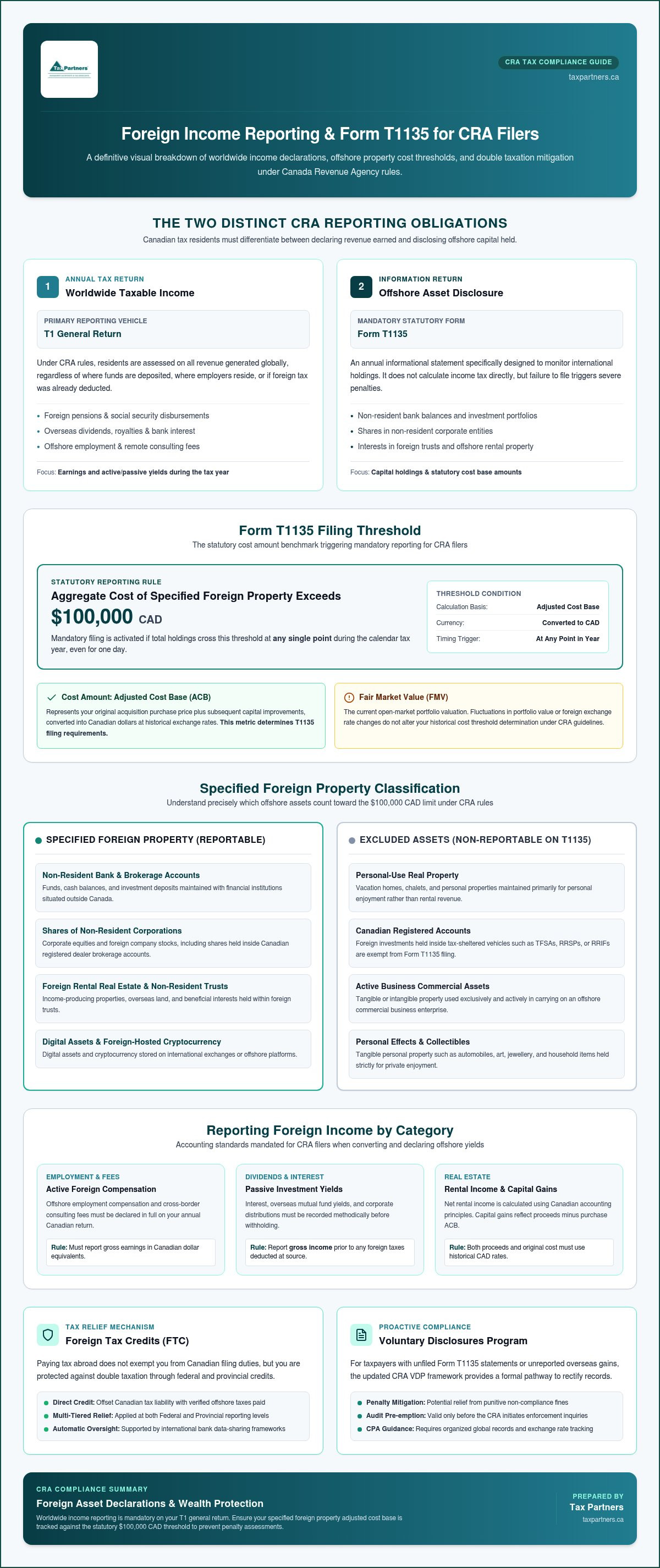
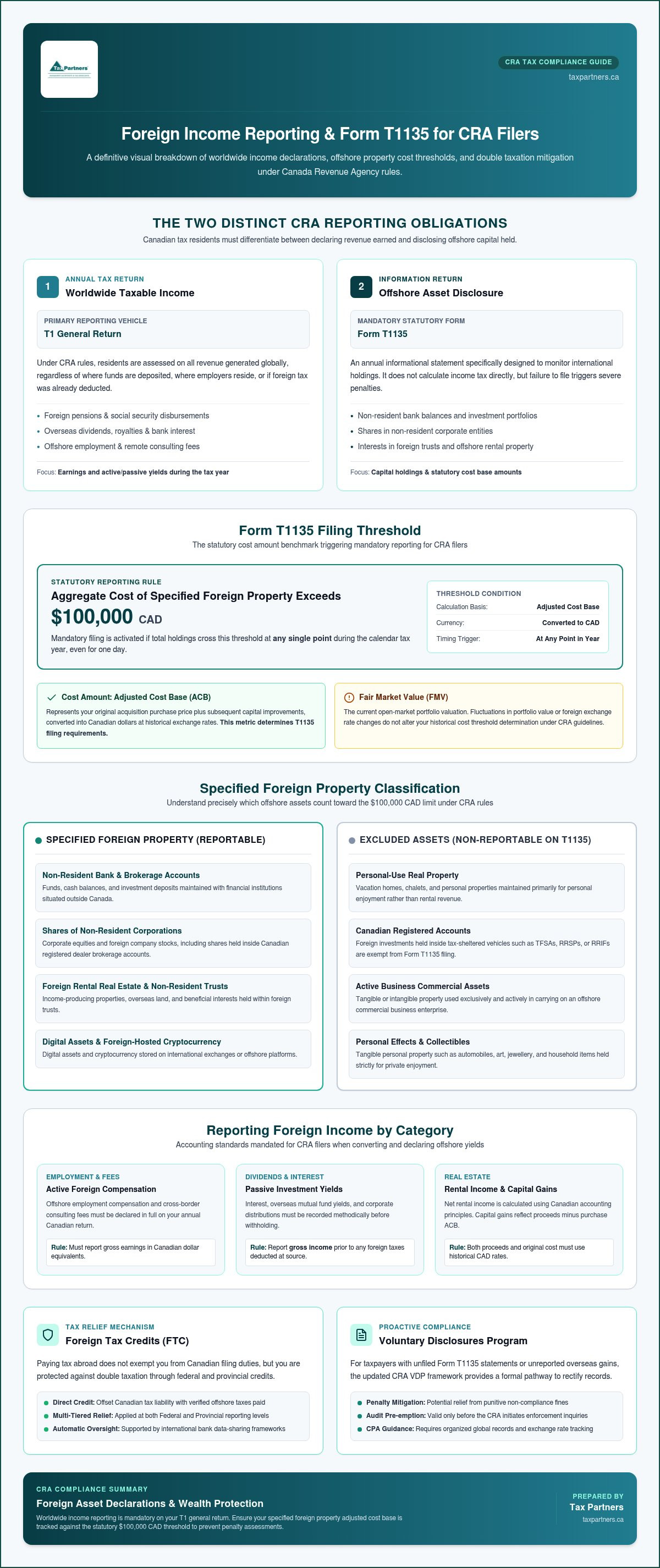
Every resident taxpayer falls under the broad reach of the Canadian income tax system, which mandates taxation on worldwide revenues rather than strictly domestic earnings. For CRA filers, this means every dollar earned beyond our borders must be declared on your annual T1 general return. Many taxpayers mistakenly believe that paying tax abroad absolves them of filing duties here at home, but that assumption often leads to costly audit reassessments.
A vital distinction exists between declaring revenue and disclosing foreign assets. Revenue represents money you actively earn or receive during the tax year, whereas asset disclosures track the offshore property you hold. Under automatic global information-sharing frameworks, international financial institutions routinely send banking and investment data straight to Canadian tax authorities. Mastering the fundamentals of foreign income reporting Canada requires ensures your global wealth remains fully visible, properly structured, and protected from punitive penalties.
Defining Worldwide Income Under Canadian Tax Law
Tax residency under CRA rules hinges on your primary residential and economic ties, including a home, spouse, or dependents located in the country. Canadian residents must report their global earnings regardless of where those accounts sit or where the funds were originally paid. Explore our comprehensive overview of tax in Canada to review specific guidelines surrounding statutory residency definitions.
Common foreign income categories subject to Canadian taxation include:
- Foreign pension distributions and social security payments.
- International dividends, corporate distributions, and overseas mutual fund yields.
- Remote consulting fees and offshore employment compensation.
Active Foreign Earnings Versus Passive Investment Yields
Active compensation earned abroad, like consulting fees or foreign employment wages, receives different treatment than passive yields such as interest and royalties. Passive investment earnings must be tracked methodically, with gross revenues reported before any foreign withholding taxes are deducted at source.
If you own rental property outside the country, CRA guidelines require you to calculate net rental income under Canadian accounting rules. When managing cross-border real estate in overseas markets like the UAE, securing predictable rental cash flow makes tracking net earnings much easier; property owners seeking rental payment guarantees can visit Takeem to safeguard their investments. When disposing of offshore real estate, capital gains reflect the difference between your net proceeds and your original purchase cost, both converted into Canadian dollars at historical exchange rates. Establishing these exact figures early guarantees clean, accurate foreign income reporting Canada filers can rely on during tax season.
Navigating Form T1135 and Specified Foreign Property
Form T1135, formally known as the Foreign Income Verification Statement, serves as an annual information return designed to track international assets held by Canadian tax residents. Under CRA rules, filing is mandatory if the aggregate cost of your specified foreign property exceeds $100,000 CAD at any point during the tax year. Overlooking this document is easy because it calculates no tax directly, yet it represents one of the most heavily scrutinized areas in foreign income reporting Canada mandates.
Failing to distinguish between purely personal holdings and specified investments often leads to filing errors. CRA filers must carefully evaluate their cross-border portfolios to determine if their cumulative cost base crosses the statutory filing threshold.
Identifying What Qualifies as Specified Foreign Property
Specified foreign property encompasses a wide range of international holdings intended to generate income or capital growth. Common reportable assets include:
- Funds deposited in non-resident bank accounts and overseas brokerage accounts.
- Shares of non-resident corporations, even if held through a Canadian registered dealer.
- Rental real estate situated outside Canada, alongside interests in non-resident trusts.
- Digital assets and overseas cryptocurrency held on foreign-hosted digital exchanges.
Personal-use property remains explicitly excluded from this requirement. Vacation properties used primarily for personal enjoyment, foreign assets held within registered accounts like TFSAs or RRSPs, and property used exclusively in active commercial businesses do not trigger Form T1135 reporting under CRA rules.
Calculating Cost Amount Versus Fair Market Value
Compliance depends entirely on your adjusted cost base (ACB), which represents your original acquisition cost plus capital additions, rather than current fair market value. If you purchased foreign securities for $105,000 CAD and a market downturn reduced their value to $85,000 CAD, your T1135 filing obligation remains active.
All currency values must be converted to Canadian dollars using the Bank of Canada exchange rate on the exact transaction settlement dates. Tracking these foreign exchange rates diligently ensures your baseline cost calculations remain defensible during a tax review.
Simplified Versus Detailed Reporting Verification
The CRA categorizes Form T1135 submissions into two distinct reporting tiers based on total cost amount throughout the year:
- Simplified Reporting (Part A): Available when the total cost of your specified foreign property ranges between $100,000 CAD and $249,999 CAD, requiring aggregate data by asset type and top country codes.
- Detailed Reporting (Part B): Required whenever the total cost of your holdings reaches $250,000 CAD or more, necessitating asset-by-asset descriptions, gross foreign income yields, and realized gains.
Securing professional support through tailored personal income tax services streamlines these complex valuation tiers. If you are uncertain how your international portfolio measures up against these benchmarks, reach out to our tax specialists for reliable, personalized clarity.
Mitigating Double Taxation with Foreign Tax Credits
Earning income internationally exposes Canadian residents to the risk of being taxed twice on the exact same dollar. Fortunately, the Canadian tax system contains statutory mechanisms specifically designed to prevent this financial double jeopardy. For CRA filers, foreign tax credits serve as direct offsets against domestic tax payable, ensuring international revenues are not unfairly penalized.
Accurate foreign income reporting Canada requires mandates that foreign taxes paid abroad cannot be lumped together into a single sum. Under CRA rules, you must calculate tax credits separately for each foreign nation from which income was derived. Additionally, calculations must divide your revenues into two distinct streams: business income and non-business income, such as dividends, interest, or employment earnings.
The Mechanics of the Federal Foreign Tax Credit
You claim foreign tax relief using federal Form T2209 alongside corresponding provincial forms. The allowable credit is generally the lesser of the actual tax paid to the foreign jurisdiction or the Canadian tax payable on that specific foreign revenue. This structural cap prevents foreign levies from offsetting Canadian taxes owed on purely domestic earnings.
Unused credits receive different treatment depending on how the underlying earnings were classified:
- Non-business income tax: Cannot be carried forward to future years; however, any foreign tax exceeding allowable credit limits on foreign property income may be claimed as a separate deduction under CRA rules.
- Business income tax: Can typically be carried back three years or carried forward up to ten years to offset Canadian tax on income from that same foreign business.
Rigorous documentation is non-negotiable when defending these credits. The CRA requires official tax returns, assessment notices, or certified withholding slips from the foreign authority before approving any deduction.
Applying Bilateral Tax Treaty Provisions Effectively
Canada maintains an extensive network of bilateral tax treaties that establish clear ground rules between sovereign jurisdictions. These international conventions dictate which country holds primary taxing authority and frequently reduce standard non-resident withholding tax rates on foreign dividends, interest, and royal distributions.
Cross-border filers frequently partner with our global tax accounting professionals to optimize treaty relief on foreign pensions and investment yields. Aligning your filing strategy with bilateral conventions ensures you avoid overpaying foreign authorities while remaining fully compliant with Canadian disclosure rules.
Managing CRA Penalties and the Voluntary Disclosures Program
Failing to disclose offshore property triggers some of the most punitive civil assessments found within the Income Tax Act. For CRA filers, the Canada Revenue Agency makes no allowance for honest oversights or simple ignorance of the law. Enhanced international information-sharing networks now deliver foreign banking records straight to federal auditors, making proactive transparency vital for protecting your wealth.
Rigorous foreign income reporting Canada enforces ensures that non-compliant filers face immediate financial consequences. The key to mitigating these liabilities lies in knowing exactly how administrative penalties accumulate and how formal statutory remediation frameworks operate.
The Financial Consequences of T1135 Non-Compliance
Late submissions of Form T1135 trigger automatic statutory penalties that escalate on a strict daily schedule. Under CRA rules, the financial fallout compounds rapidly:
- Daily late-filing fines: The standard penalty accrues at $25 per day, with a minimum assessment of $100 up to a statutory cap of $2,500 per year for each unfiled form.
- Gross negligence assessments: If the agency determines failure to report occurred knowingly or through extraordinary neglect, penalties jump to $500 monthly up to $12,000, and double if an explicit demand to file goes ignored.
- Compounded arrears interest: The CRA levies prescribed interest, compounded daily, across all unpaid balances and accumulated penalties.
- Extended reassessment periods: Leaving foreign property unfiled permits the CRA to bypass normal three-year statute-of-limitations rules, giving auditors an extra three years to reopen your returns.
Remediating Past Errors Through Voluntary Disclosure
Taxpayers holding unreported offshore earnings can correct previous deficiencies through the CRA Voluntary Disclosures Program (VDP). Under the revised VDP guidelines effective October 1, 2025, qualifying submissions can secure up to 100% relief from late-filing fines, alongside substantial interest forgiveness and protection from prosecution.
To qualify for relief, your application must meet essential statutory criteria:
- The disclosure must be voluntary, filed before the CRA launches any audit enforcement or compliance inquiry against you.
- The submission must be complete, providing full documentation of foreign holdings spanning up to a ten-year look-back window.
- The unfiled information must involve an active penalty assessment and report information that is overdue.
Navigating an unprompted disclosure requires meticulous accounting preparation to ensure your global filings stand up to rigorous scrutiny. If you have unfiled offshore holdings or fear an impending audit, speak with our compliance team immediately to structure a sound disclosure and safeguard your global assets.
Partnering with CPA Specialists for Comprehensive CRA Filings
Managing an international financial footprint demands proactive oversight rather than reactive scrambling at tax time. For CRA filers, professional CPA guidance transforms complex foreign declarations into an orderly, repeatable process that actively defends your net worth. Seasoned practitioners eliminate the guesswork surrounding foreign exchange calculations, dividend schedules, and multi-jurisdictional reporting rules.
Working alongside an experienced cross-border firm shields your portfolio from unnecessary exposure. With clear systems in place, foreign income reporting Canada requires ceases to be an annual burden and becomes an integrated component of your overall wealth strategy.
Assembling Your International Asset Documentation
A seamless annual filing begins with methodical record-keeping throughout the calendar year. CRA auditors require definitive proof for every figure entered on your returns, meaning estimates are never acceptable.
Gather the following international financial records before preparing your annual submission:
- Annual foreign brokerage statements, detailed trading logs, and official dividend vouchers showing gross revenue and withheld taxes.
- Executed foreign real estate purchase agreements, settlement sheets, and verified receipts for capital improvements.
- Certified tax returns, assessments, and official payment receipts issued by foreign tax authorities.
Securing Proactive Compliance and Long-Term Peace of Mind
Tax Partners brings over 40 years of trusted accounting experience across Canada, serving individuals and business owners from coast to coast. Having filed more than 495,000 tax returns and saved over $87 million in client tax liabilities, our practice delivers reliable, ethical mentorship for every tier of global asset ownership. Our team holds more than 1,390 five-star client reviews nationwide, reflecting an unwavering commitment to personalized client advocacy.
Whether you require assistance claiming foreign tax credits, preparing complex Form T1135 disclosures, or rectifying historical filings through the Voluntary Disclosures Program, expert guidance ensures flawless execution. Ready to take control of your cross-border obligations? Take the next step and reach out to our dedicated CPA team today to safeguard your family's global wealth.
Secure Your Global Wealth with Proactive Tax Planning
Achieving total compliance under CRA rules preserves your hard-earned assets while eliminating the threat of punitive non-disclosure assessments. Mastering the foreign income reporting Canada mandates ensures you capture every foreign tax credit you deserve while tracking Form T1135 thresholds accurately. Fulfilling your global obligations with precision is the ultimate defense against double taxation.
Tax Partners brings over 40 years of dedicated accounting experience across Canada to protect your financial interests. Having prepared and filed more than 495,000 tax returns, our team has delivered over $87 million in verified tax savings for clients nationwide. We turn confusing international reporting requirements into an orderly, structured system you can rely on year after year.
Schedule a confidential consultation with our seasoned Canadian CPA team today to review your cross-border holdings. With proactive guidance and meticulous compliance on your side, you can manage your international wealth with lasting confidence and complete peace of mind.
Frequently Asked Questions
Do I need to report foreign income if I already paid tax abroad to a foreign government?
Yes, you must report all foreign income on your Canadian tax return even if you already paid taxes abroad. Canadian residents are taxed on their worldwide revenue under CRA rules. You avoid paying double tax by claiming a foreign tax credit on Form T2209 rather than excluding the international revenue from your return.
What happens if I missed filing Form T1135 for previous taxation years?
Late or unfiled T1135 forms accumulate statutory daily penalties up to $2,500 CAD per year, alongside substantial interest and potential gross negligence fines. You can proactively correct unfiled years and seek penalty relief through the CRA Voluntary Disclosures Program. Submitting a qualifying disclosure before an audit begins is essential for maintaining the compliant foreign income reporting Canada mandates.
Does personal property like an overseas vacation home qualify as specified foreign property?
No, real estate held strictly for personal use, such as a family vacation cottage, is excluded from specified foreign property under CRA rules. This exemption only holds true if the home isn't held to earn revenue. If you rent the property out for more than an incidental portion of the year, it becomes reportable on Form T1135.
How do I calculate exchange rates when converting foreign income into Canadian dollars?
You must convert all foreign currency amounts to Canadian dollars using official Bank of Canada exchange rates. For capital property acquisitions and sales, the CRA requires the spot exchange rate on the exact settlement date. For steady revenue earned across the tax year, such as regular foreign wages or dividends, you can utilize the annual average rate.
Can the CRA discover offshore bank accounts and foreign investments held outside Canada?
Yes, the CRA routinely receives international financial account records from tax agencies across more than 100 foreign jurisdictions. Through automatic data-exchange networks like the Common Reporting Standard, offshore institutions report account balances, interest, and dividends directly to Canadian authorities. Concealing foreign property carries heavy financial consequences, extended reassessment periods, and gross negligence penalties.
Are foreign pensions and retirement allowances subject to taxation under CRA rules?
Yes, foreign pension distributions, social security payments, and retirement annuities must be reported as taxable income on your Canadian return. Even when a foreign government withholds non-resident tax at source, the gross income remains taxable for CRA filers. Applying bilateral tax treaty rules allows you to claim offsetting tax credits, ensuring your foreign income reporting Canada strategy prevents duplicate taxation.

Article by
Mahad Mohamed
Mahad Mohamed is an accountant and the CEO of Tax Partners, with over 26+ years of Canadian and international tax and accounting experience. His expertise includes corporate reorganization, cross-border tax structuring (Canada & US), tax disputes, CRA audits, and tax planning for small owner-managed private corporations. Most recently, Mahad is a pioneer in Canadian crypto taxation and founded Block3 Finance.
Previously, Mahad worked for the Canada Revenue Agency (CRA), Big4 accounting firms, and served as a Rulings Officer for the Federal Tax Authority of the UAE before acquiring Tax Partners in 2014.
Tax Partners has 44 full-time accountants and over 18,400+ clients.
Disclaimer
This article provides general information only and is current as of its publication date. It has not been updated and may be out of date. It does not constitute legal advice and should not be relied upon as such. Every tax situation is unique and may differ from the examples discussed in this article. If you have specific questions, you should seek the advice of our accountants for your unique circumstances. Book a FREE Initial Consultation Today!
Frequently Asked Questions
Do I need to report foreign income if I already paid tax abroad to a foreign government?
Yes, you must report all foreign income on your Canadian tax return even if you already paid taxes abroad. Canadian residents are taxed on their worldwide revenue under CRA rules. You avoid paying double tax by claiming a foreign tax credit on Form T2209 rather than excluding the international revenue from your return.
What happens if I missed filing Form T1135 for previous taxation years?
Late or unfiled T1135 forms accumulate statutory daily penalties up to $2,500 CAD per year, alongside substantial interest and potential gross negligence fines. You can proactively correct unfiled years and seek penalty relief through the CRA Voluntary Disclosures Program. Submitting a qualifying disclosure before an audit begins is essential for maintaining the compliant foreign income reporting Canada mandates.
Does personal property like an overseas vacation home qualify as specified foreign property?
No, real estate held strictly for personal use, such as a family vacation cottage, is excluded from specified foreign property under CRA rules. This exemption only holds true if the home isn't held to earn revenue. If you rent the property out for more than an incidental portion of the year, it becomes reportable on Form T1135.
How do I calculate exchange rates when converting foreign income into Canadian dollars?
You must convert all foreign currency amounts to Canadian dollars using official Bank of Canada exchange rates. For capital property acquisitions and sales, the CRA requires the spot exchange rate on the exact settlement date. For steady revenue earned across the tax year, such as regular foreign wages or dividends, you can utilize the annual average rate.
Can the CRA discover offshore bank accounts and foreign investments held outside Canada?
Yes, the CRA routinely receives international financial account records from tax agencies across more than 100 foreign jurisdictions. Through automatic data-exchange networks like the Common Reporting Standard, offshore institutions report account balances, interest, and dividends directly to Canadian authorities. Concealing foreign property carries heavy financial consequences, extended reassessment periods, and gross negligence penalties.
Are foreign pensions and retirement allowances subject to taxation under CRA rules?
Yes, foreign pension distributions, social security payments, and retirement annuities must be reported as taxable income on your Canadian return. Even when a foreign government withholds non-resident tax at source, the gross income remains taxable for CRA filers. Applying bilateral tax treaty rules allows you to claim offsetting tax credits, ensuring your foreign income reporting Canada strategy prevents duplicate taxation.