T1 Personal Tax Return Ontario: 2026 Guide for CRA Filers

We understand that the fear of a CRA audit or confusion over provincial credits can make tax season feel overwhelming. You deserve the peace of mind that comes from expert oversight and a proactive approach to your financial obligations.
This 2026 guide provides the clarity you need to navigate Form ON428, report complex digital assets, and optimize your return for maximum savings. We will walk you through essential income categories and the strategic advantages of professional CPA support.
Our journey moves from foundational filing requirements to advanced strategies for minimizing your tax liability. By the end of this guide, you will have a clear roadmap for achieving total control over your financial outcome.
Key Takeaways
- Understand how the T1 Income Tax and Benefit Return functions as your primary document for reporting worldwide income to the CRA.
- Learn to navigate Form ON428 to maximize Ontario-specific credits and distinguish between refundable and non-refundable tax benefits.
- Discover the strategic advantages of professional oversight for your T1 personal tax return Ontario, particularly when managing complex assets like cryptocurrency.
- Identify key income categories and deduction opportunities that ensure full CRA compliance while minimizing your overall tax liability.
- See how integrating wealth management with professional tax services provides a proactive shield against audits and secures your financial future.
Understanding the T1 Personal Tax Return for CRA Filers
The T1 General tax return serves as the primary document for individuals to report their annual income to the Canada Revenue Agency (CRA). For residents of our province, the T1 personal tax return Ontario is a multi-faceted form that captures both federal and provincial tax obligations in a single submission. This unified approach simplifies the process, but it requires precise attention to detail to ensure you meet the standards of both jurisdictions.
CRA filers must report their worldwide income from all sources, regardless of where the money was earned. This includes employment earnings, investment dividends, and profits from digital assets. Beyond mere compliance, your T1 return acts as a critical gateway to essential government benefits. Without a filed return, the CRA cannot determine your eligibility for various credits or social programs designed to support Ontario families.
What is a T1 Personal Tax Return?
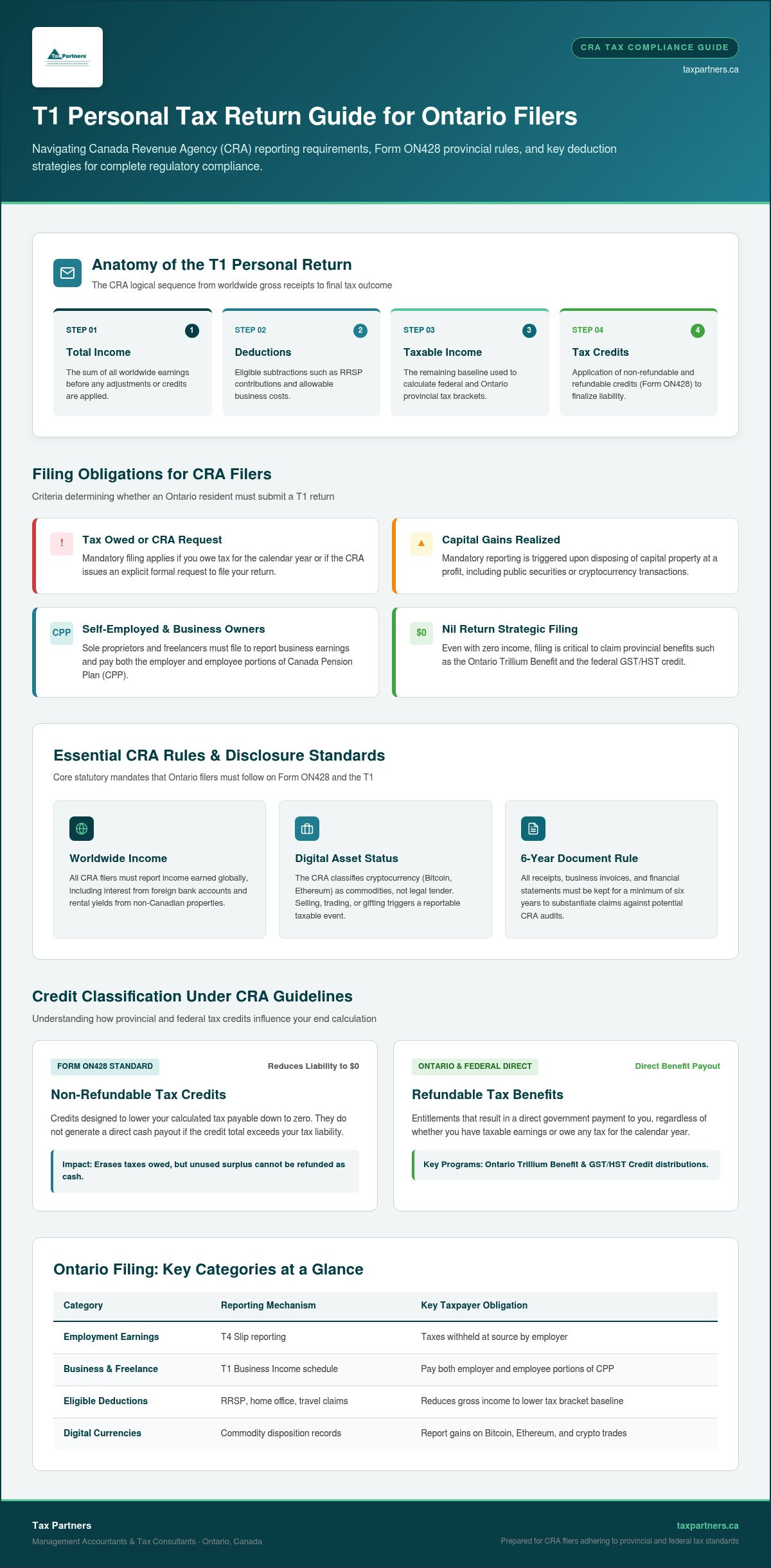
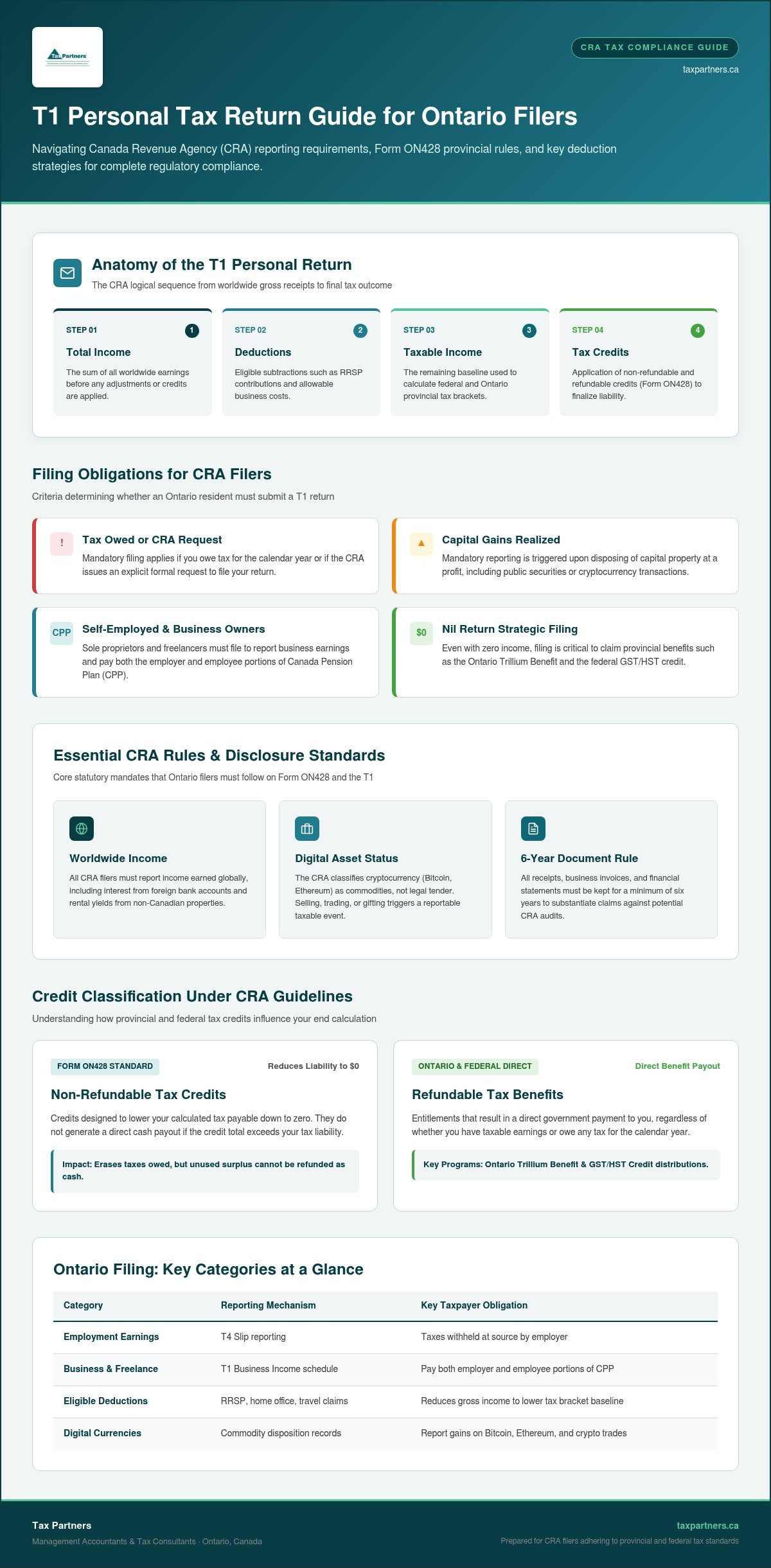
A T1 return is a summary of your financial life over a specific calendar year, running from January 1 to December 31. For every CRA filer, which is any individual required to report income or benefits to the federal tax authority, this document is the foundation of their regulatory standing. It follows a logical flow that begins with total income and moves through deductions to arrive at your taxable income.
From there, you apply non-refundable credits, which are credits that reduce the amount of tax you owe to zero but do not result in a payment to you if they exceed your tax bill. Our team at Tax Partners focuses on providing a bespoke approach to personal income tax preparation. We look beyond the surface of the forms to identify opportunities for optimization and long-term stability.
Who is Required to File in Ontario?
Most residents must file a T1 personal tax return Ontario if they owe tax for the year or if the CRA has sent them a formal request to file. You are also required to submit a return if you realized a capital gain, which is the profit made from selling an asset like stocks or cryptocurrency. Self-employed individuals and business owners must also file to report their professional activities and pay Canada Pension Plan (CPP) contributions.
Even if you had no income in 2026, filing remains a strategic move. A nil return allows you to claim provincial credits such as the Ontario Trillium Benefit or the GST/HST credit. This proactive step ensures you don't leave money on the table while maintaining a clean record with the CRA. Accuracy matters for your peace of mind.
Key Income and Deduction Categories for Ontario Residents
Accuracy begins with a clear view of your financial landscape. For your T1 personal tax return Ontario, you must report all sources of income, whether they originated within our borders or abroad. The CRA requires filers to disclose worldwide earnings, including interest from foreign bank accounts or rental income from properties outside Canada. This transparency is a fundamental requirement under CRA personal income tax guidelines.
Understanding the distinction between your total income and your taxable income is vital for strategic planning. Total income represents the sum of every dollar you earned before any adjustments. Taxable income is the figure remaining after you apply specific deductions, such as Registered Retirement Savings Plan (RRSP) contributions or professional expenses. This final amount determines your specific tax bracket and overall liability for the year.
Precision in your documentation is your best shield against regulatory scrutiny. You must keep receipts, invoices, and financial statements for at least six years to support every claim made on your return. Missing records can lead to disallowed deductions and unnecessary stress during a CRA review. Maintaining an organized digital archive ensures you're always prepared to defend your filings.
Reporting Employment and Business Income
Most workers receive a T4 slip for employment earnings, where taxes are withheld at the source by their employer. If you are a consultant, freelancer, or sole proprietor, you must report professional fees and commissions as business income. This requires a more detailed approach on your T1 personal tax return Ontario, as you're responsible for calculating and paying both the employer and employee portions of Canada Pension Plan (CPP) contributions.
Business owners in Ontario have unique provincial obligations that require careful tracking of eligible expenses. You can deduct costs directly related to earning income, such as home office expenses or travel. We help you navigate these nuances to ensure you're only paying what's legally required while maximizing your net profit.
Navigating Cryptocurrency and Digital Assets
The CRA treats digital assets like Bitcoin or Ethereum as commodities, not legal tender. When you sell, trade, or gift these assets, you trigger a taxable event that must be reported. If you invest casually, these profits are usually treated as capital gains, which refers to the profit realized from the sale of an investment. Currently, only 50% of a capital gain is included in your taxable income.
Frequent trading, mining, or staking may be classified as business income, where 100% of the profit is taxable. Tracking these transactions in Canadian dollars (CAD) at the exact time of the trade is a complex task. If you find these requirements overwhelming, our cryptocurrency accounting tax services provide the precision needed for full compliance. Securing your financial standing requires a proactive approach to these emerging sectors, so feel free to reach out to our senior advisors for a detailed review of your portfolio.
Comparing Professional Tax Preparation and DIY Software
Many taxpayers are tempted by the low upfront cost of DIY software for their T1 personal tax return Ontario. While these platforms are efficient for simple, single-source income scenarios, they often function as basic data-entry tools rather than strategic advisors. They don't understand the context of your financial life or the specific goals you've set for your family's future.
The true cost of tax preparation isn't the fee you pay; it's the potential for missed deductions and unoptimized credits. Software lacks the human intuition to ask the right questions about your lifestyle, family changes, or long-term investments. Choosing professional oversight ensures your filing moves from a compliance chore to a strategic advantage.
Our team provides year-round guidance, helping you make financial decisions in July that will benefit your return the following April. This proactive approach is something an automated algorithm simply cannot replicate. You gain a partner who is invested in your success, rather than just a digital interface for your data.
Why Software Often Misses Strategic Opportunities
DIY platforms follow rigid algorithms that might not interpret nuanced CRA Ontario tax and credits instructions correctly for your specific situation. These tools are designed for mass use, which means they often overlook the creative combination of provincial credits that a seasoned professional would spot instantly. A software mistake can lead to an assessment that costs you far more than a professional fee.
Additionally, automated systems cannot advocate for you if the CRA requests more information. If you face a CRA audit, software leaves you to navigate the complex regulatory process alone. Having a steady hand at the helm during these moments provides invaluable peace of mind.
The Value of a CPA for Complex Returns
For high-net-worth individuals or those with diverse asset classes, a CPA acts as a proactive guardian. We don't just react to the numbers you provide; we look ahead to secure a better outcome through estate planning and wealth management. This forward-thinking outlook ensures your T1 personal tax return Ontario is part of a larger, cohesive financial strategy.
At Tax Partners, we bring 40 years of institutional wisdom to every return we file. We've filed over 495,000 returns and saved our clients more than $87M through meticulous, bespoke planning. This depth of experience allows us to identify subtle patterns and opportunities that generic software isn't programmed to recognize.
Maximizing Ontario-Specific Tax Credits and Benefits
Completing your T1 personal tax return Ontario involves more than just reporting your annual earnings. You must also navigate Form ON428, which is the specific schedule used to calculate your provincial tax and credits under CRA rules. This form allows you to apply various offsets that directly reduce the amount you owe to the Ontario government.
Understanding the difference between credit types is essential for your financial planning. Non-refundable credits can reduce your provincial tax bill to zero, but they won't provide a refund for any excess amount. In contrast, refundable credits are paid out to you even if you have no tax to pay, acting as a direct financial benefit.
Provincial credits interact closely with federal tax obligations to determine your final balance or refund. Because eligibility rules and income thresholds can change, we encourage you to confirm current details directly with the CRA or the Ontario Ministry of Finance. Our team stays ahead of these adjustments to ensure your filing is always optimized for the current year.
Ontario Provincial Credits for Individuals
The Ontario Trillium Benefit remains a cornerstone for many CRA filers in our province. This refundable credit combines payments for energy costs, sales tax, and property tax into a single monthly or annual amount. It is designed to help low-to-middle income residents manage the rising cost of living in Ontario; those needing more immediate support may also choose to explore Payday Loans for short-term liquidity.
Strategic deductions are the most effective way to lower the base income that both the federal and provincial governments tax. Contributing to a Registered Retirement Savings Plan (RRSP) is a primary strategy under CRA rules. Every dollar you contribute reduces your taxable income, which can potentially move you into a lower tax bracket and increase your refund.
Medical expenses also offer a path to tax relief, provided they exceed the specific thresholds set by the CRA for the 2026 tax year. These thresholds are typically calculated as 3% of your net income or a set dollar amount, whichever is lower. To ensure you don't miss these opportunities, we advise maintaining a comprehensive checklist of all medical and professional receipts throughout the year.
Managing these overlapping provincial and federal rules requires precision and foresight to secure the best possible outcome. If you want to ensure you are capturing every possible benefit on your return, book a consultation with our tax specialists today to review your eligibility.
Strategic Tax Planning and Filing with Tax Partners
Tax Partners stands as your dedicated ally in an environment where regulatory shifts are constant. We move beyond the traditional once-a-year filing mindset to provide a continuous loop of financial oversight. By choosing our firm, your T1 personal tax return Ontario becomes a reflection of a carefully managed financial life rather than a source of seasonal stress.
Our end-to-end support covers every facet of your tax journey. We handle everything from the initial bookkeeping to the final submission to the CRA, ensuring no detail is overlooked. This comprehensive service allows you to focus on your professional and personal life while we manage the complexities of compliance.
We integrate Wealth Management & Financial Planning directly into the tax preparation process. This ensures that every deduction claimed today aligns with your long-term goals for wealth preservation and growth. You aren't just filing a return; you're executing a strategy.
The Tax Partners Approach: Precision and Foresight
Our firm is built on a foundation of ethical steadfastness and absolute transparency. We believe that individual tax return preparation should be a bespoke experience tailored to your unique circumstances. We don't use generic templates because your financial situation is one of a kind.
The ultimate goal is simple: keep more of what you earn through rigorous legal optimization. We analyze your worldwide income and assets to identify every available path for tax efficiency under CRA rules. This proactive guardian mindset ensures you are always positioned for the best possible outcome.
Preparing Your Documentation for Filing
A successful filing begins with meticulous organization. To ensure your T1 personal tax return Ontario is filed accurately, you should gather all relevant documentation well in advance of the deadline. This includes:
- T-slips, such as T4s for employment and T5s for investment income.
- Receipts for medical expenses and charitable donations.
- Records for cryptocurrency transactions, including acquisition costs and trade dates.
- Documentation for professional or business expenses.
Timely submission is critical to avoid CRA late-filing penalties, which can quickly erode your savings. For CRA filers, missing the standard April 30 deadline triggers a 5% penalty on the balance owing, plus an additional 1% for each full month the return is late. We manage these timelines on your behalf to protect your financial standing.
Taking control of your financial future starts with a single conversation. If you are ready for a higher standard of care, visit our contact page to schedule a personalized consultation. Let us provide the steady hand you need to navigate the 2026 tax year with total confidence.
Secure Your Financial Future Today
Navigating your T1 personal tax return Ontario doesn't have to be a source of annual anxiety. By understanding the dual nature of federal and provincial credits, you can transform a mandatory requirement into a strategic opportunity for wealth preservation. Precision in reporting worldwide income and digital assets ensures you remain fully compliant while minimizing your overall liability.
Our firm has filed over 495,000 returns since 1981 and saved our clients more than $87M in taxes. With 1,390+ five-star Google reviews, our reputation as a proactive guardian for CRA filers is built on decades of institutional wisdom and personalized care. We prioritize transparency and ethical steadfastness in every bespoke tax plan we create for our clients.
Don't leave your compliance to chance or unoptimized software. Secure your financial future with expert T1 tax preparation from Tax Partners and experience the peace of mind that comes from professional partnership. We look forward to helping you achieve total control over your tax outcomes and securing a better financial path forward.
Frequently Asked Questions
What is the deadline for filing a T1 personal tax return in Ontario?
Under CRA rules, the standard deadline to file a T1 personal tax return Ontario is April 30. Self-employed individuals have an extended filing deadline of June 15, but their tax payments remain due by April 30. Filing on time is essential for CRA filers to avoid a 5% late-filing penalty on any outstanding balance.
How do I report cryptocurrency gains or losses on my T1 return?
For CRA filers, cryptocurrency is classified as a commodity rather than legal currency. Casual investors report profits as capital gains on Schedule 3, where only 50% is included in taxable income. However, active trading or mining is treated as business income under CRA rules, requiring 100% inclusion on Form T2125.
What is the difference between a tax deduction and a tax credit under CRA rules?
A tax deduction reduces your taxable income, which is the amount of earnings subject to tax under CRA rules. Conversely, a tax credit directly reduces the amount of tax you owe to the government. Non-refundable credits can lower your bill to zero, while refundable credits are paid out even if no tax is owed.
Can I file my Ontario T1 return if I have income from the United States?
Yes, you must report worldwide income, including earnings from the United States, as part of your T1 personal tax return Ontario. Under CRA rules, you can typically claim a Foreign Tax Credit to prevent being taxed twice on the same income. This ensures you remain compliant with Canadian regulations while protecting your global assets.
What happens if I make a mistake on my T1 return after filing with the CRA?
If you discover an error after filing, do not submit a second return to the CRA. Instead, wait for your Notice of Assessment and then request an adjustment using the "Change my Return" service or Form T1-ADJ. This process allows CRA filers to correct mistakes while maintaining the integrity of their financial records.
Do I need to file a T1 return if I have no income to report for the year?
Filing a nil return is highly beneficial for CRA filers who had no income during the year. Submitting your return ensures you remain eligible for the GST/HST credit and provincial benefits like the Ontario Trillium Benefit. Under CRA rules, it also allows you to carry forward specific amounts, such as tuition credits, for future use.
How long should I keep my tax receipts and records in Ontario?
Under CRA rules, you must retain your tax receipts and supporting documentation for a minimum of six years. This requirement applies to all CRA filers and covers T-slips, business expense invoices, and cryptocurrency transaction records. Maintaining these files provides the necessary evidence if your return is selected for a formal review.
What is the Ontario Trillium Benefit and how do I apply for it?
The Ontario Trillium Benefit (OTB) is a refundable credit for CRA filers that combines energy, sales, and property tax relief. You apply for this benefit by submitting Form ON-BEN along with your annual tax return. Under CRA rules, these payments are distributed monthly to help eligible residents manage the rising cost of living.

Article by
Mahad Mohamed
Mahad Mohamed is an accountant and the CEO of Tax Partners, with over 26+ years of Canadian and international tax and accounting experience. His expertise includes corporate reorganization, cross-border tax structuring (Canada & US), tax disputes, CRA audits, and tax planning for small owner-managed private corporations. Most recently, Mahad is a pioneer in Canadian crypto taxation and founded Block3 Finance.
Previously, Mahad worked for the Canada Revenue Agency (CRA), Big4 accounting firms, and served as a Rulings Officer for the Federal Tax Authority of the UAE before acquiring Tax Partners in 2014.
Tax Partners has 44 full-time accountants and over 18,400+ clients.
Disclaimer
This article provides general information only and is current as of its publication date. It has not been updated and may be out of date. It does not constitute legal advice and should not be relied upon as such. Every tax situation is unique and may differ from the examples discussed in this article. If you have specific questions, you should seek the advice of our accountants for your unique circumstances. Book a FREE Initial Consultation Today!
Frequently Asked Questions
What is a T1 Personal Tax Return?
A T1 return is a summary of your financial life over a specific calendar year, running from January 1 to December 31. For every CRA filer, which is any individual required to report income or benefits to the federal tax authority, this document is the foundation of their regulatory standing. It follows a logical flow that begins with total income and moves through deductions to arrive at your taxable income. From there, you apply non-refundable credits, which are credits that reduce the amount of tax you owe to zero but do not result in a payment to you if they exceed your tax bill. Our team at Tax Partners focuses on providing a bespoke approach to personal income tax preparation. We look beyond the surface of the forms to identify opportunities for optimization and long-term stability.
Who is Required to File in Ontario?
Most residents must file a T1 personal tax return Ontario if they owe tax for the year or if the CRA has sent them a formal request to file. You are also required to submit a return if you realized a capital gain, which is the profit made from selling an asset like stocks or cryptocurrency. Self-employed individuals and business owners must also file to report their professional activities and pay Canada Pension Plan (CPP) contributions. Even if you had no income in 2026, filing remains a strategic move. A nil return allows you to claim provincial credits such as the Ontario Trillium Benefit or the GST/HST credit. This proactive step ensures you don't leave money on the table while maintaining a clean record with the CRA. Accuracy matters for your peace of mind. Accuracy begins with a clear view of your financial landscape. For your T1 personal tax return Ontario, you must report all sources of income, whether they originated within our borders or abroad. The CRA requires filers to disclose worldwide earnings, including interest from foreign bank accounts or rental income from properties outside Canada. This transparency is a fundamental requirement under CRA personal income tax guidelines. Understanding the distinction between your total income and your taxable income is vital for strategic planning. Total income represents the sum of every dollar you earned before any adjustments. Taxable income is the figure remaining after you apply specific deductions, such as Registered Retirement Savings Plan (RRSP) contributions or professional expenses. This final amount determines your specific tax bracket and overall liability for the year. Precision in your documentation is your best shield against regulatory scrutiny. You must keep receipts, invoices, and financial statements for at least six years to support every claim made on your return. Missing records can lead to disallowed deductions and unnecessary stress during a CRA review. Maintaining an organized digital archive ensures you're always prepared to defend your filings.
What is the deadline for filing a T1 personal tax return in Ontario?
Under CRA rules, the standard deadline to file a T1 personal tax return Ontario is April 30. Self-employed individuals have an extended filing deadline of June 15, but their tax payments remain due by April 30. Filing on time is essential for CRA filers to avoid a 5% late-filing penalty on any outstanding balance.
How do I report cryptocurrency gains or losses on my T1 return?
For CRA filers, cryptocurrency is classified as a commodity rather than legal currency. Casual investors report profits as capital gains on Schedule 3, where only 50% is included in taxable income. However, active trading or mining is treated as business income under CRA rules, requiring 100% inclusion on Form T2125.
What is the difference between a tax deduction and a tax credit under CRA rules?
A tax deduction reduces your taxable income, which is the amount of earnings subject to tax under CRA rules. Conversely, a tax credit directly reduces the amount of tax you owe to the government. Non-refundable credits can lower your bill to zero, while refundable credits are paid out even if no tax is owed.
Can I file my Ontario T1 return if I have income from the United States?
Yes, you must report worldwide income, including earnings from the United States, as part of your T1 personal tax return Ontario. Under CRA rules, you can typically claim a Foreign Tax Credit to prevent being taxed twice on the same income. This ensures you remain compliant with Canadian regulations while protecting your global assets.
What happens if I make a mistake on my T1 return after filing with the CRA?
If you discover an error after filing, do not submit a second return to the CRA. Instead, wait for your Notice of Assessment and then request an adjustment using the "Change my Return" service or Form T1-ADJ. This process allows CRA filers to correct mistakes while maintaining the integrity of their financial records.
Do I need to file a T1 return if I have no income to report for the year?
Filing a nil return is highly beneficial for CRA filers who had no income during the year. Submitting your return ensures you remain eligible for the GST/HST credit and provincial benefits like the Ontario Trillium Benefit. Under CRA rules, it also allows you to carry forward specific amounts, such as tuition credits, for future use.
How long should I keep my tax receipts and records in Ontario?
Under CRA rules, you must retain your tax receipts and supporting documentation for a minimum of six years. This requirement applies to all CRA filers and covers T-slips, business expense invoices, and cryptocurrency transaction records. Maintaining these files provides the necessary evidence if your return is selected for a formal review.
What is the Ontario Trillium Benefit and how do I apply for it?
The Ontario Trillium Benefit (OTB) is a refundable credit for CRA filers that combines energy, sales, and property tax relief. You apply for this benefit by submitting Form ON-BEN along with your annual tax return. Under CRA rules, these payments are distributed monthly to help eligible residents manage the rising cost of living.