Maximizing the Canadian Dividend Tax Credit: A 2026 Guide

What if your dividend income was actually worth significantly more than the cash deposited into your brokerage account? While most investors focus on the yield, the real value lies in how the Canadian dividend tax credit reduces your personal tax liability to account for taxes already paid at the corporate level. It's a sophisticated integration system designed to prevent double taxation.
You aren't alone if you feel frustrated by the shifting definitions of eligible and non-eligible dividends. The anxiety of facing an unexpected tax bill can often overshadow the excitement of building a long-term portfolio. We're here to replace that stress with a sense of stability and professional clarity.
This guide will show you how to realize substantial tax savings by mastering the nuances of dividend taxation. We've organized this 2026 roadmap to help you calculate your true after-tax income and compare the efficiency of dividends against salary. Let's move from uncertainty toward total control.
Key Takeaways
- Understand the integration system, which is a mechanism designed to ensure your income is not taxed twice at both corporate and personal levels.
- Distinguish between eligible and non-eligible dividends based on whether the issuing corporation paid the general or small business tax rate.
- Master the calculation steps for the Canadian dividend tax credit to accurately forecast your after-tax cash flow for the 2026 filing season.
- Evaluate the tax efficiency of salary versus dividend payments to determine the most effective distribution strategy for your specific situation.
- Learn how professional oversight can help you organize your investment portfolio for maximum tax integration and long-term stability.
Navigating the Complexity of the Canadian Dividend Tax Credit
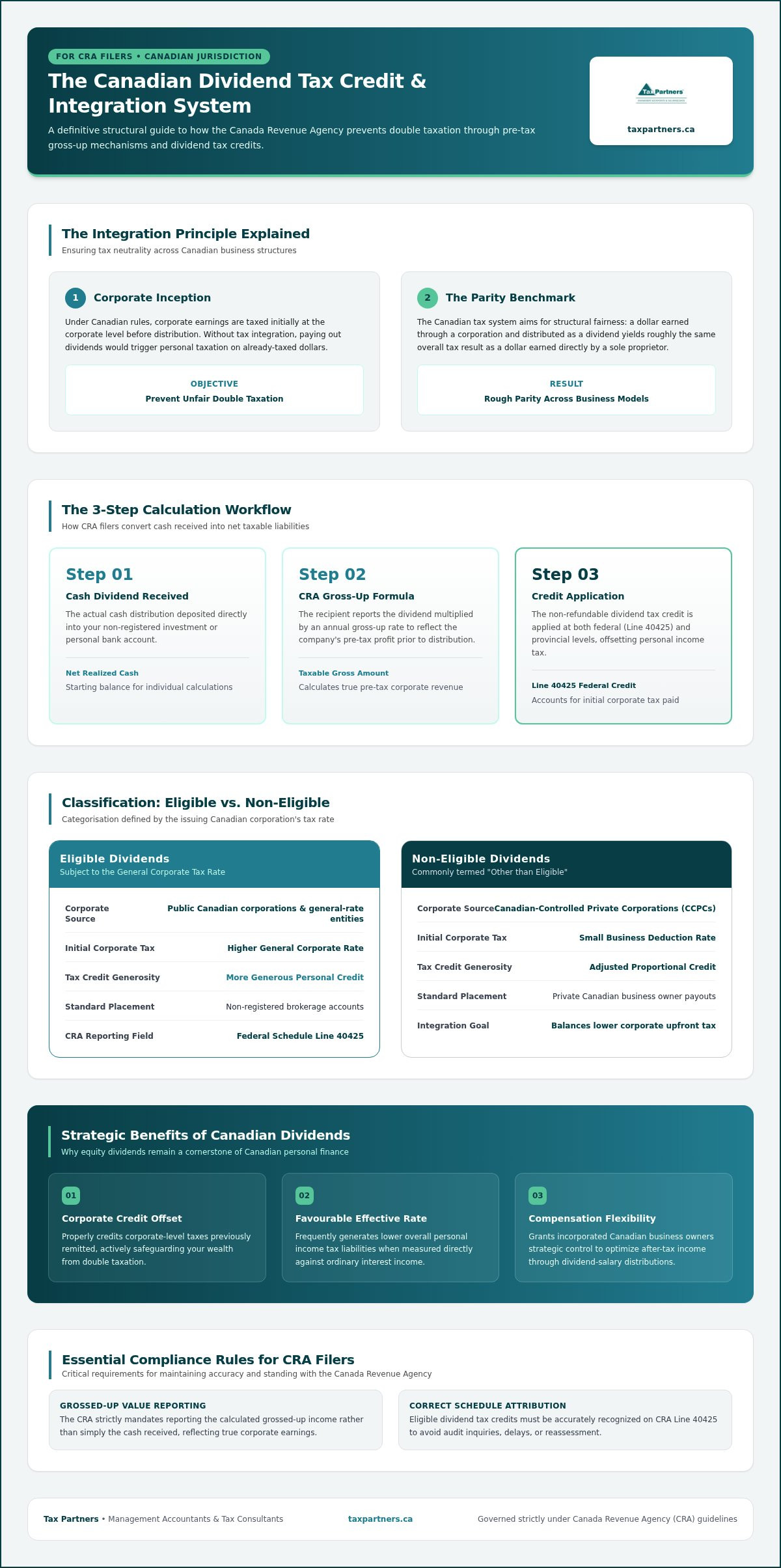
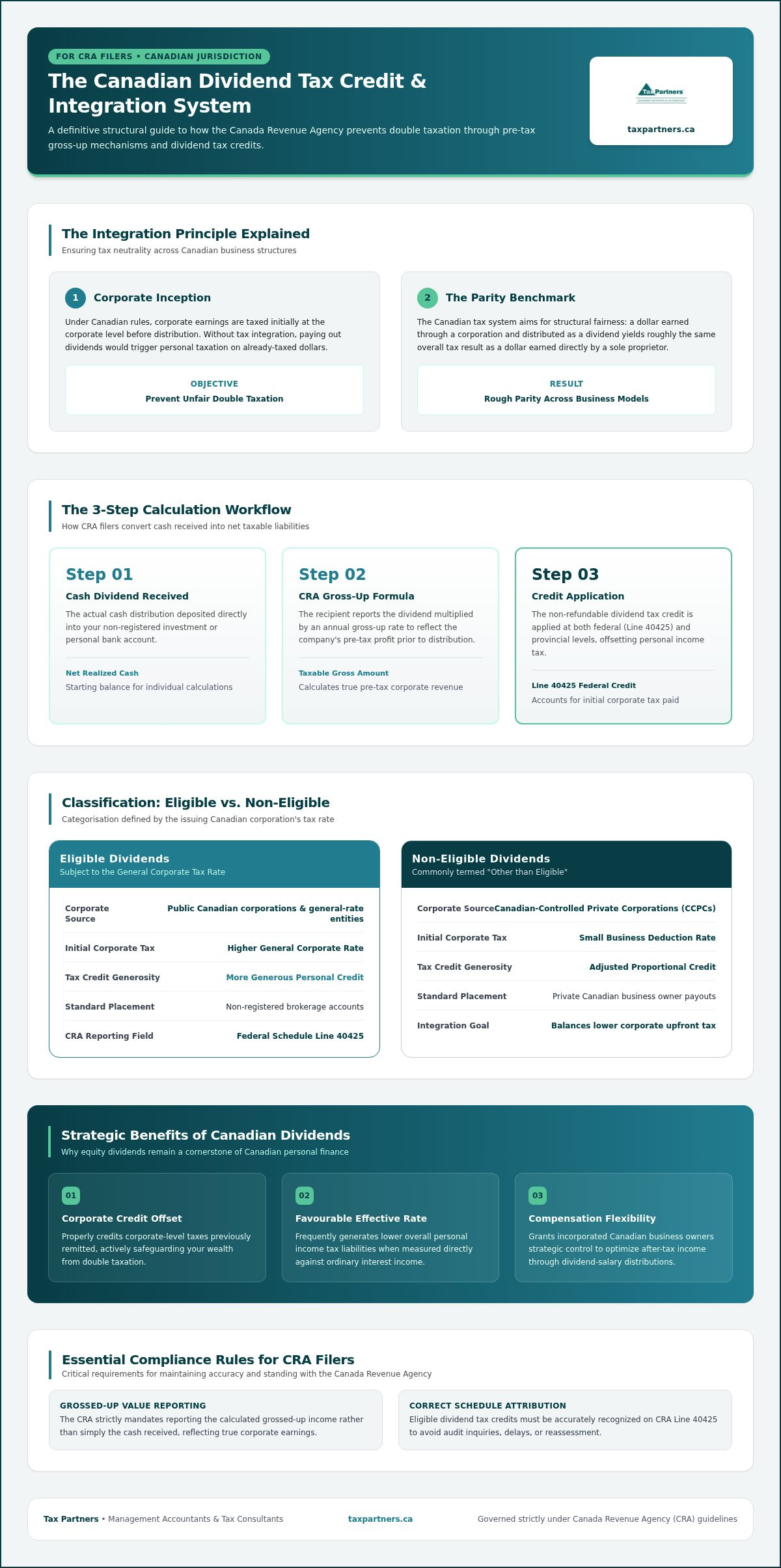
Dividends aren't like your typical T4 employment income. When you receive a dividend, you're receiving a share of profits that a corporation has already paid tax on. To avoid taxing that same dollar twice, the Canadian personal income tax system uses a mechanism known as integration. This ensures that a dollar earned through a corporation and then paid to you results in roughly the same total tax as a dollar earned directly as a sole proprietor.
The goal is simple: fairness across all business structures. Understanding this concept is the essential first step before you start plugging numbers into a Canadian dividend tax calculator. Integration provides a level of predictability that helps investors and business owners plan for their financial future with confidence. It transforms a complex regulatory requirement into a clear pathway for wealth preservation.
The Role of the Canada Revenue Agency in Dividend Oversight
The CRA acts as the primary guardian of these rules, setting specific gross-up and tax credit rates annually. These rates aren't arbitrary; they're carefully calibrated to reflect the corporate tax rates paid by the distributing company. Accuracy in your personal income tax filing is vital to maintaining your standing with the agency. The CRA requires you to report the "grossed-up" amount of the dividend, which represents the pre-tax profit the company earned before paying you. Failing to report these amounts accurately can lead to frustrating audits or unexpected reassessments of your returns.
Why Dividends Often Result in Lower Personal Tax
Many investors prefer dividends because they often lead to a lower personal tax bill compared to interest income or regular salary. This happens because of the non-refundable tax credit applied at both the federal and provincial levels. Since the corporation already settled its tax bill on those profits, the Canadian dividend tax credit offsets your personal tax to account for that previous payment. For many, this makes dividends a superior choice for building a tax-efficient stream of cash flow.
This system rewards your commitment to Canadian equity and helps you keep more of your earnings. Consider these benefits of the dividend system:
- It recognizes the tax already paid by Canadian corporations, preventing double taxation.
- It provides a more favourable tax rate for many individuals compared to interest-bearing investments.
- It allows business owners to customize their compensation strategy for maximum efficiency.
By mastering the Canadian dividend tax credit, you move from a state of uncertainty toward a feeling of total control over your financial outcomes. It’s about using the rules exactly as they were intended to support your long-term stability.
Distinguishing Between Eligible and Non-Eligible Dividends
Not all dividends carry the same tax weight. The CRA categorizes distributions into two distinct groups: eligible and non-eligible. This classification isn't arbitrary; it depends entirely on the tax rate the corporation paid on its earnings before the money reached you.
Choosing the correct category is vital for your 2026 tax planning. Each type uses a unique gross-up percentage and credit rate to maintain the integration system. If you apply the wrong category in a calculator, you risk a significant error in your estimated tax bill and potential scrutiny from the CRA.
Understanding Eligible Dividends for CRA Filers
Eligible dividends typically come from large, public Canadian corporations or private companies that pay the general corporate tax rate. Because these entities pay a higher initial tax rate, the Canadian dividend tax credit you receive is more generous. This ensures the total tax paid by both the company and you remains fair and balanced.
Investors frequently encounter these dividends when holding Canadian stocks in non-registered brokerage accounts. When you prepare your return, you'll need to follow the CRA guidelines for Line 40425 to claim the federal credit correctly. These dividends are a cornerstone of tax-efficient wealth building for many Canadian households who prioritize long-term stability.
Characteristics of Non-Eligible Dividends
Non-eligible dividends are often referred to as "other than eligible" in official documentation. These are usually paid by Canadian-controlled private corporations (CCPCs) that benefit from the small business deduction. Since the corporation paid a lower tax rate on these profits, the gross-up and credit for the individual are proportionally lower.
Small business owners must be particularly careful when deciding how to pay themselves. While these dividends are common, they require precise reporting to avoid complications during the filing season. If you find the distinction between these categories confusing, you might consult with a tax advisor to clarify your specific reporting requirements and organize your strategy.
Mastering these distinctions allows you to project your after-tax income with much greater accuracy. It moves you from guessing about your year-end obligations to a state of total clarity. Whether you're an investor or a business owner, knowing which "bucket" your income falls into is the key to maximizing the Canadian dividend tax credit effectively.
How the Dividend Tax Calculation Works in Canada
Calculating your tax obligation on dividends follows a precise, three-step sequence. It moves from the cash in your hand to a theoretical pre-tax amount; then it applies credits to find the final balance. This methodical approach ensures your personal income tax return aligns with the principle of integration. You start by identifying the actual dividend, which is the exact dollar amount received in your bank account.
The second step involves the gross-up. This is an adjustment that reflects the pre-tax profit the corporation earned before distributing funds to you. Finally, you apply the federal and provincial credits. This stage is where the Canadian dividend tax credit directly lowers your tax payable. It's a structured journey toward financial clarity.
The Gross-Up Mechanism Explained
The gross-up represents the pre-tax profit the corporation earned to pay you that dividend. CRA filers report the grossed-up amount as income, not just the cash received. This ensures that your total income reflects the full economic value of the earnings before corporate taxes were applied. This step is essential for calculating your total income and determining your eligibility for certain federal benefits. For a deeper look at the technical interpretations of these rules, you can review the Income Tax Folio S3-F2-C2. Reporting these figures accurately is the best way to maintain a transparent relationship with the CRA.
Applying Federal and Provincial Tax Credits
The Canadian dividend tax credit is subtracted directly from the total taxes you owe to the CRA. It's important to remember that this is a non-refundable credit. It can reduce your tax bill to zero, but it won't result in a refund of the credit itself. Every province and territory in Canada has its own unique credit rate that must be applied alongside the federal credit. A robust Canadian dividend tax calculator must account for your specific province of residence to be accurate. This provincial variation reflects the different corporate tax rates across the country. By applying both credits, you ensure that the integration system works exactly as intended for your specific location. It provides a sense of resolution and confidence during the filing season.
Strategic Planning with a Canadian Dividend Tax Calculator
Calculators offer a window into your financial future. They allow you to test various income levels and see how the Canadian dividend tax credit impacts your bottom line in real time. For many investors, this is the first step toward moving from uncertainty to a sense of total control. You can quickly visualize how different distribution amounts will affect your take-home pay for the 2026 season.
While these tools provide immediate clarity, they have inherent limitations. A standard calculator often misses complex interactions like the Alternative Minimum Tax (AMT) or the impact on specific federal benefits. It's a powerful diagnostic tool; however, it shouldn't be the final word in a sophisticated wealth management strategy. Use these results as a baseline for deeper conversations about your financial goals.
Comparing Salary versus Dividends for Business Owners
Business owners face a perennial choice between taking a salary or a dividend. Dividends are often attractive because they don't require Canada Pension Plan (CPP) contributions, which saves the company money immediately. This can significantly improve your short-term cash flow and simplify your bookkeeping. It's a direct way to realize the benefits of the integration system you've built within your company.
On the other hand, taking a salary creates valuable Registered Retirement Savings Plan (RRSP) contribution room. Dividends don't provide this benefit, which might affect your long-term retirement planning and wealth preservation. Balancing these factors requires looking beyond the next filing season to secure your financial legacy. A calculator helps you see the immediate tax savings, but a professional look ensures you aren't sacrificing future stability for a smaller tax bill today.
The Impact of Provincial Tax Variations
Your physical location in Canada plays a massive role in your final tax bill. Since every province and territory sets its own rate for the Canadian dividend tax credit, the after-tax value of your investment income can shift significantly if you move. Some regions offer much higher credits for eligible dividends than others to encourage local investment. This provincial variation is a key factor in determining the true yield of your portfolio.
Ensure your planning tool is set to your specific province for the 2026 tax year. An error here could lead to a frustrating surprise when you actually file your return with the CRA. If you want to ensure your strategy is perfectly tailored to your local regulations and unique financial situation, contact us for a professional consultation today. We can help you organize your corporate income tax distributions for maximum efficiency and peace of mind.
Beyond the Calculator: Professional Optimization with Tax Partners
A Canadian dividend tax calculator is a useful diagnostic tool, but it lacks the foresight of a seasoned professional. Our team at Tax Partners brings over 40 years of experience to every file, ensuring your strategy remains resilient against shifting CRA regulations. We provide a sophisticated second look that turns a simple calculation into a comprehensive financial roadmap.
We help you realize efficiencies that automated systems often miss during the 2026 filing process. By reviewing your unique situation, we can identify how the Canadian dividend tax credit interacts with other deductions to maximize your after-tax cash flow. This level of precision is what separates a standard return from a truly optimized tax position.
Our firm has filed more than 495,000 returns for clients across diverse industries. This institutional wisdom allows us to anticipate challenges before they appear on your year-end statement. We act as a steady hand at the helm, combining traditional reliability with a forward-thinking outlook on emerging sectors.
Customized Tax Planning for SMEs and Investors
We analyze your specific industry and financial goals to optimize your income mix. Our team ensures that your corporate income tax and personal filings are perfectly integrated. This holistic approach prevents the double taxation that the integration system was built to avoid.
You can explore our personal income tax services for detailed support on individual filings. Strategic planning allows you to centre your portfolio around the most tax-effective assets available in the Canadian market. We look beyond the immediate 2026 filing season to help you structure your wealth for long-term growth.
Securing Your Financial Future
Proper dividend planning is a cornerstone of tax efficient wealth management. We act as a proactive guardian for your assets, looking ahead to secure a better outcome for your family or business. This partnership provides the reassurance of a seasoned mentor who remains deeply invested in your success.
Clarity and control are the natural results of a well-organized tax strategy. We move you quickly from a state of potential uncertainty toward a feeling of total understanding. Contact our team to organize a comprehensive review of your tax strategy today.
Secure Your Financial Clarity for 2026
Master the nuances of the Canadian dividend tax credit to transform your tax return into a strategic asset. You now understand how the integration system protects your earnings from double taxation and why distinguishing between eligible and non-eligible dividends is the key to precision. These insights move you beyond simple calculations toward a state of total control over your financial future.
Since 1981, we've helped clients navigate these complexities with a steady hand at the helm. With over 495,000 returns filed and 1,390 five-star Google reviews, Tax Partners offers the deep-seated reliability you need for complex corporate and personal tax integration. Our role is to act as your proactive guardian, ensuring every credit is maximized and every record is perfectly organized.
Book a Consultation for Personalized Tax Planning to secure your long-term stability. Let's work together to build a prosperous and predictable outcome for the years ahead.
Frequently Asked Questions
What is the difference between an eligible and non-eligible dividend under CRA rules?
Eligible dividends are typically paid from corporate profits that were taxed at the general corporate rate. Non-eligible dividends, often called "other than eligible," come from income taxed at the lower small business rate. The main distinction lies in the gross-up and credit percentages applied to each. Eligible dividends generally provide a higher Canadian dividend tax credit to reflect the higher corporate tax already paid by the company.
How do I calculate the dividend tax credit in Canada for the 2026 tax year?
You calculate the credit by first applying the specific CRA gross-up percentage to the actual cash dividend you received. This determines the taxable amount of the dividend for your return. Next, you multiply that grossed-up figure by the federal and provincial credit rates for 2026. This two-step process ensures that the personal tax you owe is reduced by the amount the corporation has already contributed to the CRA.
Why does the CRA require a gross-up on my dividend income?
The gross-up mechanism exists to represent the pre-tax profit the corporation earned before it distributed a dividend to you. By reporting the grossed-up amount, your total income reflects the full economic value of those earnings. This step is the foundation of the integration system. It allows the CRA to apply the Canadian dividend tax credit fairly, ensuring that the same dollar isn't taxed twice at the full rate.
Can a Canadian dividend tax calculator account for provincial tax differences?
A robust calculator must include provincial settings because every province and territory in Canada sets its own unique credit rate. Your final tax liability can shift significantly based on where you reside on December 31. These variations reflect the different corporate tax environments across the country. Always ensure your planning tool is updated for your specific province to maintain total control over your 2026 tax estimates and avoid surprises.
Is it better to receive a salary or dividends from my small business in 2026?
The choice depends on whether you prioritize immediate cost savings or long-term retirement planning. Dividends don't require CPP contributions, which can improve your company's cash flow. However, salary creates RRSP contribution room, which dividends do not provide. Many business owners use a customized mix of both to optimize their tax efficiency while securing their financial legacy. Consulting a professional can help you decide which balance offers the most stability.
Do I pay tax on dividends if my total income is below a certain threshold?
You may pay zero federal tax on dividends if your total taxable income remains below specific thresholds. Because the dividend tax credit is non-refundable, it can reduce your tax payable on those dividends to nothing. While you must still report the grossed-up amount, the credit often offsets the entire tax burden for lower-income filers. This makes dividends a highly tax-efficient source of income for many Canadian investors and retirees.
How do I report foreign dividends on my Canadian tax return?
Foreign dividends are reported as regular investment income and do not qualify for the Canadian dividend tax credit. Since this credit is designed to integrate with Canadian corporate taxes, distributions from US or international stocks are taxed at your full marginal rate. You must convert the amount to Canadian dollars using the appropriate exchange rate. You may be eligible for a foreign tax credit if taxes were withheld by the foreign jurisdiction.
What happens if I forget to report the gross-up on my CRA filing?
Forgetting to report the gross-up usually results in a notice of reassessment from the CRA. The agency receives copies of your T5 slips and will identify any discrepancies between your filing and their records. This can lead to unexpected tax bills and potential interest charges on the unpaid balance. It is vital to organize your documents carefully or work with a proactive guardian to ensure every slip is accurately reflected on your return.

Article by
Mahad Mohamed
Mahad Mohamed is an accountant and the CEO of Tax Partners, with over 26+ years of Canadian and international tax and accounting experience. His expertise includes corporate reorganization, cross-border tax structuring (Canada & US), tax disputes, CRA audits, and tax planning for small owner-managed private corporations. Most recently, Mahad is a pioneer in Canadian crypto taxation and founded Block3 Finance.
Previously, Mahad worked for the Canada Revenue Agency (CRA), Big4 accounting firms, and served as a Rulings Officer for the Federal Tax Authority of the UAE before acquiring Tax Partners in 2014.
Tax Partners has 44 full-time accountants and over 18,400+ clients.
Disclaimer
This article provides general information only and is current as of its publication date. It has not been updated and may be out of date. It does not constitute legal advice and should not be relied upon as such. Every tax situation is unique and may differ from the examples discussed in this article. If you have specific questions, you should seek the advice of our accountants for your unique circumstances. Book a FREE Initial Consultation Today!
Frequently Asked Questions
What is the difference between an eligible and non-eligible dividend under CRA rules?
Eligible dividends are paid by public corporations or private firms taxed at the general rate, while non-eligible dividends come from companies benefiting from the small business deduction. Under CRA rules, the distinction is based on the tax rate the corporation paid on its earnings. Eligible dividends carry a higher 38% gross-up and a more generous Canadian dividend tax credit. Non-eligible dividends use a 15% gross-up to reflect the lower initial corporate tax paid.
How do I calculate the dividend tax credit in Canada for the 2026 tax year?
To calculate your liability for the 2026 tax year, you start with the actual cash received. For eligible dividends, add a 38% gross-up to find the taxable amount. For non-eligible dividends, the gross-up is 15%. Once you have the taxable amount, you apply the federal credit, which is approximately 15.02% for eligible or 9.03% for non-eligible, along with your specific provincial credit. This final step reduces the total tax you owe to the CRA.
Why does the CRA require a gross-up on my dividend income?
The CRA requires a gross-up to maintain the principle of tax integration. This mechanism ensures that the combined corporate and personal tax you pay is roughly equal to what you'd pay if you earned the income directly. By grossing up the cash dividend, you report the full pre-tax profit the company earned. The Canadian dividend tax credit then acts as a refund for the tax the corporation already paid on those profits.
Can a Canadian dividend tax calculator account for provincial tax differences?
A robust Canadian dividend tax calculator should account for provincial tax differences to provide an accurate estimate. Every province and territory in Canada sets its own unique credit rates to complete the integration process. If a calculator doesn't ask for your province of residence, the results will be unreliable for your 2026 filing. Provincial variations can significantly change your after-tax cash flow, so using the correct regional data is essential for precision.
Is it better to receive a salary or dividends from my small business in 2026?
Choosing between salary and dividends in 2026 depends on your long-term financial goals and cash flow needs. Dividends are often attractive because they don't require Canada Pension Plan (CPP) contributions, which saves immediate costs. However, salary payments are necessary to create RRSP contribution room and qualify for certain disability benefits. Most business owners use a mix of both to balance immediate tax savings with future retirement security and wealth preservation.
Do I pay tax on dividends if my total income is below a certain threshold?
You may pay zero tax on dividends if your total taxable income stays below the basic personal amount and other available credits. In fact, due to the Canadian dividend tax credit, it's possible for low-income filers to have a negative effective federal tax rate on eligible dividends. However, the gross-up increases your net income on Line 23600. This could trigger clawbacks of income-tested benefits like the Canada Child Benefit (CCB) even if you owe no tax.
How do I report foreign dividends on my Canadian tax return?
Under CRA regulations, foreign dividends are reported as regular investment income and do not qualify for the Canadian dividend tax credit. You report the full amount received on Line 12100 of your T1 return without any gross-up. If you paid foreign withholding tax, you might be able to claim a Foreign Tax Credit to prevent double taxation. It's important to keep your Canadian and foreign investment records separate to avoid reporting errors on your return.
What happens if I forget to report the gross-up on my CRA filing?
If you forget to report the gross-up, the CRA will likely issue a reassessment because they receive copies of your T5 slips directly. This error can result in unexpected tax bills and interest charges on the unpaid balance. If you've already filed, you can request an adjustment to your return through the Change my Return service in CRA My Account. Tax Partners has filed over 495,000 returns and can help you correct these filing discrepancies efficiently.