Financial Advisory for Startups Canada: A 2026 CRA Guide

What if the most significant risk to your startup isn't a market shift, but a subtle administrative error in your first fiscal year? Most founders realize that building a product is the easy part, while managing the complexities of Canadian corporate tax feels like a full-time job you never applied for. Seeking professional financial advisory for startups Canada ensures you don't let the stress of CRA compliance stifle your innovation or drain your capital.
You deserve a clear path through the regulatory maze that turns your tax obligations into a strategic advantage. This guide provides a definitive roadmap for 2026, helping you optimize your business structure and protect your hard-earned revenue from unnecessary audit risks. We'll move from the confusion of early bookkeeping to a state of total clarity regarding your filing duties.
We will examine the essential components of tax-efficient structuring, the mechanics of cross-border expansion, and the specific incentives available to Canadian innovators. By the end of this article, you'll have the foresight needed to scale with confidence and maintain total control over your financial future.
Key Takeaways
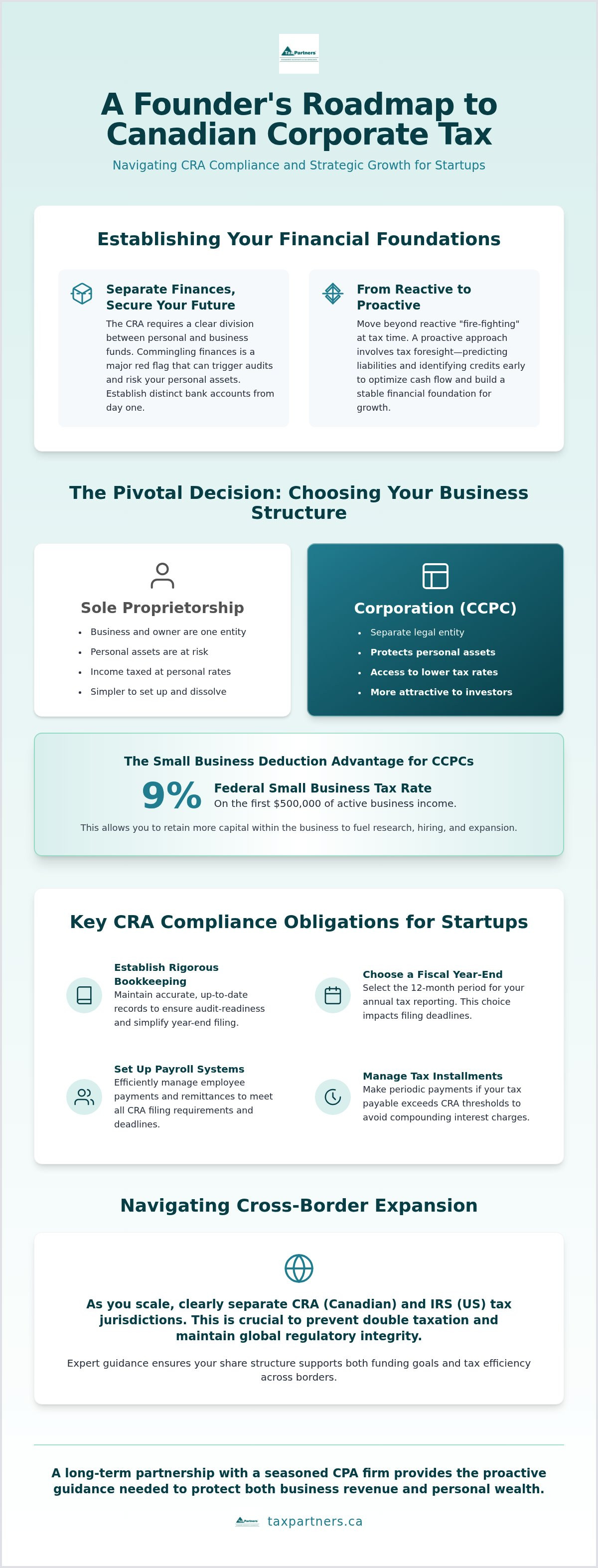
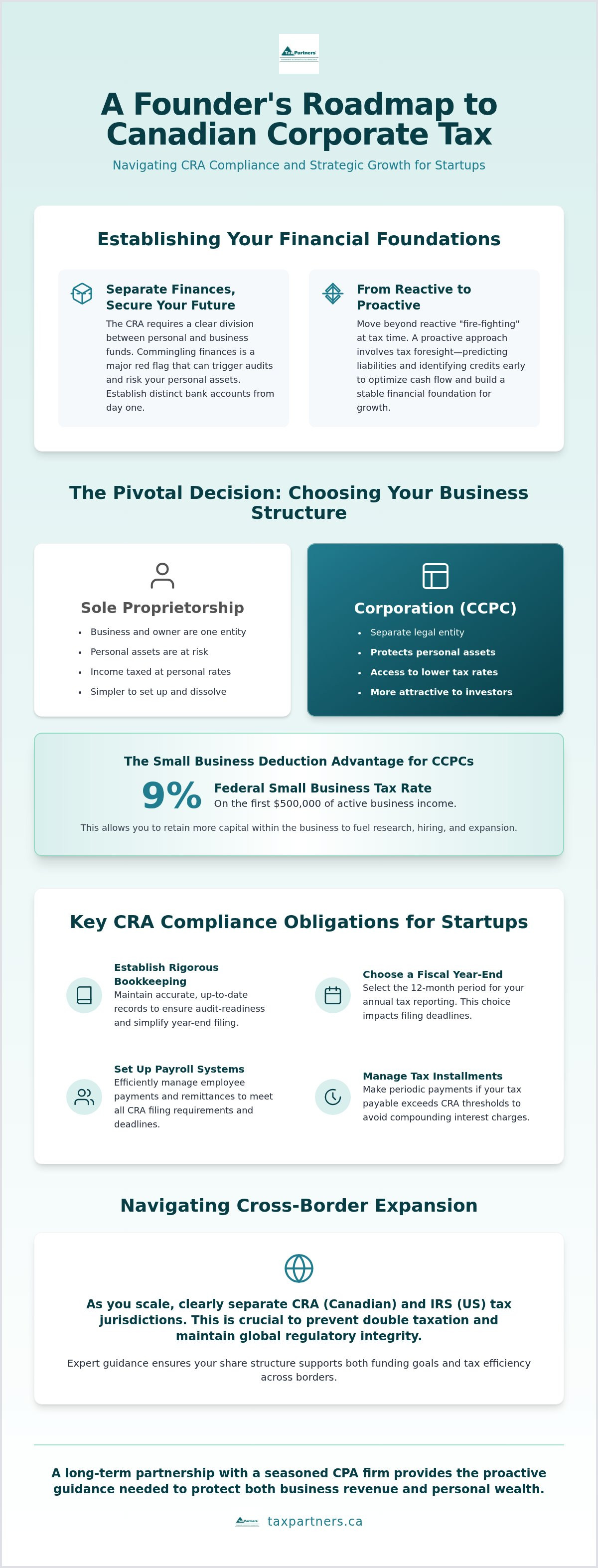
- Strategic financial advisory for startups Canada transforms complex CRA compliance into a streamlined roadmap for sustainable growth and audit protection.
- Identifying the precise moment to incorporate allows founders to maximize the CRA small business deduction and optimize their corporate tax structure.
- Establishing rigorous bookkeeping and payroll systems ensures your venture meets all CRA filing deadlines while maintaining high operational efficiency.
- Navigating cross-border expansion requires a clear separation of CRA and IRS jurisdictions to prevent double taxation and maintain global regulatory integrity.
- A long-term partnership with a seasoned CPA firm provides the proactive guidance needed to protect both business revenue and personal wealth.
Establishing Financial Foundations for CRA Filers
Professional financial advisory for startups Canada serves as the vital bridge between a brilliant concept and a sustainable corporate entity. It involves much more than simply recording expenses or tracking revenue. It's the strategic application of the Income Tax Act to your specific growth model, ensuring every decision aligns with current regulatory expectations.
One of the first lessons a seasoned mentor provides is the absolute necessity of separating personal and business finances. The CRA views commingled funds with significant skepticism, which often leads to avoidable and invasive audits. Establishing distinct boundaries from day one protects your personal assets and simplifies your year-end reporting process.
Partnering with a CPA firm like Tax Partners, with over 40 years of experience, alleviates the mental burden of complex paperwork. We've filed over 495,000 returns, helping founders find peace of mind. This allows you to focus on product-market fit while we handle the technical intricacies of corporate income tax filings.
Why Startups Need a Proactive Guardian
Many founders start by managing their own spreadsheets, but this approach quickly becomes a liability as revenue scales. A proactive guardian moves your business from reactive fire-fighting to a model of "tax foresight." This means predicting your tax liabilities long before they impact your cash flow.
This foresight involves identifying potential tax credits or structural weaknesses early in the fiscal cycle. By adopting a mentor-led approach, you build a stable foundation that survives the volatile early years of a new venture. You'll learn to spot financial red flags before they become systemic problems that threaten your operational survival.
Understanding the CRA Compliance Landscape
Grasping the basics of Corporate tax in Canada is essential for every director. You must choose a fiscal year-end, which is the specific 12-month period your business uses for its annual tax reporting. This choice can have significant implications for when your taxes are due and how you manage your initial capital.
New founders often overlook tax installments, which are periodic payments the CRA requires if your tax payable exceeds certain thresholds. Ignoring these requirements leads to compounding interest charges that can drain your startup's limited cash reserves. We help you calculate these amounts accurately to ensure you remain in good standing with federal authorities.
Procrastinating on compliance is a common mistake that often results in heavy penalties and lost opportunities for savings. By the time many founders realize they need professional financial advisory for startups Canada, they're already facing preventable hurdles. Establishing these foundations early transforms compliance from a source of anxiety into a routine part of your journey toward success.
Strategic Incorporation and Tax Planning under CRA Rules
Deciding how to structure your venture is a pivotal moment that defines your future tax liability and legal exposure. High-growth ventures almost always benefit from incorporation over remaining a sole proprietorship. Under CRA rules, a corporation exists as a separate legal entity, which provides a robust shield for your personal assets against business liabilities.
Financial advisory for startups Canada helps you weigh the immediate costs of incorporation against long-term tax advantages. In 2026, the federal small business tax rate is 9% on the first $500,000 of active business income for Canadian-Controlled Private Corporations (CCPCs). This allows you to retain more capital within the business to fuel research, hiring, and expansion.
Choosing the Right Business Structure
Maintaining CCPC status is vital for startups aiming to leverage federal incentives. If foreign investors gain voting control, your business could lose access to enhanced refundable tax credits. Professional advice ensures your share structure supports both your funding goals and your tax efficiency from the outset.
Properly structured corporations also attract venture capital more effectively. Investors prefer the clarity of defined, transferable shares within a corporate framework. For a deeper dive into the technical requirements of corporate filing, the CRA T2 Corporation Income Tax Guide provides the foundational rules every director should understand.
Tax Optimization Strategies for Founders
Effective tax planning involves more than just filing returns. It's about choosing between salary and dividends to minimize your total tax bill. Salaries are a deductible expense for the corporation, while dividends are paid from after-tax profits and offer different personal tax advantages.
Innovation-driven startups should prioritize the Scientific Research and Experimental Development (SR&ED) program. In 2026, the enhanced SR&ED expenditure limit for CCPCs has increased to $6 million, offering a major boost for R&D-heavy firms. Navigating these incentives requires precision to ensure you maximize your claims without triggering unnecessary scrutiny.
Every founder's situation is unique. You need a bespoke approach to wealth management and tax minimization through dedicated financial advisory for startups Canada. If you're unsure which structure best serves your vision, you can speak with our advisory team to build a customized plan.
Operational Efficiency: Bookkeeping and Payroll for Startups
Clean financial records act as the pulse of your venture, providing a real-time view of your operational health. Comprehensive financial advisory for startups Canada ensures that every receipt and invoice is categorized according to the latest standards for CRA filers. This systematic approach transforms raw data into actionable insights, allowing you to monitor burn rates and cash runways with absolute precision.
Accurate records are your primary shield against the stress of a CRA audit. Under CRA rules, businesses must maintain books and records supported by source documents for six years from the end of the last tax year they relate to. If you're just starting your journey, the Government of Canada's guide to starting a business provides an excellent overview of these initial regulatory expectations.
Outsourcing these operational tasks allows you to reclaim your most valuable asset: time. Instead of wrestling with ledger entries, you can focus on product development and market expansion. This partnership ensures your foundation remains firm, your filings are punctual, and your focus remains entirely on the future of your company.
The Foundation of Accurate Record-Keeping
Monthly reconciliations are non-negotiable for high-growth tech companies. They ensure your internal records match your bank and credit card statements, catching errors before they compound into systemic issues. This process is the only way to guarantee your financial statements reflect the true state of your business at any given moment.
Maintaining compliance for CRA filers involves several core bookkeeping duties:
- Accurate categorization of all business expenses and revenue.
- Meticulous tracking of capital assets and depreciation.
- Retention of digital or physical source documents for six years.
While modern digital tools offer impressive automation, they require professional CPA oversight to ensure the data aligns with complex Canadian tax laws. Software can categorize a transaction, but it cannot always determine the correct tax treatment under the Income Tax Act for CRA filers. You can explore our professional bookkeeping services to see how we bridge the gap between technology and compliance.
Managing Payroll and GST/HST Compliance
Once your startup's worldwide taxable supplies exceed $30,000 under CRA rules in a single calendar quarter or over four consecutive quarters, GST/HST registration becomes mandatory. Failing to register or remit these taxes on time leads to significant penalties and interest charges. We help you monitor these thresholds to ensure you're never caught off guard by a sudden filing requirement from the CRA.
Managing payroll is equally demanding for CRA filers and requires strict attention to detail. You must calculate and remit Canada Pension Plan (CPP) contributions, Employment Insurance (EI) premiums, and income tax deductions for every employee by strict deadlines. Under CRA rules, these remittances are usually due by the 15th of the month following the payroll period.
Handling these deductions incorrectly can lead to personal liability for directors, a risk that no founder should take. Our role as your proactive guardian is to ensure every remittance is accurate and every deadline is met. To streamline these tasks, Tax Partners offers bookkeeping and payroll services designed to scale alongside your growing team.
Cross-Border and Global Tax Advisory for Growing Startups
Expanding south into the United States introduces a dual-layered regulatory environment that requires precise navigation. You must carefully distinguish between your obligations to the CRA and those required under IRS rules. Mismanaging this boundary can lead to double taxation and costly penalties that drain your expansion capital.
The US-Canada tax treaty serves as your most powerful tool to prevent being taxed twice on the same income. Professional financial advisory for startups Canada ensures you apply treaty benefits correctly to protect your corporate margins. Our team specializes in these complexities, supporting dual citizens and Canadian expats as they scale their ventures across international borders.
Expanding into the United States
If your startup generates income effectively connected with a US trade or business, you may need to file a Form 1040 or 1040-NR under IRS rules. This requirement often catches founders by surprise when they first hire US-based contractors or open a satellite office. These filings are mandatory and must be handled with precision to avoid IRS scrutiny.
Most Canadian residents doing business in the US will require an Individual Taxpayer Identification Number (ITIN), which is a tax processing number issued by the IRS. This acts as an identification for those not eligible for a Social Security Number. For specific compliance details and a breakdown of these requirements, you can refer to our guide on 1040-NR filing for Canadians.
Global Tax Strategies for Tech Startups
Global accounting services are essential for managing transfer pricing, which involves the pricing of transactions between related entities in different countries. Canada's transfer pricing regime was significantly overhauled in Bill C-15, which received Royal Assent on March 26, 2026, under CRA rules. We help you implement simplified documentation requirements to remain compliant with these updated regulations.
You must also be mindful of mandatory disclosures such as CRA form T1134 for foreign affiliates or CRA form T106 for non-arm's length transactions with non-residents. For a corporation with a December 31, 2025, year-end, the deadline for CRA form T106 is June 30, 2026. A seasoned mentor helps you navigate these global information requirements before you reach the $100,000 threshold for CRA form T1135 foreign property reporting.
The implementation of the Global Minimum Tax Act in 2026 signals a shift toward international tax harmonization for large multinational groups. While your startup may not yet meet the revenue thresholds, these rules reflect an environment of increased global scrutiny on profit shifting. Contact our cross-border specialists today to ensure your international expansion strategy is built on a compliant and tax-efficient foundation.
Securing Long-Term Success with Professional Financial Guidance
A partnership with a seasoned CPA firm isn't just about annual filings; it's about building a lasting legacy. Moving from reactive survival to proactive dominance requires a steady hand at the helm of your financial operations. High-level financial advisory for startups Canada provides this essential stability, ensuring that your corporate growth translates directly into personal security.
Founders often get caught in the cycle of "putting out fires" rather than looking toward the horizon. This reactive approach creates unnecessary stress and leaves money on the table. By shifting to a proactive planning model, you gain the clarity needed to make bold business moves without fearing CRA repercussions.
We've helped clients save over $87M through strategic planning and precise execution since 1981. This level of impact only comes from a long-term partnership rooted in mutual trust and deep-seated reliability. It's about having a mentor who's as invested in your success as you are.
Wealth Management and Succession Planning
Strategic wealth management isn't a separate task from your corporate tax planning. They're two sides of the same coin, influencing your lifestyle today and your retirement tomorrow. Decisions made within your corporation, such as share structures or dividend policies, have immediate effects on your personal tax bracket and wealth accumulation.
Succession planning is another critical pillar that many founders overlook in the early years. Whether you're planning for an IPO, a strategic acquisition, or a family transition, your exit strategy must be built into your foundation. You can explore our tax efficient wealth management services to see how we integrate these goals into a cohesive strategy.
Proper planning ensures that your hard work doesn't result in a massive tax bill at the finish line. We help you navigate the complexities of capital gains exemptions and corporate restructuring to maximize your final payout. This foresight protects the fruits of your labour for the next generation.
Your Next Steps with Tax Partners
Tax Partners has been a proactive guardian for Canadian entrepreneurs for over 40 years. With more than 495,000 returns filed, we bring decades of institutional wisdom to your startup's journey. Our 1,390+ five-star Google reviews reflect our commitment to approachable warmth and professional authority.
Getting started is a straightforward process of discovery where we align our bespoke advisory services with your specific vision. We don't offer generic templates; we provide customized solutions that evolve as your business scales. You deserve a partner who's both highly competent and genuinely attentive to your individual concerns.
Take control of your financial destiny by moving beyond simple bookkeeping to strategic advisory. Let us handle the regulatory burden so you can focus on changing the world with your innovation. Contact Tax Partners today to secure your startup's financial future.
Secure Your Vision with Strategic Foresight
Building a startup requires more than just innovation; it demands a compliance fortress that protects your vision from regulatory friction. By establishing clean bookkeeping and choosing the right corporate structure early, you ensure your venture is ready for the CRA small business deduction and future investment.
As you scale into the United States or beyond, the complexity of dual jurisdictions makes specialized cross-border foresight essential. Our team brings deep-seated reliability to every engagement, backed by over 495,000 returns filed since 1981 and 1,390+ five-star Google reviews.
Accessing professional financial advisory for startups Canada allows you to focus on your core mission while we handle the technical intricacies of international tax. We invite you to Book a Consultation with Our Startup Advisory Experts to secure your long-term success. Your journey toward a stable and tax-efficient future starts with a single proactive step.
Frequently Asked Questions
What is the difference between a bookkeeper and a financial advisor for startups?
A bookkeeper focuses on the accurate recording of daily financial transactions and ledger maintenance. In contrast, financial advisory for startups Canada provides high-level strategic guidance, tax optimization, and long-term planning. While bookkeepers ensure your data is organized, an advisor acts as a mentor to help you navigate complex CRA regulations and scale your business efficiently.
When should a Canadian startup register for a GST/HST account?
You must register for a GST/HST account for CRA filers once your worldwide taxable supplies exceed $30,000 in a single calendar quarter or over four consecutive quarters. Many founders choose to register voluntarily before reaching this threshold to claim Input Tax Credits (ITCs) on business expenses. This proactive approach helps recover the tax paid on startup costs, improving your overall cash flow in the early stages.
How can a startup minimize its corporate tax liability under CRA rules?
Startups can minimize tax liability by leveraging the small business deduction and claiming Scientific Research and Experimental Development (SR&ED) credits. Proper choice between salary and dividend payments for directors also plays a significant role in reducing the overall tax burden. Strategic financial advisory for startups Canada ensures you utilize every available deduction while remaining fully compliant with the Income Tax Act for CRA filers.
Do I need to file US taxes if my Canadian startup has US customers?
You may need to file US taxes if your startup has income effectively connected with a US trade or business under IRS rules. This often depends on whether you have a permanent establishment or physical presence south of the border. We recommend reviewing the US-Canada tax treaty with a cross-border specialist to determine your specific filing obligations and avoid potential double taxation.
What are the common CRA audit triggers for new businesses in Canada?
Common triggers for a CRA audit include reporting significant losses for multiple consecutive years or showing inconsistencies between GST/HST filings and corporate tax returns. The CRA also uses AI and machine learning to flag businesses that fall outside of standard industry benchmarks for expenses. Maintaining meticulous records and following professional advisory guidelines helps mitigate these risks and demonstrates your commitment to transparency.
How much does professional financial advisory cost for an early-stage startup?
The cost of advisory services varies based on the complexity of your corporate structure and the specific level of support required. Most firms offer bespoke packages that scale alongside your business growth, ensuring you only pay for the expertise you currently need. It's best to discuss your unique requirements during a consultation to receive a customized plan that aligns with your startup's budget.
Can a CPA help with SR&ED tax credit applications for tech startups?
A CPA is essential for navigating the SR&ED application process, particularly for Canadian-Controlled Private Corporations (CCPCs) seeking refundable credits. They ensure your technical documentation and financial records meet the strict CRA eligibility criteria for research and development activities. In 2026, the enhanced expenditure limit has increased to $6 million, making professional guidance even more valuable for maximizing your claim.
What is the small business deduction and how does it benefit my corporation?
The small business deduction reduces the federal corporate income tax rate to 9% on the first $500,000 of active business income for CCPCs under CRA rules. This significant tax break allows startups to retain more capital for reinvestment into hiring and product development. To benefit from this lower rate, your corporation must meet specific criteria regarding its ownership and the nature of its income.

Article by
Mahad Mohamed
Mahad Mohamed is an accountant and the CEO of Tax Partners, with over 26+ years of Canadian and international tax and accounting experience. His expertise includes corporate reorganization, cross-border tax structuring (Canada & US), tax disputes, CRA audits, and tax planning for small owner-managed private corporations. Most recently, Mahad is a pioneer in Canadian crypto taxation and founded Block3 Finance.
Previously, Mahad worked for the Canada Revenue Agency (CRA), Big4 accounting firms, and served as a Rulings Officer for the Federal Tax Authority of the UAE before acquiring Tax Partners in 2014.
Tax Partners has 44 full-time accountants and over 18,400+ clients.
Disclaimer
This article provides general information only and is current as of its publication date. It has not been updated and may be out of date. It does not constitute legal advice and should not be relied upon as such. Every tax situation is unique and may differ from the examples discussed in this article. If you have specific questions, you should seek the advice of our accountants for your unique circumstances. Book a FREE Initial Consultation Today!
Frequently Asked Questions
What is the difference between a bookkeeper and a financial advisor for startups?
A bookkeeper focuses on the accurate recording of daily financial transactions and ledger maintenance. In contrast, financial advisory for startups Canada provides high-level strategic guidance, tax optimization, and long-term planning. While bookkeepers ensure your data is organized, an advisor acts as a mentor to help you navigate complex CRA regulations and scale your business efficiently.
When should a Canadian startup register for a GST/HST account?
You must register for a GST/HST account for CRA filers once your worldwide taxable supplies exceed $30,000 in a single calendar quarter or over four consecutive quarters. Many founders choose to register voluntarily before reaching this threshold to claim Input Tax Credits (ITCs) on business expenses. This proactive approach helps recover the tax paid on startup costs, improving your overall cash flow in the early stages.
How can a startup minimize its corporate tax liability under CRA rules?
Startups can minimize tax liability by leveraging the small business deduction and claiming Scientific Research and Experimental Development (SR&ED) credits. Proper choice between salary and dividend payments for directors also plays a significant role in reducing the overall tax burden. Strategic financial advisory for startups Canada ensures you utilize every available deduction while remaining fully compliant with the Income Tax Act for CRA filers.
Do I need to file US taxes if my Canadian startup has US customers?
You may need to file US taxes if your startup has income effectively connected with a US trade or business under IRS rules. This often depends on whether you have a permanent establishment or physical presence south of the border. We recommend reviewing the US-Canada tax treaty with a cross-border specialist to determine your specific filing obligations and avoid potential double taxation.
What are the common CRA audit triggers for new businesses in Canada?
Common triggers for a CRA audit include reporting significant losses for multiple consecutive years or showing inconsistencies between GST/HST filings and corporate tax returns. The CRA also uses AI and machine learning to flag businesses that fall outside of standard industry benchmarks for expenses. Maintaining meticulous records and following professional advisory guidelines helps mitigate these risks and demonstrates your commitment to transparency.
How much does professional financial advisory cost for an early-stage startup?
The cost of advisory services varies based on the complexity of your corporate structure and the specific level of support required. Most firms offer bespoke packages that scale alongside your business growth, ensuring you only pay for the expertise you currently need. It's best to discuss your unique requirements during a consultation to receive a customized plan that aligns with your startup's budget.
Can a CPA help with SR&ED tax credit applications for tech startups?
A CPA is essential for navigating the SR&ED application process, particularly for Canadian-Controlled Private Corporations (CCPCs) seeking refundable credits. They ensure your technical documentation and financial records meet the strict CRA eligibility criteria for research and development activities. In 2026, the enhanced expenditure limit has increased to $6 million, making professional guidance even more valuable for maximizing your claim.
What is the small business deduction and how does it benefit my corporation?
The small business deduction reduces the federal corporate income tax rate to 9% on the first $500,000 of active business income for CCPCs under CRA rules. This significant tax break allows startups to retain more capital for reinvestment into hiring and product development. To benefit from this lower rate, your corporation must meet specific criteria regarding its ownership and the nature of its income.