Dual Citizen Tax Filing Canada US: A 2026 Compliance Guide

You deserve a clear roadmap to help you secure total compliance with both the IRS and the CRA while ensuring the Canada-US Tax Treaty protects your hard-earned assets from double taxation. This 2026 guide provides exactly that. We'll break down the specific 2026 deadlines for each jurisdiction, explore how the IRS Streamlined Foreign Offshore Procedures help those catching up, and clarify reporting obligations for CRA filers. By the end, you'll have a steady plan to move from uncertainty to total control of your cross-border obligations.
Key Takeaways
- Understand the fundamental distinction between citizenship-based taxation under IRS rules and residency-based requirements for CRA filers.
- Master the complexities of dual citizen tax filing Canada US by identifying essential forms, including the IRS Form 1040 and the Canadian T1 General return.
- Avoid significant penalties by meeting the October 15, 2026, FBAR filing deadline if your combined foreign accounts exceeded the $10,000 threshold under IRS regulations.
- Protect your global assets from double taxation by utilizing Foreign Tax Credits and the Foreign Earned Income Exclusion available under the Canada-US Tax Treaty.
- Discover a reliable path to compliance through the IRS Streamlined Foreign Offshore Procedures if you need to catch up on late filings without facing severe penalties.
The Dual Filer Burden: IRS and CRA Jurisdictions Explained
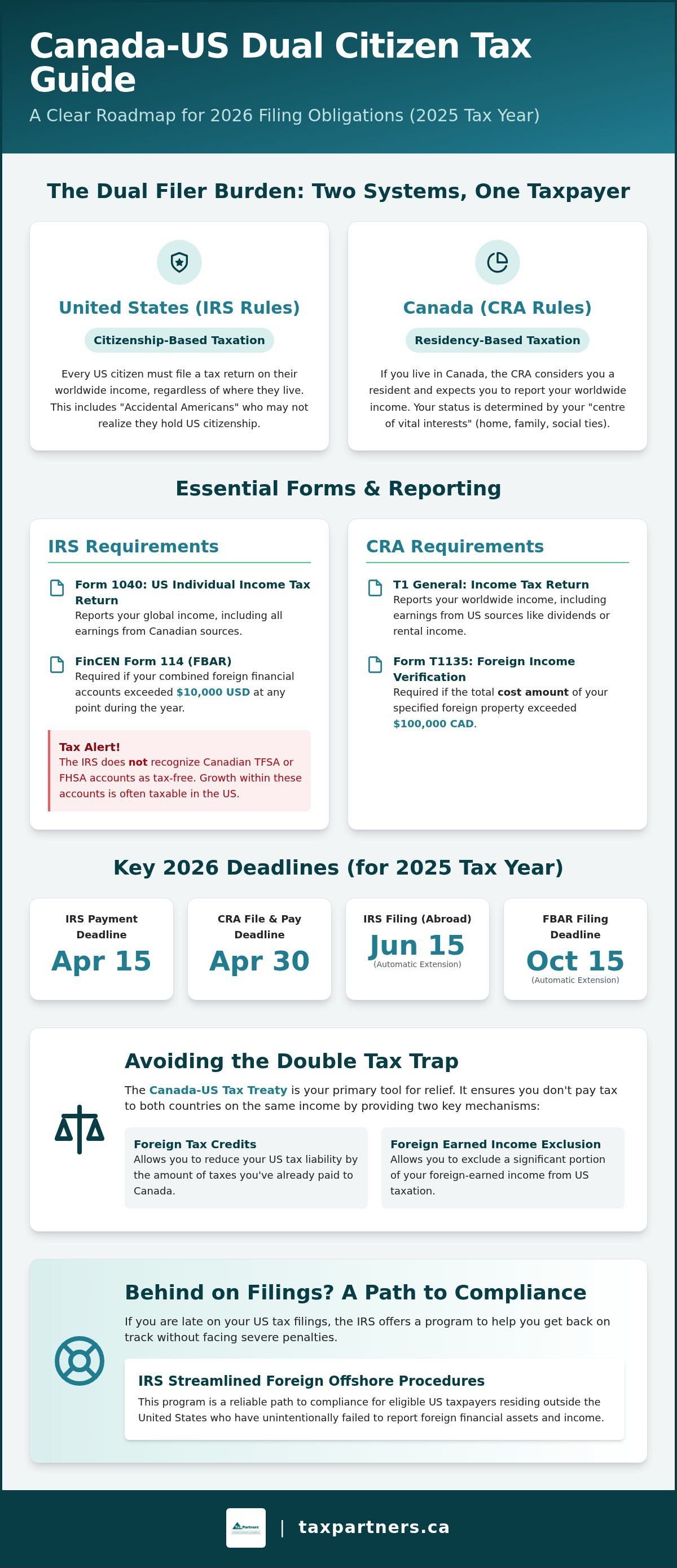
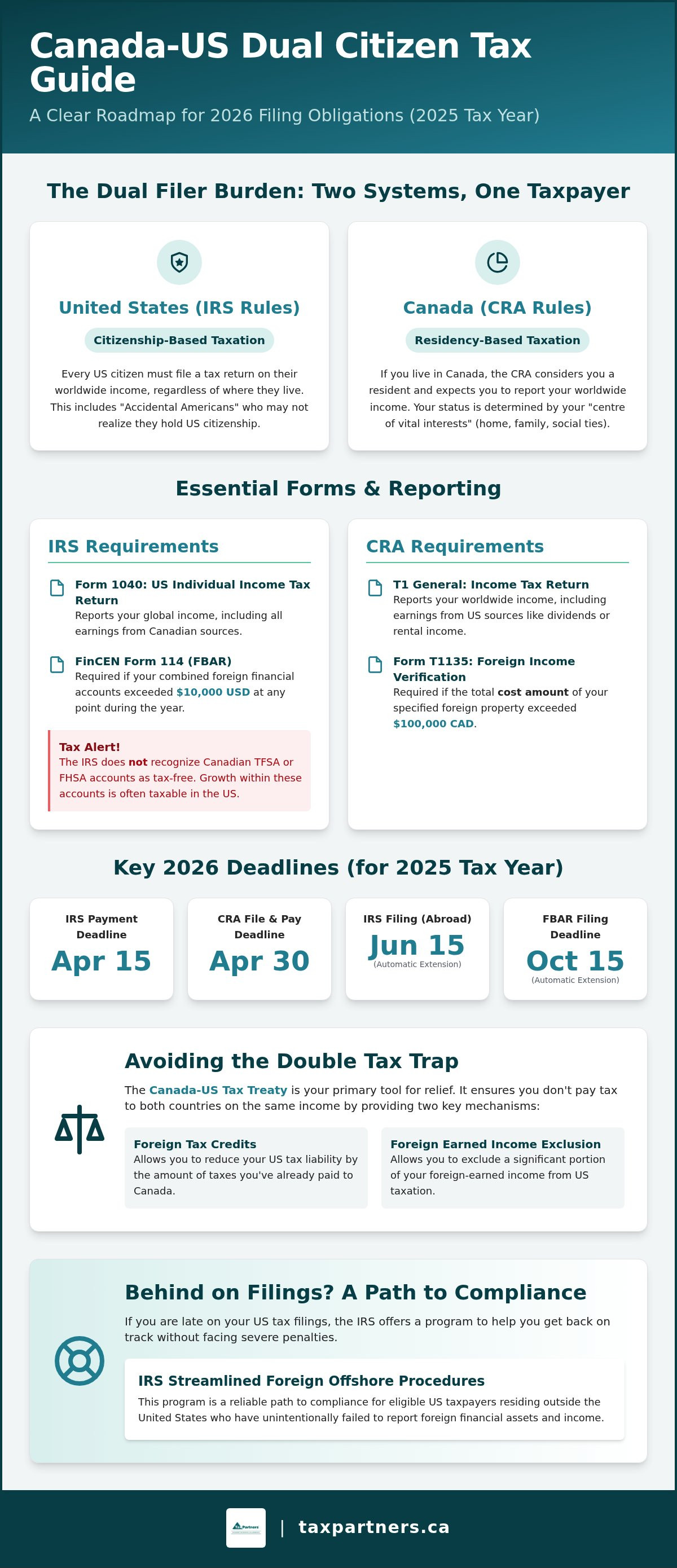
Managing your finances as a dual citizen feels like serving two distinct masters. Under IRS rules, the United States taxes based on citizenship. This means every US citizen must file a return, regardless of where they live in the world. Conversely, for CRA filers, Canada taxes based on residency. If you live in Canada, the CRA expects you to report your worldwide income on your annual return.
This overlap often creates the threat of double taxation. This occurs when both the US and Canada claim the right to tax the same dollar of income. Fortunately, the Canada-US Tax Treaty serves as your primary tool for relief. It provides a framework to determine which country has the primary taxing right, ensuring you don't pay twice on the same earnings.
The compliance burden is reinforced by the FATCA agreement. This data-sharing arrangement ensures that Canadian financial institutions report certain account information to the IRS. It makes transparency essential for anyone managing a dual citizen tax filing Canada US. You can learn more about these requirements through our US tax services.
US Citizenship-Based Taxation Under IRS Rules
The IRS requires all citizens to file Form 1040 annually. This obligation persists even if you have never lived or worked in the United States. Many individuals are "Accidental Americans," having been born in the US to Canadian parents without realizing they hold US citizenship. Under IRS rules, filing a return is a mandatory legal step, though it frequently results in zero tax owing after applying treaty benefits.
Canadian Residency-Based Taxation for CRA Filers
For CRA filers, your tax liability is determined by your residential ties to Canada. The CRA evaluates your "centre of vital interests," which includes your primary home, family, and social connections. If you're a resident, you must report all global income on your T1 General return. This includes any salary, dividends, or interest earned from US sources.
Deadlines also vary between the two nations. For the 2025 tax year, the IRS payment deadline is April 15, 2026. US citizens residing abroad receive an automatic filing extension until June 15, 2026. However, for CRA filers, the standard deadline to file and pay is April 30, 2026. Keeping these dates straight is vital for avoiding late-filing penalties.
Essential Forms for Dual Citizens: 1040s, T1s, and FBARs
Staying compliant requires a precise understanding of which forms belong to which agency. A dual citizen tax filing Canada US involves a dual reporting stream that captures both income and asset values across borders. You must satisfy the specific documentation standards of both the IRS and the CRA to avoid costly administrative errors.
The IRS Filing Requirements: 1040 and FBAR
Under IRS rules, the primary vehicle for reporting global income is Form 1040. This return must include all earnings, such as Canadian salary, dividends, and interest. Beyond income, the IRS requires FinCEN Form 114, commonly known as the FBAR. You must file this if the aggregate value of your foreign financial accounts exceeded $10,000 at any point during the 2025 calendar year. The deadline for this form is April 15, 2026, though an automatic extension is granted until October 15, 2026.
Failure to file the FBAR can lead to severe penalties, often starting at significant dollar amounts for non-willful violations. Additionally, under IRS rules, certain taxpayers must file Form 8938 to report specified foreign financial assets if they meet specific thresholds. It's vital to recognize that the IRS does not grant "tax-free" status to Canadian Tax-Free Savings Accounts (TFSAs) or First Home Savings Accounts (FHSAs). The IRS often treats these as taxable investment accounts, meaning you may owe US tax on the growth even if the CRA considers it tax-exempt. You can find more detail on these protections in the U.S.-Canada Income Tax Treaty.
The CRA Filing Requirements: T1 and Form T1135
For CRA filers, the T1 General serves as the foundation for your annual tax obligations. This return captures your worldwide income, including any earnings from US sources like dividends or rental income. If you hold foreign property with a total cost amount of more than $100,000 CAD at any time in the year, you must also file Form T1135. This Foreign Income Verification Statement ensures transparency regarding your assets held outside of Canada, including those in the United States.
The T1135 threshold is strictly based on the "cost amount" rather than the fair market value. This distinction is crucial for CRA filers who have seen their US investments grow significantly over time. Managing these requirements simultaneously is a complex task, and missing a single form can trigger audits or assessments from either agency. If you feel overwhelmed by these overlapping obligations, you can speak with our cross-border specialists to ensure every box is checked for 2026.
Avoiding the Double Tax Trap: Credits and Treaties
The core of a successful dual citizen tax filing Canada US strategy is ensuring you aren't taxed twice on the same income. This protection isn't automatic; it requires careful coordination between your Canadian and US filings. For CRA filers, if you pay taxes to the IRS on US-source income, Canada allows you to claim a foreign tax credit to reduce your Canadian tax payable.
The U.S.-Canada Income Tax Treaty provides the legal framework for this essential relief. It establishes "tie-breaker" rules to determine residency and clarifies which country has the primary right to tax specific types of income. By following these rules, you can effectively use taxes paid in one country to reduce your liability in the other, keeping more of your hard-earned wealth.
Leveraging the Foreign Tax Credit Under IRS Rules
Under IRS rules, you can utilize the Foreign Tax Credit (FTC) to offset US tax liabilities with the income tax you've already paid to the CRA. This is often more advantageous than the Foreign Earned Income Exclusion (FEIE). While the FEIE only applies to earned income up to a specific limit, the FTC can apply to various income types and allows you to carry forward unused credits for future years.
To maximize this benefit, keep your Canadian tax slips well-organized. You'll need to prove the exact amount of tax paid to the CRA to justify the credit on your US Form 1116. This meticulous record-keeping is the best way to ensure the IRS respects your treaty-based claims and prevents unnecessary payments.
Canadian Tax-Free Accounts and the IRS
One of the most significant challenges for dual citizens is the "tax-free" paradox. Under IRS rules, the Canadian Tax-Free Savings Account (TFSA) is not recognized as a tax-exempt vehicle. Consequently, any interest, dividends, or capital gains earned within a TFSA must be reported as taxable income on your US return, potentially leading to unexpected bills.
Similarly, the First Home Savings Account (FHSA) presents potential tax implications under IRS rules. While the CRA allows for tax-free growth and withdrawals for home purchases, the IRS may view this as a taxable investment account. In contrast, the Registered Retirement Savings Plan (RRSP) generally enjoys protected status, allowing for tax-deferred growth for both the CRA and the IRS under the treaty.
Catching Up: The IRS Streamlined Procedure for Canadians
Discovering years of unfiled returns often triggers significant stress. Under IRS rules, the Streamlined Foreign Offshore Procedures (SFOP) offer a specific pathway for individuals to correct past omissions without facing the most severe financial penalties. This program is a vital tool for managing a dual citizen tax filing Canada US when you have fallen behind on your obligations. It provides a steady hand to guide you back toward total compliance and peace of mind.
Eligibility for the Streamlined Procedure
To qualify for this program under IRS rules, you must certify that your failure to file was "non-willful." The IRS defines non-willful conduct as conduct that is due to negligence, inadvertence, or mistake, or conduct that is the result of a good faith misunderstanding of the requirements of the law. It's essentially for those who simply didn't realize they had a US filing obligation while living in Canada.
You must also meet specific residency requirements. Under IRS rules, this generally means you did not have a "abode" in the United States and were physically present outside the US for a required number of days. Choosing this path is a proactive way to protect your assets. You should realize that once the IRS initiates an examination of your returns, you are no longer eligible for this specific relief program.
The Submission Process: Returns and FBARs
A complete streamlined submission under IRS rules requires a precise set of documents. You must prepare and file the last three years of delinquent income tax returns, including all required informational returns. Additionally, you must file the last six years of FBAR (FinCEN Form 114) reports to disclose your Canadian bank and investment accounts. Accuracy is the foundation of a successful submission, so centre your focus on gathering complete records for all foreign holdings.
The most critical element of the package is Form 14653. On this form, you provide a signed, detailed narrative explaining the specific facts that led to your previous non-compliance. This statement must clearly demonstrate that your failure to report global income or file FBARs was not a deliberate attempt to hide assets from the IRS. For a more detailed breakdown of these requirements, you can explore the IRS Streamlined Procedure for US expats.
Successfully navigating this process requires a methodical approach to both Canadian and US documentation. If you are ready to resolve your unfiled returns and secure your cross-border standing, contact our cross-border tax specialists to develop a clear plan for your 2026 submission.
Securing Your Cross-Border Future with Tax Partners
Managing a dual citizen tax filing Canada US requires more than just filling out forms. It demands a holistic view of your financial life across two different legal systems. By choosing a single firm to handle both your IRS and CRA obligations, you eliminate the risk of conflicting advice and ensure that every deduction is synchronized for maximum benefit.
Tax Partners acts as a proactive guardian for your wealth. We don't just react to deadlines; we look ahead to secure better outcomes for your long-term financial health. Our integrated approach ensures that your individual tax return preparation is handled with the precision that complex cross-border situations demand.
Why Specialized Cross-Border Expertise Matters
General accountants often lack the specialized knowledge required to interpret the nuances of the Canada-US Tax Treaty. This can lead to missed opportunities for credits or accidental non-compliance with the IRS. Since 1981, Tax Partners has filed over 495,000 returns, saving our clients more than $87M in potential taxes and penalties.
Our deep-seated reliability provides the peace of mind you need when dealing with regulatory bodies. If the CRA or the IRS ever questions your filings, you have the support of a firm with decades of institutional wisdom. We provide end-to-end support, from initial planning to audit defense, acting as your steady hand at the helm.
Next Steps for Dual Citizens in Canada
The first step toward total control is organization. Collect your financial records for the 2025 tax year, ensuring you have clear documentation for all global income sources. You should also review your Canadian investment accounts, such as TFSAs or FHSAs, to understand their potential exposure under IRS rules.
- Gather all Canadian T-slips and US W-2s or 1099s.
- Identify all foreign financial accounts to determine FBAR eligibility under IRS rules.
- Consult with a specialist to align your wealth management and financial planning with your tax obligations.
Don't let the complexity of cross-border regulations stall your progress. You can book a consultation with Tax Partners today to review your dual citizen status and build a bespoke compliance plan for 2026. Our team is ready to help you move from uncertainty to a state of total understanding and security.
Master Your Cross-Border Obligations for 2026
Achieving total compliance requires a precise alignment of your obligations under IRS rules and your requirements as a CRA filer. You now have a clear roadmap to navigate the essential forms and treaty benefits that protect your global assets. This steady approach ensures that you avoid double taxation while meeting every 2026 deadline with confidence.
Managing a dual citizen tax filing Canada US doesn't have to be a source of constant stress. With over 40 years of specialized experience and more than 1,390 five-star Google reviews, Tax Partners offers the reliable expertise you need to handle both jurisdictions in one place. We specialize in the IRS Streamlined Procedures to help you catch up without fear of severe penalties.
Take the final step toward financial clarity and security. Secure your cross-border compliance with Tax Partners today to ensure your future remains protected. You've worked hard for your success; let us help you keep it.
Frequently Asked Questions
Do I have to file US taxes if I live in Canada and have no US income?
Yes, you must file. Under IRS rules, US citizens are taxed on their worldwide income, which refers to total earnings from all global sources regardless of where the money is earned. Even if you only have Canadian-source income and owe nothing to the US after applying credits, the return is mandatory. Failure to file can lead to the IRS assessing penalties even if no tax is actually due.
What happens if I haven't filed US taxes for several years as a dual citizen?
You face potential fines, but you can catch up without penalties through the Streamlined Foreign Offshore Procedures. Under IRS rules, this program is available to non-willful taxpayers who didn't realize they had a filing obligation. You must submit three years of back-dated returns and six years of FBARs. Tax Partners has helped thousands of clients navigate this process, saving them millions in potential IRS penalties.
Are Canadian TFSAs taxable by the IRS for dual citizens?
Yes, the IRS considers the Tax-Free Savings Account (TFSA) a taxable investment account rather than a tax-free vehicle. Under IRS rules, any interest, dividends, or capital gains earned within your TFSA must be reported on your Form 1040 return. This differs significantly from the rules for CRA filers, where the account remains entirely tax-exempt. Managing this is a vital part of a dual citizen tax filing Canada US.
What is the FBAR and do I need to file it if I live in Canada?
The Foreign Bank and Financial Accounts (FBAR) report is a mandatory disclosure for the US Department of the Treasury. Under IRS rules, you must file this if the aggregate value of your Canadian accounts exceeded $10,000 at any point in 2025. This includes bank accounts, mutual funds, and brokerage accounts. For 2026, the filing deadline is April 15, though an automatic extension to October 15 is granted to all filers.
How does the Canada-US Tax Treaty prevent me from paying tax twice?
The treaty provides a framework for claiming a Foreign Tax Credit (FTC) on your returns. Under IRS rules, you can often use the income tax paid to the CRA to reduce or eliminate your US tax bill. Conversely, for CRA filers, taxes paid to the IRS on US-source income can be credited against Canadian tax. This coordination ensures your income isn't depleted by two different tax authorities claiming the same earnings.
Can I lose my US citizenship if I don't file my taxes?
No, you won't lose your citizenship for tax non-compliance, but the financial consequences are severe. Under IRS rules, unfiled returns can lead to significant interest and penalties that grow over time. Additionally, the US government has the authority to revoke or deny passport renewals for individuals with seriously delinquent tax debt. It's better to address these obligations proactively to maintain your freedom of movement and financial stability.
What is the deadline for dual citizens in Canada to file their US tax returns?
For the 2025 tax year, the IRS grants US citizens living abroad an automatic extension to file until June 15, 2026. However, under IRS rules, any tax owed must still be paid by April 15, 2026, to avoid interest charges. This differs from the standard deadline for CRA filers, which is April 30, 2026. Managing these conflicting dates is a core part of a successful dual citizen tax filing Canada US.
Do I need an ITIN or a Social Security Number to file US taxes from Canada?
Yes, you must have a valid taxpayer identification number to file. Under IRS rules, US citizens must use a Social Security Number (SSN). If you don't have one, you must apply through the Social Security Administration. An Individual Taxpayer Identification Number (ITIN) is generally reserved for non-citizens who have a US filing requirement. Tax Partners can assist with the ITIN application process if you don't qualify for an SSN.

Article by
Mahad Mohamed
Mahad Mohamed is an accountant and the CEO of Tax Partners, with over 26+ years of Canadian and international tax and accounting experience. His expertise includes corporate reorganization, cross-border tax structuring (Canada & US), tax disputes, CRA audits, and tax planning for small owner-managed private corporations. Most recently, Mahad is a pioneer in Canadian crypto taxation and founded Block3 Finance.
Previously, Mahad worked for the Canada Revenue Agency (CRA), Big4 accounting firms, and served as a Rulings Officer for the Federal Tax Authority of the UAE before acquiring Tax Partners in 2014.
Tax Partners has 44 full-time accountants and over 18,400+ clients.
Disclaimer
This article provides general information only and is current as of its publication date. It has not been updated and may be out of date. It does not constitute legal advice and should not be relied upon as such. Every tax situation is unique and may differ from the examples discussed in this article. If you have specific questions, you should seek the advice of our accountants for your unique circumstances. Book a FREE Initial Consultation Today!
Frequently Asked Questions
Do I have to file US taxes if I live in Canada and have no US income?
Yes, you must file. Under IRS rules, US citizens are taxed on their worldwide income, which refers to total earnings from all global sources regardless of where the money is earned. Even if you only have Canadian-source income and owe nothing to the US after applying credits, the return is mandatory. Failure to file can lead to the IRS assessing penalties even if no tax is actually due.
What happens if I haven't filed US taxes for several years as a dual citizen?
You face potential fines, but you can catch up without penalties through the Streamlined Foreign Offshore Procedures. Under IRS rules, this program is available to non-willful taxpayers who didn't realize they had a filing obligation. You must submit three years of back-dated returns and six years of FBARs. Tax Partners has helped thousands of clients navigate this process, saving them millions in potential IRS penalties.
Are Canadian TFSAs taxable by the IRS for dual citizens?
Yes, the IRS considers the Tax-Free Savings Account (TFSA) a taxable investment account rather than a tax-free vehicle. Under IRS rules, any interest, dividends, or capital gains earned within your TFSA must be reported on your Form 1040 return. This differs significantly from the rules for CRA filers, where the account remains entirely tax-exempt. Managing this is a vital part of a dual citizen tax filing Canada US.
What is the FBAR and do I need to file it if I live in Canada?
The Foreign Bank and Financial Accounts (FBAR) report is a mandatory disclosure for the US Department of the Treasury. Under IRS rules, you must file this if the aggregate value of your Canadian accounts exceeded $10,000 at any point in 2025. This includes bank accounts, mutual funds, and brokerage accounts. For 2026, the filing deadline is April 15, though an automatic extension to October 15 is granted to all filers.
How does the Canada-US Tax Treaty prevent me from paying tax twice?
The treaty provides a framework for claiming a Foreign Tax Credit (FTC) on your returns. Under IRS rules, you can often use the income tax paid to the CRA to reduce or eliminate your US tax bill. Conversely, for CRA filers, taxes paid to the IRS on US-source income can be credited against Canadian tax. This coordination ensures your income isn't depleted by two different tax authorities claiming the same earnings.
Can I lose my US citizenship if I don't file my taxes?
No, you won't lose your citizenship for tax non-compliance, but the financial consequences are severe. Under IRS rules, unfiled returns can lead to significant interest and penalties that grow over time. Additionally, the US government has the authority to revoke or deny passport renewals for individuals with seriously delinquent tax debt. It's better to address these obligations proactively to maintain your freedom of movement and financial stability.
What is the deadline for dual citizens in Canada to file their US tax returns?
For the 2025 tax year, the IRS grants US citizens living abroad an automatic extension to file until June 15, 2026. However, under IRS rules, any tax owed must still be paid by April 15, 2026, to avoid interest charges. This differs from the standard deadline for CRA filers, which is April 30, 2026. Managing these conflicting dates is a core part of a successful dual citizen tax filing Canada US.
Do I need an ITIN or a Social Security Number to file US taxes from Canada?
Yes, you must have a valid taxpayer identification number to file. Under IRS rules, US citizens must use a Social Security Number (SSN). If you don't have one, you must apply through the Social Security Administration. An Individual Taxpayer Identification Number (ITIN) is generally reserved for non-citizens who have a US filing requirement. Tax Partners can assist with the ITIN application process if you don't qualify for an SSN.