Global Mobility Services: A Guide for Canadian Businesses

We recognize that the fear of non-compliance with CRA or IRS rules weighs heavily on Canadian leadership teams. This guide provides a clear compliance roadmap to help you mitigate double taxation risks and realize a seamless relocation experience for your key talent. Our goal is to replace that uncertainty with a sense of total control while protecting your corporate bottom line.
We'll examine the intricacies of dual-residency tax status and how to structure assignments that protect both the company and the employee. You'll gain the precise jurisdictional guidance needed to move your workforce with confidence and foresight. Let's transform these regulatory hurdles into a steady path for your international growth and long-term stability.
Key Takeaways
- Learn how global mobility services integrate tax, immigration, and payroll compliance to ensure a seamless international transition for your workforce.
- Understand the specific criteria for determining tax residency for CRA filers, focusing on the significance of primary and secondary residential ties to Canada.
- Master the Substantial Presence Test and other requirements under IRS rules to navigate the unique compliance hurdles faced by employees moving to the United States.
- Discover how to establish a compliant cross-border payroll system using strategies like Shadow Payroll to manage international assignments effectively.
- Gain a proactive roadmap designed to mitigate double taxation risks and protect your business from the high costs of failed assignments.
What are Global Mobility Services and Why Do They Matter?
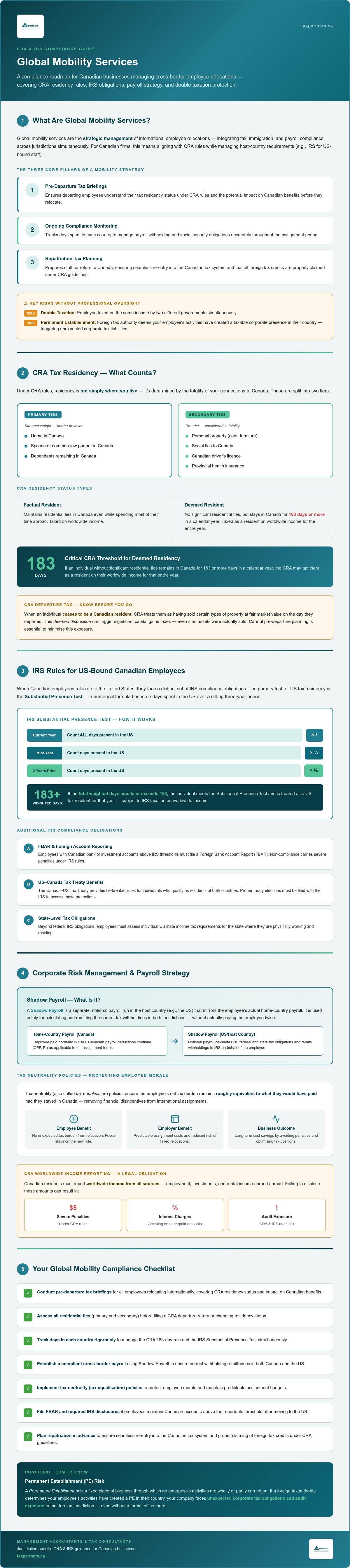
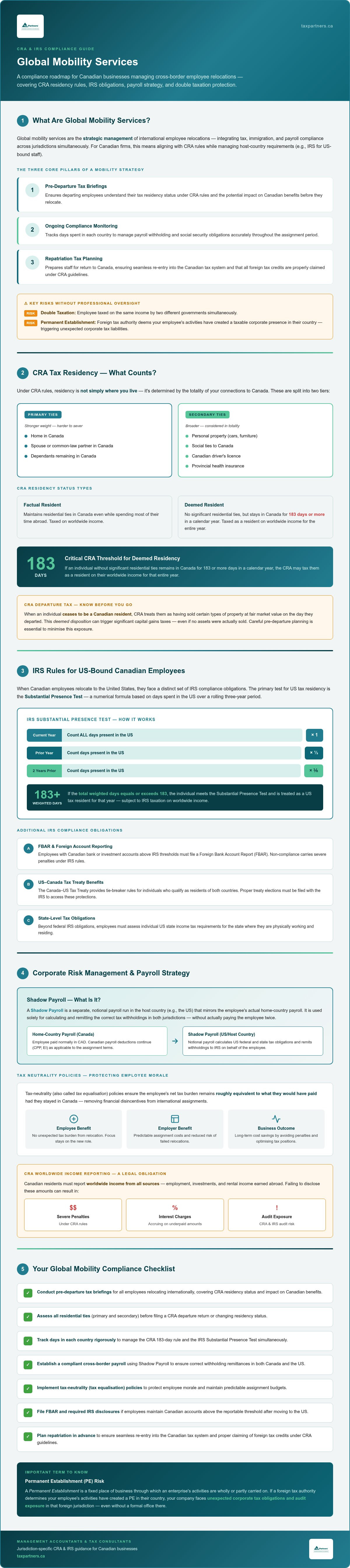
Global mobility services represent the strategic management of international employee relocations. It's more than just booking flights; it's a specialized framework that integrates tax, immigration, and payroll compliance across different jurisdictions. For Canadian firms, this means aligning with CRA rules while simultaneously managing the requirements of the host country, such as the IRS for US-bound staff. It's a proactive approach that ensures your talent remains focused on their new roles rather than their tax returns.
Precision in these services prevents the financial disaster of double taxation, where an employee might be taxed on the same income by two different governments. Effective global mobility services also protect the employer from permanent establishment risks. This occurs when a foreign tax authority determines that your employee's activities have created a taxable corporate presence in their country. Without foresight, your business could face unexpected corporate tax liabilities and complex audit procedures in a foreign jurisdiction.
The Core Pillars of a Mobility Strategy
A successful strategy begins with pre-departure tax briefings for all departing employees. These sessions ensure staff understand their tax residency status under CRA rules and the potential impact on their Canadian benefits before they relocate. During the assignment, ongoing compliance monitoring is essential. This involves tracking the number of days spent in each country to manage payroll withholding and social security obligations accurately. Finally, repatriation tax planning prepares staff for their eventual return to Canada. It ensures the transition back into the Canadian tax system is seamless and that all foreign tax credits are properly claimed under CRA guidelines.
Benefits of Professional Mobility Oversight
Utilizing professional global mobility services significantly reduces the administrative burden on your internal HR teams. Instead of struggling with foreign tax codes or treaty interpretations, your team can focus on core business operations. These services also preserve employee morale through the use of tax-neutrality policies. These policies ensure that an employee's tax burden remains roughly the same as if they had stayed in Canada, which removes the financial stress often associated with international moves. Proactive planning doesn't just manage risk; it realizes long-term cost savings for the business. By avoiding late-filing penalties and optimizing tax positions before the move occurs, you secure a more predictable return on your talent investment.
Managing Tax Residency and Compliance for CRA Filers
Determining tax residency is the cornerstone of any global mobility services strategy for Canadian businesses. Under CRA rules, your residency status is not simply based on where you live but on where you maintain your strongest connections. These connections are categorized into primary and secondary residential ties to Canada.
Primary ties include a home in Canada, a spouse or common-law partner, and dependants who remain in the country. Secondary ties are broader and include personal property like cars or furniture, social ties, a Canadian driver’s licence, and provincial health insurance. The CRA looks at the totality of these factors to decide if you have truly severed your ties for tax purposes.
When an individual ceases to be a resident of Canada, they may face a "departure tax." This rule treats the individual as having sold certain types of property at its fair market value on the day they left. This deemed disposition can trigger significant capital gains taxes even if the assets weren't actually sold. For corporate planning, it's also vital to understand "Permanent Establishment." This term refers to a fixed place of business through which the business of an enterprise is wholly or partly carried on, which can trigger corporate tax obligations under CRA regulations.
CRA Residency Status: Factual vs. Deemed
The CRA distinguishes between factual residents and deemed residents. Factual residents are those who maintain residential ties in Canada, even if they spend most of their time abroad. Deemed residents are individuals who do not have significant residential ties but stay in Canada for 183 days or more in a calendar year.
This 183-day rule is a critical threshold for many international assignments. If you reach this limit, you may be taxed as a resident on your worldwide income for the entire year. We recommend that you consult with an advisor to confirm specific residency thresholds directly with the CRA to avoid unexpected liabilities.
Reporting Requirements for Global Income
Canadian residents have a legal obligation to report their worldwide income from all sources, both inside and outside Canada. This includes employment income, investment returns, and rental income earned abroad. Failing to disclose these amounts can lead to severe penalties and interest charges under CRA rules.
Specific reporting forms, such as Form T1135, are required when a resident holds certain types of foreign property that exceed a specific cost threshold. These rules ensure transparency and prevent tax evasion on assets held outside the country. For more detailed information on individual filing rules and how they apply to your specific situation, you can explore our guide on tax in Canada.
Navigating IRS Regulations for US-Bound Employees
Relocating talent from Canada to the United States introduces a new layer of complexity that goes beyond simple logistics. While your team may be familiar with CRA rules, they must now adapt to the stringent requirements of the IRS. Effective global mobility services provide the necessary foresight to manage this transition without triggering costly audits or compliance failures. The primary hurdle for most US-bound staff is determining their tax residency status under IRS rules.
The IRS uses the Substantial Presence Test to decide if a non-US citizen must be treated as a resident for tax purposes. This test isn't a simple calendar count; it's a weighted calculation that looks at the days spent in the US over a three-year period. If an employee meets this threshold, they're generally taxed on their worldwide income, just like a US citizen. To prevent this from leading to double taxation, we rely heavily on the US-Canada Tax Treaty. This treaty provides "tie-breaker" rules that help determine which country has the primary right to tax specific types of income.
Managing these filings requires precision. For those who don't meet the residency criteria but earn US-sourced income, specialized compliance becomes a mandatory part of their routine. Ensuring your staff understands their obligations regarding tax in the US is essential to protect their take-home pay and your corporate reputation.
Key IRS Filing Requirements for Expats
Cross-border workers must understand which forms apply to their unique situation. A US resident for tax purposes typically files Form 1040, while a non-resident with US income uses Form 1040-NR. Beyond income tax, the US government requires disclosure of foreign financial interests. This includes FBAR (Foreign Bank Account Report) and FATCA (Foreign Account Tax Compliance Act) filings for those with significant assets outside the US. If an employee has fallen behind, the IRS Streamlined Procedure offers a path to catch up on past filings without facing heavy penalties.
Social Security and Totalization Agreements
One of the most significant benefits for Canadian businesses is the US-Canada Social Security Agreement, often called a Totalization Agreement. This treaty prevents "dual coverage," meaning employees and employers don't have to pay into both the Canada Pension Plan (CPP) and US Social Security for the same work. To realize these savings, you must obtain a Certificate of Coverage from the CRA to present to the IRS. This document proves the employee remains covered by the Canadian system. We recommend consulting an expert to ensure all treaty elections are properly documented to maximize these cost-saving opportunities.
Corporate Risk Management and Payroll Strategy
Establishing a compliant cross-border payroll system is a multi-step process that requires careful synchronization between home and host country regulations. You must first determine which country has the primary taxing right under the relevant treaty. Then, you need to register for the appropriate employer accounts with the CRA and, if applicable, the IRS.
A critical component of global mobility services is the implementation of a "Shadow Payroll." This is a reporting mechanism where an employee is paid in their home country, but the employer also reports those earnings in the host country to satisfy local withholding requirements. It ensures that the host country's tax authorities receive the correct amount of tax without disrupting the employee's actual pay cycle.
Having employees in a new jurisdiction isn't just a payroll issue; it's a corporate tax risk. If an employee's activities are deemed to create a taxable presence, your company could face unexpected filing obligations and liabilities. Engaging in regular global tax services is essential to monitor changing laws and maintain compliance.
Mitigating Permanent Establishment (PE) Risk
Permanent Establishment (PE) is a fixed place of business through which the business of an enterprise is wholly or partly carried on. Under both CRA and IRS rules, a PE creates a taxable presence that requires corporate tax filings in that jurisdiction. This can lead to unexpected tax liabilities and the need for complex profit attribution studies.
Employee activities can inadvertently trigger these rules, such as when a senior manager signs contracts or makes strategic decisions while working abroad. To protect your business, we suggest using this monitoring checklist:
- Confirm if the employee has the authority to conclude contracts in the foreign country.
- Determine if the employee's home office constitutes a fixed place of business under local rules.
- Track the duration of the assignment against treaty-defined time limits for service PEs.
Payroll Withholding and Treaty Relief
Dual withholding is a common challenge where both the CRA and IRS may require tax deductions from the same paycheck. This can lead to significant cash flow issues for the employee and administrative complexity for your HR team. It's vital to resolve these overlaps before they impact your staff's financial stability.
You can often apply for a waiver of withholding under specific treaty provisions to prevent this overlap. This requires filing specific forms with the relevant tax authority to prove that the income is exempt under treaty rules. For US-bound staff, this often involves the IRS Form 8233, while for those entering Canada, you must look at CRA Regulation 102 waivers.
Organized record-keeping is vital to satisfy both CRA and IRS auditors during a review. You should maintain clear documentation of time spent in each country and the specific duties performed to justify your tax positions. If you need help structuring your global payroll to avoid these risks, reach out to our team today.
Strategic Partnership for Global Success
Tax Partners acts as a steady hand at the helm for your global business operations. We move beyond simple compliance to provide a bespoke mobility strategy tailored specifically to the needs of SMEs. Our team ensures that your international expansion remains a source of growth rather than a drain on resources.
By choosing specialized global mobility services, you gain a partner who understands the nuance of your specific industry. We offer end-to-end support that spans from initial assignment planning to the final tax filings in each jurisdiction. This holistic approach allows you to realize your international growth potential with the confidence that every regulatory detail is handled.
Our firm provides the stability needed to navigate volatile global markets. We focus on creating a seamless experience for your key talent while protecting your corporate bottom line. With our guidance, you can transform the stress of cross-border expansion into a clear, manageable roadmap for success.
Why Choose Tax Partners for Global Mobility?
Our firm brings 40+ years of institutional wisdom to every client engagement. We've filed over 495,000 returns and earned more than 1,390 five-star Google reviews, reflecting our deep-seated reliability and precision. This legacy positions us as a proactive guardian for your workforce and your corporate interests.
One of our greatest advantages is having both Canadian and US tax experts working under one roof. This integrated model eliminates the communication gaps that often occur when dealing with multiple firms in different countries. You can learn more about our dedicated team and our commitment to client success on our about us page.
Taking the First Step
Success in international relocation depends on proactive planning. we strongly advise an early consultation before any employee officially moves across a border. This foresight allows us to structure assignments in a way that minimizes tax friction for both the company and the individual under both CRA and IRS rules.
You can explore our full range of global tax services to see how we manage cross-border complexities. Whether you're moving a single executive or an entire team, our guidance ensures a seamless transition. Contact us today for a personalized consultation to secure your business's future in the global market.
Secure Your International Expansion
Expanding your business across borders is a significant achievement that shouldn't be overshadowed by regulatory stress. By placing your talent at the centre of your strategy and mastering the nuances of residency under CRA rules, you protect both your company and your people. This guide has shown that proactive planning is the only way to avoid double taxation and permanent establishment risks while operating in new territories.
Our team brings over 40 years of cross-border tax expertise to help you navigate these complexities with foresight. We've earned more than 1,390 five-star Google reviews and successfully saved our clients over $87M in taxes. We act as your proactive guardian, ensuring that every relocation is a step toward greater success rather than a financial burden.
It's time to replace uncertainty with a clear compliance roadmap and realize your full potential. Secure your global workforce with a custom mobility strategy from Tax Partners today. With the right global mobility services in place, your business is ready to thrive on the world stage.
Frequently Asked Questions
What are global mobility services in a business context?
Global mobility services involve the strategic coordination of moving employees across international borders. This framework integrates tax compliance, immigration requirements, and payroll logistics to ensure a seamless transition for the workforce. By aligning with both CRA and host-country regulations, companies manage expansion risks and avoid unexpected tax liabilities.
Do I need to file a Canadian tax return if I am working in the US?
Your obligation to file a Canadian tax return depends on your residency status under CRA rules. If you remain a factual resident of Canada, you must report your worldwide income on a Canadian return, even if you are working in the US. However, if you have severed residential ties and are a non-resident, you generally only file in Canada for specific Canadian-sourced income.
How does the US-Canada Tax Treaty protect employees from double taxation?
The US-Canada Tax Treaty provides "tie-breaker" rules that determine which country has the primary right to tax specific income. This prevents you from paying tax on the same dollar to both the CRA and the IRS. These provisions ensure that cross-border workers are not unfairly penalized for their international mobility.
What is a shadow payroll and when is it required under CRA rules?
A shadow payroll is a reporting mechanism used to satisfy host-country tax withholding requirements without changing where an employee actually receives their pay. Under CRA rules, if a non-resident employee is performing work in Canada, the employer may need to report these earnings locally to ensure correct tax deductions. This process ensures that the Canadian government receives the appropriate tax revenue while the employee remains on their home-country payroll system.
Can an employee working remotely from another country create tax risks for my company?
Yes, a remote employee can inadvertently create a "Permanent Establishment" (a taxable corporate presence) for your company in a foreign jurisdiction. This occurs when an employee's activities create a taxable presence under local tax laws, such as IRS rules in the US. If this happens, your business may be required to file corporate tax returns and pay taxes on profits in that country.
What is the departure tax for Canadians moving abroad?
Departure tax is a term used to describe the "deemed disposition" of certain assets when an individual ceases to be a resident of Canada for tax purposes. Under CRA rules, you are treated as having sold your property at its fair market value on the day you left the country. This can trigger capital gains taxes on assets like stocks or private business interests.
How often should a global mobility strategy be reviewed for compliance?
We recommend reviewing your global mobility strategy at least once a year or whenever there are significant changes to CRA or IRS regulations. Since tax laws and treaty interpretations evolve, a strategy that was compliant last year might now expose your business to new risks. Regular audits of your payroll withholding and residency determinations help catch errors before they lead to costly penalties.
What is the difference between an expat and a digital nomad for tax purposes?
An expat is typically a long-term resident of a host country, while a digital nomad moves between jurisdictions frequently while working remotely. For tax purposes, the CRA looks at the duration of stay and residential ties to determine residency for both groups. While an expat may become a non-resident of Canada, a digital nomad often remains a factual resident if they don't establish a permanent home elsewhere.

Article by
Mahad Mohamed
Mahad Mohamed is an accountant and the CEO of Tax Partners, with over 26+ years of Canadian and international tax and accounting experience. His expertise includes corporate reorganization, cross-border tax structuring (Canada & US), tax disputes, CRA audits, and tax planning for small owner-managed private corporations. Most recently, Mahad is a pioneer in Canadian crypto taxation and founded Block3 Finance.
Previously, Mahad worked for the Canada Revenue Agency (CRA), Big4 accounting firms, and served as a Rulings Officer for the Federal Tax Authority of the UAE before acquiring Tax Partners in 2014.
Tax Partners has 44 full-time accountants and over 18,400+ clients.
Disclaimer
This article provides general information only and is current as of its publication date. It has not been updated and may be out of date. It does not constitute legal advice and should not be relied upon as such. Every tax situation is unique and may differ from the examples discussed in this article. If you have specific questions, you should seek the advice of our accountants for your unique circumstances. Book a FREE Initial Consultation Today!
Frequently Asked Questions
Why Choose Tax Partners for Global Mobility?
Our firm brings 40+ years of institutional wisdom to every client engagement. We've filed over 495,000 returns and earned more than 1,390 five-star Google reviews, reflecting our deep-seated reliability and precision. This legacy positions us as a proactive guardian for your workforce and your corporate interests. One of our greatest advantages is having both Canadian and US tax experts working under one roof. This integrated model eliminates the communication gaps that often occur when dealing with multiple firms in different countries. You can learn more about our dedicated team and our commitment to client success on our about us page.
What are global mobility services in a business context?
Global mobility services involve the strategic coordination of moving employees across international borders. This framework integrates tax compliance, immigration requirements, and payroll logistics to ensure a seamless transition for the workforce. By aligning with both CRA and host-country regulations, companies manage expansion risks and avoid unexpected tax liabilities.
Do I need to file a Canadian tax return if I am working in the US?
Your obligation to file a Canadian tax return depends on your residency status under CRA rules. If you remain a factual resident of Canada, you must report your worldwide income on a Canadian return, even if you are working in the US. However, if you have severed residential ties and are a non-resident, you generally only file in Canada for specific Canadian-sourced income.
How does the US-Canada Tax Treaty protect employees from double taxation?
The US-Canada Tax Treaty provides "tie-breaker" rules that determine which country has the primary right to tax specific income. This prevents you from paying tax on the same dollar to both the CRA and the IRS. These provisions ensure that cross-border workers are not unfairly penalized for their international mobility.
What is a shadow payroll and when is it required under CRA rules?
A shadow payroll is a reporting mechanism used to satisfy host-country tax withholding requirements without changing where an employee actually receives their pay. Under CRA rules, if a non-resident employee is performing work in Canada, the employer may need to report these earnings locally to ensure correct tax deductions. This process ensures that the Canadian government receives the appropriate tax revenue while the employee remains on their home-country payroll system.
Can an employee working remotely from another country create tax risks for my company?
Yes, a remote employee can inadvertently create a "Permanent Establishment" (a taxable corporate presence) for your company in a foreign jurisdiction. This occurs when an employee's activities create a taxable presence under local tax laws, such as IRS rules in the US. If this happens, your business may be required to file corporate tax returns and pay taxes on profits in that country.
What is the departure tax for Canadians moving abroad?
Departure tax is a term used to describe the "deemed disposition" of certain assets when an individual ceases to be a resident of Canada for tax purposes. Under CRA rules, you are treated as having sold your property at its fair market value on the day you left the country. This can trigger capital gains taxes on assets like stocks or private business interests.
How often should a global mobility strategy be reviewed for compliance?
We recommend reviewing your global mobility strategy at least once a year or whenever there are significant changes to CRA or IRS regulations. Since tax laws and treaty interpretations evolve, a strategy that was compliant last year might now expose your business to new risks. Regular audits of your payroll withholding and residency determinations help catch errors before they lead to costly penalties.
What is the difference between an expat and a digital nomad for tax purposes?
An expat is typically a long-term resident of a host country, while a digital nomad moves between jurisdictions frequently while working remotely. For tax purposes, the CRA looks at the duration of stay and residential ties to determine residency for both groups. While an expat may become a non-resident of Canada, a digital nomad often remains a factual resident if they don't establish a permanent home elsewhere.