2026 Tax Planning for Healthcare Professionals in Canada

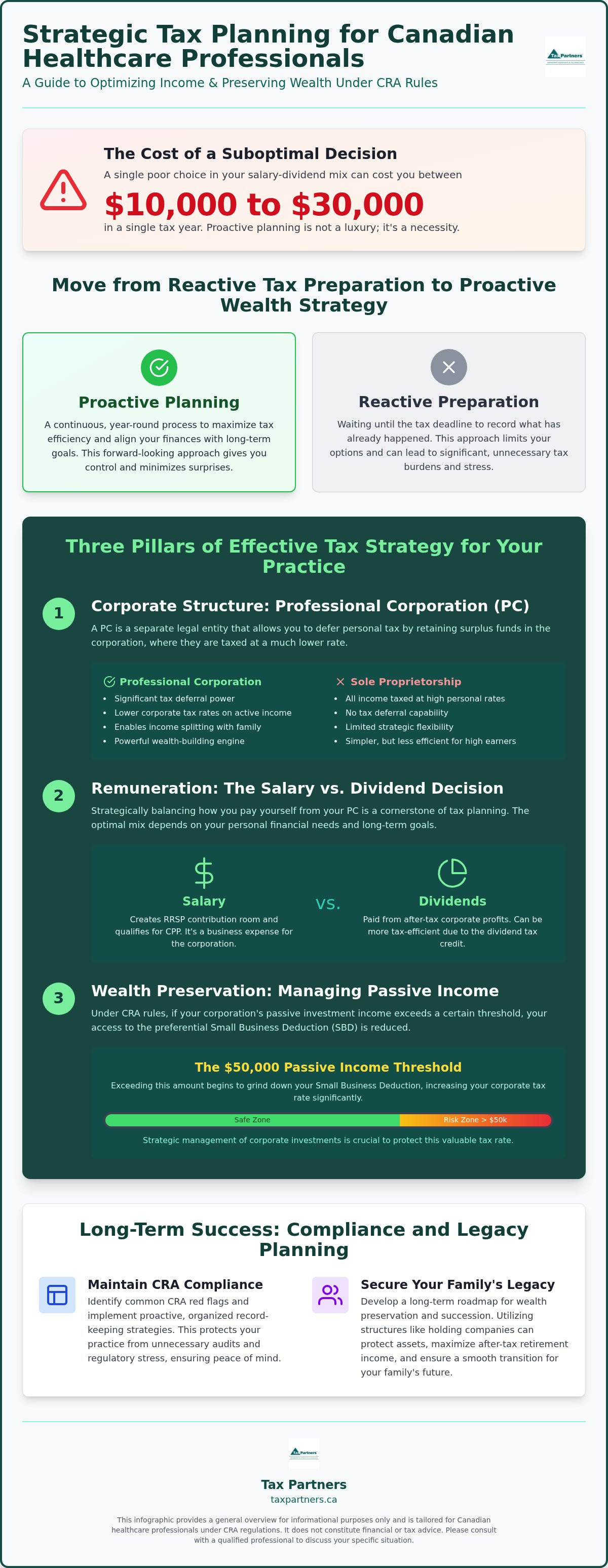
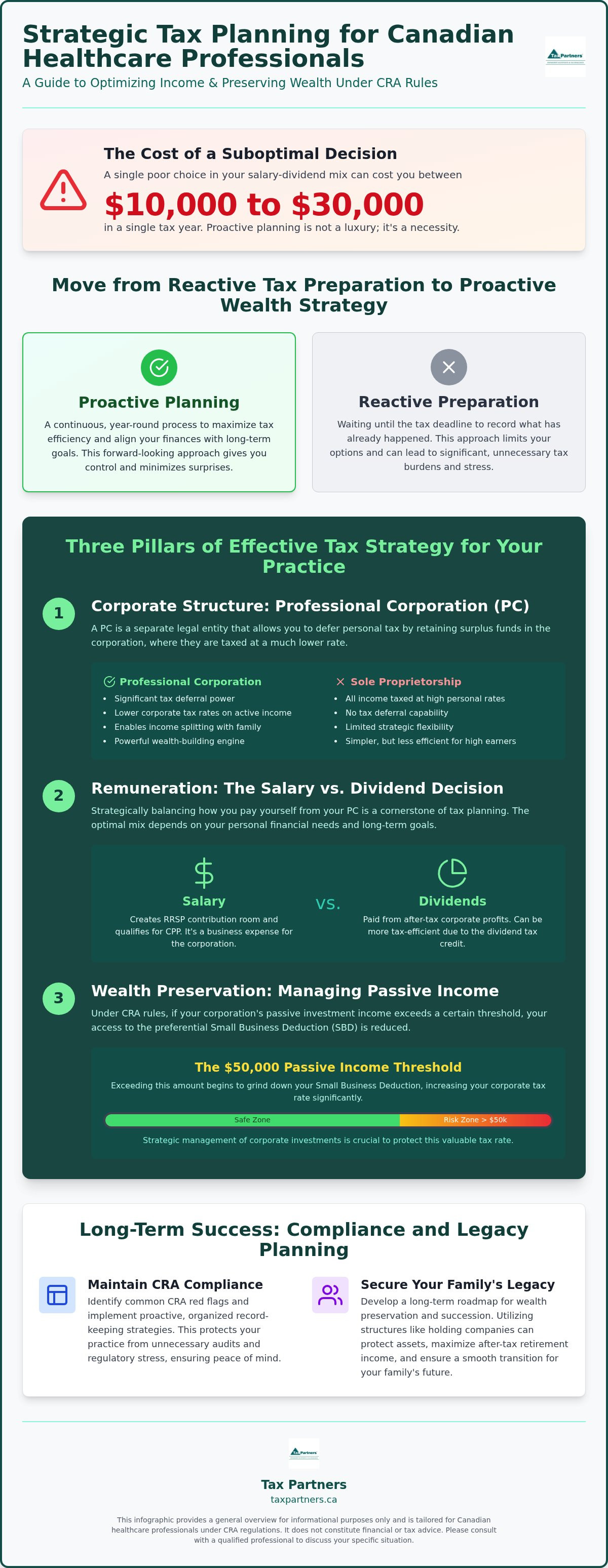
A single suboptimal decision regarding your salary versus dividend mix could cost you between $10,000 and $30,000 in a single tax year. For many medical practitioners, the weight of the highest personal tax brackets makes effective tax planning for healthcare professionals Canada a necessity rather than a luxury. You spend your days caring for others, yet the complexity of managing a Professional Corporation often leaves your own financial health on the sidelines.
It's understandable to feel overwhelmed by the intricate rules governing your earnings. You deserve a financial strategy that mirrors the precision you bring to your clinical work. We recognize that your time is your most precious resource, and managing wealth shouldn't feel like a second full-time job.
This guide provides a clear roadmap to help you optimize your professional income and preserve wealth through strategic 2026 planning tailored for the Canadian market. You'll learn how to maximize after-tax income for your family, navigate CRA passive income thresholds, and gain total confidence in your retirement path. We will break down the essential steps to move from uncertainty to a position of absolute control over your financial legacy.
Key Takeaways
- Discover how to leverage a Professional Corporation to defer significant income tax and utilize the CRA integration principle to ensure fair taxation across your practice structures.
- Learn to optimize your 2026 remuneration by strategically balancing salary and dividends, which is a cornerstone of effective tax planning for healthcare professionals Canada.
- Understand how to manage passive income within your corporation to avoid hitting the $50,000 threshold that can reduce your eligibility for the small business tax rate.
- Identify common CRA red flags and implement proactive record-keeping strategies to maintain compliance and protect your practice from unnecessary regulatory stress.
- Develop a long-term roadmap for wealth preservation and succession that uses holding companies to secure your family legacy and maximize after-tax retirement income.
The Strategic Importance of Tax Planning for Canadian Healthcare Professionals
Tax planning is the proactive analysis of your financial situation to maximize tax efficiency under Canada Revenue Agency (CRA) rules. It's a forward-looking discipline that differs fundamentally from tax preparation, which merely records what has already happened. For physicians, dentists, and specialists, this distinction is vital because high income levels often trigger the top personal tax brackets. Without a deliberate strategy, you may find yourself surrendering more than half of your incremental earnings to the government.
Adopting a "proactive guardian" approach means you aren't just reacting to tax deadlines. You're actively looking ahead to secure a better outcome for your family and your practice. This level of foresight allows you to align your current clinical income with long-term wealth goals like early retirement or practice succession. By making informed choices today, you protect the fruits of your labour from unnecessary erosion.
Moving Beyond Annual Tax Preparation
Waiting until April to think about your taxes significantly limits your options. By the time you gather your receipts for the previous year, most effective tax-saving strategies are no longer available. Real tax planning for healthcare professionals Canada requires year-round engagement and organized reviews with a seasoned mentor. This consistent oversight ensures that every financial move you make is optimized for the current tax year.
Proactive planning also serves as a powerful tool for stress reduction. Many healthcare providers experience significant anxiety when facing an unpredictable and high tax bill at the end of the year. When you have a clear roadmap, you gain the confidence that comes from knowing exactly where your money is going. You can focus on patient care while resting assured that your financial house is in order.
Defining the CRA Jurisdiction for Medical Practices
This guidance is built strictly upon the Canadian Income Tax Act and the regulations enforced by the CRA. It's essential to recognize that Corporate Tax in Canada operates under a specific set of rules that govern how professional income is treated. Healthcare practitioners must adhere to these domestic standards to remain compliant while seeking efficiency. Whether you are a sole proprietor or incorporated, your strategy must be rooted in Canadian law.
We must also clarify that these strategies apply specifically to your Canadian practice and assets. If you hold medical interests or property in the United States, those require a separate and distinct set of strategies under IRS rules. Mixing these jurisdictions can lead to complex compliance issues and double taxation. By focusing on a clear, CRA-compliant path, you ensure your Canadian wealth remains protected and productive.
Evaluating Professional Corporations and CRA Tax Implications
For physicians and dentists, establishing a Professional Corporation (PC) is often the most effective vehicle for high-level tax planning for healthcare professionals Canada. A PC is a separate legal and tax entity that allows you to control the timing of your personal income. The Canada Revenue Agency (CRA) uses the principle of integration, which aims to ensure that the total tax paid through a corporation and personally is roughly equivalent to what an individual would pay directly. However, the real advantage lies in the ability to defer taxes by keeping surplus funds within the corporation at a lower rate.
Deciding when to transition from a sole proprietorship to a PC depends largely on your practice's profitability and your personal spending habits. If your practice generates more revenue than you require for your annual lifestyle, incorporation becomes a powerful tool. This surplus capital can be reinvested or used to pay down debt more efficiently than if it were taxed at high personal graduated rates. It's a strategic shift that transforms your practice from a simple job into a sophisticated wealth-building engine.
Sole Proprietorship vs. Professional Corporation
While a sole proprietorship is simpler to manage, it lacks the robust deferral power and income-smoothing capabilities of a corporation. A PC allows you to maintain a consistent personal income regardless of practice fluctuations, which is invaluable for long-term stability. The following table outlines the primary differences you should consider under CRA regulations.
| Feature | Sole Proprietorship | Professional Corporation |
|---|---|---|
| Tax Rate | Personal graduated rates (up to ~53.5%) | SBD rate (preferential combined federal and provincial rates, typically around 12.2% on the first $500k, varying by jurisdiction) |
| Liability | Unlimited personal liability | Limited (excluding professional negligence) |
| Reporting | Personal T1 Return | Corporate T2 Return |
| Tax Deferral | None available | High (keep surplus in corporation) |
Leveraging the Small Business Deduction (SBD)
The Small Business Deduction (SBD) is a preferential tax rate available to Canadian-controlled private corporations on active business income. For 2026, the combined federal and provincial SBD rate can be as low as approximately 12.2% on the first $500,000 of income, with specific rates varying by province. This low rate is a cornerstone of tax planning for healthcare professionals Canada, as it leaves more capital available for practice growth. You should consult with a specialist to confirm these limits annually, as thresholds can be adjusted by the government.
If you operate multiple associated corporations, such as a separate hygiene company or a holding company, you must share the $500,000 SBD limit among them. Failing to organize these affairs correctly can lead to income being taxed at the general corporate rate of approximately 26.5% for CRA filers. Proactive management ensures you maximize the benefit of the lower rate across all your professional interests.
Optimizing Remuneration: Salary vs. Dividend Strategies for 2026
Choosing how to pay yourself is a pivotal decision that directly impacts your personal cash flow and long-term wealth. For 2026, the choice between drawing a salary or receiving dividends requires a nuanced understanding of the current CRA landscape. This decision shouldn't be made in a vacuum; it must align with your lifestyle needs, your desire for retirement savings, and your practice's overall profitability. Effective tax planning for healthcare professionals Canada hinges on this annual calibration of remuneration.
Your remuneration choice affects more than just your monthly bank balance. It influences your ability to contribute to registered accounts and determines your future eligibility for government benefits. A customized plan ensures that your income strategy supports your specific retirement goals while remaining flexible enough to adapt to practice fluctuations. By finding the right balance, you can protect your earnings from excessive taxation while building a robust financial foundation.
Salary vs. Dividends: Finding the Right Balance
Drawing a salary from your corporation offers several distinct advantages for Canadian practitioners. First, it creates Registered Retirement Savings Plan (RRSP) room, allowing for a maximum contribution of up to $33,810 in 2026. Salaries also require contributions to the Canada Pension Plan (CPP), which provides a stable, government-backed foundation for retirement income. For many, the first earnings ceiling for CPP contributions of $74,600 serves as a reliable benchmark for determining an appropriate salary level.
Dividends represent a distribution of after-tax corporate profits and are often taxed at a lower immediate rate than salary. They are simpler to administer because they don't require payroll tax withholdings or CPP contributions. This can lead to increased short-term cash flow, which might be preferable if you have significant personal debt or immediate investment goals outside of an RRSP. Most professionals find that a hybrid approach provides the most tax-efficient outcome:
- Take enough salary to maximize RRSP contribution room.
- Draw additional required funds as dividends to minimize payroll taxes.
- Adjust the mix annually based on changes to personal tax brackets.
The Power of Income Deferral
The most compelling reason to incorporate is the ability to leave surplus profits within the corporation to be taxed at the lower small business rate. In Ontario, this rate is approximately 12.2% on the first $500,000 of active business income for 2026. By deferring personal income, you keep nearly 88 cents of every dollar available for reinvestment within the practice. This is a massive advantage compared to the roughly 46 cents you might keep if that same dollar were taxed at the highest personal bracket.
These deferred funds can act as a powerful engine for future practice expansion or as a dedicated retirement fund. However, you must be mindful of the $50,000 passive income threshold, beyond which your small business deduction begins to grind down. This tailored approach to tax planning for healthcare professionals Canada ensures that your remuneration strategy remains a source of strength rather than a compliance risk. Consulting with a seasoned mentor will help you realize these benefits while staying firmly within CRA guidelines.
Wealth Preservation and Managing Passive Income Risks
Wealth preservation is about more than just current earnings; it's about safeguarding the capital you've worked hard to accumulate over decades of practice. For practitioners with surplus cash, effective tax planning for healthcare professionals Canada must address how corporate investments are structured to avoid unintended consequences. Without a clear plan, your clinical success can inadvertently trigger significantly higher tax rates on your active business income.
Holding Companies and Asset Protection
Many physicians and dentists use holding companies to create a vital layer of protection between their professional practice and their personal wealth. This structure allows you to move surplus funds from your operating Professional Corporation into a separate entity, effectively insulating those assets from practice-related risks. It's a strategic move that preserves capital for long-term goals while maintaining a clean operational profile for the CRA.
The flow of funds between these entities can be handled tax-efficiently through inter-corporate dividends, which are generally received tax-free by the holding company. This allows you to centralize your investments and simplify your Wealth Management & Financial Planning efforts. By separating clinical risk from investment capital, you ensure that your family's future remains secure regardless of practice fluctuations or professional liability concerns.
Navigating Passive Income Thresholds
You must be mindful of the CRA rules regarding Adjusted Aggregate Investment Income (AAII), which can limit your access to the Small Business Deduction. Under current regulations, every dollar of passive investment income over $50,000 reduces your SBD limit by $5 for CRA filers. If your corporation earns $150,000 in passive income, your access to the preferential 12.2% tax rate on active income is completely eliminated, leading to a much higher tax bill.
Managing these thresholds requires a proactive approach to your investment mix and asset allocation. You might consider strategies like individual pension plans or corporate-owned life insurance to grow wealth in a tax-sheltered environment that doesn't count toward the $50,000 limit. Regular reviews are essential to ensure your tax planning for healthcare professionals Canada stays ahead of evolving legislative changes and practice growth.
Securing a legacy for the next generation requires a steady hand at the helm and a forward-thinking outlook on emerging tax changes. Integrated wealth management combines your corporate tax strategy with your estate goals to ensure a seamless and tax-efficient transition of wealth. If you're concerned about how passive income rules might impact your 2026 tax bill, speak with our team today for a personalized assessment of your corporate structure.
Protecting Your Practice: CRA Compliance and Proactive Mentorship
Building a robust financial legacy is a significant achievement, but protecting that wealth from regulatory scrutiny is equally vital. For medical practitioners, the complexity of a Professional Corporation often brings increased attention from the Canada Revenue Agency. Meticulous record-keeping serves as your primary line of defence, ensuring that every deduction and deferral strategy is supported by clear evidence. This disciplined approach transforms your practice from a target of scrutiny into a model of compliance.
The CRA often identifies specific red flags in healthcare practices, such as excessive travel claims or inconsistent shareholder loan accounts. A proactive guardian helps you identify these potential triggers long before they result in a formal inquiry. By maintaining a clean operational profile, you can handle CRA correspondence with total confidence. You deserve the peace of mind that comes from knowing your financial house is built on a foundation of ethical steadfastness.
Essential Record-Keeping for Medical Practices
Under CRA rules, healthcare professionals must retain all financial records and supporting documents for at least six years from the end of the last tax year they relate to. This requirement covers everything from patient billing summaries and bank statements to corporate minute books and payroll records. Failing to produce these documents during a review can lead to disallowed expenses and significant penalties for CRA filers.
Professional bookkeeping ensures that your practice remains audit-ready at all times, removing the stress of a last-minute scramble for receipts. It provides a clear trail of your clinical income and business expenditures, which is essential for defending your tax position. You can learn more about establishing these systems through our Professional Bookkeeping Services, which are designed to meet the unique needs of Canadian medical practices.
Implementing a Proactive Tax Strategy
Moving from a state of uncertainty to total control over your financial future requires a long-term partnership with a seasoned CPA mentor. This journey starts with a comprehensive review of your current corporate structure and remuneration mix to identify immediate opportunities for efficiency. From there, we develop a multi-year roadmap that aligns your practice growth with your family wealth goals.
If the CRA ever requests a formal audit, having an expert to represent your interests is critical for a favourable outcome. We act as your proactive shield, managing all communications with the agency and ensuring your rights are protected throughout the process. Our specialized CRA Audit Help provides the steady hand you need to navigate complex regulatory challenges. Contact Tax Partners today to optimize your 2026 tax position and secure the professional guardianship your practice deserves.
Securing Your Financial Legacy Through Proactive Strategy
Effective tax planning for healthcare professionals Canada is more than a year-end checklist; it's a commitment to your long-term prosperity. By balancing your remuneration mix and shielding your practice from passive income risks, you ensure that your clinical success translates into lasting family wealth. You've worked hard to care for your community, and your financial structure should work just as hard for you.
At Tax Partners, we bring over 40 years of institutional wisdom to every client relationship. Our team has saved clients over $87M and earned 1,390+ five-star Google reviews by acting as a proactive guardian for medical practices across the country. We invite you to move from a state of uncertainty toward a future of total financial control and understanding.
Secure your financial future-schedule a strategic tax planning session with Tax Partners. Your journey toward a more tax-efficient 2026 starts with a single, informed decision today. We look forward to helping you protect what you've built.
Frequently Asked Questions
What is the small business tax rate for healthcare corporations in 2026?
The combined federal and Ontario small business tax rate is 12.2% on the first $500,000 of active business income for 2026. This preferential rate is available to Canadian-controlled private corporations that qualify for the Small Business Deduction.
Any income exceeding this $500,000 threshold is taxed at the general corporate rate of approximately 26.5%. You should confirm the exact rates for your specific province with the CRA or a seasoned tax mentor.
Should I pay myself a salary or dividends from my medical practice?
The choice depends on your personal financial goals and immediate cash flow needs. A salary allows you to maximize RRSP contributions and participate in the Canada Pension Plan, which provides a stable retirement foundation.
Dividends are generally taxed at a lower immediate rate and don't require CPP contributions, which can increase your short-term cash flow. Most practitioners find that a hybrid approach is the most efficient method for tax planning for healthcare professionals Canada.
How do the CRA passive income rules affect my professional corporation?
CRA rules reduce your access to the small business tax rate if your corporation earns more than $50,000 in passive investment income. For every dollar earned above this threshold, your $500,000 Small Business Deduction limit is reduced by $5.
If your passive income reaches $150,000, your access to the lower tax rate is completely eliminated. Proactive asset allocation within your corporation is necessary to manage these thresholds and protect your clinical earnings from higher taxes.
What are the tax benefits of incorporating as a healthcare professional?
Incorporation offers significant tax deferral opportunities by allowing you to keep surplus earnings within the corporation at a lower tax rate. This deferred capital can be reinvested in your practice or used for future retirement goals.
You also gain the ability to smooth your personal income over several years, which helps you avoid the highest personal tax brackets. Additionally, you may eventually qualify for the Lifetime Capital Gains Exemption upon the eventual sale of your practice shares.
How long do I need to keep my financial records for the CRA?
You must retain all financial records and supporting documents for at least six years from the end of the tax year to which they relate. This requirement includes patient billing summaries, bank statements, corporate minutes, and payroll information.
The CRA requires these records to be easily accessible in case of a review or formal audit. Maintaining organized digital records can simplify this process and ensure your medical practice remains compliant with all Canadian regulations.
Can proactive tax planning help me avoid a CRA audit?
While no strategy can completely eliminate the possibility of a review, proactive tax planning for healthcare professionals Canada significantly reduces the risk of triggering red flags. Professional oversight helps identify inconsistencies in shareholder loans or travel claims before they attract scrutiny.
By ensuring your deductions are defensible and your corporate structure follows current CRA guidelines, you project a profile of ethical steadfastness. This disciplined approach provides a sense of total control and understanding for your practice.
What is the deadline for filing corporate tax returns for a PC?
For CRA filers, the corporate income tax return (T2) must be filed within six months of the end of your corporation's fiscal year. However, any taxes owing are typically due either two or three months after your year-end.
Missing these critical deadlines can result in significant late-filing penalties and interest charges. It's vital to coordinate with your accountant early to ensure all filings are submitted accurately and on time to avoid unnecessary costs.
How can a holding company help protect my practice assets?
A holding company acts as a protective layer by separating your accumulated wealth from the operational risks of your medical practice. You can move surplus cash from your Professional Corporation to a holding company through tax-free inter-corporate dividends.
This strategy insulates your investment capital from potential professional liability claims or practice-related debts. It also simplifies your long-term wealth management by centralizing your family assets in a structure designed for preservation and eventual succession to the next generation.

Article by
Mahad Mohamed
Mahad Mohamed is an accountant and the CEO of Tax Partners, with over 26+ years of Canadian and international tax and accounting experience. His expertise includes corporate reorganization, cross-border tax structuring (Canada & US), tax disputes, CRA audits, and tax planning for small owner-managed private corporations. Most recently, Mahad is a pioneer in Canadian crypto taxation and founded Block3 Finance.
Previously, Mahad worked for the Canada Revenue Agency (CRA), Big4 accounting firms, and served as a Rulings Officer for the Federal Tax Authority of the UAE before acquiring Tax Partners in 2014.
Tax Partners has 44 full-time accountants and over 18,400+ clients.
Disclaimer
This article provides general information only and is current as of its publication date. It has not been updated and may be out of date. It does not constitute legal advice and should not be relied upon as such. Every tax situation is unique and may differ from the examples discussed in this article. If you have specific questions, you should seek the advice of our accountants for your unique circumstances. Book a FREE Initial Consultation Today!
Frequently Asked Questions
What is the small business tax rate for healthcare corporations in 2026?
The combined federal and Ontario small business tax rate is 12.2% on the first $500,000 of active business income for 2026. This preferential rate is available to Canadian-controlled private corporations that qualify for the Small Business Deduction. Any income exceeding this $500,000 threshold is taxed at the general corporate rate of approximately 26.5%. You should confirm the exact rates for your specific province with the CRA or a seasoned tax mentor.
Should I pay myself a salary or dividends from my medical practice?
The choice depends on your personal financial goals and immediate cash flow needs. A salary allows you to maximize RRSP contributions and participate in the Canada Pension Plan, which provides a stable retirement foundation. Dividends are generally taxed at a lower immediate rate and don't require CPP contributions, which can increase your short-term cash flow. Most practitioners find that a hybrid approach is the most efficient method for tax planning for healthcare professionals Canada.
How do the CRA passive income rules affect my professional corporation?
CRA rules reduce your access to the small business tax rate if your corporation earns more than $50,000 in passive investment income. For every dollar earned above this threshold, your $500,000 Small Business Deduction limit is reduced by $5. If your passive income reaches $150,000, your access to the lower tax rate is completely eliminated. Proactive asset allocation within your corporation is necessary to manage these thresholds and protect your clinical earnings from higher taxes.
What are the tax benefits of incorporating as a healthcare professional?
Incorporation offers significant tax deferral opportunities by allowing you to keep surplus earnings within the corporation at a lower tax rate. This deferred capital can be reinvested in your practice or used for future retirement goals. You also gain the ability to smooth your personal income over several years, which helps you avoid the highest personal tax brackets. Additionally, you may eventually qualify for the Lifetime Capital Gains Exemption upon the eventual sale of your practice shares.
How long do I need to keep my financial records for the CRA?
You must retain all financial records and supporting documents for at least six years from the end of the tax year to which they relate. This requirement includes patient billing summaries, bank statements, corporate minutes, and payroll information. The CRA requires these records to be easily accessible in case of a review or formal audit. Maintaining organized digital records can simplify this process and ensure your medical practice remains compliant with all Canadian regulations.
Can proactive tax planning help me avoid a CRA audit?
While no strategy can completely eliminate the possibility of a review, proactive tax planning for healthcare professionals Canada significantly reduces the risk of triggering red flags. Professional oversight helps identify inconsistencies in shareholder loans or travel claims before they attract scrutiny. By ensuring your deductions are defensible and your corporate structure follows current CRA guidelines, you project a profile of ethical steadfastness. This disciplined approach provides a sense of total control and understanding for your practice.
What is the deadline for filing corporate tax returns for a PC?
For CRA filers, the corporate income tax return (T2) must be filed within six months of the end of your corporation's fiscal year. However, any taxes owing are typically due either two or three months after your year-end. Missing these critical deadlines can result in significant late-filing penalties and interest charges. It's vital to coordinate with your accountant early to ensure all filings are submitted accurately and on time to avoid unnecessary costs.
How can a holding company help protect my practice assets?
A holding company acts as a protective layer by separating your accumulated wealth from the operational risks of your medical practice. You can move surplus cash from your Professional Corporation to a holding company through tax-free inter-corporate dividends. This strategy insulates your investment capital from potential professional liability claims or practice-related debts. It also simplifies your long-term wealth management by centralizing your family assets in a structure designed for preservation and eventual succession to the next generation.