Why Leave a Big 4 Accounting Firm? A Career Guide for 2026

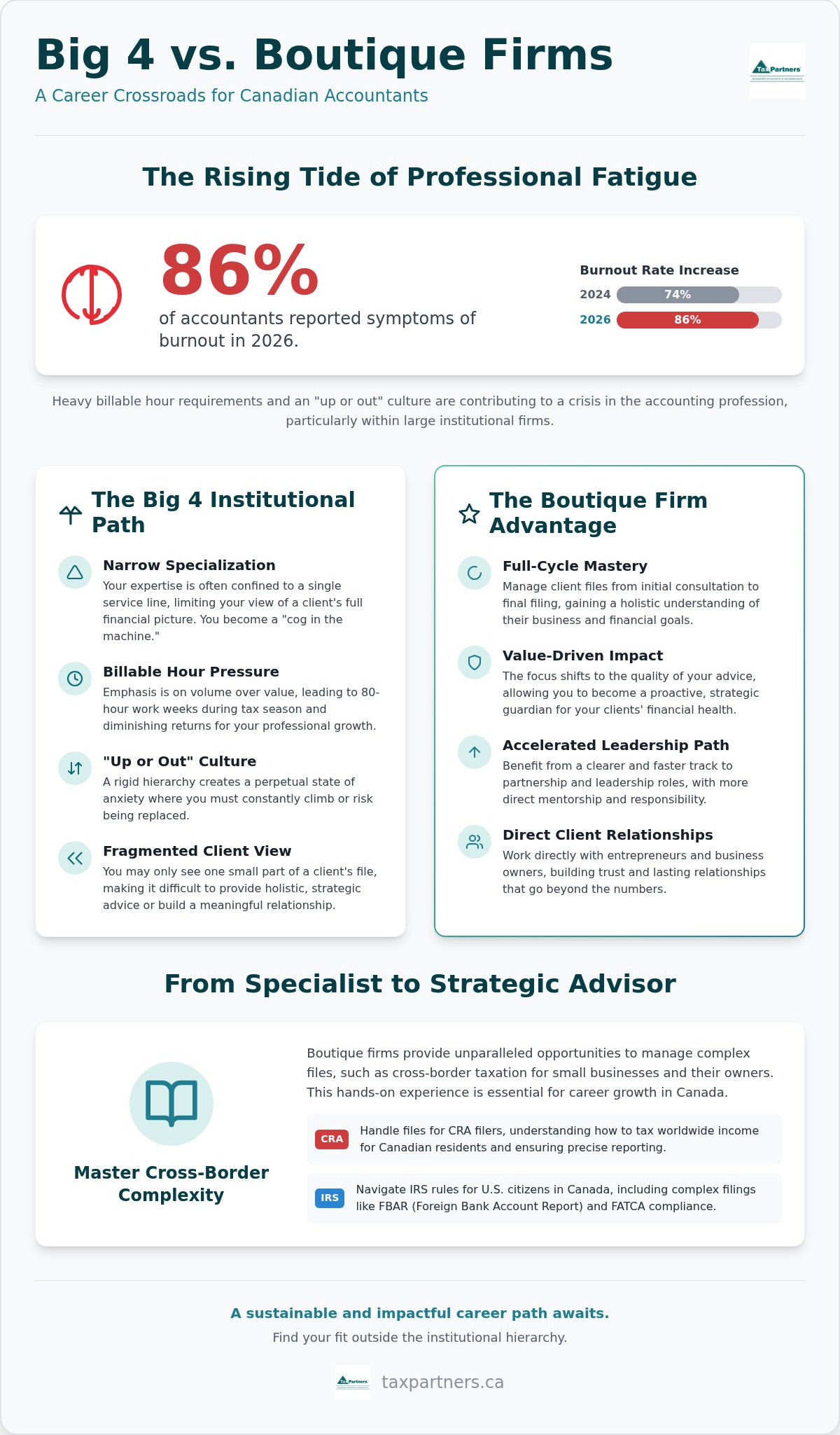
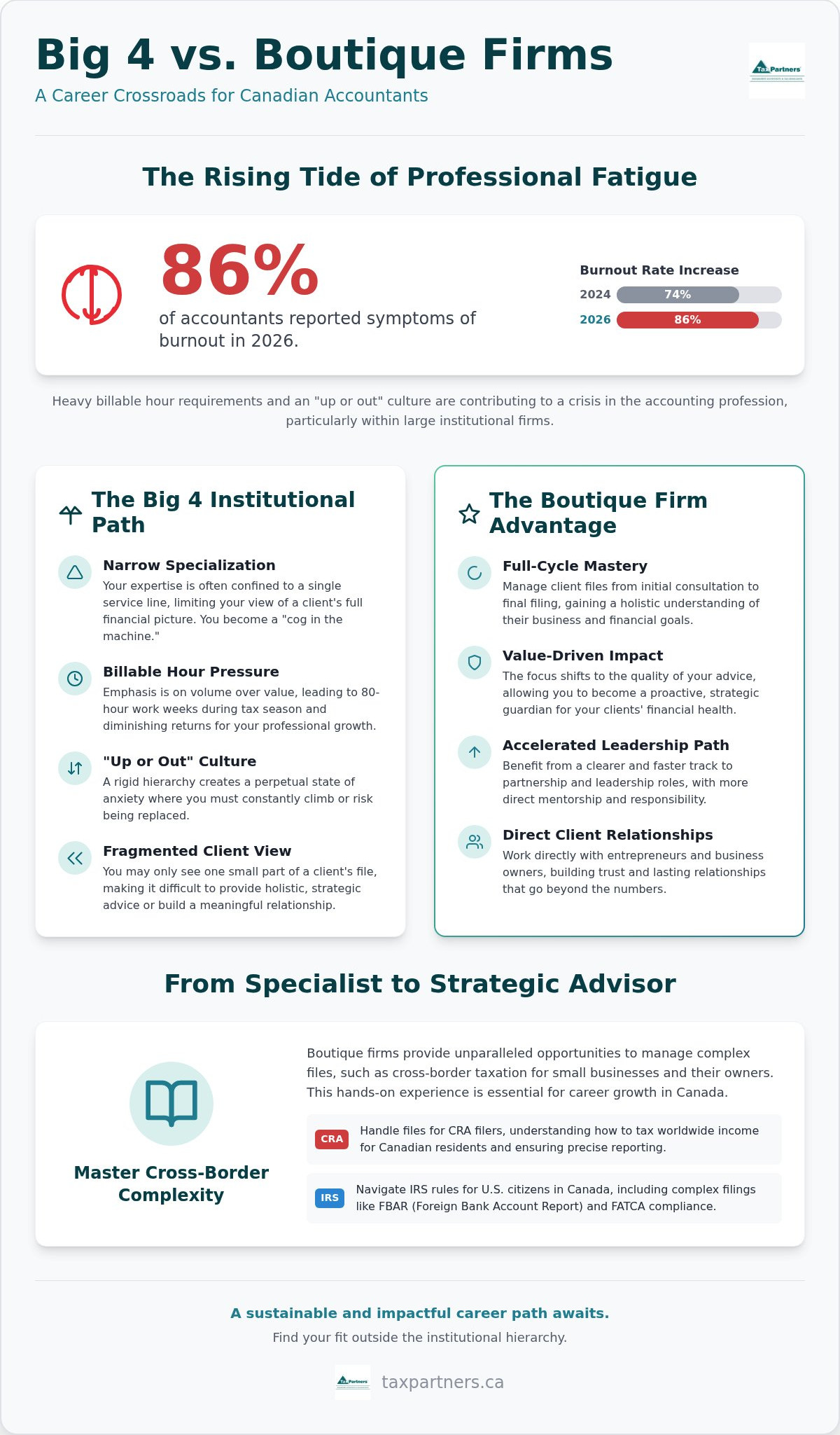
Recent data shows that 86% of accountants reported symptoms of burnout in 2026, a sharp rise from just 74% in 2024. If you're currently at a Big 4 firm, you likely feel this exhaustion every time busy season arrives. The weight of heavy billable hour requirements often overshadows the pride you take in your professional contributions.
It's frustrating to realize that your deep technical expertise is often confined to a single, narrow service line. You want to see the full picture and build lasting relationships with the entrepreneurs behind the numbers. When comparing a big 4 vs mid-size accounting firm for small business, the difference in personal impact and professional variety is often profound.
We promise to show you how a boutique environment empowers you to trade rigid specialization for a diverse range of client files, including complex cross-border work for CRA filers. You'll discover how to achieve a better work-life balance while pursuing a faster path to leadership. This guide explores why moving to a firm that values mentorship and proactive care is a strategic career pivot for 2026.
Key Takeaways
- Learn how to escape the "up or out" culture and reclaim your mental health by prioritizing a sustainable work-life balance.
- Discover the professional growth that comes from managing full-cycle files and complex cross-border tax issues for CRA filers.
- Understand the strategic advantages of a big 4 vs mid-size accounting firm for small business when it comes to direct client impact and relationship building.
- Identify the clear, accelerated path to leadership and partnership that exists outside the traditional institutional hierarchy.
- Gain practical steps to evaluate a boutique firm’s culture to ensure your next career move aligns with your long-term values.
The Big 4 Burnout: Recognizing the Signs of Professional Fatigue
The prestige of working at one of the Big Four accounting firms is undeniable. However, for many CPAs in Canada, that gold star on a resume comes at a staggering personal cost. A 2026 survey revealed that 86% of accountants reported symptoms of burnout. This isn't just a phase; it's a systemic issue. When comparing a big 4 vs mid-size accounting firm for small business, the most immediate difference is the sustainability of the culture.
The Reality of the Up or Out Culture
The "up or out" model creates a perpetual state of anxiety. You aren't just expected to perform. You're required to constantly climb, or you're shown the door. This pressure peaks when you move from Senior Associate to Manager. It isn't just about technical skill anymore. It's about surviving a hierarchy that often ignores personal boundaries. For many, this leads to a sense of professional fatigue that masks their original passion for the craft. The mental health toll can be significant, affecting your life far beyond the office walls.
When Billable Hours Overtake Professional Growth
In large institutions, billable hour targets frequently prioritize volume over genuine value. You might find yourself grinding through repetitive tasks just to hit a number. This leaves little room for the complex problem-solving that actually helps clients. High billable requirements create diminishing returns for your own development. Instead of learning, you're just producing. Transitioning to a big 4 vs mid-size accounting firm for small business allows for a shift toward value-based service. Here, the focus remains on the quality of the advice rather than the quantity of the hours logged.
The Canadian tax season is notoriously demanding for those handling files for CRA filers. Within the largest firms, this period often translates to 80-hour weeks and a total loss of personal time. Institutional bureaucracy adds layers of administrative burden that don't benefit the client or the accountant. Every decision requires multiple approvals, which slows down the resolution process. This rigidity makes it difficult to adapt to the unique needs of small and medium-sized enterprises. When your day is consumed by hurdles, your ability to act as a proactive guardian for your clients vanishes.
Specialization vs. Generalization: Why Narrow Scopes Limit Growth
While Big 4 firms offer deep expertise, that expertise is often siloed into tiny, repetitive segments. You might spend years focused solely on the tax depreciation of heavy machinery for a handful of massive corporations. This narrow scope limits your ability to understand how different financial elements interact in a real-world scenario. When considering a big 4 vs mid-size accounting firm for small business, the primary advantage for a professional is the exposure to full-cycle accounting.
The 'Cog in the Machine' Phenomenon
In a massive institutional environment, you often see only a fragment of a client's financial story. You might prepare a specific schedule for a corporate return without ever understanding the business owner's long-term goals. This lack of context can make the work feel mechanical and unfulfilling. It's hard to feel like a proactive guardian when you don't see the whole picture.
Boutique firms operate differently by allowing you to manage a file from the initial consultation to the final filing. This holistic approach is essential for professional development. It teaches you to identify risks and opportunities that a specialist might miss. You aren't just a number cruncher; you're a strategic advisor who understands the entire business lifecycle.
Mastering Cross-Border Complexity under IRS and CRA Rules
Cross-border tax is one of the most rewarding niches for career growth in Canada. Many small businesses have owners who are dual citizens or have operations on both sides of the border. Under CRA rules, Canadian residents are taxed on their worldwide income, which requires precise reporting. Working in a boutique firm allows you to master these nuances for CRA filers while seeing how they impact the client's overall wealth. This variety ensures your skills remain sharp and highly marketable in a changing economy.
The complexity increases when you apply IRS rules for US citizens living in Canada. These individuals must file an FBAR, or Foreign Bank Account Report, which is a mandatory disclosure of foreign financial accounts to the US Treasury. They also face FATCA, known as the Foreign Account Tax Compliance Act, which involves reporting foreign assets to the IRS. Small business owners often struggle to find advisors who understand both sides of the border. This creates a unique opportunity when comparing a big 4 vs mid-size accounting firm for small business, as boutique firms often provide more direct access to these complex files.
If you're ready to move beyond a narrow scope and tackle complex, meaningful files that truly help people, reach out to us today. Mastering these distinct jurisdictions is a powerful career move that positions you as an indispensable expert.
The Boutique Advantage: Impact, Autonomy, and Client Relationships
Transitioning from a Big 4 environment to a boutique firm represents a fundamental shift from institutional compliance to personalized advisory. In a boutique setting, you gain the autonomy to make decisions that directly affect your clients' financial health. This sense of ownership is often missing in larger organizations where layers of management can stifle individual initiative.
Comparing a big 4 vs mid-size accounting firm for small business reveals that boutique firms prioritize agility and responsiveness. At Tax Partners, our professionals aren't buried under administrative bureaucracy. They're empowered to apply their expertise to solve real problems for Canadian SMEs. This autonomy fosters a culture where professional creativity and foresight actually thrive.
Direct Client Access and Relationship Building
Moving from the back office to a client-facing role changes how you view your career. In the Big 4, you might never meet the individual whose return you are preparing. At a boutique firm, you sit across the table from the business owner and see how your tax planning strategies help them expand operations or secure their family's future.
This direct impact builds a deep sense of professional purpose. You aren't just filing documents for CRA filers; you're helping a local business navigate complex regulations. Seeing the tangible results of your work creates a level of job satisfaction that institutional audits simply cannot match. It transforms a routine engagement into a long-term partnership.
Mentorship and the Proactive Guardian Persona
Boutique firms offer organic mentorship opportunities that are rare in larger institutions. Instead of formal, rigid performance reviews, you get daily interaction with senior partners who have decades of experience. This direct access allows you to learn the nuances of the "Proactive Guardian" approach, where the focus is on looking ahead to secure better outcomes.
Working closely with seasoned experts helps you internalize institutional wisdom while developing your own leadership style. You learn to anticipate needs before the client even realizes they have them. This mentorship is designed to move you quickly toward a state of total control over your professional journey. To see how this philosophy drives our work, you can learn about our mission and vision.
Helping Canadian SMEs grow is a uniquely rewarding experience. These businesses are the backbone of our economy, and they rely on precise, customized advice to succeed. When you act as their guardian, you aren't just an accountant; you're a vital part of their success story. This relationship-focused model is the hallmark of a big 4 vs mid-size accounting firm for small business.
Career Progression Outside the Big 4: Redefining Professional Success
Many young CPAs fear that leaving a global brand will stall their professional momentum. This is a common misconception that ignores the current market reality. In truth, the skills you've honed at a large firm are highly coveted by mid-size firms serving the SME sector.
When comparing a big 4 vs mid-size accounting firm for small business, the career trajectory often shifts from being a specialist to becoming a business leader. Your Big 4 pedigree serves as a mark of technical excellence. However, it's your ability to adapt that creates long-term value for clients and your own career.
The Prestige Myth and Market Reality
Employers in the Canadian SME market prioritize professionals who can think on their feet. They don't just want a technical expert; they want a strategic partner. A boutique professional manages complex files for CRA filers with a level of agility that institutional roles rarely permit.
Total compensation in 2026 is also evolving beyond just the base salary. While a median base salary for a manager is approximately $142,000, boutique environments often provide better work-life balance and mental health. This flexibility is a vital part of your overall professional value that large firms often overlook.
Pathways to Partnership and Firm Ownership
The traditional partner track in a large firm can span 15 years or more. In contrast, boutique firms like Tax Partners offer a significantly compressed timeline. You're noticed faster because your impact is visible every day to the senior leadership team.
Equity and profit-sharing are often more accessible in smaller environments. This allows you to build genuine wealth as you help the firm expand its footprint. You can explore our business solutions for SMEs to see the types of high-value engagements that drive this firm-wide growth.
Beyond tax compliance, boutique firms allow you to branch into wealth management and financial planning. This broader scope ensures you aren't just reacting to past data. Instead, you're actively building a client's future through foresight and precision. This holistic career path offers a level of stability and fulfillment that is hard to find in a siloed corporate role.
If you're ready to take control of your career and accelerate your path to leadership, contact our team to discuss your future.
Navigating Your Transition: Why Boutique Firms Win
Making the leap from a global institution to a boutique firm requires more than just a resignation letter. It's a strategic move that demands a clear understanding of your professional goals. When you weigh the options of a big 4 vs mid-size accounting firm for small business, the winning choice is the one that aligns with your desire for autonomy and technical mastery.
A successful transition starts with an audit of your own skills. You must move beyond the "cog in the machine" mindset and embrace the versatility required in a boutique setting. This means preparing to handle full-cycle accounting and direct client advisory for a diverse range of Canadian SMEs. It's about trading institutional rigidness for a role where your foresight actually shapes a client's future.
Evaluating Firm Culture and Mission
Aligning with a firm's core values is the most critical step in your journey. You should look for an environment that mirrors your own commitment to ethical steadfastness and reliability. Many ex-Big 4 professionals find that they thrive in firms that prioritize long-term partnerships over short-term billable targets. To understand the philosophy that guides a successful boutique firm, you can meet our Managing Partner and learn about our commitment to excellence.
Stability is another key factor to consider during your evaluation. A firm with a deep-seated history provides the reassurance you need to build a lasting career. You aren't just looking for a new job; you're looking for a proactive guardian who will invest in your growth. This cultural fit ensures that your transition is a step toward a more sustainable and rewarding professional life.
Making the Move to Specialized Tax Excellence
The demand for high-level expertise in the SME sector has never been higher. Professionals who can navigate international tax advisory Canada are particularly valuable. This field requires a precise understanding of CRA filers' needs while maintaining a strict separation of duties under different jurisdictions. For example, managing Canadian tax obligations must always be handled separately from any requirements under IRS rules to ensure total compliance.
Tax Partners offers the ideal home for those who want to apply their Big 4 skills in a meaningful way. With over 40 years of experience and more than 495,000 returns filed, we provide the institutional wisdom of a large firm with the warmth of a boutique office. You'll work on complex files that challenge your technical abilities while enjoying a better work-life balance. If you're ready to redefine your success, contact Tax Partners to discuss your career transition and discover how your expertise can make a real difference.
Secure Your Professional Future
Choosing between a big 4 vs mid-size accounting firm for small business is about more than just your next paycheck. It's a choice to prioritize your mental health and reclaim your professional purpose. You've learned that trading rigid specialization for full-cycle advisory allows you to see the real impact of your work on CRA filers. This transition empowers you to move from being a cog in a machine to a proactive guardian for growing Canadian SMEs.
Tax Partners provides the stability of 40+ years of Canadian tax expertise and the support of over 1,390 five-star Google reviews. We offer specialized mentorship in cross-border tax, ensuring your skills remain sharp and highly marketable. It's time to realize your full potential in an environment that values your history while securing your future. Join a team that values your Big 4 expertise-explore careers at Tax Partners.
Your best professional years are still ahead of you. We are ready to help you take that next step toward a more fulfilling and balanced career.
Frequently Asked Questions
Will leaving a Big 4 firm hurt my chances of returning to a large corporation later?
Leaving a large firm often enhances your prospects rather than limiting them. Large corporations in 2026 value the versatile, full-cycle experience that only a boutique firm provides. While a Big 4 name offers initial prestige, boutique experience proves you can manage diverse challenges and direct client relationships. Many employers now prioritize professionals who understand the entire business lifecycle over those who have only worked in narrow, specialized silos.
What is the typical salary difference between Big 4 and boutique accounting firms in Canada?
Salary differences are often narrower than most realize, especially when you factor in total compensation. In 2026, median base salaries for managers are approximately $142,000 across the industry. Boutique firms might offer slightly different base pay but often compensate with better bonuses and significant lifestyle benefits. When analyzing a big 4 vs mid-size accounting firm for small business, you must consider the financial value of your time and mental health.
How do boutique firms handle busy season compared to Big 4 firms?
Boutique firms typically manage the tax season with more flexibility and proactive planning. While the volume of work for CRA filers naturally increases, the 80-hour work weeks common at larger institutions are rarely the standard. We prioritize realistic billable targets and clear communication to prevent professional fatigue. This approach ensures our team remains sharp and attentive to individual client concerns even during the most demanding periods of the year.
Do boutique firms provide enough technical support for complex tax filings?
Boutique firms like Tax Partners provide deep technical support through decades of institutional wisdom. With over 40 years of experience and 495,000 returns filed, we have the resources to handle very complex tax files. You'll have direct access to senior partners who act as mentors in a collaborative environment. This structure ensures every professional has the guidance needed to resolve intricate regulatory matters with total precision and confidence.
Can I specialize in cross-border tax at a boutique firm like Tax Partners?
You can absolutely specialize in cross-border tax at our firm. We focus heavily on assisting dual citizens and expats with complex 1040 filings and CRA compliance. You'll gain expertise in FBAR, the Foreign Bank Account Report, and FATCA, known as the Foreign Account Tax Compliance Act. This niche is highly rewarding and offers a level of technical challenge that rivals any large institutional engagement while providing deeper client impact.
What are the most in-demand skills for CPAs leaving the Big 4 in 2026?
The most in-demand skills include cross-border tax expertise, advisory-led relationship building, and proficiency in AI-driven automation. Professionals who can translate complex data into actionable strategies for SMEs are highly valued. When comparing a big 4 vs mid-size accounting firm for small business, the ability to act as a proactive guardian is what sets top CPAs apart. Technical skill is the baseline, but strategic foresight is the true differentiator.
How does the client base differ between Big 4 and boutique firms?
The client base at a boutique firm consists primarily of entrepreneurs and small-to-midsize enterprises rather than massive public corporations. You'll work directly with business owners who value your personalized advice and long-term partnership. This creates a much tighter feedback loop and a stronger sense of professional purpose. Instead of auditing a faceless entity, you are helping real people grow their businesses and protect their family wealth through precise planning.
Is it possible to achieve a better work-life balance without sacrificing my career growth?
Achieving a better work-life balance is possible and often accelerates your career growth. Boutique firms offer faster paths to partnership and leadership because your contributions are more visible to the decision-makers. You trade the "up or out" pressure for a sustainable trajectory that respects your personal life and mental health. This balance allows you to stay in the profession longer and achieve a higher level of mastery without the risk of burnout.

Article by
Mahad Mohamed
Mahad Mohamed is an accountant and the CEO of Tax Partners, with over 26+ years of Canadian and international tax and accounting experience. His expertise includes corporate reorganization, cross-border tax structuring (Canada & US), tax disputes, CRA audits, and tax planning for small owner-managed private corporations. Most recently, Mahad is a pioneer in Canadian crypto taxation and founded Block3 Finance.
Previously, Mahad worked for the Canada Revenue Agency (CRA), Big4 accounting firms, and served as a Rulings Officer for the Federal Tax Authority of the UAE before acquiring Tax Partners in 2014.
Tax Partners has 44 full-time accountants and over 18,400+ clients.
Disclaimer
This article provides general information only and is current as of its publication date. It has not been updated and may be out of date. It does not constitute legal advice and should not be relied upon as such. Every tax situation is unique and may differ from the examples discussed in this article. If you have specific questions, you should seek the advice of our accountants for your unique circumstances. Book a FREE Initial Consultation Today!
Frequently Asked Questions
Will leaving a Big 4 firm hurt my chances of returning to a large corporation later?
Leaving a large firm often enhances your prospects rather than limiting them. Large corporations in 2026 value the versatile, full-cycle experience that only a boutique firm provides. While a Big 4 name offers initial prestige, boutique experience proves you can manage diverse challenges and direct client relationships. Many employers now prioritize professionals who understand the entire business lifecycle over those who have only worked in narrow, specialized silos.
What is the typical salary difference between Big 4 and boutique accounting firms in Canada?
Salary differences are often narrower than most realize, especially when you factor in total compensation. In 2026, median base salaries for managers are approximately $142,000 across the industry. Boutique firms might offer slightly different base pay but often compensate with better bonuses and significant lifestyle benefits. When analyzing a big 4 vs mid-size accounting firm for small business, you must consider the financial value of your time and mental health.
How do boutique firms handle busy season compared to Big 4 firms?
Boutique firms typically manage the tax season with more flexibility and proactive planning. While the volume of work for CRA filers naturally increases, the 80-hour work weeks common at larger institutions are rarely the standard. We prioritize realistic billable targets and clear communication to prevent professional fatigue. This approach ensures our team remains sharp and attentive to individual client concerns even during the most demanding periods of the year.
Do boutique firms provide enough technical support for complex tax filings?
Boutique firms like Tax Partners provide deep technical support through decades of institutional wisdom. With over 40 years of experience and 495,000 returns filed, we have the resources to handle very complex tax files. You'll have direct access to senior partners who act as mentors in a collaborative environment. This structure ensures every professional has the guidance needed to resolve intricate regulatory matters with total precision and confidence.
Can I specialize in cross-border tax at a boutique firm like Tax Partners?
You can absolutely specialize in cross-border tax at our firm. We focus heavily on assisting dual citizens and expats with complex 1040 filings and CRA compliance. You'll gain expertise in FBAR, the Foreign Bank Account Report, and FATCA, known as the Foreign Account Tax Compliance Act. This niche is highly rewarding and offers a level of technical challenge that rivals any large institutional engagement while providing deeper client impact.
What are the most in-demand skills for CPAs leaving the Big 4 in 2026?
The most in-demand skills include cross-border tax expertise, advisory-led relationship building, and proficiency in AI-driven automation. Professionals who can translate complex data into actionable strategies for SMEs are highly valued. When comparing a big 4 vs mid-size accounting firm for small business, the ability to act as a proactive guardian is what sets top CPAs apart. Technical skill is the baseline, but strategic foresight is the true differentiator.
How does the client base differ between Big 4 and boutique firms?
The client base at a boutique firm consists primarily of entrepreneurs and small-to-midsize enterprises rather than massive public corporations. You'll work directly with business owners who value your personalized advice and long-term partnership. This creates a much tighter feedback loop and a stronger sense of professional purpose. Instead of auditing a faceless entity, you are helping real people grow their businesses and protect their family wealth through precise planning.
Is it possible to achieve a better work-life balance without sacrificing my career growth?
Achieving a better work-life balance is possible and often accelerates your career growth. Boutique firms offer faster paths to partnership and leadership because your contributions are more visible to the decision-makers. You trade the "up or out" pressure for a sustainable trajectory that respects your personal life and mental health. This balance allows you to stay in the profession longer and achieve a higher level of mastery without the risk of burnout.