Dealing With a CRA Reassessment Notice: Canada Guide

If you’re dealing with a CRA reassessment notice, start by identifying exactly what the Canada Revenue Agency (CRA) changed. A revised amount for income, credits, deductions, tax, interest or penalties can be unsettling, but the notice is a starting point for understanding the adjustment, not proof that you made an error or that the CRA’s calculation is correct.
Your next step might be to ask the CRA for clarification, request a change to your return or file a formal objection. The right route depends on whether you accept the adjustment, need more information or disagree with the facts or tax treatment. Review the notice promptly, since objection deadlines and filing requirements apply.
This guide explains how to compare the reassessment with your filed return, identify the CRA’s reasons and organize relevant records. It also covers response options, what to consider if you owe a balance and when Canadian tax support may help with a more complex reassessment.
Key Takeaways
- Understand what a CRA Notice of Reassessment changes and how it differs from your original Notice of Assessment.
- Compare each adjusted item with your filed Canadian tax return and records before drawing conclusions about the CRA’s reasons.
- When dealing with a CRA reassessment notice, match your response to the issue: a correction request, a discussion with the CRA or a formal objection.
- Build a clear objection by identifying the disputed issue, explaining the relevant facts and including supporting documents.
- For complex calculations or records, Canadian tax support can help organize your materials and clarify the questions to address.
What a CRA Notice of Reassessment Means for Your Canadian Tax Return
A Notice of Reassessment is the CRA’s updated assessment after it changes a return that has already been assessed. Your original Notice of Assessment showed the CRA’s initial results; the reassessment sets out the revised results. It may change your balance, refund, credits, deductions, income or other amounts.
The notice is important because it records the CRA’s revised calculation. A change doesn’t automatically mean you made an error or that the adjustment is correct. The Canada Revenue Agency (CRA) administers Canadian tax returns, and its notice is the first place to look for details about the change affecting you.
Take a measured approach: identify what changed, compare it with your filed return and supporting records, then decide whether the adjustment appears accurate. If you need clarification or disagree with the revised result, consider the appropriate response. Dealing with a CRA reassessment notice starts with understanding the calculation rather than guessing at the reason.
What information does a CRA reassessment notice show?
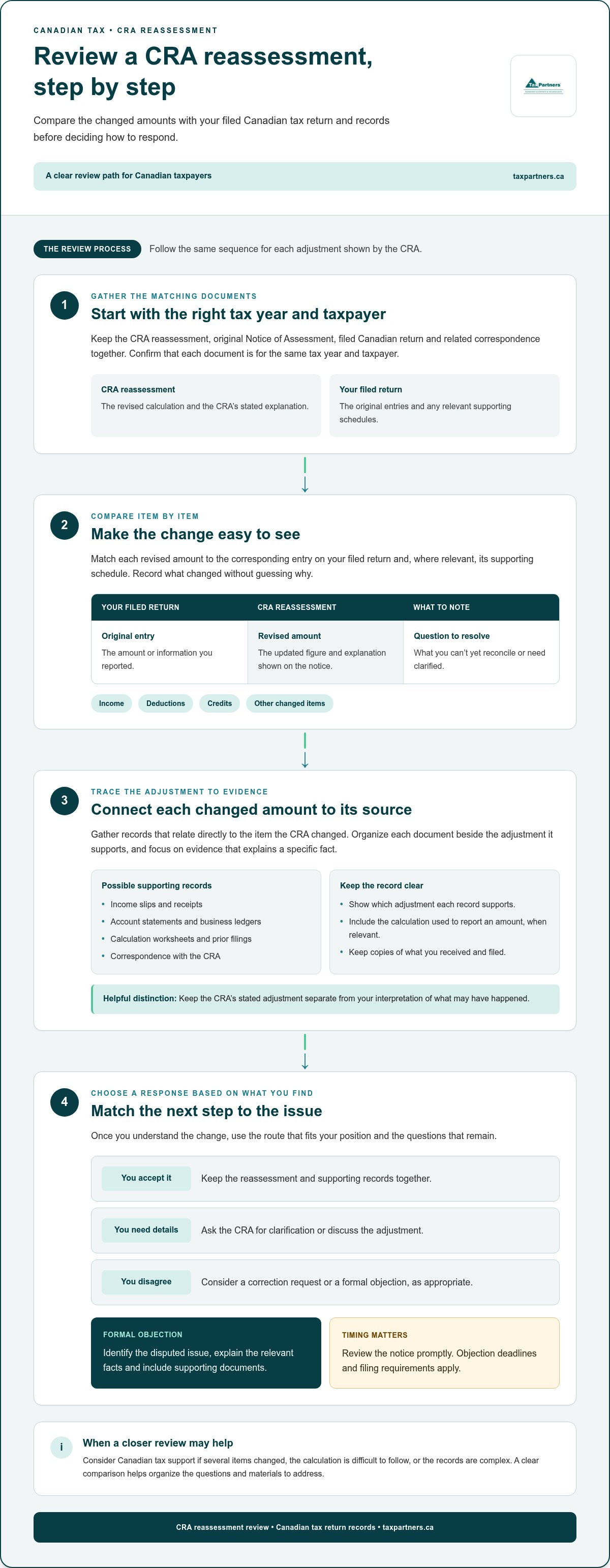
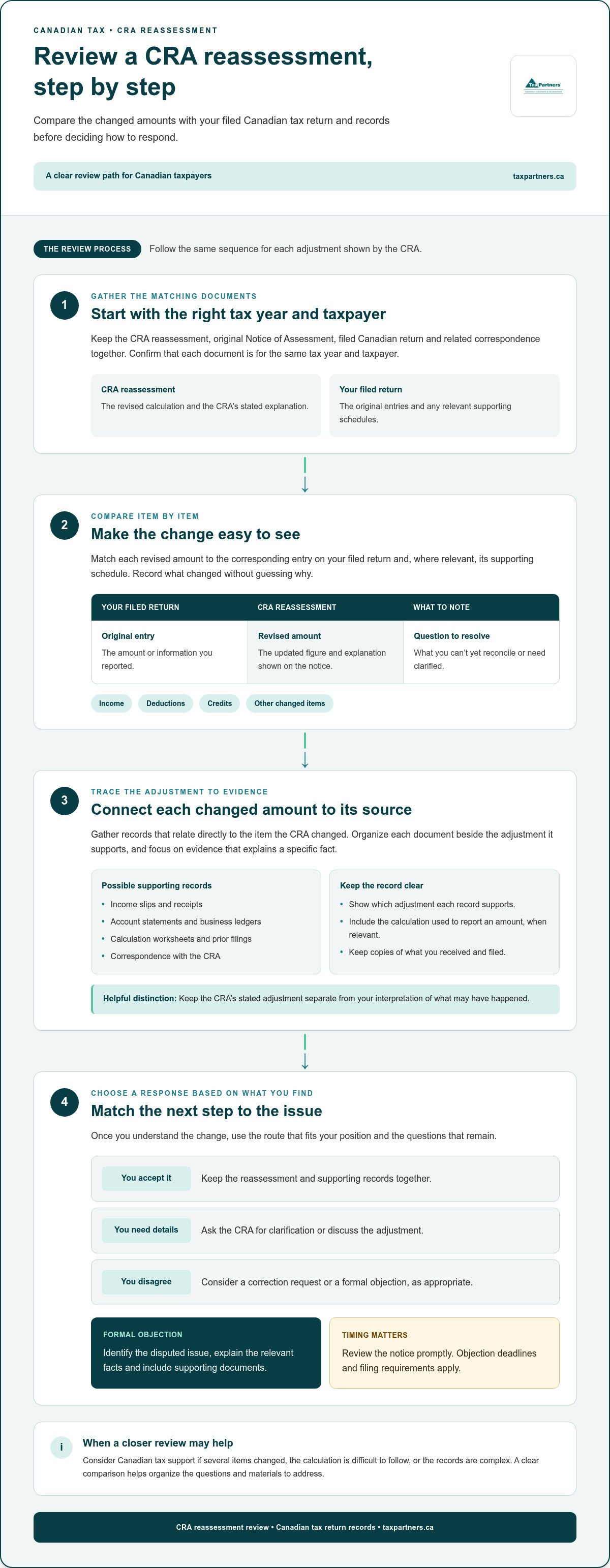
Compare the reassessment with both your original Notice of Assessment and the return you filed. Look for the revised calculation, the affected tax-return items and any explanation of the changes. Record the tax year, the date on the notice, each changed amount and the CRA’s stated reason.
Separate what the notice says from what you think may have happened. For example, if the CRA changed a reported income amount, note the change, then check the corresponding entry on your return and the related records. If the explanation doesn’t answer a question, write it down rather than assuming what the CRA meant.
Why might the CRA reassess a Canadian tax return?
A reassessment may follow a review that changes how an item on a Canadian tax return was reported or calculated. The CRA’s explanation may refer to a discrepancy, missing documents or a different treatment of an amount. Possible issues can involve income, deductions or credits, but the reason for your reassessment should be identified in the notice or relevant CRA guidance.
A notice alone doesn’t establish that someone deliberately failed to meet Canadian tax requirements. It records a revised assessment, but it may not explain every detail behind the adjustment. Compare the stated reason with your records before deciding whether the revised result reflects your circumstances.
For individuals and businesses, connect each changed amount to its source, such as the filed return, slips, receipts, statements or other relevant records. Keep your questions specific. This gives you a clearer basis for deciding whether to accept the change, seek clarification or use the appropriate CRA process to dispute it.
Read the CRA Reassessment Carefully Before You Respond
Before choosing how to respond, make a clear record of what changed. Keep the CRA reassessment, original Notice of Assessment, filed Canadian return and related correspondence together. Check that each document is for the same tax year and taxpayer, since a mismatch can lead you to review the wrong information.
As you compare the documents, distinguish the CRA’s stated adjustment from your interpretation. Note what the notice says, what you expected to see and any questions that remain. This gives you a sound starting point for dealing with a CRA reassessment notice without guessing at the reason.
How to compare the reassessment with your filed return
Work through the reassessment item by item. Match each revised amount to the corresponding entry on your filed return and, where relevant, its supporting schedule. Record the original amount beside the CRA’s revised figure, then note whether the change relates to income, a deduction, a credit or another item identified in the notice.
- Changed item: Record the line or description shown on the notice.
- Original entry: Copy the amount or information from your filed return.
- CRA revision: Record the updated amount and the explanation provided.
- Question to resolve: Note what you can’t yet reconcile, without assuming why the change was made.
Check names and calculations as well as amounts. Trace any difference back to the underlying records before drawing a conclusion. It may relate to a revised figure, a document interpreted differently or another adjustment described in the notice.
Which records can help explain a CRA adjustment?
Gather records that relate directly to the item the CRA changed. Depending on the issue, these might include income slips, receipts, account statements, business ledgers, calculation worksheets, prior filings or correspondence with the CRA. Focus on the evidence that explains a specific fact rather than sending a large volume of unrelated paperwork.
Organize each document beside the adjustment it supports. If a changed amount relates to a business expense, for example, connect the relevant receipt and accounting entry to that expense, and include the calculation used to report it. Keep copies of what you received and filed so the sequence of events remains clear.
For a corporation filing a T2, meaning a Canadian corporation income tax return, the CRA’s guidance on CRA reassessment periods and reasons provides information specific to corporations. Use guidance that matches the taxpayer and return involved, and check the CRA’s current instructions when needed.
When does a reassessment need closer professional review?
Consider professional tax guidance if the CRA changed several items, the calculation is difficult to follow or the records involve complex business activity. A review can help connect the notice, return and source documents, identify unanswered questions and organize the facts for a response. It can also help distinguish a record-keeping gap from a disagreement about the tax treatment.
Tax Partners provides Canadian tax support to help review a notice and organize related tax materials. Discuss your CRA reassessment with the team.
Choose the Right CRA Response: Correction, Discussion, or Objection
Once you’ve identified what changed, choose a response that fits the issue. A return detail that needs correcting may call for a correction route, while an unresolved disagreement with the assessment may require a formal objection. The appropriate option depends on the issue, the tax type and the current CRA procedures for that return.
Correction request
May fit when a return detail appears incomplete or incorrect and you want the CRA to process a change. Follow the current process for the return and issue.
CRA discussion
May help clarify the reason for an adjustment or explain what information the CRA considered. A conversation alone may not preserve the time to file a formal objection.
Formal objection
May fit when you disagree with the CRA’s assessment or reassessment and want to dispute it through the applicable formal process.
These are different routes, not interchangeable labels. Decide whether you accept the CRA’s tax treatment, need clarification or believe the revised assessment should change. Check the CRA’s current instructions for your tax type before submitting anything.
When might a correction request or CRA discussion fit?
A correction request may be appropriate if you’ve found a return detail that needs updating and can now report the information accurately. A discussion with the CRA may help if the notice is unclear or you need to understand how the CRA reached a particular adjustment. In either case, use the current CRA process for your return and issue.
Keep the formal objection deadline in view while seeking clarification. A discussion by itself may not preserve your right to object, so check the applicable CRA deadline rather than assuming that an ongoing conversation pauses it.
When should you consider a formal Notice of Objection?
A Notice of Objection is a formal written dispute used to challenge a CRA assessment or reassessment through the applicable process. Consider this route if you’ve reviewed the change and disagree with the facts or tax treatment behind it. State which adjustment you dispute, why you disagree and what change you believe is appropriate.
Eligibility, deadlines and filing requirements can depend on the taxpayer and type of tax matter. Check the current CRA requirements promptly. Tax Partners provides tax assessment objection support to help organize the issue and related records.
How should you think about CRA mediation?
Mediation is a possible dispute-resolution option only where current CRA guidance says it applies to the matter. It isn’t a universal alternative to an objection, and exploring mediation doesn’t necessarily replace a required filing step or deadline. Confirm the applicable CRA process before relying on it.
Where relevant, CRA mediation support may help parties work through the issues in a dispute. Keep formal requirements in view as you consider any resolution option. Understanding how each route applies can help you choose the next step when dealing with a CRA reassessment notice.
Prepare and File a CRA Objection With a Clear Record
A Notice of Objection is a formal written dispute of a CRA assessment or reassessment. A clear submission connects the adjustment you challenge to the facts and documents that support your position. When dealing with a CRA reassessment notice, focus on a concise explanation instead of sending a large, unexplained bundle of records.
Build the objection in a logical sequence:
- Identify the issue. Name the tax year and the specific adjustment you’re disputing, using the wording or item shown on the CRA notice.
- State the facts. Set out the relevant details plainly, including what you reported and which records support it.
- Explain the disagreement. Describe why the CRA’s change appears incorrect based on the facts and tax treatment relevant to your case.
- State the requested change. Explain what you believe should be corrected, without relying on unsupported assumptions.
- Attach relevant evidence and submit. Include documents that relate directly to the disputed issue, then follow the current CRA filing instructions for your matter.
How to explain each disputed item
Address each adjustment separately, especially if the CRA changed more than one item. For each one, identify the corresponding return entry or explanation on the notice, state the relevant facts, explain why you disagree and describe the correction you’re seeking.
Make sure each point is consistent with the records you attach. If your objection concerns how a reported amount was calculated, for example, show the calculation and connect it to the supporting statements or other source documents. A focused explanation makes it easier to see how your evidence supports your position.
How to check CRA objection deadlines and filing requirements
Don’t assume the same deadline or filing steps apply to every Canadian tax matter. Requirements can depend on the type of taxpayer and dispute, so check current official CRA guidance for your case before preparing to submit.
Confirm the deadline, eligibility, any required form and available submission channel using the CRA’s current instructions. If anything is unclear, verify it with the CRA promptly. An informal discussion shouldn’t be treated as a substitute for meeting a formal objection deadline.
What to keep after submitting an objection
Save a complete copy of the objection as submitted, including the explanation and every attachment. Keep the submission confirmation or delivery proof, and record the filing date so you can refer to the details accurately if the CRA follows up.
Store later CRA letters, requests and replies with the original notice and objection materials. A single, organized record helps you track what the CRA has asked for and keep future responses consistent with the facts already provided.
Tax Partners can help review your tax materials and organize your response. Get help organizing your CRA response.
Get Tailored Support for a Complex CRA Reassessment
Some Canadian reassessments are straightforward. Others involve several tax-return items, detailed calculations or records spread across personal and business accounts. If the facts are difficult to reconcile, professional Canadian tax support can help organize the materials before you decide how to respond.
Tax Partners provides Canadian personal and corporate tax services, including CRA audit support. For a reassessment, support can include reviewing the notice alongside the filed return and relevant records, identifying questions that need answers, and organizing evidence for the applicable CRA process. A review can help you prepare a clearer response, but it cannot promise that the CRA will change its assessment.
What a tax professional can help you prepare
A tax professional can compare the CRA’s adjustment with the corresponding return entry, calculations and source documents. This can help identify whether an amount is supported by the records, whether information is missing or whether the explanation needs further clarification.
For example, a corporate reassessment may involve figures drawn from bookkeeping records, financial statements and tax calculations. Reviewing those materials together can help isolate which facts relate to the disputed adjustment and where documentation may be incomplete.
With that groundwork, you can organize the issue into a concise explanation: what the CRA changed, what the records show and what question or correction you want addressed. The aim is a response that is specific and consistent with the evidence, not simply a larger package of documents.
- Review: Compare the reassessment with the return and relevant supporting records.
- Clarify: Identify unanswered questions, calculation differences or gaps in documentation.
- Organize: Connect each relevant record to the fact or adjustment it supports.
- Prepare: Support a clear explanation within the CRA process that applies to the matter.
This kind of assistance is especially useful when you’re dealing with a CRA reassessment notice that affects more than one item or requires a careful review of business records. Professional tax support can help you understand the materials and prepare your next steps, while formal disputes remain subject to the applicable CRA procedures.
When the reassessment connects to a wider CRA review
A reassessment may follow a review of information on a return, but receiving one doesn’t by itself establish that the CRA has started an audit. Read the notice and related CRA correspondence to understand what the agency is asking about and whether it has identified a broader review.
If the CRA requests additional information or raises questions beyond the reassessed item, keep those requests with the notice and note how each relates to the return. Tax Partners’ CRA audit support can help organize tax materials and clarify questions connected to CRA review work. A reassessment is not necessarily an audit, and no particular result is guaranteed.
For tailored help reviewing the notice, return and supporting records, contact Tax Partners about your CRA reassessment.
Take Your Next Step With Clarity
A reassessment can raise questions that extend beyond a single line on a return. Keep your reasoning tied to the documents, note what remains unresolved and make decisions with the applicable CRA process in mind. An organized record helps you explain your position and track the next steps.
Tax Partners brings more than 40 years of experience serving Canadian clients. The firm reports filing over 495,000 returns and receiving over 1,390 five-star Google reviews. If you’re dealing with a CRA reassessment notice and would value support reviewing the tax materials and planning your next step, discuss your reassessment with Tax Partners.
You don’t have to resolve every question at once. Start with the adjustment, the relevant records and the CRA process that applies to your matter.
Frequently Asked Questions
Is a CRA Notice of Reassessment the same as a CRA audit?
No. A Notice of Reassessment reports a change to a return the CRA has already assessed; it isn’t, by itself, an audit notice. Check whether the CRA sent separate correspondence requesting records or answers, since that communication may have its own instructions. Keep each letter with the tax year it concerns and respond to specific CRA requests according to their stated requirements.
Can I disagree with a CRA reassessment after receiving it?
Yes, if your dispute is eligible under the CRA’s applicable rules. If you agree with part of the revised assessment but disagree with another part, make the scope of your disagreement clear rather than describing the entire reassessment as incorrect. Keep a record of what you submitted and any CRA response so you can track the outstanding issue.
How long do I have to object to a CRA reassessment?
The deadline depends on the Canadian tax matter and the rules that apply to you. When the notice arrives, record its date and the date you received it, then check current CRA guidance for the relevant taxpayer and tax type. Don’t confuse a request to provide information with the deadline to object. If the dates or rules are unclear, seek Canadian tax advice promptly.
Does filing a CRA objection automatically stop collection of a disputed amount?
For Canadian income tax disputes, the CRA generally pauses collection action on the disputed amount after an objection is filed. This does not apply to GST/HST, meaning goods and services tax/harmonized sales tax, or payroll debts. Check current CRA guidance for your tax matter and take any collection correspondence seriously. If you’re unsure how a payment request affects you, address the question promptly with the CRA.
What documents should I include when disputing a CRA reassessment?
Send relevant, readable copies that support the points in your dispute, and label them so each can be matched to the related issue. Use clear file names or document descriptions rather than a collection of unlabelled scans. Keep original records safely with your own files, along with a copy of the exact package submitted. Follow the CRA’s current instructions about document format and submission.
Can I request more time to object to a CRA reassessment?
An extension may be available in some circumstances, but the CRA doesn’t accept a late objection automatically. Check current CRA rules for eligibility, timing and how to make the request, then act promptly. Be prepared to explain why you missed the original deadline and provide details relevant to your circumstances. Keep a copy of the extension request and any CRA correspondence about it.

Article by
Mahad Mohamed
Mahad Mohamed is an accountant and the CEO of Tax Partners, with over 26+ years of Canadian and international tax and accounting experience. His expertise includes corporate reorganization, cross-border tax structuring (Canada & US), tax disputes, CRA audits, and tax planning for small owner-managed private corporations. Most recently, Mahad is a pioneer in Canadian crypto taxation and founded Block3 Finance.
Previously, Mahad worked for the Canada Revenue Agency (CRA), Big4 accounting firms, and served as a Rulings Officer for the Federal Tax Authority of the UAE before acquiring Tax Partners in 2014.
Tax Partners has 44 full-time accountants and over 18,400+ clients.
Disclaimer
This article provides general information only and is current as of its publication date. It has not been updated and may be out of date. It does not constitute legal advice and should not be relied upon as such. Every tax situation is unique and may differ from the examples discussed in this article. If you have specific questions, you should seek the advice of our accountants for your unique circumstances. Book a FREE Initial Consultation Today!
Frequently Asked Questions
What information does a CRA reassessment notice show?
Compare the reassessment with both your original Notice of Assessment and the return you filed. Look for the revised calculation, the affected tax-return items and any explanation of the changes. Record the tax year, the date on the notice, each changed amount and the CRA’s stated reason. Separate what the notice says from what you think may have happened. For example, if the CRA changed a reported income amount, note the change, then check the corresponding entry on your return and the related records. If the explanation doesn’t answer a question, write it down rather than assuming what the CRA meant.
Why might the CRA reassess a Canadian tax return?
A reassessment may follow a review that changes how an item on a Canadian tax return was reported or calculated. The CRA’s explanation may refer to a discrepancy, missing documents or a different treatment of an amount. Possible issues can involve income, deductions or credits, but the reason for your reassessment should be identified in the notice or relevant CRA guidance. A notice alone doesn’t establish that someone deliberately failed to meet Canadian tax requirements. It records a revised assessment, but it may not explain every detail behind the adjustment. Compare the stated reason with your records before deciding whether the revised result reflects your circumstances. For individuals and businesses, connect each changed amount to its source, such as the filed return, slips, receipts, statements or other relevant records. Keep your questions specific. This gives you a clearer basis for deciding whether to accept the change, seek clarification or use the appropriate CRA process to dispute it. Before choosing how to respond, make a clear record of what changed. Keep the CRA reassessment, original Notice of Assessment, filed Canadian return and related correspondence together. Check that each document is for the same tax year and taxpayer, since a mismatch can lead you to review the wrong information. As you compare the documents, distinguish the CRA’s stated adjustment from your interpretation. Note what the notice says, what you expected to see and any questions that remain. This gives you a sound starting point for dealing with a CRA reassessment notice without guessing at the reason.
Which records can help explain a CRA adjustment?
Gather records that relate directly to the item the CRA changed. Depending on the issue, these might include income slips, receipts, account statements, business ledgers, calculation worksheets, prior filings or correspondence with the CRA. Focus on the evidence that explains a specific fact rather than sending a large volume of unrelated paperwork. Organize each document beside the adjustment it supports. If a changed amount relates to a business expense, for example, connect the relevant receipt and accounting entry to that expense, and include the calculation used to report it. Keep copies of what you received and filed so the sequence of events remains clear. For a corporation filing a T2, meaning a Canadian corporation income tax return, the CRA’s guidance on CRA reassessment periods and reasons provides information specific to corporations. Use guidance that matches the taxpayer and return involved, and check the CRA’s current instructions when needed.
When does a reassessment need closer professional review?
Consider professional tax guidance if the CRA changed several items, the calculation is difficult to follow or the records involve complex business activity. A review can help connect the notice, return and source documents, identify unanswered questions and organize the facts for a response. It can also help distinguish a record-keeping gap from a disagreement about the tax treatment. Tax Partners provides Canadian tax support to help review a notice and organize related tax materials. Discuss your CRA reassessment with the team. Once you’ve identified what changed, choose a response that fits the issue. A return detail that needs correcting may call for a correction route, while an unresolved disagreement with the assessment may require a formal objection. The appropriate option depends on the issue, the tax type and the current CRA procedures for that return. Correction request May fit when a return detail appears incomplete or incorrect and you want the CRA to process a change. Follow the current process for the return and issue. CRA discussion May help clarify the reason for an adjustment or explain what information the CRA considered. A conversation alone may not preserve the time to file a formal objection. Formal objection May fit when you disagree with the CRA’s assessment or reassessment and want to dispute it through the applicable formal process. These are different routes, not interchangeable labels. Decide whether you accept the CRA’s tax treatment, need clarification or believe the revised assessment should change. Check the CRA’s current instructions for your tax type before submitting anything.
When might a correction request or CRA discussion fit?
A correction request may be appropriate if you’ve found a return detail that needs updating and can now report the information accurately. A discussion with the CRA may help if the notice is unclear or you need to understand how the CRA reached a particular adjustment. In either case, use the current CRA process for your return and issue. Keep the formal objection deadline in view while seeking clarification. A discussion by itself may not preserve your right to object, so check the applicable CRA deadline rather than assuming that an ongoing conversation pauses it.
When should you consider a formal Notice of Objection?
A Notice of Objection is a formal written dispute used to challenge a CRA assessment or reassessment through the applicable process. Consider this route if you’ve reviewed the change and disagree with the facts or tax treatment behind it. State which adjustment you dispute, why you disagree and what change you believe is appropriate. Eligibility, deadlines and filing requirements can depend on the taxpayer and type of tax matter. Check the current CRA requirements promptly. Tax Partners provides tax assessment objection support to help organize the issue and related records.
How should you think about CRA mediation?
Mediation is a possible dispute-resolution option only where current CRA guidance says it applies to the matter. It isn’t a universal alternative to an objection, and exploring mediation doesn’t necessarily replace a required filing step or deadline. Confirm the applicable CRA process before relying on it. Where relevant, CRA mediation support may help parties work through the issues in a dispute. Keep formal requirements in view as you consider any resolution option. Understanding how each route applies can help you choose the next step when dealing with a CRA reassessment notice. A Notice of Objection is a formal written dispute of a CRA assessment or reassessment. A clear submission connects the adjustment you challenge to the facts and documents that support your position. When dealing with a CRA reassessment notice, focus on a concise explanation instead of sending a large, unexplained bundle of records. Build the objection in a logical sequence:
Is a CRA Notice of Reassessment the same as a CRA audit?
No. A Notice of Reassessment reports a change to a return the CRA has already assessed; it isn’t, by itself, an audit notice. Check whether the CRA sent separate correspondence requesting records or answers, since that communication may have its own instructions. Keep each letter with the tax year it concerns and respond to specific CRA requests according to their stated requirements.
Can I disagree with a CRA reassessment after receiving it?
Yes, if your dispute is eligible under the CRA’s applicable rules. If you agree with part of the revised assessment but disagree with another part, make the scope of your disagreement clear rather than describing the entire reassessment as incorrect. Keep a record of what you submitted and any CRA response so you can track the outstanding issue.
How long do I have to object to a CRA reassessment?
The deadline depends on the Canadian tax matter and the rules that apply to you. When the notice arrives, record its date and the date you received it, then check current CRA guidance for the relevant taxpayer and tax type. Don’t confuse a request to provide information with the deadline to object. If the dates or rules are unclear, seek Canadian tax advice promptly.
Does filing a CRA objection automatically stop collection of a disputed amount?
For Canadian income tax disputes, the CRA generally pauses collection action on the disputed amount after an objection is filed. This does not apply to GST/HST, meaning goods and services tax/harmonized sales tax, or payroll debts. Check current CRA guidance for your tax matter and take any collection correspondence seriously. If you’re unsure how a payment request affects you, address the question promptly with the CRA.
What documents should I include when disputing a CRA reassessment?
Send relevant, readable copies that support the points in your dispute, and label them so each can be matched to the related issue. Use clear file names or document descriptions rather than a collection of unlabelled scans. Keep original records safely with your own files, along with a copy of the exact package submitted. Follow the CRA’s current instructions about document format and submission.
Can I request more time to object to a CRA reassessment?
An extension may be available in some circumstances, but the CRA doesn’t accept a late objection automatically. Check current CRA rules for eligibility, timing and how to make the request, then act promptly. Be prepared to explain why you missed the original deadline and provide details relevant to your circumstances. Keep a copy of the extension request and any CRA correspondence about it.