CRA Penalties for Misclassifying Employees in Canada

What if a contract calls someone a contractor, but the way your business works with them tells a different story? That distinction matters: CRA penalties for misclassifying employees can come with demands for unremitted payroll deductions and contributions, plus interest. The paperwork and day-to-day relationship don’t always point in the same direction.
Under Canadian tax rules, the Canada Revenue Agency (CRA) looks at the actual working relationship, not just the title in an agreement. It considers factors such as who controls the work, who supplies tools, whether the worker can profit or incur a loss, and how closely the work is integrated into the business. No single factor decides the outcome.
This article explains how the CRA assesses worker status and what reclassification could mean for your business, including potential payroll liabilities, interest, and penalties. It also covers practical steps for reviewing an arrangement, organizing supporting records, and addressing a past classification concern. A clear, documented approach can help you respond thoughtfully and strengthen compliance.
Key Takeaways
- A contractor agreement doesn’t settle worker status. Compare its terms with how the work is actually carried out.
- Review the full arrangement, including subcontracting, financial risk, and the worker’s opportunity to earn a profit.
- CRA penalties for misclassifying employees may be only part of the financial exposure. Unpaid deductions and contributions, along with interest, may also apply.
- Keep agreements, invoices, payroll records, and communications to support a thorough review of the relationship and potential exposure.
- A coordinated review of work practices, tax records, and payroll can help your business plan a response and strengthen future compliance.
What CRA employee misclassification means for a Canadian business
A contractor agreement can make an arrangement seem straightforward: the worker invoices the business, and both parties treat the relationship as self-employment. But the picture can change when the worker’s daily duties, schedule, or place in the business look more like employment. That’s when it can be useful to review how the arrangement works in practice.
Misclassification occurs when a business treats a worker as self-employed, but the CRA determines that the relationship is employment. The worker’s status can affect whether the payer must deduct and remit income tax, Canada Pension Plan (CPP) contributions, and Employment Insurance (EI) premiums under Canadian rules. If the CRA determines that a worker was an employee, the business may face CRA penalties for misclassifying employees as well as other financial consequences, depending on the circumstances.
A worker’s label is evidence, but the facts of the working relationship carry more weight when determining status. A contract that says “independent contractor” doesn’t settle the question on its own. Nor does issuing invoices automatically make someone self-employed.
Employee or self-employed contractor: why the distinction matters
In practical terms, an employee generally receives employment income, while a self-employed person earns business income by providing services. The distinction affects who handles tax-related responsibilities and how the worker reports the income for Canadian tax purposes.
Payroll deductions are amounts withheld from an employee’s pay and sent to the CRA when required under Canadian rules. Depending on the worker’s status and applicable requirements, a payer may need to handle income tax, CPP contributions, and EI premiums. A self-employed worker generally manages their own business income reporting and related obligations.
Why a written contract does not settle CRA status
The agreement matters because it records the parties’ stated intentions and may describe duties, payment terms, or the right to subcontract work. But the CRA can compare those terms with the actual arrangement. For example, a contract may describe a worker as independent while the business sets their schedule, assigns ongoing duties, and directs how the work is done.
Consider a business that hires a contractor for a defined project. If the worker controls how to complete it and the arrangement operates as described, the label may align with the facts. If the role changes over time, however, the original agreement may no longer reflect the working relationship.
This doesn’t mean every contractor arrangement is misclassification. The CRA considers each relationship on its facts, so businesses can check whether their agreements and day-to-day practices remain consistent. Keep a clear record of duties, payment arrangements, instructions, and changes to the role to help explain how the relationship operates.
How the CRA assesses whether a worker is an employee
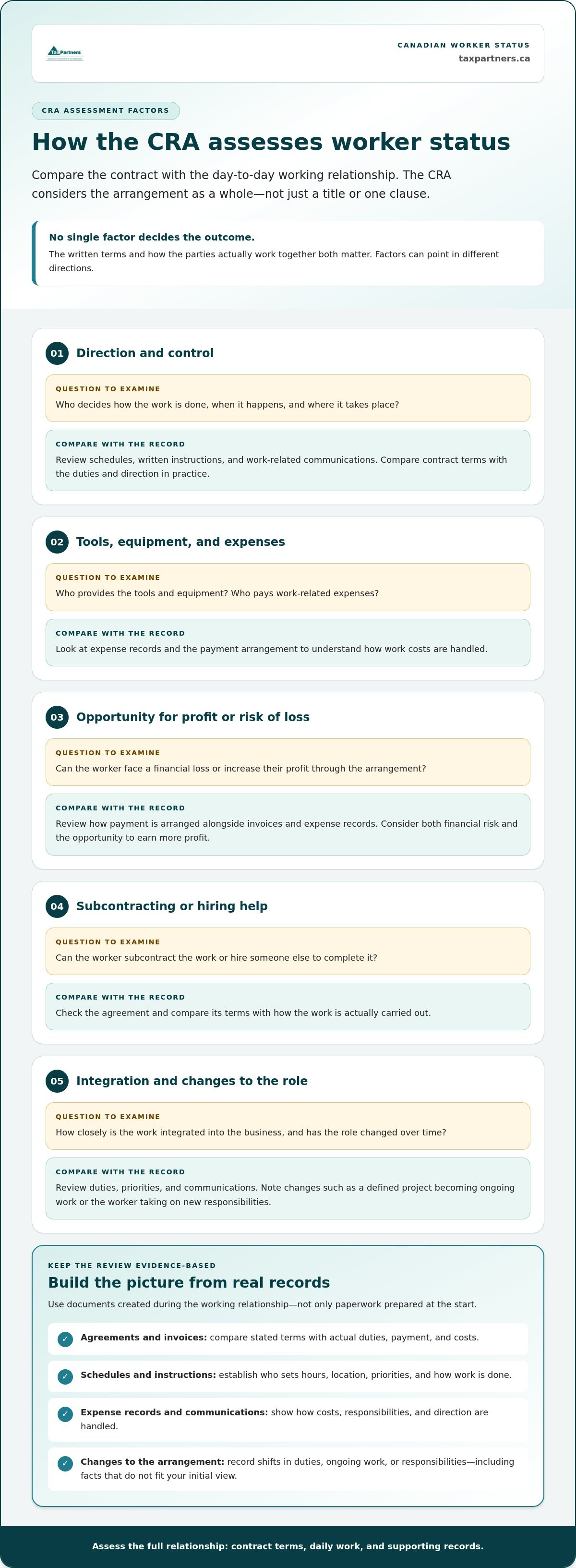
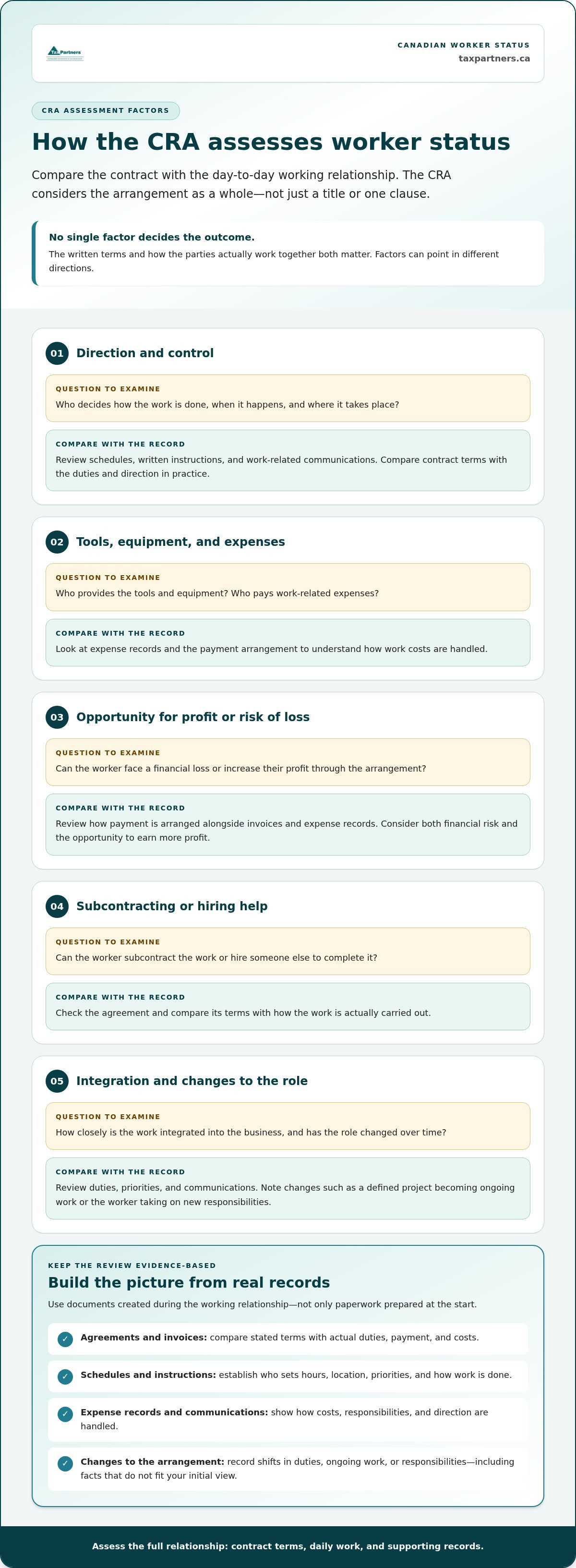
The CRA looks at the relationship as a whole when deciding whether a worker is an employee or self-employed. It considers how the arrangement operates in practice, not simply the job title or one clause in an agreement.
The factors can point in different directions. A worker might supply some of their own equipment, for example, while the business still directs their schedule and day-to-day tasks. The weight of each detail depends on the working arrangement and the evidence available.
No single contract clause decides worker status. The CRA considers what the agreement says alongside how the parties actually work together. Examine both the written terms and the day-to-day record before drawing conclusions about potential CRA penalties for misclassifying employees.
The relationship factors the CRA may consider
Start with the level of direction the business exercises. Who decides how the work is done, when it happens, and where it takes place? The answers help describe the relationship, but control alone doesn’t settle the CRA’s assessment.
Other relevant details include who provides tools and equipment, who pays work-related expenses, and whether the worker can face a financial loss or has an opportunity to increase profit. The CRA may also consider whether the worker can subcontract or hire someone else to complete the work. Together, these factors help show how much independence the worker has in carrying out the arrangement.
Evidence that helps explain how the work actually happens
Build a clear picture from records created during the working relationship, not just documents prepared when the arrangement began. Review agreements, invoices, schedules, written instructions, expense records, and work-related communications for evidence about responsibilities, direction, and independence.
- Compare contract terms with the duties and instructions the worker receives in practice.
- Review invoices and expense records to see how payment and work costs are handled.
- Look at schedules and communications to establish who sets hours, location, and priorities.
- Note material changes, such as a project becoming ongoing work or the worker taking on new responsibilities.
Keep the review balanced. An invoice or a right to subcontract may support one interpretation, while close supervision or limited control over expenses may suggest another. Record relevant facts, including evidence that doesn’t fit your initial view, so the assessment reflects the relationship rather than one selected detail.
Quebec has a distinct civil-law context, so businesses with Quebec arrangements should refer to applicable CRA guidance for that context rather than assume the analysis applies unchanged across Canada. When the facts are complex or inconsistent, a worker-status review can help organize the relevant records and questions.
What CRA penalties and financial exposure may follow misclassification
If the CRA determines that a worker should have been treated as an employee, the business may face more than one kind of payroll exposure. The amount and type depend on the CRA’s determination, the facts of the arrangement, and the Canadian rules that apply.
Consider the potential components separately. Unremitted source deductions, CPP contributions, EI premiums, interest, and penalties are distinct issues, and not every review leads to the same result. CRA penalties for misclassifying employees are only one part of the potential assessment.
Potential payroll liabilities and penalties under CRA rules
If the CRA determines that required payroll amounts weren’t deducted or remitted, the payer may be responsible for outstanding amounts. These can include income tax deductions and required CPP contributions and EI premiums, including applicable employer and employee portions. The CRA’s determination and the worker’s circumstances affect what may be owing.
Interest may apply to overdue amounts, while penalties may apply in certain circumstances. Neither should be treated as automatic in every case. Check current CRA rules and calculations before relying on a particular rate, amount, or outcome.
The table separates the main categories to help frame a review. It isn’t a calculation of liability: current CRA guidance and the facts of the arrangement determine what may apply.
An honest mistake doesn’t automatically remove exposure
A signed agreement, the worker’s acceptance of contractor status, or the business’s good-faith belief doesn’t by itself settle the CRA’s assessment. The actual working arrangement remains central. Documents may help explain what happened, but they don’t guarantee a particular outcome.
Identifying a possible classification risk is not the same as concluding that the CRA will assess a penalty. First establish the facts and potential payroll amounts, then verify the applicable CRA rules before estimating exposure or deciding how to respond.
How to review worker status and respond to CRA concerns
A structured review can help your business move from uncertainty to a documented next step. Describe the work as it happens, compare that picture with the agreement and relevant records, and then estimate any potential payroll exposure.
- Map the duties. Note the work performed, who assigns it, how scheduling and supervision operate, and whether the role has changed over time.
- Compare practice with contract terms. Identify where the actual arrangement matches the agreement and where it differs. Record when changes occurred and the business reasons behind them.
- Gather supporting records. Preserve agreements, invoices, payroll records, schedules, expense documents, instructions, and communications relevant to the relationship.
- Assess the potential exposure. Review the status factors alongside the records, then identify which payroll periods and obligations may need further analysis. Don’t treat a checklist as a final CRA determination.
Build a clear record of the working relationship
Create a timeline that connects duties, supervision, scheduling, payment arrangements, and changes in practice. For example, note whether a defined project later became ongoing work, or whether the worker’s responsibilities or level of direction changed.
Compare the evidence with each relevant status factor, but don’t force every detail into a simple yes-or-no test. Flag inconsistencies, preserve records that show different sides of the arrangement, and explain the operational reasons for material changes. This gives your review a factual foundation without treating it as a legal or CRA ruling.
Address a potential error without guessing at CRA procedures
Separate the question of how the worker should be classified now from whether past payroll records may need correction. The current arrangement may have changed, while a historical review may involve different duties, practices, or records.
Before requesting a CRA ruling, adjusting payroll information, or responding to a particular CRA request, check the current process and requirements in CRA guidance. Procedures can depend on the issue and the correspondence received, so don’t assume one correction route applies to every situation.
If the CRA has contacted your business, read the correspondence carefully, note what information it requests, and respond promptly and accurately using records that support your account. Keep a copy of the response and the documents provided. If information is incomplete or inconsistent, identify that clearly instead of guessing or presenting assumptions as established facts.
A broader compliance review can connect worker-status questions with bookkeeping, payroll records, and corporate tax information. That wider view may help when assessing potential CRA penalties for misclassifying employees, but it can’t guarantee a particular CRA outcome.
For help organizing records and reviewing the tax and payroll implications, connect with Tax Partners about your classification concern.
Get informed Canadian tax and payroll support for a classification concern
A worker-status concern can affect several parts of a business at once. A coordinated review of contracts, actual work practices, payroll records, and tax information can connect the facts, identify gaps, and clarify which questions need further attention.
This support can be especially useful when the working arrangement has changed, records appear inconsistent, or the business is assessing possible past payroll exposure. A review can help organize the information and identify issues to verify against current CRA guidance, without assuming how the CRA will decide the matter.
What a focused classification review can help clarify
A focused review compares documented terms with how the worker performs the work and receives payment. It can also identify which payroll records and CRA correspondence relate to the concern, and which tax or payroll questions need verification against current CRA guidance before the business acts.
Tax Partners provides Canadian tax, bookkeeping, payroll, and CRA audit support relevant to these concerns. With more than 40 years of experience serving clients, the firm can help businesses organize the accounting and tax details involved in assessing potential CRA penalties for misclassifying employees. The aim is a clearer view of the facts and responsibilities, not a promised assessment result.
Prepare for a useful conversation with a tax professional
An organized file makes it easier to discuss the arrangement and pinpoint what remains uncertain. Gather the relevant agreement, invoices, payment history, work instructions, payroll records, and any CRA correspondence connected to the issue.
Summarize when the arrangement began and note meaningful changes in duties, supervision, scheduling, or payment practices. A short timeline can distinguish the original terms from how the relationship developed, while highlighting records that may need closer review.
- Separate confirmed facts from assumptions or missing information.
- Note which records relate to current practices and which concern earlier periods.
- List questions about worker status, payroll responsibilities, and potential corrections.
A review should help you understand the available options and responsibilities, not lead you to assume that a particular correction process or CRA outcome will apply. Check any ruling, adjustment, or response procedure against current CRA guidance and the details of your business’s situation.
Classification concerns can feel difficult to untangle, but a careful review gives the discussion a practical starting point. Discuss your worker-classification concern with Tax Partners to review the relevant Canadian tax and payroll facts and consider a suitable next step.
Make worker-status reviews part of your business routine
A worker-status review is most useful when it reflects how the business operates now, not only how an arrangement began. Treat changes in duties, supervision, or payment practices as a reason to revisit the records and confirm that your approach remains consistent.
Reviewing the arrangement can help you address uncertainty while the facts are still clear. If you’re concerned about CRA penalties for misclassifying employees, start with a documented account of the relationship and the payroll questions that still need answers. A measured review can help you decide what to verify and what action may be appropriate, without assuming the CRA’s conclusion.
Tax Partners can bring Canadian tax, bookkeeping, payroll, and CRA audit considerations into the same discussion. You don’t need to have every answer in hand before taking the next step; a clear timeline and the records you’ve gathered provide a practical starting point.
Arrange a conversation about your Canadian classification concerns and take a considered step towards stronger compliance.
Frequently Asked Questions
How does the CRA decide whether a worker is an employee or self-employed?
The CRA assesses the specific engagement, so separate roles or contracts shouldn’t automatically be treated as having identical status. For example, a person might perform a defined assignment for one payer and different ongoing duties for another. Describe each arrangement separately and identify which work the question concerns. This helps avoid applying one conclusion to work with different terms or practices.
Can a contractor agreement protect a business from CRA penalties?
No agreement can guarantee protection from CRA penalties for misclassifying employees. A worker’s agreement to a contractor arrangement doesn’t, by itself, remove the payer’s responsibilities if the CRA determines that employment rules apply. Treat contractual protections as separate from payroll obligations: a clause transferring costs or responsibilities to the worker doesn’t settle what the business may owe under current Canadian requirements.
What happens if a worker asks the CRA to determine their status?
The worker can ask the CRA for a formal Canada Pension Plan (CPP) and Employment Insurance (EI) ruling on whether the work is pensionable or insurable. The payer can request one as well. Define which work arrangement the question concerns and follow the CRA’s current instructions for supporting information. A CPP/EI ruling addresses those programs; don’t assume it resolves every question about employment rights or tax reporting.
Can the CRA reassess a business after it has treated someone as a contractor?
Yes. Prior payroll treatment or the absence of an earlier CRA inquiry doesn’t confirm that a worker’s status has been formally settled. If the issue comes up later, the relevant period and the facts for that period matter. Keep prior filings available, and check current CRA review and reassessment procedures before concluding which periods or amounts could be affected.
Can a business correct a worker’s classification before the CRA contacts it?
A business can review a possible error proactively, but the right correction process depends on the circumstances and current CRA procedures. The CRA’s Voluntary Disclosures Program may offer relief from penalties or prosecution if an application is accepted, but relief isn’t guaranteed. Before applying or changing payroll records, check current program conditions and consider how the proposed correction affects the business’s reporting and remittances.
Could misclassification affect a worker’s CPP or EI position?
Yes. A status decision can affect how the worker’s earnings are treated for CPP pensionable earnings or EI insurable earnings, which may matter to the worker’s records and benefit calculations. If the worker believes the payer’s treatment has affected those records, they can ask the CRA about a CPP/EI ruling. The result depends on the CRA’s decision and the circumstances of the work.
What records should a business gather when reviewing worker status?
Make the file easy to interpret as you collect relevant documents. Keep original records unchanged, label documents by date and source, and distinguish records created during the arrangement from notes prepared later. If information is missing or an estimate is needed, mark that clearly rather than filling gaps with an undocumented assumption. This makes it easier to see what the evidence can and can’t establish.

Article by
Mahad Mohamed
Mahad Mohamed is an accountant and the CEO of Tax Partners, with over 26+ years of Canadian and international tax and accounting experience. His expertise includes corporate reorganization, cross-border tax structuring (Canada & US), tax disputes, CRA audits, and tax planning for small owner-managed private corporations. Most recently, Mahad is a pioneer in Canadian crypto taxation and founded Block3 Finance.
Previously, Mahad worked for the Canada Revenue Agency (CRA), Big4 accounting firms, and served as a Rulings Officer for the Federal Tax Authority of the UAE before acquiring Tax Partners in 2014.
Tax Partners has 44 full-time accountants and over 18,400+ clients.
Disclaimer
This article provides general information only and is current as of its publication date. It has not been updated and may be out of date. It does not constitute legal advice and should not be relied upon as such. Every tax situation is unique and may differ from the examples discussed in this article. If you have specific questions, you should seek the advice of our accountants for your unique circumstances. Book a FREE Initial Consultation Today!
Frequently Asked Questions
How does the CRA decide whether a worker is an employee or self-employed?
The CRA assesses the specific engagement, so separate roles or contracts shouldn’t automatically be treated as having identical status. For example, a person might perform a defined assignment for one payer and different ongoing duties for another. Describe each arrangement separately and identify which work the question concerns. This helps avoid applying one conclusion to work with different terms or practices.
Can a contractor agreement protect a business from CRA penalties?
No agreement can guarantee protection from CRA penalties for misclassifying employees. A worker’s agreement to a contractor arrangement doesn’t, by itself, remove the payer’s responsibilities if the CRA determines that employment rules apply. Treat contractual protections as separate from payroll obligations: a clause transferring costs or responsibilities to the worker doesn’t settle what the business may owe under current Canadian requirements.
What happens if a worker asks the CRA to determine their status?
The worker can ask the CRA for a formal Canada Pension Plan (CPP) and Employment Insurance (EI) ruling on whether the work is pensionable or insurable. The payer can request one as well. Define which work arrangement the question concerns and follow the CRA’s current instructions for supporting information. A CPP/EI ruling addresses those programs; don’t assume it resolves every question about employment rights or tax reporting.
Can the CRA reassess a business after it has treated someone as a contractor?
Yes. Prior payroll treatment or the absence of an earlier CRA inquiry doesn’t confirm that a worker’s status has been formally settled. If the issue comes up later, the relevant period and the facts for that period matter. Keep prior filings available, and check current CRA review and reassessment procedures before concluding which periods or amounts could be affected.
Can a business correct a worker’s classification before the CRA contacts it?
A business can review a possible error proactively, but the right correction process depends on the circumstances and current CRA procedures. The CRA’s Voluntary Disclosures Program may offer relief from penalties or prosecution if an application is accepted, but relief isn’t guaranteed. Before applying or changing payroll records, check current program conditions and consider how the proposed correction affects the business’s reporting and remittances.
Could misclassification affect a worker’s CPP or EI position?
Yes. A status decision can affect how the worker’s earnings are treated for CPP pensionable earnings or EI insurable earnings, which may matter to the worker’s records and benefit calculations. If the worker believes the payer’s treatment has affected those records, they can ask the CRA about a CPP/EI ruling. The result depends on the CRA’s decision and the circumstances of the work.
What records should a business gather when reviewing worker status?
Make the file easy to interpret as you collect relevant documents. Keep original records unchanged, label documents by date and source, and distinguish records created during the arrangement from notes prepared later. If information is missing or an estimate is needed, mark that clearly rather than filling gaps with an undocumented assumption. This makes it easier to see what the evidence can and can’t establish.