IRS ITIN for Canadians: Application Guide (2026)

Could income from a U.S. rental property, a treaty-related payment or a U.S. real estate sale mean you need an IRS ITIN, even though you live in Canada? An ITIN is not a general-purpose identity number, and applying without the right U.S. tax purpose or supporting documents can complicate a U.S. tax filing.
This guide explains when Canadians may need an ITIN under IRS rules, what the number can and cannot be used for, and how to prepare an application. You’ll learn about Form W-7, identity documents the IRS may accept, and when an application generally needs to accompany a U.S. tax return.
Start by identifying the U.S. tax matter behind your application, then check the IRS requirements that apply to your situation. Tax Partners provides U.S. and cross-border tax support, including ITIN applications and related U.S. tax filings, to help applicants prepare with their tax obligations in view.
Key Takeaways
- Identify the U.S. tax purpose for your request and assess whether it meets IRS criteria for an ITIN application.
- Use the current IRS Form W-7 instructions to prepare your application and supporting documents.
- Understand that an IRS ITIN is for federal tax administration, not general identification or immigration purposes.
- U.S. tax support can help align your application with its tax purpose and related filing needs.
What is an IRS ITIN, and when might a Canadian resident need one?
The Internal Revenue Service (IRS) issues an Individual Taxpayer Identification Number (ITIN) to a person who needs a taxpayer identification number for U.S. federal tax purposes but isn’t eligible for a Social Security number (SSN). Under IRS rules, an ITIN helps the IRS process a tax return or record other tax-related information.
An IRS ITIN is a federal tax-processing number, not a Social Security number, passport or immigration document. It doesn’t establish immigration status or authorize someone to work in the United States. You can find a broader overview of the Individual Taxpayer Identification Number (ITIN), but the IRS determines the applicable rules and application requirements.
What does an ITIN identify under IRS rules?
An ITIN lets the IRS associate a person with U.S. federal tax records when that person can’t use an SSN for tax reporting. It helps the IRS process tax filings and other federal tax matters, but it isn’t general identification for everyday transactions.
A U.S. tax-related reason to provide an identifying number doesn’t, by itself, mean the IRS will approve an application. The ITIN’s purpose remains limited to federal tax administration under IRS guidance.
Who may need to explore an ITIN application?
A Canadian resident’s U.S. tax circumstances may prompt them to consider an ITIN application. For example, a person with U.S.-source rental or business income may need to file a U.S. non-resident tax return, which certain people who aren’t U.S. residents use to report U.S. income.
Other situations may include claiming a tax treaty benefit, which can affect U.S. tax withholding on certain income, or providing an ITIN for a spouse or dependent included on a U.S. tax return. A sale of U.S. real estate may also raise federal tax questions under FIRPTA, the U.S. law covering tax withholding on certain sales of U.S. property by foreign persons.
These examples are reasons to examine your circumstances, not automatic approval criteria. A possible U.S. filing obligation and eligibility for an IRS ITIN are separate questions. The IRS assesses each application against its current rules.
- Identify the U.S. income, transaction or tax filing behind the request.
- Determine whether you need to file a U.S. federal tax return or meet another IRS requirement.
- Review current IRS guidance to see whether your circumstances qualify for an ITIN application.
Tax Partners provides ITIN application support connected to U.S. tax compliance. Reviewing the tax purpose first helps clarify what to prepare and which IRS requirements apply before you begin the application.
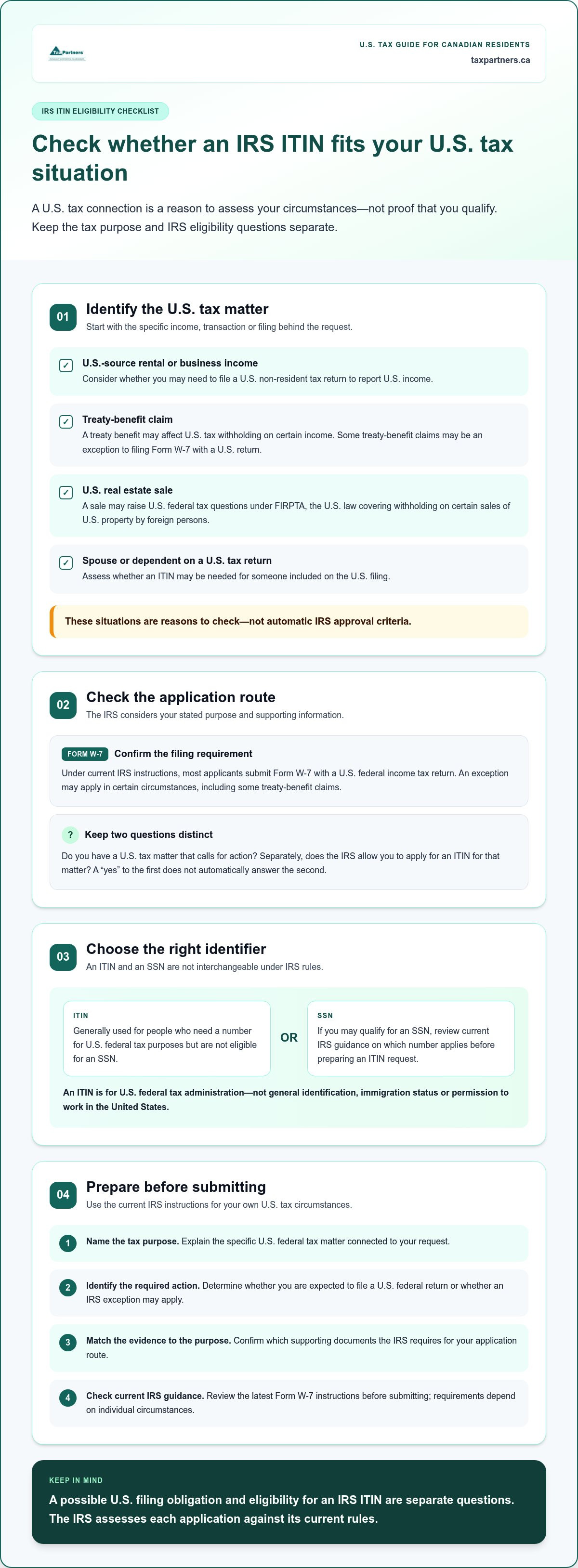
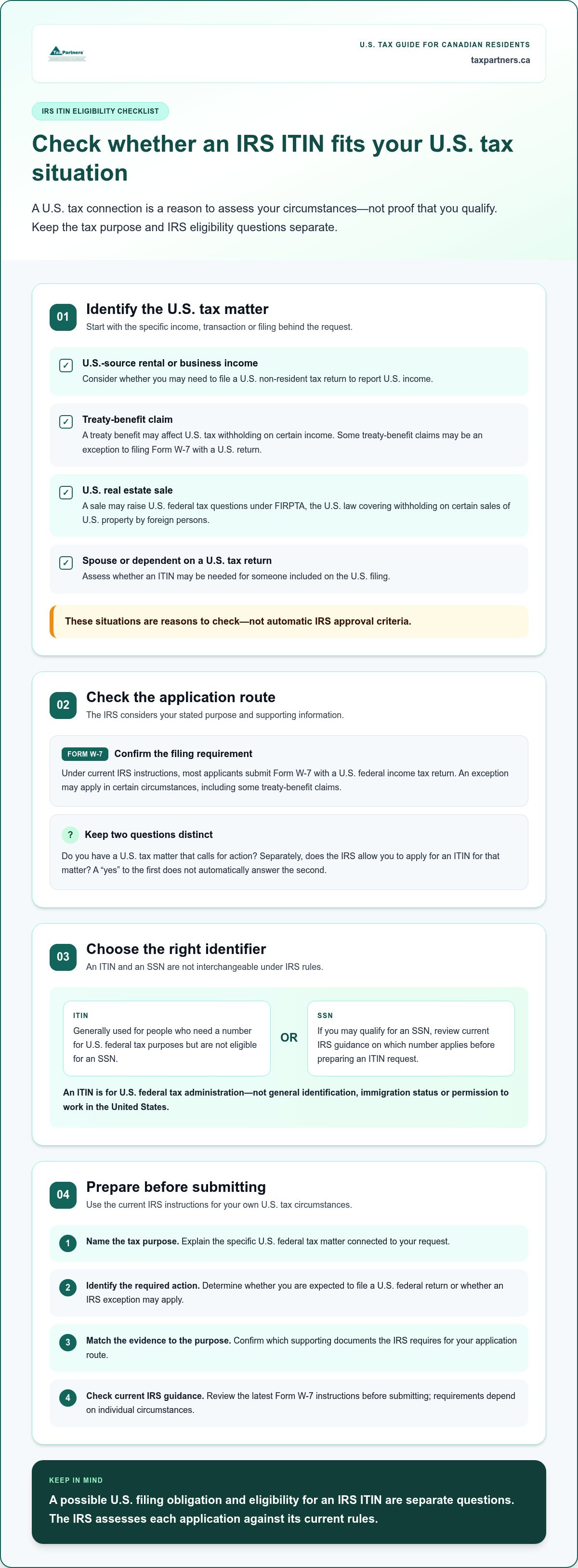
Check whether an IRS ITIN fits your US tax situation
A U.S. tax connection is a reason to assess your circumstances, not proof that you qualify for an ITIN. Under IRS rules, the IRS decides whether an applicant meets the requirements based on the purpose of the request and the supporting information provided.
An ITIN application must meet current IRS requirements for your specific U.S. tax circumstances. Keep two questions separate: do you have a U.S. tax matter that calls for action, and does the IRS allow you to apply for an ITIN to address it? A “yes” to the first question doesn’t automatically answer the second.
Which U.S. tax circumstances should you assess first?
Start with the precise reason you believe you need a U.S. taxpayer identification number. Identify the income, transaction, tax return or other federal tax matter involved, then determine what action the IRS expects from you. A general connection to the United States, without a defined tax purpose, may not explain why you need an ITIN.
The tax purpose can affect the IRS application route. Under current IRS instructions, most applicants submit Form W-7 with a U.S. federal income tax return. An exception may apply in certain circumstances, including some treaty-benefit claims. The IRS criteria and evidence for your stated purpose matter, so a potential filing need alone doesn’t settle eligibility.
When might another U.S. taxpayer identification number apply?
An ITIN and an SSN aren’t interchangeable. The IRS generally uses an ITIN for people who need a number for federal tax purposes but aren’t eligible for an SSN. If you may qualify for an SSN, review current IRS guidance on which number applies before preparing an ITIN request.
Choosing the right identifier is a tax-administration question, not an immigration shortcut. An ITIN doesn’t grant immigration status or permission to work in the United States, and applying for one doesn’t change those rules.
Use this checklist to organize your assessment before preparing paperwork:
- Name the tax purpose. Be ready to explain the specific U.S. federal tax matter connected to your request.
- Identify the required action. Determine whether you’re expected to file a U.S. federal return or whether an IRS exception may apply.
- Check the identifier question. Review IRS guidance if an SSN may be appropriate instead.
- Match the evidence to the purpose. Confirm which supporting documents the IRS requires for your application route.
- Use current instructions. Requirements depend on individual circumstances, so consult the latest IRS Form W-7 guidance before submitting.
If your U.S. tax purpose or application route is unclear, experienced U.S. tax support can help organize the facts around IRS requirements. You can discuss your ITIN application circumstances as part of planning for related U.S. tax compliance.
Prepare an IRS ITIN application and supporting documents
Once you’ve identified the U.S. tax purpose, prepare your application using the IRS’s current instructions rather than relying on a generic checklist. The central document is IRS Form W-7, Application for IRS Individual Taxpayer Identification Number. Your form, tax return or exception documents, and identity evidence should all support the same reason for applying.
Organize the IRS application information
Before completing IRS Form W-7, gather the details needed to establish your identity and explain your tax purpose. The current IRS form instructions set the exact fields and evidence requirements, so use them to confirm what applies to your situation.
- Your legal name and any other identifying details requested on the IRS form.
- Your date and place of birth, citizenship and foreign status information, as requested under IRS instructions.
- Your mailing address and any other contact information the IRS requires.
- A clear explanation of the U.S. federal tax purpose, along with the return or exception documentation required for your application route.
Use the IRS Form W-7 instructions to select the correct reason for applying, complete every applicable field and sign the form as directed. Under IRS rules, most applicants submit Form W-7 with a completed U.S. federal income tax return. Some exceptions, including certain treaty-benefit claims, may allow an application without a return. Confirm the current IRS requirements for your specific reason before assembling your submission.
Review identity documents and submission options
The IRS requires documents that establish both identity and foreign status. Under current IRS guidance, a valid Canadian passport can serve as a stand-alone document for both. Without one, applicants generally need a combination of documents from the IRS-accepted list, with at least one containing a photograph. Check the current list and rules before relying on a particular document.
The IRS generally requires original identification documents or certified copies issued by the agency that holds the originals. A notarized copy isn’t the same as an issuing-agency certified copy. Review the IRS’s current document rules before sending anything.
- Match the documents to your application. Compare names and other details across Form W-7, tax paperwork and identity documents. Resolve inconsistencies before submission.
- Choose an IRS-accepted submission route. Applicants may mail documents to the IRS or use an available in-person option, such as an IRS Taxpayer Assistance Center or an IRS-approved Certifying Acceptance Agent. These options may allow original documents to be authenticated and returned without mailing them to the IRS.
- Verify current logistics. Check IRS submission addresses, appointment or agent procedures, and document-handling requirements in current IRS guidance before sending your package.
Tax Partners supports applicants with ITIN application services organized around the related U.S. tax purpose and filing needs. A coherent application package can make the information easier to review, but the IRS determines whether an application meets its requirements.
Understand what an IRS ITIN does, and does not, do
An IRS ITIN has a narrow role: it helps the IRS administer U.S. federal tax matters. Understanding that limit can prevent confusion when completing tax paperwork, dealing with another U.S. agency or deciding what identification you need.
The comparison below summarizes how these identifiers and documents differ under U.S. rules. It doesn’t replace current IRS guidance on which taxpayer identification number may apply to your circumstances.
| Item | Purpose or effect | What it doesn’t establish |
|---|---|---|
| ITIN | Used by the IRS for federal tax administration when a person needs a taxpayer identification number and isn’t eligible for an SSN. | Immigration status, permission to work, or automatic eligibility for a particular tax treatment. |
| Social Security number (SSN) | A separate U.S. identifier. IRS guidance directs taxpayers to use the appropriate number based on their eligibility. | It isn’t interchangeable with an ITIN simply because a person has a U.S. tax matter. |
| Immigration or employment authorization documents | Address immigration status or authorization under the rules administered by the relevant U.S. authorities. | They aren’t an IRS taxpayer identification number. |
ITIN versus Social Security number
An ITIN and an SSN serve different purposes under U.S. federal rules. The IRS uses an ITIN for tax administration when a person isn’t eligible for an SSN, while an SSN is a distinct identifier. Taxpayers shouldn’t treat the two as alternatives they can freely choose between.
If you’re unsure which number applies, review current IRS guidance before submitting tax paperwork. The IRS’s determination depends on your circumstances, so don’t assume that needing to report income automatically means an ITIN is the right identifier.
ITIN versus immigration and employment authorization
An ITIN doesn’t grant or change immigration status, and it doesn’t authorize employment in the United States. Those questions are separate from the IRS’s use of taxpayer identification numbers.
Keep the documents and processes distinct. An IRS tax number may help the IRS process tax information, but it isn’t proof of permission to enter, remain or work in the United States. This distinction explains the number’s tax function without making a determination about anyone’s immigration circumstances.
An ITIN also doesn’t settle every U.S. tax question. Having one doesn’t, by itself, determine whether you must file a U.S. federal tax return, what income must be reported or whether a treaty provision applies. Those matters depend on the applicable IRS rules and your facts. Assess each obligation separately using current IRS guidance.
Clearly identifying the tax issue can help keep an ITIN request aligned with your wider U.S. filing needs. For support connecting your taxpayer identification needs with related U.S. tax compliance, discuss your U.S. tax circumstances with Tax Partners.
Get experienced help with your IRS ITIN application
Preparing an IRS application involves more than filling in a form. You need to connect the request to its U.S. federal tax purpose, follow current IRS instructions and organize supporting documents for your application route.
Tax Partners provides ITIN application support and U.S. tax filings, including Forms 1040 and 1040-NR under U.S. rules. The firm brings more than 40 years of experience, has filed over 495,000 returns and has more than 1,390 five-star Google reviews. These credentials reflect the firm’s tax experience, not a promise of IRS approval or a particular outcome.
What focused ITIN application support can help organize
Structured support can help connect the parts of an application: the reason for requesting a number, the relevant U.S. tax filing or exception, and the identity documents required under current IRS guidance. Reviewing these together can help identify missing information or inconsistencies before submission.
A tax professional can also help you understand the preparation sequence, identify which IRS instructions apply and consider how the application relates to a U.S. filing. For example, if your circumstances involve a non-resident return, the application and return may need to be coordinated under IRS requirements. The appropriate steps depend on your facts and current IRS rules.
- Clarify the tax purpose. Summarize the income, transaction or filing that prompted your application.
- Organize the paperwork. Gather IRS correspondence, completed tax documents and identity evidence relevant to your application route.
- Review for consistency. Compare names and other key details across the application and supporting records.
- Plan for related filings. Identify any U.S. federal tax return or follow-up matter connected to your request.
Preparation can reduce avoidable confusion, but the IRS makes the decision and controls processing. No tax professional can guarantee that the IRS will issue a number, accept a particular document or reach a specific tax result.
Choose a clear next step for your U.S. tax matter
Before discussing your situation, gather any IRS letters, prior applications, relevant tax records and notes explaining why you believe you need a number. You don’t need to resolve every question in advance. A clear record of the facts can help structure the review.
Tax Partners’ U.S. tax experience can help bring your application and related filing considerations into focus, with guidance tailored to your circumstances. If you’re ready to discuss your application, contact Tax Partners about your ITIN application.
Take your next U.S. tax step with clarity
Connect the number you’re requesting with the tax action you need to take. Keep a clear record of the reason for your ITIN request and any IRS correspondence, so you can refer to the same facts as you prepare paperwork or address related U.S. federal tax matters.
Plan beyond the application itself. Consider what filing or follow-up may depend on the IRS’s decision, and be prepared to adjust your next steps if the IRS requests more information. The goal is an organized path forward, not simply a completed form.
Tax Partners can help you consider your ITIN application in the context of your U.S. tax circumstances and related filings. Discuss your IRS ITIN application with our team.
With careful preparation and tax support, you can approach your U.S. tax matter with greater clarity.
Frequently Asked Questions About IRS ITINs
Can I apply for an IRS ITIN without filing a US tax return?
Usually, an IRS ITIN application must accompany a completed U.S. federal income tax return. IRS exceptions apply in some situations; certain treaty-benefit claims may allow an application without a return.
Whether an exception fits depends on your circumstances and the IRS’s current criteria. Check the latest Form W-7 instructions before applying without a return, and make sure you can provide the evidence required for the exception.
How long does the IRS take to process an ITIN application?
Under current IRS guidance, standard processing takes about seven weeks. The IRS indicates processing can take nine to eleven weeks for applications sent from abroad or submitted during peak tax season, January 15 to April 30.
These are estimates, not guaranteed decision dates. If a U.S. tax filing depends on the number, allow for possible delays and consult current IRS guidance before relying on a particular timeline.
Can I renew an expired ITIN online?
Renewing an expired ITIN requires a new Form W-7. Check the latest IRS instructions for accepted submission methods before choosing how to apply.
A tax return doesn’t need to accompany an IRS ITIN renewal application. Current IRS guidance can also help you determine which supporting documents apply to your renewal and how to submit them.
What documents does the IRS accept for an ITIN application?
The IRS accepts identity documents that establish both identity and foreign status. A valid Canadian passport is the only stand-alone document that proves both; otherwise, applicants generally need a combination from the IRS’s accepted-document list, including at least one photo document.
Under IRS rules, documents must be originals or certified copies from the issuing agency; notarized copies aren’t accepted. Review the current IRS list before applying, since the evidence required depends on your circumstances.
Does an IRS ITIN expire?
Yes. Under IRS rules, an ITIN automatically expires on December 31 if it hasn’t appeared on a U.S. federal tax return for three consecutive tax years.
If you expect to use the number for a later U.S. tax filing, check its status and current IRS renewal instructions before filing. Renewal requires a new Form W-7, but the IRS doesn’t require a tax return to accompany a renewal application.
Can a dependent receive an IRS ITIN?
Yes, a dependent may receive an IRS ITIN if a U.S. federal tax matter requires an identifying number and the application meets IRS criteria. For example, a taxpayer may need to include a dependent on a U.S. federal return.
Being named as a dependent doesn’t automatically establish eligibility. The IRS assesses the dependent’s circumstances and supporting documents, so consult current Form W-7 instructions for the appropriate application route.
Does an IRS ITIN allow me to work in the United States?
No. An IRS ITIN doesn’t grant immigration status or authorize employment in the United States. It also doesn’t make someone eligible for Social Security benefits.
These matters are separate from IRS tax identification. Don’t treat an ITIN as evidence of permission to enter, remain or work in the United States; those questions depend on separate rules and documents.

Article by
Mahad Mohamed
Mahad Mohamed is an accountant and the CEO of Tax Partners, with over 26+ years of Canadian and international tax and accounting experience. His expertise includes corporate reorganization, cross-border tax structuring (Canada & US), tax disputes, CRA audits, and tax planning for small owner-managed private corporations. Most recently, Mahad is a pioneer in Canadian crypto taxation and founded Block3 Finance.
Previously, Mahad worked for the Canada Revenue Agency (CRA), Big4 accounting firms, and served as a Rulings Officer for the Federal Tax Authority of the UAE before acquiring Tax Partners in 2014.
Tax Partners has 44 full-time accountants and over 18,400+ clients.
Disclaimer
This article provides general information only and is current as of its publication date. It has not been updated and may be out of date. It does not constitute legal advice and should not be relied upon as such. Every tax situation is unique and may differ from the examples discussed in this article. If you have specific questions, you should seek the advice of our accountants for your unique circumstances. Book a FREE Initial Consultation Today!
Frequently Asked Questions
What does an ITIN identify under IRS rules?
An ITIN lets the IRS associate a person with U.S. federal tax records when that person can’t use an SSN for tax reporting. It helps the IRS process tax filings and other federal tax matters, but it isn’t general identification for everyday transactions. A U.S. tax-related reason to provide an identifying number doesn’t, by itself, mean the IRS will approve an application. The ITIN’s purpose remains limited to federal tax administration under IRS guidance.
Who may need to explore an ITIN application?
A Canadian resident’s U.S. tax circumstances may prompt them to consider an ITIN application. For example, a person with U.S.-source rental or business income may need to file a U.S. non-resident tax return, which certain people who aren’t U.S. residents use to report U.S. income. Other situations may include claiming a tax treaty benefit, which can affect U.S. tax withholding on certain income, or providing an ITIN for a spouse or dependent included on a U.S. tax return. A sale of U.S. real estate may also raise federal tax questions under FIRPTA, the U.S. law covering tax withholding on certain sales of U.S. property by foreign persons. These examples are reasons to examine your circumstances, not automatic approval criteria. A possible U.S. filing obligation and eligibility for an IRS ITIN are separate questions. The IRS assesses each application against its current rules. Tax Partners provides ITIN application support connected to U.S. tax compliance. Reviewing the tax purpose first helps clarify what to prepare and which IRS requirements apply before you begin the application. A U.S. tax connection is a reason to assess your circumstances, not proof that you qualify for an ITIN. Under IRS rules, the IRS decides whether an applicant meets the requirements based on the purpose of the request and the supporting information provided. An ITIN application must meet current IRS requirements for your specific U.S. tax circumstances. Keep two questions separate: do you have a U.S. tax matter that calls for action, and does the IRS allow you to apply for an ITIN to address it? A “yes” to the first question doesn’t automatically answer the second.
Which U.S. tax circumstances should you assess first?
Start with the precise reason you believe you need a U.S. taxpayer identification number. Identify the income, transaction, tax return or other federal tax matter involved, then determine what action the IRS expects from you. A general connection to the United States, without a defined tax purpose, may not explain why you need an ITIN. The tax purpose can affect the IRS application route. Under current IRS instructions, most applicants submit Form W-7 with a U.S. federal income tax return. An exception may apply in certain circumstances, including some treaty-benefit claims. The IRS criteria and evidence for your stated purpose matter, so a potential filing need alone doesn’t settle eligibility.
When might another U.S. taxpayer identification number apply?
An ITIN and an SSN aren’t interchangeable. The IRS generally uses an ITIN for people who need a number for federal tax purposes but aren’t eligible for an SSN. If you may qualify for an SSN, review current IRS guidance on which number applies before preparing an ITIN request. Choosing the right identifier is a tax-administration question, not an immigration shortcut. An ITIN doesn’t grant immigration status or permission to work in the United States, and applying for one doesn’t change those rules. Use this checklist to organize your assessment before preparing paperwork: If your U.S. tax purpose or application route is unclear, experienced U.S. tax support can help organize the facts around IRS requirements. You can discuss your ITIN application circumstances as part of planning for related U.S. tax compliance. Once you’ve identified the U.S. tax purpose, prepare your application using the IRS’s current instructions rather than relying on a generic checklist. The central document is IRS Form W-7, Application for IRS Individual Taxpayer Identification Number. Your form, tax return or exception documents, and identity evidence should all support the same reason for applying.
Can I apply for an IRS ITIN without filing a US tax return?
Usually, an IRS ITIN application must accompany a completed U.S. federal income tax return. IRS exceptions apply in some situations; certain treaty-benefit claims may allow an application without a return. Whether an exception fits depends on your circumstances and the IRS’s current criteria. Check the latest Form W-7 instructions before applying without a return, and make sure you can provide the evidence required for the exception.
How long does the IRS take to process an ITIN application?
Under current IRS guidance, standard processing takes about seven weeks. The IRS indicates processing can take nine to eleven weeks for applications sent from abroad or submitted during peak tax season, January 15 to April 30. These are estimates, not guaranteed decision dates. If a U.S. tax filing depends on the number, allow for possible delays and consult current IRS guidance before relying on a particular timeline.
Can I renew an expired ITIN online?
Renewing an expired ITIN requires a new Form W-7. Check the latest IRS instructions for accepted submission methods before choosing how to apply. A tax return doesn’t need to accompany an IRS ITIN renewal application. Current IRS guidance can also help you determine which supporting documents apply to your renewal and how to submit them.
What documents does the IRS accept for an ITIN application?
The IRS accepts identity documents that establish both identity and foreign status. A valid Canadian passport is the only stand-alone document that proves both; otherwise, applicants generally need a combination from the IRS’s accepted-document list, including at least one photo document. Under IRS rules, documents must be originals or certified copies from the issuing agency; notarized copies aren’t accepted. Review the current IRS list before applying, since the evidence required depends on your circumstances.
Does an IRS ITIN expire?
Yes. Under IRS rules, an ITIN automatically expires on December 31 if it hasn’t appeared on a U.S. federal tax return for three consecutive tax years. If you expect to use the number for a later U.S. tax filing, check its status and current IRS renewal instructions before filing. Renewal requires a new Form W-7, but the IRS doesn’t require a tax return to accompany a renewal application.
Can a dependent receive an IRS ITIN?
Yes, a dependent may receive an IRS ITIN if a U.S. federal tax matter requires an identifying number and the application meets IRS criteria. For example, a taxpayer may need to include a dependent on a U.S. federal return. Being named as a dependent doesn’t automatically establish eligibility. The IRS assesses the dependent’s circumstances and supporting documents, so consult current Form W-7 instructions for the appropriate application route.
Does an IRS ITIN allow me to work in the United States?
No. An IRS ITIN doesn’t grant immigration status or authorize employment in the United States. It also doesn’t make someone eligible for Social Security benefits. These matters are separate from IRS tax identification. Don’t treat an ITIN as evidence of permission to enter, remain or work in the United States; those questions depend on separate rules and documents.