Bookkeeping Checklist: 2026 Canadian Small Business Guide

What if staying on top of your books took a few steady habits instead of a stressful year-end catch-up? A bookkeeping checklist for Canadian small business owners can bring order to receipts and invoices across email, paper, and software, while making it clearer what to record and review.
Bookkeeping can feel like one more responsibility competing for your time, especially when routine recordkeeping gets tangled up with tax preparation. Consistent habits help keep business transactions organized, reveal gaps sooner, and give you financial records you can use to make day-to-day decisions.
This Canada-focused guide offers practical steps for organizing income, expenses, receipts, invoices, and other supporting documents, then reviewing your books regularly. It explains how ongoing bookkeeping supports, but differs from, tax filing and year-end accounting, and when full-cycle professional support can help. With a repeatable routine, you can approach your records with greater confidence and less last-minute pressure.
Key Takeaways
- Use a bookkeeping checklist for Canadian small business to create a consistent routine for recording and categorizing transactions.
- Match each transaction to supporting documents so your records are easier to review and understand.
- Reconcile your books with account statements and investigate unmatched transactions, duplicate entries, and unclear descriptions.
- Track receivables and payables regularly to keep a clearer view of money owed to you and bills due.
- Consider bookkeeping support when maintaining organized records and useful financial reports takes more time than your business can spare.
Why a Canadian small business needs a bookkeeping checklist
Bookkeeping is the organized recording and classification of a business’s financial activity. A bookkeeping checklist for Canadian small business owners turns that work into a repeatable process, helping you record each transaction with enough context to understand what happened and why.
Consistent records show how money moves through your business. They help you see whether customer payments have arrived, which bills remain outstanding, and how expenses compare with income, giving you a clearer basis for everyday decisions.
What does bookkeeping cover in a Canadian business?
Bookkeeping covers the regular recording of income, expenses, payments, and amounts owed to or by the business. Each entry should connect to supporting documents, such as a sales invoice, supplier receipt, payment confirmation, or other relevant record, so you can understand the transaction later.
A chart of accounts is the set of categories used to organize transactions, such as sales, supplies, or rent. Using consistent categories makes it easier to group similar activity and review your finances. For a foundational overview, see What is bookkeeping?
Why small, regular checks matter more than catch-up
Records are easier to clarify while the details are fresh. If you delay entering a transaction, you may have to search old emails for an unfamiliar payment or work out what a vague card charge was for. Regular checks help you connect transactions to documents before those clues become harder to find.
Current records also make it easier to review cash flow and outstanding balances. For example, you can identify unpaid customer invoices and supplier bills that need attention without assuming every balance has been collected or paid.
Bookkeeping supports year-end accounting and tax preparation, but it isn’t the same task. Ongoing bookkeeping organizes and updates transactions. Year-end accounting reviews financial information for reporting, while tax preparation uses relevant records to prepare tax filings. Keeping these roles distinct makes both the routine work and the handoff more orderly.
Canadian businesses also need to follow Canada Revenue Agency (CRA) recordkeeping requirements. The CRA requires businesses to keep records and supporting documents for six years from the end of the last tax year they relate to. A practical Canadian bookkeeping checklist can make regular record organization part of your process instead of a year-end scramble.
Build a reliable Canadian small business bookkeeping system
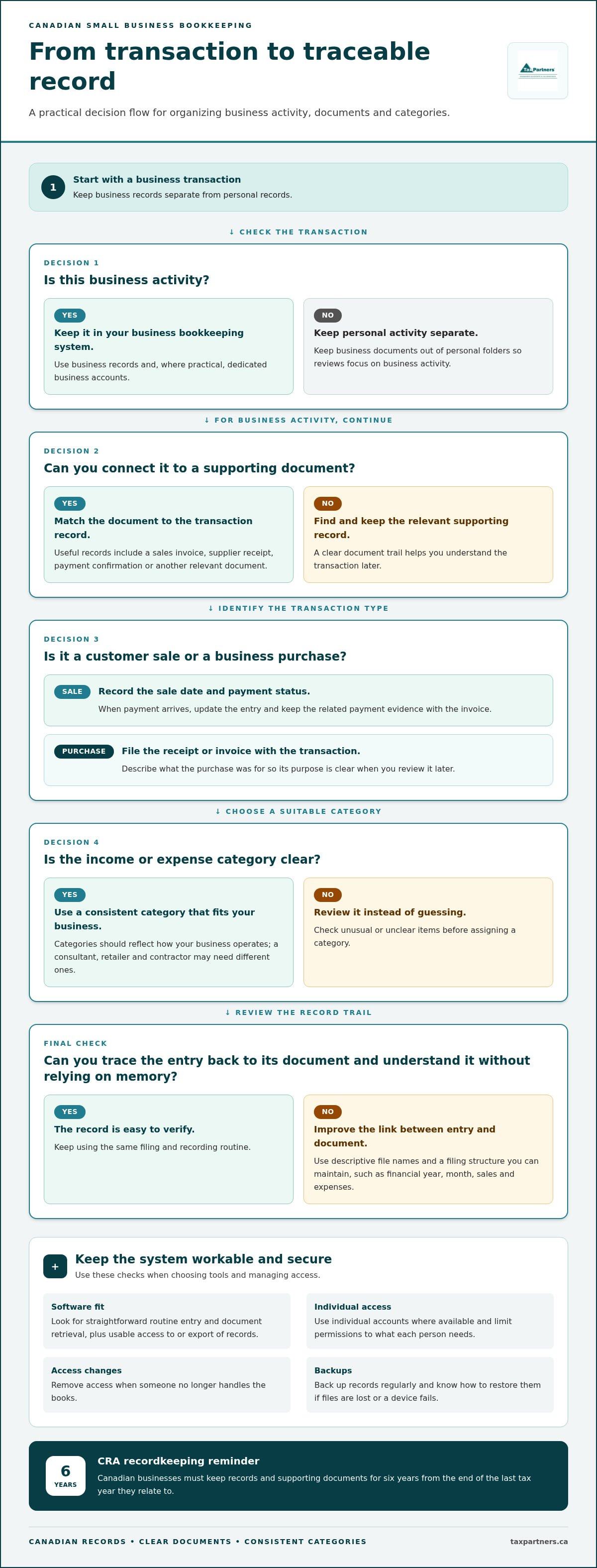
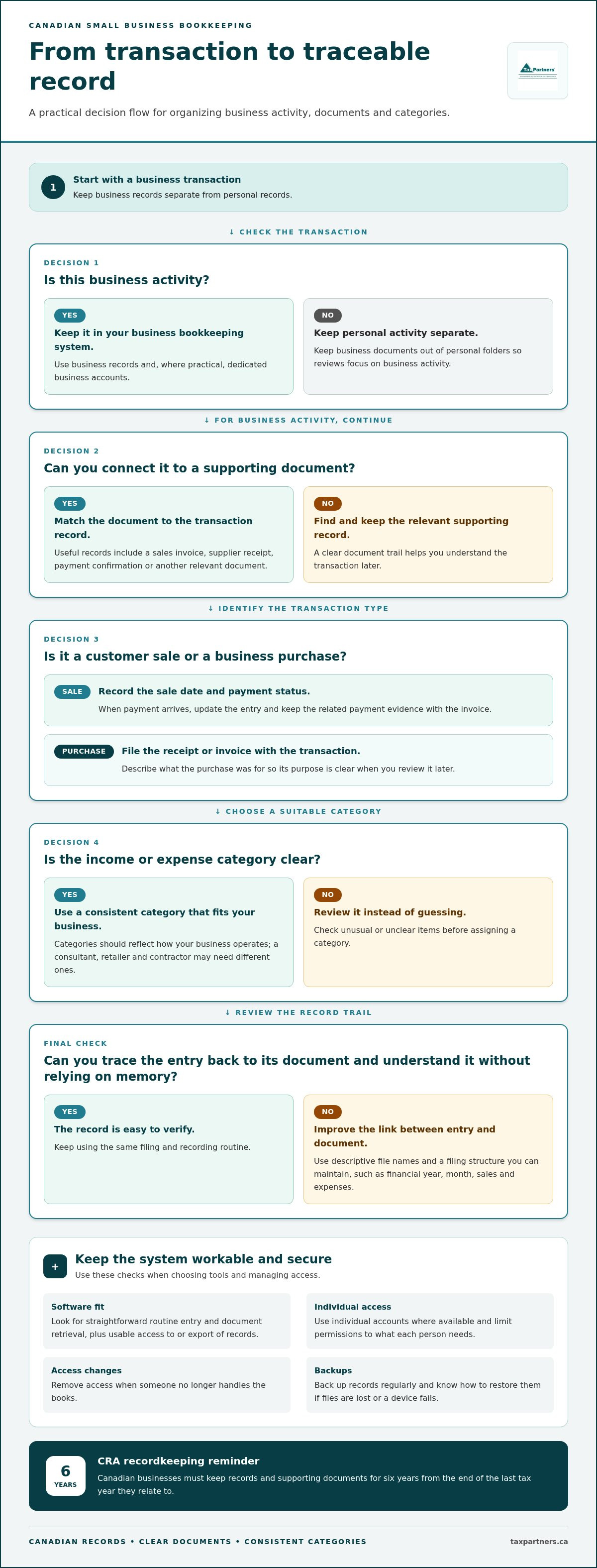
A dependable system connects each financial transaction to its supporting document and to the place where you record it. Choose a main bookkeeping method and decide where invoices, receipts, payment confirmations, and bank records belong. When information is split across tools or filing systems, even a correctly entered transaction can be difficult to verify later.
Organize income, expenses, invoices, and receipts
Start by separating business records from personal records. Use dedicated business accounts where practical, and keep business documents out of personal folders so reviews focus on your business activity.
Choose a filing structure you can maintain, whether it’s clearly labelled digital folders or an orderly paper system. For example, sort documents by financial year and then by month, with separate folders for sales and expenses. Use descriptive file names, such as “Supplier-name_invoice_date,” to make it easier to match a document to a bookkeeping entry.
Connect each source document to its transaction record. For a customer sale, retain the invoice and record the sale date and payment status. When payment arrives, update the entry and keep the related payment evidence. For a business purchase, file the receipt or invoice with the transaction and describe what the purchase was for.
Choose income and expense categories that reflect how your business operates. A consultant, retailer, and contractor may need different categories to make their reports useful, so don’t force every transaction into a universal chart. Keep category names consistent and review unusual or unclear items instead of assigning them by guesswork.
Choose bookkeeping software and access controls
Bookkeeping software can bring transaction entries, digital documents, and financial reports together, but the right fit depends on your workflow and recordkeeping needs. Consider whether it makes routine entry and document retrieval straightforward, and whether you can export or access records in a usable format.
Set up secure access deliberately. Use individual user accounts where available, limit permissions to what each person needs, and remove access when someone no longer handles the books. Back up records regularly, and know how to restore them if files are lost or a device fails.
Keep Canadian tax treatment separate from everyday categorization. Whether a transaction affects income tax or GST/HST reporting can depend on the circumstances, so check current Canada Revenue Agency (CRA) guidance rather than assuming a software category determines its tax treatment. The CRA’s record-keeping requirements for Canadian businesses explain how Canadian businesses should manage their records.
A well-maintained system should let you trace a report entry back to its document and understand the transaction without relying on memory. If setting up or maintaining that process takes time away from running your business, you can discuss bookkeeping support with Tax Partners.
Review your books: reconciliation, errors, and DIY limits
Accurate entries matter, but regular review helps reveal when something has gone off track. Reconciliation means comparing the transactions in your bookkeeping records with statements for the corresponding bank or business account, then investigating any differences.
Think of reconciliation as a check that your records agree with the activity shown in the account. It can catch omissions and duplicate entries before they distort reports or make it harder to understand your business’s financial position.
How to review bank and business account records
Compare each recorded deposit, withdrawal, fee, or transfer with the matching account statement. Check the transaction date and amount, and confirm that transfers between business accounts haven’t been recorded as income or expenses by mistake.
If something doesn’t match, investigate instead of changing an entry just to make the totals agree. A missing receipt, a transaction recorded twice, or an entry posted to the wrong account may explain the difference. Add a clear note or correct the record once you understand the cause.
As you review, look for prompts that call for follow-up:
- Unmatched transactions: A statement item has no corresponding entry, or a recorded item doesn’t appear on the statement.
- Duplicate entries: The same purchase or deposit appears more than once.
- Unclear descriptions: A label such as “miscellaneous” doesn’t explain the transaction’s business purpose.
- Unexpected balances: An account balance or outstanding amount differs from what your records support.
Software can organize entries and automate parts of the process, but it can’t ensure every transaction is entered correctly or classified appropriately. A feed may import the same item twice, and an automated suggestion may not reflect the transaction’s actual purpose. Review supporting documents and use your knowledge of the business to assess the result.
When does DIY bookkeeping stop being practical?
DIY bookkeeping can suit a business with straightforward activity if the owner has time to keep entries current and review them with confidence. Reassess your approach if recordkeeping keeps slipping, unresolved items pile up, or you can’t readily explain balances in your reports.
Consider the demands of your records, not just how busy the business feels. Payroll, multiple revenue streams, frequent transactions, and more involved reporting needs can increase the care required to maintain and review your books. Professional support may help if recordkeeping pulls you away from operations or you’re unsure whether your records are complete.
A bookkeeping checklist for Canadian small business owners can show where your process needs attention, but it can’t replace informed review. If your books are becoming harder to manage, explore professional bookkeeping services to support consistent records and clearer financial reporting.
Follow this monthly bookkeeping checklist for a Canadian small business
A monthly routine gives you a regular point to catch up on transactions, check balances, and flag questions while the details are accessible. Use this bookkeeping checklist for Canadian small business records as a repeatable sequence, adapting it to your activity and existing system.
Complete the recurring recordkeeping checks
Work through the steps in order so each entry has supporting documents before you assess the bigger picture. Keep a short follow-up list for anything you can’t resolve during the review.
- Gather the month’s records. Collect sales invoices, supplier bills, receipts, payment confirmations, and account activity. Note any documents you’re waiting for or can’t locate.
- Enter income and expenses. Record business transactions in your bookkeeping system, including the date, amount, and a description that explains the purpose. Attach or file the relevant supporting document so you can trace the entry to its source.
- Review customer invoices. Check which invoices remain outstanding and confirm their amounts, dates, and status against your records. Note payments received or details that need follow-up without assuming an invoice will be paid by a particular time.
- Review supplier bills. Check that recorded bills match the documents received and identify which remain unpaid. Record payments accurately when they’re made, and flag unclear or disputed items for follow-up.
- Check descriptions and categories. Scan entries for vague labels, inconsistent categories, or transactions that may have been recorded more than once. Correct errors only after checking the supporting information.
- Review payroll records, if you have employees. Compare payroll entries with your payroll records and account activity. Flag missing information or differences for review, and consult current Canada Revenue Agency guidance for applicable payroll obligations.
- Reconcile business accounts. Compare recorded activity with statements for the corresponding accounts. Investigate differences instead of changing entries simply to force a match.
Prepare a clear snapshot for business decisions
After completing routine entries and checks, review the reports your system provides. Look for changes that need context, such as an expense that appears higher than expected, income that differs from your usual pattern, or a cash balance that doesn’t align with upcoming bills.
Use reports to prompt questions, not as a substitute for judgement. List unclear transactions, missing documents, and balances that need checking, then assign a next step so they don’t disappear into next month’s workload.
This monthly routine supports decision-making, but it isn’t year-end accounting or corporate tax filing. Corporate tax compliance has its own reporting requirements. For an overview of Canadian corporate tax compliance, review relevant guidance and confirm current rules with the CRA.
If keeping this process current takes time away from running your business, talk with Tax Partners about bookkeeping support.
Get dependable bookkeeping support for your Canadian small business
A bookkeeping process should fit the way your business operates and provide useful records without adding an unnecessary administrative burden. If the work involved exceeds the time you have available, consistent support can help keep transaction records organized and financial reporting useful.
Tax Partners provides bookkeeping and payroll management for small-to-midsize enterprises, along with financial reporting and advisory support. The firm brings more than 40 years of Canadian accounting experience to this work, providing context and guidance without promising a particular financial outcome.
What a bookkeeping support relationship can help organize
Ongoing support can help record business activity, maintain organized financial records, and prepare information for review. Where relevant, bookkeeping can also connect with payroll management and financial reporting, giving business owners a clearer picture of their activity.
Explore accounting support for businesses when your recordkeeping needs connect with broader accounting requirements.
A useful support arrangement starts with a clear understanding of what’s already in place. Before discussing your needs, gather a brief overview of:
- Your current system: Note where transactions are recorded and how invoices, receipts, and other source documents are stored.
- Recurring tasks: Identify the work you handle regularly, such as entering transactions, reviewing account activity, or maintaining payroll records.
- Areas taking the most time: Point out tasks that are repeatedly delayed or difficult to complete with confidence.
- Open questions: List missing documents, unexplained entries, reporting needs, or balances you haven’t been able to resolve.
This summary gives you a practical starting point. It can help distinguish between a process that needs a few adjustments and one that would benefit from more comprehensive bookkeeping support.
Take the next step with a clear picture of your needs
Tax Partners tailors accounting and bookkeeping support to each business’s circumstances. Sharing how your records are organized, what you currently manage, and where you need help makes it easier to discuss an approach that fits your operations.
A bookkeeping checklist for Canadian small business owners can help you identify what’s working and where support may be useful. You don’t need to resolve every open item before starting a conversation. A clear outline of your current process and questions is a good first step.
If you’re ready to discuss bookkeeping support for your business, connect with Tax Partners.
Make your next bookkeeping step manageable
You don’t need to redesign your entire recordkeeping process at once. Choose one practical improvement for the coming month, such as setting aside time to review records or clarifying who handles a recurring bookkeeping task, then build from there.
A bookkeeping checklist for Canadian small business owners is most useful when it fits the way your business works and can adapt as circumstances change. If you’re weighing what to keep in-house and where support could help, a conversation can clarify a suitable next step.
Discuss bookkeeping support for your Canadian small business with Tax Partners. A more manageable process can start with one clear decision.
Frequently Asked Questions
Is bookkeeping different from accounting for a Canadian small business?
Yes. Bookkeeping maintains transaction records, while accounting can use those records to prepare reports and assess what they indicate about the business. For instance, an accountant may ask how a balance was calculated or whether a transaction needs clarification before using it in a report. Notes on unusual items can make that handoff more useful and reduce the need to reconstruct decisions later.
Can bookkeeping software do all the bookkeeping for my Canadian business?
No. Software can help organize records, but someone still needs to check that the information accurately reflects business activity. Review unfamiliar entries and changes to recurring transactions instead of accepting every automated suggestion without thought. If a report looks unexpected, trace the figure back to the underlying records before relying on it to make a business decision.
Do I need a separate bank account for my Canadian small business?
A dedicated business account is a practical way to distinguish business finances from personal spending. It can also simplify the review of deposits, payments, and transfers when you prepare records for an accountant or bookkeeper. If you use an account for both personal and business activity, keep a clear method for identifying the business portion of each transaction and retain notes that explain your calculations.
How long should a Canadian small business keep bookkeeping records?
Follow the applicable Canada Revenue Agency (CRA) retention period for your records, and check current CRA guidance for the rules that apply to your circumstances. Make records easy to retrieve: label them by the tax year they relate to, keep supporting documents connected to the relevant transactions, and ensure the person responsible for the books can locate them if questions arise later.
What should I do if my Canadian business bookkeeping is behind?
Start by assessing what’s missing before trying to enter everything. Identify the most recent period with complete records, list gaps by account or document type, and mark uncertain transactions rather than guessing. Note decisions made while catching up so you can revisit them if new information appears. If the backlog includes payroll or unclear balances, professional support can help you set priorities.
Does a sole proprietor need to keep bookkeeping records in Canada?
Yes. A sole proprietor benefits from records showing how business income and expenses were calculated, even when the operation is small. For example, deposits from a payment processor may not match total sales because fees or adjustments affect the payout. Keep processor reports alongside sales records so you can explain how the figures relate, and consult current CRA guidance for recordkeeping obligations.

Article by
Mahad Mohamed
Mahad Mohamed is an accountant and the CEO of Tax Partners, with over 26+ years of Canadian and international tax and accounting experience. His expertise includes corporate reorganization, cross-border tax structuring (Canada & US), tax disputes, CRA audits, and tax planning for small owner-managed private corporations. Most recently, Mahad is a pioneer in Canadian crypto taxation and founded Block3 Finance.
Previously, Mahad worked for the Canada Revenue Agency (CRA), Big4 accounting firms, and served as a Rulings Officer for the Federal Tax Authority of the UAE before acquiring Tax Partners in 2014.
Tax Partners has 44 full-time accountants and over 18,400+ clients.
Disclaimer
This article provides general information only and is current as of its publication date. It has not been updated and may be out of date. It does not constitute legal advice and should not be relied upon as such. Every tax situation is unique and may differ from the examples discussed in this article. If you have specific questions, you should seek the advice of our accountants for your unique circumstances. Book a FREE Initial Consultation Today!
Frequently Asked Questions
What does bookkeeping cover in a Canadian business?
Bookkeeping covers the regular recording of income, expenses, payments, and amounts owed to or by the business. Each entry should connect to supporting documents, such as a sales invoice, supplier receipt, payment confirmation, or other relevant record, so you can understand the transaction later. A chart of accounts is the set of categories used to organize transactions, such as sales, supplies, or rent. Using consistent categories makes it easier to group similar activity and review your finances. For a foundational overview, see What is bookkeeping?
When does DIY bookkeeping stop being practical?
DIY bookkeeping can suit a business with straightforward activity if the owner has time to keep entries current and review them with confidence. Reassess your approach if recordkeeping keeps slipping, unresolved items pile up, or you can’t readily explain balances in your reports. Consider the demands of your records, not just how busy the business feels. Payroll, multiple revenue streams, frequent transactions, and more involved reporting needs can increase the care required to maintain and review your books. Professional support may help if recordkeeping pulls you away from operations or you’re unsure whether your records are complete. A bookkeeping checklist for Canadian small business owners can show where your process needs attention, but it can’t replace informed review. If your books are becoming harder to manage, explore professional bookkeeping services to support consistent records and clearer financial reporting. A monthly routine gives you a regular point to catch up on transactions, check balances, and flag questions while the details are accessible. Use this bookkeeping checklist for Canadian small business records as a repeatable sequence, adapting it to your activity and existing system.
Is bookkeeping different from accounting for a Canadian small business?
Yes. Bookkeeping maintains transaction records, while accounting can use those records to prepare reports and assess what they indicate about the business. For instance, an accountant may ask how a balance was calculated or whether a transaction needs clarification before using it in a report. Notes on unusual items can make that handoff more useful and reduce the need to reconstruct decisions later.
Can bookkeeping software do all the bookkeeping for my Canadian business?
No. Software can help organize records, but someone still needs to check that the information accurately reflects business activity. Review unfamiliar entries and changes to recurring transactions instead of accepting every automated suggestion without thought. If a report looks unexpected, trace the figure back to the underlying records before relying on it to make a business decision.
Do I need a separate bank account for my Canadian small business?
A dedicated business account is a practical way to distinguish business finances from personal spending. It can also simplify the review of deposits, payments, and transfers when you prepare records for an accountant or bookkeeper. If you use an account for both personal and business activity, keep a clear method for identifying the business portion of each transaction and retain notes that explain your calculations.
How long should a Canadian small business keep bookkeeping records?
Follow the applicable Canada Revenue Agency (CRA) retention period for your records, and check current CRA guidance for the rules that apply to your circumstances. Make records easy to retrieve: label them by the tax year they relate to, keep supporting documents connected to the relevant transactions, and ensure the person responsible for the books can locate them if questions arise later.
What should I do if my Canadian business bookkeeping is behind?
Start by assessing what’s missing before trying to enter everything. Identify the most recent period with complete records, list gaps by account or document type, and mark uncertain transactions rather than guessing. Note decisions made while catching up so you can revisit them if new information appears. If the backlog includes payroll or unclear balances, professional support can help you set priorities.
Does a sole proprietor need to keep bookkeeping records in Canada?
Yes. A sole proprietor benefits from records showing how business income and expenses were calculated, even when the operation is small. For example, deposits from a payment processor may not match total sales because fees or adjustments affect the payout. Keep processor reports alongside sales records so you can explain how the figures relate, and consult current CRA guidance for recordkeeping obligations.