CRA Crypto Tax Challenges: Reporting Digital Assets in 2026

What if your crypto tax risk isn’t a large trade, but thousands of small transactions spread across wallets and platforms? These cra crypto tax challenges can make it difficult to reconstruct activity, calculate gains accurately and feel confident about what to report to the Canada Revenue Agency (CRA).
If you’re unsure whether your crypto activity counts as a capital gain or business income, you’re not alone. The distinction matters: under CRA rules, capital gains and business income receive different tax treatment, and transactions such as trading one cryptocurrency for another may have tax consequences even when you haven’t converted your holdings to Canadian dollars.
This guide will help you understand your CRA reporting obligations, organize transaction records and reduce the risk of avoidable errors. You’ll learn how to approach taxable events, track the adjusted cost base, and assess whether your activity may be on account of capital or income. With support from Tax Partners’ specialized Blockchain Accountants, crypto investors and high-volume traders can bring greater precision to complex records. Clear documentation can turn a stressful filing process into a more manageable plan, and help protect your financial future.
Key Takeaways
- Recognize which crypto transactions can create reporting obligations under CRA rules, even when you don’t cash out to Canadian dollars.
- Learn how to organize transaction records to support accurate Adjusted Cost Base calculations across wallets and platforms.
- Assess the factors the CRA may consider when distinguishing capital gains from business income, since the classification affects tax treatment.
- Understand how blockchain analysis and legally obtained exchange data can help the CRA identify potential reporting gaps, and why complete records matter.
- Get a practical path through cra crypto tax challenges with support from Tax Partners’ Blockchain Accountants for complex or high-volume crypto activity.
Understanding Cryptocurrency Taxation Under CRA Rules
For Canadian tax purposes, the Canada Revenue Agency (CRA) treats cryptocurrency as a commodity, not as traditional currency. That distinction affects how you report activity: using crypto to pay for something is generally treated as a barter transaction, where you exchange one form of value for another.
A taxable event is a transaction or other event that may require you to report a gain or loss for tax purposes. It doesn’t always involve receiving Canadian dollars. Selling crypto, trading one digital asset for another, or using crypto to buy goods or services can all have tax consequences under CRA rules.
Common Types of Taxable Crypto Activities
For CRA filers, review more than sales to a bank account. Common activities that may require tax reporting include:
- Selling cryptocurrency for Canadian dollars or another fiat currency, meaning government-issued money.
- Exchanging one digital asset for another, such as trading Bitcoin for Ethereum. The fact that no cash changes hands doesn’t, by itself, make the trade tax-free.
- Using cryptocurrency to purchase goods or services. The transaction may require you to report the disposition of the crypto you spent.
- Gifting cryptocurrency to someone other than a spouse or common-law partner. A gift can have tax consequences, so keep a record of the transfer and its value.
By contrast, buying cryptocurrency with Canadian dollars and simply holding it generally don’t trigger a taxable event at the time. Transfers between wallets you own are also generally not taxable by themselves, although associated fees may need separate consideration.
Why the CRA Classification Matters
When you pay with crypto, the CRA’s barter approach means you need to account for both sides of the exchange. Record the value of the goods or services in Canadian dollars, along with details of the cryptocurrency used and the transaction date. That information helps establish the proceeds from disposing of the crypto and supports your tax reporting.
This is where cra crypto tax challenges can emerge: a purchase or coin-to-coin trade can be easy to overlook if you’re tracking only cash withdrawals. Missing those transactions can leave gaps in your records and make it harder to calculate gains or losses accurately. For help with individual tax reporting, see personal income tax services.
The practical rule is to document each transaction, then determine whether it represents a disposition under CRA rules. That careful distinction helps separate taxable activity from routine holding or transfers and gives you a clearer foundation for the calculations discussed next.
The Tracking Nightmare: Calculating Adjusted Cost Base (ACB)
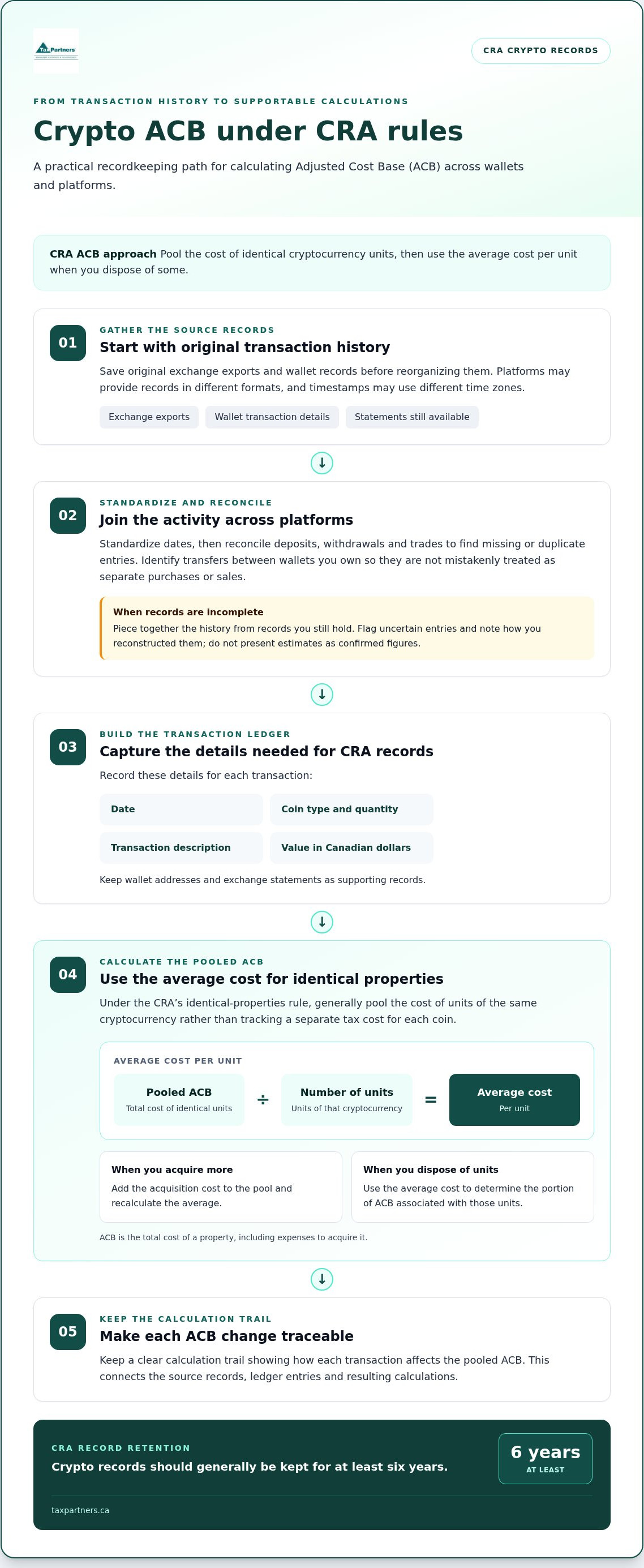
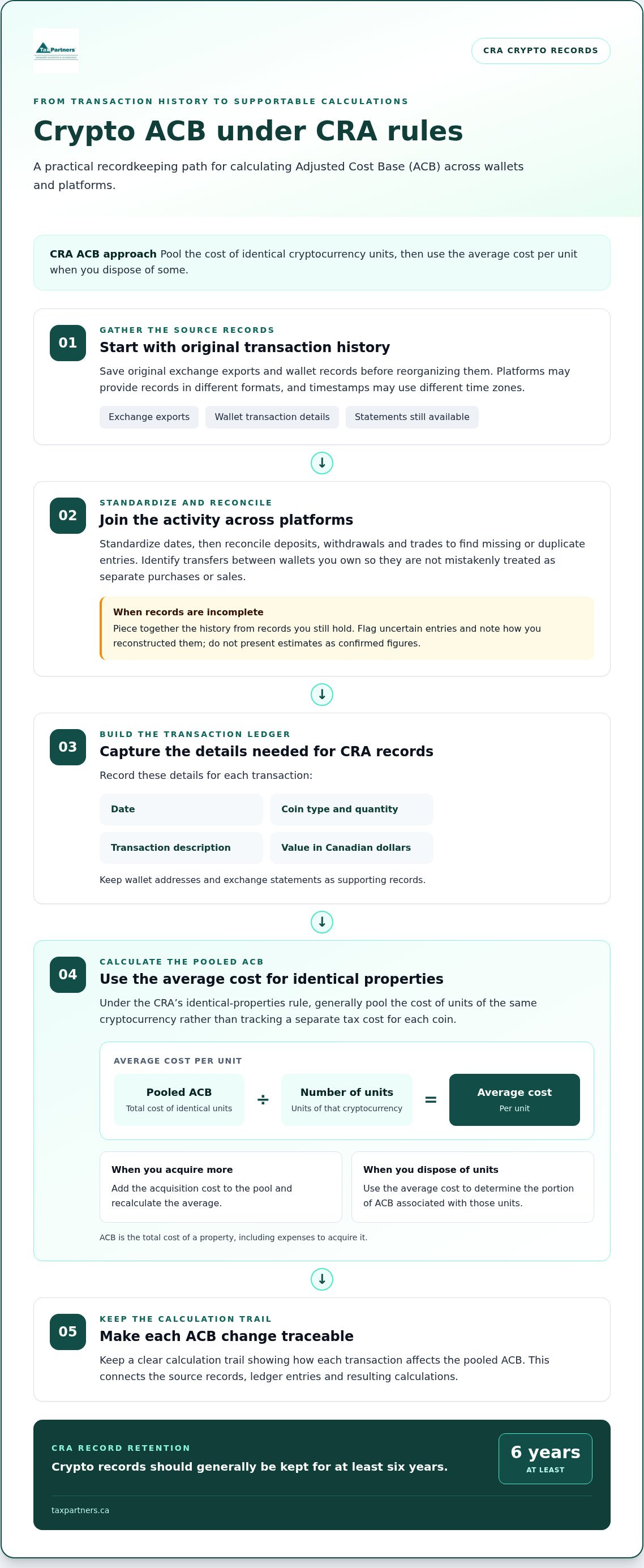
For CRA filers, calculating a gain or loss starts with the asset’s Adjusted Cost Base (ACB). ACB is the total cost of a property, including expenses to acquire it. The CRA’s identical-properties rule means you generally pool the cost of units of the same cryptocurrency rather than track a separate tax cost for each coin.
In practice, divide the pooled ACB by the number of identical units to find the average cost per unit. If you acquire more of that cryptocurrency, add its acquisition cost to the pool and recalculate the average. When you dispose of some units, use the average cost to determine the portion of ACB associated with those units. This approach can become difficult to maintain across frequent trades and multiple exchanges.
The Challenge of Multi-Platform Trading
Each platform may provide transaction records in a different format, and timestamps may use different time zones. Before calculating ACB under CRA rules, bring the records together, standardize the dates and identify transfers between wallets you own so they aren’t mistakenly treated as separate purchases or sales.
Gaps make the process harder. If an exchange has closed or older statements are missing, you may need to piece together the history from records you still hold, such as account exports and wallet transaction details. Avoid filling gaps with estimates presented as confirmed figures; flag uncertain entries and keep notes explaining how you reconstructed the record.
Documentation Requirements for CRA Compliance
Keep a transaction ledger that records dates, coin types, quantities, transaction descriptions and values in Canadian dollars. Retain wallet addresses and exchange statements as supporting records. The CRA’s guidance describes record-keeping expectations, including in the CRA's Official Cryptocurrency Tax Guide; CRA guidance says crypto records should generally be kept for at least six years.
- Save original exchange exports and wallet records before reorganizing the data.
- Reconcile deposits, withdrawals and trades across platforms to identify missing entries or duplicate transactions.
- Keep a clear calculation trail showing how each transaction affects the pooled ACB.
These steps turn a scattered transaction history into records you can explain and use to support your CRA filing. Tax Partners’ cryptocurrency accounting services can help organize complex crypto records and ACB calculations. If you’d like support with your records, you can connect with Tax Partners.
Capital Gains vs. Business Income for CRA Filers
For CRA filers, crypto profits may be treated as either capital gains or business income. A capital gain is the profit from disposing of an asset held as an investment, while business income is profit earned through activity the CRA considers a business. The classification affects how much is included in taxable income: under current CRA rules for 2026, 50% of a net capital gain is included, while 100% of net business income is included.
There isn’t a single trade count that automatically makes crypto activity a business. The CRA considers the circumstances together, including your intention, how frequently you trade, how long you hold assets and whether your conduct resembles a commercial operation. That judgement can become a point of disagreement during a CRA audit, so keep records that show the purpose and pattern of your activity.
Signs You Are Carrying on a Crypto Business
Frequent transactions and short holding periods may suggest an intention to profit from market movements rather than hold crypto as a longer-term investment. Other relevant indicators can include extensive market knowledge, specialized trading tools or software, and a deliberate short-term profit-making approach.
These are clues, not a checklist. One factor alone doesn’t settle the classification; the CRA considers the full picture. For example, using trading software doesn’t automatically mean you’re carrying on a business, just as describing your activity as investing doesn’t determine the outcome.
The Tax Implications of Classification
If the CRA treats your crypto activity as a business, eligible expenses incurred to earn that business income may be deductible. A home-office cost, for example, isn’t automatically deductible just because you trade from home; the expense must meet the applicable CRA requirements and relate to earning business income.
Capital losses are generally applied against capital gains, not against other types of income such as employment or business income. This means the classification of a loss matters too. Keep transaction records and supporting documents that show how you calculated your results and why you treated the activity as capital or business income.
These cra crypto tax challenges call for a considered assessment, not a label chosen solely for a preferred tax result. Tax Partners can help CRA filers review crypto activity and understand how its classification may affect their personal tax reporting. Learn more about personal income tax in Canada, or discuss your crypto tax reporting with the team.
Audit Risks and How the CRA Monitors Crypto
Crypto activity can leave a detailed trail, even when a taxpayer’s identity isn’t immediately visible on a public blockchain. The Canada Revenue Agency (CRA) can use analytical tools to examine blockchain transactions and compare information with tax filings. A mismatch between reported income and apparent activity may prompt questions; spending that seems inconsistent with reported income can also draw scrutiny.
The CRA may seek exchange records through an Unnamed Persons Requirement, a court-authorized legal demand for information about a group of people whose identities are not named in the request. This can help the CRA identify users and examine whether their crypto activity was properly reported. It doesn’t mean every exchange user is under audit, but it does mean you shouldn’t rely on perceived anonymity as a reporting strategy.
Data Sharing and International Cooperation
Information-sharing obligations are expanding. Under Canada’s implementation of the Crypto-Asset Reporting Framework (CARF), crypto-asset service providers in Canada are required to collect and report customer transaction information to the CRA starting in 2026, with the first reporting to the CRA scheduled for 2027 for the 2026 calendar year. This adds another potential source of information for CRA compliance work.
Decentralized platforms don’t remove the need to keep records or report taxable activity. Blockchain transactions can remain visible, and regulatory reporting is evolving. For an overview of crypto-related audits and support, see Tax Partners’ cryptocurrency audit services.
Mitigating Risk Through Voluntary Disclosure
If you discover missed crypto income or incomplete past filings, you may be able to correct the issue through the CRA’s Voluntary Disclosures Program before the CRA contacts you about it. Acceptance isn’t automatic. The CRA applies eligibility requirements, and a successful application may provide relief from certain penalties or interest, depending on the circumstances and current program rules.
Act carefully. Reconstructing past activity may require matching exchange statements, wallet records and transaction histories, then determining the appropriate tax treatment for each item. Incomplete or inconsistent information can complicate a disclosure, so organize the records and calculations before submitting an application.
The best response to cra crypto tax challenges is a clear audit trail: preserve source documents, reconcile activity across platforms and make sure reported amounts follow CRA rules. If you need help reviewing past crypto filings or preparing for CRA scrutiny, contact Tax Partners about your crypto tax records.
Navigating Crypto Complexity with Tax Partners
Crypto records can become difficult to manage when activity spans multiple wallets, exchanges and tax years. Tax Partners’ specialized Blockchain Accountants help individuals and corporations bring that information together and apply CRA rules to their digital asset activity.
Support can include organizing transaction histories, calculating Adjusted Cost Base (ACB), and reviewing whether profits or losses should be treated as capital or business income. These steps connect the underlying records to the tax reporting decisions they support, rather than relying on a transaction summary alone.
Customized Solutions for Digital Investors
No two crypto portfolios are identical. A long-term holder, an active trader and a corporation using digital assets may have different transaction patterns and record-keeping needs, so the review should reflect the taxpayer’s actual activity.
Tax Partners works with CRA filers to identify relevant tax treatment and potential planning opportunities while keeping compliance in view. That doesn’t mean every transaction creates a tax-saving opportunity; it means examining the records carefully can help avoid missed details and support informed decisions.
Why Professional Oversight Is Essential
Software can help organize transaction data, but the output still depends on complete records and appropriate classifications. Transfers, missing exchange history and frequent trades can require human review to distinguish what happened and how it should be reported under CRA rules.
Tax Partners’ team can help create a clearer record trail for current filings and future reference. For clients facing CRA questions, the firm also provides audit support, helping organize relevant documents and explain how reported amounts were determined.
These cra crypto tax challenges can feel especially demanding for high-volume traders and businesses with digital asset activity. A structured review can bring together transaction records, ACB calculations and income classification in a way that supports more consistent reporting over time.
For tailored help with crypto accounting and tax reporting, contact Tax Partners about crypto tax assistance.
Build Confidence in Your CRA Crypto Reporting
Crypto reporting becomes more manageable when you recognize which transactions may have tax consequences, keep complete records and calculate your Adjusted Cost Base consistently. For CRA filers, accurately distinguishing capital gains from business income is also essential, especially when trading activity is frequent or spans multiple platforms.
These cra crypto tax challenges don’t have to leave you facing tax season alone. Tax Partners has served Canadian taxpayers since 1981, with a specialized team of Blockchain Accountants and over 1,390 five-star Google reviews. The team can help organize complex transaction data and support your CRA reporting with care and precision.
Connect with Tax Partners about your crypto tax reporting and take a clear next step towards more organized records and greater confidence in your filing. With the right preparation, you can move forward with greater peace of mind.
Frequently Asked Questions
Is cryptocurrency anonymous for CRA tax purposes?
No. Cryptocurrency transactions may use wallet addresses rather than names, but that doesn’t make activity invisible to the CRA. Blockchain records can show transaction details, and the CRA may obtain information from crypto-asset service providers or seek exchange customer records through legal processes. For CRA filers, treat crypto activity as traceable and keep records that support how you reported each transaction.
How does the CRA track my crypto transactions?
The CRA can analyze blockchain transaction data and compare it with tax filings and information obtained through compliance activities. It may also use legal processes, including an Unnamed Persons Requirement, to seek records about a group of exchange users whose identities aren’t specified in the request. Under Canada’s CARF reporting framework, crypto-asset service providers are required to collect and report customer transaction information to the CRA starting in 2026, with initial reporting for 2026 activity scheduled for 2027.
What happens if I don't report my crypto gains to the CRA?
If you don’t report taxable crypto income or gains, the CRA may reassess your return and require you to pay additional tax, interest and penalties under Canadian rules. The consequences depend on the circumstances. The CRA may apply a gross-negligence penalty where it determines a taxpayer knowingly or through gross negligence failed to report income. If you discover an omission, review your records and consider whether Canada’s Voluntary Disclosures Program may apply before the CRA contacts you.
Can I use capital losses from crypto to offset my salary income?
Generally, no. Under CRA rules, a capital loss is generally used to offset capital gains, not employment income such as salary. First, the crypto activity must be correctly classified as being on capital account; if the CRA considers it business activity, the loss may instead be treated under business-income rules. Keep transaction records and seek advice on classification before applying a crypto loss to your Canadian tax return.
Do I have to pay tax if I only traded one crypto for another?
A crypto-to-crypto trade may create a taxable disposition under CRA rules, even if you didn’t receive Canadian dollars. For example, exchanging one coin for another can require you to calculate whether you realized a gain or loss on the coin you gave up. Record the transaction date, the assets and quantities exchanged, and their values in Canadian dollars so you can support the calculation for your Canadian tax filing.
What records do I need to keep for my crypto taxes in Canada?
For Canadian tax reporting, keep transaction dates, asset types and quantities, descriptions, values in Canadian dollars, wallet addresses and exchange statements. Retain enough information to calculate the Adjusted Cost Base and support each reported gain, loss or income amount. CRA guidance generally requires crypto transaction records to be kept for at least six years. These cra crypto tax challenges become easier to manage when you save original exports and reconcile activity across platforms.
How is NFT income taxed under CRA rules?
Under CRA rules, the tax treatment of a non-fungible token (NFT) depends on the facts, including how it was acquired, used and disposed of, and whether the activity is an investment or a business. Selling or exchanging an NFT may have tax consequences, even if payment is received in cryptocurrency. Keep records of the transaction, its Canadian-dollar value and related costs, then assess the appropriate reporting treatment for your circumstances.
Is mining cryptocurrency considered business income or capital gains?
It depends on the mining activity and the surrounding facts. The CRA may consider factors such as the activity’s organization, scale, frequency and commercial purpose when deciding whether it amounts to a business. If the activity is treated as a business, its profits are generally reported as business income; later disposal of mined crypto may have separate tax consequences. Keep records of mining activity, receipts and subsequent transactions for your Canadian tax reporting.

Article by
Mahad Mohamed
Mahad Mohamed is an accountant and the CEO of Tax Partners, with over 26+ years of Canadian and international tax and accounting experience. His expertise includes corporate reorganization, cross-border tax structuring (Canada & US), tax disputes, CRA audits, and tax planning for small owner-managed private corporations. Most recently, Mahad is a pioneer in Canadian crypto taxation and founded Block3 Finance.
Previously, Mahad worked for the Canada Revenue Agency (CRA), Big4 accounting firms, and served as a Rulings Officer for the Federal Tax Authority of the UAE before acquiring Tax Partners in 2014.
Tax Partners has 44 full-time accountants and over 18,400+ clients.
Disclaimer
This article provides general information only and is current as of its publication date. It has not been updated and may be out of date. It does not constitute legal advice and should not be relied upon as such. Every tax situation is unique and may differ from the examples discussed in this article. If you have specific questions, you should seek the advice of our accountants for your unique circumstances. Book a FREE Initial Consultation Today!
Frequently Asked Questions
Is cryptocurrency anonymous for CRA tax purposes?
No. Cryptocurrency transactions may use wallet addresses rather than names, but that doesn’t make activity invisible to the CRA. Blockchain records can show transaction details, and the CRA may obtain information from crypto-asset service providers or seek exchange customer records through legal processes. For CRA filers, treat crypto activity as traceable and keep records that support how you reported each transaction.
How does the CRA track my crypto transactions?
The CRA can analyze blockchain transaction data and compare it with tax filings and information obtained through compliance activities. It may also use legal processes, including an Unnamed Persons Requirement, to seek records about a group of exchange users whose identities aren’t specified in the request. Under Canada’s CARF reporting framework, crypto-asset service providers are required to collect and report customer transaction information to the CRA starting in 2026, with initial reporting for 2026 activity scheduled for 2027.
What happens if I don't report my crypto gains to the CRA?
If you don’t report taxable crypto income or gains, the CRA may reassess your return and require you to pay additional tax, interest and penalties under Canadian rules. The consequences depend on the circumstances. The CRA may apply a gross-negligence penalty where it determines a taxpayer knowingly or through gross negligence failed to report income. If you discover an omission, review your records and consider whether Canada’s Voluntary Disclosures Program may apply before the CRA contacts you.
Can I use capital losses from crypto to offset my salary income?
Generally, no. Under CRA rules, a capital loss is generally used to offset capital gains, not employment income such as salary. First, the crypto activity must be correctly classified as being on capital account; if the CRA considers it business activity, the loss may instead be treated under business-income rules. Keep transaction records and seek advice on classification before applying a crypto loss to your Canadian tax return.
Do I have to pay tax if I only traded one crypto for another?
A crypto-to-crypto trade may create a taxable disposition under CRA rules, even if you didn’t receive Canadian dollars. For example, exchanging one coin for another can require you to calculate whether you realized a gain or loss on the coin you gave up. Record the transaction date, the assets and quantities exchanged, and their values in Canadian dollars so you can support the calculation for your Canadian tax filing.
What records do I need to keep for my crypto taxes in Canada?
For Canadian tax reporting, keep transaction dates, asset types and quantities, descriptions, values in Canadian dollars, wallet addresses and exchange statements. Retain enough information to calculate the Adjusted Cost Base and support each reported gain, loss or income amount. CRA guidance generally requires crypto transaction records to be kept for at least six years. These cra crypto tax challenges become easier to manage when you save original exports and reconcile activity across platforms.
How is NFT income taxed under CRA rules?
Under CRA rules, the tax treatment of a non-fungible token (NFT) depends on the facts, including how it was acquired, used and disposed of, and whether the activity is an investment or a business. Selling or exchanging an NFT may have tax consequences, even if payment is received in cryptocurrency. Keep records of the transaction, its Canadian-dollar value and related costs, then assess the appropriate reporting treatment for your circumstances.
Is mining cryptocurrency considered business income or capital gains?
It depends on the mining activity and the surrounding facts. The CRA may consider factors such as the activity’s organization, scale, frequency and commercial purpose when deciding whether it amounts to a business. If the activity is treated as a business, its profits are generally reported as business income; later disposal of mined crypto may have separate tax consequences. Keep records of mining activity, receipts and subsequent transactions for your Canadian tax reporting.