Cross-Border Tax Planning for Canada and the US: 2026 Guide

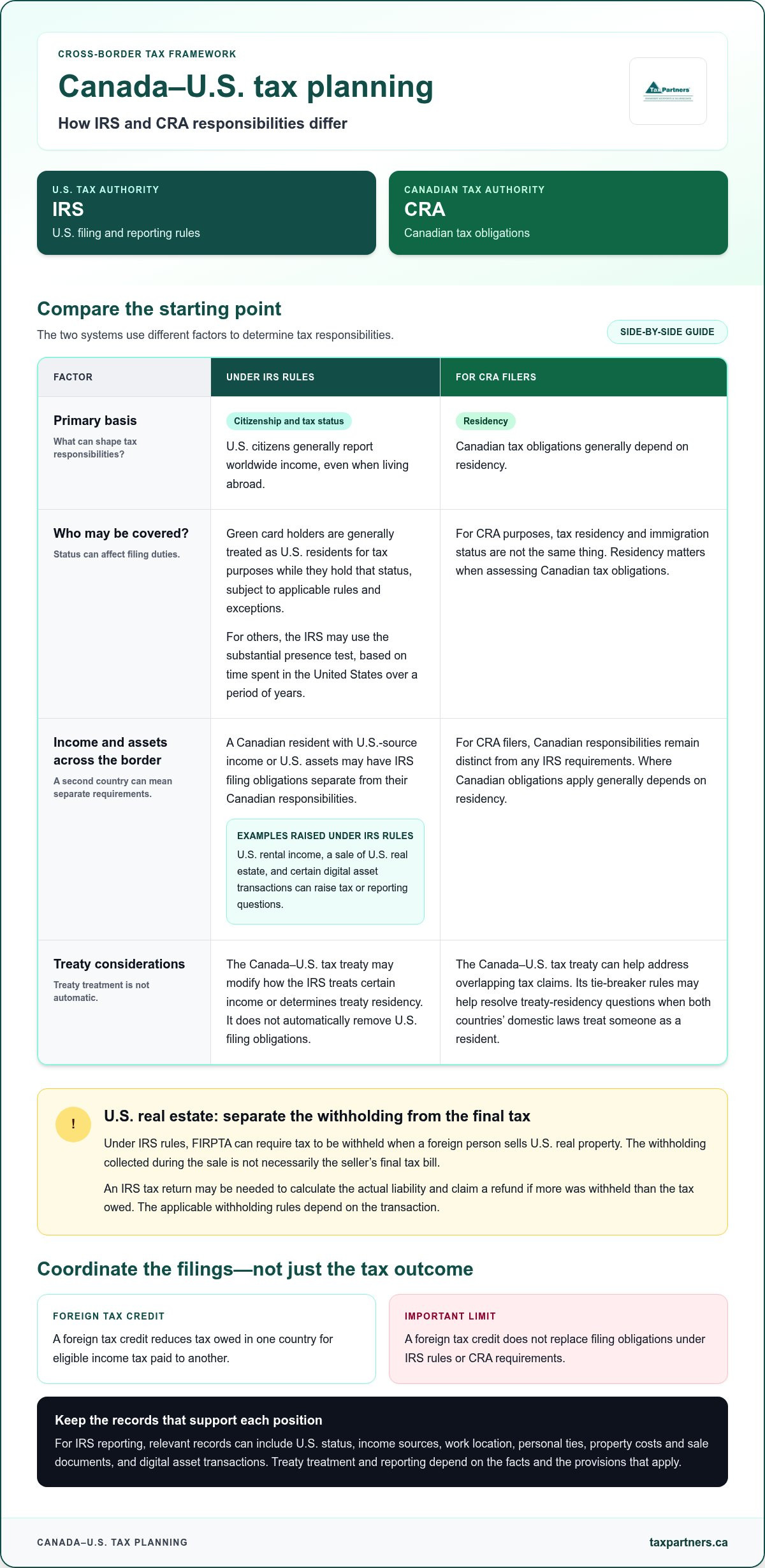
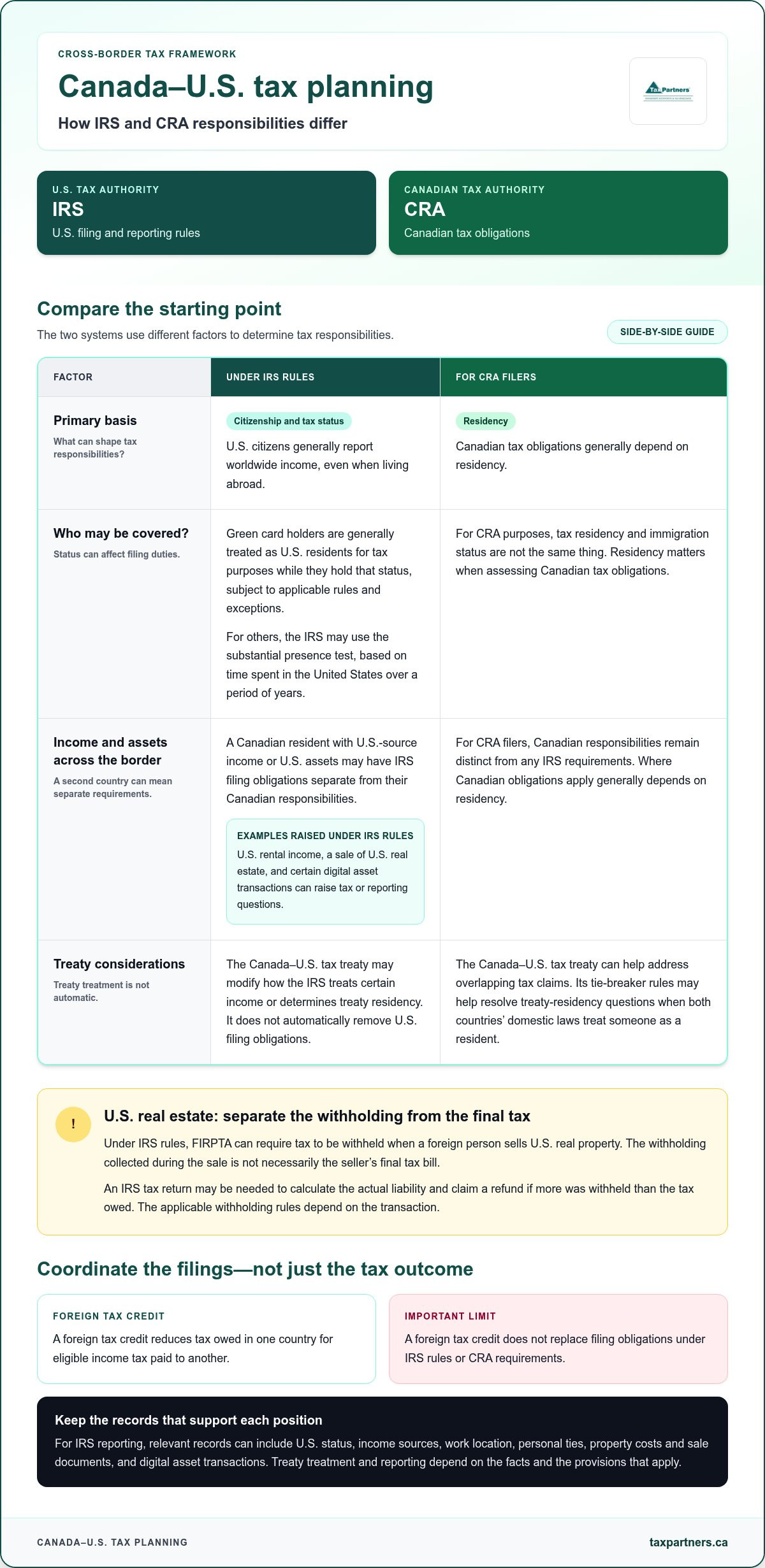
What if avoiding double taxation depends less on finding a loophole and more on coordinating two separate tax systems? Cross border tax planning Canada US starts with understanding the distinction: under IRS rules, U.S. citizens generally report worldwide income even when living abroad; for CRA purposes, Canadian tax obligations generally depend on residency. Each jurisdiction has its own filing and disclosure requirements, and the Canada-U.S. tax treaty can help address overlapping tax claims.
If you’re worried about penalties, uncertain how treaty rules apply, or tired of coordinating separate advisors, that concern is understandable. A foreign tax credit, which reduces tax owed in one country for eligible income tax paid to another, may help limit double taxation, but it doesn’t replace filing obligations in either country.
This 2026 guide explains how to organize your IRS and CRA requirements, understand key reporting obligations, and plan across the border for income, retirement, and estate considerations. With a clear roadmap and coordinated support, you can make informed decisions with greater confidence. Tax Partners brings a steady hand to complex cross-border matters, backed by experience dating to 1981 and nearly 500,000 returns filed.
Key Takeaways
- Use cross border tax planning Canada US to build a coordinated approach, while keeping IRS and CRA filing obligations distinct.
- For CRA filers, understand how tax residency differs from immigration status and why it matters when assessing Canadian tax obligations.
- Under IRS rules, identify whether U.S.-source income or U.S. real estate may bring filing and reporting requirements, including when property is rented or sold.
- For U.S. citizens living in Canada, learn how IRS income tax returns and foreign-account disclosures fit into annual compliance.
- Plan ahead for wealth held in both countries by understanding how Canadian deemed disposition and U.S. estate tax can affect long-term decisions.
Fundamentals of Canada-US Cross-Border Taxation
For people with U.S. tax obligations, the first step is identifying how the IRS classifies them. U.S. citizens generally have U.S. filing responsibilities on worldwide income even while living abroad. Other people may be treated as U.S. residents for tax purposes based on their immigration status or time spent in the United States.
The U.S.-Canada tax treaty can affect how the IRS treats certain income and residency situations, but it doesn’t automatically remove U.S. filing obligations. Effective cross border tax planning Canada US means understanding your U.S. status and the treaty provisions that may apply to your circumstances.
Residency vs. Citizenship: The Core Conflict
Under IRS rules, U.S. citizens generally remain subject to U.S. income tax reporting on worldwide income, regardless of where they live. Green card holders are generally treated as U.S. residents for tax purposes while they hold that status, subject to applicable rules and exceptions.
For people who aren’t U.S. citizens or green card holders, the IRS may use the substantial presence test, a calculation based on time spent in the United States over a period of years. Meeting the test can make someone a U.S. resident for tax purposes, although exceptions may apply. Immigration permission and tax classification are related concepts, but they aren’t interchangeable.
The IRS term tax home generally refers to the main location of a person’s work or business, rather than simply their citizenship or mailing address. Under U.S. tax rules, it can matter for certain provisions involving people who work abroad, so it’s useful to keep work location and travel records clear.
The Role of the US-Canada Tax Treaty
From the U.S. filing perspective, the treaty provides rules that may modify how the IRS taxes certain income or determines treaty residency. Its tie-breaker rules can help resolve treaty-residency questions when an individual is considered a resident under both countries’ domestic laws. The result depends on the person’s facts and the treaty provisions that apply.
Treaty benefits aren’t necessarily automatic. A U.S. taxpayer may need to disclose or claim the relevant treatment through the appropriate IRS filing process, depending on the provision and income involved. Keep records of your U.S. status, income sources, work location, and relevant personal ties so the position reported to the IRS is well supported.
For guidance focused on U.S. tax matters, explore U.S. tax services.
Compliance Requirements for Canadians with US Interests
Canadian residents with U.S.-source income or U.S. assets may have filing obligations under IRS rules, separate from their responsibilities as CRA filers. U.S. rental income, a sale of U.S. real estate, and certain digital asset transactions can each raise different tax and reporting questions. The right filing approach depends on your circumstances, not simply on where you live.
Filing Form 1040-NR Under IRS Rules
Under IRS rules, a Canadian who is a non-resident alien for U.S. tax purposes may need to file a U.S. non-resident income tax return, Form 1040-NR, when they have certain U.S.-source income. This can include income from U.S. rental property; the filing requirement and how the income is treated depend on the facts and applicable rules.
An ITIN, or Individual Taxpayer Identification Number, is a U.S. tax-processing number for people who need a U.S. taxpayer identification number but aren’t eligible for a Social Security number. Canadians who need an ITIN can learn about the ITIN application service.
Owning U.S. property can involve more than reporting rent. A later sale may bring U.S. tax and withholding considerations, so keep purchase records, improvement costs, rental income and sale documents organized. For IRS guidance on international filing matters, consult the IRS international taxpayer FAQs.
U.S. Real Estate, FIRPTA and Digital Assets
Under IRS rules, the Foreign Investment in Real Property Tax Act, or FIRPTA, can require tax to be withheld when a foreign person sells U.S. real property. Withholding is generally collected during the sale process; it isn’t necessarily the seller’s final tax bill. A U.S. tax return may be needed to calculate the actual liability and claim a refund if the amount withheld exceeds the tax owed.
Plan before closing. Reviewing the expected sale, available records and filing steps in advance can help avoid surprises and support a timely claim for any excess withholding. The applicable withholding rules depend on the transaction, so don’t assume the amount withheld equals the final tax.
For 2026, Canadians with U.S. tax filing obligations should also review how the IRS treats digital asset activity. Selling, exchanging or using cryptocurrency to pay for something may have U.S. tax consequences; the reporting treatment depends on the transaction and current IRS instructions. Keep transaction records and check the IRS guidance that applies to the relevant tax year rather than assuming crypto activity is outside U.S. reporting.
These requirements can intersect. Discussing your cross-border tax situation can help bring U.S. filings, property transactions and digital asset records into one coordinated plan.
IRS Reporting for US Citizens Residing in Canada
Living in Canada doesn’t end a U.S. citizen’s IRS filing responsibilities. Under IRS rules, a U.S. citizen generally reports worldwide income on an annual Form 1040, while separate information returns may be required to disclose certain Canadian financial accounts or assets. These disclosures help the IRS track foreign holdings; they don’t, by themselves, create tax on the accounts’ value.
Understand FBAR and FATCA Disclosures
An FBAR, the Report of Foreign Bank and Financial Accounts, is a separate disclosure to FinCEN, the U.S. financial crimes agency, rather than an income tax return filed with the IRS. For the 2025 calendar year, U.S. persons generally must file if the combined value of their foreign financial accounts exceeded US$10,000 at any point; the due date is April 15, 2026, with an automatic extension to October 15, 2026.
FATCA, the Foreign Account Tax Compliance Act, requires certain U.S. taxpayers to report specified foreign financial assets to the IRS on Form 8938. For U.S. citizens living abroad, the 2026 thresholds are more than US$200,000 at year-end or US$300,000 at any time for single or married-filing-separately filers; for married filing jointly, more than US$400,000 at year-end or US$600,000 at any time. FBAR and FATCA rules are distinct, so one disclosure doesn’t automatically replace the other.
Failing to disclose when required can lead to significant penalties. Keep account statements and ownership details organized, and distinguish reporting forms from the income tax return: interest, dividends, or other income may still need to be reported on the U.S. return even when an account disclosure itself doesn’t create tax.
Catch Up Through the IRS Streamlined Procedure
The IRS Streamlined Filing Compliance Procedures may offer a route for eligible U.S. taxpayers to catch up on missed filings. Eligibility centres on whether the failure was non-willful, meaning it resulted from a mistake, oversight, or misunderstanding rather than intentional disregard of tax obligations. The IRS reviews each submission, so the procedure doesn’t guarantee penalty relief.
Broadly, the process involves assessing eligibility, preparing the required late tax returns and foreign-account disclosures, explaining the non-willful conduct, and paying any tax and interest due. The IRS streamlined procedure guide outlines eligibility considerations. Coordinated US and cross-border accounting can help align the filings; for the treaty framework relevant to some cross-border tax questions, consult the official U.S.-Canada Income Tax Convention.
Digital assets also deserve attention. Under IRS rules, transactions such as selling or exchanging cryptocurrency may have tax consequences, and applicable reporting depends on the activity and current IRS instructions. Keep transaction records with your other tax documents as part of a clear cross border tax planning Canada US process. For support organizing outstanding IRS filings and disclosures, discuss your U.S. tax compliance needs.
Strategic Planning to Mitigate Double Taxation
Planning is different from filing. Filing reports income and accounts; planning looks ahead at where income arises, when tax is paid, and which relief may apply under IRS and CRA rules. A review of the treaty and your circumstances for 2026 can help identify options before a transaction, account withdrawal, or other major financial decision.
Foreign Tax Credits vs. Exclusions
A foreign tax credit reduces tax in one country for eligible income tax paid to the other, subject to that country’s rules and limits. For CRA filers, Canada may allow a credit for qualifying foreign income tax; under IRS rules, a U.S. taxpayer may be able to claim a credit for qualifying foreign income tax against U.S. tax on foreign-source income.
Under IRS rules, the Foreign Earned Income Exclusion (FEIE) lets qualifying taxpayers exclude some foreign earned income from U.S. taxable income. The maximum exclusion for 2026 is US$132,900 per qualifying person. Unlike a credit, an exclusion removes eligible income from the U.S. tax calculation; it doesn’t directly credit tax paid to Canada. A foreign tax credit may be more useful in some circumstances, including where Canadian tax on the same income is substantial, but the best result depends on income type, eligibility, and applicable limits.
Timing matters. Keep track of when foreign income tax is paid or accrued, which tax year it relates to, and how each return treats it. Under IRS rules, the method used to claim a foreign tax credit can affect the relevant year; for CRA filers, claim eligibility and timing also depend on Canadian rules. Don’t assume a payment made in one calendar year will automatically match income reported in that year across both returns.
Plan Around Canadian Registered Accounts
A Canadian TFSA, or Tax-Free Savings Account, doesn’t receive the same tax-free treatment under IRS rules that it receives for Canadian tax purposes. Income earned inside a TFSA may therefore have U.S. tax consequences, and the account can raise additional reporting questions. Treating the account as tax-free in both countries can lead to missed U.S. reporting or tax.
An RRSP, or Registered Retirement Savings Plan, may receive different treatment under the Canada-U.S. treaty. Treaty provisions can allow eligible U.S. taxpayers to defer U.S. tax on income accumulating in an RRSP until distribution, but the account and withdrawals still need to be considered correctly in U.S. tax reporting. Review the account’s treatment under IRS rules and the treaty rather than assuming Canadian tax treatment carries across the border.
Coordinated cross-border wealth management can help align investment and retirement decisions with tax obligations in both countries. For a tailored 2026 review of credits, exclusions, and registered accounts, discuss your cross-border tax plan.
Designing a Long-Term Cross-Border Wealth Strategy
Estate planning becomes more complex when a family’s assets, beneficiaries, or tax obligations span Canada and the United States. A coordinated plan can clarify who owns each asset, how it may be taxed at death, and what records the estate will need, helping reduce uncertainty for family members.
Plan for Different Estate Tax Systems
For CRA filers, Canada generally treats a person as having disposed of many capital property assets at fair market value immediately before death. This deemed disposition means the final Canadian income tax return may report gains even when the assets haven’t actually been sold. The treatment depends on the asset and circumstances.
Under IRS rules, U.S. estate tax is a separate system that can apply to a person’s taxable estate. For 2026, the federal estate tax exemption is US$15 million per individual for U.S. citizens and domiciliaries; for non-resident aliens, including some Canadian residents who own U.S.-situs assets, the exemption is US$60,000 for those assets. U.S.-situs assets are property the IRS treats as located in the United States, such as U.S. real estate or stock in U.S. corporations.
Cross-border trusts may be considered as part of succession planning, but a trust’s tax treatment can differ under CRA and IRS rules. Its structure, contributors, beneficiaries, and assets all matter, so don’t assume a trust that works for Canadian purposes will receive the same treatment under U.S. rules. For information on Canadian estate income tax, consider how the final Canadian return fits with any U.S. filing obligations.
Coordinate the Plan Across Both Countries
A unified global tax approach brings asset ownership, beneficiary designations, trust arrangements, and tax filings into one clear picture. That coordination can help family members understand the plan and reduce the chance that incomplete records or conflicting instructions create avoidable disputes. It also makes it easier to identify potential tax bills before an estate must address them.
Working with one firm on both CRA and IRS requirements can provide continuity across annual filings and long-term planning. Tax Partners has worked in accounting and tax since 1981, bringing a steady hand to decisions that affect family wealth across borders. Cross border tax planning Canada US should be reviewed as circumstances change, including changes to residency, asset ownership, or family structure.
Build a plan around your family’s assets and goals. Secure your cross-border future with a coordinated review of your Canadian and U.S. tax considerations.
Take the Next Step with Confidence
Cross-border tax planning Canada US works best when you treat IRS and CRA requirements as distinct, coordinated responsibilities. Clear records, properly considered treaty benefits, and advance planning for income, retirement accounts, and estate matters can help reduce uncertainty and keep important decisions on track.
Tax Partners brings over 40 years of cross-border expertise, with experience supporting both CRA and IRS compliance. More than 1,390 five-star Google reviews reflect the trust clients place in the firm to help manage complex tax matters with care and precision.
Give your cross-border finances a clear path forward. Book a Cross-Border Consultation with Tax Partners to discuss a plan shaped around your circumstances and long-term goals. With the right support, you can move ahead with greater clarity and peace of mind.
Frequently Asked Questions
Do I have to file a US tax return if I am a US citizen living in Canada?
Generally, U.S. citizens must report worldwide income to the IRS, even while living in Canada, but whether you must file a U.S. return depends on your circumstances and the IRS filing requirements for that year. A foreign tax credit or another available provision may reduce U.S. tax, but it doesn’t automatically remove the filing obligation. Keep your Canadian income and tax records organized alongside your U.S. documents.
What happens if I forget to file an FBAR for my Canadian bank accounts?
If you were required to file an FBAR under U.S. rules and missed it, you may face significant penalties. An FBAR is a U.S. disclosure of certain foreign financial accounts, filed separately from your IRS income tax return. Review your account balances and filing history, then address the omission promptly. The right correction process depends on why you missed the filing and your wider U.S. tax compliance history.
Can the IRS tax my Canadian RRSP or TFSA?
Under IRS rules, a Canadian RRSP may qualify for treaty-based tax deferral on eligible growth, though U.S. reporting obligations can still apply. A TFSA generally doesn’t receive the same tax-free treatment under IRS rules that it receives for Canadian tax purposes, so investment income may have U.S. tax consequences. The accounts differ; review each one separately rather than assuming Canadian treatment carries over to your U.S. return.
How does the US-Canada tax treaty prevent me from paying double tax?
The treaty coordinates certain tax matters between the countries, including residency questions and the treatment of some income. It doesn’t eliminate the need to file where filing is required. Instead, relief may be available through treaty provisions or foreign tax credits, which reduce tax in one country for eligible tax paid to the other, subject to each country’s rules. The right claim depends on your residency, income type, and specific circumstances.
What is an ITIN and do I need one to sell my US property?
An ITIN is an Individual Taxpayer Identification Number issued for U.S. tax administration to someone who needs a U.S. taxpayer number but isn’t eligible for a Social Security number. You may need one to meet IRS filing requirements connected with a U.S. property sale or to claim a refund of excess withholding. An ITIN isn’t, by itself, permission to work or proof of immigration status.
Is there an IRS program to catch up on late tax returns without penalties?
The IRS Streamlined Filing Compliance Procedures may help eligible taxpayers living abroad catch up on certain overdue returns and foreign-account disclosures. Eligibility depends in part on whether the failure was non-willful, meaning it resulted from a mistake or misunderstanding rather than intentional disregard. The process doesn’t guarantee penalty relief. It generally involves preparing required late filings, providing a statement about the conduct, and paying any tax and interest due.
Does the CRA tax my US-source Social Security or pension income?
For CRA filers who are Canadian residents, U.S. Social Security benefits are generally taxable only in Canada under the treaty, with 85% of the benefit included in taxable income, subject to the applicable rules. Other U.S. pension income may receive different treatment depending on the type of plan and the treaty provisions. Keep benefit statements and confirm the correct Canadian reporting treatment for your specific income.
How do I report my cryptocurrency holdings in a cross-border context?
For IRS purposes, simply holding cryptocurrency isn’t the same as making a taxable transaction, but selling, exchanging, or using it to pay for something may have tax consequences. For CRA purposes, the tax treatment depends on the activity and whether it is considered income or a capital gain. Cross border tax planning Canada US means keeping transaction dates, values, and records organized for the rules that apply in each country.

Article by
Mahad Mohamed
Mahad Mohamed is an accountant and the CEO of Tax Partners, with over 26+ years of Canadian and international tax and accounting experience. His expertise includes corporate reorganization, cross-border tax structuring (Canada & US), tax disputes, CRA audits, and tax planning for small owner-managed private corporations. Most recently, Mahad is a pioneer in Canadian crypto taxation and founded Block3 Finance.
Previously, Mahad worked for the Canada Revenue Agency (CRA), Big4 accounting firms, and served as a Rulings Officer for the Federal Tax Authority of the UAE before acquiring Tax Partners in 2014.
Tax Partners has 44 full-time accountants and over 18,400+ clients.
Disclaimer
This article provides general information only and is current as of its publication date. It has not been updated and may be out of date. It does not constitute legal advice and should not be relied upon as such. Every tax situation is unique and may differ from the examples discussed in this article. If you have specific questions, you should seek the advice of our accountants for your unique circumstances. Book a FREE Initial Consultation Today!
Frequently Asked Questions
Do I have to file a US tax return if I am a US citizen living in Canada?
Generally, U.S. citizens must report worldwide income to the IRS, even while living in Canada, but whether you must file a U.S. return depends on your circumstances and the IRS filing requirements for that year. A foreign tax credit or another available provision may reduce U.S. tax, but it doesn’t automatically remove the filing obligation. Keep your Canadian income and tax records organized alongside your U.S. documents.
What happens if I forget to file an FBAR for my Canadian bank accounts?
If you were required to file an FBAR under U.S. rules and missed it, you may face significant penalties. An FBAR is a U.S. disclosure of certain foreign financial accounts, filed separately from your IRS income tax return. Review your account balances and filing history, then address the omission promptly. The right correction process depends on why you missed the filing and your wider U.S. tax compliance history.
Can the IRS tax my Canadian RRSP or TFSA?
Under IRS rules, a Canadian RRSP may qualify for treaty-based tax deferral on eligible growth, though U.S. reporting obligations can still apply. A TFSA generally doesn’t receive the same tax-free treatment under IRS rules that it receives for Canadian tax purposes, so investment income may have U.S. tax consequences. The accounts differ; review each one separately rather than assuming Canadian treatment carries over to your U.S. return.
How does the US-Canada tax treaty prevent me from paying double tax?
The treaty coordinates certain tax matters between the countries, including residency questions and the treatment of some income. It doesn’t eliminate the need to file where filing is required. Instead, relief may be available through treaty provisions or foreign tax credits, which reduce tax in one country for eligible tax paid to the other, subject to each country’s rules. The right claim depends on your residency, income type, and specific circumstances.
What is an ITIN and do I need one to sell my US property?
An ITIN is an Individual Taxpayer Identification Number issued for U.S. tax administration to someone who needs a U.S. taxpayer number but isn’t eligible for a Social Security number. You may need one to meet IRS filing requirements connected with a U.S. property sale or to claim a refund of excess withholding. An ITIN isn’t, by itself, permission to work or proof of immigration status.
Is there an IRS program to catch up on late tax returns without penalties?
The IRS Streamlined Filing Compliance Procedures may help eligible taxpayers living abroad catch up on certain overdue returns and foreign-account disclosures. Eligibility depends in part on whether the failure was non-willful, meaning it resulted from a mistake or misunderstanding rather than intentional disregard. The process doesn’t guarantee penalty relief. It generally involves preparing required late filings, providing a statement about the conduct, and paying any tax and interest due.
Does the CRA tax my US-source Social Security or pension income?
For CRA filers who are Canadian residents, U.S. Social Security benefits are generally taxable only in Canada under the treaty, with 85% of the benefit included in taxable income, subject to the applicable rules. Other U.S. pension income may receive different treatment depending on the type of plan and the treaty provisions. Keep benefit statements and confirm the correct Canadian reporting treatment for your specific income.
How do I report my cryptocurrency holdings in a cross-border context?
For IRS purposes, simply holding cryptocurrency isn’t the same as making a taxable transaction, but selling, exchanging, or using it to pay for something may have tax consequences. For CRA purposes, the tax treatment depends on the activity and whether it is considered income or a capital gain. Cross border tax planning Canada US means keeping transaction dates, values, and records organized for the rules that apply in each country.