How to Switch Accounting Firms in Canada

What if changing accountants didn’t mean putting your tax filings or bookkeeping on hold? The key is a managed handoff. Understanding how to switch accounting firms Canada-wide starts with choosing your next firm before ending the current relationship, then coordinating records, deadlines and CRA access.
If you’re concerned about what to request from your current accountant, or whether your new firm will have the information and authorizations it needs, those are sensible questions. A clear transition plan can help protect continuity while giving you the opportunity to find an accounting relationship that better fits your needs.
This guide walks you through the practical steps: when to notify your current firm, which financial records and details to gather, and how to manage CRA representative access during the change. You’ll also learn how to plan around ongoing tax, bookkeeping and payroll work, so the move feels organized rather than uncertain.
Key Takeaways
- Recognize when your accounting needs have changed, from unclear advice to limited visibility into ongoing work.
- Learn how to switch accounting firms Canada: assess your needs, review your current terms and plan the handoff in a clear sequence.
- Build a practical transfer checklist that covers relevant tax returns, financial statements, bookkeeping data and supporting records.
- Clarify who is responsible for open filings, payroll tasks and CRA access during the transition to help avoid missed work.
- Use the change as an opportunity to establish an accounting relationship suited to your current needs and future plans.
When should you switch accounting firms in Canada?
It’s frustrating when emails go unanswered, advice feels difficult to understand, or you can’t tell which tasks your accountant has completed. Your needs may also have changed: a growing business, new revenue sources, added payroll responsibilities or more complex finances can call for a different level or mix of support.
A change can make sense when the service you receive no longer matches what you need. That doesn’t mean one missed call or disagreement automatically calls for a new firm. Look for a recurring mismatch in communication, expertise or the work included in your arrangement, and consider whether a direct conversation could resolve it.
What signs suggest it may be time for a change?
Consider whether you can get clear answers, understand the advice you receive and identify who is responsible for each task. Repeated uncertainty about bookkeeping, tax filings or payroll can make it harder to plan and keep your financial work on track.
Changing circumstances matter, too. A self-employed person moving into a corporation, or an SME adding employees, may need support that differs from what suited them before. If your current firm’s scope no longer aligns with your priorities, explore a relationship that better fits your Canadian accounting needs. Tax Partners provides accounting support in Canada for individuals and businesses.
Professional standards are part of the picture, but don’t confuse a national professional organization with your provincial or territorial regulator. Chartered Professional Accountants of Canada (CPA Canada) provides background on the national organization; the central question for your decision is whether the service, communication and scope meet your needs.
How do you choose the right time to move?
Timing is about planning, not finding one universally perfect date. Before deciding when to make the change, map upcoming Canadian tax filings, reporting work, bookkeeping tasks and payroll responsibilities, then note what’s already underway and who is handling it.
Review your current engagement terms before ending services. An engagement letter describes the agreed work and terms of the relationship, so check what it says about responsibilities and ending the arrangement. Don’t assume a standard notice period applies to every Canadian client; follow the terms that apply to your engagement.
With that information in hand, you can discuss a transition date with the new firm and plan around open work. This preparation is a practical first step in how to switch accounting firms Canada without leaving responsibilities unclear. Keep the focus on a documented handoff for Canadian accounting and CRA-related matters.
How to switch accounting firms in Canada, step by step
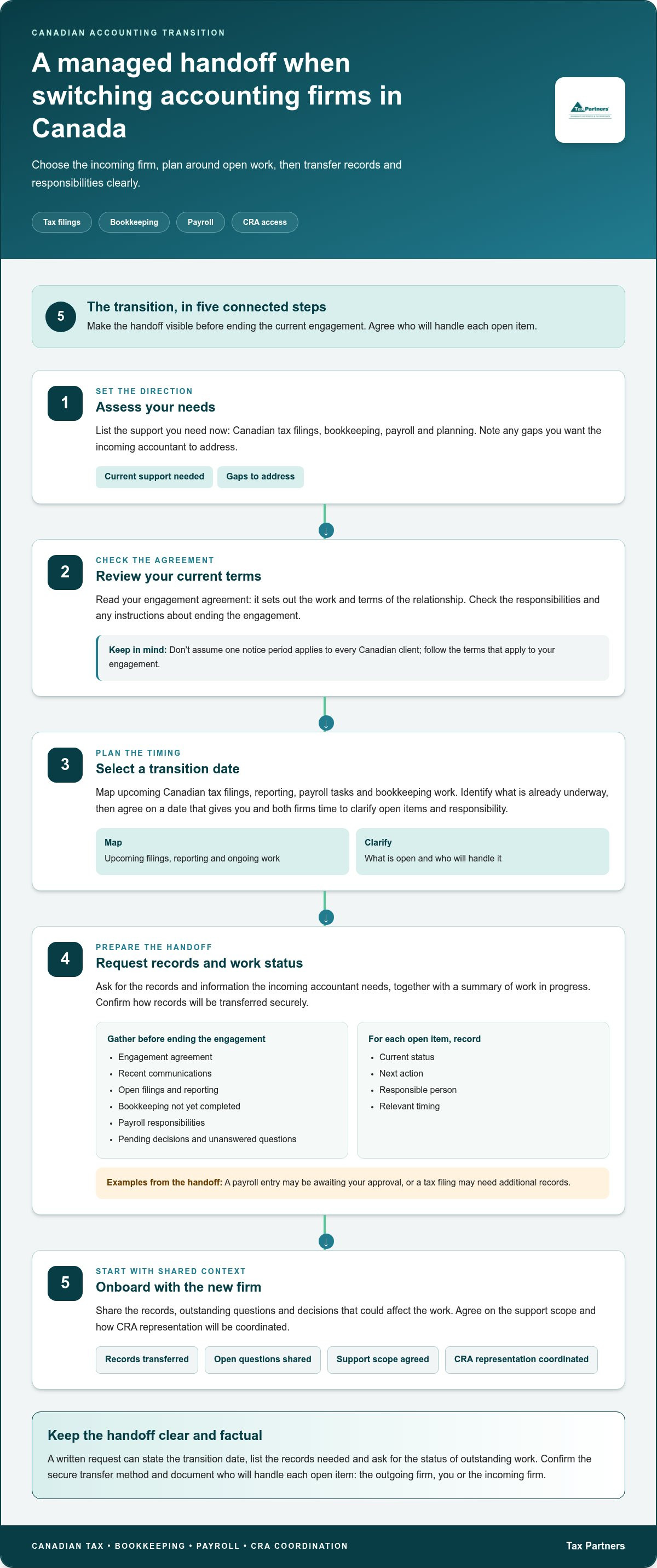
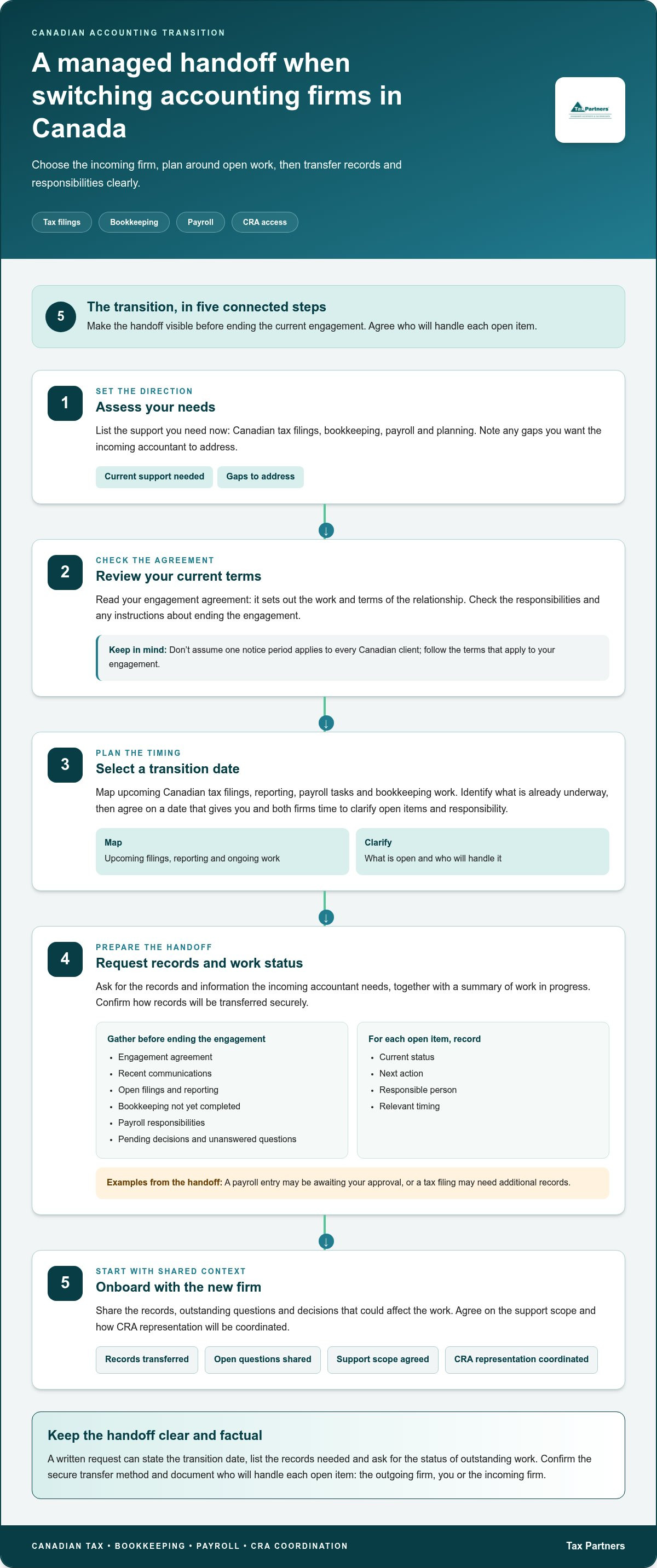
A smooth transition is a managed handoff, not simply a change of contact. Before notifying your current accountant, choose the incoming firm and outline the Canadian tax, bookkeeping, payroll and advisory work that’s underway. This gives everyone a clearer view of what must continue and who will handle it.
Use this sequence to plan how to switch accounting firms Canada-wide while keeping responsibilities visible:
- Step 1: Assess your needs. Identify the support you need now, including tax filings, bookkeeping, payroll and planning. Note any gaps you want the incoming accountant to address.
- Step 2: Review your current terms. Read your engagement agreement, which sets out the work and terms of your relationship. Check responsibilities and any instructions about ending the engagement.
- Step 3: Select a transition date. Map upcoming Canadian filings, reporting, payroll tasks and bookkeeping work. Choose a date that gives you and both firms time to identify open items and agree on responsibility.
- Step 4: Request records. Ask for the records and information the incoming accountant needs, along with a summary of work in progress. Confirm how the transfer will be handled securely.
- Step 5: Onboard with the new firm. Share the records, outstanding questions and decisions that could affect the work. Agree on the scope of support and how CRA representation will be coordinated.
What should you prepare before ending the engagement?
Gather your engagement agreement, recent communications and a working list of open tasks. Include filing or reporting work underway, bookkeeping not yet completed, payroll responsibilities, pending decisions and questions that still need an answer.
Keep the handoff respectful and factual. A clear written request can state the transition date, identify the records you need and ask for the status of outstanding work, without assigning blame or assuming misconduct.
How should you coordinate the handoff?
Write down who will handle each open item: the outgoing firm, you or the incoming firm. For every task, capture its status, next action, responsible person and relevant timing; for example, note whether a payroll entry is awaiting your approval or a tax filing needs additional records.
Confirm which records will move and the secure method for transferring them. A concise handoff summary helps prevent assumptions and gives the new accountant useful context before work begins. For support with Canadian tax services, Tax Partners works with individuals and SMEs on Canadian tax and accounting needs.
If you’re planning a change, you can discuss your transition with Tax Partners and outline the work you need covered.
What records and CRA access should transfer to your new accountant?
A well-organized handoff gives your incoming accountant more than files. It provides context behind earlier Canadian filings, current balances and work still in progress. The checklist below is a practical starting point, not a statement that every item is legally required in every situation.
Which Canadian accounting records are useful for onboarding?
Gather records that help explain your tax history, financial position and ongoing activity. Depending on your circumstances, useful items may include:
- Recent Canadian personal or corporate tax returns and related CRA notices or correspondence.
- Financial statements, account balances and bookkeeping data, including transaction records and reconciliations.
- Payroll information and records supporting amounts reported or paid.
- Source documents connected to open or recurring work, such as invoices, receipts, contracts or other relevant business records.
- A list of outstanding questions, adjustments or decisions that could affect upcoming accounting work.
Focus on completeness and context. If a return, balance or transaction needs explanation, include the related correspondence or a brief note rather than assuming the new accountant will know its history. Keep the original records you need for your own files, and agree with the firms on what will be transferred and how it will be shared securely.
For coordinated accounting support, explore accounting services in Canada.
What should you know about changing CRA representation?
CRA representative access is separate from transferring accounting records. It’s permission for an accountant or other representative to view or act on your CRA account, according to the access level you authorize.
For a business, the CRA’s My Business Account is the online route to authorize or cancel a representative. The new accountant will need your Business Number and their RepID or GroupID, identification codes the CRA uses for a representative or a group of representatives. CRA authorization levels differ: Level 1 allows viewing, Level 2 allows viewing and changing information, and Level 3 also allows the representative to authorize others. Confirm the appropriate access with your new accountant and consult the CRA’s current instructions for the applicable account and authorization process.
Review existing access as part of the handoff. For a business, a representative’s authorization doesn’t automatically end just because you change firms; it remains until it’s cancelled or reaches a set expiry date. Check who is authorized, remove access that’s no longer appropriate, and arrange authorization for the incoming accountant. This records-and-access review is an important part of how to switch accounting firms Canada with the necessary information and permissions in place.
How to prevent missed work during an accounting firm change
A change in accountant doesn’t have to mean losing track of ongoing work. A shared task list, a record inventory and one agreed communication channel help you, the outgoing firm and the incoming firm see what’s open, who owns each item and what needs to happen next. They can reduce confusion, though they can’t guarantee a particular tax outcome or eliminate every error.
How can you keep ongoing Canadian tax and accounting work on track?
Make one list of active Canadian tax filings, bookkeeping cycles, payroll tasks and unresolved questions. For each item, record its current status, the next action, the person responsible and the timing agreed by the people involved. Ask the incoming firm to document its understanding of open work during onboarding, so any gaps or differing assumptions can be addressed early.
Use a simple table to make responsibilities visible. Adjust the examples to your circumstances rather than treating them as universal Canadian deadlines.
| Transition risk | Practical action | Responsible person |
|---|---|---|
| An active filing has no clear owner | Confirm who will prepare, review and submit it, and record the agreed timing. | Client and both firms |
| A bookkeeping cycle is incomplete | Note the last completed period, missing information and next step in the task list. | Outgoing firm and client |
| A payroll task is left between firms | Identify the next required work, who supplies the information and who completes it. | Client and incoming firm |
| Important context is lost | Include related records and a short explanation in the handoff inventory. | Outgoing firm and client |
Choose one communication channel for transition updates, such as a designated email thread or secure client portal. Keep decisions and changes to task ownership in writing, so everyone works from the same current information.
What should you compare when assessing a new firm’s fit?
Compare the proposed service scope, communication approach, relevant experience and how the firm coordinates work. For an SME, consider whether bookkeeping, payroll, Canadian tax preparation and planning needs fit together, rather than viewing each task in isolation. If corporate filings are part of the handoff, review this guide to Canadian corporate tax services for related context.
A practical plan for how to switch accounting firms Canada-wide should make the next steps and responsibilities clear to everyone involved. If you’re ready to discuss a coordinated transition, contact Tax Partners about your accounting needs.
Start your transition with a Canadian accounting firm that fits
A successful change rests on a few clear foundations: review what support you need, organize the records, agree on a handoff and make responsibility for open work explicit. This is the practical foundation for understanding how to switch accounting firms Canada-wide without treating the transition as a simple change of contact.
Tax Partners supports individuals and small and medium-sized enterprises with Canadian tax and accounting needs, including personal and corporate tax, bookkeeping and payroll. The firm brings more than 40 years of experience, has filed more than 495,000 returns, reports more than C$87 million saved for clients, and has more than 1,390 five-star Google reviews.
What should you expect from a thoughtful onboarding process?
Onboarding should begin with understanding your situation and priorities. Be prepared to explain whether you need support with personal tax, corporate tax, bookkeeping, payroll or a combination, and identify open work that needs attention. The incoming firm can then clarify the scope of support and review the records available to help establish context.
Communication matters throughout. You should be able to discuss questions plainly, understand what work is being handled and identify any information still needed. The details will depend on your circumstances, so focus on agreeing how the work will be coordinated rather than assuming every client follows the same process or timeline.
How can you take the next step?
Before starting a conversation, write a short summary of your needs and current open work. Include the records you have, any unresolved questions, and the Canadian tax, bookkeeping or payroll tasks that need continuity. This gives the discussion a practical starting point.
A clear handoff can begin with an organized discussion about your priorities and the work ahead. You don’t need to have every detail resolved before taking that step; a concise overview can help clarify what to address next.
If you’re considering a change, contact Tax Partners to discuss your Canadian accounting needs. A considered conversation can help you explore a suitable path forward for your Canadian accounting transition.
Make your next accounting relationship a thoughtful fit
A well-planned transition starts with a clear review of your needs, an organized transfer of records and written agreement about who will handle open work. Knowing how to switch accounting firms Canada-wide can help you approach the change with greater clarity, including who needs CRA access and which Canadian tax, bookkeeping or payroll tasks need continuity.
Tax Partners supports individuals and SMEs with Canadian accounting and tax needs, backed by more than 40 years of experience. The firm has filed more than 495,000 returns, saved clients more than C$87 million and earned more than 1,390 five-star Google reviews.
To begin, summarize the support you need and any work already underway. Then discuss your Canadian accounting needs with Tax Partners and explore a transition plan that fits your circumstances. A clear next step can make the change feel more manageable.
Frequently Asked Questions
Is it difficult to switch accounting firms in Canada?
Switching firms can be manageable with a planned handoff. Start by reviewing your engagement terms, listing active work and organizing relevant records so the incoming accountant can understand what’s underway.
For example, note whether bookkeeping is current, a filing is being prepared or a payroll task is still open. The effort depends on your financial situation and the condition of your records, so transition timelines can vary.
Can I change accountants during the Canadian tax year?
Yes, you can consider changing accountants during the Canadian tax year. Before setting a transition date, identify filings, bookkeeping cycles, payroll tasks and other work already underway, then agree in writing who will handle each item.
Review your engagement terms and arrange the transfer of relevant records. The right timing depends on your circumstances, so don’t assume there’s one transition deadline for everyone, and check current CRA requirements relevant to your situation.
How do I transfer my records to a new accounting firm in Canada?
Begin with a list of records related to your Canadian tax, bookkeeping, payroll or advisory work. Depending on your circumstances, that may include prior returns, CRA notices, financial statements, bookkeeping data and supporting documents for open matters.
Agree with both firms on what will be transferred and how it will be shared securely. Keep a copy of your inventory, add context to files that need explanation, and ask the incoming accountant to flag missing information.
Do I need to tell my old accounting firm that I am switching?
You’ll generally need to notify your current firm so the record transfer and outstanding work can be coordinated. First, review your engagement agreement for any notice or termination terms that apply to your relationship.
Then send a clear written message stating that you’re ending the engagement, identifying the records you need and asking for the status of open tasks. Don’t assume a universal Canadian notice period applies; your agreement and circumstances matter.
How do I change CRA representative access when I switch accountants?
Review who is authorized to represent you with the CRA and whether each authorization remains appropriate after the change. CRA procedures for representative authorization and online account access can change, so check the CRA’s current instructions before adding or removing access.
Coordinate with your incoming accountant about the authorization they need, and don’t share your CRA login credentials as a substitute. Keep the records transfer and representative authorization as separate items on your transition list.
Will switching accounting firms delay my Canadian tax filing?
Changing firms doesn’t automatically mean your Canadian tax filing will be delayed, but unclear ownership or an incomplete handoff can create avoidable uncertainty. Make a list of active filings, confirm who is responsible for each one, and transfer the records needed to continue the work.
A firm change doesn’t change a filing date or automatically transfer responsibility. Check current CRA requirements for your situation and get clear agreement on the next steps.
What should I look for in a new accounting firm in Canada?
Look for a fit between your needs and the firm’s service scope, relevant experience, communication approach and coordination of ongoing work. An individual may need personal tax support, while an SME may also need corporate tax preparation, bookkeeping or payroll.
Discuss which work is included, how responsibilities will be clarified and how the firm will keep you informed. These details help you understand the relationship before the transition begins.

Article by
Mahad Mohamed
Mahad Mohamed is an accountant and the CEO of Tax Partners, with over 26+ years of Canadian and international tax and accounting experience. His expertise includes corporate reorganization, cross-border tax structuring (Canada & US), tax disputes, CRA audits, and tax planning for small owner-managed private corporations. Most recently, Mahad is a pioneer in Canadian crypto taxation and founded Block3 Finance.
Previously, Mahad worked for the Canada Revenue Agency (CRA), Big4 accounting firms, and served as a Rulings Officer for the Federal Tax Authority of the UAE before acquiring Tax Partners in 2014.
Tax Partners has 44 full-time accountants and over 18,400+ clients.
Disclaimer
This article provides general information only and is current as of its publication date. It has not been updated and may be out of date. It does not constitute legal advice and should not be relied upon as such. Every tax situation is unique and may differ from the examples discussed in this article. If you have specific questions, you should seek the advice of our accountants for your unique circumstances. Book a FREE Initial Consultation Today!
Frequently Asked Questions
What signs suggest it may be time for a change?
Consider whether you can get clear answers, understand the advice you receive and identify who is responsible for each task. Repeated uncertainty about bookkeeping, tax filings or payroll can make it harder to plan and keep your financial work on track. Changing circumstances matter, too. A self-employed person moving into a corporation, or an SME adding employees, may need support that differs from what suited them before. If your current firm’s scope no longer aligns with your priorities, explore a relationship that better fits your Canadian accounting needs. Tax Partners provides accounting support in Canada for individuals and businesses. Professional standards are part of the picture, but don’t confuse a national professional organization with your provincial or territorial regulator. Chartered Professional Accountants of Canada (CPA Canada) provides background on the national organization; the central question for your decision is whether the service, communication and scope meet your needs.
How do you choose the right time to move?
Timing is about planning, not finding one universally perfect date. Before deciding when to make the change, map upcoming Canadian tax filings, reporting work, bookkeeping tasks and payroll responsibilities, then note what’s already underway and who is handling it. Review your current engagement terms before ending services. An engagement letter describes the agreed work and terms of the relationship, so check what it says about responsibilities and ending the arrangement. Don’t assume a standard notice period applies to every Canadian client; follow the terms that apply to your engagement. With that information in hand, you can discuss a transition date with the new firm and plan around open work. This preparation is a practical first step in how to switch accounting firms Canada without leaving responsibilities unclear. Keep the focus on a documented handoff for Canadian accounting and CRA-related matters. A smooth transition is a managed handoff, not simply a change of contact. Before notifying your current accountant, choose the incoming firm and outline the Canadian tax, bookkeeping, payroll and advisory work that’s underway. This gives everyone a clearer view of what must continue and who will handle it. Use this sequence to plan how to switch accounting firms Canada-wide while keeping responsibilities visible:
What should you prepare before ending the engagement?
Gather your engagement agreement, recent communications and a working list of open tasks. Include filing or reporting work underway, bookkeeping not yet completed, payroll responsibilities, pending decisions and questions that still need an answer. Keep the handoff respectful and factual. A clear written request can state the transition date, identify the records you need and ask for the status of outstanding work, without assigning blame or assuming misconduct.
How should you coordinate the handoff?
Write down who will handle each open item: the outgoing firm, you or the incoming firm. For every task, capture its status, next action, responsible person and relevant timing; for example, note whether a payroll entry is awaiting your approval or a tax filing needs additional records. Confirm which records will move and the secure method for transferring them. A concise handoff summary helps prevent assumptions and gives the new accountant useful context before work begins. For support with Canadian tax services, Tax Partners works with individuals and SMEs on Canadian tax and accounting needs. If you’re planning a change, you can discuss your transition with Tax Partners and outline the work you need covered. A well-organized handoff gives your incoming accountant more than files. It provides context behind earlier Canadian filings, current balances and work still in progress. The checklist below is a practical starting point, not a statement that every item is legally required in every situation.
Which Canadian accounting records are useful for onboarding?
Gather records that help explain your tax history, financial position and ongoing activity. Depending on your circumstances, useful items may include: Focus on completeness and context. If a return, balance or transaction needs explanation, include the related correspondence or a brief note rather than assuming the new accountant will know its history. Keep the original records you need for your own files, and agree with the firms on what will be transferred and how it will be shared securely. For coordinated accounting support, explore accounting services in Canada.
What should you know about changing CRA representation?
CRA representative access is separate from transferring accounting records. It’s permission for an accountant or other representative to view or act on your CRA account, according to the access level you authorize. For a business, the CRA’s My Business Account is the online route to authorize or cancel a representative. The new accountant will need your Business Number and their RepID or GroupID, identification codes the CRA uses for a representative or a group of representatives. CRA authorization levels differ: Level 1 allows viewing, Level 2 allows viewing and changing information, and Level 3 also allows the representative to authorize others. Confirm the appropriate access with your new accountant and consult the CRA’s current instructions for the applicable account and authorization process. Review existing access as part of the handoff. For a business, a representative’s authorization doesn’t automatically end just because you change firms; it remains until it’s cancelled or reaches a set expiry date. Check who is authorized, remove access that’s no longer appropriate, and arrange authorization for the incoming accountant. This records-and-access review is an important part of how to switch accounting firms Canada with the necessary information and permissions in place. A change in accountant doesn’t have to mean losing track of ongoing work. A shared task list, a record inventory and one agreed communication channel help you, the outgoing firm and the incoming firm see what’s open, who owns each item and what needs to happen next. They can reduce confusion, though they can’t guarantee a particular tax outcome or eliminate every error.
How can you keep ongoing Canadian tax and accounting work on track?
Make one list of active Canadian tax filings, bookkeeping cycles, payroll tasks and unresolved questions. For each item, record its current status, the next action, the person responsible and the timing agreed by the people involved. Ask the incoming firm to document its understanding of open work during onboarding, so any gaps or differing assumptions can be addressed early. Use a simple table to make responsibilities visible. Adjust the examples to your circumstances rather than treating them as universal Canadian deadlines. Choose one communication channel for transition updates, such as a designated email thread or secure client portal. Keep decisions and changes to task ownership in writing, so everyone works from the same current information.
What should you compare when assessing a new firm’s fit?
Compare the proposed service scope, communication approach, relevant experience and how the firm coordinates work. For an SME, consider whether bookkeeping, payroll, Canadian tax preparation and planning needs fit together, rather than viewing each task in isolation. If corporate filings are part of the handoff, review this guide to Canadian corporate tax services for related context. A practical plan for how to switch accounting firms Canada-wide should make the next steps and responsibilities clear to everyone involved. If you’re ready to discuss a coordinated transition, contact Tax Partners about your accounting needs. A successful change rests on a few clear foundations: review what support you need, organize the records, agree on a handoff and make responsibility for open work explicit. This is the practical foundation for understanding how to switch accounting firms Canada-wide without treating the transition as a simple change of contact. Tax Partners supports individuals and small and medium-sized enterprises with Canadian tax and accounting needs, including personal and corporate tax, bookkeeping and payroll. The firm brings more than 40 years of experience, has filed more than 495,000 returns, reports more than C$87 million saved for clients, and has more than 1,390 five-star Google reviews.
What should you expect from a thoughtful onboarding process?
Onboarding should begin with understanding your situation and priorities. Be prepared to explain whether you need support with personal tax, corporate tax, bookkeeping, payroll or a combination, and identify open work that needs attention. The incoming firm can then clarify the scope of support and review the records available to help establish context. Communication matters throughout. You should be able to discuss questions plainly, understand what work is being handled and identify any information still needed. The details will depend on your circumstances, so focus on agreeing how the work will be coordinated rather than assuming every client follows the same process or timeline.
How can you take the next step?
Before starting a conversation, write a short summary of your needs and current open work. Include the records you have, any unresolved questions, and the Canadian tax, bookkeeping or payroll tasks that need continuity. This gives the discussion a practical starting point. A clear handoff can begin with an organized discussion about your priorities and the work ahead. You don’t need to have every detail resolved before taking that step; a concise overview can help clarify what to address next. If you’re considering a change, contact Tax Partners to discuss your Canadian accounting needs. A considered conversation can help you explore a suitable path forward for your Canadian accounting transition. A well-planned transition starts with a clear review of your needs, an organized transfer of records and written agreement about who will handle open work. Knowing how to switch accounting firms Canada-wide can help you approach the change with greater clarity, including who needs CRA access and which Canadian tax, bookkeeping or payroll tasks need continuity. Tax Partners supports individuals and SMEs with Canadian accounting and tax needs, backed by more than 40 years of experience. The firm has filed more than 495,000 returns, saved clients more than C$87 million and earned more than 1,390 five-star Google reviews. To begin, summarize the support you need and any work already underway. Then discuss your Canadian accounting needs with Tax Partners and explore a transition plan that fits your circumstances. A clear next step can make the change feel more manageable.
Is it difficult to switch accounting firms in Canada?
Switching firms can be manageable with a planned handoff. Start by reviewing your engagement terms, listing active work and organizing relevant records so the incoming accountant can understand what’s underway. For example, note whether bookkeeping is current, a filing is being prepared or a payroll task is still open. The effort depends on your financial situation and the condition of your records, so transition timelines can vary.
Can I change accountants during the Canadian tax year?
Yes, you can consider changing accountants during the Canadian tax year. Before setting a transition date, identify filings, bookkeeping cycles, payroll tasks and other work already underway, then agree in writing who will handle each item. Review your engagement terms and arrange the transfer of relevant records. The right timing depends on your circumstances, so don’t assume there’s one transition deadline for everyone, and check current CRA requirements relevant to your situation.
How do I transfer my records to a new accounting firm in Canada?
Begin with a list of records related to your Canadian tax, bookkeeping, payroll or advisory work. Depending on your circumstances, that may include prior returns, CRA notices, financial statements, bookkeeping data and supporting documents for open matters. Agree with both firms on what will be transferred and how it will be shared securely. Keep a copy of your inventory, add context to files that need explanation, and ask the incoming accountant to flag missing information.
Do I need to tell my old accounting firm that I am switching?
You’ll generally need to notify your current firm so the record transfer and outstanding work can be coordinated. First, review your engagement agreement for any notice or termination terms that apply to your relationship. Then send a clear written message stating that you’re ending the engagement, identifying the records you need and asking for the status of open tasks. Don’t assume a universal Canadian notice period applies; your agreement and circumstances matter.
How do I change CRA representative access when I switch accountants?
Review who is authorized to represent you with the CRA and whether each authorization remains appropriate after the change. CRA procedures for representative authorization and online account access can change, so check the CRA’s current instructions before adding or removing access. Coordinate with your incoming accountant about the authorization they need, and don’t share your CRA login credentials as a substitute. Keep the records transfer and representative authorization as separate items on your transition list.
Will switching accounting firms delay my Canadian tax filing?
Changing firms doesn’t automatically mean your Canadian tax filing will be delayed, but unclear ownership or an incomplete handoff can create avoidable uncertainty. Make a list of active filings, confirm who is responsible for each one, and transfer the records needed to continue the work. A firm change doesn’t change a filing date or automatically transfer responsibility. Check current CRA requirements for your situation and get clear agreement on the next steps.
What should I look for in a new accounting firm in Canada?
Look for a fit between your needs and the firm’s service scope, relevant experience, communication approach and coordination of ongoing work. An individual may need personal tax support, while an SME may also need corporate tax preparation, bookkeeping or payroll. Discuss which work is included, how responsibilities will be clarified and how the firm will keep you informed. These details help you understand the relationship before the transition begins.