Best Way to Pay Yourself as a Business Owner in Canada

The best way to pay yourself as a business owner in Canada depends first on how your business is structured. It’s natural to want reliable personal income while protecting business cash flow and avoiding surprises at tax time. But under Canadian tax rules, a sole proprietor’s options differ from those of an incorporated business owner.
Your business structure sets the starting point. A sole proprietor generally reports business profit personally, while an incorporated owner may consider salary, dividends, or a combination. Each approach can affect personal taxes, payroll administration, recordkeeping, and longer-term planning, so a generic tax-rate comparison rarely gives the full picture.
This guide compares owner withdrawals, salary, and dividends to help you identify a practical approach for your Canadian business and personal cash needs. You’ll see which options fit each structure, how to compare predictability with flexibility, and what records to keep. We’ll also outline what to discuss with an accounting or tax professional, including how CRA requirements and your broader financial plans may shape the decision.
Key Takeaways
- Confirm whether your business is a sole proprietorship or corporation before assessing payment options under Canadian rules.
- Compare salary, dividends, and owner withdrawals by administration, cash-flow impact, and the records each may require.
- Weigh your personal cash needs against the business’s ability to maintain liquidity when choosing between predictable payments and flexibility.
- Keep corporate payroll or dividend records aligned with the transaction, and check current CRA requirements before setting up your process.
- Treat the best way to pay yourself as a business owner Canada as a planning question, then seek tailored Canadian tax, bookkeeping, or payroll guidance for your circumstances.
Start with your business structure before choosing how to pay yourself in Canada
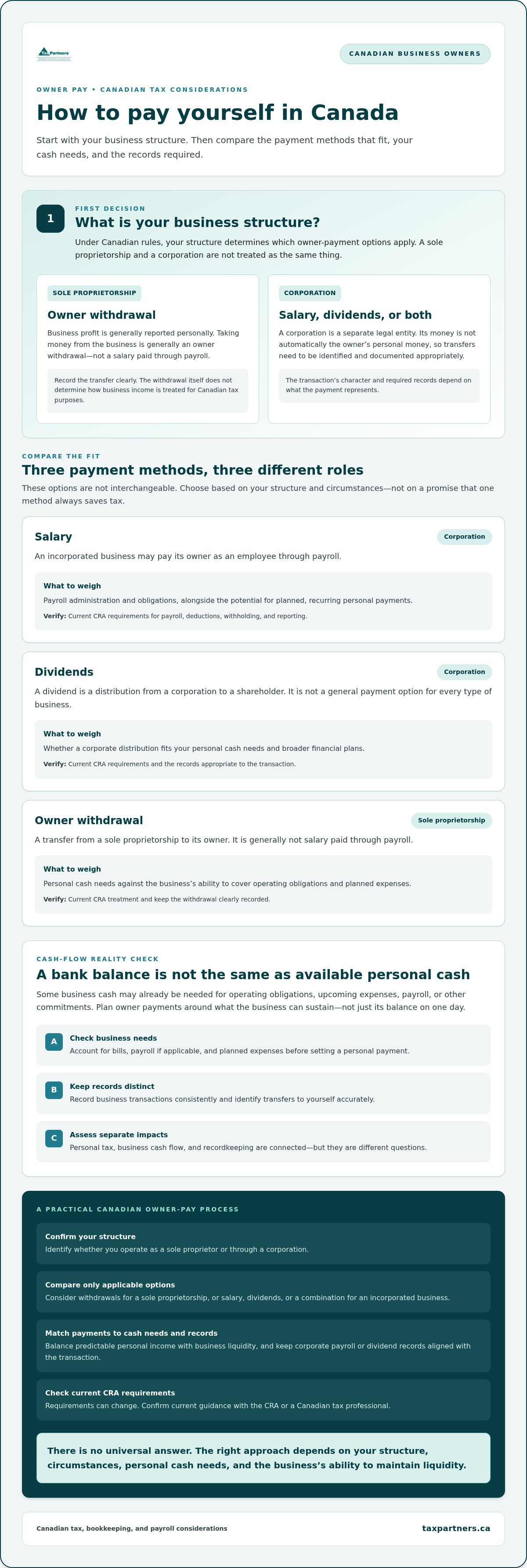
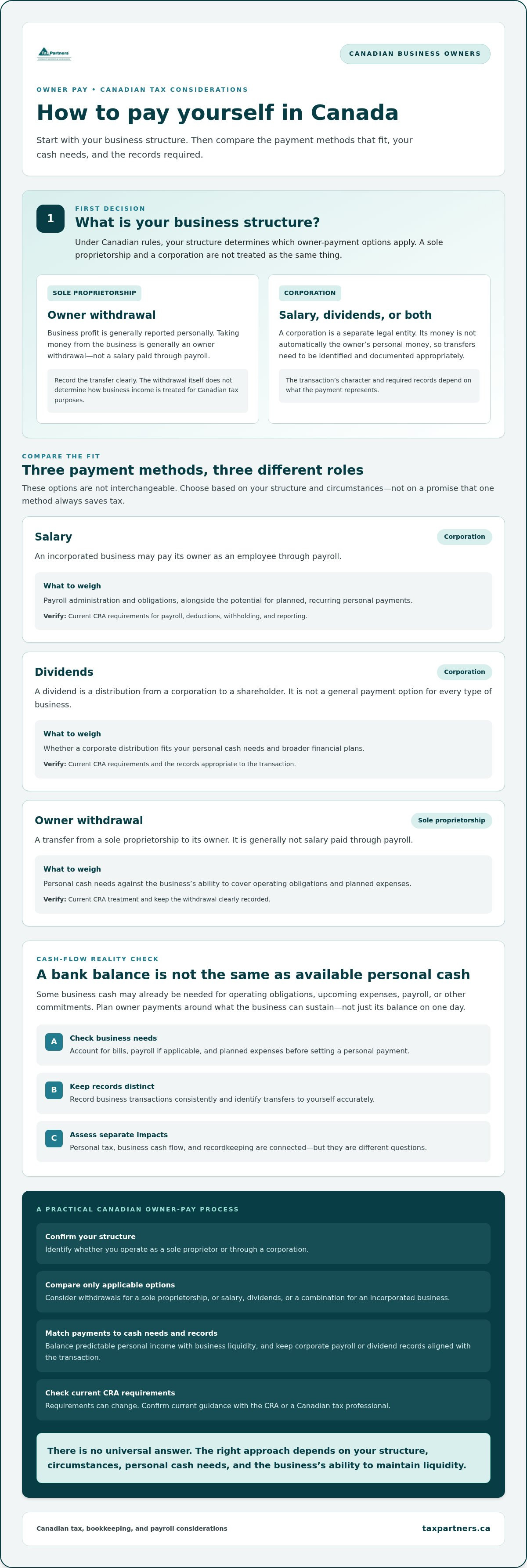
The right way to pay yourself in Canada depends first on your business’s legal structure. Owner compensation means money or benefits transferred to you through your business activity, but the same transfer can have different tax and recordkeeping implications depending on whether you operate as a sole proprietor or through a corporation.
A sole proprietorship is operated by an individual and is not a separate corporation. A corporation is a separate legal entity, so its money and obligations aren’t automatically the owner’s personal money and obligations. That distinction affects which payment methods are available and how transactions should be recorded under Canadian rules.
This section focuses on Canadian and CRA considerations. Check the CRA’s current guidance for the treatment of withdrawals, salary, dividends, and any related reporting or payroll requirements, as details can change. For a broader introduction to corporate tax in Canada, keep in mind that corporate tax is only one part of an owner’s compensation decision. Tax Partners also outlines its Canadian tax services.
How business structure changes your payment options
For a sole proprietor, taking money from the business account is generally an owner withdrawal, not a salary paid through payroll. The withdrawal itself doesn’t determine how the business’s income is treated for Canadian tax purposes. Record it clearly, and confirm the current CRA treatment with a tax professional or directly with the CRA.
A corporation’s separate status means a transfer to its owner needs to be identified and documented appropriately. Don’t assume that moving funds from a corporate account to a personal account is equivalent to a sole proprietor withdrawing business cash. The transaction’s character and required records depend on what the payment represents.
Separate business cash from personal income
A healthy-looking bank balance doesn’t show on its own how much you can safely take out. Some cash may already be needed for operating obligations, upcoming expenses, payroll, or other business commitments. Plan personal transfers around what the business can sustain, not just the balance on a particular day.
- Check business needs: Account for bills, payroll if applicable, and planned expenses before setting a personal payment.
- Keep records distinct: Record business transactions consistently and identify transfers to yourself accurately.
- Assess separate impacts: Personal tax, business cash flow, and recordkeeping are connected, but they are different questions.
There’s no universal answer to the best way to pay yourself as a business owner Canada. First confirm your structure, then assess personal cash needs alongside business liquidity and CRA recordkeeping requirements. That foundation makes it easier to compare payment options.
Compare salary, dividends, and owner withdrawals under Canadian rules
Once you’ve confirmed your business structure, compare the options that actually apply to it. A salary is compensation paid through payroll, a dividend is a corporate distribution to a shareholder, and an owner withdrawal is a transfer from a sole proprietorship to its owner. They aren’t interchangeable, and the right fit depends on your circumstances, not on a claim that one method always saves tax.
| Method | Availability | Administration | Cash-flow effect | What to verify under Canadian rules |
|---|---|---|---|---|
| Salary | Can be considered by an incorporated business paying its owner as an employee. | Requires payroll administration. Confirm applicable deductions, withholding, and reporting with the CRA. | Can support planned, recurring personal payments, while requiring the business to manage payroll obligations. | Current CRA payroll and reporting requirements, and how salary fits your personal financial plans. |
| Dividends | Available to a shareholder receiving a distribution from a corporation, not a general option for every business. | Requires corporate records that accurately reflect the distribution. Confirm the current CRA reporting treatment. | May offer flexibility in timing, but distributions depend on the corporation’s circumstances and available cash. | Whether the payment is properly treated as a dividend and how it must be reported under current CRA guidance. |
| Owner withdrawal | Relevant to a sole proprietor taking money from the business. | Record the transfer clearly. Don’t label it corporate salary or a dividend. | Reduces cash available for business needs, so plan the amount around upcoming obligations. | How the business income and withdrawal should be treated and reported under current CRA rules. |
When salary may suit a Canadian business owner
Salary may suit an incorporated owner who values a regular payment schedule and is prepared to manage payroll administration. Payroll deductions and reporting can affect both the business’s records and the owner’s personal planning. Confirm current requirements directly with the CRA before setting up or changing payments.
When dividends or owner withdrawals may be considered
Dividends are a corporate payment option for shareholders, while a sole proprietor’s transfer for personal use is an owner withdrawal. To assess the best way to pay yourself as a business owner Canada, compare your need for predictable income with the corporation’s cash position, your recordkeeping capacity, and your broader financial goals. Check the CRA’s information on reporting income as part of a compliant owner-pay process.
There’s no universal tax result. Your structure, personal circumstances, and the corporation’s situation all matter. If you’d like support assessing the options alongside Canadian accounting, tax, or payroll considerations, you can contact Tax Partners to discuss your needs.
Choose the payment approach that fits your cash flow and goals
After identifying which payment methods fit your business structure, compare them against two practical needs: the cash your business must retain and the income you need personally. A payment routine should support personal planning without leaving the business short of funds for operating costs or planned commitments.
Questions to ask before setting an owner-pay routine
Start with your business’s cash-flow picture, then consider how you want to receive personal income. These questions can help turn a broad choice into a workable plan under Canadian rules:
- What must the business retain? Review upcoming expenses, operating obligations, and other planned commitments before deciding what cash may be available for you.
- How consistent does your personal income need to be? Regular payments may suit a predictable household budget, while more flexible distributions may better match changing business cash flow.
- What records and approvals apply? Identify the bookkeeping entries and supporting documents your structure and chosen method require. For a corporation, confirm the appropriate documentation for salary or dividends with a qualified professional.
For example, an owner with steady personal expenses may value a planned payment schedule, while a business with uneven receipts may need more room to adjust transfers. Neither preference determines the tax result on its own. Weigh both against the business’s ability to meet its commitments.
How to compare the tax and administrative trade-offs
Compare the options only after confirming how current CRA rules apply to your structure and personal circumstances. Consider the whole process: bookkeeping entries, payroll administration if you pay salary, corporate records if you issue dividends, and how the income is reported on your Canadian personal tax return.
A broader comparison can help you identify questions for your adviser, but it isn’t a substitute for CRA guidance. Intuit TurboTax offers a general overview of salary, dividends, and owner withdrawals. Verify the current Canadian tax treatment with the CRA before acting.
Corporate owners should also understand how corporate tax obligations connect with decisions about retaining or distributing business funds. Review Tax Partners’ Canadian corporate tax compliance guide for relevant corporate tax considerations, then confirm current requirements with the CRA.
There’s no universal tax-saving method. The best way to pay yourself as a business owner Canada is a considered choice that fits your legal structure, personal cash needs, recordkeeping capacity, and the liquidity your business needs to operate reliably.
Set up a compliant owner-pay process and review it regularly
A consistent process helps keep personal transfers clear in your books and makes it easier to check whether your approach still fits your business. Under Canadian rules, the records you keep and any payroll or corporate documentation you need depend on your structure, payment method, and current CRA requirements. Confirm the details with the CRA before implementing or changing your process.
Use this checklist to get started:
- Confirm your business structure. Establish whether you operate as a sole proprietor or through a corporation, since the payment options and records differ.
- Choose a method that fits. Consider your personal cash needs, the business’s operating commitments, and the administration involved.
- Document the decision. Keep a clear record of the payment’s purpose and the supporting information for the chosen method.
- Separate and review transactions. Use bookkeeping records to distinguish business spending from personal payments, then check that entries match bank activity and supporting records.
Records to organize for your chosen method
Keep bookkeeping entries and bank records that show when money moved, how much moved, and how the transaction was classified. If you use payroll, organize the relevant payroll records. If your corporation pays dividends, keep corporate records that accurately reflect the distribution.
Use consistent descriptions for owner payments instead of grouping them with ordinary business expenses. For hands-on help maintaining accurate financial tracking, business owners can explore Outsourced Bookkeeping and Accounting Services. The specific records, approvals, and reporting that apply can vary, so verify current CRA requirements for your Canadian business rather than relying on a generic checklist.
When to revisit your compensation approach
Review your process if your business structure, profitability, cash needs, or personal circumstances change. A method that once suited your income pattern may no longer fit the business’s ability to meet its commitments or your need for predictable payments.
If you’re unsure how to classify a transaction, don’t guess or leave it unexplained in the books. Review it with an accountant and confirm any applicable CRA treatment. Coordinated bookkeeping and accounting support can help keep your records and payment process aligned.
For tailored help reviewing your owner-pay records or payroll considerations, contact Tax Partners to discuss your accounting and payroll needs.
Get tailored Canadian tax and accounting guidance for your next step
There’s no single payment method that suits every owner. Start by confirming whether your business is a sole proprietorship or corporation, then weigh your personal income needs, the cash your business must retain, and the recordkeeping and CRA requirements for the method you’re considering.
The question “best way to pay yourself as a business owner Canada” is best answered with your circumstances in view, not with a promise that salary, dividends, or withdrawals will always produce a particular tax result. Tax Partners provides Canadian personal and corporate tax support, along with bookkeeping and payroll services, to help owners assess these connected considerations.
What to prepare before speaking with an accountant
A focused discussion starts with a clear picture of how your business operates today. Gather the following so an accountant can consider your options in context:
- Your business structure and, if incorporated, relevant corporate details.
- Recent business financial and bookkeeping records that show income, expenses, and available cash.
- Your current payment practices, including how you record transfers, salary, or dividends.
- Your expected personal cash needs and questions about administration, reporting, or tax planning.
These details help frame the discussion around the trade-offs, rather than assuming one approach guarantees lower tax. If corporate tax is part of the decision, Tax Partners’ Canadian corporate tax services may be relevant to the discussion.
Plan a compensation approach with professional support
Ask how each option may affect your business records, cash flow, payroll administration where relevant, and personal tax planning. A coordinated review can help you understand what to document and which details to confirm with the CRA, including requirements that may vary by province or territory.
Before putting a change in place, confirm the current Canadian requirements with the CRA and discuss how the decision fits your broader financial circumstances. Tax Partners can help you consider Canadian tax, corporate tax, bookkeeping, and payroll factors together, without promising a specific tax outcome.
For a tailored discussion of your business structure and owner-pay questions, discuss your Canadian owner-pay questions with Tax Partners.
Make your next owner-pay decision with confidence
The right payment approach starts with your legal business structure. From there, weigh predictable personal income against business cash needs, and compare salary, dividends, or owner withdrawals with the records and CRA requirements each may involve.
There’s no universal tax-saving option. The best way to pay yourself as a business owner Canada depends on your business and personal circumstances, so confirm current CRA requirements and any applicable provincial or territorial details before changing how you pay yourself.
Tax Partners offers Canadian tax, corporate tax, bookkeeping, and payroll services to help owners assess these considerations together. The firm has more than 40 years of experience and can provide tailored guidance without promising a particular tax outcome.
Bring your business structure, recent financial records, current payment practices, and questions to the conversation. Discuss your Canadian business tax and owner-pay questions with Tax Partners, and take a clear, considered next step for your business.
Frequently Asked Questions
What is the best way to pay yourself as a business owner in Canada?
The best approach depends first on whether you operate as a sole proprietor or through a corporation. Sole proprietors generally take owner withdrawals, while incorporated owners may consider salary, dividends, or a combination. Then weigh personal cash needs, business liquidity, administration, and recordkeeping. There’s no universally tax-saving choice. To answer “best way to pay yourself as a business owner Canada,” confirm how current Canada Revenue Agency (CRA) rules apply to your structure and circumstances.
Should I pay myself a salary or dividends from my Canadian corporation?
It depends on your personal income needs, the corporation’s cash position, and your broader financial plans. Salary is paid through payroll and may affect Canada Pension Plan (CPP) contributions, which help fund retirement, disability, and survivor benefits, and Registered Retirement Savings Plan (RRSP) contribution room, the amount you may contribute and deduct based on eligible income. Dividends are distributions to shareholders and don’t create RRSP contribution room. Confirm current CRA requirements with a Canadian tax professional.
Can a sole proprietor pay themselves a salary in Canada?
A sole proprietor generally doesn’t pay themselves a salary as though they were an employee of a separate corporation. A transfer from the business account to the owner is usually recorded as an owner withdrawal, not a wage expense. Under Canadian tax rules, business profit is generally reported by the proprietor personally. Keep personal and business transactions distinct in your bookkeeping, and confirm current CRA reporting treatment for your circumstances.
Are dividends taxed differently from salary in Canada?
Yes. Under Canadian tax rules, salary is employment income, while dividends are investment income distributed by a corporation to its shareholders, and each is reported differently. For Canadian personal tax purposes, a dividend gross-up increases the amount of dividend income included in taxable income; the dividend tax credit then reduces the tax calculated on that income. Your overall result depends on your circumstances and applicable provincial or territorial rules, so confirm current CRA guidance.
How often should a business owner pay themselves in Canada?
Choose a schedule that suits your personal budget and the business’s ability to meet operating commitments. A regular salary schedule may support predictable income but requires consistent payroll administration under current CRA rules. A sole proprietor can plan withdrawals around cash flow, while corporate dividends should be properly documented as distributions. Review the schedule when business finances or personal needs change, and confirm applicable CRA requirements before adjusting payments.
Do I need payroll to pay myself from my Canadian corporation?
If your corporation pays you a salary, payroll administration will generally be relevant, including checking current CRA withholding, remittance, and reporting requirements. Withholding means deductions taken from pay; remittance means sending required amounts to the CRA. A dividend isn’t salary and isn’t paid through payroll, but it still needs appropriate corporate records and personal tax reporting. Confirm the correct treatment for the actual transaction with the CRA or an accountant.
What records should I keep when paying myself from my business?
Keep bookkeeping entries and bank records that show the date, amount, and purpose of each transfer. For salary, organize relevant payroll records; for corporate dividends, keep corporate records that reflect the actual distribution. Sole proprietors should distinguish owner withdrawals from business expenses. Use consistent transaction descriptions and keep supporting records together, then verify with the CRA which records and reporting requirements apply to your structure and chosen payment method.

Article by
Mahad Mohamed
Mahad Mohamed is an accountant and the CEO of Tax Partners, with over 26+ years of Canadian and international tax and accounting experience. His expertise includes corporate reorganization, cross-border tax structuring (Canada & US), tax disputes, CRA audits, and tax planning for small owner-managed private corporations. Most recently, Mahad is a pioneer in Canadian crypto taxation and founded Block3 Finance.
Previously, Mahad worked for the Canada Revenue Agency (CRA), Big4 accounting firms, and served as a Rulings Officer for the Federal Tax Authority of the UAE before acquiring Tax Partners in 2014.
Tax Partners has 44 full-time accountants and over 18,400+ clients.
Disclaimer
This article provides general information only and is current as of its publication date. It has not been updated and may be out of date. It does not constitute legal advice and should not be relied upon as such. Every tax situation is unique and may differ from the examples discussed in this article. If you have specific questions, you should seek the advice of our accountants for your unique circumstances. Book a FREE Initial Consultation Today!
Frequently Asked Questions
What is the best way to pay yourself as a business owner in Canada?
The best approach depends first on whether you operate as a sole proprietor or through a corporation. Sole proprietors generally take owner withdrawals, while incorporated owners may consider salary, dividends, or a combination. Then weigh personal cash needs, business liquidity, administration, and recordkeeping. There’s no universally tax-saving choice. To answer “best way to pay yourself as a business owner Canada,” confirm how current Canada Revenue Agency (CRA) rules apply to your structure and circumstances.
Should I pay myself a salary or dividends from my Canadian corporation?
It depends on your personal income needs, the corporation’s cash position, and your broader financial plans. Salary is paid through payroll and may affect Canada Pension Plan (CPP) contributions, which help fund retirement, disability, and survivor benefits, and Registered Retirement Savings Plan (RRSP) contribution room, the amount you may contribute and deduct based on eligible income. Dividends are distributions to shareholders and don’t create RRSP contribution room. Confirm current CRA requirements with a Canadian tax professional.
Can a sole proprietor pay themselves a salary in Canada?
A sole proprietor generally doesn’t pay themselves a salary as though they were an employee of a separate corporation. A transfer from the business account to the owner is usually recorded as an owner withdrawal, not a wage expense. Under Canadian tax rules, business profit is generally reported by the proprietor personally. Keep personal and business transactions distinct in your bookkeeping, and confirm current CRA reporting treatment for your circumstances.
Are dividends taxed differently from salary in Canada?
Yes. Under Canadian tax rules, salary is employment income, while dividends are investment income distributed by a corporation to its shareholders, and each is reported differently. For Canadian personal tax purposes, a dividend gross-up increases the amount of dividend income included in taxable income; the dividend tax credit then reduces the tax calculated on that income. Your overall result depends on your circumstances and applicable provincial or territorial rules, so confirm current CRA guidance.
How often should a business owner pay themselves in Canada?
Choose a schedule that suits your personal budget and the business’s ability to meet operating commitments. A regular salary schedule may support predictable income but requires consistent payroll administration under current CRA rules. A sole proprietor can plan withdrawals around cash flow, while corporate dividends should be properly documented as distributions. Review the schedule when business finances or personal needs change, and confirm applicable CRA requirements before adjusting payments.
Do I need payroll to pay myself from my Canadian corporation?
If your corporation pays you a salary, payroll administration will generally be relevant, including checking current CRA withholding, remittance, and reporting requirements. Withholding means deductions taken from pay; remittance means sending required amounts to the CRA. A dividend isn’t salary and isn’t paid through payroll, but it still needs appropriate corporate records and personal tax reporting. Confirm the correct treatment for the actual transaction with the CRA or an accountant.
What records should I keep when paying myself from my business?
Keep bookkeeping entries and bank records that show the date, amount, and purpose of each transfer. For salary, organize relevant payroll records; for corporate dividends, keep corporate records that reflect the actual distribution. Sole proprietors should distinguish owner withdrawals from business expenses. Use consistent transaction descriptions and keep supporting records together, then verify with the CRA which records and reporting requirements apply to your structure and chosen payment method.