Wealth Management CPA Ontario: A Canadian Guide

What if the tax, estate, retirement, and business decisions shaping your future could be considered together instead of handled in separate conversations? If you’re searching for wealth management CPA Ontario support, the key question is not simply whether an advisor is a CPA. It’s whether the services they offer match the decisions you need help coordinating.
It’s understandable to want one trusted relationship, while recognizing that not every CPA provides the same wealth management or financial planning services. A CPA may bring Canadian tax expertise to broader planning discussions, but you’ll want to confirm the engagement’s scope, who will advise you, and how the work connects with your existing professionals.
This guide explains how Canadian tax planning can fit into long-term financial decisions and what to ask when assessing an Ontario CPA’s wealth management services. You’ll also learn how estate planning, business succession, and retirement goals may intersect, and how to use an initial conversation to clarify fit without assuming a particular outcome. The aim is to help you take an informed next step based on your needs and the support the advisor actually provides.
Key Takeaways
- Wealth management CPA Ontario services can vary, so clarify which planning areas are included and where other professionals may be involved.
- Consider tax, estate, succession, and financial priorities together when discussing major personal or business decisions in Canada.
- Compare advisors by their scope, tax coordination, estate planning support, investment advice, and approach to ongoing communication.
- Before choosing an advisor, define your goals, identify the services you need, verify relevant qualifications, and agree on how you’ll work together.
- Explore whether Tax Partners’ stated wealth management and financial planning services align with your needs, including estate planning, succession strategies, and wealth preservation.
What does wealth management with an Ontario CPA actually involve?
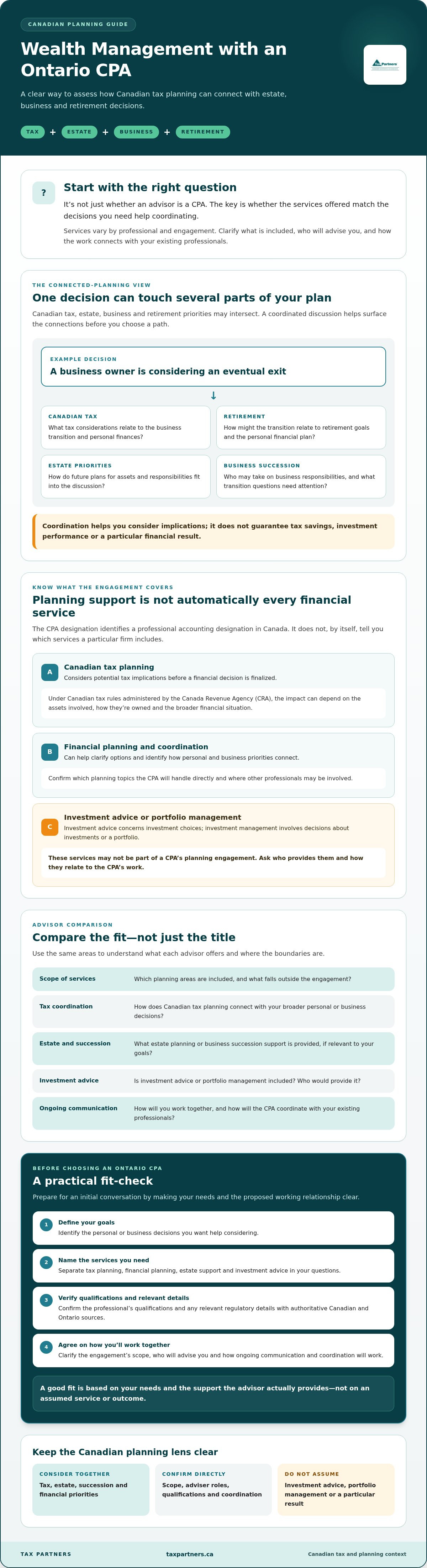
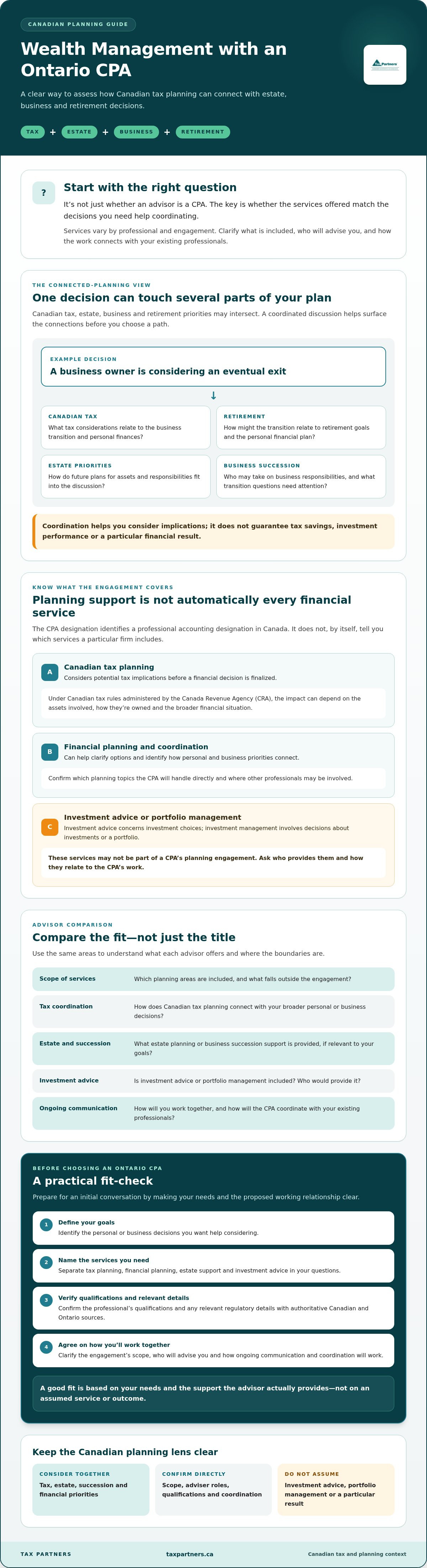
Wealth management with an Ontario CPA can bring Canadian tax, estate, succession, and financial priorities into a coordinated planning discussion. The goal is to understand how decisions may affect one another, not to promise investment performance or a particular tax outcome.
The scope depends on the professional and the engagement. Tax planning and financial planning may help clarify options and identify connected considerations. Investment management, by contrast, involves decisions about investments or a portfolio. Ask what the CPA will handle directly and what may require another professional.
This coordination can be useful when personal and business finances overlap. For example, a business owner considering an eventual exit may want to discuss how the decision relates to personal tax planning, retirement goals, and estate priorities. Which topics matter depends on the person’s circumstances, goals, and existing arrangements.
Which financial decisions can a CPA help coordinate?
Canadian tax planning may be relevant to retirement income decisions, estate planning, business succession, and the transfer or sale of a business. A CPA-supported discussion can help surface these connections, but confirm the engagement’s scope rather than assuming these topics are covered.
Someone nearing retirement may have different questions from a business owner planning a transition. For dedicated guidance on annuities and retirement planning, agencies like Safe Harbor Financial Resources offer examples of how specialized insurance and retirement solutions can complement broader wealth planning discussions. Tax Partners’ wealth management and financial planning overview outlines the firm’s service area for readers who want to explore its stated scope.
What does CPA involvement not automatically include?
The Chartered Professional Accountant (CPA) designation identifies a professional accounting designation in Canada, but it doesn’t tell you which services a particular firm includes. A wealth management CPA Ontario engagement could focus on planning and tax coordination without including investment advice or portfolio management.
Ask directly whether investment advice or portfolio management is part of the engagement, who would provide it, and how those services relate to the CPA’s work. Confirm the professional’s qualifications and any relevant regulatory details with authoritative Canadian and Ontario sources. Don’t assume different financial roles are interchangeable.
Tax Partners describes its wealth management and financial planning services at wealth management services. Use an initial discussion to clarify which planning topics are relevant to you, what the firm’s engagement includes, and whether additional professionals may need to be involved.
How Canadian tax, estate, and business planning fit together
A major financial decision rarely sits in just one category. Selling a business, changing its ownership, or preparing for retirement may raise questions about Canadian tax, how assets will be handled in the future, and who will take on business responsibilities.
Coordinated Canadian planning can help you see how tax, estate, and business decisions connect, so you can consider the implications before choosing a path. It doesn’t guarantee tax savings or a particular financial result. The relevant considerations depend on your circumstances and should be reviewed with appropriate professionals.
Connect personal wealth planning with Canadian tax considerations
Tax planning means considering potential tax implications before finalizing a financial decision. Under Canadian tax rules administered by the Canada Revenue Agency (CRA), the impact of a choice can depend on details such as the type of assets involved, how they’re owned, and the person’s broader financial situation.
For example, someone preparing for retirement might ask how a planned business transition could affect their personal financial plan. Tax planning is distinct from investment advice: tax planning considers tax implications, while investment advice concerns investment choices. For more background on Canadian tax planning, explore tax information for Canada.
Include estate and business succession in the planning conversation
Estate planning means preparing for how assets and responsibilities may be handled in the future. Business succession planning focuses on preparing for a change in business ownership or leadership. For a family business owner, these topics may overlap with personal financial priorities, insurance protection, and Canadian tax considerations. For instance, when estate or key-person arrangements require coverage for individuals with medical conditions or high-risk factors, consulting specialized services such as specialriskterm.com can help clarify options alongside broader advisory work.
Rather than assume a particular strategy is right, bring practical questions to the discussion:
- If I sell or transfer my business, what Canadian tax considerations should I understand before proceeding?
- How might a change in ownership affect my family’s longer-term plans?
- Who may take on leadership or ownership responsibilities, and what planning could that transition involve?
- Which parts of the plan require input from an accountant, an investment professional, or another qualified advisor?
Answers depend on the facts of the situation. A Chartered Professional Accountants of Ontario resource can help readers learn about the CPA profession and its standards, but it isn’t a substitute for advice tailored to an individual’s circumstances.
If you’re considering a wealth management CPA Ontario relationship, start by clarifying which decisions need coordinated attention and which services are included. Tax Partners’ contact page can be a starting point for discussing the scope of its Canadian wealth management and financial planning support.
CPA wealth management versus other financial advice: what should you compare?
Professional titles offer useful context, but they don’t tell you exactly what a particular engagement covers. A wealth management CPA Ontario relationship may focus on Canadian tax planning and coordination, while another advisor may concentrate on financial planning or investment decisions. These roles can complement one another, but don’t assume they’re interchangeable.
Compare services and responsibilities, not titles alone
Ask who will handle each part of your plan and how the professionals will work together. A written service description should explain what’s included, what’s excluded, and whether other professionals need to be involved.
| Area to compare | Questions to ask |
|---|---|
| Service scope | What planning and advice will this engagement provide, and what falls outside it? |
| Canadian tax coordination | Who will consider Canadian tax implications, and how will this work connect with other financial decisions? |
| Estate planning | Does the service include estate planning discussions, or will another professional need to address related matters? |
| Investment advice | Is investment advice or portfolio management included? If so, who provides it and what qualifications or registration apply? |
| Ongoing communication | Who is your main contact, how will updates be handled, and how will the advisor coordinate with your other professionals? |
A CPA engagement may not include every service you expect. Before proceeding, review the written terms and confirm the professional’s credentials, any relevant registrations, responsibilities, and service limits. For Ontario-specific CPA information, consult authoritative sources rather than relying on a title alone.
When might a coordinated CPA relationship be useful?
Coordination may be worth exploring if your personal and business finances intersect, you’re considering an ownership or leadership transition, or estate priorities affect longer-term financial decisions. The useful question isn’t whether you meet a particular asset threshold. It’s whether your goals and decisions call for connected planning.
No professional category is universally the right choice. Compare the work you need with the advisor’s actual scope, then decide whether a CPA, financial planner, investment professional, or combination of specialists fits your situation.
How to assess an Ontario CPA's wealth-management fit
A good fit starts with clarity, not a particular title or promised outcome. Use this sequence to assess whether a wealth management CPA Ontario engagement aligns with your priorities:
- Define your goals. Note the decisions you’re preparing for, such as retirement, estate planning, or a business transition.
- Identify the services you need. Separate Canadian tax planning and financial planning from investment advice or other services.
- Verify qualifications. Confirm the professional’s credentials and any relevant registrations through appropriate Canadian and Ontario sources.
- Compare the scope. Review what the firm will deliver, what it excludes, and whether other professionals may be involved.
- Agree on communication. Clarify who your contact will be, how recommendations will be shared, and how changing goals will be addressed.
Questions to ask before choosing a CPA
Ask how the proposed engagement addresses your Canadian tax and estate planning needs, and how it may connect with business or investment-related decisions. Find out which services the firm provides directly and which require another professional.
- How will you learn about changes to my goals or circumstances?
- How will recommendations be communicated, and who will explain the next steps?
- How do you coordinate with other professionals involved in my planning?
These questions help distinguish a coordinated planning relationship from a collection of separate services. They also let you assess whether the advisor explains responsibilities and limitations in a way you can understand.
Check service scope, qualifications, and working arrangements
Request a written description of the engagement, including deliverables, each party’s responsibilities, and any limitations. Review the fees and payment terms directly with the firm. Costs vary by engagement, so don’t rely on assumed or typical price ranges.
Confirm credentials and any relevant registrations using authoritative Canadian and Ontario sources. If you’re considering Tax Partners, its wealth management overview describes the firm’s service positioning, which you can compare with your needs and questions.
Before deciding, make sure you understand how the relationship will work and whether investment advice or portfolio management is included or handled separately. A clear discussion of scope can help you judge fit without assuming a specific financial or tax result.
If you’d like to clarify whether the firm’s services align with your planning priorities, discuss your wealth-planning needs.
Explore Tax Partners' Canadian wealth-management support
Tax Partners provides wealth management and financial planning that may help individuals and business owners consider longer-term priorities alongside Canadian tax expertise. Its stated services include estate planning, succession strategies, wealth preservation, and planning related to business incorporation and exits. Confirm which activities are included in a proposed engagement before proceeding.
The firm reports more than 40 years of experience. It also reports filing over 495,000 returns and saving clients more than $87 million. Firm-wide figures don’t predict an individual client’s results or guarantee a particular outcome.
Match the conversation to your planning priorities
Before discussing wealth management CPA Ontario services, prepare a short outline of your personal, family, or business goals. Identify decisions you want to coordinate with Canadian tax planning, such as a planned business transition, estate priorities, or a change in your long-term financial plans.
Recommendations depend on your circumstances and the firm’s confirmed service scope. Reviewing Tax Partners’ wealth management overview can help you understand its service positioning and prepare questions about fit.
Agree on clear next steps before proceeding
Ask what information the firm needs to understand your situation, and request a clear explanation of proposed services, responsibilities, and communication arrangements. Confirm which work Tax Partners would provide directly and whether another professional may need to address related matters.
An exploratory conversation can help clarify scope and fit. Use it to understand proposed next steps without assuming a financial outcome or committing to proceed.
If you’re ready to discuss your priorities, contact Tax Partners to explore whether its Canadian wealth management and financial planning services suit your needs.
Make your next planning decision with clarity
The right wealth management CPA Ontario relationship should fit your priorities and clearly explain which services are included. Coordinating Canadian tax, estate, and business planning can help you see where decisions connect. Confirming the advisor’s scope, qualifications, responsibilities, and communication approach can help you assess whether the relationship suits your needs.
Tax Partners provides wealth management and financial planning, including estate planning, succession strategies, and wealth preservation. The firm reports more than 40 years of experience and over 1,390 five-star Google reviews. These are background and firm-reported trust signals, not a promise of individual results.
Start with the questions that matter most to you. An initial conversation can clarify your planning needs, the services available, and whether the engagement is a fit, without assuming a particular outcome or obligating you to proceed. Discuss your wealth-management needs with Tax Partners and take a considered next step.
Frequently Asked Questions
What does a wealth management CPA do in Ontario?
A wealth management CPA may help coordinate Canadian tax planning with estate, succession, and broader financial priorities, depending on the firm’s services. The aim is to understand how decisions relate, not to assume every service is included. For example, a business owner planning an exit may want to discuss how the transition connects with personal financial and estate priorities. Confirm the proposed engagement’s scope and responsibilities before proceeding.
Can a CPA provide investment advice in Ontario?
A CPA designation alone doesn’t establish that investment advice or portfolio management is part of an engagement. Ask who would provide investment-related services, what qualifications or registrations they hold, and how that work connects with the CPA’s tax or financial planning. Verify credentials and regulatory details with authoritative Canadian and Ontario sources. If investment advice isn’t included, ask whether you’ll need to coordinate with a separate professional.
How is a wealth management CPA different from a financial planner?
A CPA may bring accounting and Canadian tax expertise to planning discussions, while a financial planner may focus on organizing broader financial goals and strategies. However, titles don’t define every firm’s services, and roles can overlap or work together. Ask who will handle tax planning, estate-related discussions, investment advice, and coordination with other professionals. Compare actual service descriptions rather than assuming one professional category is universally better.
Is CPA-led wealth management suitable for business owners?
It may suit business owners whose personal financial priorities connect with business decisions, such as incorporation, an ownership transition, or an eventual exit. A wealth management CPA Ontario engagement may help bring Canadian tax and longer-term planning questions into the same conversation, if those services are included. Suitability depends on your goals and circumstances, so ask what the firm handles directly and where another professional may be needed.
What should I bring to a first wealth-management meeting?
Bring a concise summary of your goals, current decisions, and questions. For example, note whether you’re planning for retirement, reviewing an estate plan, or considering a business transition, and what you want to understand about Canadian tax planning. If the firm requests financial or business information, confirm what’s needed and how it will be used. You don’t need to arrive with a complete plan. The discussion can help clarify your priorities.
Does a wealth management CPA guarantee tax savings or investment returns?
No. A planning engagement can help you understand options and potential implications, but it can’t guarantee tax savings, investment performance, or a particular financial result. Outcomes depend on individual circumstances, decisions, and other factors. Ask how recommendations will be explained, what assumptions they rely on, and which services are included. Treat firm-wide results or testimonials as background information, not a prediction of what you’ll achieve.
How do I choose a wealth management CPA in Ontario?
Start by defining your goals and identifying the services you need. Then verify relevant qualifications and registrations through authoritative Canadian and Ontario sources, compare written service scopes, and clarify fees, responsibilities, and communication arrangements. Ask how the professional coordinates Canadian tax, estate, business, and investment-related work, including what falls outside the engagement. Choose based on fit and clarity, not the title alone or an assumed financial outcome.

Article by
Mahad Mohamed
Mahad Mohamed is an accountant and the CEO of Tax Partners, with over 26+ years of Canadian and international tax and accounting experience. His expertise includes corporate reorganization, cross-border tax structuring (Canada & US), tax disputes, CRA audits, and tax planning for small owner-managed private corporations. Most recently, Mahad is a pioneer in Canadian crypto taxation and founded Block3 Finance.
Previously, Mahad worked for the Canada Revenue Agency (CRA), Big4 accounting firms, and served as a Rulings Officer for the Federal Tax Authority of the UAE before acquiring Tax Partners in 2014.
Tax Partners has 44 full-time accountants and over 18,400+ clients.
Disclaimer
This article provides general information only and is current as of its publication date. It has not been updated and may be out of date. It does not constitute legal advice and should not be relied upon as such. Every tax situation is unique and may differ from the examples discussed in this article. If you have specific questions, you should seek the advice of our accountants for your unique circumstances. Book a FREE Initial Consultation Today!
Frequently Asked Questions
Which financial decisions can a CPA help coordinate?
Canadian tax planning may be relevant to retirement income decisions, estate planning, business succession, and the transfer or sale of a business. A CPA-supported discussion can help surface these connections, but confirm the engagement’s scope rather than assuming these topics are covered. Someone nearing retirement may have different questions from a business owner planning a transition. Tax Partners’ wealth management and financial planning overview outlines the firm’s service area for readers who want to explore its stated scope.
What does CPA involvement not automatically include?
The Chartered Professional Accountant (CPA) designation identifies a professional accounting designation in Canada, but it doesn’t tell you which services a particular firm includes. A wealth management CPA Ontario engagement could focus on planning and tax coordination without including investment advice or portfolio management. Ask directly whether investment advice or portfolio management is part of the engagement, who would provide it, and how those services relate to the CPA’s work. Confirm the professional’s qualifications and any relevant regulatory details with authoritative Canadian and Ontario sources. Don’t assume different financial roles are interchangeable. Tax Partners describes its wealth management and financial planning services at wealth management services. Use an initial discussion to clarify which planning topics are relevant to you, what the firm’s engagement includes, and whether additional professionals may need to be involved. A major financial decision rarely sits in just one category. Selling a business, changing its ownership, or preparing for retirement may raise questions about Canadian tax, how assets will be handled in the future, and who will take on business responsibilities. Coordinated Canadian planning can help you see how tax, estate, and business decisions connect, so you can consider the implications before choosing a path. It doesn’t guarantee tax savings or a particular financial result. The relevant considerations depend on your circumstances and should be reviewed with appropriate professionals.
When might a coordinated CPA relationship be useful?
Coordination may be worth exploring if your personal and business finances intersect, you’re considering an ownership or leadership transition, or estate priorities affect longer-term financial decisions. The useful question isn’t whether you meet a particular asset threshold. It’s whether your goals and decisions call for connected planning. No professional category is universally the right choice. Compare the work you need with the advisor’s actual scope, then decide whether a CPA, financial planner, investment professional, or combination of specialists fits your situation. A good fit starts with clarity, not a particular title or promised outcome. Use this sequence to assess whether a wealth management CPA Ontario engagement aligns with your priorities:
What does a wealth management CPA do in Ontario?
A wealth management CPA may help coordinate Canadian tax planning with estate, succession, and broader financial priorities, depending on the firm’s services. The aim is to understand how decisions relate, not to assume every service is included. For example, a business owner planning an exit may want to discuss how the transition connects with personal financial and estate priorities. Confirm the proposed engagement’s scope and responsibilities before proceeding.
Can a CPA provide investment advice in Ontario?
A CPA designation alone doesn’t establish that investment advice or portfolio management is part of an engagement. Ask who would provide investment-related services, what qualifications or registrations they hold, and how that work connects with the CPA’s tax or financial planning. Verify credentials and regulatory details with authoritative Canadian and Ontario sources. If investment advice isn’t included, ask whether you’ll need to coordinate with a separate professional.
How is a wealth management CPA different from a financial planner?
A CPA may bring accounting and Canadian tax expertise to planning discussions, while a financial planner may focus on organizing broader financial goals and strategies. However, titles don’t define every firm’s services, and roles can overlap or work together. Ask who will handle tax planning, estate-related discussions, investment advice, and coordination with other professionals. Compare actual service descriptions rather than assuming one professional category is universally better.
Is CPA-led wealth management suitable for business owners?
It may suit business owners whose personal financial priorities connect with business decisions, such as incorporation, an ownership transition, or an eventual exit. A wealth management CPA Ontario engagement may help bring Canadian tax and longer-term planning questions into the same conversation, if those services are included. Suitability depends on your goals and circumstances, so ask what the firm handles directly and where another professional may be needed.
What should I bring to a first wealth-management meeting?
Bring a concise summary of your goals, current decisions, and questions. For example, note whether you’re planning for retirement, reviewing an estate plan, or considering a business transition, and what you want to understand about Canadian tax planning. If the firm requests financial or business information, confirm what’s needed and how it will be used. You don’t need to arrive with a complete plan. The discussion can help clarify your priorities.
Does a wealth management CPA guarantee tax savings or investment returns?
No. A planning engagement can help you understand options and potential implications, but it can’t guarantee tax savings, investment performance, or a particular financial result. Outcomes depend on individual circumstances, decisions, and other factors. Ask how recommendations will be explained, what assumptions they rely on, and which services are included. Treat firm-wide results or testimonials as background information, not a prediction of what you’ll achieve.
How do I choose a wealth management CPA in Ontario?
Start by defining your goals and identifying the services you need. Then verify relevant qualifications and registrations through authoritative Canadian and Ontario sources, compare written service scopes, and clarify fees, responsibilities, and communication arrangements. Ask how the professional coordinates Canadian tax, estate, business, and investment-related work, including what falls outside the engagement. Choose based on fit and clarity, not the title alone or an assumed financial outcome.