Global Tax Compliance in Canada: A 2026 Guide

Could an overseas investment, bank account, rental property, or crypto platform affect what you need to report to the CRA? For Canadian taxpayers, the answer depends on the activity, the asset, and the applicable reporting rules. That’s why global tax compliance Canada starts with mapping cross-border activity to Canadian requirements, not assuming an asset held abroad is outside the CRA’s view.
It’s understandable to feel unsure about what belongs on a Canadian tax return and what may require a separate disclosure. Some reporting questions depend on the details of your circumstances, so keeping clear records and checking current CRA guidance can help you know what needs closer attention.
This 2026 guide will help you understand the Canadian scope of global tax compliance, organize records for international income, assets, and transactions, and recognize when a question needs qualified support. You’ll also learn when to confirm current requirements directly with the CRA or a tax professional, so you can approach cross-border reporting with greater clarity.
Key Takeaways
- Understand what global tax compliance Canada means for your circumstances, without assuming every cross-border activity triggers the same CRA requirement.
- Use an inventory of income, assets, transactions, and business relationships to identify Canadian reporting questions that need review.
- Organize supporting records by tax year and activity so reported amounts can be traced back to their source documents.
- Follow a repeatable review process: map activity, gather records, flag questions, confirm current CRA guidance, and document decisions.
- When a question needs tailored attention, Tax Partners’ global accounting and tax services can support Canadian-focused international tax matters.
What Global Tax Compliance in Canada Means for CRA Filers
Global tax compliance in Canada means meeting the Canadian tax reporting and recordkeeping requirements that apply to a person’s or business’s cross-border financial activities. The Canada Revenue Agency (CRA) is the federal agency that administers Canadian tax rules. Which requirements apply depends on the filer’s circumstances and the current guidance, so an international connection doesn’t automatically mean every activity has the same reporting result.
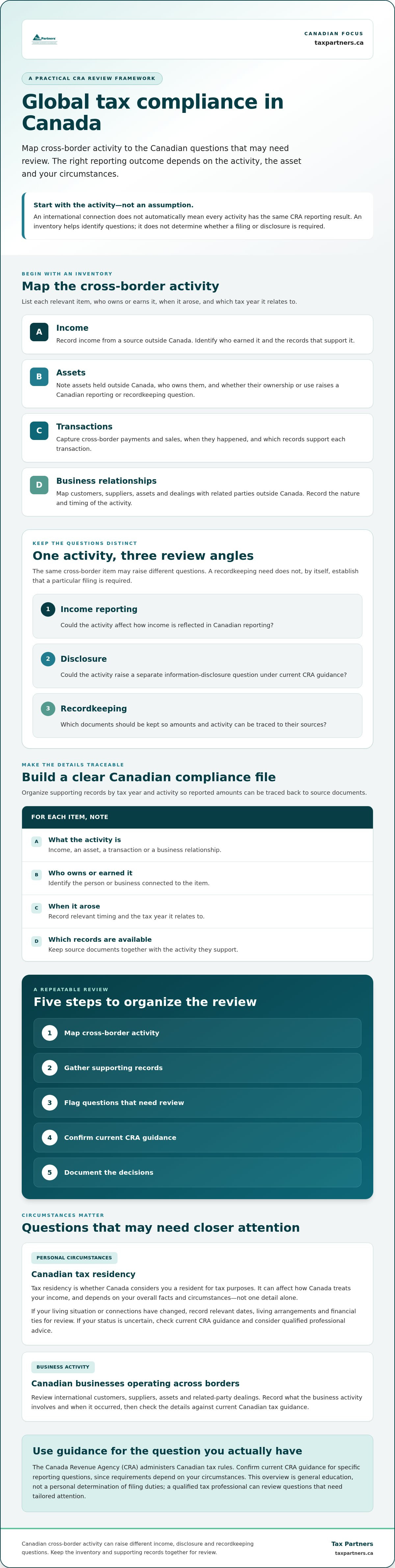
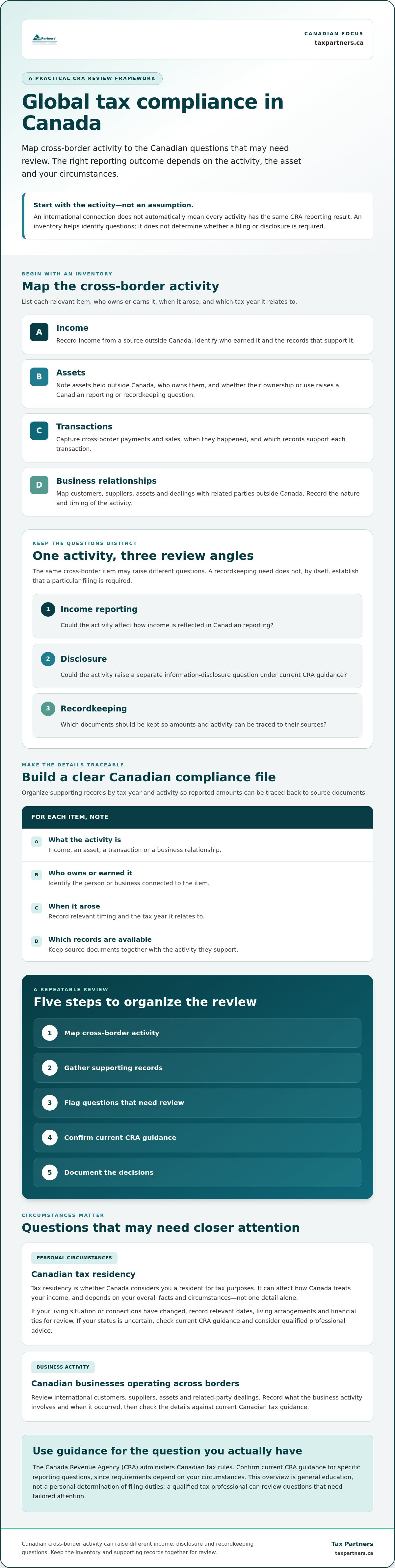
Think of the process as matching each activity to the right Canadian question: Does it affect income reporting, require information to be disclosed, or call for records to be kept? These are separate considerations. A recordkeeping need, for instance, doesn’t by itself establish that a particular filing is required.
For broad context, Taxation in Canada offers an overview of the country’s tax system. Use it as background, not as a substitute for current CRA guidance or advice about your own circumstances.
Which Cross-Border Activities May Matter Under Canadian Rules?
Start by noting any foreign income, overseas assets, or business activity involving another country. These are areas to assess under Canadian rules, but their relevance depends on the details, such as the type of income or asset and how a business operates. For organizations managing international operations or cross-border corporate reporting, you can discover לוי ושות' רואי חשבון (Levi and Co. CPA) for financial statement auditing and specialized bookkeeping assistance.
Keep the first review practical. Record what the activity is, who owns or earns it, and which tax year it relates to; then identify what needs checking against current CRA guidance. An inventory flags questions for review, it doesn’t determine whether a Canadian filing is required.
Who Should Review Their Canadian Tax Position?
Individuals with international financial connections and businesses operating across borders can benefit from reviewing their Canadian tax position. Changes in income sources, asset ownership, or business activities may raise questions that are easy to miss when records are spread across accounts and files.
This guide provides general education, not a personal determination of your filing duties. For broader Canada-focused context, explore Canadian tax information, then confirm any specific reporting question with the CRA or a qualified tax professional.
Identify Canadian Reporting Questions Before They Become Compliance Gaps
A clear inventory helps you spot Canadian tax questions before preparing a return or organizing year-end records. List income sources, assets, transactions, and business relationships connected to activity outside Canada. This inventory flags issues for review; it doesn’t determine whether a particular Canadian filing or disclosure is required.
For each item, note who owns or earned it, when it arose, and what records are available. Use the prompts below to guide your review, then confirm how current Canada Revenue Agency (CRA) guidance applies to your circumstances.
| Situation to record | Canadian question to verify |
|---|---|
| Income from a source outside Canada | How, if at all, should this income be reflected in Canadian reporting? |
| An asset held outside Canada | Does its ownership or use raise a Canadian reporting or recordkeeping question? |
| A cross-border payment or sale | What records support the transaction, and could it affect Canadian reporting? |
| Business dealings with customers, suppliers, or related parties outside Canada | What details should the business review under current Canadian tax guidance? |
Canadian Tax Residency and Personal Circumstances
Tax residency is whether Canada considers you a resident for tax purposes. It can affect how Canada treats your income, but the determination depends on your overall facts and circumstances, not one detail alone.
If your living situation or connections have changed, record relevant dates, living arrangements, and financial ties for qualified review. Check how current CRA guidance applies to your facts, and seek professional advice if your Canadian tax residency is uncertain.
Canadian Businesses with International Activity
Businesses can map customers, suppliers, assets, and dealings with related parties outside Canada. Record the nature and timing of each relationship, the transactions involved, and the supporting contracts or statements. This overview helps identify issues for review without assuming every international connection creates the same Canadian tax obligation.
For business-specific context, see Canadian corporate income tax services. If you need help framing a Canadian reporting question, you can contact Tax Partners about its accounting and tax services. Use your inventory as a starting point, then confirm any filing requirement with the CRA or a qualified tax professional.
Build a Canadian Compliance File for Cross-Border Activity
A well-organized file makes Canadian tax review easier because each reported amount can be traced back to its supporting documents. For global tax compliance Canada, sort records by tax year and activity, such as investment income, a property transaction, or a business payment. Keep the original statements and records alongside any working notes or calculations used to prepare Canadian reporting.
Use a consistent naming system that identifies the date, activity, and document type. Store files securely, limit access to people who need them, and check current CRA guidance for how long specific records should be kept. Don’t assume one retention period applies to every record or circumstance.
| Record category | Purpose in a Canadian tax review | Follow-up question |
|---|---|---|
| Income statements and account records | Support the source and amount of income recorded | Can each reported amount be matched to a statement or account entry? |
| Transaction histories and receipts | Document relevant activity and help explain calculations | Are dates, amounts, and transaction details complete? |
| Contracts and correspondence | Provide context for an agreement, payment, or change in ownership | Do the documents explain the parties and purpose of the activity? |
| Business invoices and accounting records | Connect business entries with supporting transaction documents | Can the business trace an entry in its books to an invoice or other source? |
Records Individuals Can Gather for Canadian Tax Review
Individuals can gather income statements, account records, transaction histories, and correspondence related to international financial activity. For example, if an account statement helps support an amount included in Canadian reporting, save it with any records that explain how you arrived at that amount.
Which documents matter depends on your circumstances and applicable Canadian requirements. Keep a clear folder structure, use descriptive file names, and note any missing records so you can follow up before the review is complete.
Records Businesses Can Organize for CRA Compliance
Businesses can organize accounting records, contracts, invoices, ownership details, and documents supporting cross-border transactions. Consistent bookkeeping helps connect an amount in the business records to the underlying invoice, agreement, or payment record, making it easier to respond clearly if the CRA asks about reported figures.
For relevant professional support, explore Tax Partners’ global tax services. A tidy file won’t decide which Canadian requirements apply, but it gives you and your adviser a stronger foundation for reviewing them.
Use a Repeatable Canadian Tax Compliance Review Process
A consistent annual review gives individuals and businesses a practical way to examine cross-border activity under Canadian rules. Treat it as an organizing workflow, not a substitute for checking current Canada Revenue Agency (CRA) guidance or assessing how it applies to your facts.
Organized records support accurate Canadian reporting, but they don’t guarantee compliance. The review should help you identify questions, verify the applicable Canadian requirements, and keep a clear note of how you reached your decisions. For global tax compliance Canada, that repeatable process can make complex issues easier to discuss with a qualified tax professional.
A Step-by-Step Canadian Review Checklist
Work through these steps for the relevant tax period. Keep a record of the source and date of any CRA guidance you consult, so you or an adviser can revisit the basis for a decision.
- Map the activity. List personal or business cross-border income, assets, transactions, and relationships relevant to the period.
- Gather supporting records. Match each activity to statements, contracts, invoices, or other documents that explain it.
- Identify unanswered questions. Note what needs clarification, including whether residency, business structure, or the classification of a transaction affects the Canadian review.
- Verify current CRA guidance. Check the CRA’s current information for each question. If the guidance doesn’t clearly address your circumstances, flag the issue for qualified review.
- Document decisions. Record the conclusion, the facts considered, and the CRA source and date checked. Keep the note with the relevant records for future reference.
This process keeps facts and conclusions connected. It also helps prevent an assumption from being mistaken for a confirmed Canadian reporting position.
When to Ask a Canadian Tax Professional for Help
Seek professional advice if you’re unsure about your Canadian tax residency, the scope of reporting, business relationships, or how a transaction should be classified. Past filings that may have missed or mischaracterized cross-border activity also warrant careful review rather than guesswork.
An adviser needs the full picture to assess your Canadian situation: relevant dates, ownership details, transaction context, prior reporting, and the records that support your account. Tax Partners provides Canadian and global accounting and tax services for individuals and businesses with international tax questions.
If you have unresolved questions after organizing your review, contact Tax Partners about Canadian tax support. A focused discussion can help clarify which facts and records need attention, without assuming a particular outcome.
Get Canadian Global Tax Compliance Support with a Clear Next Step
Once you’ve mapped your cross-border activity and organized the records, focus on the specific Canadian question that still needs an answer. Is it about how an income source should be reviewed, what records support a transaction, or how your personal or business circumstances affect reporting? A clearly framed question helps make the next discussion more focused.
Global tax compliance Canada can involve different facts for each person or business. Tax Partners provides global accounting and tax services, including support with international tax compliance questions viewed through a Canadian lens. The goal is to review the circumstances and clarify appropriate next steps, not to assume that every cross-border situation has the same answer.
What to Prepare Before Discussing Your Canadian Tax Situation
Gather a short summary of the activity you want reviewed, the relevant supporting records, any prior Canadian filings connected to the question, and a list of what remains unclear. For example, note when an activity began or changed, who was involved, and which documents explain the amounts or transactions.
Be candid about gaps or uncertainty. It’s more useful to identify an incomplete record or an assumption than to treat it as a settled Canadian reporting position. An initial discussion can help clarify the scope of the issue and what information or follow-up may be appropriate, without promising a particular result.
How Tax Partners Can Support Cross-Border Tax Questions
Tax Partners’ global accounting and tax services can support individuals and businesses organizing international activity for Canadian tax review. A discussion can help bring the relevant facts, records, and questions into focus so that the Canadian reporting issues can be considered in context.
Tax Partners reports more than 40 years of experience, along with firm-reported client and return statistics. These figures should be confirmed as current before publication; they don’t replace an assessment of your particular situation. What matters in a review is a clear understanding of your facts and the applicable Canadian guidance.
Prepare your summary and records, identify the question you need answered, and take a measured next step. Discuss your Canadian tax situation with Tax Partners.
Take the Next Step with Greater Clarity
Cross-border tax questions become easier to address when you start with a clear picture of your Canadian circumstances. The central lesson of global tax compliance Canada is practical: identify the activity, keep records that support the details, and verify any reporting questions against current CRA guidance.
Your inventory and organized compliance file can help you distinguish confirmed facts from assumptions. If residency, business activity, or the treatment of a transaction still feels unclear, bring those questions and relevant records to a qualified tax professional rather than trying to resolve uncertainty on your own.
Tax Partners reports more than 40 years of experience, over 495,000 returns filed, and more than 1,390 five-star Google reviews. These firm-reported figures should be verified before publication and are trust signals, not a promise of a particular result.
Give your Canadian tax questions a clear starting point. Discuss your Canadian tax situation with Tax Partners and take the next step with greater confidence.
Frequently Asked Questions About Global Tax Compliance in Canada
What is global tax compliance in Canada?
Global tax compliance in Canada means meeting the Canadian tax reporting and recordkeeping requirements that apply to your cross-border financial activity. This may involve reviewing income, assets, transactions, or business relationships connected to activity outside Canada. The relevant questions depend on your circumstances, so an international connection alone doesn’t determine whether a specific Canadian filing or disclosure is required. Use current Canada Revenue Agency (CRA) guidance or qualified advice to check your situation.
Who may need to review foreign income under Canadian tax rules?
Anyone with income from a source outside Canada may need to review how it relates to their Canadian tax position. This can include an individual receiving overseas investment or rental income, or a business earning revenue from customers abroad. The review depends on factors such as the person’s Canadian tax residency, the type of income, and the circumstances in which it was earned. Confirm any reporting questions against current CRA guidance.
Does Canada tax foreign income?
Canadian residents are generally required to report their worldwide income, including income from sources outside Canada, on their Canadian tax return. Reporting and the amount of Canadian tax payable are not always the same question: the treatment can depend on the income type and the person’s circumstances. If you’re unsure about your residency or how an amount should be reported, check current CRA guidance or have a qualified Canadian tax professional review the facts.
What records should I keep for Canadian tax compliance involving international activity?
Keep records that show where an amount or transaction came from and how you reported it in Canada. Depending on your circumstances, these may include income statements, account records, transaction histories, contracts, receipts, and relevant correspondence. Organize them by tax year and activity, and use clear file names so amounts can be traced to source documents. Check current CRA guidance for applicable Canadian recordkeeping requirements and how long you should retain specific records.
How can a Canadian business organize records for cross-border transactions?
A Canadian business can organize its accounting records by tax year and transaction type, then keep related invoices, contracts, payment records, ownership details, and correspondence together. For example, a customer invoice can be filed with the records showing how the payment was recorded in the books. Consistent bookkeeping helps explain reported amounts during a Canadian tax review. For growing companies seeking strategic oversight to streamline their financial management and recordkeeping, outsourced leadership from PCFO provides part-time Finance Director and CFO guidance. The documents a business needs will depend on its activities and current CRA requirements.
When should I speak with a Canadian tax professional about global tax compliance?
Speak with a qualified Canadian tax professional when you can’t determine how residency, international income, a business relationship, or a transaction affects your Canadian reporting. It can also be helpful if you’re uncertain about a past Canadian filing or don’t have complete supporting records. Bring a summary of the activity, relevant documents, and specific questions. A professional can assess the facts and help identify appropriate next steps without assuming a particular outcome.
Can I rely on general CRA information to determine my Canadian filing obligations?
General CRA information is a useful starting point, but it may not resolve how a requirement applies to your specific facts. Compare the guidance with your residency circumstances, income, assets, transactions, and available records. If the information doesn’t clearly address your situation, don’t treat an assumption as a confirmed filing position. Record the question and the guidance you reviewed, then seek qualified advice or confirm the interpretation with the CRA where appropriate.

Article by
Mahad Mohamed
Mahad Mohamed is an accountant and the CEO of Tax Partners, with over 26+ years of Canadian and international tax and accounting experience. His expertise includes corporate reorganization, cross-border tax structuring (Canada & US), tax disputes, CRA audits, and tax planning for small owner-managed private corporations. Most recently, Mahad is a pioneer in Canadian crypto taxation and founded Block3 Finance.
Previously, Mahad worked for the Canada Revenue Agency (CRA), Big4 accounting firms, and served as a Rulings Officer for the Federal Tax Authority of the UAE before acquiring Tax Partners in 2014.
Tax Partners has 44 full-time accountants and over 18,400+ clients.
Disclaimer
This article provides general information only and is current as of its publication date. It has not been updated and may be out of date. It does not constitute legal advice and should not be relied upon as such. Every tax situation is unique and may differ from the examples discussed in this article. If you have specific questions, you should seek the advice of our accountants for your unique circumstances. Book a FREE Initial Consultation Today!
Frequently Asked Questions
Which Cross-Border Activities May Matter Under Canadian Rules?
Start by noting any foreign income, overseas assets, or business activity involving another country. These are areas to assess under Canadian rules, but their relevance depends on the details, such as the type of income or asset and how a business operates. Keep the first review practical. Record what the activity is, who owns or earns it, and which tax year it relates to; then identify what needs checking against current CRA guidance. An inventory flags questions for review, it doesn’t determine whether a Canadian filing is required.
Who Should Review Their Canadian Tax Position?
Individuals with international financial connections and businesses operating across borders can benefit from reviewing their Canadian tax position. Changes in income sources, asset ownership, or business activities may raise questions that are easy to miss when records are spread across accounts and files. This guide provides general education, not a personal determination of your filing duties. For broader Canada-focused context, explore Canadian tax information, then confirm any specific reporting question with the CRA or a qualified tax professional. A clear inventory helps you spot Canadian tax questions before preparing a return or organizing year-end records. List income sources, assets, transactions, and business relationships connected to activity outside Canada. This inventory flags issues for review; it doesn’t determine whether a particular Canadian filing or disclosure is required. For each item, note who owns or earned it, when it arose, and what records are available. Use the prompts below to guide your review, then confirm how current Canada Revenue Agency (CRA) guidance applies to your circumstances.
What is global tax compliance in Canada?
Global tax compliance in Canada means meeting the Canadian tax reporting and recordkeeping requirements that apply to your cross-border financial activity. This may involve reviewing income, assets, transactions, or business relationships connected to activity outside Canada. The relevant questions depend on your circumstances, so an international connection alone doesn’t determine whether a specific Canadian filing or disclosure is required. Use current Canada Revenue Agency (CRA) guidance or qualified advice to check your situation.
Who may need to review foreign income under Canadian tax rules?
Anyone with income from a source outside Canada may need to review how it relates to their Canadian tax position. This can include an individual receiving overseas investment or rental income, or a business earning revenue from customers abroad. The review depends on factors such as the person’s Canadian tax residency, the type of income, and the circumstances in which it was earned. Confirm any reporting questions against current CRA guidance.
Does Canada tax foreign income?
Canadian residents are generally required to report their worldwide income, including income from sources outside Canada, on their Canadian tax return. Reporting and the amount of Canadian tax payable are not always the same question: the treatment can depend on the income type and the person’s circumstances. If you’re unsure about your residency or how an amount should be reported, check current CRA guidance or have a qualified Canadian tax professional review the facts.
What records should I keep for Canadian tax compliance involving international activity?
Keep records that show where an amount or transaction came from and how you reported it in Canada. Depending on your circumstances, these may include income statements, account records, transaction histories, contracts, receipts, and relevant correspondence. Organize them by tax year and activity, and use clear file names so amounts can be traced to source documents. Check current CRA guidance for applicable Canadian recordkeeping requirements and how long you should retain specific records.
How can a Canadian business organize records for cross-border transactions?
A Canadian business can organize its accounting records by tax year and transaction type, then keep related invoices, contracts, payment records, ownership details, and correspondence together. For example, a customer invoice can be filed with the records showing how the payment was recorded in the books. Consistent bookkeeping helps explain reported amounts during a Canadian tax review. The documents a business needs will depend on its activities and current CRA requirements.
When should I speak with a Canadian tax professional about global tax compliance?
Speak with a qualified Canadian tax professional when you can’t determine how residency, international income, a business relationship, or a transaction affects your Canadian reporting. It can also be helpful if you’re uncertain about a past Canadian filing or don’t have complete supporting records. Bring a summary of the activity, relevant documents, and specific questions. A professional can assess the facts and help identify appropriate next steps without assuming a particular outcome.
Can I rely on general CRA information to determine my Canadian filing obligations?
General CRA information is a useful starting point, but it may not resolve how a requirement applies to your specific facts. Compare the guidance with your residency circumstances, income, assets, transactions, and available records. If the information doesn’t clearly address your situation, don’t treat an assumption as a confirmed filing position. Record the question and the guidance you reviewed, then seek qualified advice or confirm the interpretation with the CRA where appropriate.