Rental Income Tax Canada: Complete Guide for CRA Filers

Relying on generic software to manage your rental income tax Canada obligations often introduces far more audit risk than actual relief. It's completely understandable to feel uneasy when deciding whether an expensive renovation is a deductible current expense or a capital outlay, especially with the Canada Revenue Agency scrutinizing property claims. You shouldn't have to sacrifice legitimate profits just to avoid unwanted federal attention.
Protecting your cash flow starts with proactive tax strategy, not automated guesswork. This guide provides the practical guidance you need to accurately report your rental earnings, maximize every allowable CRA deduction, and optimize your property returns safely. You'll gain total clarity over your filing position while keeping your hard-earned equity secure.
Ahead, we'll examine how to properly file Form T776, evaluate the long-term consequences of claiming Capital Cost Allowance, and implement the six-year record-keeping practices needed to keep your portfolio compliant.
Key Takeaways
- Master the fundamentals of rental income tax Canada by separating gross revenue from net taxable income to claim every eligible operating deduction under CRA rules.
- Apply the CRA four-test assessment to distinguish routine maintenance from capital outlays, protecting your portfolio from costly reassessments.
- Ensure complete reporting accuracy on Form T776 by properly documenting co-ownership percentages, property details, and gross earnings.
- Understand the tax trade-offs between holding property personally versus incorporating to shield your portfolio against passive investment surtaxes.
- Adopt proactive record-keeping habits that keep your books organized and audit-ready across the mandatory six-year CRA document retention period.
Understanding Rental Income Tax in Canada Under CRA Rules
Every dollar you earn from leasing real estate is subject to specific reporting guidelines administered by the Canada Revenue Agency. For CRA filers, grasping your obligations for rental income tax Canada starts with identifying what constitutes taxable revenue versus deductible operational outlays. Transparent records protect your portfolio against reassessments during routine reviews.
Your net rental earnings don't exist in a vacuum. Instead, they integrate directly with your other worldwide earnings, such as employment or dividend income, and are taxed at your marginal personal tax rate. Working through proactive personal income tax planning ensures you don't inadvertently bump yourself into a higher tax bracket without realizing it.
Gross Rental Income Versus Net Rental Income Explained
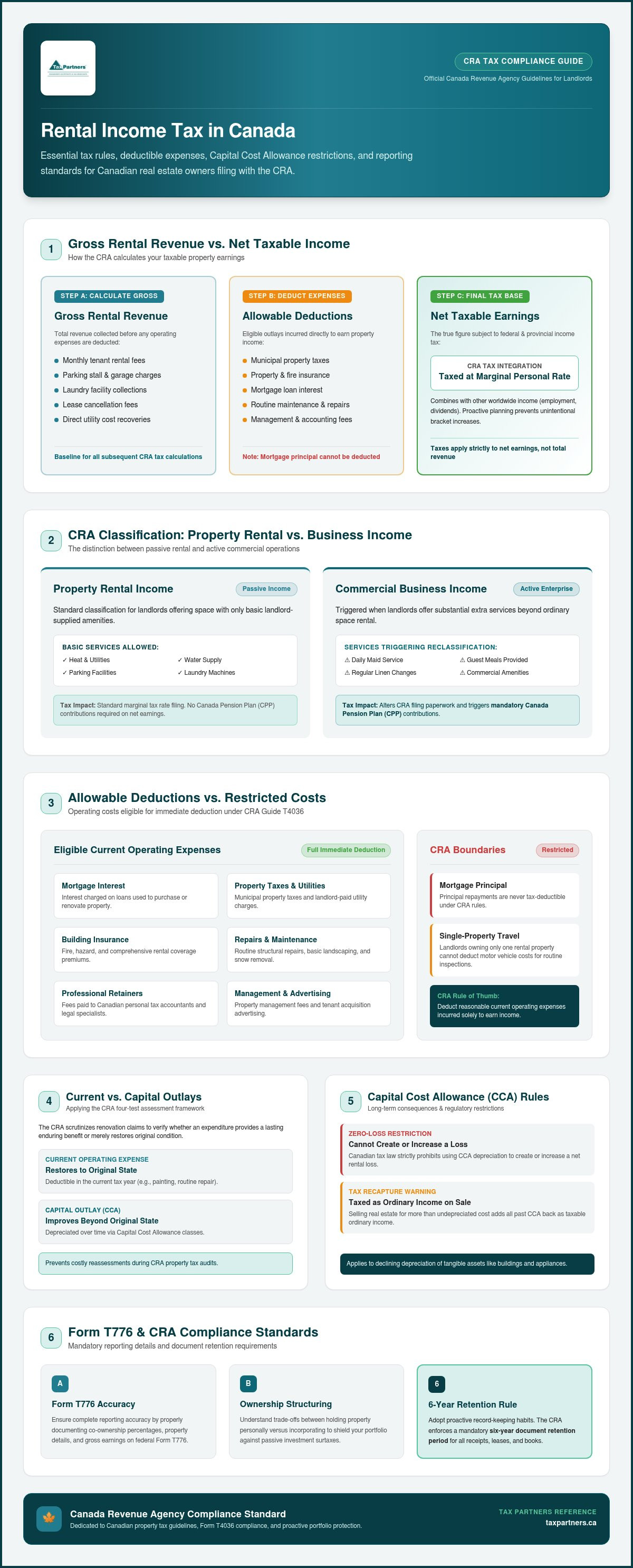
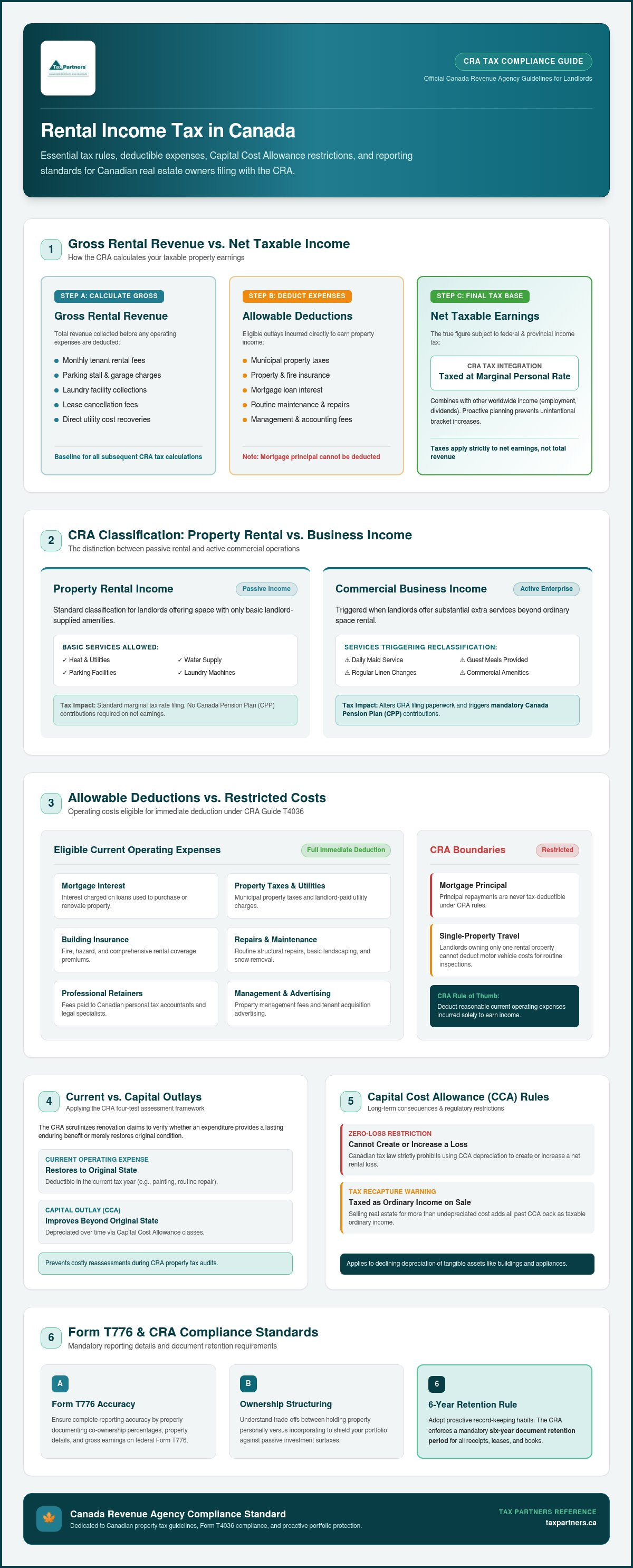
Gross rental income reflects the total revenue collected before taking a single expense into account. This total includes monthly tenant rent, parking fees, laundry facility payments, and lease cancellation charges. Calculating this complete figure accurately forms the baseline for all subsequent calculations.
Net rental income represents your true taxable amount. You determine this balance by deducting allowable operating outlays, along with depreciation under established Capital Cost Allowance (CCA) rules, from your gross earnings. Canadian income taxes apply strictly to this remaining net figure rather than your total revenue.
- Gross Revenue: Aggregate payments collected from tenant rents, parking, and utility recoveries.
- Allowable Deductions: Eligible operational expenses incurred directly to earn property income.
- Net Taxable Earnings: The final balance subject to Canadian federal and provincial tax rates.
Rental Income Versus Business Income Under CRA Guidelines
The CRA draws a strict line between earning passive income from property and operating an active commercial enterprise. If you rent space while supplying only basic services like heat, water, parking, and laundry, the CRA classifies your earnings as property rental income. Most residential landlords fall squarely into this standard category.
Providing substantial extra services quickly changes your regulatory status. When you offer daily maid service, guest meals, or regular linen changes, the CRA reclassifies your activity as business income. This commercial classification alters your filing paperwork and triggers mandatory Canada Pension Plan contribution requirements on all net earnings.
Allowable Rental Expenses: What Canadian Landlords Can Deduct
Optimizing your deductions is the most effective way to lower your rental income tax Canada liability legally. Under CRA guidelines, you can deduct reasonable current operating expenses incurred solely to earn income from your property. As outlined in CRA Guide T4036 on Rental Income, these include local property taxes, fire insurance, and landlord-paid utility services.
Operating Costs Eligible for Immediate Annual Deduction
Routine operational costs qualify for immediate full deduction in the calendar year you pay them. These include tenant advertising, basic landscaping, snow removal, and routine structural repairs. You can also claim property management fees and professional retainers paid to Canadian personal tax specialists who handle your annual filings.
Financing costs offer significant tax relief, but strict boundaries apply. You can write off mortgage interest charged on loans used to purchase or renovate the rental, but you cannot deduct any mortgage principal repayments. CRA rules also restrict travel expenses; landlords with only one rental property generally cannot deduct motor vehicle costs to inspect the property.
Understanding Capital Cost Allowance and Depreciation Traps
Capital Cost Allowance (CCA) enables property owners to deduct the declining depreciation of tangible assets, like the building structure or appliances, over time. Claiming CCA provides short-term tax deductions, but it introduces substantial long-term financial traps. Canadian tax law strictly prohibits using CCA to create or increase a net rental loss.
Deducting CCA triggers a heavy tax recapture when you eventually sell the real estate for more than its remaining undepreciated cost. All past tax depreciation gets added back and taxed as ordinary income in the transaction year. Claiming CCA on a primary residence with a rental suite also permanently eliminates your future Principal Residence Exemption on that portion.
Common Non-Deductible Costs Under CRA Regulations
Failing to distinguish between deductible operational outlays and disallowed costs frequently attracts CRA review. Understanding which expenditures are prohibited keeps your portfolio fully compliant:
- Mortgage Principal: Only interest charges are deductible; principal repayments represent equity growth.
- Personal Use Portions: Mixed-use properties require reasonable proration based on square footage.
- Sweat Equity: The CRA prohibits deducting any monetary value for your own physical labour.
If you're unsure whether an expenditure meets federal standards, you can speak with a Canadian tax advisor to protect your returns before filing.
Current Expenses Versus Capital Outlays: The CRA Boundary
Differentiating between a routine repair and a capital improvement is one of the most contentious battlegrounds in rental income tax Canada reporting. Misclassifying a major renovation as an immediate current expense can quickly trigger an audit from the Canada Revenue Agency. When properly categorized, capital expenditures increase your property's adjusted cost base (ACB), effectively lowering your taxable capital gains when you eventually sell.
Core Criteria Used by the CRA to Classify Outlays
Federal auditors evaluate property expenditures using common-law principles rather than arbitrary dollar thresholds. Detailed under the official CRA guidelines on current versus capital expenses, these criteria evaluate the true economic character of the outlay:
- Lasting Benefit: Outlays that simply restore an asset to its original operating state are current expenses, while additions that enhance overall property longevity must be capitalized.
- Integral Unit vs. Separate Asset: Repairing existing wooden deck boards maintains an integral part of the building, whereas constructing a brand new detached garage creates a distinct capital asset.
- Condition at Acquisition: Work required to put a newly acquired, rundown property into a suitable condition for tenant occupancy is treated as a capital outlay by the CRA, regardless of the scope of work.
Tax Implications of Capital Cost Allowance Recapture
Capital expenditures cannot be fully written off in the year you incur them. Instead, they must be amortized gradually over multiple taxation years through Capital Cost Allowance (CCA) pools. While this spreads tax relief across the asset's useful life, it creates an ongoing compliance liability that requires precise tracking.
Selling your property for more than its remaining undepreciated cost base triggers a complete recapture of all previously claimed depreciation. The CRA adds this recaptured amount directly to your taxable income in the year of sale, which can easily push you into the highest personal tax bracket. Consulting with seasoned Canadian tax planning advisors helps you evaluate whether taking annual depreciation aligns with your broader exit strategy.
Filing Form T776: Reporting Rental Income to the CRA Accurately
Every individual Canadian resident who rents out real estate must submit Form T776, Statement of Real Estate Rentals, alongside their annual T1 General return. This form serves as the official mechanism for calculating net earnings subject to rental income tax Canada. Failing to complete each field accurately invites unnecessary questions from federal tax authorities.
Dual-purpose properties and partial-year rentals require particular care on this form. If you rent out a basement suite while occupying the main floor, you must allocate shared carrying costs, such as heating and insurance, on a reasonable basis like square footage. Documenting this allocation clearly on Form T776 protects your calculations from arbitrary reassessment.
Step-by-Step Reporting on CRA Form T776
Completing Form T776 requires entering your property identification and financial figures across designated federal lines. This structured process ensures every deductible outlay is properly recognized by the Canada Revenue Agency:
- Fiscal Identification: State the exact property address, the fiscal period covered, and the number of rental units in operation.
- Gross Revenue Logging: Record total tenant rents received along with separate entries for utility recoveries and parking fees.
- Line-by-Line Expense Allocation: Enter current expenses across individual lines, such as property taxes, insurance, mortgage interest, and advertising.
- Net Balance Calculation: Deduct total allowable expenses from your gross income to determine your net rental income or allowable net loss for the year.
Managing Co-Ownership, Spousal Splits, and Document Retention
Co-ownership reporting must mirror legal ownership and the original capital contributed to acquire the asset. You cannot arbitrarily shift rental profits to a spouse in a lower tax bracket simply to reduce household tax liability. Under CRA rules, net income must be split according to who provided the funds used to purchase the property.
Retaining comprehensive financial records is your primary defence against adverse audit outcomes. The CRA mandates that property owners retain all tenant leases, bank statements, and vendor invoices for a minimum of six years from the end of the relevant taxation year. If you face an unexpected review, consider getting professional support by seeking CRA audit help to resolve disputes effectively.
Protect your portfolio with personalized guidance. Book a consultation with our Canadian tax specialists to ensure your rental filings remain compliant and secure.
Strategic Tax Structuring for Canadian Real Estate Portfolios
As your real estate portfolio expands, selecting the right legal structure becomes vital for managing rental income tax Canada obligations effectively. While purchasing properties under personal title remains straightforward, seasoned investors frequently evaluate corporate structures to manage legal exposure and build long-term equity. Aligning your ownership model with your broader investment horizon ensures you keep more of your revenue.
Personal Ownership Versus Canadian Corporate Holding Structures
Holding rental properties in your personal name means all net rental profits flow directly onto your individual tax return and are taxed at your marginal rates. Utilizing a Canadian-Controlled Private Corporation (CCPC) offers commercial liability protection, but it subjects rental revenue to specific CRA passive income rules.
Unless your company employs more than five full-time employees, the CRA classifies corporate rental revenue as passive income from a Specified Investment Business. This classification denies the federal small business deduction, resulting in an initial corporate tax rate of roughly 50%. While a significant portion of this tax is refunded through the Refundable Dividend Tax on Hand (RDTOH) account when dividends are paid out, corporate ownership requires precise execution. Implementing customized wealth management and financial planning helps ensure your holding structure preserves capital rather than creating cash-flow drag.
Partnering with Tax Partners for Proactive CRA Compliance
Managing real estate tax compliance requires strategic foresight that automated filing programs simply cannot provide. Generic software cannot structure corporate share classes, plan around anti-flipping rules, or represent your files during detailed CRA audits.
Tax Partners brings over 40 years of dedicated accounting experience across Canada, having successfully filed more than 495,000 tax returns. Backed by over 1,390 five-star client reviews and more than $87M in verified client tax savings, our CPAs provide the national guidance property investors trust. Protect your growing portfolio from unexpected reassessments by taking the time to schedule a consultation with Tax Partners.
Secure Your Real Estate Returns with Confident Filing
Navigating your rental income tax Canada requirements successfully comes down to disciplined expense classification and accurate documentation. Accurately distinguishing current repairs from capital outlays shields your deductions on Form T776, while strategic ownership planning preserves your profits as your portfolio expands.
Tax Partners has supported Canadian property owners through evolving tax landscapes for over 40 years. With more than 495,000 tax returns filed, over $87M in verified savings, and over 1,390 five-star reviews, our team brings trusted national advisory excellence to every return.
Schedule a consultation with Tax Partners to optimize your rental property tax return and claim every allowable deduction with confidence. You don't have to face the Canada Revenue Agency alone when experienced CPA guidance is ready to assist your journey.
Frequently Asked Questions
How is rental income taxed in Canada for individual property owners?
Under Canada Revenue Agency rules, rental income tax Canada obligations are calculated on your net property earnings, which are added directly to your personal income on your T1 return. This net balance is taxed at your marginal tax bracket alongside employment or investment earnings. Maintaining accurate expense deductions ensures you only pay tax on your true net profits rather than gross rent.
Can I deduct my entire mortgage payment against rental income under CRA rules?
No, you cannot deduct your entire mortgage payment against your rental earnings under CRA regulations. You are only permitted to deduct the interest portion charged on funds borrowed to purchase or improve the property. The principal portion represents equity growth and personal wealth accumulation, meaning the CRA strictly disallows it as an operating expense on your tax filing.
Should I claim Capital Cost Allowance on my Canadian rental property?
Claiming Capital Cost Allowance (CCA) requires careful consideration because it provides immediate tax deductions at the cost of future liabilities. While CCA reduces current taxable income, any claimed depreciation gets fully recaptured and taxed as ordinary income in the year you sell the property. It can also permanently jeopardize your Principal Residence Exemption if you rent out part of your primary residence.
What happens if my rental property runs at a net financial loss?
If your allowable operating expenses exceed your gross revenue, you generate a net rental loss for rental income tax Canada reporting. You can generally deduct this legitimate loss against other personal income sources, such as employment earnings, to lower your overall tax balance. You cannot, however, claim or increase a rental loss by deducting Capital Cost Allowance on your depreciable assets.
Can I split rental income with my spouse to reduce Canadian taxes?
You cannot arbitrarily split rental income with a spouse simply to take advantage of lower tax brackets. The CRA strictly mandates that rental profits and losses must be allocated according to the original capital contributed to acquire the property. If you contributed 100% of the down payment and purchase capital, you must report 100% of the net rental income on your return.
How long must Canadian landlords retain receipts and rental tax records?
The CRA requires Canadian landlords to retain all receipts, tenant leases, contracts, bank statements, and tax worksheets for a minimum of six years. This six-year retention period begins at the end of the taxation year to which the specific records relate. Maintaining organized digital records ensures you can readily provide verifiable proof if selected for a routine CRA audit or deduction review.
Do I need to charge and collect GST/HST on residential rental units?
Long-term residential leases lasting more than one month are exempt from GST/HST under Canadian tax legislation. Landlords offering standard residential leases do not charge sales tax to tenants and cannot claim input tax credits on related operating expenses. Short-term rentals or commercial leases, by contrast, may trigger mandatory GST/HST registration once total taxable revenues exceed federal threshold limits.

Article by
Mahad Mohamed
Mahad Mohamed is an accountant and the CEO of Tax Partners, with over 26+ years of Canadian and international tax and accounting experience. His expertise includes corporate reorganization, cross-border tax structuring (Canada & US), tax disputes, CRA audits, and tax planning for small owner-managed private corporations. Most recently, Mahad is a pioneer in Canadian crypto taxation and founded Block3 Finance.
Previously, Mahad worked for the Canada Revenue Agency (CRA), Big4 accounting firms, and served as a Rulings Officer for the Federal Tax Authority of the UAE before acquiring Tax Partners in 2014.
Tax Partners has 44 full-time accountants and over 18,400+ clients.
Disclaimer
This article provides general information only and is current as of its publication date. It has not been updated and may be out of date. It does not constitute legal advice and should not be relied upon as such. Every tax situation is unique and may differ from the examples discussed in this article. If you have specific questions, you should seek the advice of our accountants for your unique circumstances. Book a FREE Initial Consultation Today!
Frequently Asked Questions
How is rental income taxed in Canada for individual property owners?
Under Canada Revenue Agency rules, rental income tax Canada obligations are calculated on your net property earnings, which are added directly to your personal income on your T1 return. This net balance is taxed at your marginal tax bracket alongside employment or investment earnings. Maintaining accurate expense deductions ensures you only pay tax on your true net profits rather than gross rent.
Can I deduct my entire mortgage payment against rental income under CRA rules?
No, you cannot deduct your entire mortgage payment against your rental earnings under CRA regulations. You are only permitted to deduct the interest portion charged on funds borrowed to purchase or improve the property. The principal portion represents equity growth and personal wealth accumulation, meaning the CRA strictly disallows it as an operating expense on your tax filing.
Should I claim Capital Cost Allowance on my Canadian rental property?
Claiming Capital Cost Allowance (CCA) requires careful consideration because it provides immediate tax deductions at the cost of future liabilities. While CCA reduces current taxable income, any claimed depreciation gets fully recaptured and taxed as ordinary income in the year you sell the property. It can also permanently jeopardize your Principal Residence Exemption if you rent out part of your primary residence.
What happens if my rental property runs at a net financial loss?
If your allowable operating expenses exceed your gross revenue, you generate a net rental loss for rental income tax Canada reporting. You can generally deduct this legitimate loss against other personal income sources, such as employment earnings, to lower your overall tax balance. You cannot, however, claim or increase a rental loss by deducting Capital Cost Allowance on your depreciable assets.
Can I split rental income with my spouse to reduce Canadian taxes?
You cannot arbitrarily split rental income with a spouse simply to take advantage of lower tax brackets. The CRA strictly mandates that rental profits and losses must be allocated according to the original capital contributed to acquire the property. If you contributed 100% of the down payment and purchase capital, you must report 100% of the net rental income on your return.
How long must Canadian landlords retain receipts and rental tax records?
The CRA requires Canadian landlords to retain all receipts, tenant leases, contracts, bank statements, and tax worksheets for a minimum of six years. This six-year retention period begins at the end of the taxation year to which the specific records relate. Maintaining organized digital records ensures you can readily provide verifiable proof if selected for a routine CRA audit or deduction review.
Do I need to charge and collect GST/HST on residential rental units?
Long-term residential leases lasting more than one month are exempt from GST/HST under Canadian tax legislation. Landlords offering standard residential leases do not charge sales tax to tenants and cannot claim input tax credits on related operating expenses. Short-term rentals or commercial leases, by contrast, may trigger mandatory GST/HST registration once total taxable revenues exceed federal threshold limits.