US Expat Tax Return Guide for Canada Filers (IRS & CRA)

What if your move to Canada didn't actually end your relationship with the IRS? For many Americans living north of the border, the realization that they must still file a US expat tax return Canada comes with a wave of stress and confusion.
You likely understand the headache of tracking two different tax calendars while fearing the steep penalties that come with a simple oversight. It's a complex balancing act that requires precision to ensure you aren't paying more than your fair share to either the IRS or the Canada Revenue Agency (CRA).
This guide will help you master your cross-border obligations and show you exactly how to prevent double taxation. We'll provide a clear roadmap for staying compliant with both sets of regulations so you can focus on your life in Canada with total peace of mind.
We'll examine the specific forms required under IRS rules, the annual filing timelines for CRA filers, and how the tax treaty protects your income. We'll also clarify how to organize your records to avoid the most common filing errors and secure your financial future.
Key Takeaways
- Understand the fundamental differences between citizenship-based taxation under IRS rules and the residency-based system used for CRA filers.
- Identify which essential documents you must file, including Form 1040 and the FinCEN Form 114 (FBAR) used to report Canadian financial accounts to the IRS.
- Learn how to leverage the US-Canada Tax Treaty and the Foreign Earned Income Exclusion to eliminate double taxation on your US expat tax return Canada.
- Discover how the IRS Streamlined Filing Compliance Procedures can help you catch up on missed filings from previous years while minimizing potential penalties.
- See how a unified approach to cross-border tax planning can simplify your annual reporting for both the IRS and the CRA.
Understanding the Dual Tax Filing Obligation (IRS & CRA)
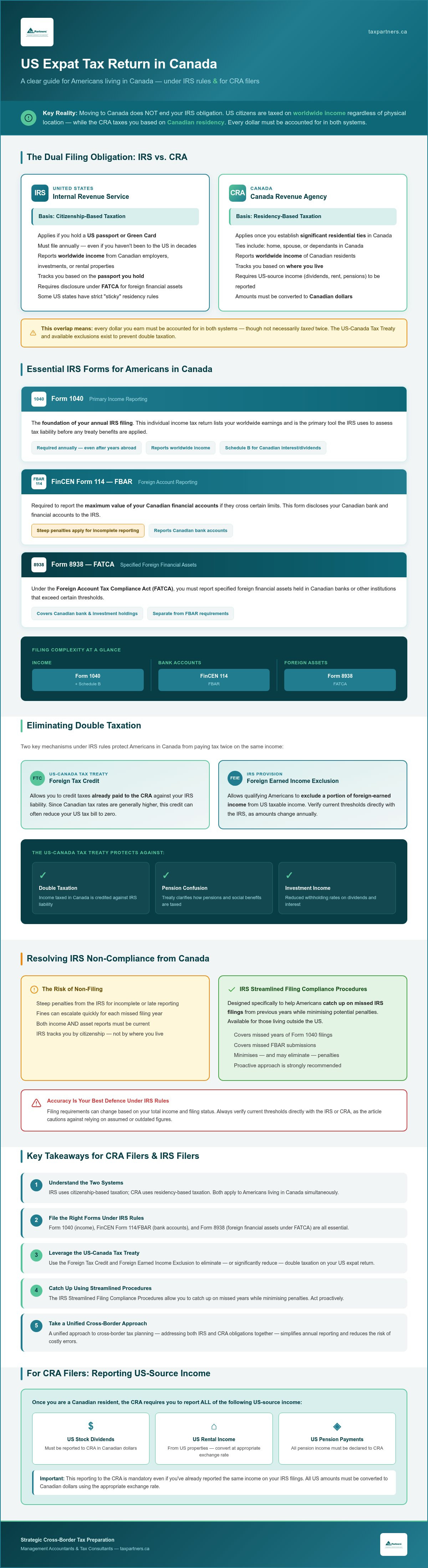
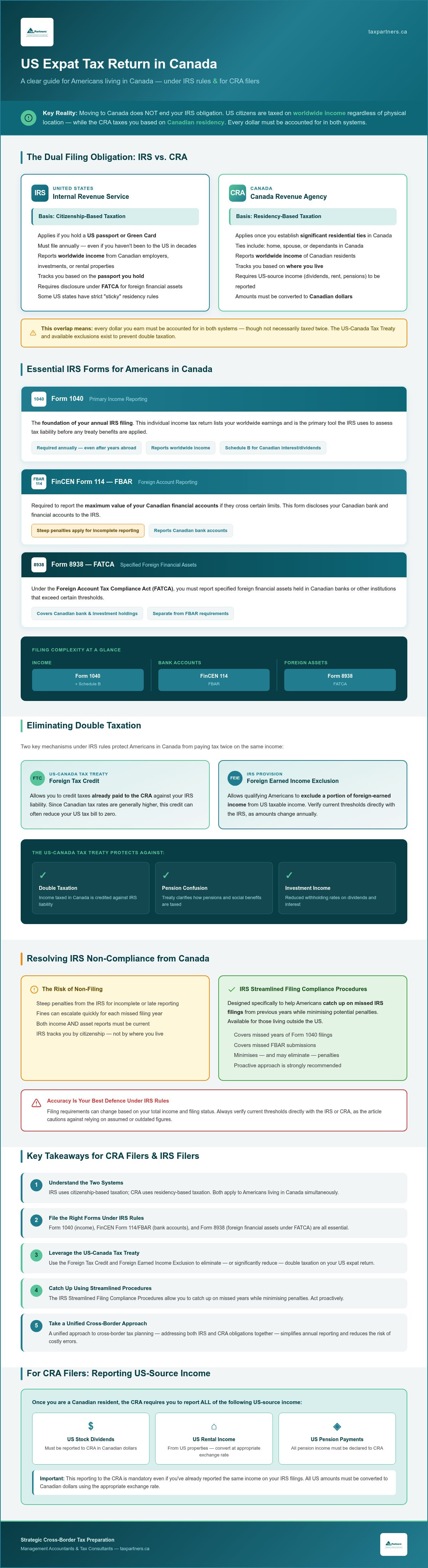
Americans living in Canada face a unique and demanding financial reality. Unlike most citizens of other nations, your tax obligations aren't determined solely by where you live. This creates a dual filing requirement where you must satisfy the rules of the Internal Revenue Service (IRS) in the United States while simultaneously complying with the Canada Revenue Agency (CRA).
Both countries exercise a broad reach over your finances. Under IRS rules, US citizens are taxed on their worldwide income regardless of their physical location. For CRA filers, the focus shifts to residency. The CRA taxes residents on their global earnings once they establish a primary home or significant ties in Canada. This overlap means that every dollar you earn must be accounted for twice, though not necessarily taxed twice.
Managing a US expat tax return Canada requires a clear understanding of these two distinct jurisdictions. While the IRS tracks you based on the passport you hold, the CRA tracks you based on where you lay your head at night. Balancing these competing claims is the first step toward achieving total compliance and financial clarity.
The IRS Requirement for Global Income Reporting
The United States uses citizenship-based taxation. If you hold a US passport or Green Card, you're legally required to file a return with the IRS every year. This obligation remains active even if you haven't stepped foot on US soil in decades. The IRS expects you to report every cent earned from Canadian employers, investments, or rental properties worldwide.
Living in Canada doesn't provide an automatic exemption from these federal duties. Beyond simple income, you must also navigate complex disclosure requirements like the Foreign Account Tax Compliance Act (FATCA). This law requires you to report specified foreign financial assets held in Canadian banks or other institutions. You should also check if your last US state of residence still considers you a taxpayer, as some states have strict "sticky" residency rules.
The CRA Requirement for Canadian Residents
Once you establish residency in Canada, the CRA expects full transparency regarding your financial life. Under Canadian law, residents must report their worldwide income on their annual return. The CRA determines your status based on "significant residential ties," such as having a home, a spouse, or dependants in the country. If you're living and working here, you're likely a resident for tax purposes.
For those managing tax in Canada, you must report all US-source income correctly. This includes dividends from US stocks, rental income from US properties, or pension payments. You must convert these amounts into Canadian dollars using the appropriate exchange rate. Reporting this income to the CRA is mandatory, even if you've already reported it on your tax in US filings.
Essential IRS Forms for Americans Resident in Canada
Successfully filing a US expat tax return Canada requires navigating a complex web of forms designed to track global wealth. It's not just about what you earned; it's also about where you keep your assets. Under IRS rules, you're expected to provide a transparent view of your entire financial life north of the border.
Accuracy is your best defence against the steep penalties the IRS may apply for incomplete reporting. When you realize how quickly these fines can escalate, the value of precise documentation becomes clear. Taking a proactive approach to your paperwork ensures you remain in good standing without unnecessary stress.
Primary Income Reporting with Form 1040
Form 1040 serves as the foundation for your annual filing under IRS rules. Even if you've lived in Canada for years, this individual income tax return is where you list your worldwide earnings. It's the primary tool the IRS uses to assess your tax liability before any treaty benefits are applied.
You may need to attach extra schedules, such as Schedule B, to report interest or dividends from Canadian institutions. Consulting IRS guidance for US citizens living abroad is a practical way to confirm your current thresholds for a US expat tax return Canada. Always verify the latest instructions, as filing requirements can change based on your total income and filing status.
Foreign Asset Disclosure: FBAR and Form 8938
Beyond income, you must report the maximum value of your Canadian financial accounts if they cross certain limits. The FinCEN Form 114, commonly known as the FBAR, is filed through the BSA E-Filing System rather than with your tax return. It covers Canadian bank accounts, mutual funds, and even certain insurance policies that have a cash value. You must report these accounts even if they don't produce taxable income under IRS rules.
Form 8938 is a distinct requirement under the Foreign Account Tax Compliance Act (FATCA) that you file directly with your Form 1040. While it may seem redundant, the thresholds for Form 8938 differ from the FBAR, and the IRS uses this form to monitor a wider range of foreign financial assets. Failing to file this form can lead to significant financial consequences and extended audit periods.
If your family members lack social security numbers, they may need ITIN application services to fulfill their reporting duties. If you're feeling overwhelmed by these overlapping forms, speak with a cross-border specialist to ensure your paperwork is flawless and fully compliant.
Eliminating Double Taxation Under the US-Canada Tax Treaty
The US-Canada Tax Treaty is your most powerful defence against paying twice. While both countries claim a right to your income, this bilateral agreement establishes clear rules to decide which jurisdiction gets first priority. It's a strategic framework designed to ensure that living abroad doesn't become a financial burden. You can't rely on the IRS or CRA to apply these rules for you.
You must proactively claim these benefits on your tax filings. The treaty doesn't apply itself automatically; you have to invoke specific provisions to protect your wealth. Following IRS guidance for US citizens living abroad is essential to understanding which credits or exclusions apply to your unique situation. This proactive approach turns a potential double-taxation nightmare into a manageable, compliant process.
The treaty covers many types of income, including:
- Employment earnings and self-employment income.
- Pensions and social security benefits.
- Investment income like interest and dividends.
- Gains from the sale of real estate.
Managing these benefits often involves more than just tax reporting. If you are also considering your US medical coverage options, The Modern Medicare Agency provides expert guidance on Medicare plans for Americans living outside the United States.
The Foreign Earned Income Exclusion (FEIE)
The Foreign Earned Income Exclusion (FEIE) is a specific provision under IRS rules. It allows you to exclude a significant portion of your Canadian salary or self-employment income from US taxation. To qualify, you must pass either the physical presence test or the bona fide residence test. This choice depends on your long-term plans and physical location.
The physical presence test requires you to be outside the US for 330 full days in a 12-month period. The bona fide residence test is for those who have established a long-term home in Canada. Choosing between these tests requires precision. A mistake here could disqualify your exclusion and lead to an unexpected bill on your US expat tax return Canada.
Utilizing Foreign Tax Credits (FTC)
Foreign Tax Credits (FTC) offer a different path to tax relief. Instead of excluding income, you use the taxes you've already paid to the CRA as a credit against your IRS liability. Since Canadian tax rates are often higher than US rates, this method frequently reduces your US tax bill to zero. It's a dollar-for-dollar reduction that recognizes your contributions to the Canadian system.
This method is particularly useful for passive income, such as dividends or interest, which the FEIE doesn't cover. It ensures you aren't paying tax on the same dollar to both the CRA and the IRS. For complex portfolios, professional individual tax return preparation is the best way to maximize these credits. We help you navigate these choices to secure the most favourable outcome for your US expat tax return Canada.
Resolving IRS Non-Compliance from Canada
Finding out that you're behind on your tax obligations is a stressful moment for any American living abroad. Many people only realize they must file a US expat tax return Canada after receiving a notice from their bank or discussing their finances with a peer. It's a common situation, and the most important step is to address it before the IRS reaches out to you.
The fear of high penalties often prevents people from taking action, but the IRS provides specific programs to encourage voluntary disclosure. Initiating the process yourself is a proactive way to protect your financial future. By coming forward, you can resolve your status and regain your peace of mind while avoiding the most severe consequences of non-compliance.
The IRS Streamlined Procedure Explained
The Streamlined Foreign Offshore Procedures serve as a bridge back to compliance for non-willful taxpayers. Under IRS rules, non-willfulness is defined as conduct that is due to negligence, inadvertence, or a misunderstanding of the law's requirements. This program is specifically designed for expats who didn't know they had a filing duty.
To use this program, you generally need to file three years of delinquent tax returns and six years of FBAR disclosures. You must also include a signed statement certifying that your previous failure to file was not intentional. For a deep dive into the eligibility requirements, consult our IRS Streamlined Procedure guide.
Correcting Past Errors and Late Filings
If you've filed previously but realized your returns contained mistakes, filing an amended return under IRS rules is the correct path forward. This allows you to report missed Canadian investment income or correct errors in your treaty claims. Accuracy in these corrections is vital to ensure you don't trigger further inquiries from the authorities.
Late FBAR filings require a separate submission to the Department of the Treasury's Financial Crimes Enforcement Network. You must provide a brief explanation for why the reports are being filed late to help mitigate potential issues. Even if you've missed several years, the Treasury often accepts late filings from those who are trying to do the right thing.
Our firm acts as a proactive guardian for clients who need to clean up their tax history. We've helped thousands of Americans in Canada navigate these complex procedures with precision and care. If you're ready to resolve your status and finalize your US expat tax return Canada, contact our cross-border specialists to get started.
Strategic Cross-Border Tax Preparation with Tax Partners
Managing complex tax duties requires more than just basic software. It demands a partner with deep-seated reliability and decades of institutional wisdom. With over 40 years of experience, our firm specializes in the intricate details of both US and Canadian tax law.
We've filed over 495,000 returns and saved our clients more than $87M. This track record demonstrates our commitment to precision and ethical steadfastness. We act as a proactive guardian for your wealth, ensuring every US expat tax return Canada is handled with foresight and care.
Integrated US and Canadian Tax Solutions
Having a single firm manage both your IRS and CRA filings eliminates the risk of conflicting data. We ensure total consistency between your US Form 1040 and your Canadian T1 individual tax return. This unified approach prevents the common errors that often lead to stressful audits or double taxation.
You benefit from having a steady hand at the helm of your financial affairs. Our mission and vision focus on long-term partnerships and personalized care. We combine our accounting expertise with wealth management and financial planning to provide a holistic view of your cross-border life.
We don't just react to deadlines; we actively look ahead to anticipate challenges and secure a better outcome for our clients. This proactive stance ensures that your reporting under IRS rules never conflicts with your obligations as a CRA filer.
Taking the Next Step Toward Compliance
Securing your financial future begins with a comprehensive cross-border tax review. We analyze your specific assets and income streams to find the most advantageous treaty claims and credits. This methodical process moves you from a state of uncertainty toward total control and understanding.
Our 1,390 five-star Google reviews reflect our dedication to providing a bespoke service that meets individual concerns. Professional oversight by seasoned experts provides the reassurance you need to live confidently in Canada. We lead you on a guided journey toward total compliance and financial clarity.
Our team is ready to guide you through every step of the filing process. For immediate assistance with your US expat tax return Canada, visit our contact page to book your consultation. We're here to help you master your obligations and protect your global wealth.
Secure Your Cross-Border Financial Future
Mastering your cross-border obligations is a strategic exercise in wealth protection. By understanding the distinct rules set by the IRS and the CRA, you can eliminate the fear of double taxation and missed deadlines. Precision in your US expat tax return Canada ensures that you remain compliant while maximizing the benefits offered by the US-Canada Tax Treaty.
Tax Partners has been serving clients worldwide since 1981, providing specialized expertise in IRS and CRA compliance. With over 1,390 five-star Google reviews, our firm offers the deep-seated reliability you need to navigate these complex regulations. We act as your proactive guardian, looking ahead to secure the best possible outcome for your unique situation.
Don't let the complexity of dual jurisdictions hold you back from a stable financial life. Secure your cross-border financial future with Tax Partners today. We're ready to provide the steady hand you need to thrive in Canada while staying right with the IRS.
Frequently Asked Questions
Do I have to file a US tax return if I live in Canada and pay Canadian taxes?
Yes, you must file a US return regardless of where you live or where you pay taxes. The United States follows a citizenship-based taxation system under IRS rules. This means all US citizens and green card holders must report their worldwide income annually. Even if your Canadian tax credits reduce your US bill to zero, the filing requirement for your US expat tax return Canada remains mandatory.
What is the deadline for filing a US expat tax return while living in Canada?
Under IRS rules, Americans living abroad receive an automatic two-month extension to June 15 to file their Form 1040. It's important to realize that any taxes owed are still due by April 15 to avoid interest charges. For CRA filers, the standard Canadian deadline is April 30. You should always verify current dates with the IRS or CRA to ensure you don't miss these critical windows.
How much money can I earn in Canada before I owe tax to the IRS?
You must file a return if your gross income exceeds the filing threshold set under IRS rules for your filing status. While the Foreign Earned Income Exclusion (FEIE) allows you to exclude a significant portion of Canadian earnings, this exclusion isn't automatic. You must file a return to claim it. If your income is above the IRS threshold, you have a reporting duty even if you don't owe any tax.
What happens if I have never filed a US tax return since moving to Canada?
If you haven't filed since moving, you are considered non-compliant under IRS rules and may face significant penalties. The IRS offers the Streamlined Filing Compliance Procedures to help non-willful taxpayers catch up. This program allows you to file three years of back taxes and six years of FBARs. It's a proactive way to resolve your status before the IRS initiates an audit or inquiry.
Is a Canadian TFSA or RRSP taxable on my US expat tax return?
Under the US-Canada Tax Treaty, RRSPs are generally recognized as tax-deferred accounts for IRS purposes. However, the IRS does not grant the same status to Canadian TFSAs. Under IRS rules, income earned within a TFSA is typically taxable annually on your US expat tax return Canada. You should consult current IRS guidelines regarding the specific reporting forms required for these Canadian investment vehicles.
Do I need to report my Canadian home sale on my US tax return?
Yes, you must report the sale of your Canadian principal residence to the IRS. While the CRA often exempts these gains from tax in Canada, the IRS applies its own rules to the sale. You may qualify for a capital gains exclusion under IRS Section 121 up to a certain limit. If your gain exceeds this threshold, you might owe US tax even if the sale was tax-free in Canada.
What is the penalty for failing to file an FBAR under IRS rules?
Failing to file an FBAR can result in steep financial penalties under IRS rules. For non-willful violations, the IRS may impose a fine for each year or account missed. If the failure to file is deemed willful, the penalties can increase significantly to a higher percentage of your account balances. These rules apply to anyone with Canadian financial accounts that exceed the reporting threshold at any time during the year.
Can I claim the Foreign Tax Credit and the Foreign Earned Income Exclusion at the same time?
You can use both the Foreign Tax Credit (FTC) and the Foreign Earned Income Exclusion (FEIE), but you cannot apply them to the same income. This prevents what the IRS calls "double dipping." Many expats in Canada find that using the FTC alone is more beneficial because Canadian tax rates are generally higher than US rates. You should review your specific income levels under IRS rules to determine the most efficient strategy.

Article by
Mahad Mohamed
Mahad Mohamed is an accountant and the CEO of Tax Partners, with over 26+ years of Canadian and international tax and accounting experience. His expertise includes corporate reorganization, cross-border tax structuring (Canada & US), tax disputes, CRA audits, and tax planning for small owner-managed private corporations. Most recently, Mahad is a pioneer in Canadian crypto taxation and founded Block3 Finance.
Previously, Mahad worked for the Canada Revenue Agency (CRA), Big4 accounting firms, and served as a Rulings Officer for the Federal Tax Authority of the UAE before acquiring Tax Partners in 2014.
Tax Partners has 44 full-time accountants and over 18,400+ clients.
Disclaimer
This article provides general information only and is current as of its publication date. It has not been updated and may be out of date. It does not constitute legal advice and should not be relied upon as such. Every tax situation is unique and may differ from the examples discussed in this article. If you have specific questions, you should seek the advice of our accountants for your unique circumstances. Book a FREE Initial Consultation Today!
Frequently Asked Questions
Do I have to file a US tax return if I live in Canada and pay Canadian taxes?
Yes, you must file a US return regardless of where you live or where you pay taxes. The United States follows a citizenship-based taxation system under IRS rules. This means all US citizens and green card holders must report their worldwide income annually. Even if your Canadian tax credits reduce your US bill to zero, the filing requirement for your US expat tax return Canada remains mandatory.
What is the deadline for filing a US expat tax return while living in Canada?
Under IRS rules, Americans living abroad receive an automatic two-month extension to June 15 to file their Form 1040. It's important to realize that any taxes owed are still due by April 15 to avoid interest charges. For CRA filers, the standard Canadian deadline is April 30. You should always verify current dates with the IRS or CRA to ensure you don't miss these critical windows.
How much money can I earn in Canada before I owe tax to the IRS?
You must file a return if your gross income exceeds the filing threshold set under IRS rules for your filing status. While the Foreign Earned Income Exclusion (FEIE) allows you to exclude a significant portion of Canadian earnings, this exclusion isn't automatic. You must file a return to claim it. If your income is above the IRS threshold, you have a reporting duty even if you don't owe any tax.
What happens if I have never filed a US tax return since moving to Canada?
If you haven't filed since moving, you are considered non-compliant under IRS rules and may face significant penalties. The IRS offers the Streamlined Filing Compliance Procedures to help non-willful taxpayers catch up. This program allows you to file three years of back taxes and six years of FBARs. It's a proactive way to resolve your status before the IRS initiates an audit or inquiry.
Is a Canadian TFSA or RRSP taxable on my US expat tax return?
Under the US-Canada Tax Treaty, RRSPs are generally recognized as tax-deferred accounts for IRS purposes. However, the IRS does not grant the same status to Canadian TFSAs. Under IRS rules, income earned within a TFSA is typically taxable annually on your US expat tax return Canada. You should consult current IRS guidelines regarding the specific reporting forms required for these Canadian investment vehicles.
Do I need to report my Canadian home sale on my US tax return?
Yes, you must report the sale of your Canadian principal residence to the IRS. While the CRA often exempts these gains from tax in Canada, the IRS applies its own rules to the sale. You may qualify for a capital gains exclusion under IRS Section 121 up to a certain limit. If your gain exceeds this threshold, you might owe US tax even if the sale was tax-free in Canada.
What is the penalty for failing to file an FBAR under IRS rules?
Failing to file an FBAR can result in steep financial penalties under IRS rules. For non-willful violations, the IRS may impose a fine for each year or account missed. If the failure to file is deemed willful, the penalties can increase significantly to a higher percentage of your account balances. These rules apply to anyone with Canadian financial accounts that exceed the reporting threshold at any time during the year.
Can I claim the Foreign Tax Credit and the Foreign Earned Income Exclusion at the same time?
You can use both the Foreign Tax Credit (FTC) and the Foreign Earned Income Exclusion (FEIE), but you cannot apply them to the same income. This prevents what the IRS calls "double dipping." Many expats in Canada find that using the FTC alone is more beneficial because Canadian tax rates are generally higher than US rates. You should review your specific income levels under IRS rules to determine the most efficient strategy.