CCPC Tax Issues: A 2026 Guide for Canadian Business Owners

What if a tax decision that seems routine today creates a problem for your corporation later? For Canadian business owners, the rules can affect how income is taxed, how family members are paid and what records the CRA may ask to see.
If passive investment income, TOSI requirements or shareholder withdrawals feel hard to assess, you’re not alone. A clear view of the rules can help you make decisions with greater confidence.
This 2026 guide outlines key Canadian CCPC tax considerations and practical ways to approach them. You’ll learn what to review, where compliance concerns can arise and how to plan with your corporation’s longer-term goals in mind.
Key Takeaways
- Confirm your corporation’s CCPC status under CRA rules, including who controls it, before relying on tax treatment available to CCPCs.
- Understand how passive investment income can reduce access to the small business deduction, and plan before investment income grows.
- Review salary and dividend decisions with TOSI and CRA reasonableness considerations in mind, especially when family members receive income.
- Keep personal and business spending clearly separate, and maintain records that can help address common CRA audit concerns.
- Explore how succession planning tools may support long-term wealth preservation while addressing Canadian controlled private corporation tax issues.
Understanding CCPC Status Under CRA Rules
Before considering tax planning, confirm that your corporation qualifies as a Canadian-controlled private corporation (CCPC) under Canadian tax rules. In general, a CCPC is a private corporation resident in Canada that is not controlled by one or more non-residents or public corporations, alone or together. The CRA assesses the corporation’s status at the end of its taxation year, so changes in ownership or control can affect whether it qualifies.
Eligibility Criteria for CCPC Status
Three conditions deserve close attention: the corporation must be private, resident in Canada and Canadian-controlled. Control is not always as simple as checking who owns the largest shareholding. Voting rights, ownership arrangements and indirect control can also matter, so review the full structure rather than relying on a single ownership percentage.
A corporation generally won’t qualify if it is controlled by non-residents or public corporations, or if its shares are listed on a designated stock exchange. The statutory definition includes detailed rules and exceptions, so an unusual share structure or change in ownership should be reviewed under CRA requirements.
Residency is a separate test. A corporation incorporated in Canada is generally treated as resident in Canada, while a corporation formed elsewhere may also be considered resident if its central management and control is exercised in Canada. In practice, that means looking beyond the registered office to where key decisions are actually made. For cross-border ownership or management, get advice before assuming the corporation’s residency is settled.
The Value of the Small Business Deduction
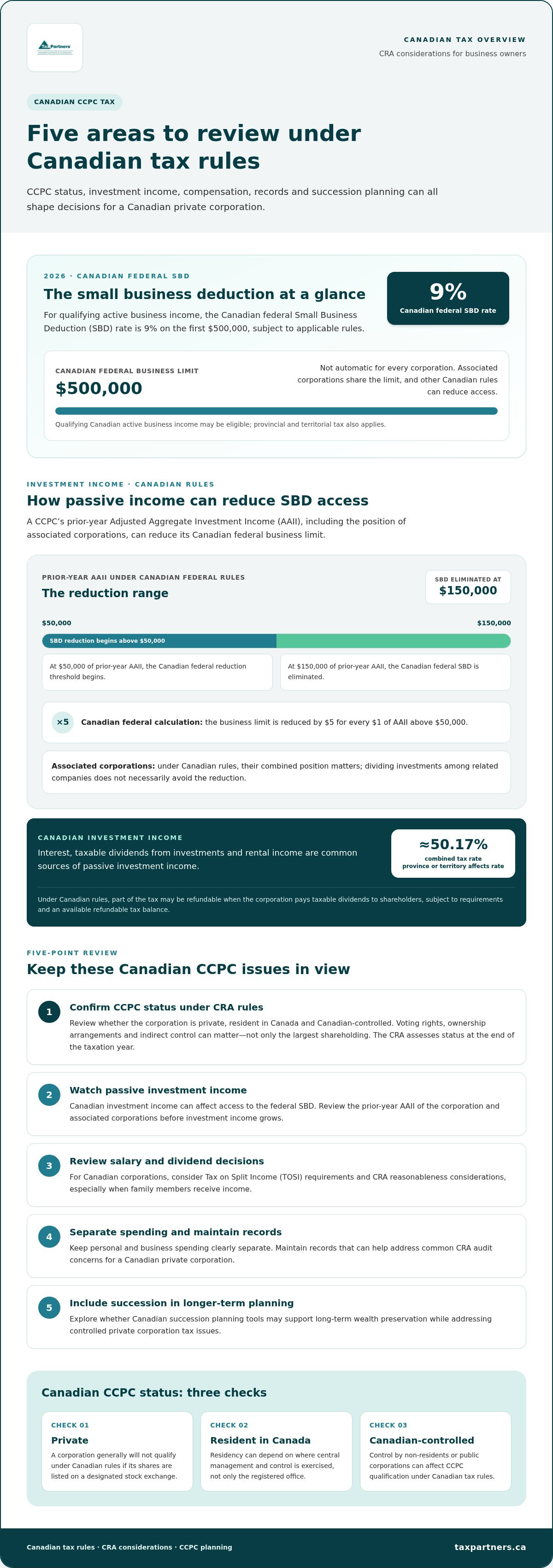
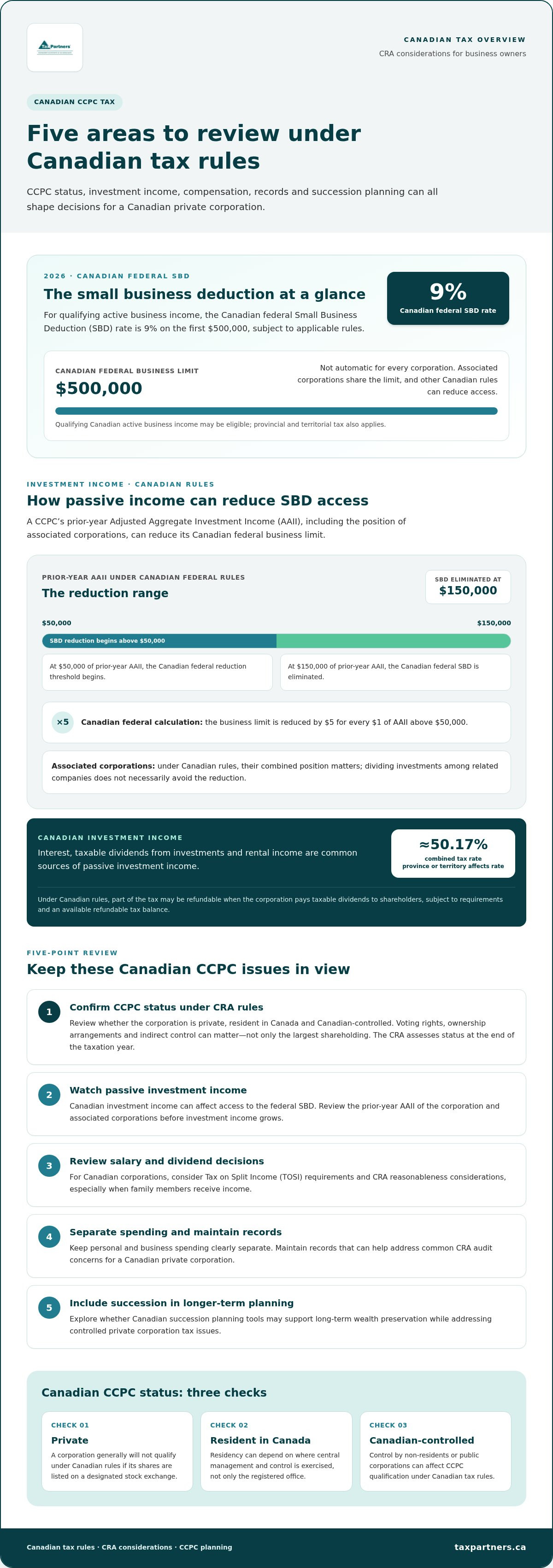
CCPC status can open the door to the federal Small Business Deduction (SBD), which lowers the federal corporate tax rate on qualifying active business income. Active business income generally refers to income earned from operating the business, rather than investment income. For 2026, the federal SBD rate is 9% on the first $500,000 of qualifying income, subject to the applicable rules. Provincial and territorial tax also applies, so the combined rate depends on where the corporation operates.
The $500,000 amount is the federal business limit, not an automatic allowance for every corporation. Associated corporations share this limit, and other rules can reduce access to it. For a broader overview of corporate tax rates in Canada, see how federal rates distinguish between income eligible for the SBD and income taxed at the general rate.
These Canadian controlled private corporation tax issues can affect both your corporate tax bill and longer-term planning. Tax Partners provides Canadian corporate income tax services that can help business owners review eligibility and reporting considerations under CRA rules.
The Passive Income Issue: Impact on the Small Business Deduction
A CCPC can earn income from its day-to-day business and from investments held inside the corporation. Under Canadian tax rules administered by the CRA, investment income can affect access to the federal Small Business Deduction (SBD), so retaining profits in the company doesn’t make the tax consequences disappear.
Interest, taxable dividends from investments, and rental income are common sources of passive investment income. Under Canadian federal and provincial tax rules, the combined tax rate on this income is approximately 50.17%, although the actual rate depends on the province or territory. Under CRA rules, part of the tax may be refundable when the corporation pays taxable dividends to shareholders, subject to the applicable requirements and available refundable tax balance.
Calculating the AAII Threshold Impact
Adjusted Aggregate Investment Income (AAII) is a measure of a corporation’s investment income, calculated by including specified income and subtracting certain losses under CRA rules. Under Canadian rules, the prior year’s AAII for a CCPC and its associated corporations determines whether the federal SBD business limit is reduced.
For 2026, under Canadian federal tax rules, the business limit is $500,000, and the passive-income reduction generally applies when prior-year AAII is between $50,000 and $150,000. Under the Canadian SBD calculation, the limit is reduced by $5 for every $1 of AAII over $50,000, and the SBD is eliminated when AAII reaches $150,000. Associated corporations must consider their combined position, so dividing investments among related companies doesn’t necessarily avoid the reduction.
For example, if a corporation’s prior-year AAII is above $50,000, some of its business limit may be reduced for the current year under Canadian tax rules. The calculation can affect how much active business income receives the federal SBD rate, so a year-end review of investment income and corporate relationships can help avoid surprises.
Strategies to Manage Investment Income
There’s no single ownership strategy that suits every business owner. Reinvesting surplus cash in genuine business operations may support growth, while holding investment assets personally instead of corporately can change the timing and character of taxes. Consider cash-flow needs, risk, future withdrawals and the tax consequences across both the corporation and shareholder before moving assets.
Under CRA rules, 30.67% of tax paid on passive investment income is added to the corporation’s Refundable Dividend Tax on Hand (RDTOH) account. A dividend payment can trigger a refund, but the corporation must have the relevant balance and meet the CRA’s requirements.
These calculations are distinct from family income-splitting rules. For a separate discussion of the Tax on Split Income (TOSI) rules, consult the linked overview. To assess how investment income affects your corporation’s SBD access, consider speaking with a Canadian tax professional.
Shareholder Compensation and TOSI Challenges
Paying family members or distributing dividends can be legitimate ways to compensate people who contribute to a business. But under Canadian tax rules, income splitting that doesn’t meet an applicable exception may fall under the Tax on Split Income (TOSI) rules. TOSI can apply to certain income received by related individuals from a private corporation, including adult family members, and may tax that income at the top personal rate, up to 53% under the Canadian rules.
That makes the distinction between an “on-side” and “off-side” strategy important. An on-side arrangement reflects genuine work, investment or risk and meets the relevant requirements; an off-side payment may be challenged or subject to TOSI. These Canadian controlled private corporation tax issues call for documented decisions, not assumptions that a family relationship alone supports a payment.
Navigating TOSI Exclusions
Some exclusions may keep income outside TOSI, but each has specific conditions under CRA rules. For example, the excluded business exception may apply when a related family member actively works in the business for an average of at least 20 hours per week. The excluded shares exception may apply to an adult aged 25 or older who owns at least 10% of the votes and value of a corporation that isn’t primarily a service business.
Salary payments also need to be reasonable. The CRA can consider the work performed, time and effort invested, assets contributed and risks assumed. Keep records such as job descriptions, time records, and evidence of responsibilities to support the amount paid. A payment that fits the actual contribution is easier to explain than one based only on the desired tax result.
Salary vs. Dividend Optimization
Salary and dividends have different corporate and personal tax consequences. A reasonable salary is generally deductible when calculating corporate income and can create Canada Pension Plan (CPP) contribution obligations. Dividends are paid from after-tax corporate profits, don’t create CPP contributions, and may qualify for the personal dividend tax credit, a credit intended to account for corporate tax already paid.
There’s no universal winner. The result depends on factors such as the corporation’s income, the shareholder’s personal tax position, CPP considerations and whether the recipient could face TOSI. Before distributing income to family members, review the Canadian tax rules and planning considerations, and consider having a Canadian tax professional model the options. A personalized compensation review can help you assess the trade-offs and keep the rationale well documented.
Mitigating CRA Audit Risks for Private Corporations
CRA reviews often focus on whether a corporation’s reported income, expenses and shareholder transactions are supported by consistent records. For 2026, the CRA identifies shareholder withdrawals that aren’t properly recorded, persistent shareholder loans, mismatches between GST/HST and corporate income tax filings, and aggressive Scientific Research and Experimental Development (SR&ED) claims as potential red flags. A flag doesn’t automatically mean an audit will follow, but it’s a reason to check that filings and records tell the same story.
Start with clear separation. Pay personal costs from personal accounts, not the corporation’s, and record any legitimate business use of shared assets with supporting details. This helps prevent personal spending from being treated as a taxable shareholder benefit, meaning value received from the corporation that may have personal tax consequences.
Address Shareholder Benefits and Loans
If a shareholder uses a corporate vehicle or property personally, document the use and how related costs are allocated. Record withdrawals accurately as salary, dividends, loans or another appropriate transaction rather than leaving them unexplained in the books.
Under CRA rules, a shareholder loan that isn’t repaid within one year after the corporation’s fiscal year-end may be included in the shareholder’s income, subject to applicable exceptions. Keep loan agreements, repayment records and approvals, and retain contracts, invoices and accounting entries for transactions between related or associated corporations.
Prepare for a CRA Compliance Review
For corporations handling crypto assets, record each transaction and retain supporting exchange statements, wallet records and valuation details. Reconcile these records with the accounting ledger and corporate tax filings. CRA scrutiny of crypto assets makes complete, consistent documentation especially important; crypto-corporation accounting considerations can help identify records to review.
Organized bookkeeping makes it easier to answer questions and explain how figures were calculated. The CRA requires a T2 corporate income tax return within six months of the corporation’s fiscal year-end. Late filing can lead to penalties, and unpaid tax may accrue interest; information slips also have filing requirements and penalties may apply for late or missing submissions. Confirm current CRA requirements for the corporation’s circumstances.
If you receive a CRA audit letter or Notice of Assessment, read it carefully, note any response dates stated, and gather the records relevant to the questions. Don’t ignore it or send an incomplete response. A qualified tax professional can help you understand the request and prepare a clear reply. For support reviewing your records and next steps, contact Tax Partners about CRA compliance support.
Strategic Planning: Succession and Wealth Preservation
Succession planning isn’t only for large corporations. For a Canadian business owner, decisions made years before a sale or transfer can affect the tax treatment of shares, who benefits from future growth and how wealth passes to the next generation. Addressing Canadian controlled private corporation tax issues early gives you more time to review options and correct problems before a transaction is underway.
Two tools may form part of a broader plan: the Lifetime Capital Gains Exemption (LCGE) and an estate freeze. Neither applies automatically, and each depends on the corporation’s circumstances and CRA requirements.
Maximizing the Lifetime Capital Gains Exemption
The LCGE can significantly reduce tax on the sale of shares that qualify as shares of a small business corporation under Canadian tax rules. Eligibility depends on specific tests, so don’t assume that CCPC status alone makes shares eligible.
Under CRA rules, qualification can depend on the corporation’s assets, how they’re used in its business, and the shareholder’s ownership history during required periods. “Purification” refers to planning to address assets that may prevent the shares from meeting the applicable tests, such as excess passive investments. Review the balance sheet and current CRA criteria well before a potential sale; moving assets can have tax consequences of its own.
The LCGE amount is subject to tax-law changes and indexation. Before relying on it in a 2026 sale or succession plan, confirm the current limit and eligibility requirements with the CRA or a qualified Canadian tax professional.
Build a Customized Succession Plan
An estate freeze can generally fix the current value of an owner’s interest, while allowing future growth to accrue to shares held by the next generation or a family trust. It may help with succession and estate planning, but it doesn’t remove the need to consider control, family circumstances and the tax effects of restructuring.
A holding company may also be considered as part of a corporate structure to separate certain investments from the operating business. Its usefulness depends on the company’s goals and existing arrangements; adding an entity doesn’t automatically reduce tax and may bring additional compliance considerations.
Plan in stages. Review the business’s value, ownership, retained assets and potential buyers or successors, then coordinate corporate tax planning with estate and wealth considerations. A tailored, multi-year exit strategy can give you time to assess the LCGE, possible restructuring and the right transition path instead of making rushed decisions at the point of sale.
For help shaping your 2026 plan around your corporation’s circumstances, contact Tax Partners to discuss succession and corporate tax planning.
Put a Proactive CCPC Plan in Place
Strong corporate tax planning connects today’s decisions with your business’s longer-term goals. Confirm your CCPC status, monitor how investment income may affect access to the Small Business Deduction, and ensure compensation and shareholder transactions are properly supported. Reviewing succession options early gives you more time to make informed decisions.
These Canadian controlled private corporation tax issues can feel complex, but you don’t have to address them alone. Tax Partners brings over 40 years of Canadian tax expertise and comprehensive CRA audit support, and has served clients since 1981.
Secure your CCPC’s financial future with Tax Partners through thoughtful Canadian tax planning and compliance support. With a clear strategy and the right guidance, you can approach your corporation’s next stage with greater confidence.
Frequently Asked Questions
What is a Canadian Controlled Private Corporation (CCPC) under CRA rules?
A CCPC is generally a private corporation resident in Canada that isn’t controlled by one or more non-residents or public corporations. The CRA assesses CCPC status at the end of the corporation’s taxation year, considering ownership and control, including relevant voting rights and arrangements. A corporation’s place of incorporation alone doesn’t establish its status. Confirm both Canadian residency and who has control before relying on tax treatment available to CCPCs.
How much passive income can a CCPC earn before it loses the Small Business Deduction?
Under Canadian rules, a CCPC’s federal Small Business Deduction (SBD) business limit is reduced when its prior-year Adjusted Aggregate Investment Income (AAII), combined with that of associated corporations, is between $50,000 and $150,000. The limit is reduced by $5 for each $1 of AAII above $50,000, and the SBD is eliminated when AAII reaches $150,000. These thresholds apply under Canadian tax rules; confirm the calculation for your corporation.
Can I pay my spouse a salary from my CCPC to reduce my overall tax bill?
Yes, a CCPC can pay a spouse a salary for genuine work, but the amount should be reasonable for the services provided. Under CRA rules, the reasonableness assessment can consider the work, time, responsibilities and other contributions. Keep records such as job duties, hours and payment details. A salary that exceeds a reasonable amount may be challenged, and income splitting may also raise TOSI concerns, so don’t base compensation only on a desired tax outcome.
What are the most common CRA audit triggers for private corporations in Canada?
Potential CRA red flags include persistent shareholder loans, withdrawals that aren’t properly recorded, mismatches between GST/HST and corporate income tax filings, and aggressive Scientific Research and Experimental Development claims. The CRA also scrutinizes personal expenses claimed by a corporation and shareholder compensation. A red flag doesn’t automatically mean an audit will occur. Reconcile filings, separate personal and business spending, and keep source documents that explain transactions and support reported amounts.
What happens if my CCPC is no longer controlled by Canadian residents?
If non-residents gain control, the corporation may no longer meet the Canadian-controlled requirement for CCPC status under CRA rules. That can affect access to tax treatment reserved for CCPCs, including the SBD, depending on the corporation’s circumstances. The CRA assesses status at taxation-year end, and control can depend on voting rights and ownership arrangements, not just where shareholders live. Review proposed share transfers or changes in voting control before they take effect.
How do TOSI rules affect dividends paid to my adult children?
Under Canadian Tax on Split Income (TOSI) rules, certain dividends received by related individuals from a private corporation can be taxed at the recipient’s top personal tax rate, potentially up to 53%, unless an exclusion applies. An adult child’s age alone doesn’t make a dividend exempt. CRA exceptions can include an excluded business for an active participant or, for qualifying adults aged 25 or older, excluded shares that meet ownership and business-type conditions.
Is it better to take a salary or dividends from my Canadian corporation in 2026?
Neither salary nor dividends is automatically better for every Canadian corporation owner in 2026. Salary is generally deductible to the corporation when calculating income and can create Canada Pension Plan contribution obligations. Dividends are paid from after-tax corporate profits and may qualify for the personal dividend tax credit, but don’t create CPP contributions. Compare corporate and personal tax effects, cash needs and retirement considerations before choosing a mix.
How do I qualify for the Lifetime Capital Gains Exemption when selling my business?
To claim the Lifetime Capital Gains Exemption (LCGE) under Canadian tax rules, the shares sold must meet the requirements for qualifying small business corporation shares, and the seller must satisfy applicable ownership and other conditions. CCPC status alone doesn’t guarantee eligibility. The corporation’s asset mix and use of assets can matter, so owners sometimes review whether passive assets affect qualification. Confirm current CRA tests and the available exemption before arranging a sale.

Article by
Mahad Mohamed
Mahad Mohamed is an accountant and the CEO of Tax Partners, with over 26+ years of Canadian and international tax and accounting experience. His expertise includes corporate reorganization, cross-border tax structuring (Canada & US), tax disputes, CRA audits, and tax planning for small owner-managed private corporations. Most recently, Mahad is a pioneer in Canadian crypto taxation and founded Block3 Finance.
Previously, Mahad worked for the Canada Revenue Agency (CRA), Big4 accounting firms, and served as a Rulings Officer for the Federal Tax Authority of the UAE before acquiring Tax Partners in 2014.
Tax Partners has 44 full-time accountants and over 18,400+ clients.
Disclaimer
This article provides general information only and is current as of its publication date. It has not been updated and may be out of date. It does not constitute legal advice and should not be relied upon as such. Every tax situation is unique and may differ from the examples discussed in this article. If you have specific questions, you should seek the advice of our accountants for your unique circumstances. Book a FREE Initial Consultation Today!
Frequently Asked Questions
What is a Canadian Controlled Private Corporation (CCPC) under CRA rules?
A CCPC is generally a private corporation resident in Canada that isn’t controlled by one or more non-residents or public corporations. The CRA assesses CCPC status at the end of the corporation’s taxation year, considering ownership and control, including relevant voting rights and arrangements. A corporation’s place of incorporation alone doesn’t establish its status. Confirm both Canadian residency and who has control before relying on tax treatment available to CCPCs.
How much passive income can a CCPC earn before it loses the Small Business Deduction?
Under Canadian rules, a CCPC’s federal Small Business Deduction (SBD) business limit is reduced when its prior-year Adjusted Aggregate Investment Income (AAII), combined with that of associated corporations, is between $50,000 and $150,000. The limit is reduced by $5 for each $1 of AAII above $50,000, and the SBD is eliminated when AAII reaches $150,000. These thresholds apply under Canadian tax rules; confirm the calculation for your corporation.
Can I pay my spouse a salary from my CCPC to reduce my overall tax bill?
Yes, a CCPC can pay a spouse a salary for genuine work, but the amount should be reasonable for the services provided. Under CRA rules, the reasonableness assessment can consider the work, time, responsibilities and other contributions. Keep records such as job duties, hours and payment details. A salary that exceeds a reasonable amount may be challenged, and income splitting may also raise TOSI concerns, so don’t base compensation only on a desired tax outcome.
What are the most common CRA audit triggers for private corporations in Canada?
Potential CRA red flags include persistent shareholder loans, withdrawals that aren’t properly recorded, mismatches between GST/HST and corporate income tax filings, and aggressive Scientific Research and Experimental Development claims. The CRA also scrutinizes personal expenses claimed by a corporation and shareholder compensation. A red flag doesn’t automatically mean an audit will occur. Reconcile filings, separate personal and business spending, and keep source documents that explain transactions and support reported amounts.
What happens if my CCPC is no longer controlled by Canadian residents?
If non-residents gain control, the corporation may no longer meet the Canadian-controlled requirement for CCPC status under CRA rules. That can affect access to tax treatment reserved for CCPCs, including the SBD, depending on the corporation’s circumstances. The CRA assesses status at taxation-year end, and control can depend on voting rights and ownership arrangements, not just where shareholders live. Review proposed share transfers or changes in voting control before they take effect.
How do TOSI rules affect dividends paid to my adult children?
Under Canadian Tax on Split Income (TOSI) rules, certain dividends received by related individuals from a private corporation can be taxed at the recipient’s top personal tax rate, potentially up to 53%, unless an exclusion applies. An adult child’s age alone doesn’t make a dividend exempt. CRA exceptions can include an excluded business for an active participant or, for qualifying adults aged 25 or older, excluded shares that meet ownership and business-type conditions.
Is it better to take a salary or dividends from my Canadian corporation in 2026?
Neither salary nor dividends is automatically better for every Canadian corporation owner in 2026. Salary is generally deductible to the corporation when calculating income and can create Canada Pension Plan contribution obligations. Dividends are paid from after-tax corporate profits and may qualify for the personal dividend tax credit, but don’t create CPP contributions. Compare corporate and personal tax effects, cash needs and retirement considerations before choosing a mix.
How do I qualify for the Lifetime Capital Gains Exemption when selling my business?
To claim the Lifetime Capital Gains Exemption (LCGE) under Canadian tax rules, the shares sold must meet the requirements for qualifying small business corporation shares, and the seller must satisfy applicable ownership and other conditions. CCPC status alone doesn’t guarantee eligibility. The corporation’s asset mix and use of assets can matter, so owners sometimes review whether passive assets affect qualification. Confirm current CRA tests and the available exemption before arranging a sale.