Calculating Cost of Goods Sold for E-commerce: CRA Guide

Relying solely on supplier purchase invoices will quietly distort your store's true profitability. Real commercial success when calculating cost of goods sold for ecommerce demands that you track every component of total landed cost. For CRA filers, mastering this valuation process protects your operating margins and prevents unexpected tax adjustments.
You built your online brand to grow sustainable sales, not to spend stressful evenings untangling freight receipts, duty charges, and multi-channel fulfillment expenses. When cash-basis accounting errors blur your true unit acquisition costs, it's difficult to know which product lines actually generate profit. We understand how daunting inventory tax compliance can feel when you're managing complex supply chains.
In this guide, you'll master a repeatable formula to determine your direct inventory costs accurately for Canadian income tax compliance. We examine accepted CRA inventory valuation methods, clarify which landed expenses qualify as direct costs, and provide a clear framework to keep your financial statements audit-ready.
Key Takeaways
- Master the core formula for calculating cost of goods sold for ecommerce to ensure your net business income aligns with CRA reporting requirements.
- Identify which landed expenses qualify as direct inventory costs, from import freight to production labour, while correctly separating customer shipping fees.
- Select an approved CRA inventory valuation method, such as FIFO or weighted average, to maintain consistent year-over-year tax records.
- Transition from cash-basis tracking to accrual inventory accounting to prevent margin distortions and eliminate surprise year-end corporate adjustments.
- Synchronize multi-channel sales channels and payment platforms directly with your general ledger to maintain clean, audit-ready financial statements.
Understanding Cost of Goods Sold for Canadian Ecommerce Merchants
Every commercial item you sell carries direct acquisition expenses. Fundamentally, Cost of goods sold (COGS) represents the accumulated direct costs required to produce or purchase the inventory your business liquidated during a fiscal period. In ecommerce accounting, mastering this figure ensures your gross margin accurately reflects product performance.
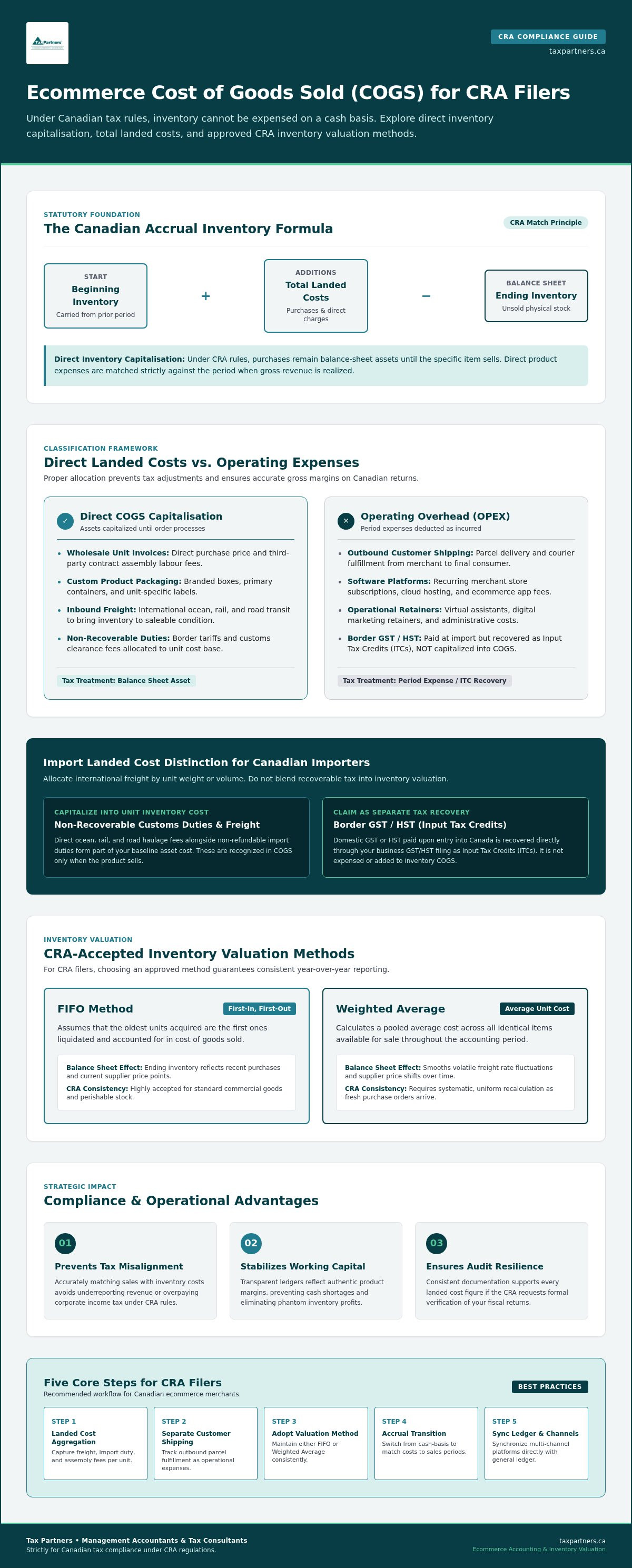
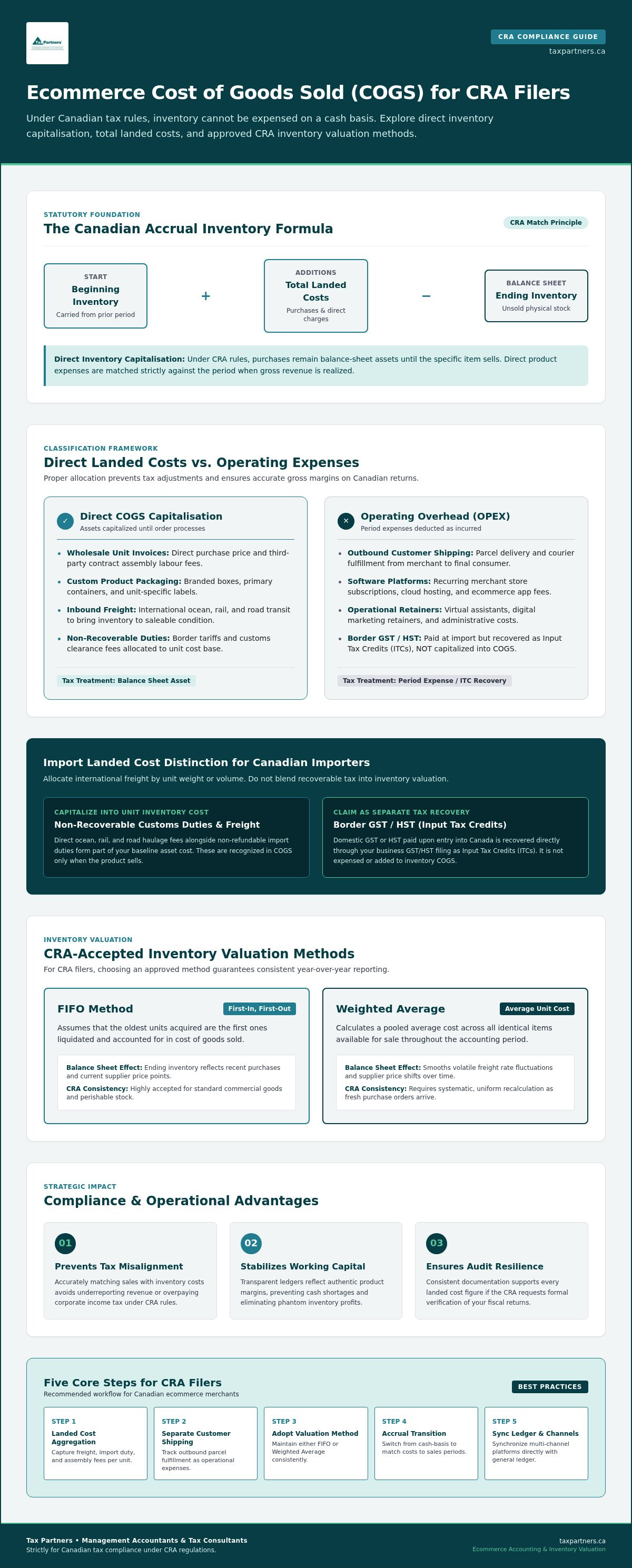
For CRA filers, calculating cost of goods sold for ecommerce is a mandatory step in establishing true gross profit. Cost of goods sold directly offsets your gross revenue on your annual tax return, reducing your net business income before operating deductions. Under Canadian tax rules, you cannot expense inventory as cash spent; instead, you must match direct product costs to the exact period in which the corresponding item sells.
Direct inventory capitalisation means recording inventory as a balance sheet asset until an order processes. Operating expenses, by contrast, reflect ongoing period expenses like website hosting or virtual assistant retainers. Businesses seeking strategic clarity often turn to specialized ecommerce accounting and tax services to establish these boundaries correctly.
Why Accurate Calculations Matter for CRA Filers
Accurate reporting establishes your true net business income under CRA rules. Distorted inventory ledgers skew commercial taxable earnings across fiscal periods, creating phantom profits or artificial losses. Meticulous calculations protect Canadian merchants by maintaining clear evidence during formal compliance audits.
- Prevents tax misalignment: Accurately matching sales with inventory costs avoids underreporting or overpaying corporate tax.
- Stabilizes working capital: Transparent ledgers show your true product margins, preventing cash shortages.
- Ensures audit resilience: Consistent documentation supports every landed cost figure if the CRA requests verification.
Direct Product Costs Versus Operating Expenses
Canadian merchants frequently confuse everyday operational overhead with direct product expenditures. Distinguishing these categories is essential for accurate bookkeeping and tax filing.
- Wholesale unit fees: Invoiced merchandise costs and contract assembly labour qualify directly as inventory assets.
- Software platforms: Recurring merchant store subscriptions and app fees belong strictly in operating expenses.
- Custom product packaging: Protective containers, branded boxes, and product-specific labels are direct inventory capitalisation costs.
- Freight allocation: Inbound freight from overseas suppliers adds directly to landed inventory cost, while outbound parcel delivery to customers represents a separate operational selling expense.
Maintaining these distinctions ensures that your ending inventory valuation matches statutory reporting requirements. Precision here eliminates unexpected adjustments at tax time.
Components of Ecommerce COGS: Tracking the Total Landed Cost
Total landed cost represents the complete economic investment required to manufacture or acquire an item and bring it to saleable condition. When calculating cost of goods sold for ecommerce, relying only on your supplier's factory invoice leaves significant capital unassigned. True unit economics require aggregating wholesale purchasing fees, raw fabrication elements, and third-party contract assembly charges into your inventory ledger.
Every dollar spent moving raw inputs toward a saleable state forms part of that product's baseline cost. Industry specialists identify freight and preparation as vital direct costs for ecommerce operations. Capturing these costs correctly guarantees that your reported margins match economic reality.
Inbound Shipping, Customs, and Import Tariffs
International ocean, rail, and road freight should be allocated across specific purchase orders based on unit weight or volume. For CRA filers, non-recoverable customs duties and clearance handling fees must be capitalized directly into inventory asset value. This distinction is critical because non-recoverable customs duties become part of your inventory cost base, while domestic GST or HST paid at the border is recovered through Input Tax Credits.
- Proportional allocation: Apportion total shipping container invoices across individual SKUs using weight or landed value ratios.
- Duty capitalisation: Treat non-refundable border tariffs as permanent additions to per-unit inventory asset value.
- Tax recovery separation: Separate recoverable sales tax levies from non-recoverable customs brokerage fees.
Navigating these import boundaries is simpler when working with professionals experienced in specialized ecommerce accounting across complex border logistics.
Packaging, Assembly, and Storage Capitalisation
Product packaging is another area where cost distinctions matter under Canadian accounting rules. Primary packaging, such as custom branded boxes and protective inserts essential for shelf readiness, must be capitalized into finished goods. Similarly, direct contract labour spent assembling promotional gift bundles or multi-packs increases your unit asset cost.
- Primary packaging: Include unit bottles, pouches, and product presentation cartons as capitalized production inventory.
- Kitting labour: Capitalize direct warehouse labour fees paid to combine separate inventory items into bundled units.
- Inbound intake handling: Add initial receiving, unloading, and barcode inspection fees directly into your inventory valuation balances.
Ongoing monthly warehousing and pallet holding fees remain operational period expenses rather than inventory costs. If reconciling these logistics expenses creates uncertainty, you can connect with our accounting team to audit your landed cost structure.
Step-by-Step Guide to E-commerce Cost of Goods Sold
Calculating cost of goods sold for ecommerce requires a disciplined, repeatable month-end routine. Rather than relying on inventory dashboard estimates, businesses must execute a standard mathematical formula that mirrors general ledger movements. For CRA filers, this periodic calculation ties directly into corporate tax schedules and unincorporated business returns.
The universal equation connects three core figures across your financial year:
Cost of Goods Sold = Beginning Inventory + Net Purchases - Ending Inventory
Each variable demands verifiable documentation to ensure audit compliance under Canadian tax rules. Implementing a structured month-end sequence ensures these numbers remain dependable:
- Confirm opening balances: Verify your beginning inventory figure against the exact closing inventory recorded on your prior period's balance sheet.
- Tally landed additions: Total all invoiced product acquisitions, foreign currency adjustments, and qualifying inbound freight accumulated during the current period.
- Execute physical stock counts: Conduct systematic warehouse counts at fiscal year-end rather than trusting unverified store software quantities.
- Establish ending inventory valuation: Multiply physical unit counts by their assigned landed cost to determine closing stock value.
Applying the Universal Calculation Formula
Your opening inventory represents stored capital carried forward from prior months. As new stock arrives, your net purchase additions expand this total cost pool. This cumulative total reflects the maximum dollar value of merchandise available for sale during that specific timeframe.
The deduction of ending inventory is what protects your profitability. By removing the cost value of unsold units resting on warehouse shelves, you defer those expenses into future reporting periods. You only deduct expenses for the specific goods that generated revenue this month.
Accounting for Merchant Returns, Breakage, and Shrinkage
Everyday retail disruptions require immediate adjustments to your inventory equation. Unprocessed customer returns and damaged items distort book values if handled incorrectly.
- Restocked returns: Inspect and reintegrate undamaged merchandise back into ending inventory counts at its original landed cost.
- Damaged goods: Remove unsellable stock from ending counts and reclassify the cost to an inventory writedown expense account with dated photographic evidence.
- Inventory shrinkage: Record unexplained volume variances uncovered during cycle counts into a separate inventory variance ledger.
Maintaining clear audit trails for write-offs ensures full transparency during CRA compliance reviews. For complex multi-warehouse networks, working with specialized accounting professionals ensures every inventory adjustment reconciles cleanly without manual calculation errors.
CRA Inventory Valuation: FIFO Versus Weighted Average Methods
Selecting an appropriate inventory valuation framework determines how inventory assets transfer into your income statement. Under CRA rules, Canadian enterprises must value inventory using an approved statutory approach. When calculating cost of goods sold for ecommerce, your chosen valuation formula establishes the cost foundation for every dispatched order.
Canadian tax guidelines permit valuing each item at the lower of its cost or fair market value, or valuing your entire inventory at fair market value. Within these frameworks, the Canada Revenue Agency recognizes two primary cost flow assumptions:
- First-In, First-Out (FIFO): Assumes the earliest purchased or produced units are the first ones dispatched to buyers.
- Weighted average cost: Recomputes unit acquisition expenses across your total inventory pool after every shipment receipt.
- Specific identification: Assigns distinct historical acquisition expenses to high-value, individualized merchandise.
- Last-In, First-Out (LIFO) prohibition: CRA regulations strictly prohibit using the LIFO method for Canadian tax reporting purposes.
Evaluating First-In, First-Out (FIFO) in Volatile Markets
The FIFO method tracks the physical flow of goods through standard supply chains. When supplier pricing and manufacturing charges rise over time, FIFO matches your oldest, lower-cost receipts against current sales transactions. This timing results in a lower cost of goods sold deduction and yields higher net commercial income for the period.
Operating under FIFO requires meticulous bookkeeping to track incoming batches and stock movements. Your warehouse management records must clearly link outgoing orders with their historical purchase documentation. This disciplined tracing ensures defensible audit trails if tax authorities examine your cost allocations.
Utilizing the Weighted Average Cost Approach
The weighted average method blends unit pricing by dividing the total landed expenditure of available stock by the total quantity of units on hand. This calculation smooths out the margin volatility caused by erratic overseas ocean shipping rates and temporary supplier surcharges. As a result, calculating cost of goods sold for ecommerce becomes simpler when managing large quantities of interchangeable retail SKUs.
Consistency remains mandatory once you select an inventory valuation method. The CRA expects businesses to apply their chosen valuation approach consistently across consecutive fiscal years. Review our reference framework on Canadian corporate tax compliance to see how inventory continuity influences annual tax schedules.
If you need assistance evaluating whether FIFO or weighted average best aligns with your multichannel sales model, contact our corporate tax team for a structured valuation review.
Streamlining Ecommerce Bookkeeping and Maintaining CRA Compliance
Operating a scaling digital storefront requires moving beyond spreadsheet estimates. When calculating cost of goods sold for ecommerce, you must integrate everyday storefront transactions into a formal double-entry bookkeeping framework. For CRA filers, building automated data flows between sales channels and primary ledgers prevents calculation discrepancies before they reach tax filings.
Automated software connections bridge the gap between merchant carts, payment processors, and core general ledgers. These synchronized data feeds record gross receipts, merchant processing deductions, and inventory disbursements simultaneously. Without this real-time balance, multi-channel sales quickly create untracked variances in your ending inventory balances.
Establishing a predictable month-end closing routine helps uncover stock discrepancies early. Reviewing your landed cost ledger monthly ensures you detect unallocated ocean freight charges, missing vendor invoices, or unexpected exchange rate variances promptly.
Transitioning to Accrual Accounting for Inventory
Cash-basis accounting records inventory as an immediate expense upon paying a supplier invoice. This practice creates severe profit distortions, showing heavy artificial losses during restock months followed by exaggerated earnings when stock sells. Under Canadian tax rules, businesses carrying commercial merchandise must use accrual accounting to capitalize stock on the balance sheet until units are delivered.
Accrual matching ensures that production and procurement expenses offset revenue only when a sale occurs. Adopting structured professional bookkeeping services gives merchants the tools needed to manage asset accounts correctly throughout the operating cycle.
- Asset capitalisation: Log incoming stock shipments directly as current assets on your balance sheet rather than immediate expenses.
- Synchronized deductions: Shift asset value into cost of goods sold only as corresponding customer orders are fulfilled.
- Even commercial margins: Eliminate artificial month-to-month margin volatility caused by irregular batch reordering schedules.
Maintaining Audit-Ready Documentation for CRA Reviews
Canadian tax compliance requires meticulous record retention. The Canada Revenue Agency mandates that all businesses retain supporting receipts, commercial invoices, and bank statements for a minimum of six years from the end of the relevant tax year. Storing organized digital records ensures swift resolution if the CRA audits your inventory deductions.
- Clearance declarations: Archive customs entry paperwork, tariff assessment notices, and international freight bills alongside vendor purchase orders.
- Physical count verifications: Retain dated year-end inventory counting sheets bearing manager signatures and count variance explanations.
- Merchant payout statements: Keep detailed settlement files from payment gateways to confirm net payout deductions and inventory timing.
Partnering with experienced Canadian accounting specialists ensures calculating cost of goods sold for ecommerce remains fully compliant with national reporting standards. Reliable records protect your bottom line while keeping your enterprise ready for regulatory scrutiny.
Take Control of Your Ecommerce Margins Today
Accurate inventory tracking does far more than satisfy annual regulatory filings. Mastering the process of calculating cost of goods sold for ecommerce ensures you capture true landed costs, choose an accepted CRA valuation approach, and prevent surprise year-end adjustments. When your books reflect genuine unit acquisition expenses, you make strategic pricing decisions with total confidence.
Tax Partners brings over 40 years of dedicated accounting practice experience across Canada, with more than 495,000 completed tax filings for commercial and individual clients. Our nationwide firm delivers proactive bookkeeping and corporate tax solutions tailored to the fast-paced demands of online retail. We help you replace inventory guesswork with structured financial clarity.
Audit-ready ledgers give you the peace of mind needed to scale your brand sustainably. Connect with our Canadian accounting professionals today to establish a reliable inventory routine that protects your commercial margins.
Frequently Asked Questions
What is the standard formula for calculating cost of goods sold for ecommerce?
The standard formula is Beginning Inventory plus Net Purchases minus Ending Inventory. When calculating cost of goods sold for ecommerce, this equation isolates the direct costs of merchandise delivered to customers during a specific accounting period. Beginning inventory reflects prior closing assets, purchases encompass all landed acquisition expenses, and ending stock represents unsold items deferred to subsequent fiscal periods.
Can Canadian ecommerce businesses deduct inventory purchases immediately as business expenses?
No, under CRA rules, Canadian businesses cannot expense merchandise purchases immediately upon payment. Purchased goods must be recorded as inventory assets on the balance sheet under accrual accounting standards. These capitalized costs only transition to deductible expenses once the specific items are sold to customers, matching revenue directly against production costs.
Does cost of goods sold include outbound shipping fees charged to retail customers?
Outbound shipping fees to final customers are not included in cost of goods sold. The CRA classifies parcel delivery from your fulfillment facility to a retail buyer as an indirect operating selling expense. Only inbound freight paid to transport raw materials or finished products to your distribution centre qualifies as a capitalized inventory landed cost.
Which inventory valuation methods are accepted under CRA rules for online sellers?
For CRA filers, accepted valuation methods include valuing each item at the lower of cost or fair market value, or valuing the total inventory at fair market value. Within these frameworks, businesses can apply First-In, First-Out (FIFO) or the weighted-average cost approach to determine unit values. Selected costing conventions must be applied consistently across consecutive tax years to preserve ledger integrity.
Is the Last-In, First-Out (LIFO) method permitted for Canadian tax filers?
No, the Last-In, First-Out method is strictly prohibited for Canadian income tax filings under CRA rules. Canadian accounting standards and tax regulations disallow LIFO because it systematically misstates inventory asset values on balance sheets. Merchants calculating cost of goods sold for ecommerce must use FIFO, weighted-average costing, or specific item identification instead.
How should ecommerce merchants account for damaged, stolen, or expired inventory?
Merchants should account for unsellable inventory by writing down its carrying value through a documented balance sheet adjustment. Under CRA guidelines, damaged or obsolete units can be revalued to their current fair market value, generating an immediate allowable loss deduction. Businesses must preserve detailed records, such as disposal logs and photographic evidence, to substantiate inventory shrinkage or write-downs during audits.
What supporting documents must Canadian businesses retain to substantiate inventory calculations?
Canadian businesses must retain comprehensive purchase invoices, customs import declarations, freight manifests, and documented year-end physical inventory count tallies. The CRA requires enterprise filers to preserve all digital or physical financial source records for a minimum of six years from the end of the applicable tax year. Clear documentation substantiates landed unit costs and proves ending balance accuracy during compliance assessments.

Article by
Mahad Mohamed
Mahad Mohamed is an accountant and the CEO of Tax Partners, with over 26+ years of Canadian and international tax and accounting experience. His expertise includes corporate reorganization, cross-border tax structuring (Canada & US), tax disputes, CRA audits, and tax planning for small owner-managed private corporations. Most recently, Mahad is a pioneer in Canadian crypto taxation and founded Block3 Finance.
Previously, Mahad worked for the Canada Revenue Agency (CRA), Big4 accounting firms, and served as a Rulings Officer for the Federal Tax Authority of the UAE before acquiring Tax Partners in 2014.
Tax Partners has 44 full-time accountants and over 18,400+ clients.
Disclaimer
This article provides general information only and is current as of its publication date. It has not been updated and may be out of date. It does not constitute legal advice and should not be relied upon as such. Every tax situation is unique and may differ from the examples discussed in this article. If you have specific questions, you should seek the advice of our accountants for your unique circumstances. Book a FREE Initial Consultation Today!
Frequently Asked Questions
What is the standard formula for calculating cost of goods sold for ecommerce?
The standard formula is Beginning Inventory plus Net Purchases minus Ending Inventory. When calculating cost of goods sold for ecommerce, this equation isolates the direct costs of merchandise delivered to customers during a specific accounting period. Beginning inventory reflects prior closing assets, purchases encompass all landed acquisition expenses, and ending stock represents unsold items deferred to subsequent fiscal periods.
Can Canadian ecommerce businesses deduct inventory purchases immediately as business expenses?
No, under CRA rules, Canadian businesses cannot expense merchandise purchases immediately upon payment. Purchased goods must be recorded as inventory assets on the balance sheet under accrual accounting standards. These capitalized costs only transition to deductible expenses once the specific items are sold to customers, matching revenue directly against production costs.
Does cost of goods sold include outbound shipping fees charged to retail customers?
Outbound shipping fees to final customers are not included in cost of goods sold. The CRA classifies parcel delivery from your fulfillment facility to a retail buyer as an indirect operating selling expense. Only inbound freight paid to transport raw materials or finished products to your distribution centre qualifies as a capitalized inventory landed cost.
Which inventory valuation methods are accepted under CRA rules for online sellers?
For CRA filers, accepted valuation methods include valuing each item at the lower of cost or fair market value, or valuing the total inventory at fair market value. Within these frameworks, businesses can apply First-In, First-Out (FIFO) or the weighted-average cost approach to determine unit values. Selected costing conventions must be applied consistently across consecutive tax years to preserve ledger integrity.
Is the Last-In, First-Out (LIFO) method permitted for Canadian tax filers?
No, the Last-In, First-Out method is strictly prohibited for Canadian income tax filings under CRA rules. Canadian accounting standards and tax regulations disallow LIFO because it systematically misstates inventory asset values on balance sheets. Merchants calculating cost of goods sold for ecommerce must use FIFO, weighted-average costing, or specific item identification instead.
How should ecommerce merchants account for damaged, stolen, or expired inventory?
Merchants should account for unsellable inventory by writing down its carrying value through a documented balance sheet adjustment. Under CRA guidelines, damaged or obsolete units can be revalued to their current fair market value, generating an immediate allowable loss deduction. Businesses must preserve detailed records, such as disposal logs and photographic evidence, to substantiate inventory shrinkage or write-downs during audits.
What supporting documents must Canadian businesses retain to substantiate inventory calculations?
Canadian businesses must retain comprehensive purchase invoices, customs import declarations, freight manifests, and documented year-end physical inventory count tallies. The CRA requires enterprise filers to preserve all digital or physical financial source records for a minimum of six years from the end of the applicable tax year. Clear documentation substantiates landed unit costs and proves ending balance accuracy during compliance assessments.