Tax Planning for High-Income Earners in Canada: CRA Guide

What if the most useful tax decision isn’t about reducing this year’s bill, but coordinating income, investments and goals over several years? If you’re a high-income earner in Canada, it can be difficult to assess which options fit, especially when compensation, family priorities and business interests overlap. Effective tax planning for high income earners Canada starts with the full picture, not a single tactic.
Good planning considers when income is received, how registered accounts fit your goals and how today’s choices may affect retirement or other long-term plans. The right approach depends on your circumstances and must reflect current CRA rules and the tax rules in your province or territory.
This guide outlines practical Canadian tax-planning considerations, including income timing, registered accounts and longer-term goals. Use the questions and recordkeeping prompts to prepare for decisions and identify when individualized professional advice may help.
Key Takeaways
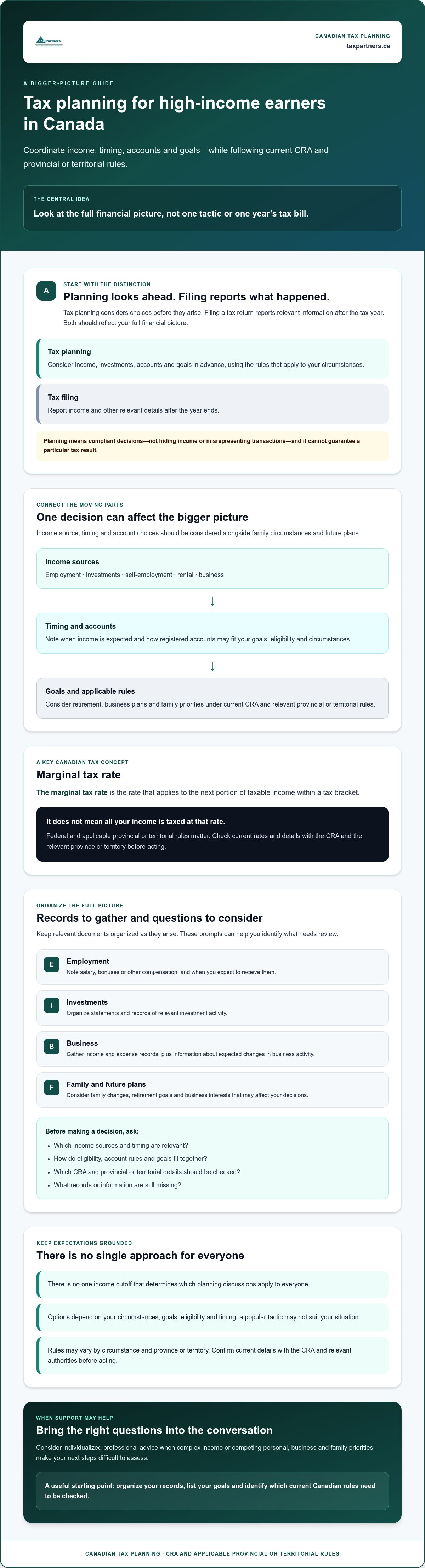
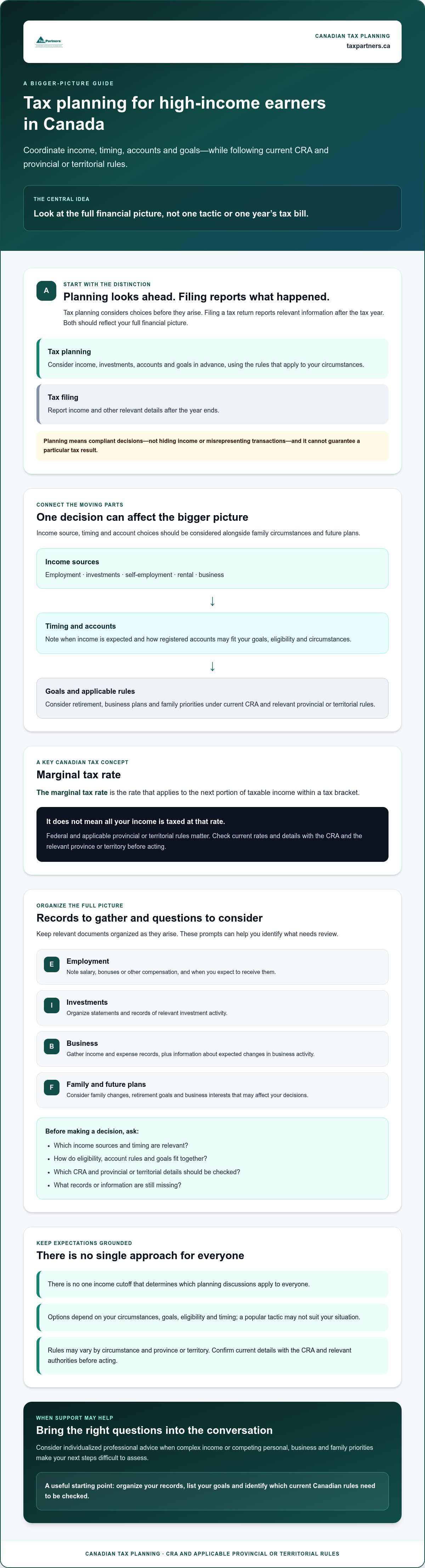
- Tax planning looks ahead to compliant decisions, while filing a return reports relevant information. Both should reflect your full financial picture.
- Explore tax planning for high income earners Canada by considering income type, timing and how marginal tax rates work in your province or territory.
- Assess planning options against your goals, eligibility, timing and recordkeeping needs instead of assuming one strategy suits every high-income taxpayer.
- Gather relevant income, investment, account, business and family records, then list the questions you want answered before making decisions.
- Consider professional advice when complex income or competing personal, business and family priorities make your next steps difficult to assess.
Tax Planning for High-Income Earners in Canada: Benefits
Tax planning for high-income earners in Canada means making proactive, compliant decisions about income and financial goals while considering applicable CRA and provincial or territorial rules. It differs from filing a tax return, which reports relevant information after the tax year. It does not mean hiding income or misrepresenting transactions.
Tax preparation reports what has happened; tax planning considers choices ahead of time without guaranteeing a particular tax result. This distinction matters when income comes from several sources or personal, family and business priorities intersect. An individualized discussion can help identify what needs attention and which current rules to check with the CRA.
If you’re researching tax planning for high income earners Canada, look beyond an income label. The Canadian income tax system provides background on personal income tax administration, but the details that matter to you depend on your circumstances and location. Tax Partners’ Canadian tax information is another resource for understanding the Canadian context.
What does high income mean for Canadian tax planning?
There isn’t one income cutoff that determines which planning discussions apply to everyone. Start by identifying whether you receive employment, self-employment, investment, rental or business income, then consider how those sources relate to your family circumstances and future goals. For high-income earners actively expanding or managing property portfolios in Ontario, collaborating with a brokerage like Pinnacle Realty can help ensure residential and commercial transactions fit smoothly into your overall wealth strategy.
The type and timing of income can shape the questions to ask, alongside plans for a business, retirement or family finances. Rules and eligibility may vary by circumstance and province or territory, so check current details with the CRA and relevant provincial or territorial authorities before acting.
Why start planning before filing a CRA return?
Planning looks ahead to decisions that may arise during the year; filing a CRA return generally reports income and other relevant details after the year ends. Starting earlier gives you time to identify which income sources, transactions and goals need review, rather than relying on a last-minute collection of records.
Keep relevant documents organized as they arise, including income records and information about investments, rental activity, business matters or family changes. These records can help you and a qualified tax professional identify gaps, frame questions and assess options. The aim is informed, compliant decision-making under current Canadian rules, not a shortcut around reporting responsibilities.
How Canadian tax planning connects income, timing, and accounts
Income, timing and account choices work together. A decision that seems straightforward on its own may need a closer look when you consider other income, family priorities, future plans and the CRA rules that apply to your circumstances.
A marginal tax rate is the rate that applies to the next portion of taxable income within a tax bracket. Under Canadian federal and applicable provincial or territorial tax rules, it doesn’t mean all your income is taxed at that rate. Check current rates and details with the CRA and the relevant province or territory before acting.
Income source and timing matter because they shape which rules, records and future goals should be considered together. Tax planning for high income earners Canada is less about choosing a popular tactic and more about understanding how each decision fits your overall financial picture.
Coordinate employment, investment, and business income
Start by listing your income sources and gathering the related records. Employment compensation, investment income and business income are distinct planning inputs. Each can raise different questions about documentation, timing and how it fits with your other priorities.
- Employment: Note your salary, bonuses or other compensation, along with when you expect to receive them.
- Investments: Organize statements and records of relevant investment activity.
- Business: Gather income and expense records, plus information about expected changes in business activity.
These are preparation prompts, not recommendations to change how or when you receive income. Resources such as Intuit TurboTax Canada’s overview of tax-saving strategies for high-income earners can introduce common topics, but eligibility and suitability depend on your circumstances and current Canadian rules.
Understand registered accounts and tax treatment
Registered accounts have different purposes and tax treatment. Under Canadian tax rules, contributions to a Registered Retirement Savings Plan (RRSP) may be deductible, while withdrawals are generally taxable. A Tax-Free Savings Account (TFSA) is funded with after-tax dollars, and growth and withdrawals are generally tax-free under Canadian tax rules.
These differences can inform a discussion about timing, savings goals and future income, but they don’t make either account the right choice for everyone. Eligibility, contribution room and other details can depend on personal circumstances, so check current CRA guidance before contributing or withdrawing.
For questions about your personal tax situation, Tax Partners’ Canadian personal income tax services may be relevant. To discuss how income sources and account choices relate to your priorities, contact the tax team.
Compare Canadian tax-planning options without assuming one fits everyone
A high income alone doesn’t make a particular strategy suitable. The relevant questions depend on what you want to accomplish, when you may need access to funds, which Canadian rules apply and what records you can provide.
Use this comparison to prepare for a discussion, not to predict a tax result. Eligibility and tax treatment can depend on personal details, so verify the current rules before acting.
| Planning area | Questions to ask |
|---|---|
| Registered accounts | Does the account fit my savings goal and timeline? What eligibility, contribution-room, withdrawal and recordkeeping details should I confirm with the CRA? |
| Investments | What type of investment income or transaction is involved, when might it arise, and what statements or transaction records should I retain? |
| Charitable giving | What documentation should I keep, and how does the CRA treat the proposed gift in my circumstances? Confirm current rules before assuming a credit or other tax treatment applies. |
Compare registered-account, investment, and charitable-giving considerations
Each category serves a different purpose. An account may support a savings objective, investment decisions may raise questions about income and timing, and charitable giving may connect personal values with tax considerations. None guarantees a deduction, refund or reduction in tax.
Before choosing, compare the objective, time horizon, eligibility, complexity and records required. A wealth management and financial planning overview may offer broader context for connecting investment choices with longer-term goals.
When business or estate considerations change the discussion
If you own a business, personal decisions may intersect with corporate finances, compensation and business plans. Keep personal and corporate questions distinct, then identify where they affect one another. Check relevant CRA and applicable provincial or territorial rules before making changes.
For business owners, a Canadian corporate income tax guide may help frame compliance questions. Estate considerations are most relevant when they connect directly to goals such as transferring assets or planning for family needs. Tax planning for high income earners Canada should reflect those priorities rather than assume every option belongs in one plan.
Build a practical Canadian tax-planning checklist
A focused preparation process can turn broad tax concerns into questions you can discuss and verify. This checklist is a starting point, not individualized tax advice. Your options depend on your circumstances and current CRA rules, including applicable provincial or territorial requirements.
Gather records and define planning priorities
Begin with your goals, then collect documents that explain your financial picture. Keep records organized and secure, and note expected changes without assuming how they’ll be treated for Canadian tax purposes.
- Clarify your priorities. Write down what you want to plan for, such as retirement, investment decisions, family needs or business goals.
- Summarize income. Gather applicable employment, self-employment, investment, rental and business income records.
- Organize account information. Collect relevant statements and details about registered accounts, including information you may need to confirm with the CRA.
- Prepare investment and business records. Set aside statements, transaction details and business records that explain activity, timing or expected changes.
- Note family and life changes. Record expected events such as a change in work, a family transition, a major investment decision or a business change. These are prompts for discussion, not assumptions about tax treatment.
Prepare questions for a tax-planning conversation
Bring a short list of decisions you’re considering, when they may need attention and what you don’t yet understand. Ask what additional information an adviser needs, which CRA rules apply to your circumstances and whether your province or territory affects the analysis.
Use general educational information to identify topics, not to replace advice tailored to your situation. Before acting, check current CRA requirements and relevant provincial or territorial details. Rules, eligibility and tax treatment can depend on the facts.
Tax planning for high income earners Canada works best as an organized review of goals, records and decisions, not a search for a one-size-fits-all answer. Preparing in advance can make a professional discussion more focused and clarify what needs further review.
When you’re ready to discuss your circumstances, discuss your Canadian tax-planning questions with Tax Partners.
Choose informed support for your Canadian tax plan
A tax professional may be helpful when income comes from several sources, you own a business, or personal, family and investment priorities pull in different directions. A CPA or other tax professional can help assess relevant facts, explain which Canadian rules to verify and identify questions that need further review.
Support should help you understand your options, not pressure you toward a predetermined answer. For tax planning for high income earners Canada, the value lies in recommendations that account for your complete financial picture and current CRA requirements, without promising a particular outcome.
What to look for in Canadian tax-planning support
Ask about the professional’s experience with situations like yours, what the engagement includes and what information they’ll need. A clear scope helps you understand what is covered, what may require another specialist and how recommendations will be communicated.
Look for explanations you can follow. Ask how the professional checks that advice reflects current CRA requirements and applicable provincial or territorial rules, and what assumptions the analysis depends on. You should understand the reasoning behind a recommendation, the records supporting it and any uncertainties to resolve before acting.
- Experience: Does the professional understand the income sources and priorities you need to discuss?
- Communication: Will they explain technical terms and answer questions in plain language?
- Scope: Is it clear what work is included and what falls outside it?
- Reasoning: Can they explain how a recommendation fits your facts and relevant Canadian rules?
Turn planning questions into a clear next step
Before a discussion, organize your income, investment, account, business and family records. Clarify what you want your plan to address, list decisions on the horizon and note any CRA or provincial or territorial details that need current confirmation.
Tax Partners provides Canadian personal tax services and wealth management and financial planning. These services may be relevant if you want to assess tax questions alongside broader financial priorities; the appropriate scope depends on your needs.
Clear advice starts with clear questions. Contact Tax Partners about Canadian tax planning to discuss your situation and the records or details that may help frame the conversation.
Make your next tax-planning decision with clarity
Effective tax planning for high income earners Canada is not about choosing a tactic based on income alone. It means connecting your income sources, timing, registered accounts and long-term priorities, then checking that decisions fit your circumstances and current CRA rules.
Start with a clear picture. Organize relevant records, identify upcoming personal or business changes, and prepare questions about eligibility, documentation and applicable provincial or territorial requirements. Individualized advice can help you weigh these factors together without assuming a particular strategy or tax outcome will suit you.
Tax Partners provides Canadian personal tax services and wealth management and financial planning. The firm reports more than 40 years of experience, over 495,000 returns filed and more than 1,390 five-star Google reviews. These figures describe the firm and don’t guarantee any particular result.
Ready to turn your questions into a considered plan? Contact Tax Partners to discuss your Canadian tax-planning needs. A well-prepared conversation can help you move forward with greater confidence.
Frequently Asked Questions
What is tax planning for high-income earners in Canada?
Tax planning for high-income earners in Canada means reviewing income, financial goals and relevant transactions before decisions are finalized, while following applicable CRA rules. It’s broader than preparing a tax return after the year ends. The right questions depend on your income sources, family circumstances, location in Canada and plans. Check current requirements with the CRA or a qualified Canadian tax professional before acting.
How can high-income earners reduce taxes in Canada?
There’s no single tax strategy that suits every Canadian taxpayer, and no option guarantees a tax reduction. Planning may involve reviewing income sources and timing, eligible registered accounts, charitable giving or business circumstances. Each option has rules and may not fit your situation. Avoid generic savings claims; ask a qualified adviser to assess your circumstances and verify current CRA and applicable provincial or territorial requirements.
Which registered accounts should high-income earners consider in Canada?
Consider Registered Retirement Savings Plans (RRSPs), Tax-Free Savings Accounts (TFSAs) and First Home Savings Accounts (FHSAs) based on their different purposes and rules. A high income alone doesn’t determine which account is appropriate. Before contributing or withdrawing, check current eligibility, contribution and withdrawal details directly with the CRA. Individual advice may be useful if you’re coordinating accounts or planning for major financial changes.
When should I start tax planning in Canada?
Start while you can still consider upcoming financial decisions, rather than waiting until you’re preparing a tax return. Review income sources, investments, business circumstances and important life changes throughout the year. Useful timing depends on the decision and the applicable rules. Check any relevant CRA deadlines or requirements directly with the CRA, since dates and details can depend on your circumstances.
Does high income mean I need a tax professional in Canada?
Not necessarily. Some people have straightforward tax situations, while others may need help coordinating several income sources, investments, business interests or changing family circumstances. Consider whether you can understand the applicable CRA rules and assess the implications of planned decisions. A Canadian tax professional can explain options and information needed, but advice should reflect your circumstances and shouldn’t promise a particular result.
Can tax planning for high-income earners involve a corporation?
Yes, corporate tax planning may be relevant if you own or operate a business, but corporate and personal tax considerations are distinct and depend on the facts. Don’t assume incorporation or a particular payment approach will reduce tax. Ask a qualified Canadian adviser to review your business structure, personal circumstances and current CRA requirements. Check the details before making changes, and keep the discussion focused on Canadian rules.

Article by
Mahad Mohamed
Mahad Mohamed is an accountant and the CEO of Tax Partners, with over 26+ years of Canadian and international tax and accounting experience. His expertise includes corporate reorganization, cross-border tax structuring (Canada & US), tax disputes, CRA audits, and tax planning for small owner-managed private corporations. Most recently, Mahad is a pioneer in Canadian crypto taxation and founded Block3 Finance.
Previously, Mahad worked for the Canada Revenue Agency (CRA), Big4 accounting firms, and served as a Rulings Officer for the Federal Tax Authority of the UAE before acquiring Tax Partners in 2014.
Tax Partners has 44 full-time accountants and over 18,400+ clients.
Disclaimer
This article provides general information only and is current as of its publication date. It has not been updated and may be out of date. It does not constitute legal advice and should not be relied upon as such. Every tax situation is unique and may differ from the examples discussed in this article. If you have specific questions, you should seek the advice of our accountants for your unique circumstances. Book a FREE Initial Consultation Today!
Frequently Asked Questions
What does high income mean for Canadian tax planning?
There isn’t one income cutoff that determines which planning discussions apply to everyone. Start by identifying whether you receive employment, self-employment, investment, rental or business income, then consider how those sources relate to your family circumstances and future goals. The type and timing of income can shape the questions to ask, alongside plans for a business, retirement or family finances. Rules and eligibility may vary by circumstance and province or territory, so check current details with the CRA and relevant provincial or territorial authorities before acting.
Why start planning before filing a CRA return?
Planning looks ahead to decisions that may arise during the year; filing a CRA return generally reports income and other relevant details after the year ends. Starting earlier gives you time to identify which income sources, transactions and goals need review, rather than relying on a last-minute collection of records. Keep relevant documents organized as they arise, including income records and information about investments, rental activity, business matters or family changes. These records can help you and a qualified tax professional identify gaps, frame questions and assess options. The aim is informed, compliant decision-making under current Canadian rules, not a shortcut around reporting responsibilities. Income, timing and account choices work together. A decision that seems straightforward on its own may need a closer look when you consider other income, family priorities, future plans and the CRA rules that apply to your circumstances. A marginal tax rate is the rate that applies to the next portion of taxable income within a tax bracket. Under Canadian federal and applicable provincial or territorial tax rules, it doesn’t mean all your income is taxed at that rate. Check current rates and details with the CRA and the relevant province or territory before acting. Income source and timing matter because they shape which rules, records and future goals should be considered together. Tax planning for high income earners Canada is less about choosing a popular tactic and more about understanding how each decision fits your overall financial picture.
What is tax planning for high-income earners in Canada?
Tax planning for high-income earners in Canada means reviewing income, financial goals and relevant transactions before decisions are finalized, while following applicable CRA rules. It’s broader than preparing a tax return after the year ends. The right questions depend on your income sources, family circumstances, location in Canada and plans. Check current requirements with the CRA or a qualified Canadian tax professional before acting.
How can high-income earners reduce taxes in Canada?
There’s no single tax strategy that suits every Canadian taxpayer, and no option guarantees a tax reduction. Planning may involve reviewing income sources and timing, eligible registered accounts, charitable giving or business circumstances. Each option has rules and may not fit your situation. Avoid generic savings claims; ask a qualified adviser to assess your circumstances and verify current CRA and applicable provincial or territorial requirements.
Which registered accounts should high-income earners consider in Canada?
Consider Registered Retirement Savings Plans (RRSPs), Tax-Free Savings Accounts (TFSAs) and First Home Savings Accounts (FHSAs) based on their different purposes and rules. A high income alone doesn’t determine which account is appropriate. Before contributing or withdrawing, check current eligibility, contribution and withdrawal details directly with the CRA. Individual advice may be useful if you’re coordinating accounts or planning for major financial changes.
When should I start tax planning in Canada?
Start while you can still consider upcoming financial decisions, rather than waiting until you’re preparing a tax return. Review income sources, investments, business circumstances and important life changes throughout the year. Useful timing depends on the decision and the applicable rules. Check any relevant CRA deadlines or requirements directly with the CRA, since dates and details can depend on your circumstances.
Does high income mean I need a tax professional in Canada?
Not necessarily. Some people have straightforward tax situations, while others may need help coordinating several income sources, investments, business interests or changing family circumstances. Consider whether you can understand the applicable CRA rules and assess the implications of planned decisions. A Canadian tax professional can explain options and information needed, but advice should reflect your circumstances and shouldn’t promise a particular result.
Can tax planning for high-income earners involve a corporation?
Yes, corporate tax planning may be relevant if you own or operate a business, but corporate and personal tax considerations are distinct and depend on the facts. Don’t assume incorporation or a particular payment approach will reduce tax. Ask a qualified Canadian adviser to review your business structure, personal circumstances and current CRA requirements. Check the details before making changes, and keep the discussion focused on Canadian rules.