Canadian Tax on US Social Security Benefits: 2026 Guide

Could a benefit you’ve received for years still need careful treatment on your Canadian tax return? The Canadian tax on US social security benefits can be confusing when treaty rules, residency, currency conversion and US tax withholding all come into play.
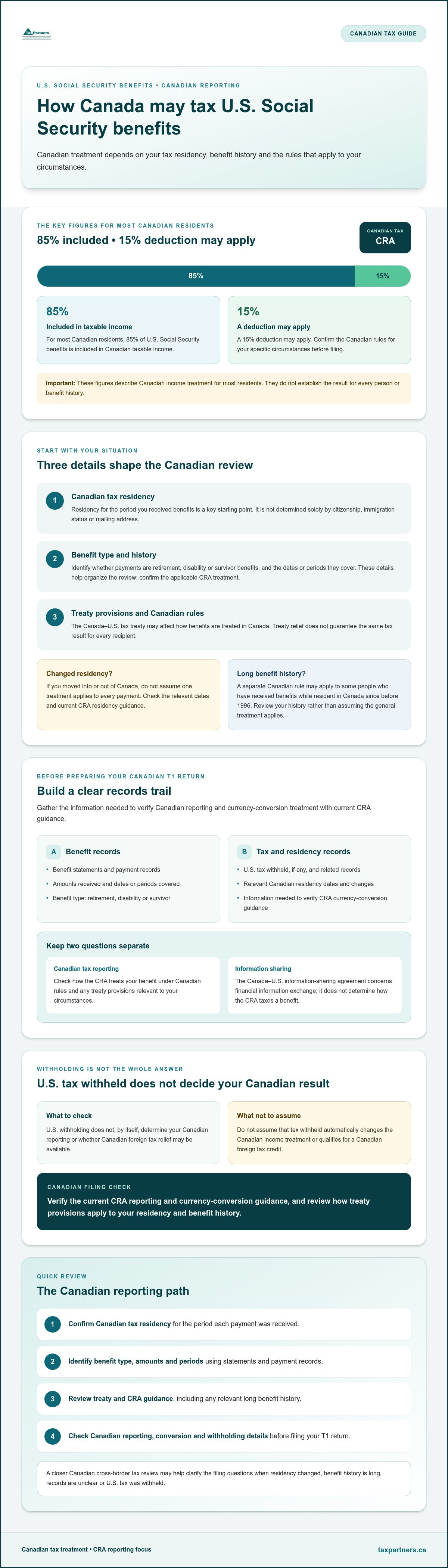
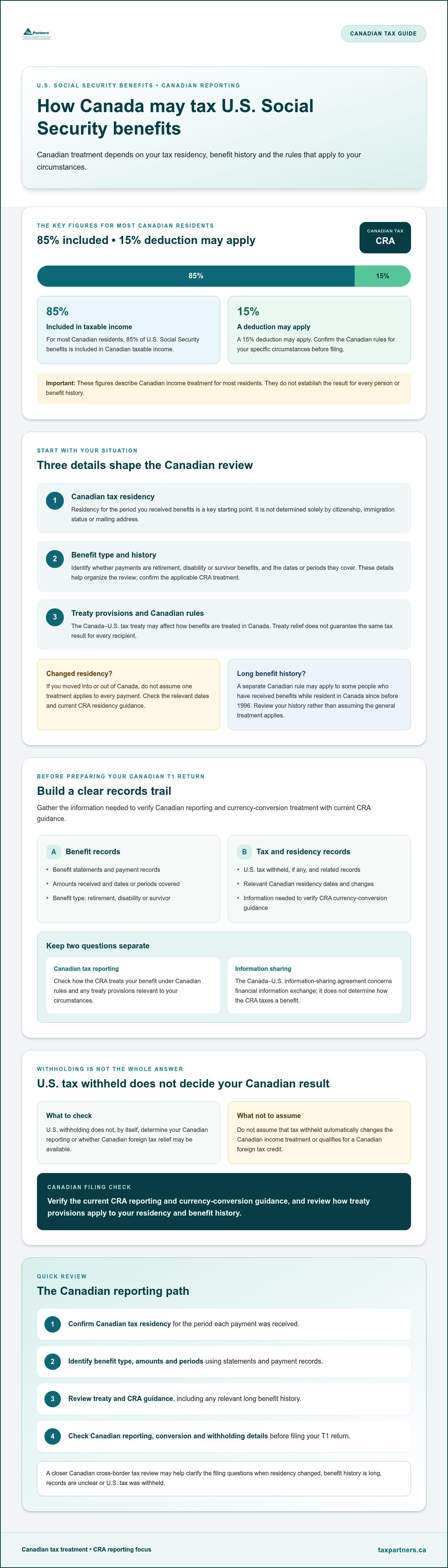
For most Canadian residents, 85% of US Social Security benefits is included in taxable income in Canada, while a 15% deduction may apply. A separate rule may apply to some people who have received benefits while resident in Canada since before 1996. Because the details of your residency and benefit history matter, check the applicable rules before filing with the CRA.
This 2026 guide explains the general Canadian treatment and how benefits are reported on a Canadian T1 return. You’ll learn what to check about residency and benefit history, which payment records to gather, and how to approach currency conversion. It also explains why US tax withheld may not qualify for a Canadian foreign tax credit, and when cross-border tax advice may help you clarify your filing.
Key Takeaways
- Canadian tax on US social security benefits depends on your Canadian tax residency and individual circumstances, not simply your citizenship or mailing address.
- Check how treaty provisions apply to your situation before assuming every Canadian resident receives the same tax treatment.
- US tax withheld doesn’t, by itself, determine your Canadian reporting or whether foreign tax relief may be available.
- Before filing your Canadian return, gather benefit and withholding records, then confirm the current CRA reporting and currency-conversion guidance.
- A cross-border tax review may help clarify your next steps if you’ve changed residency, have a long benefit history, or see tax withheld.
Canadian tax on US Social Security benefits: who needs to review the rules?
Canadian tax treatment depends on your circumstances and the rules for the relevant tax period. A payment doesn’t become tax-free in Canada simply because it comes from the United States. If you’re preparing a Canadian return, check how the CRA treats your benefits based on your residency and the details of the payments.
This guide focuses on Canadian tax reporting and CRA treatment, not filing a US tax return. Canadian tax residency means whether Canada considers you a resident for tax purposes during a particular period. That determination depends on your situation, not solely on your citizenship, immigration status or mailing address.
Does Canadian tax residency affect how benefits are reported?
Yes. Your residency status for the period when you received benefits is a key starting point for understanding your Canadian tax obligations. If you moved into or out of Canada during the year, don’t assume one treatment applies to every payment. Check current CRA residency guidance against your circumstances before preparing your return.
Residency questions can be less straightforward when your living arrangements or ties to Canada changed. Reviewing the relevant dates and circumstances can help clarify which Canadian reporting rules to verify. For support with personal tax matters, see Tax Partners’ Canadian personal income tax services.
Which benefit details should recipients identify first?
Start by identifying the benefit type, such as retirement, disability or survivor benefits, and the period each payment covers. These details help organize your records, but don’t assume they automatically produce different Canadian tax results. Confirm the CRA treatment that applies to your specific benefit.
Gather benefit statements and payment records before preparing your Canadian return. Check that you can identify the amount received and the dates or periods covered. If a statement doesn’t clearly explain a payment, note what is unclear so you can check it against current CRA guidance rather than guessing.
Keep the tax question separate from the information-sharing question. The Canada-US information-sharing agreement concerns financial information exchange. It doesn’t determine how the CRA taxes a benefit. That question relates to the treaty provisions and Canadian rules that apply to your circumstances.
How Canada and the US tax treaty shape CRA treatment
The Canada and US tax treaty may affect how the CRA treats US Social Security benefits for Canadian tax purposes. A tax treaty coordinates certain tax rules between countries. For your Canadian return, the key question is how the treaty and current CRA guidance apply to your residency, benefit history and payments.
Treaty relief means a treaty rule may change how income is treated for tax purposes, but you need to confirm whether it applies to your circumstances. It doesn’t guarantee that every recipient will have the same Canadian tax result or that a benefit is automatically exempt from Canadian tax.
What does treaty treatment mean for a Canadian resident?
The treaty provides a framework for considering cross-border income, including Social Security benefits. Its provisions may affect what a Canadian resident needs to include or deduct when reporting income to the CRA. They don’t replace the need to check your Canadian filing obligations or determine your individual tax result.
For background, the U.S.-Canada Income Tax Convention and its technical explanations are available from the US Internal Revenue Service. Use the treaty text as a reference, then confirm the Canadian consequences against current CRA guidance. This section addresses Canadian tax treatment, not US return filing.
Why can the same benefit history need a closer review?
Two people receiving the same type of payment may need different analyses if their Canadian residency periods or benefit histories differ. A move into or out of Canada, a gap or change in payments, or incomplete records can affect what needs checking. Don’t assume that a rule applying to one period automatically applies to another.
Historical or grandfathering provisions may also be relevant for some recipients. Treat them as questions to verify against current CRA guidance and the applicable treaty provisions, not as automatic entitlements. Keep records showing when you became resident in Canada and when benefits began, so the timeline can be reviewed.
If your residency or benefit history spans multiple periods, a broader review may help connect the treaty question with your Canadian tax situation. Tax Partners provides international tax advisory services for cross-border questions. You can also contact the team about your circumstances if you need help identifying what to verify.
Use the treaty as a starting point when reviewing the Canadian tax on US social security benefits, not as a substitute for checking current CRA reporting guidance. Confirm the rules for the tax period and retain the records that support your conclusion.
Is US Social Security taxed twice? Check the Canadian tax details
US tax withheld doesn’t, by itself, determine the Canadian tax result. For a Canadian resident, CRA income-reporting rules and any possible foreign tax relief are separate questions. Don’t assume that withholding makes the benefit exempt in Canada, or that a Canadian credit will automatically offset tax owing.
Under current Canadian guidance, a Canadian resident generally reports the gross US Social Security benefit in Canadian dollars, with 85% included in taxable income and a 15% deduction available. A separate historical rule may allow a 50% deduction for someone who has been a Canadian resident receiving these benefits continuously since before January 1, 1996. Verify the applicable rule and reporting details with the CRA for the tax year in question.
What if US tax was withheld from the benefit?
Keep the benefit statement and any tax document showing the gross payment and amount withheld. For Canadian tax purposes, a foreign tax credit is a potential reduction of Canadian tax for eligible foreign income tax paid. Check eligibility and the amount that may be claimed under current CRA rules. Withholding alone doesn’t establish that a credit is available.
US Social Security payments to Canadian residents generally aren’t subject to US income tax withholding under the treaty treatment described in current guidance. If your records show withholding, note the amount and seek clarification before deciding how it affects your Canadian return. Don’t claim it as a Canadian credit without confirming the facts and CRA requirements.
When could historical rules or tax credits matter?
A long benefit history, a change in Canadian residency, or an unusual payment record can affect which rules need review. Confirm any applicable treaty provision, inclusion percentage, deduction or historical treatment against current CRA guidance rather than assuming a rule applies to every recipient.
Use this table to organize what to check. It summarizes questions, not a personalized tax calculation or a guarantee that foreign tax relief will apply.
| Canadian reporting question | Records to check | Point requiring current verification |
|---|---|---|
| What benefit amount should be reported? | Benefit statements and payment records | CRA reporting line, currency conversion and applicable inclusion or deduction |
| Was tax withheld outside Canada? | Statements showing gross benefits and withholding | Whether the amount qualifies for Canadian foreign tax relief |
| Could an earlier rule apply? | Residency timeline and benefit history | Whether a historical or treaty provision applies to your facts |
The Canadian tax on US social security benefits depends on the rules that apply to your situation, not simply on whether tax was withheld elsewhere. Confirm Canadian reporting and any potential relief separately with the CRA before filing.
Prepare your Canadian return: records and reporting points to verify
A clear paper trail makes it easier to check how US Social Security benefits belong on your Canadian return. Work through these steps before filing with the CRA, especially if your residency or payment history changed during the year.
What documents should you gather before filing in Canada?
Keep the original benefit statements and payment records, including documents showing tax withheld. Note the dates and amounts received, and save prior-year Canadian returns if they help explain your benefit or residency history.
- Confirm your residency. Identify whether your Canadian tax residency changed during the year, and gather records that help establish the relevant dates.
- Identify the benefits. Note whether payments are retirement, disability or survivor benefits, and which period each statement covers.
- Collect supporting records. Organize benefit statements, payment histories and any records showing tax withheld. Keep the original documents for reference.
- Verify CRA reporting. Check the current Canadian return instructions for the applicable reporting line, any deduction, and the currency-conversion method for the tax year.
What should you verify before submitting a CRA return?
Confirm the CRA’s current instructions for the benefit and tax year you’re filing. The amount reported in Canada may need to be converted from the payment currency into Canadian dollars. Check the CRA’s guidance on which exchange rate or method applies to your payment pattern.
Review whether foreign tax relief may apply before claiming it. A record of tax withheld is useful, but it doesn’t confirm eligibility or the amount of a Canadian credit. If your records are incomplete or your residency changed, resolve those questions before submitting your return.
This preparation fits into your broader Canadian personal return. For additional context on Canadian personal income tax preparation, review the records and reporting requirements relevant to your circumstances.
The Canadian tax on US social security benefits can require closer attention when your benefit history, residency timeline or withholding records are unusual. If you’d like help reviewing a complex situation, contact Tax Partners about your Canadian tax return.
Get clear Canadian tax guidance for US Social Security benefits
A reliable review follows a clear sequence: confirm your Canadian tax residency for the period, identify the benefit type and payment history, verify current CRA treatment, then review any tax withheld. These details help frame the Canadian tax on US social security benefits and highlight questions to resolve before filing.
The answer may be straightforward when your residency and records are consistent. A move into or out of Canada, benefits received across multiple tax years, a long benefit history or unexpected withholding can make the review more involved. Checking your documents against current CRA guidance can help clarify the Canadian reporting considerations without assuming a particular tax outcome.
When is professional cross-border tax advice useful?
Consider a cross-border review if your Canadian residency changed, your benefits span several tax years, historical treatment may apply, or your records show tax withheld. An adviser can review your documents and the relevant current rules, then explain which Canadian tax questions need attention. No review can guarantee a particular assessment or tax result.
Tax Partners provides Canadian personal tax services and specialized cross-border tax support, backed by more than 40 years of experience in accounting and tax services. If your situation raises broader US and Canadian questions, explore the firm’s cross-border tax services to understand the support available.
What should you prepare for an initial tax discussion?
Bring records that help establish what you received, when you received it and what was withheld. A simple timeline can make changes and gaps easier to identify.
- Benefit statements and payment histories for the periods under review
- Records showing any tax withheld from benefits
- Relevant Canadian tax-return information from prior years
- A timeline of your Canadian residency and benefit receipt, including any moves
- Notes about unclear payments, missing records or questions about historical treatment
Having these details organized gives the discussion a practical starting point. You don’t need to resolve every question in advance. Identifying what’s unclear can help focus the review on the Canadian rules and CRA reporting points that matter to you.
For guidance tailored to your circumstances, Discuss your Canadian tax questions with our team.
Take the next step with confidence
The Canadian tax on US social security benefits depends on your Canadian residency, benefit history and the CRA rules for the relevant tax year. Confirm how the treaty affects your situation, keep benefit statements and withholding records, and check Canadian reporting and currency-conversion guidance before filing.
If your residency changed, your benefits span multiple years or tax was withheld, a cross-border review can help clarify what to verify without assuming a particular tax outcome. Tax Partners combines Canadian personal tax services with specialized US and cross-border tax compliance experience, backed by more than 40 years in accounting and tax.
Discuss your Canadian tax questions with our team to get guidance tailored to your circumstances. With the relevant records organized, you can focus the discussion on the Canadian rules and reporting points that apply to your return.
Frequently Asked Questions
Are US Social Security benefits taxable in Canada?
Generally, US Social Security benefits are taxable in Canada when received by a Canadian resident, subject to applicable treaty rules and any specific deductions. The Canadian tax on US social security benefits depends on your residency, benefit history and the rules for the tax year. Don’t assume the payments are tax-free because they come from outside Canada. Confirm your circumstances against current Canada Revenue Agency (CRA) guidance.
How much of US Social Security benefits is taxable in Canada?
For most Canadian residents, 85% of US Social Security benefits is included in taxable income, and a deduction equal to 15% may be available under current Canadian treatment. A special 50% deduction may apply if you’ve been a Canadian resident receiving benefits continuously since before January 1, 1996. Check current CRA guidance to confirm which treatment applies to your benefit history and tax year.
Do I report US Social Security benefits on my Canadian tax return?
Yes, Canadian residents generally report the gross benefit amount in Canadian dollars on their Canadian income tax return. CRA guidance identifies line 11500 for reporting the gross amount and line 25600 for claiming the 15% deduction, where applicable. Verify the current Canadian return instructions for the year you’re filing, especially if a historical rule or a change in residency could affect your reporting.
Can I claim a Canadian foreign tax credit for US tax withheld from Social Security?
Not automatically. A Canadian foreign tax credit is a possible reduction of Canadian tax for eligible foreign income tax paid, but eligibility and the amount must be confirmed under CRA rules. Current guidance indicates that US income tax isn’t withheld from Social Security benefits paid to Canadian residents, so there generally isn’t foreign tax paid on these benefits to claim. If your records show withholding, verify its treatment before claiming a credit.
What documents do I need to report US Social Security in Canada?
Gather benefit statements, payment histories and any records showing tax withheld. Keep the original documents, and note payment dates, amounts and the periods covered. Records of changes in Canadian residency and relevant prior-year Canadian returns may also help clarify your situation. Before filing, check current CRA instructions for the reporting line and how to convert payments into Canadian dollars.
What if I moved to Canada after starting to receive US Social Security?
Your move may affect how you report benefits in Canada because residency during the relevant tax period is an important starting point. Gather records showing when you moved, when payments were received and any changes to your benefits. Don’t rely on citizenship or a mailing address alone to determine Canadian tax residency. Check current CRA residency guidance, and seek an individualized review if the timing or applicable rules are unclear.
Should I get professional help with Canadian tax on US Social Security benefits?
Professional guidance may be useful if you changed residency, received benefits across multiple tax years, have questions about historical treatment or found tax withheld in your records. Tax Partners provides Canadian personal tax services and specialized US and cross-border tax compliance, supported by more than 40 years of accounting and tax experience. A review can help clarify which Canadian rules to verify, without guaranteeing a particular tax result.

Article by
Mahad Mohamed
Mahad Mohamed is an accountant and the CEO of Tax Partners, with over 26+ years of Canadian and international tax and accounting experience. His expertise includes corporate reorganization, cross-border tax structuring (Canada & US), tax disputes, CRA audits, and tax planning for small owner-managed private corporations. Most recently, Mahad is a pioneer in Canadian crypto taxation and founded Block3 Finance.
Previously, Mahad worked for the Canada Revenue Agency (CRA), Big4 accounting firms, and served as a Rulings Officer for the Federal Tax Authority of the UAE before acquiring Tax Partners in 2014.
Tax Partners has 44 full-time accountants and over 18,400+ clients.
Disclaimer
This article provides general information only and is current as of its publication date. It has not been updated and may be out of date. It does not constitute legal advice and should not be relied upon as such. Every tax situation is unique and may differ from the examples discussed in this article. If you have specific questions, you should seek the advice of our accountants for your unique circumstances. Book a FREE Initial Consultation Today!
Frequently Asked Questions
Does Canadian tax residency affect how benefits are reported?
Yes. Your residency status for the period when you received benefits is a key starting point for understanding your Canadian tax obligations. If you moved into or out of Canada during the year, don’t assume one treatment applies to every payment. Check current CRA residency guidance against your circumstances before preparing your return. Residency questions can be less straightforward when your living arrangements or ties to Canada changed. Reviewing the relevant dates and circumstances can help clarify which Canadian reporting rules to verify. For support with personal tax matters, see Tax Partners’ Canadian personal income tax services.
Which benefit details should recipients identify first?
Start by identifying the benefit type, such as retirement, disability or survivor benefits, and the period each payment covers. These details help organize your records, but don’t assume they automatically produce different Canadian tax results. Confirm the CRA treatment that applies to your specific benefit. Gather benefit statements and payment records before preparing your Canadian return. Check that you can identify the amount received and the dates or periods covered. If a statement doesn’t clearly explain a payment, note what is unclear so you can check it against current CRA guidance rather than guessing. Keep the tax question separate from the information-sharing question. The Canada-US information-sharing agreement concerns financial information exchange. It doesn’t determine how the CRA taxes a benefit. That question relates to the treaty provisions and Canadian rules that apply to your circumstances. The Canada and US tax treaty may affect how the CRA treats US Social Security benefits for Canadian tax purposes. A tax treaty coordinates certain tax rules between countries. For your Canadian return, the key question is how the treaty and current CRA guidance apply to your residency, benefit history and payments. Treaty relief means a treaty rule may change how income is treated for tax purposes, but you need to confirm whether it applies to your circumstances. It doesn’t guarantee that every recipient will have the same Canadian tax result or that a benefit is automatically exempt from Canadian tax.
What does treaty treatment mean for a Canadian resident?
The treaty provides a framework for considering cross-border income, including Social Security benefits. Its provisions may affect what a Canadian resident needs to include or deduct when reporting income to the CRA. They don’t replace the need to check your Canadian filing obligations or determine your individual tax result. For background, the U.S.-Canada Income Tax Convention and its technical explanations are available from the US Internal Revenue Service. Use the treaty text as a reference, then confirm the Canadian consequences against current CRA guidance. This section addresses Canadian tax treatment, not US return filing.
Why can the same benefit history need a closer review?
Two people receiving the same type of payment may need different analyses if their Canadian residency periods or benefit histories differ. A move into or out of Canada, a gap or change in payments, or incomplete records can affect what needs checking. Don’t assume that a rule applying to one period automatically applies to another. Historical or grandfathering provisions may also be relevant for some recipients. Treat them as questions to verify against current CRA guidance and the applicable treaty provisions, not as automatic entitlements. Keep records showing when you became resident in Canada and when benefits began, so the timeline can be reviewed. If your residency or benefit history spans multiple periods, a broader review may help connect the treaty question with your Canadian tax situation. Tax Partners provides international tax advisory services for cross-border questions. You can also contact the team about your circumstances if you need help identifying what to verify. Use the treaty as a starting point when reviewing the Canadian tax on US social security benefits, not as a substitute for checking current CRA reporting guidance. Confirm the rules for the tax period and retain the records that support your conclusion. US tax withheld doesn’t, by itself, determine the Canadian tax result. For a Canadian resident, CRA income-reporting rules and any possible foreign tax relief are separate questions. Don’t assume that withholding makes the benefit exempt in Canada, or that a Canadian credit will automatically offset tax owing. Under current Canadian guidance, a Canadian resident generally reports the gross US Social Security benefit in Canadian dollars, with 85% included in taxable income and a 15% deduction available. A separate historical rule may allow a 50% deduction for someone who has been a Canadian resident receiving these benefits continuously since before January 1, 1996. Verify the applicable rule and reporting details with the CRA for the tax year in question.
What if US tax was withheld from the benefit?
Keep the benefit statement and any tax document showing the gross payment and amount withheld. For Canadian tax purposes, a foreign tax credit is a potential reduction of Canadian tax for eligible foreign income tax paid. Check eligibility and the amount that may be claimed under current CRA rules. Withholding alone doesn’t establish that a credit is available. US Social Security payments to Canadian residents generally aren’t subject to US income tax withholding under the treaty treatment described in current guidance. If your records show withholding, note the amount and seek clarification before deciding how it affects your Canadian return. Don’t claim it as a Canadian credit without confirming the facts and CRA requirements.
When could historical rules or tax credits matter?
A long benefit history, a change in Canadian residency, or an unusual payment record can affect which rules need review. Confirm any applicable treaty provision, inclusion percentage, deduction or historical treatment against current CRA guidance rather than assuming a rule applies to every recipient. Use this table to organize what to check. It summarizes questions, not a personalized tax calculation or a guarantee that foreign tax relief will apply. The Canadian tax on US social security benefits depends on the rules that apply to your situation, not simply on whether tax was withheld elsewhere. Confirm Canadian reporting and any potential relief separately with the CRA before filing. A clear paper trail makes it easier to check how US Social Security benefits belong on your Canadian return. Work through these steps before filing with the CRA, especially if your residency or payment history changed during the year.
What documents should you gather before filing in Canada?
Keep the original benefit statements and payment records, including documents showing tax withheld. Note the dates and amounts received, and save prior-year Canadian returns if they help explain your benefit or residency history.
What should you verify before submitting a CRA return?
Confirm the CRA’s current instructions for the benefit and tax year you’re filing. The amount reported in Canada may need to be converted from the payment currency into Canadian dollars. Check the CRA’s guidance on which exchange rate or method applies to your payment pattern. Review whether foreign tax relief may apply before claiming it. A record of tax withheld is useful, but it doesn’t confirm eligibility or the amount of a Canadian credit. If your records are incomplete or your residency changed, resolve those questions before submitting your return. This preparation fits into your broader Canadian personal return. For additional context on Canadian personal income tax preparation, review the records and reporting requirements relevant to your circumstances. The Canadian tax on US social security benefits can require closer attention when your benefit history, residency timeline or withholding records are unusual. If you’d like help reviewing a complex situation, contact Tax Partners about your Canadian tax return. A reliable review follows a clear sequence: confirm your Canadian tax residency for the period, identify the benefit type and payment history, verify current CRA treatment, then review any tax withheld. These details help frame the Canadian tax on US social security benefits and highlight questions to resolve before filing. The answer may be straightforward when your residency and records are consistent. A move into or out of Canada, benefits received across multiple tax years, a long benefit history or unexpected withholding can make the review more involved. Checking your documents against current CRA guidance can help clarify the Canadian reporting considerations without assuming a particular tax outcome.
When is professional cross-border tax advice useful?
Consider a cross-border review if your Canadian residency changed, your benefits span several tax years, historical treatment may apply, or your records show tax withheld. An adviser can review your documents and the relevant current rules, then explain which Canadian tax questions need attention. No review can guarantee a particular assessment or tax result. Tax Partners provides Canadian personal tax services and specialized cross-border tax support, backed by more than 40 years of experience in accounting and tax services. If your situation raises broader US and Canadian questions, explore the firm’s cross-border tax services to understand the support available.
What should you prepare for an initial tax discussion?
Bring records that help establish what you received, when you received it and what was withheld. A simple timeline can make changes and gaps easier to identify. Having these details organized gives the discussion a practical starting point. You don’t need to resolve every question in advance. Identifying what’s unclear can help focus the review on the Canadian rules and CRA reporting points that matter to you. For guidance tailored to your circumstances, Discuss your Canadian tax questions with our team. The Canadian tax on US social security benefits depends on your Canadian residency, benefit history and the CRA rules for the relevant tax year. Confirm how the treaty affects your situation, keep benefit statements and withholding records, and check Canadian reporting and currency-conversion guidance before filing. If your residency changed, your benefits span multiple years or tax was withheld, a cross-border review can help clarify what to verify without assuming a particular tax outcome. Tax Partners combines Canadian personal tax services with specialized US and cross-border tax compliance experience, backed by more than 40 years in accounting and tax. Discuss your Canadian tax questions with our team to get guidance tailored to your circumstances. With the relevant records organized, you can focus the discussion on the Canadian rules and reporting points that apply to your return.
Are US Social Security benefits taxable in Canada?
Generally, US Social Security benefits are taxable in Canada when received by a Canadian resident, subject to applicable treaty rules and any specific deductions. The Canadian tax on US social security benefits depends on your residency, benefit history and the rules for the tax year. Don’t assume the payments are tax-free because they come from outside Canada. Confirm your circumstances against current Canada Revenue Agency (CRA) guidance.
How much of US Social Security benefits is taxable in Canada?
For most Canadian residents, 85% of US Social Security benefits is included in taxable income, and a deduction equal to 15% may be available under current Canadian treatment. A special 50% deduction may apply if you’ve been a Canadian resident receiving benefits continuously since before January 1, 1996. Check current CRA guidance to confirm which treatment applies to your benefit history and tax year.
Do I report US Social Security benefits on my Canadian tax return?
Yes, Canadian residents generally report the gross benefit amount in Canadian dollars on their Canadian income tax return. CRA guidance identifies line 11500 for reporting the gross amount and line 25600 for claiming the 15% deduction, where applicable. Verify the current Canadian return instructions for the year you’re filing, especially if a historical rule or a change in residency could affect your reporting.
Can I claim a Canadian foreign tax credit for US tax withheld from Social Security?
Not automatically. A Canadian foreign tax credit is a possible reduction of Canadian tax for eligible foreign income tax paid, but eligibility and the amount must be confirmed under CRA rules. Current guidance indicates that US income tax isn’t withheld from Social Security benefits paid to Canadian residents, so there generally isn’t foreign tax paid on these benefits to claim. If your records show withholding, verify its treatment before claiming a credit.
What documents do I need to report US Social Security in Canada?
Gather benefit statements, payment histories and any records showing tax withheld. Keep the original documents, and note payment dates, amounts and the periods covered. Records of changes in Canadian residency and relevant prior-year Canadian returns may also help clarify your situation. Before filing, check current CRA instructions for the reporting line and how to convert payments into Canadian dollars.
What if I moved to Canada after starting to receive US Social Security?
Your move may affect how you report benefits in Canada because residency during the relevant tax period is an important starting point. Gather records showing when you moved, when payments were received and any changes to your benefits. Don’t rely on citizenship or a mailing address alone to determine Canadian tax residency. Check current CRA residency guidance, and seek an individualized review if the timing or applicable rules are unclear.
Should I get professional help with Canadian tax on US Social Security benefits?
Professional guidance may be useful if you changed residency, received benefits across multiple tax years, have questions about historical treatment or found tax withheld in your records. Tax Partners provides Canadian personal tax services and specialized US and cross-border tax compliance, supported by more than 40 years of accounting and tax experience. A review can help clarify which Canadian rules to verify, without guaranteeing a particular tax result.