Best Way to Save for Retirement in Canada (2026)

The best way to save for retirement in Canada isn’t necessarily to choose one account and put everything into it. A stronger plan brings together your savings, expected income and tax picture, while leaving room for today’s expenses and other goals.
If you’re unsure how much retirement may cost, or whether an RRSP or TFSA makes more sense, you’re not alone. The right choice depends on your circumstances, including how your income may change over time. Understanding how these accounts are treated for tax purposes under CRA rules can help you make more informed decisions.
This guide compares Canada’s main retirement savings options, including RRSPs, TFSAs and workplace pensions, and explains how government benefits such as CPP and OAS may fit into your income plan. You’ll also find practical next steps for setting a sustainable savings routine and preparing for withdrawals, not just contributions. With a clearer view of the pieces, you can build a plan that reflects your priorities and know when personalized tax or financial planning support may help.
Key Takeaways
- The best way to save for retirement in Canada depends on your goals, timeline, income and existing retirement benefits.
- Compare RRSPs, TFSAs and FHSAs by their purpose and general tax treatment, then check current account rules with the CRA.
- Factor in workplace pensions, variable income, debt and near-term expenses when choosing a savings approach that fits your circumstances.
- Build a practical plan by setting a goal, listing expected income sources, reviewing your accounts and choosing a sustainable contribution routine.
- Consider Canadian tax and financial planning support when you need to assess account choices and retirement income together.
Best way to save for retirement in Canada: start with your goal
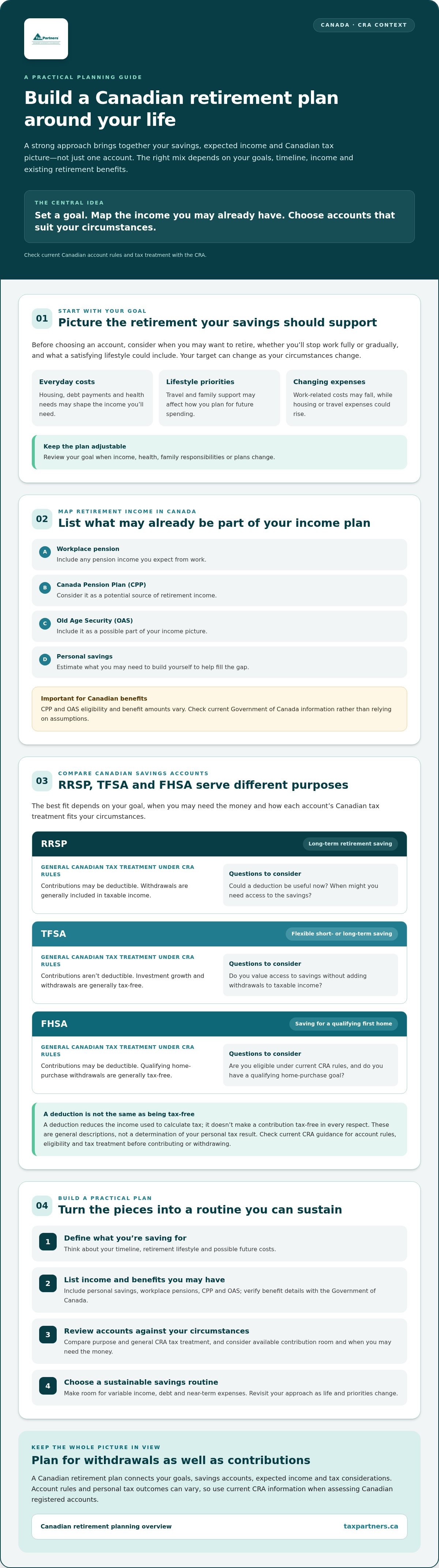
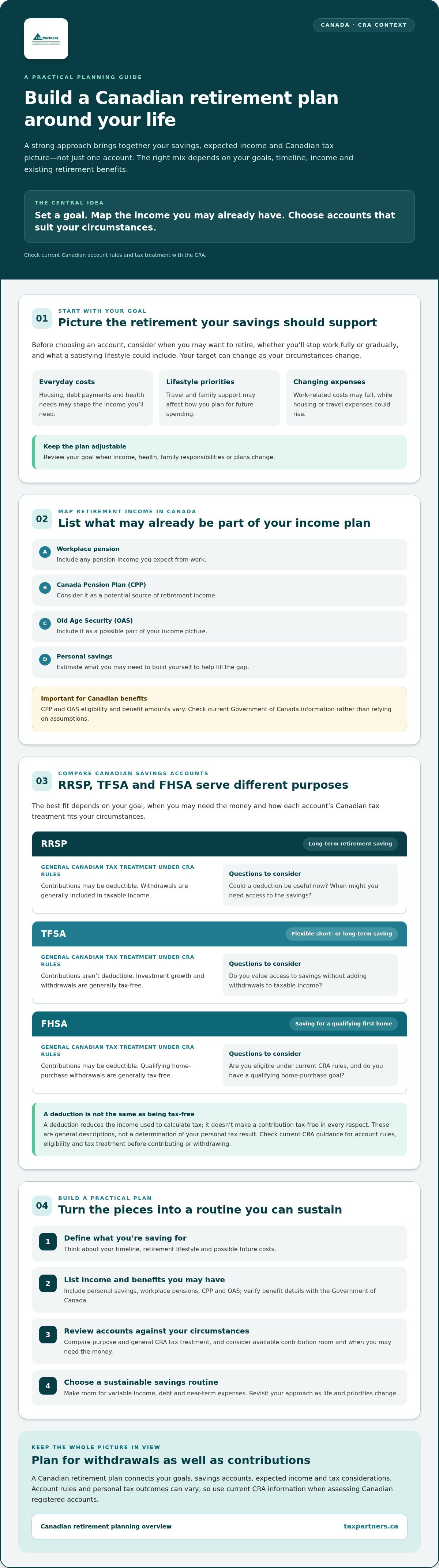
The best way to save for retirement in Canada depends on your goals, timeline, income and existing retirement benefits. Before choosing an account, sketch out the life you want your savings to support and identify income that may already be available.
A tax-aware Canadian retirement savings plan combines regular saving, suitable accounts and expected retirement income while considering how tax treatment may affect the money you keep. The aim isn’t to predict every future cost perfectly. It’s to create a practical starting point you can adjust as your circumstances change.
Think through possible costs such as housing, health needs, travel, debt payments and family support. Compare them with your current spending: commuting or work-related costs may fall, while travel or housing expenses could rise. You don’t need to set a target amount yet. First, identify the expenses and priorities that could shape it.
Canada’s registered accounts can play different roles in a savings plan. For background on the Registered Retirement Savings Plan (RRSP), consult this overview, then confirm current account rules and tax treatment with the CRA. For Canadian tax planning information, see Tax Partners’ Canadian tax services.
Set a retirement goal before choosing an account
Consider when you’d like to retire, whether you expect to stop work fully or gradually, and what a satisfying lifestyle might include. Compare your current budget with likely retirement changes, including work expenses, housing, travel and ongoing support for family members.
Your goal doesn’t have to stay fixed. Review it when your income, health, family responsibilities or plans change, so your savings approach can evolve with you.
Map existing retirement income in Canada
List potential income sources, such as a workplace pension, personal savings, the Canada Pension Plan (CPP) and Old Age Security (OAS). Eligibility and benefit amounts vary, so check current information from the Government of Canada rather than relying on assumptions.
Separate expected public or workplace income from the money you’ll need to build yourself. These sources can inform your plan, but don’t assume they’ll cover every expense. Consider how personal savings may need to fill the difference.
RRSP, TFSA and FHSA: compare Canadian savings options
Each account serves a different purpose, and the best way to save for retirement in Canada may involve more than one. Your choice depends on your goals, when you may need the money and how each account’s tax treatment fits your circumstances.
| Account | Main purpose | General tax treatment in Canada | Questions to check |
|---|---|---|---|
| Registered Retirement Savings Plan (RRSP) | Long-term retirement saving | Contributions may be deductible; withdrawals are generally taxable income. | Could a deduction be useful now, and when might you need access to the money? |
| Tax-Free Savings Account (TFSA) | Flexible saving for short- or long-term goals | Contributions aren’t deductible; investment growth and withdrawals are generally tax-free. | Do you value access to savings without adding withdrawals to taxable income? |
| First Home Savings Account (FHSA) | Saving toward a qualifying first home purchase | Contributions may be deductible, and qualifying withdrawals for a home purchase are generally tax-free. | Are you eligible under current CRA rules, and do you have a qualifying home-purchase goal? |
A deduction reduces the income on which you calculate tax; it doesn’t mean a contribution is tax-free in every respect. These are general descriptions, not a determination of your personal tax result. Check current CRA guidance for account rules, eligibility and tax treatment before contributing or withdrawing.
When an RRSP may fit a Canadian retirement plan
Under CRA rules, eligible RRSP contributions may be deducted from income, while withdrawals are generally included in income and taxed in the year you take them out. When assessing whether an RRSP fits, consider your income now, the income you expect in retirement and whether you may need access to the savings before then.
An RRSP contribution may not be the first priority for everyone. Your available contribution room, cash-flow needs and other goals can affect how it fits into your plan.
When a TFSA or FHSA may fit other goals
A TFSA can offer flexibility for savings you may need to access, as well as longer-term goals. Under CRA rules, contributions aren’t deductible, while investment income and withdrawals are generally tax-free. Confirm current details directly with the CRA.
An FHSA is relevant only if you meet current Canadian eligibility requirements and are saving for a qualifying home purchase. For help considering how account choices fit your broader Canadian tax picture, explore Canadian tax planning services.
No account is universally best. If you’d like support reviewing how your choices fit together, you can contact Tax Partners about Canadian tax and financial planning.
Choose a retirement savings mix that fits your circumstances
The best way to save for retirement in Canada isn’t the same for everyone. A suitable retirement savings mix depends on your goals, time horizon and personal circumstances.
Start by looking at how your financial commitments fit together, rather than treating retirement contributions as an isolated decision. Consider essential expenses, debt payments, accessible emergency savings, workplace benefits and the timing of your larger goals.
- If you have a workplace pension: Ask your plan administrator how the pension works, what information is available about future benefits and how your own savings could complement it.
- If your income varies: A contribution routine with room to adjust may be easier to sustain than a fixed amount that strains cash flow in a slower period.
- If you carry debt or expect near-term expenses: Review interest costs, upcoming bills and the savings you can access before deciding how much to direct toward retirement.
These situations don’t call for one-size-fits-all instructions. For example, someone with steady income and a pension may plan differently from a self-employed person whose earnings shift throughout the year. Neither situation determines the right account or contribution on its own.
Balance retirement savings with debt and near-term needs
Map out essential costs, debt obligations and emergency savings before setting a contribution you can maintain. This isn’t a rule to pay off every debt before saving, or to stop retirement contributions whenever a new expense appears. It’s a way to understand the trade-offs and choose a realistic next step.
Time horizon matters too: money intended for a distant retirement and money needed soon may require different planning. Consider how much short-term uncertainty you could manage and your comfort with fluctuations, without assuming a particular investment approach.
Revisit the balance as your income, family responsibilities or employment benefits change. A contribution amount that worked during one stage of life may need to be adjusted later.
Account for pensions and changing income
Ask your workplace plan administrator for information specific to your pension, including features that affect your projected retirement income. Use current Canadian government information to understand public retirement benefits, and avoid assuming that public or workplace income will meet all your needs.
Self-employed people and others with variable income may prefer a savings routine that can flex with cash flow. Account withdrawals and other retirement income can also interact with your Canadian tax picture, so consider them together when reviewing your plan. For broader context, explore Canadian wealth management and financial planning.
Build a Canadian retirement savings plan in practical steps
A plan becomes easier to act on when you break it into decisions you can review. These steps can help turn your retirement goal into a routine while keeping Canadian account rules and changing circumstances in view.
- Set a goal. Note your preferred retirement timing and the lifestyle and expenses you want your savings to support. Treat this as a working estimate, not a fixed target.
- List expected income. Record potential workplace pension income, Canada Pension Plan (CPP) and Old Age Security (OAS) benefits, and personal savings. Check current Government of Canada information for public benefit details and ask your pension administrator about your plan.
- Review your accounts. Take stock of any RRSP, TFSA or FHSA savings, their intended purpose and when you might need access. Confirm current Canadian contribution and withdrawal rules with the CRA before making account decisions.
- Choose a sustainable contribution. Review your household budget and select a recurring amount that leaves room for essential expenses and near-term needs. The best way to save for retirement in Canada is a plan you can maintain and revisit, not a contribution that puts your current finances under strain.
- Schedule a review. Set a recurring time to check your goal, savings routine and expected retirement income. Consider current Government of Canada retirement planning resources where available, and check that the information is current before relying on it.
Automate a contribution routine you can maintain
Once you’ve reviewed your budget, consider arranging automatic contributions at a frequency that fits your income pattern. Automation can make saving a more consistent habit, but it doesn’t guarantee investment growth or a particular retirement outcome.
Check the amount when your income, expenses or workplace benefits change. If your earnings vary, choose a routine that can accommodate those ups and downs rather than locking yourself into a commitment that no longer fits.
Review the plan and current CRA details
At each review, revisit your retirement timing, expected income and account choices. Before you contribute to or withdraw from an RRSP, TFSA or FHSA, verify the current Canadian rules directly with the CRA. Account details can affect how a decision fits your tax situation.
Revisit this checklist after a major change:
- Has your income or employment benefit changed?
- Have family responsibilities or essential expenses shifted?
- Are you considering a different retirement date?
- Have you checked current CRA guidance before acting on an account decision?
If you’d like help reviewing retirement savings choices alongside your Canadian tax picture, contact Tax Partners about financial planning support.
Get tax-aware retirement planning support in Canada
A broader view can help when retirement decisions involve several accounts, a workplace pension, public benefits or changing income. Reviewing these pieces together can clarify how your savings choices and future withdrawals may interact with your Canadian tax situation.
This may be especially useful if you’re approaching retirement, changing when you plan to stop working, or unsure how to coordinate personal savings with pension income. The best way to save for retirement in Canada depends on your circumstances, and a planning discussion can help identify which questions deserve closer attention without promising a particular tax result or investment outcome.
Questions to bring to a Canadian retirement planning discussion
Bring questions about how registered accounts may fit alongside workplace pension income and expected Canada Pension Plan (CPP) or Old Age Security (OAS) benefits. You might also ask which current CRA rules and personal tax details to confirm before contributing to or withdrawing from an account.
Relevant information may include account statements, workplace pension documents and a summary of expected income and expenses. Share sensitive financial information directly through appropriate private channels, not in public comments or posts.
Know what Tax Partners can help you review
Tax Partners provides Canadian personal tax planning, wealth management and financial planning services. This support can help you consider account choices, tax implications and retirement income as parts of your wider financial picture, rather than treating each decision in isolation.
Tax Partners brings over 40 years of experience to its accounting and tax services. That background can inform a thoughtful planning process, but it isn’t a promise of investment returns or tax savings. Learn more about wealth management and financial planning.
You can prepare by noting your main goals, expected income sources and the decisions you’re weighing. If you’d like to discuss your circumstances, discuss Canadian retirement tax planning with Tax Partners.
Make your next retirement-saving step count
The best way to save for retirement in Canada starts with a clear goal, then connects suitable accounts with workplace and government income. RRSPs, TFSAs and FHSAs each serve different purposes, so check current CRA guidance and consider your timeline, cash flow and need for accessible savings before making account decisions.
A sustainable routine matters more than choosing a contribution that strains your budget. Review your plan when your income, family needs, pension benefits or retirement timing changes, and consider how future withdrawals may fit with your overall Canadian tax picture.
Tax Partners provides personal tax planning, wealth management and financial planning services to help people consider these decisions together. The firm brings over 40 years of experience, without promising a particular financial outcome.
If you’d like to discuss how your circumstances may shape your plan, discuss Canadian retirement tax planning with Tax Partners. A clear next step can help you move forward with greater confidence.
Frequently Asked Questions
What is the best way to save for retirement in Canada?
The best way to save for retirement in Canada is to build a plan around your goals, expected income and current circumstances. Estimate the lifestyle you want, then review possible income from a workplace pension, CPP, OAS and personal savings. Compare accounts such as an RRSP and TFSA, and choose contributions that fit your budget. CRA account rules and tax treatment can change, so confirm current details with the CRA before acting.
Is an RRSP or TFSA better for retirement savings in Canada?
Neither an RRSP nor a TFSA is best for everyone. Their Canadian tax treatment and access rules differ, and the better fit for you may depend on your current and expected future income, other goals and existing savings. Compare the accounts using current CRA information rather than relying on a general rule as personalized tax advice. A qualified tax professional can help you consider how the choice fits your wider circumstances.
Can I save for retirement in both an RRSP and a TFSA?
Yes, you can consider using both an RRSP and a TFSA if each fits your goals and circumstances. One may support long-term retirement savings while the other gives you flexibility for additional goals, but your needs and eligibility matter. Before contributing, check current CRA guidance on each account’s requirements and contribution details. If your income or tax situation is complex, seek individualized advice before deciding how to divide your savings.
How much should I save for retirement in Canada?
There’s no single savings target that suits every Canadian. Your needs depend on factors such as your planned retirement age, expected spending, housing, debt, workplace pension, public benefits and other income. Estimate future costs and income, then review the picture as your circumstances change. Current Canadian government planning resources may help you develop an estimate, but treat any results as planning tools, not guarantees of future income.
What happens if I start saving for retirement later in life?
Starting later may leave less time to build savings, but you can still make a plan based on your options. Review your retirement timeline, personal savings, workplace pension and expected Canadian public benefits, then identify a contribution you can sustain. Check current CRA rules before making account decisions, and avoid assuming one contribution amount or savings approach suits everyone. A clear review can help you decide what to adjust next.
Does a workplace pension mean I don’t need an RRSP or TFSA?
Not necessarily. A workplace pension may provide part of your retirement income, while personal savings can support other goals or help address a gap between expected income and spending. Ask your plan administrator for details about your pension, then consider it alongside your broader Canadian tax and financial situation. Before contributing to an RRSP or TFSA, confirm current account rules with the CRA and assess how the choice fits your needs.
Should I speak with a tax professional about retirement savings in Canada?
Professional guidance may help if you’re weighing registered account choices, pension income and future tax considerations together, or if your income and financial circumstances are complex. A tax professional can help identify questions to review under current Canadian rules, but can’t guarantee a particular result. Bring relevant account, pension and income information to the discussion, and confirm current account requirements directly with the CRA before acting on contribution or withdrawal decisions.

Article by
Mahad Mohamed
Mahad Mohamed is an accountant and the CEO of Tax Partners, with over 26+ years of Canadian and international tax and accounting experience. His expertise includes corporate reorganization, cross-border tax structuring (Canada & US), tax disputes, CRA audits, and tax planning for small owner-managed private corporations. Most recently, Mahad is a pioneer in Canadian crypto taxation and founded Block3 Finance.
Previously, Mahad worked for the Canada Revenue Agency (CRA), Big4 accounting firms, and served as a Rulings Officer for the Federal Tax Authority of the UAE before acquiring Tax Partners in 2014.
Tax Partners has 44 full-time accountants and over 18,400+ clients.
Disclaimer
This article provides general information only and is current as of its publication date. It has not been updated and may be out of date. It does not constitute legal advice and should not be relied upon as such. Every tax situation is unique and may differ from the examples discussed in this article. If you have specific questions, you should seek the advice of our accountants for your unique circumstances. Book a FREE Initial Consultation Today!
Frequently Asked Questions
What is the best way to save for retirement in Canada?
The best way to save for retirement in Canada is to build a plan around your goals, expected income and current circumstances. Estimate the lifestyle you want, then review possible income from a workplace pension, CPP, OAS and personal savings. Compare accounts such as an RRSP and TFSA, and choose contributions that fit your budget. CRA account rules and tax treatment can change, so confirm current details with the CRA before acting.
Is an RRSP or TFSA better for retirement savings in Canada?
Neither an RRSP nor a TFSA is best for everyone. Their Canadian tax treatment and access rules differ, and the better fit for you may depend on your current and expected future income, other goals and existing savings. Compare the accounts using current CRA information rather than relying on a general rule as personalized tax advice. A qualified tax professional can help you consider how the choice fits your wider circumstances.
Can I save for retirement in both an RRSP and a TFSA?
Yes, you can consider using both an RRSP and a TFSA if each fits your goals and circumstances. One may support long-term retirement savings while the other gives you flexibility for additional goals, but your needs and eligibility matter. Before contributing, check current CRA guidance on each account’s requirements and contribution details. If your income or tax situation is complex, seek individualized advice before deciding how to divide your savings.
How much should I save for retirement in Canada?
There’s no single savings target that suits every Canadian. Your needs depend on factors such as your planned retirement age, expected spending, housing, debt, workplace pension, public benefits and other income. Estimate future costs and income, then review the picture as your circumstances change. Current Canadian government planning resources may help you develop an estimate, but treat any results as planning tools, not guarantees of future income.
What happens if I start saving for retirement later in life?
Starting later may leave less time to build savings, but you can still make a plan based on your options. Review your retirement timeline, personal savings, workplace pension and expected Canadian public benefits, then identify a contribution you can sustain. Check current CRA rules before making account decisions, and avoid assuming one contribution amount or savings approach suits everyone. A clear review can help you decide what to adjust next.
Does a workplace pension mean I don’t need an RRSP or TFSA?
Not necessarily. A workplace pension may provide part of your retirement income, while personal savings can support other goals or help address a gap between expected income and spending. Ask your plan administrator for details about your pension, then consider it alongside your broader Canadian tax and financial situation. Before contributing to an RRSP or TFSA, confirm current account rules with the CRA and assess how the choice fits your needs.
Should I speak with a tax professional about retirement savings in Canada?
Professional guidance may help if you’re weighing registered account choices, pension income and future tax considerations together, or if your income and financial circumstances are complex. A tax professional can help identify questions to review under current Canadian rules, but can’t guarantee a particular result. Bring relevant account, pension and income information to the discussion, and confirm current account requirements directly with the CRA before acting on contribution or withdrawal decisions.