Common Bookkeeping Errors to Avoid in Canada (2026)

What if your books look tidy but still don’t show what your Canadian business actually earned or spent? Common bookkeeping errors to avoid often start small: a missing receipt, a personal purchase recorded as a business expense, or a transaction that hasn’t been matched to a bank statement.
It’s understandable to question whether your records are complete, especially when gaps can complicate CRA tax reporting. Bookkeeping software can organize transactions, but it can’t replace regular reviews and reconciliations, the process of comparing your records with bank and credit card statements.
This practical checklist will help you identify mistakes, correct records carefully, and build a consistent review routine. You’ll learn what to check in expense records, GST/HST entries, payroll, and account reconciliations, and when professional bookkeeping support may help you maintain dependable financial records.
Key Takeaways
- Use this checklist to catch common bookkeeping errors in your Canadian business before they become harder to trace.
- Review transaction completeness, expense classifications, reconciliations, and supporting documents to get a clearer picture of business activity.
- Use bookkeeping software to organize entries, but keep source-document checks and owner review in your process.
- Trace each correction to the original transaction and supporting document, then add a repeatable check to help prevent similar errors.
- Consider structured bookkeeping support if recurring mistakes or limited review time make it harder to maintain reliable records.
Common bookkeeping errors Canadian businesses should catch early
Bookkeeping mistakes are a reason to review the process, not assign blame. Regular checks can help you catch gaps while transactions are still easy to trace. Start with the records behind each entry, then review the checks that make those records more dependable.
Reconciliation means comparing your bookkeeping records with statements, such as bank or credit card statements, and investigating any differences. A missing transaction, duplicate entry, or incorrectly recorded amount may explain a mismatch. For a high-level introduction to the purpose of bookkeeping, see the overview on Wikipedia.
Accurate books turn everyday transactions into clearer decisions about cash flow, spending, and business priorities. Common bookkeeping errors are easier to spot when you review entries alongside their supporting documents instead of relying on a software balance alone.
Separate business and personal transactions
When a personal purchase appears among business expenses, or business activity runs through a personal account, it becomes harder to identify which transactions belong to the company. Keep business activity separate where possible, and document owner-related transactions so their purpose and treatment are clear in the books.
Look for transactions that appear personal, lack a clear business purpose, or were paid from an unexpected account. Trace each one to its receipt or other explanation, then correct its classification. Don’t delete the original entry without keeping a record of the change.
Record every transaction with supporting documents
Missing receipts or invoices, vague descriptions, and transactions you can’t readily explain are warning signs. File supporting documents consistently, digitally or on paper, and use clear descriptions so you can connect each entry to the underlying business activity later.
If a transaction is unclear, compare its date and amount with the relevant statement and look for a matching receipt, invoice, or payment record. CRA requirements for Canadian business records can depend on the situation, so check current Canada Revenue Agency guidance for the record-keeping rules that apply.
As you review the books, note what you found and how you resolved it. This review trail makes it easier to follow up on unanswered questions and keep your Canadian business records useful for reporting and decision-making.
Use this Canadian bookkeeping checklist to find errors
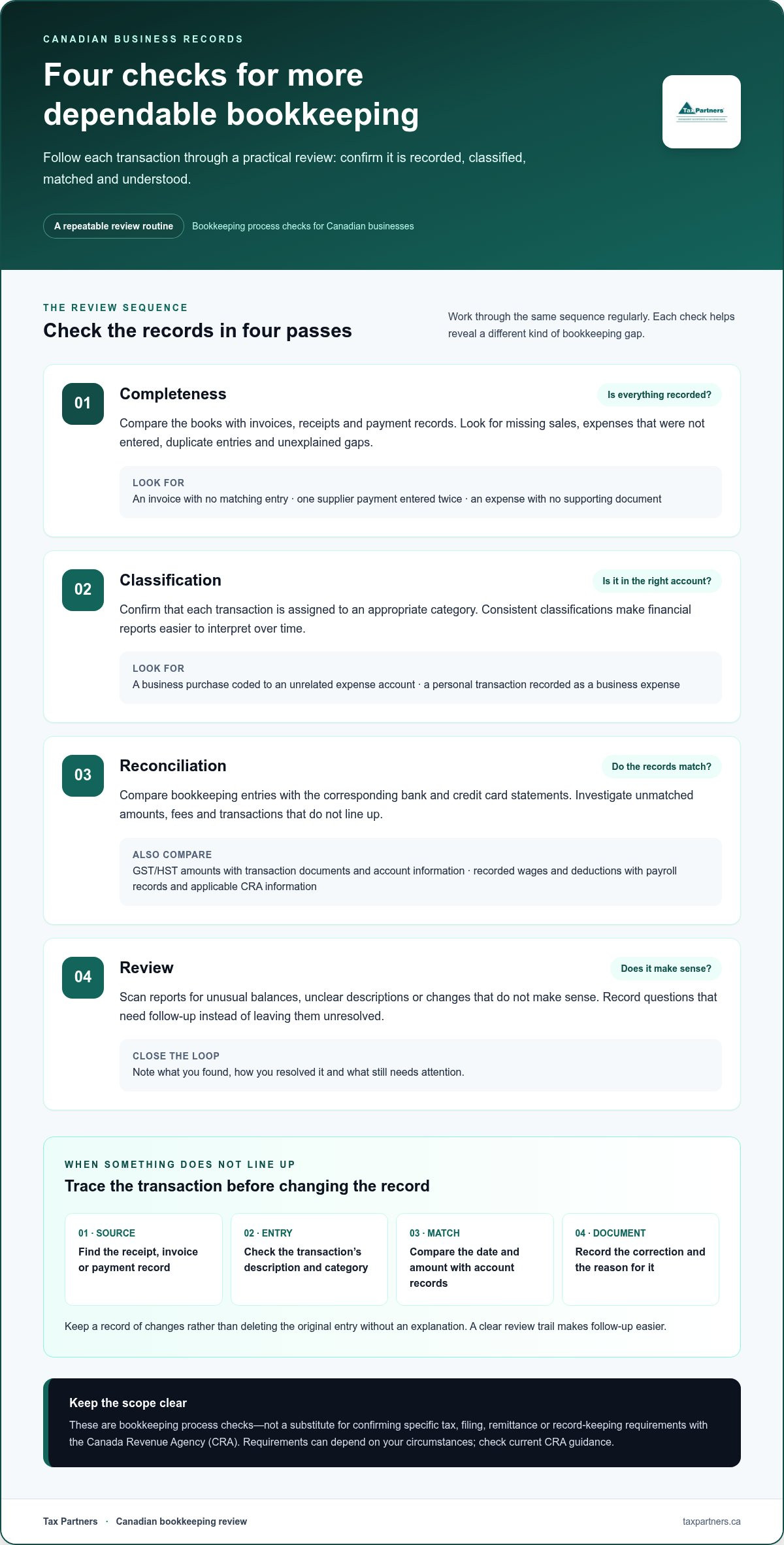
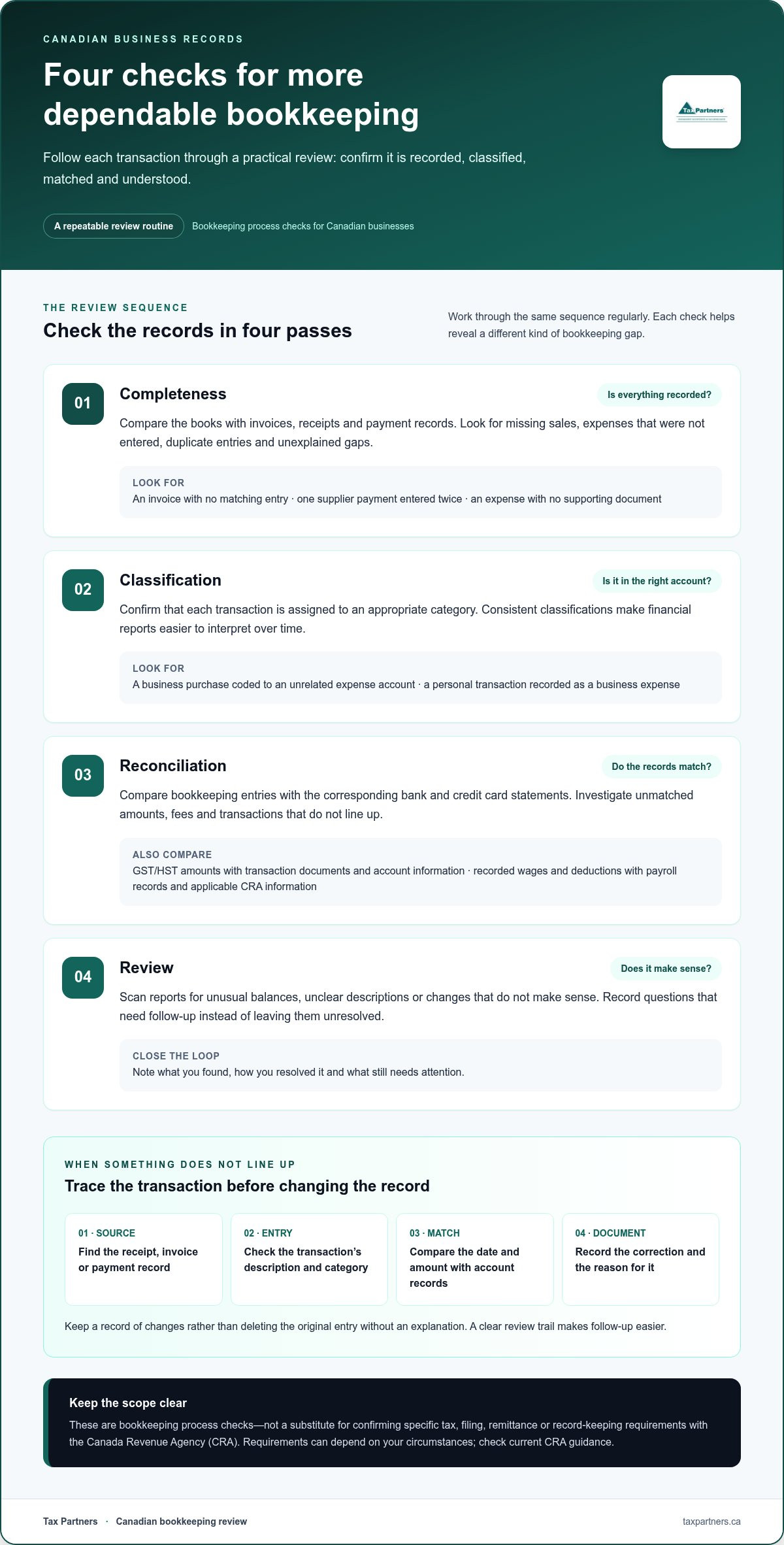
Follow each transaction through four checks: confirm it’s recorded, review its classification, match it to account records, and investigate anything that doesn’t line up. These are bookkeeping process checks for Canadian businesses, not a substitute for confirming specific tax or filing requirements with the Canada Revenue Agency (CRA).
Work through the checklist regularly as part of your bookkeeping cycle. Use the examples as prompts and adapt them to the accounts and transactions your business actually uses.
- Completeness: Check that income and expenses shown on invoices, receipts, and payment records appear in your books. Look for missing sales, duplicate entries, and unexplained gaps.
- Classification: Confirm that each transaction is assigned to an appropriate account. For example, a software subscription and an equipment purchase may need different categories, depending on the facts and your accounting approach.
- Reconciliation: Compare bookkeeping entries with bank and credit card statements. Investigate unmatched amounts, fees, or transactions.
- Review: Scan reports for unusual balances, unclear descriptions, or changes that don’t make sense. Note questions that need follow-up instead of leaving them unresolved.
Check income, expenses, and account classifications
Compare recorded sales and expenses with the documents and payment records available to you. A sales invoice with no matching entry, two entries for one supplier payment, or a business purchase coded to an unrelated expense account can each distort your records.
Consistent categories make financial reports easier to interpret over time. If a transaction’s purpose or category is uncertain, trace it to its source document and clarify the entry before relying on the report for business decisions.
Reconcile bank, credit card, GST/HST, and payroll records
Compare each bank and credit card account in your books with its corresponding statement. Investigate differences such as a payment recorded twice, a bank fee missing from the books, or a deposit that hasn’t been matched to the underlying sale.
GST/HST means Canada’s goods and services tax and harmonized sales tax. Compare the tax amounts recorded in your books with the related transaction documents and account information. For payroll, compare recorded wages and deductions with payroll records and applicable CRA information. Confirm current CRA requirements for any specific reporting or remittance obligation.
Keep the distinction clear: matching documents and accounts is a sound bookkeeping routine, while filing, remittance, and record-keeping obligations are specific CRA requirements that can depend on your circumstances. For more context, see this Canadian bookkeeping and accounting resource. Tax Partners provides bookkeeping support for Canadian businesses. You can discuss bookkeeping support with the team.
Software, owner review, or bookkeeping support: what catches errors?
Each part of a bookkeeping process catches different problems. Software can organize transactions and flag items for attention, an owner can check whether entries make sense, and professional bookkeeping support can add structure to recordkeeping and financial reporting.
A small business can benefit from a consistent review process, even if it has relatively few transactions. The aim isn’t to add unnecessary administration. It’s to catch discrepancies while they’re easier to explain and ensure the records support sound decisions.
What bookkeeping software can and cannot catch
Bookkeeping software may import transactions, suggest categories, match entries, and produce reports. These features can organize routine recordkeeping, but their usefulness depends on accurate setup and review.
An incorrectly categorized transaction can still appear neatly in a report. Review unmatched items, exceptions, and automatically categorized transactions, then compare them with the original records. Treat automation as a tool for organizing and flagging entries, not proof that every transaction is correct.
When a second set of eyes can add value
The right level of review depends on the business. More transactions, payroll, multiple accounts, or complex operations can make it harder for an owner to spot inconsistencies while managing day-to-day work.
A consistent owner review may be enough for a straightforward bookkeeping process, provided someone checks the records and follows up on unusual items. Professional bookkeeping support can help maintain organized records and prepare financial reporting that gives the business a clearer view of its activity. It doesn’t guarantee error-free books or a particular tax outcome, but it can add structure when time or complexity makes regular review difficult.
Canadian corporations also rely on organized bookkeeping records when preparing corporate reporting. For more context, see this guide to Canadian corporate income tax. Common bookkeeping errors aren’t necessarily prevented by a particular tool; they’re more likely to surface when the workflow includes checks suited to the business.
Build a repeatable routine to correct and prevent bookkeeping errors
A consistent review turns corrections into a manageable process instead of a last-minute scramble. Adapt this sequence to your bookkeeping cycle, and keep a record of resolved discrepancies and questions still awaiting follow-up.
Follow a consistent review and correction sequence
Start each correction by tracing the original transaction to its supporting document. This gives you a reliable starting point and helps distinguish a data-entry mistake from a transaction that needs clarification.
- Trace the item. Find the original invoice, receipt, payment record, or other supporting document.
- Gather the records. Bring together relevant bank and credit card statements, invoices, receipts, and current bookkeeping reports for the period under review.
- Compare and investigate. Check the records against one another, note discrepancies, and trace each one to its source before making a change.
- Record the correction. Document what changed and why, and note any item you couldn’t resolve immediately.
- Review the updated records. Check the revised entries and reports for remaining inconsistencies, including effects on account balances or classifications.
A brief adjustment log supports continuity, especially if someone else reviews the books later. Record the transaction, the issue found, the action taken, and any follow-up needed. Keep the original supporting document intact.
Set up checks that fit your business
Make responsibilities clear. Decide who enters transactions, stores documents, reviews account records, and follows up on unresolved items. In a small business, one person may handle several steps, but separating the review from the initial entry where practical can help catch mistakes that are easy to overlook.
Choose a recurring schedule that suits your business activity, then put reconciliations and follow-ups on the calendar. A business with payroll or several active accounts may need a different rhythm from one with fewer transactions. The key is to review consistently and close the loop on open questions.
This is a bookkeeping routine, not a substitute for checking CRA requirements. Before acting on a specific Canadian tax, filing, remittance, or record-keeping obligation, confirm current guidance directly with the Canada Revenue Agency.
Organized records also make year-end reporting easier to prepare and review. Explore Tax Partners’ Canadian accounting services for more on accounting support, or discuss bookkeeping support for your business.
Get dependable bookkeeping support for your Canadian business
A review routine can help catch issues, but it may be difficult to keep up when transactions become harder to manage, payroll adds another layer of records, or there’s little time to investigate unresolved items. Recurring corrections are a sign to review the process behind them, not just fix each entry and move on.
Structured bookkeeping support can help establish a consistent approach to recording business activity, maintaining supporting records, and reviewing account balances. Tax Partners provides bookkeeping and payroll management, along with financial reporting and accounting services for Canadian individuals and SMEs.
What organized bookkeeping support can help manage
Support may include recording transactions, reconciling accounts, managing payroll records, and preparing financial reports. The work depends on the business’s needs, but the aim is to keep records organized and useful, not simply produce a set of numbers.
Clear, current records help business owners understand income, expenses, and cash flow as they consider day-to-day priorities. They also provide a more coherent foundation for financial reporting. Explore Tax Partners’ bookkeeping and accounting support to learn more about these services.
Choose a practical next step
Before seeking support, note where your process feels least reliable. You might be spending too much time entering transactions, finding source documents, reviewing payroll records, or making sense of reports. A concise summary of these challenges can help shape a practical discussion about the support your business needs.
Tax Partners brings over 40 years of accounting and tax experience to its work with Canadian clients. Organized bookkeeping won’t guarantee a particular financial result, but it can provide clearer information to support informed business decisions.
If recurring bookkeeping issues or limited review time are making it harder to trust your records, discuss your bookkeeping needs with Tax Partners. A conversation can help clarify what’s creating friction and what kind of bookkeeping, payroll management, or reporting support may fit your business.
Make accurate bookkeeping part of your business routine
Common bookkeeping errors are easier to address when you review records consistently, trace questionable entries to their supporting documents, and follow up on discrepancies instead of letting them linger. Software can organize transactions, but a thoughtful review helps ensure the records make sense for your Canadian business.
Reliable books do more than support reporting. They give you a clearer view of business activity and a steadier foundation for decisions. If recurring issues or limited time make that difficult, structured bookkeeping support may bring more consistency to transaction records, payroll management, and financial reporting.
Tax Partners brings over 40 years of accounting and tax experience, with bookkeeping and payroll management, financial reporting, and advisory support for Canadian businesses. Discuss bookkeeping support for your business and take a practical next step towards records you can rely on.
Frequently Asked Questions
What are the most common bookkeeping errors for Canadian small businesses?
Common errors include missing or duplicated transactions, mixing personal and business activity, using unsuitable expense categories, skipping account reconciliations, and failing to retain clear supporting documents. These issues can make it harder to understand business performance and prepare reliable financial reports.
Review transactions against statements and source documents regularly, and investigate entries that are unclear or don’t match. Common bookkeeping errors are often caught through consistent checks, not blame.
How often should a Canadian business reconcile its accounts?
Many businesses can use a monthly reconciliation as a practical routine, though the right frequency depends on transaction volume, account activity, and available review time. Reconciliation means comparing bookkeeping entries with statements and investigating differences.
Regular checks can make unmatched transactions easier to trace while records are current. This is general bookkeeping guidance, not a CRA-mandated schedule. Confirm current Canada Revenue Agency requirements directly with the CRA if a specific obligation applies to your business.
Can bookkeeping software prevent all bookkeeping errors?
No. Bookkeeping software can help import transactions, organize entries, suggest categories, and produce reports, but it can’t ensure every record is correct. Incorrect setup, unclear transaction descriptions, or unsuitable categories can still lead to misleading books.
Review matched transactions, exceptions, and entries that don’t look right against their supporting documents. Treat automation as a way to organize and flag information, not a replacement for thoughtful review by the business owner or bookkeeper.
What should I do if I find an error in my business books?
Trace the entry to its original transaction and supporting document before changing it. Compare the date, amount, and account classification with the relevant invoice, receipt, payment record, or statement.
Record what you corrected and why, and keep unresolved questions on a follow-up list. After making the change, review the updated account balance and reports for related inconsistencies. For a correction that may affect Canadian tax reporting, check current CRA guidance or seek professional accounting support.
How should a Canadian business handle missing receipts?
Check whether another reliable record can help explain the transaction, such as an invoice, order confirmation, payment record, or account statement. Note what the purchase was for and retain any supporting information you can locate.
Don’t assume a bank statement alone meets every CRA documentation requirement. Rules can depend on the circumstances, so check current Canada Revenue Agency guidance on supporting records before deciding how to treat the expense for Canadian tax purposes.
Can bookkeeping errors affect GST/HST records?
Yes. Incorrect, missing, or duplicated transaction entries can affect the GST/HST amounts recorded in a business’s books and make it harder to prepare accurate reports. GST/HST is Canada’s goods and services tax and harmonized sales tax.
Compare recorded tax amounts with the underlying transaction documents and related bookkeeping records. Specific registration, reporting, or remittance requirements depend on the business’s circumstances, so confirm current Canadian requirements directly with the CRA rather than relying on a bookkeeping checklist alone.
When should a small business consider professional bookkeeping support?
Consider structured support if errors recur, account reconciliations fall behind, payroll records take more time than you can spare, or financial reports are difficult to interpret. A professional bookkeeper can help organize transactions, manage payroll records, and support financial reporting, giving you a clearer view of business activity.
Tax Partners provides bookkeeping and payroll management, with financial reporting and advisory support for Canadian individuals and SMEs. Support can add structure without guaranteeing a particular tax or financial outcome.

Article by
Mahad Mohamed
Mahad Mohamed is an accountant and the CEO of Tax Partners, with over 26+ years of Canadian and international tax and accounting experience. His expertise includes corporate reorganization, cross-border tax structuring (Canada & US), tax disputes, CRA audits, and tax planning for small owner-managed private corporations. Most recently, Mahad is a pioneer in Canadian crypto taxation and founded Block3 Finance.
Previously, Mahad worked for the Canada Revenue Agency (CRA), Big4 accounting firms, and served as a Rulings Officer for the Federal Tax Authority of the UAE before acquiring Tax Partners in 2014.
Tax Partners has 44 full-time accountants and over 18,400+ clients.
Disclaimer
This article provides general information only and is current as of its publication date. It has not been updated and may be out of date. It does not constitute legal advice and should not be relied upon as such. Every tax situation is unique and may differ from the examples discussed in this article. If you have specific questions, you should seek the advice of our accountants for your unique circumstances. Book a FREE Initial Consultation Today!
Frequently Asked Questions
What are the most common bookkeeping errors for Canadian small businesses?
Common errors include missing or duplicated transactions, mixing personal and business activity, using unsuitable expense categories, skipping account reconciliations, and failing to retain clear supporting documents. These issues can make it harder to understand business performance and prepare reliable financial reports. Review transactions against statements and source documents regularly, and investigate entries that are unclear or don’t match. Common bookkeeping errors are often caught through consistent checks, not blame.
How often should a Canadian business reconcile its accounts?
Many businesses can use a monthly reconciliation as a practical routine, though the right frequency depends on transaction volume, account activity, and available review time. Reconciliation means comparing bookkeeping entries with statements and investigating differences. Regular checks can make unmatched transactions easier to trace while records are current. This is general bookkeeping guidance, not a CRA-mandated schedule. Confirm current Canada Revenue Agency requirements directly with the CRA if a specific obligation applies to your business.
Can bookkeeping software prevent all bookkeeping errors?
No. Bookkeeping software can help import transactions, organize entries, suggest categories, and produce reports, but it can’t ensure every record is correct. Incorrect setup, unclear transaction descriptions, or unsuitable categories can still lead to misleading books. Review matched transactions, exceptions, and entries that don’t look right against their supporting documents. Treat automation as a way to organize and flag information, not a replacement for thoughtful review by the business owner or bookkeeper.
What should I do if I find an error in my business books?
Trace the entry to its original transaction and supporting document before changing it. Compare the date, amount, and account classification with the relevant invoice, receipt, payment record, or statement. Record what you corrected and why, and keep unresolved questions on a follow-up list. After making the change, review the updated account balance and reports for related inconsistencies. For a correction that may affect Canadian tax reporting, check current CRA guidance or seek professional accounting support.
How should a Canadian business handle missing receipts?
Check whether another reliable record can help explain the transaction, such as an invoice, order confirmation, payment record, or account statement. Note what the purchase was for and retain any supporting information you can locate. Don’t assume a bank statement alone meets every CRA documentation requirement. Rules can depend on the circumstances, so check current Canada Revenue Agency guidance on supporting records before deciding how to treat the expense for Canadian tax purposes.
Can bookkeeping errors affect GST/HST records?
Yes. Incorrect, missing, or duplicated transaction entries can affect the GST/HST amounts recorded in a business’s books and make it harder to prepare accurate reports. GST/HST is Canada’s goods and services tax and harmonized sales tax. Compare recorded tax amounts with the underlying transaction documents and related bookkeeping records. Specific registration, reporting, or remittance requirements depend on the business’s circumstances, so confirm current Canadian requirements directly with the CRA rather than relying on a bookkeeping checklist alone.
When should a small business consider professional bookkeeping support?
Consider structured support if errors recur, account reconciliations fall behind, payroll records take more time than you can spare, or financial reports are difficult to interpret. A professional bookkeeper can help organize transactions, manage payroll records, and support financial reporting, giving you a clearer view of business activity. Tax Partners provides bookkeeping and payroll management, with financial reporting and advisory support for Canadian individuals and SMEs. Support can add structure without guaranteeing a particular tax or financial outcome.