Tax Planning for Business Owners in Canada

What if the most useful tax decision you make this year happens well before you prepare a return? That’s the thinking behind tax planning for business owners Canada: connect day-to-day business choices with the owner’s personal finances and longer-term goals, rather than treating tax as a year-end task.
It’s understandable if tax decisions feel reactive. Business structure, how you pay yourself, cash flow, record-keeping and filing obligations can all affect the bigger picture, and they don’t always fit neatly into a single tax-season checklist.
A steady, year-round approach can bring those pieces together. This article explains which business decisions deserve timely tax review, how to build a practical routine for tracking records and obligations, and why compensation choices such as salary or dividends should be considered in light of your wider goals. You’ll also see where current Canada Revenue Agency guidance matters and when tailored Canadian tax, accounting, bookkeeping, payroll or wealth-planning advice can help you make informed decisions. With a clearer process, planning becomes part of running the business, not a scramble after the year has ended.
Key Takeaways
- Start tax planning before filing time by reviewing business decisions as they arise, not just when preparing returns.
- Build your tax plan around your business structure, expected income, cash needs and how you compensate yourself.
- Incorporation doesn’t automatically mean a better tax result; the outcome depends on your circumstances and applicable CRA rules.
- Use a regular review routine to update records, forecast activity and revisit plans after milestones such as hiring, major purchases or rapid growth.
- Connect tax planning for business owners Canada with bookkeeping, payroll and personal financial goals for a more coordinated view.
Start Canadian tax planning before tax season
Tax decisions are easier to consider while there’s still time to act. For Canadian business owners, tax planning means reviewing anticipated business activity and its possible tax effects before filing obligations arise, then using that information to guide decisions about cash, growth, records and personal goals.
Year-round tax planning for Canadian business owners is the ongoing review of business activity, financial records and owner priorities to inform decisions before tax filing obligations arise. It connects the work of running a business with the information that will later support tax preparation.
What does tax planning mean for a Canadian business owner?
Planning looks ahead. An owner might review projected income, expected expenses, cash needs and compensation plans before committing to a major purchase or changing how the business operates. The aim is to understand potential tax consequences in context, not to assume every decision leads to a particular tax result.
Tax liability means the tax an individual or business may owe. The right questions depend on the business’s structure and circumstances, as well as the owner’s financial needs and goals. That’s why Canadian corporate tax compliance and planning should be considered alongside relevant CRA guidance, rather than treated as a one-size-fits-all exercise.
Tax preparation serves a different purpose. It reports relevant financial information after the period has ended, while planning considers decisions in advance. Good records help connect the two: current bookkeeping can make it easier to understand business performance and identify questions to review before filing time.
Why does a year-round approach matter?
Waiting until tax season to assemble receipts and reconstruct transactions can leave less room to assess decisions while they’re still upcoming. Regular forecasting gives owners a clearer view of expected cash flow and helps them spot when their plans may need another look.
Use business changes as prompts for a review, such as:
- Hiring employees or changing payroll arrangements
- Considering a major purchase or investment
- Changing ownership or the way the business operates
- Experiencing rapid growth or a shift in cash flow
These milestones don’t automatically create a particular tax outcome. They do provide a practical reason to update records, revisit assumptions and consider whether current CRA guidance affects the decision. For a high-level overview of how federal and provincial taxes fit within the wider system, see Taxation in Canada.
In practice, tax planning for business owners Canada is not a separate year-end exercise. It’s a way to bring business activity, reliable records and owner priorities into the same conversation, so tax preparation reflects decisions that were considered with care.
Build a Canadian tax plan around business and owner decisions
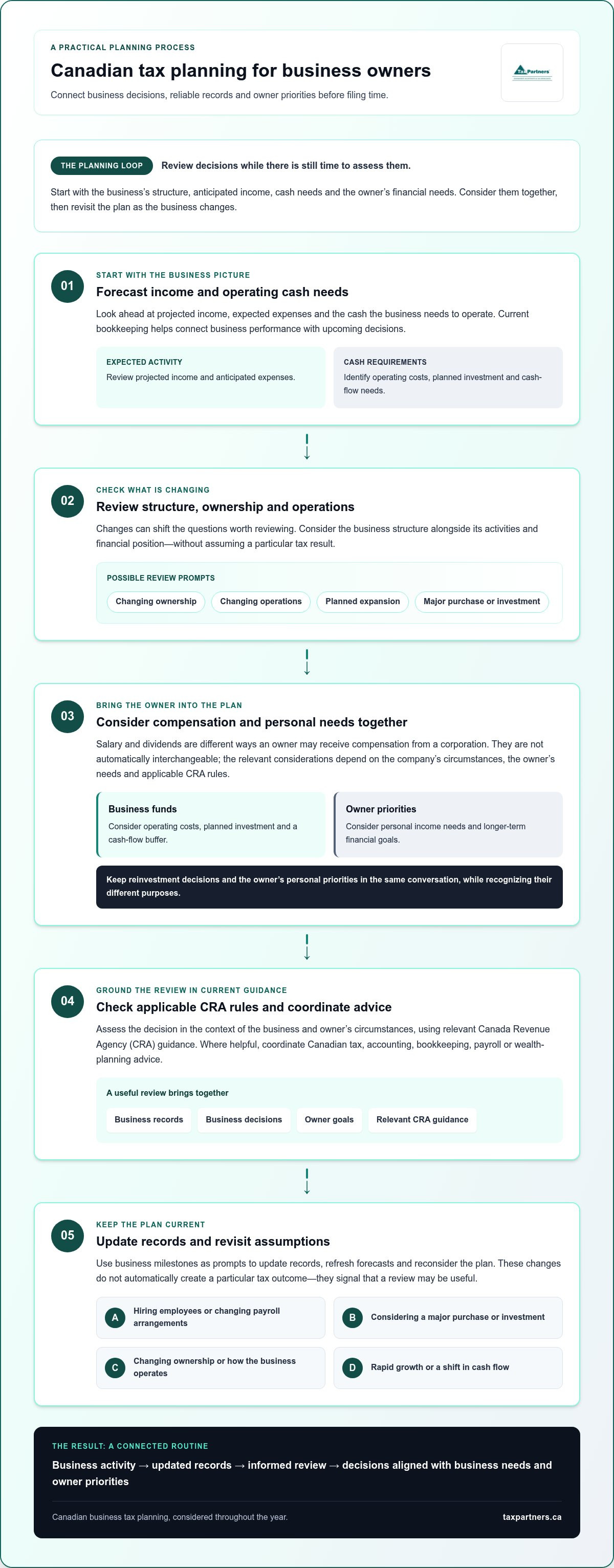
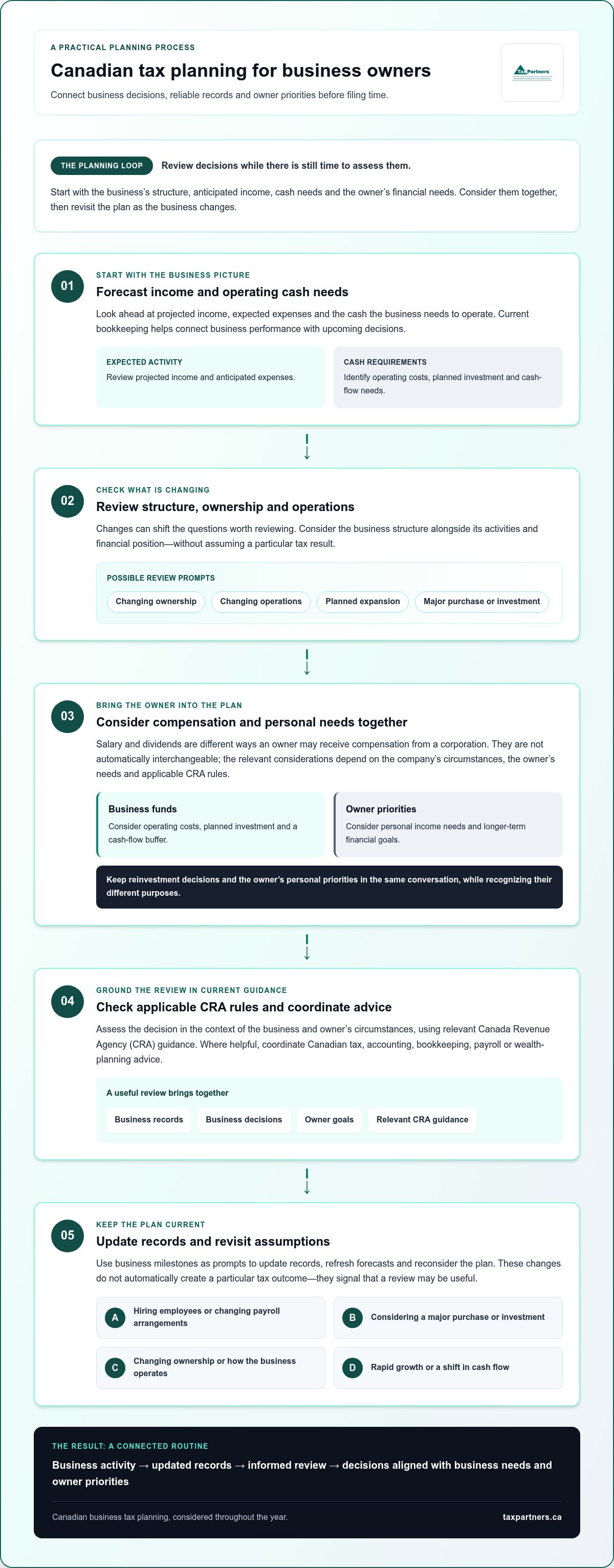
A useful plan starts with four connected questions: how the business is structured, what income it expects, how much cash it needs to operate, and what the owner needs personally. Looking at these together can help identify which decisions merit a closer review before the business commits to a change.
Tax-planning choices for a Canadian business depend on the business’s structure, activities and financial position, as well as the owner’s circumstances, and must be assessed under applicable CRA rules. The Canadian corporate income tax services page offers more context on the corporate tax side of that discussion.
Review structure, income, and owner compensation
Changes in ownership, operations or anticipated income can shift the questions a business should consider. For example, a planned expansion may affect projected revenue, operating cash needs and the owner’s compensation plans. A review can help organize those factors without assuming in advance what the tax result will be.
Salary and dividends are different ways an owner may receive compensation from a corporation. They aren’t automatically interchangeable choices: the relevant considerations depend on the company’s circumstances, the owner’s needs and applicable CRA rules. For current business tax information, consult the Canada Revenue Agency business taxes portal.
Connect business decisions with personal goals
Business cash has more than one potential role. Some funds may be needed for operating costs, planned investment or a cash-flow buffer; other amounts may be considered alongside the owner’s personal income needs and longer-term priorities. Keeping these purposes distinct can make discussions about reinvestment and compensation more focused.
Owners may benefit from coordinated wealth management and financial planning when business decisions also affect personal priorities, such as building assets over time or preparing for a future transition. The best approach depends on the owner’s full financial picture, not solely on the corporation’s tax position.
- Forecast business income and upcoming cash needs.
- Identify changes in structure, ownership or operations for review.
- Consider compensation alongside both corporate and personal circumstances.
- Connect reinvestment decisions with the owner’s longer-term plans.
This is the practical value of tax planning for business owners Canada: bringing corporate decisions and owner goals into one informed discussion. If you’d like to explore how those factors apply to your business, discuss your Canadian tax planning needs.
Separate Canadian tax planning from common assumptions
Filing a return and planning for tax are related, but they serve different purposes. Filing reports business activity for a completed period; planning considers upcoming decisions while there may still be time to assess their implications.
| Filing-focused preparation | Proactive Canadian tax planning |
|---|---|
| Organizes and reports information from a completed period. | Reviews expected activity and decisions before they happen. |
| Identifies tax information from records already available. | Uses current records and forecasts to identify questions for review. |
| Supports required filing and reporting. | Connects business choices with cash flow and owner priorities. |
Neither replaces the other. Reliable preparation depends on accurate records, while forward-looking tax planning for business owners Canada helps owners consider business and personal factors before making decisions.
Does incorporation automatically reduce tax in Canada?
No business structure guarantees a particular tax result. Incorporation changes the planning context, but the analysis still depends on the company’s activities and financial position, as well as how the owner receives compensation and uses business funds.
For example, an owner considering incorporation should look beyond a single tax estimate. The business’s cash needs, expected income and the owner’s personal circumstances all inform the discussion. Canadian federal and provincial tax considerations may both matter, so confirm the current treatment that applies to the specific situation with the CRA and relevant provincial authority.
Are deductions a complete tax planning strategy?
No. Identifying a potentially relevant business expense is only a starting point; whether and how it receives tax treatment depends on the facts and applicable Canadian rules. A generic list can’t establish that an expense is claimable for every business.
Keep organized records that explain the nature of a transaction and how it relates to business activity. For a specific expense, review the supporting documents and current CRA guidance rather than relying on a broad assumption.
A balanced review can consider:
- Whether the business decision supports its operations or plans.
- How the decision affects available business cash and owner needs.
- What records support the transaction and its treatment.
- Whether Canadian federal and provincial considerations need separate review.
That approach keeps tax planning grounded in the business’s real circumstances. Incorporation, a possible deduction or filing a return may each raise useful questions, but none should be treated as a complete plan on its own.
Put Canadian business tax planning on a practical schedule
A repeatable review process helps turn bookkeeping and business updates into useful planning discussions. The goal isn’t to predict every outcome, but to keep information current and raise questions while decisions are still being considered.
Use this sequence as a practical starting point for tax planning for business owners Canada:
- Update records. Keep bookkeeping current and organize receipts, invoices, bank activity and other supporting documents. Include payroll information where relevant.
- Forecast activity. Review expected income, operating costs, cash needs and planned investments using the latest business information.
- Assess decisions. Identify upcoming changes, such as hiring, a major purchase, an ownership change or rapid growth, and note what you need to understand before proceeding.
- Review with an adviser. Bring the records, forecast and questions together for a focused discussion of the business and owner circumstances.
What information should owners prepare for a review?
Bring current financial records, payroll information, a business forecast and a short list of decisions under consideration. Organized records make it easier to discuss the facts behind a question and identify what may need further review under Canadian tax rules.
Bookkeeping and related operational support can help keep those inputs in order. Explore business accounting and support for more information about services connected to day-to-day business needs.
When should a Canadian business owner revisit the plan?
Revisit the plan when circumstances materially change, rather than waiting for a routine tax-season conversation. A new hire, significant purchase, ownership change, unexpected shift in cash flow or change in the owner’s personal priorities can all prompt a fresh review.
Planning conversations and CRA filing or payment obligations are separate responsibilities. A review can help you prepare and identify questions, but it doesn’t replace meeting applicable CRA requirements; confirm current obligations and timing directly with the CRA.
For each review, record the decision being considered, the information used and any follow-up questions. This simple discipline helps carry useful context forward as the business develops, instead of relying on memory when filing work begins.
If you’d like support organizing a practical Canadian tax planning routine, discuss your business planning needs.
Make Canadian tax planning part of your business strategy
Tax planning works best when it informs business decisions, rather than sitting apart from them. A coordinated discussion can bring corporate tax questions, bookkeeping records, payroll information and the owner’s personal priorities into view at the same time.
This joined-up perspective helps clarify what needs attention. For example, an owner considering expansion may need to weigh expected costs and cash needs alongside hiring plans, compensation and personal financial goals. A CPA can help assess the options, identify questions for review under current Canadian tax rules and explain relevant trade-offs without promising a particular tax saving or result.
What can a tailored planning conversation cover?
A useful review starts with the facts: business structure, anticipated activity, financial records, payroll and the owner’s priorities. From there, the discussion can identify decisions that need further analysis and relevant CRA considerations, while distinguishing confirmed information from assumptions that need checking.
Tax Partners provides Canadian tax planning and accounting support, alongside wealth management and financial planning. Explore the firm’s Canadian tax services to learn more about related support for individuals and businesses.
Planning is not a promise of a specific outcome. It’s a disciplined way to understand choices, connect business and personal considerations, and decide what information or advice is needed before moving forward.
How can owners take the next step?
Prepare current financial records, relevant bookkeeping and payroll information, and a short list of upcoming decisions. Include questions about business structure, expected activity, cash needs or owner compensation so the conversation can focus on the matters most relevant to your circumstances.
Tax Partners brings experience in Canadian tax planning, accounting and wealth management, with tailored strategies for businesses across multiple industries. That combination can help owners consider business records and personal goals together, while keeping the review grounded in their specific situation and applicable CRA guidance.
Start with the decision on your mind and the records that help explain it. Discuss your Canadian business tax planning with Tax Partners.
Make planning part of the way you run your business
Tax decisions are easier to manage when you consider them before filing time. Keep records current, review expected activity, and revisit plans when business or personal circumstances change. These habits help connect corporate tax, bookkeeping, payroll and owner priorities instead of treating each as a separate concern.
Remember that incorporation doesn’t guarantee a better tax result, and a potential deduction needs to be assessed against your specific facts and current Canadian rules. A tailored approach to tax planning for business owners Canada can help clarify which decisions warrant review and what information to bring to the conversation.
Tax Partners brings Canadian tax planning, accounting and wealth management experience to discussions shaped around each business and its owner. With organized records and upcoming decisions in hand, you can take a more informed next step.
Discuss your Canadian business tax planning with Tax Partners and build a practical approach that supports your goals. A clear routine can make tax planning feel more connected to the business you’re working hard to grow.
Frequently Asked Questions
What is tax planning for business owners in Canada?
Tax planning is the process of reviewing business and personal financial decisions before tax filing obligations arise. It brings projected income, business structure, cash needs, owner compensation and longer-term goals into one discussion, with choices guided by the business’s circumstances and applicable Canadian tax rules. Unlike tax preparation, which reports information after a period ends, planning helps identify questions to consider in advance.
When should a Canadian business owner start tax planning?
Start before tax season, as soon as business decisions or changes are being considered. Keep records current and revisit the plan when hiring, making a major purchase, changing ownership, experiencing rapid growth or facing a shift in cash flow. Planning conversations don’t replace CRA filing or payment obligations, so track those separately.
Does incorporating a business in Canada automatically lower taxes?
No, incorporation doesn’t guarantee a lower overall tax result. It changes the planning context, and the analysis depends on the corporation’s activities and financial position, the owner’s compensation and personal needs, and applicable Canadian federal and provincial tax rules. Consider how the business will use its cash and how the owner expects to receive income, then review current CRA guidance for the specific circumstances.
Can a business owner deduct every business expense in Canada?
No, an expense isn’t automatically deductible simply because the business paid it. Its Canadian tax treatment depends on the facts and applicable CRA rules, including the nature and purpose of the expense. Keep supporting records showing what was purchased and how it relates to business activity, and consult current CRA guidance or tailored tax advice about specific expenses.
What records should Canadian business owners keep for tax planning?
Keep organized bookkeeping records, invoices, receipts, bank and business transaction records, payroll information and current financial reports. Forecasts and notes about upcoming decisions, such as a purchase, hiring plan or ownership change, can make a planning discussion more specific. These records connect actual business activity with future plans and support tax preparation; use current CRA guidance to confirm the record-keeping requirements for your situation.
How can owner compensation affect Canadian tax planning?
How an owner receives compensation can affect both the corporation’s planning and the owner’s personal financial picture. Salary and dividends are different approaches, not automatic substitutes with identical results; relevant considerations include business cash needs, the owner’s circumstances and applicable CRA rules. Review compensation as part of a coordinated plan and confirm the current Canadian tax treatment for your situation.
Should I work with a CPA for Canadian business tax planning?
A CPA can help review business structure, expected activity, records, compensation choices and owner priorities, then identify questions that need current Canadian tax analysis. This can be useful when a business is growing, changing ownership or making significant decisions. Tax Partners provides Canadian tax planning and accounting, alongside bookkeeping, payroll and wealth management, with advice tailored to your circumstances rather than a promised tax saving or outcome.

Article by
Mahad Mohamed
Mahad Mohamed is an accountant and the CEO of Tax Partners, with over 26+ years of Canadian and international tax and accounting experience. His expertise includes corporate reorganization, cross-border tax structuring (Canada & US), tax disputes, CRA audits, and tax planning for small owner-managed private corporations. Most recently, Mahad is a pioneer in Canadian crypto taxation and founded Block3 Finance.
Previously, Mahad worked for the Canada Revenue Agency (CRA), Big4 accounting firms, and served as a Rulings Officer for the Federal Tax Authority of the UAE before acquiring Tax Partners in 2014.
Tax Partners has 44 full-time accountants and over 18,400+ clients.
Disclaimer
This article provides general information only and is current as of its publication date. It has not been updated and may be out of date. It does not constitute legal advice and should not be relied upon as such. Every tax situation is unique and may differ from the examples discussed in this article. If you have specific questions, you should seek the advice of our accountants for your unique circumstances. Book a FREE Initial Consultation Today!
Frequently Asked Questions
What does tax planning mean for a Canadian business owner?
Planning looks ahead. An owner might review projected income, expected expenses, cash needs and compensation plans before committing to a major purchase or changing how the business operates. The aim is to understand potential tax consequences in context, not to assume every decision leads to a particular tax result. Tax liability means the tax an individual or business may owe. The right questions depend on the business’s structure and circumstances, as well as the owner’s financial needs and goals. That’s why Canadian corporate tax compliance and planning should be considered alongside relevant CRA guidance, rather than treated as a one-size-fits-all exercise. Tax preparation serves a different purpose. It reports relevant financial information after the period has ended, while planning considers decisions in advance. Good records help connect the two: current bookkeeping can make it easier to understand business performance and identify questions to review before filing time.
Why does a year-round approach matter?
Waiting until tax season to assemble receipts and reconstruct transactions can leave less room to assess decisions while they’re still upcoming. Regular forecasting gives owners a clearer view of expected cash flow and helps them spot when their plans may need another look. Use business changes as prompts for a review, such as: These milestones don’t automatically create a particular tax outcome. They do provide a practical reason to update records, revisit assumptions and consider whether current CRA guidance affects the decision. For a high-level overview of how federal and provincial taxes fit within the wider system, see Taxation in Canada. In practice, tax planning for business owners Canada is not a separate year-end exercise. It’s a way to bring business activity, reliable records and owner priorities into the same conversation, so tax preparation reflects decisions that were considered with care. A useful plan starts with four connected questions: how the business is structured, what income it expects, how much cash it needs to operate, and what the owner needs personally. Looking at these together can help identify which decisions merit a closer review before the business commits to a change. Tax-planning choices for a Canadian business depend on the business’s structure, activities and financial position, as well as the owner’s circumstances, and must be assessed under applicable CRA rules. The Canadian corporate income tax services page offers more context on the corporate tax side of that discussion.
Does incorporation automatically reduce tax in Canada?
No business structure guarantees a particular tax result. Incorporation changes the planning context, but the analysis still depends on the company’s activities and financial position, as well as how the owner receives compensation and uses business funds. For example, an owner considering incorporation should look beyond a single tax estimate. The business’s cash needs, expected income and the owner’s personal circumstances all inform the discussion. Canadian federal and provincial tax considerations may both matter, so confirm the current treatment that applies to the specific situation with the CRA and relevant provincial authority.
Are deductions a complete tax planning strategy?
No. Identifying a potentially relevant business expense is only a starting point; whether and how it receives tax treatment depends on the facts and applicable Canadian rules. A generic list can’t establish that an expense is claimable for every business. Keep organized records that explain the nature of a transaction and how it relates to business activity. For a specific expense, review the supporting documents and current CRA guidance rather than relying on a broad assumption. A balanced review can consider: That approach keeps tax planning grounded in the business’s real circumstances. Incorporation, a possible deduction or filing a return may each raise useful questions, but none should be treated as a complete plan on its own. A repeatable review process helps turn bookkeeping and business updates into useful planning discussions. The goal isn’t to predict every outcome, but to keep information current and raise questions while decisions are still being considered. Use this sequence as a practical starting point for tax planning for business owners Canada:
What information should owners prepare for a review?
Bring current financial records, payroll information, a business forecast and a short list of decisions under consideration. Organized records make it easier to discuss the facts behind a question and identify what may need further review under Canadian tax rules. Bookkeeping and related operational support can help keep those inputs in order. Explore business accounting and support for more information about services connected to day-to-day business needs.
When should a Canadian business owner revisit the plan?
Revisit the plan when circumstances materially change, rather than waiting for a routine tax-season conversation. A new hire, significant purchase, ownership change, unexpected shift in cash flow or change in the owner’s personal priorities can all prompt a fresh review. Planning conversations and CRA filing or payment obligations are separate responsibilities. A review can help you prepare and identify questions, but it doesn’t replace meeting applicable CRA requirements; confirm current obligations and timing directly with the CRA. For each review, record the decision being considered, the information used and any follow-up questions. This simple discipline helps carry useful context forward as the business develops, instead of relying on memory when filing work begins. If you’d like support organizing a practical Canadian tax planning routine, discuss your business planning needs. Tax planning works best when it informs business decisions, rather than sitting apart from them. A coordinated discussion can bring corporate tax questions, bookkeeping records, payroll information and the owner’s personal priorities into view at the same time. This joined-up perspective helps clarify what needs attention. For example, an owner considering expansion may need to weigh expected costs and cash needs alongside hiring plans, compensation and personal financial goals. A CPA can help assess the options, identify questions for review under current Canadian tax rules and explain relevant trade-offs without promising a particular tax saving or result.
What can a tailored planning conversation cover?
A useful review starts with the facts: business structure, anticipated activity, financial records, payroll and the owner’s priorities. From there, the discussion can identify decisions that need further analysis and relevant CRA considerations, while distinguishing confirmed information from assumptions that need checking. Tax Partners provides Canadian tax planning and accounting support, alongside wealth management and financial planning. Explore the firm’s Canadian tax services to learn more about related support for individuals and businesses. Planning is not a promise of a specific outcome. It’s a disciplined way to understand choices, connect business and personal considerations, and decide what information or advice is needed before moving forward.
How can owners take the next step?
Prepare current financial records, relevant bookkeeping and payroll information, and a short list of upcoming decisions. Include questions about business structure, expected activity, cash needs or owner compensation so the conversation can focus on the matters most relevant to your circumstances. Tax Partners brings experience in Canadian tax planning, accounting and wealth management, with tailored strategies for businesses across multiple industries. That combination can help owners consider business records and personal goals together, while keeping the review grounded in their specific situation and applicable CRA guidance. Start with the decision on your mind and the records that help explain it. Discuss your Canadian business tax planning with Tax Partners. Tax decisions are easier to manage when you consider them before filing time. Keep records current, review expected activity, and revisit plans when business or personal circumstances change. These habits help connect corporate tax, bookkeeping, payroll and owner priorities instead of treating each as a separate concern. Remember that incorporation doesn’t guarantee a better tax result, and a potential deduction needs to be assessed against your specific facts and current Canadian rules. A tailored approach to tax planning for business owners Canada can help clarify which decisions warrant review and what information to bring to the conversation. Tax Partners brings Canadian tax planning, accounting and wealth management experience to discussions shaped around each business and its owner. With organized records and upcoming decisions in hand, you can take a more informed next step. Discuss your Canadian business tax planning with Tax Partners and build a practical approach that supports your goals. A clear routine can make tax planning feel more connected to the business you’re working hard to grow.
What is tax planning for business owners in Canada?
Tax planning is the process of reviewing business and personal financial decisions before tax filing obligations arise. It brings projected income, business structure, cash needs, owner compensation and longer-term goals into one discussion, with choices guided by the business’s circumstances and applicable Canadian tax rules. Unlike tax preparation, which reports information after a period ends, planning helps identify questions to consider in advance.
When should a Canadian business owner start tax planning?
Start before tax season, as soon as business decisions or changes are being considered. Keep records current and revisit the plan when hiring, making a major purchase, changing ownership, experiencing rapid growth or facing a shift in cash flow. Planning conversations don’t replace CRA filing or payment obligations, so track those separately.
Does incorporating a business in Canada automatically lower taxes?
No, incorporation doesn’t guarantee a lower overall tax result. It changes the planning context, and the analysis depends on the corporation’s activities and financial position, the owner’s compensation and personal needs, and applicable Canadian federal and provincial tax rules. Consider how the business will use its cash and how the owner expects to receive income, then review current CRA guidance for the specific circumstances.
Can a business owner deduct every business expense in Canada?
No, an expense isn’t automatically deductible simply because the business paid it. Its Canadian tax treatment depends on the facts and applicable CRA rules, including the nature and purpose of the expense. Keep supporting records showing what was purchased and how it relates to business activity, and consult current CRA guidance or tailored tax advice about specific expenses.
What records should Canadian business owners keep for tax planning?
Keep organized bookkeeping records, invoices, receipts, bank and business transaction records, payroll information and current financial reports. Forecasts and notes about upcoming decisions, such as a purchase, hiring plan or ownership change, can make a planning discussion more specific. These records connect actual business activity with future plans and support tax preparation; use current CRA guidance to confirm the record-keeping requirements for your situation.
How can owner compensation affect Canadian tax planning?
How an owner receives compensation can affect both the corporation’s planning and the owner’s personal financial picture. Salary and dividends are different approaches, not automatic substitutes with identical results; relevant considerations include business cash needs, the owner’s circumstances and applicable CRA rules. Review compensation as part of a coordinated plan and confirm the current Canadian tax treatment for your situation.
Should I work with a CPA for Canadian business tax planning?
A CPA can help review business structure, expected activity, records, compensation choices and owner priorities, then identify questions that need current Canadian tax analysis. This can be useful when a business is growing, changing ownership or making significant decisions. Tax Partners provides Canadian tax planning and accounting, alongside bookkeeping, payroll and wealth management, with advice tailored to your circumstances rather than a promised tax saving or outcome.