Corporate Tax Installment Payments in Canada: 2026 Guide

What if your corporation’s biggest tax surprise isn’t the year-end bill, but an instalment you didn’t know was due? For many businesses, corporate tax installment payments Canada requires are part of an ongoing cycle of forecasting, paying and reconciling, not a task to leave until the return is filed.
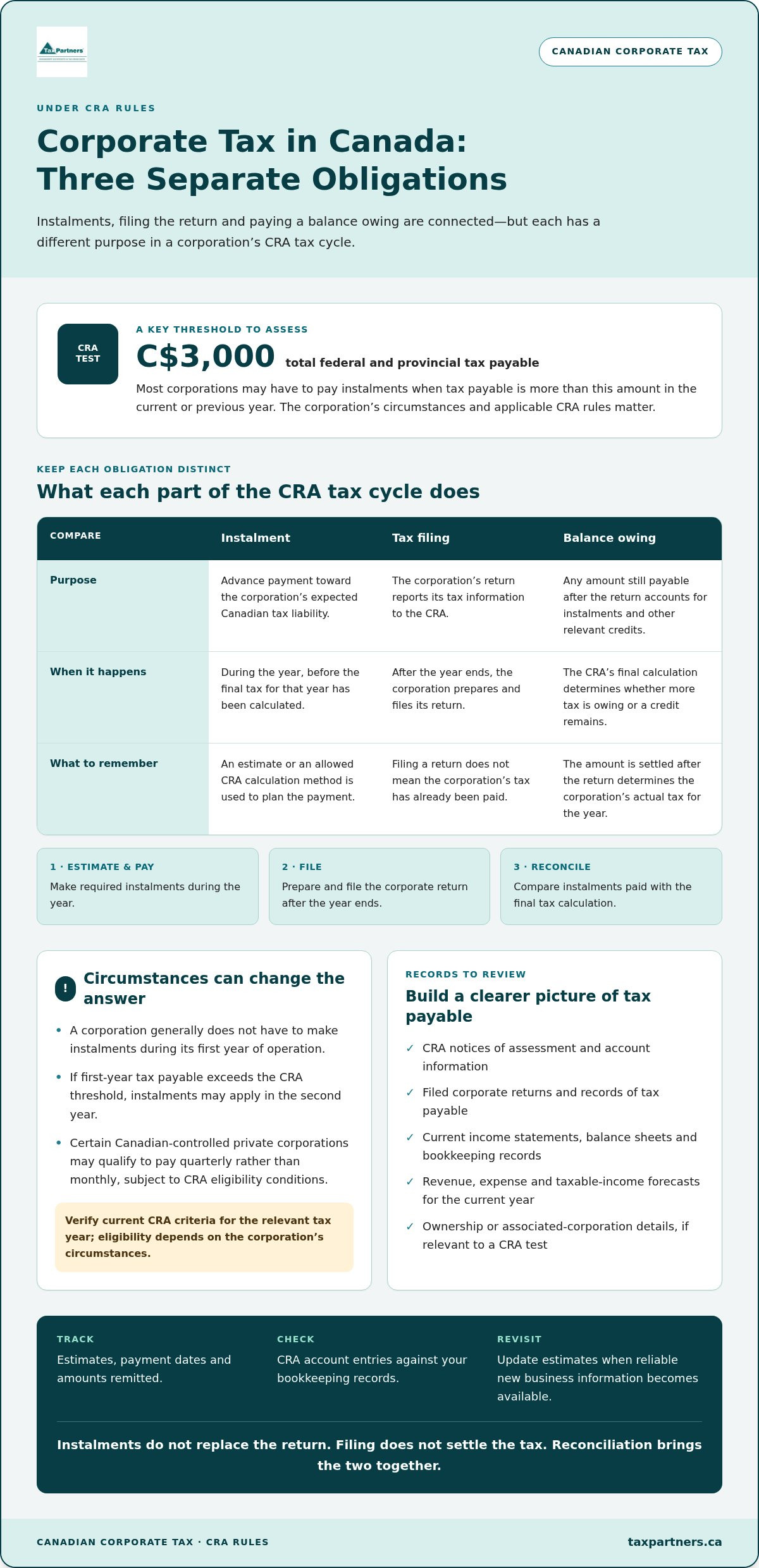
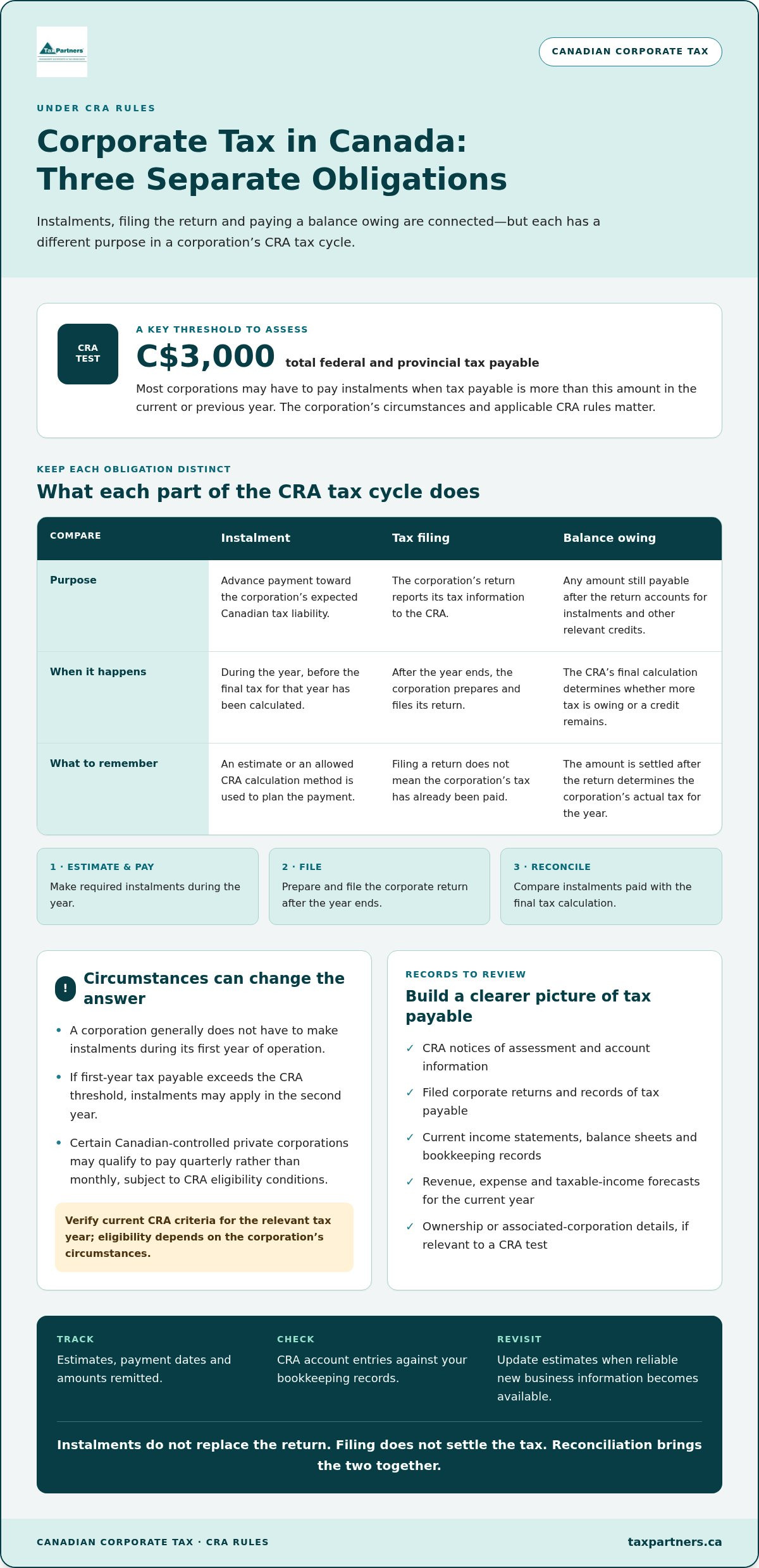
It’s understandable to feel uncertain when the final tax amount isn’t yet clear. Under CRA rules, most corporations may have to pay instalments when their total federal and provincial tax payable exceeds C$3,000 in the current or previous year. The details depend on the corporation’s circumstances and, in some provinces, which tax authority administers the tax.
This 2026 guide explains how to assess whether instalments apply, estimate payments before the corporate return is finalized, and plan for payment timing and cash flow. It also compares the available calculation approaches and shows how to keep payment records organized as business results change. A consistent bookkeeping and review process can make tax obligations more predictable and help you spot issues sooner.
Key Takeaways
- Keep corporate instalments separate from filing the return and paying any remaining balance, so each obligation has a clear place in the tax calendar.
- Use prior-year tax details and current business records to assess whether corporate tax installment payments Canada may apply to your corporation.
- Compare CRA’s current-year, prior-year and combination calculation methods against the tax information you have and your business outlook.
- Verify CRA payment instructions, schedule each instalment and reconcile payments against your records.
- Review estimates as business results change, and maintain consistent bookkeeping to keep payments easier to track.
What are corporate tax instalment payments in Canada?
Corporate tax instalments are payments a corporation makes toward its expected Canadian tax liability. They’re payments on account, made before the corporation’s final tax for the year has been calculated. They do not replace filing the corporation’s Canadian income tax return.
Not every corporation is required to pay instalments. Under CRA rules, most corporations must make them when their total federal and provincial tax payable is more than C$3,000 in either the current or previous year. The requirement depends on the corporation’s circumstances, so assess its position rather than assuming every business has the same obligation.
The distinction is timing and calculation. An instalment is an advance payment based on an estimate or an allowed CRA calculation method. The final balance is any amount left owing after the return determines the corporation’s actual tax for the year and accounts for payments already made.
How instalments fit into a corporation's CRA tax cycle
The cycle starts with estimating the corporation’s tax and making required instalments during the year. After the year ends, the corporation prepares and files its return. The CRA’s final calculation then takes instalments already paid into account to determine whether more tax is owing or a credit remains.
Instalments are therefore part of the payment and planning process, not a separate return. For an overview of the broader tax context, see Corporate tax in Canada, and explore this guide to Canadian corporate income tax.
Instalments, tax filing, and the balance owing are different
Keep three related terms distinct. An instalment is a payment toward estimated tax during the year. A tax filing is the corporation’s return reporting its tax information to the CRA. A balance owing is any amount still payable after the return accounts for instalments and other relevant credits.
Paying instalments doesn’t fulfil the corporation’s Canadian filing obligations, and filing a return doesn’t mean its tax has already been paid. Track payments and filing work separately because each step has a different purpose.
In practice, corporate tax installment payments Canada can be easier to manage when bookkeeping records show the estimates, payment dates, amounts remitted and CRA account entries. This record trail helps you compare payments with the amount calculated on the return, identify a shortfall or credit, and carry accurate information into the next tax-planning cycle.
When does the CRA require a corporation to pay instalments?
A corporation’s instalment obligation depends on its tax circumstances and the CRA rules for the relevant tax year. For most corporations, the general CRA test looks at whether total federal and provincial tax payable exceeds C$3,000 in the current or previous year. Treat this as a starting point, not a substitute for assessing the corporation’s specific situation.
Some situations have different rules. For example, a corporation generally doesn’t have to make instalments during its first year of operation; if its first-year tax payable exceeds the CRA threshold, instalments may apply in its second year. Certain Canadian-controlled private corporations may also qualify to pay quarterly rather than monthly, subject to CRA eligibility conditions.
Assess the corporation's CRA instalment obligation using its current circumstances and verified CRA criteria.
Which information helps determine whether instalments apply?
Gather records that show both the CRA’s recorded tax position and the business’s latest results. Corporate tax assessments and prior returns help establish historical tax payable, while current bookkeeping and forecasts help estimate how the business is performing in the current tax year.
- CRA notices of assessment and account information for relevant tax years
- Filed corporate tax returns and records of tax payable
- Current income statements, balance sheets and bookkeeping records
- Revenue, expense and taxable-income forecasts for the current year
- Details of ownership or associated corporations, if relevant to a CRA test
Taxable income means income the CRA uses to calculate tax after applicable adjustments. Accounting records can help estimate it, but they don’t determine whether instalments are required. That depends on the CRA’s eligibility rules. Corporate tax preparation and planning can bring the records, return history and forecast together for review.
Why the corporation's circumstances can change the answer
A revised forecast doesn’t automatically change whether the CRA requires instalments, but it can affect the estimated tax used to plan payments. A strong sales period, a major contract ending or an unexpected expense may change the year-end outlook. Revisit the estimate when reliable new information becomes available.
Ownership changes, new relationships with associated corporations or other shifts in tax circumstances may also affect how CRA criteria apply. For example, a corporation considering quarterly instalments should verify the current CRA conditions, including any tests involving taxable income, taxable capital or compliance history, instead of relying on an earlier conclusion.
Before deciding, review the CRA’s current guidance for the relevant tax year, including applicable thresholds, tests and exceptions. Corporate tax installment payments Canada rules are not a one-size-fits-all checklist. If the corporation’s forecast or eligibility is difficult to assess, discuss the corporation’s tax position with Tax Partners.
How should you compare CRA corporate instalment calculation methods?
Under current CRA guidance, corporations can use three approaches to calculate income tax instalments: an estimate based on the current year, a calculation based on the previous year, or a combination using tax information from two preceding years. The right fit depends on how reliable the corporation’s forecast is and how much its results are changing.
The table compares the approaches. Before calculating or paying, confirm the current CRA instructions for the corporation’s tax year so the method is applied correctly.
| Approach | Information used | Practical trade-off |
|---|---|---|
| Current-year estimate | The corporation’s estimated tax payable for the current tax year. | Can reflect current business expectations, but depends on a well-supported forecast that may need updating as results change. |
| Prior-year method | The tax payable reported for the previous tax year. | Uses a known historical figure, which can make planning more predictable, but may not reflect a substantial change in current-year income. |
| Combination method | Tax information from the second-to-last year for the first two payments, followed by the previous year’s tax information for the remaining payments. | Uses filed-year figures while incorporating more recent tax information later in the year. The corporation must follow the CRA sequence accurately. |
What information does each CRA calculation approach use?
The current-year approach relies on a projection of tax payable, while the prior-year approach uses tax payable from the preceding year. The combination approach uses both the second-to-last and previous years in the sequence set out by the CRA.
These approaches use different inputs, so don’t treat their figures as interchangeable. Before applying a method, use the CRA’s current terminology and instructions for the relevant tax year, and make sure the tax figures match the corporation’s records and applicable assessments.
How do you balance estimate accuracy and cash-flow certainty?
A stable business with reliable historical results may find prior-year information useful for planning. A business with changing income may need to pay closer attention to a current-year forecast. Neither situation determines the method on its own; it helps identify where uncertainty may lie and what information needs review.
Don’t select an approach simply because it produces the smallest immediate payment. An estimate that no longer reflects the corporation’s circumstances can leave a gap to address later, while an overly cautious projection can tie up more cash than expected. Review the forecast as bookkeeping records are updated, then follow the calculation rules for the method selected.
Consistent records make that review more dependable. Recording revenue and expenses clearly supports forecasts and tax planning. This overview of accounting support for businesses explains how organized financial information can help.
A sound approach to corporate tax installment payments Canada weighs forecast reliability, historical tax information and cash-flow needs, then checks the calculation against current CRA guidance. If business results shift, reassess the estimate instead of relying on an outdated projection.
How to plan, pay, and reconcile corporate instalments
A dependable process turns corporate tax instalments into a recurring bookkeeping task rather than a last-minute scramble. Under CRA rules, corporations generally pay monthly instalments by the last day of each month. If a due date falls on a weekend or public holiday, payment is considered on time when the CRA receives it on the next business day. Confirm the current CRA schedule and instructions for the corporation’s tax year before setting dates.
Use this workflow to keep each step visible:
- Confirm the obligation. Review the corporation’s tax position and current CRA information to determine whether instalments apply and whether the schedule is monthly or an eligible alternative.
- Estimate the tax. Apply a CRA-recognized calculation method using the appropriate tax information and a current forecast. Keep the method, assumptions and supporting records together.
- Verify the due dates. Check the CRA’s current instalment schedule against the corporation’s fiscal year. Don’t assume calendar-year dates apply if its year-end differs.
- Pay using current instructions. Confirm the CRA’s available payment channels and how to direct the payment to the correct corporation and tax account. CRA options include online banking bill payments and pre-authorized debit through My Business Account. Check the CRA’s current instructions before using either.
- Record and reconcile. Save the payment confirmation and enter the date, amount, corporation and applicable tax period in the bookkeeping system. Later, compare those records with CRA account information and the completed corporate tax calculation.
Set up a reliable payment and recordkeeping routine
Once you verify the CRA dates, add them to a shared calendar with enough lead time for payment approval and processing. Assign someone to review the calendar so a change in staff or routine doesn’t leave a payment untracked.
For each transaction, retain the confirmation and record the payment date, amount, tax period and account it was intended for. Consistent records help distinguish a payment that has cleared from one that is only scheduled, and make it easier to investigate differences between the bookkeeping system and the CRA account.
Reconcile instalments when the corporate return is prepared
During return preparation, compare the corporation’s instalment records with the CRA account and the tax calculated on its completed return. Depending on the corporation’s circumstances, an amount may remain to pay or a credit may be due if payments exceed the tax determined.
If the figures don’t match, check payment confirmations, dates, tax-period entries and account postings before finalizing the reconciliation. A steady review keeps corporate tax installment payments Canada organized from the first estimate through the year-end calculation.
Tax Partners provides Canadian corporate tax preparation and planning, including support to review payment records and the corporation’s tax position. Discuss your corporation’s tax instalments.
Build a dependable corporate instalment plan with tax support
Some corporations manage estimates and payment records internally. Professional support can be useful when forecasts are uncertain, business results shift, or amounts in the books don’t match the CRA account. A review can bring the corporation’s tax history, current financial picture and instalment process together, while taking its circumstances into account.
Tax Partners provides Canadian corporate tax preparation and planning, supported by more than 40 years of experience. This work can help a business assess its tax position and organize the information needed to make informed instalment decisions.
What to prepare before reviewing your instalment plan
A focused review starts with records that show what the corporation has reported, how it is performing now and what it has already paid. Gather these materials before reviewing the plan:
- Recent corporate tax returns and CRA notices of assessment
- Current financial statements and up-to-date bookkeeping records
- Payment confirmations and the corporation’s instalment payment history
- A current forecast, with notes on significant changes in revenue, expenses or business activity
These records help distinguish historical figures from estimates. Note changes that could affect the forecast, such as a major contract beginning or ending, a change in operating costs, or an unexpected shift in business activity. The purpose is to support a sound review, not to assume that one change automatically alters the corporation’s CRA instalment obligation.
Canadian corporate tax preparation and planning can connect the corporation’s filed information with its current outlook. Tax Partners’ corporate income tax support can help organize that review and identify questions to address under current CRA guidance.
Turn payment tracking into forward-looking tax planning
Payment records are more useful when reviewed alongside the corporation’s books, rather than gathered only at year-end. Periodic bookkeeping reviews can help the business see whether its forecast still reflects current results, keep instalment transactions organized and prepare clearer information for corporate tax planning.
This approach also supports broader Canadian corporate tax compliance. Instalment planning draws on accurate records and current CRA requirements, while return preparation and other tax responsibilities depend on the corporation’s full circumstances. A consistent review routine connects these activities without treating payment tracking as a substitute for filing or other obligations.
Tax Partners can review your corporation’s records and Canadian tax position as business results or circumstances change. For a practical discussion about next steps, contact Tax Partners about corporate tax planning.
Make your next tax review part of the plan
Give instalment planning a regular place in the corporation’s financial calendar. Tie the review to routine bookkeeping and forecast updates so changes in business activity prompt a timely look at assumptions, rather than a last-minute scramble. Keep the CRA’s current guidance close at hand whenever you revisit the corporation’s position.
This rhythm can make corporate tax installment payments Canada easier to manage as part of ongoing business planning. It also gives decision-makers a clearer view of what has changed, what still needs attention and which records will support the next tax review.
Tax Partners provides Canadian corporate tax preparation and strategic planning, backed by more than 40 years of accounting and tax experience. To discuss a consistent review process for your corporation, contact Tax Partners about your Canadian corporate tax instalment plan.
A clear process starts with one informed next step, and your corporation can build from there.
Frequently Asked Questions
Does every corporation in Canada have to make CRA tax instalment payments?
No. Whether a corporation must make instalments depends on its tax circumstances and the CRA criteria for the relevant tax year. Incorporation by itself doesn’t determine the answer. Review the corporation’s CRA account, notices of assessment and filed returns, then confirm the current eligibility rules with the CRA. If the business is newly incorporated or has limited tax history, consider how those circumstances affect the CRA test.
How does a corporation calculate its CRA tax instalment payments?
A corporation can use a CRA-recognized calculation approach, but it should confirm the available methods, inputs and instructions for its tax year before calculating. The information may include prior-year tax figures or an estimate based on current business forecasts. For example, review a forecast if actual revenue or expenses begin to differ from expectations. The instalment calculation remains an estimate; the final tax position is determined when the corporate return is prepared.
When are Canadian corporate tax instalment payments due?
Due dates and payment frequency depend on the corporation’s circumstances and the CRA rules for its tax year. Check the corporation’s CRA account and current CRA guidance rather than relying on another business’s schedule. Compare the verified dates with the corporation’s fiscal calendar, then set reminders that allow time for internal approval and payment processing. Recheck the schedule if the corporation’s circumstances or CRA instructions change.
Can a corporation change its instalment amount when its income changes?
Changing business results can affect the corporation’s tax estimate, but they don’t automatically determine how a payment should change. The appropriate calculation depends on the CRA rules and the method being used. Update the bookkeeping and forecast first, then compare the revised figures with the corporation’s tax information. Before changing payments, confirm the current CRA requirements; an adjustment based only on a short-term change may not reflect the full tax picture.
What happens if a corporation misses a CRA tax instalment payment?
A missed or insufficient instalment can have CRA consequences, depending on the applicable rules and the corporation’s circumstances. Review the corporation’s CRA account promptly to confirm what was received and whether a payment is outstanding. Then consult current CRA guidance for the relevant tax year and address any discrepancy using the CRA’s instructions. Keep payment records and correspondence together so the corporation can explain its account history during tax-return preparation.
Can a corporation pay CRA instalments through online banking?
Online banking may be an available way to pay CRA corporate instalments, but payment channels and instructions can change. Check the current CRA guidance and the bank’s bill-payment details before submitting funds, including how to identify the correct corporation and tax period. Save the payment confirmation and record the transaction in the bookkeeping system. That documentation can help resolve a mismatch if the payment doesn’t appear as expected in the CRA account.
How do corporate instalments appear when the CRA tax return is filed?
Recorded instalments are considered when the corporation’s final tax position is determined. During return preparation, compare the corporation’s payment records with CRA account information and the completed tax calculation, and investigate differences before finalizing the records. Depending on the corporation’s actual tax and payments, an amount may remain owing or a credit may arise. Instalments don’t replace the Canadian corporate return or guarantee a refund.

Article by
Mahad Mohamed
Mahad Mohamed is an accountant and the CEO of Tax Partners, with over 26+ years of Canadian and international tax and accounting experience. His expertise includes corporate reorganization, cross-border tax structuring (Canada & US), tax disputes, CRA audits, and tax planning for small owner-managed private corporations. Most recently, Mahad is a pioneer in Canadian crypto taxation and founded Block3 Finance.
Previously, Mahad worked for the Canada Revenue Agency (CRA), Big4 accounting firms, and served as a Rulings Officer for the Federal Tax Authority of the UAE before acquiring Tax Partners in 2014.
Tax Partners has 44 full-time accountants and over 18,400+ clients.
Disclaimer
This article provides general information only and is current as of its publication date. It has not been updated and may be out of date. It does not constitute legal advice and should not be relied upon as such. Every tax situation is unique and may differ from the examples discussed in this article. If you have specific questions, you should seek the advice of our accountants for your unique circumstances. Book a FREE Initial Consultation Today!
Frequently Asked Questions
Which information helps determine whether instalments apply?
Gather records that show both the CRA’s recorded tax position and the business’s latest results. Corporate tax assessments and prior returns help establish historical tax payable, while current bookkeeping and forecasts help estimate how the business is performing in the current tax year. Taxable income means income the CRA uses to calculate tax after applicable adjustments. Accounting records can help estimate it, but they don’t determine whether instalments are required. That depends on the CRA’s eligibility rules. Corporate tax preparation and planning can bring the records, return history and forecast together for review.
What information does each CRA calculation approach use?
The current-year approach relies on a projection of tax payable, while the prior-year approach uses tax payable from the preceding year. The combination approach uses both the second-to-last and previous years in the sequence set out by the CRA. These approaches use different inputs, so don’t treat their figures as interchangeable. Before applying a method, use the CRA’s current terminology and instructions for the relevant tax year, and make sure the tax figures match the corporation’s records and applicable assessments.
How do you balance estimate accuracy and cash-flow certainty?
A stable business with reliable historical results may find prior-year information useful for planning. A business with changing income may need to pay closer attention to a current-year forecast. Neither situation determines the method on its own; it helps identify where uncertainty may lie and what information needs review. Don’t select an approach simply because it produces the smallest immediate payment. An estimate that no longer reflects the corporation’s circumstances can leave a gap to address later, while an overly cautious projection can tie up more cash than expected. Review the forecast as bookkeeping records are updated, then follow the calculation rules for the method selected. Consistent records make that review more dependable. Recording revenue and expenses clearly supports forecasts and tax planning. This overview of accounting support for businesses explains how organized financial information can help. A sound approach to corporate tax installment payments Canada weighs forecast reliability, historical tax information and cash-flow needs, then checks the calculation against current CRA guidance. If business results shift, reassess the estimate instead of relying on an outdated projection. A dependable process turns corporate tax instalments into a recurring bookkeeping task rather than a last-minute scramble. Under CRA rules, corporations generally pay monthly instalments by the last day of each month. If a due date falls on a weekend or public holiday, payment is considered on time when the CRA receives it on the next business day. Confirm the current CRA schedule and instructions for the corporation’s tax year before setting dates. Use this workflow to keep each step visible:
Does every corporation in Canada have to make CRA tax instalment payments?
No. Whether a corporation must make instalments depends on its tax circumstances and the CRA criteria for the relevant tax year. Incorporation by itself doesn’t determine the answer. Review the corporation’s CRA account, notices of assessment and filed returns, then confirm the current eligibility rules with the CRA. If the business is newly incorporated or has limited tax history, consider how those circumstances affect the CRA test.
How does a corporation calculate its CRA tax instalment payments?
A corporation can use a CRA-recognized calculation approach, but it should confirm the available methods, inputs and instructions for its tax year before calculating. The information may include prior-year tax figures or an estimate based on current business forecasts. For example, review a forecast if actual revenue or expenses begin to differ from expectations. The instalment calculation remains an estimate; the final tax position is determined when the corporate return is prepared.
When are Canadian corporate tax instalment payments due?
Due dates and payment frequency depend on the corporation’s circumstances and the CRA rules for its tax year. Check the corporation’s CRA account and current CRA guidance rather than relying on another business’s schedule. Compare the verified dates with the corporation’s fiscal calendar, then set reminders that allow time for internal approval and payment processing. Recheck the schedule if the corporation’s circumstances or CRA instructions change.
Can a corporation change its instalment amount when its income changes?
Changing business results can affect the corporation’s tax estimate, but they don’t automatically determine how a payment should change. The appropriate calculation depends on the CRA rules and the method being used. Update the bookkeeping and forecast first, then compare the revised figures with the corporation’s tax information. Before changing payments, confirm the current CRA requirements; an adjustment based only on a short-term change may not reflect the full tax picture.
What happens if a corporation misses a CRA tax instalment payment?
A missed or insufficient instalment can have CRA consequences, depending on the applicable rules and the corporation’s circumstances. Review the corporation’s CRA account promptly to confirm what was received and whether a payment is outstanding. Then consult current CRA guidance for the relevant tax year and address any discrepancy using the CRA’s instructions. Keep payment records and correspondence together so the corporation can explain its account history during tax-return preparation.
Can a corporation pay CRA instalments through online banking?
Online banking may be an available way to pay CRA corporate instalments, but payment channels and instructions can change. Check the current CRA guidance and the bank’s bill-payment details before submitting funds, including how to identify the correct corporation and tax period. Save the payment confirmation and record the transaction in the bookkeeping system. That documentation can help resolve a mismatch if the payment doesn’t appear as expected in the CRA account.
How do corporate instalments appear when the CRA tax return is filed?
Recorded instalments are considered when the corporation’s final tax position is determined. During return preparation, compare the corporation’s payment records with CRA account information and the completed tax calculation, and investigate differences before finalizing the records. Depending on the corporation’s actual tax and payments, an amount may remain owing or a credit may arise. Instalments don’t replace the Canadian corporate return or guarantee a refund.