Cost of Accounting Services for Small Business in Canada

The lowest accounting quote may not cover the work your business actually needs. If you’re weighing the cost of accounting services for small business Canada, the key is to compare what each fee includes, not just the amount quoted. Bookkeeping, tax preparation and ongoing accounting support serve different purposes, so proposals covering different tasks aren’t directly comparable.
Predictable fees matter, especially when record quality, transaction volume or changing business needs can affect the work involved. The right scope depends on your business structure, how its financial records are maintained and the support you need for CRA filings and financial reporting.
This guide explains what can shape an accounting quote and how hourly, fixed-fee and recurring arrangements differ. It also covers how to compare service scopes and prepare useful information about your business before discussing the support you need.
Key Takeaways
- Learn what shapes the cost of accounting services for small business Canada, and use those factors to assess whether a quote reflects your needs.
- See how bookkeeping, tax preparation, payroll and advisory support differ, so you can identify the work your business requires.
- Compare hourly, fixed-fee and recurring arrangements by predictability, flexibility and how they handle work beyond the agreed scope.
- Prepare a clearer proposal request by gathering information about transactions, payroll needs and the financial reports that matter to your business.
- Explore how Tax Partners can tailor Canadian accounting, bookkeeping and payroll support as your business needs evolve.
What does the cost of accounting services for a small business in Canada cover?
Accounting services aren’t one standard package. They can include recurring or one-time work to organize financial information, support applicable Canadian filing responsibilities and help you understand your business’s financial position. For a foundational overview of the discipline, see What is accounting?
An accounting-services quote is a scope-based estimate of the work required, how often it will be done and what you’ll receive. Two proposals can use similar service labels but cover different tasks, reporting or levels of support. To understand the cost of accounting services for small business Canada, compare the actual work behind each proposed fee.
Your business structure affects that work. A sole proprietorship and an incorporated business can have different accounting and tax preparation needs, while transaction volume and record quality influence the time needed to organize and review financial information. Tax Partners provides Canadian accounting support tailored to a business’s needs, rather than treating every business as the same package.
Which accounting tasks might a small business need?
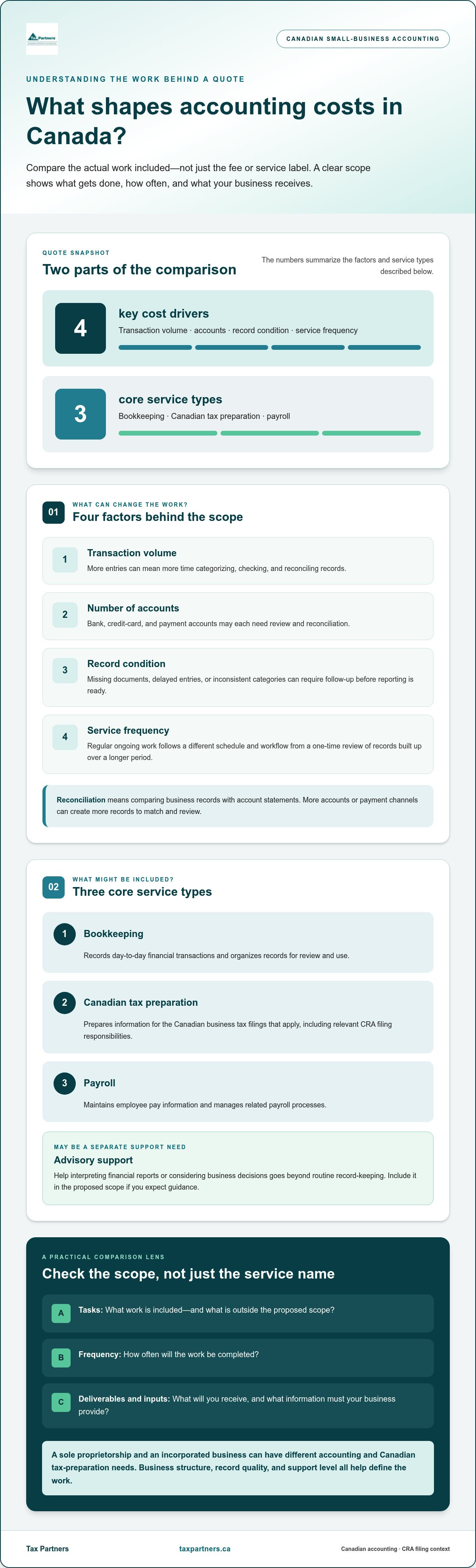
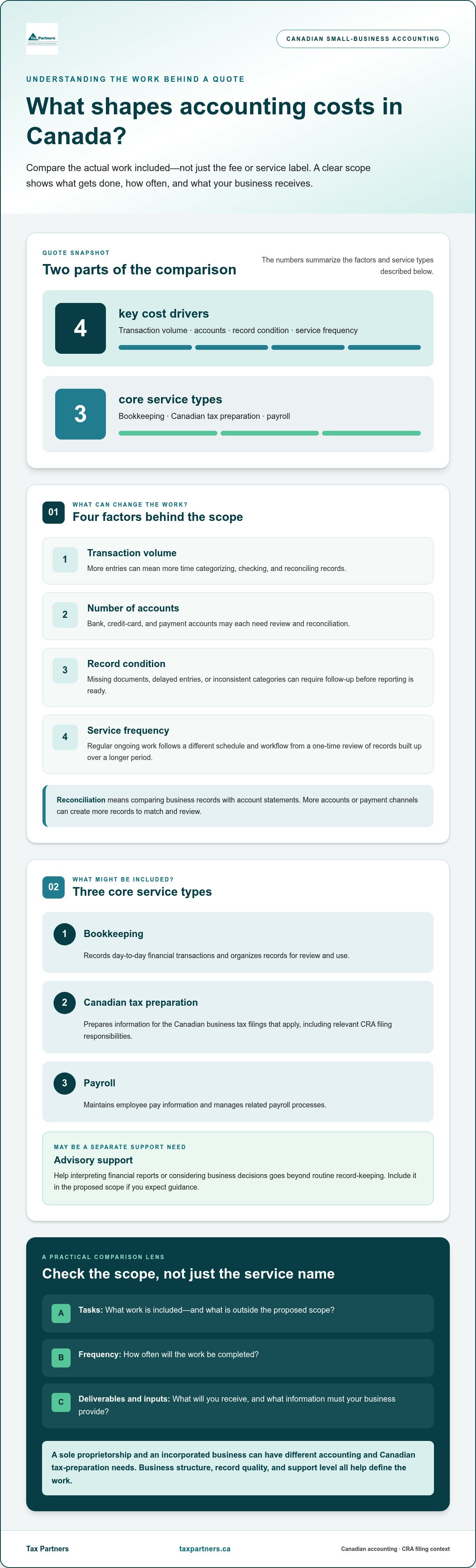
Start by listing the tasks your business needs and how often they arise. Bookkeeping records day-to-day financial transactions; tax preparation helps address applicable Canadian business filing responsibilities; and payroll support manages employee pay records and related processes.
- Bookkeeping: Recording transactions and organizing financial records so they’re easier to review and use.
- Tax preparation: Preparing information for the Canadian tax filings that apply to the business.
- Payroll: Maintaining employee pay information and managing related payroll processes.
You may also want advisory support, such as help interpreting financial reports or considering business decisions. This is different from routine record-keeping, so include it in the proposed scope if you expect guidance beyond organizing records and preparing filings.
Why is there no one-size-fits-all fee?
The work depends on the size, activity and condition of your records. A business with consistent transactions and organized documents may need less review than one with several revenue streams or incomplete records. Industry-specific activity can also affect reporting needs, but it doesn’t determine a particular fee on its own.
Transaction volume is one factor because entries may need to be categorized, checked and matched against account activity. More transactions can mean more reconciliation, which is the process of comparing records with account statements, as well as more information to review before reporting.
- Frequency: Regular ongoing support and a one-time year-end engagement involve different schedules and workflows.
- Record quality: Clear, organized records are generally easier to review than records that need sorting or correction.
- Support level: Bookkeeping alone has a different scope from bookkeeping combined with payroll, tax preparation or ongoing advice.
Before comparing fees, clarify which tasks are included, how often they’ll be completed and what information your business must provide. A defined scope helps you see what the quote covers and identify where additional work could arise.
What factors shape small-business accounting costs in Canada?
A quote reflects the work required to turn business activity into reliable, useful records. Along with transaction volume, an accounting professional may consider how many accounts the business uses, how consistently records are updated and how you want financial information organized.
Clear records and a defined service scope make accounting proposals easier to compare. They help you determine whether proposals differ because of their fee structures or because they cover different amounts of work.
The cost of accounting services for small business Canada can also depend on how money moves through your business. For example, sales through a storefront, an online platform and direct invoicing may create separate records to review and match against deposits.
- Transaction volume: More entries can require more time to categorize, check and reconcile.
- Number of accounts: Each bank, credit card or payment account may need its own review and reconciliation.
- Record condition: Missing documents, delayed entries or inconsistent categories can require follow-up before reporting is ready.
- Service frequency: Regular monthly work follows a different workflow from a one-time review of records accumulated over a longer period.
How do records and business complexity affect the scope?
Organized, regularly updated records give an accounting professional a clearer starting point. If records are backlogged or incomplete, an initial engagement may need to cover sorting transactions, resolving discrepancies and identifying missing information before routine work can begin.
Multiple payment channels, accounts or revenue streams can create additional review steps. For instance, a business that sells online and invoices clients may need deposits matched across several records. For practical context on the range of accounting needs in business services, consider how each activity affects the information your business needs to track.
How do industry and service needs change the work?
Different business activities can call for different workflows, even among businesses in the same industry. Inventory may require additional records to connect purchases and sales. A business that uses contractors may need to organize contractor-related payments and documents alongside its other transactions.
Payroll adds recurring employee pay records and related processes. These examples are prompts to identify the work your own operations involve, not rules that apply to every business in an industry. Describe your workflows so the proposed scope reflects your actual reporting needs.
Before reviewing a proposal, note how many accounts and payment channels your business uses, whether its records are current and which activities create extra reporting steps. If records need cleanup, ask for that work to be separated from ongoing services in the scope. This makes it easier to understand what the initial engagement covers and what support continues afterward.
Tax Partners offers tailored support for Canadian businesses through accounting services.
Hourly, fixed-fee, or recurring accounting support: how do you compare?
The billing structure explains how work is charged, but not necessarily what the work includes. To compare the cost of accounting services for small business Canada, look at the deliverables, how often work is done and how tasks outside the agreed scope are handled.
| Arrangement | Predictability | Flexibility | Scope and additional work |
|---|---|---|---|
| Hourly | Total charges depend on time spent. | Can suit occasional or variable requests. | Confirm which tasks are expected and how extra time is tracked. |
| Fixed-fee | More predictable for defined deliverables. | Changes to the agreed scope may require a revised arrangement. | Check which documents, filings or reports are included and what falls outside the fee. |
| Recurring | Provides a regular billing pattern for continuing work. | Can support an ongoing workflow, with scope depending on the arrangement. | Clarify included bookkeeping, payroll, reporting or tax support, and how additional tasks are treated. |
What should you compare in an accounting proposal?
Read the proposal as a description of work, not just a fee. Check which services are included, how often you’ll receive reports or other deliverables, what records your business must provide and which tasks are excluded. A one-time engagement isn’t directly comparable to a proposal for ongoing bookkeeping, payroll or tax support.
Compare equivalent scopes. If one proposal includes regular bookkeeping and another covers only a specific filing, their headline fees won’t show which arrangement better fits your needs. Tax Partners’ accounting support can be tailored to a business’s required services and reporting needs.
When might each billing structure fit?
Hourly work may suit a business with occasional questions or requests that vary over time. A fixed fee may fit when the deliverables and the records required for a defined engagement are clear. Recurring support may suit a business with work throughout the year, such as regular bookkeeping or payroll administration.
The right arrangement depends on how stable your workload is and the support you need. Consider whether you prefer a set scope, flexibility for changing requests or a regular working rhythm, then compare proposals against that preference.
Doing the books yourself is another option, but it still takes time to record and review activity, maintain oversight and prepare useful reports. Consider who will keep records current, follow up on missing information and turn financial data into reports you can use. Managing the work in-house may fit your capacity and needs, but account for your time and reporting requirements when weighing the options.
Before deciding, write down the recurring work, one-time deliverables and likely out-of-scope tasks you expect. This helps prevent a low headline fee from hiding a mismatch in service. Tax Partners provides tailored support for Canadian businesses through accounting services.
How can you prepare to compare accounting proposals?
A focused brief helps an accounting firm understand what your business needs and makes proposals easier to compare side by side. It also helps you assess the cost of accounting services for small business Canada against the work involved, rather than relying on a headline fee.
Before requesting or reviewing proposals, gather enough context to separate essential accounting tasks from support you may want later. Not every business needs ongoing advice or every available service, so start with the work that addresses your actual needs.
What information helps define your accounting needs?
Summarize how your business operates and what you need from its financial records. Include its structure, revenue activities, accounts, payroll arrangements and current bookkeeping process, along with any Canadian filing or reporting questions you want addressed.
- Note where revenue comes from and how transactions are recorded.
- List business accounts and payment channels, and say how often records are updated.
- Describe payroll needs, including who currently maintains employee pay records.
- Identify the reports you rely on and the questions they should help answer.
- Flag expected changes, such as growth, new revenue channels or staffing changes.
For an incorporated business, identify the Canadian corporate tax filing and related accounting work you want proposals to cover. The scope may include preparing the corporation’s annual tax return. Tax Partners provides Canadian corporate tax services in the context of a business’s filing needs.
How can you assess value beyond the quoted fee?
Look at how the work will be carried out and how useful the results will be. Consider the review process, communication expectations, reporting frequency and whether the support can continue as your business changes.
Clarify who handles each responsibility. Your team might provide transaction records while the accounting firm organizes and reviews them. Assign payroll duties clearly too, so tasks aren’t missed or duplicated.
Use this process to make the comparison practical:
- Define the essentials. List required bookkeeping, payroll, tax preparation and reporting work separately.
- Separate optional support. Note advisory questions you’d like help with, but keep them distinct from essential deliverables.
- Describe your records. Explain how they’re maintained and identify any gaps or work still needed.
- Set priorities. State which reports you need, how often you use them and what decisions they should inform.
- Compare the same scope. Check deliverables, responsibilities, communication and exclusions across each proposal.
Professional accounting support can help organize information and address filing responsibilities, but it doesn’t guarantee a particular tax outcome or savings. Focus on whether the proposed process, reporting and continuity suit your business. Tax Partners offers tailored support for Canadian businesses through accounting services.
Choose accounting support that can grow with your Canadian business
The right accounting relationship should fit your business as it operates now and remain adaptable as its needs change. Compare the proposed scope with your business’s complexity, the reports you rely on and how you prefer to communicate. The cost of accounting services for small business Canada makes more sense in that context than as a standalone figure.
Tax Partners provides Canadian accounting, bookkeeping and payroll support tailored to business needs, with experience serving businesses across multiple industries. That breadth can help shape support for different operating contexts, without assuming that businesses in the same industry need identical services.
What does a tailored accounting relationship look like?
Responsibilities are clear: your business knows what records and information it must provide, and the accounting team’s tasks and deliverables are defined. This can help keep work organized and clarify who handles routine bookkeeping, payroll processes and reporting.
Accurate records and useful reports also give owners a clearer basis for monitoring business activity. As operations evolve, review the service scope to reflect new responsibilities or reporting priorities instead of assuming the original arrangement will always fit.
What is a practical next step for your business?
Before discussing support, outline your current bookkeeping process, payroll needs and Canadian tax responsibilities. Note what is working, where you need help and what changes you anticipate, such as adding a revenue channel or changing how you manage operations.
Consider what you need from an accounting relationship, not just a list of tasks. Your communication preferences, reporting priorities and the complexity of your records all help shape a useful discussion about scope.
- Bookkeeping: Identify how records are maintained and what ongoing organization or review would help.
- Payroll: Describe the payroll processes your business needs support with and who currently manages them.
- Canadian tax: Note the filing responsibilities and related work you want included in the discussion.
- Future needs: Flag expected changes that could affect the type or frequency of support required.
A focused discussion can connect these needs to a clearly defined scope, whether you’re seeking specific services or support that can adjust over time. The goal is a working relationship that reflects your circumstances and clarifies responsibilities and reporting.
To discuss the bookkeeping, payroll and tax support your business needs, contact Tax Partners about your Canadian accounting requirements.
Make your next accounting decision with confidence
Your accounting needs may change as your business evolves. Treat the decision as an opportunity to build a working relationship that can be reviewed and adjusted as your priorities shift, rather than choosing support only for today’s demands.
Bring your questions and business context into a focused discussion. This gives you a clearer starting point for weighing the cost of accounting services for small business Canada against the support you need now and may need as your business grows.
Tax Partners provides tailored Canadian accounting, bookkeeping and payroll support for businesses. Discuss accounting support for your small business and outline the work you need help with.
Frequently Asked Questions
How much do accounting services cost for a small business in Canada?
There isn’t one fee for every Canadian small business. For budgeting, separate initial setup or catch-up work from ongoing support, since they address different stages of the engagement. If the scope changes after the accountant reviews your situation, clarify how the change will be discussed and approved before the additional work proceeds. This helps you plan without assuming the first estimate covers every possible task.
What accounting services does a small business usually need?
Start with the immediate problem you want to solve instead of choosing a broad package by default. You might need help preparing for year-end, improving management reports or setting up a dependable process for financial records. Rank your needs by urgency and importance to your decisions. That list can shape an initial engagement while leaving room to add other support later.
Is hiring an accountant worth it for a small business in Canada?
It can be worthwhile if your business would benefit from a consistent, documented financial process instead of relying on one person’s memory or informal routines. Consider whether you can still understand the business’s financial position if the staff member who manages the records is away or leaves. Professional support can clarify information and responsibilities, while business owners remain involved in reviewing results and making decisions.
What is the difference between a bookkeeper and an accountant for a small business?
The practical distinction is often who performs each step and who reviews the result. In a proposal, look for clarity on who enters information, checks account reconciliations, follows up on unusual items and prepares reports. Duties can vary by engagement, regardless of job title. A responsibility map helps prevent duplicated work or gaps between your internal team and the accounting firm.
Should a small business choose hourly or monthly accounting services?
Consider how the arrangement fits your planning and approval process. Decide who authorizes work outside the agreed engagement and how you want to be informed if the scope changes. Also consider how the payment schedule fits your business’s cash-flow planning. These practical details matter alongside the billing label in a proposal.
Can accounting fees change as a small business grows?
They may, so treat scope review as part of managing the relationship rather than waiting until renewal or year-end. Tell your accounting team when a planned change could affect financial workflows, and discuss any new responsibilities before they become routine. Keeping a record of agreed changes helps everyone work from the same expectations and understand why the engagement has been adjusted.
What records should I prepare before discussing accounting services?
You can start with the information you have, even if it’s incomplete. Rather than correcting every inconsistency first, make a brief note of what you’re unsure about, when the issue began and whether it affects a particular period or business activity. Include the questions you want answered. This context helps distinguish a one-time uncertainty from a broader process concern without delaying the discussion.

Article by
Mahad Mohamed
Mahad Mohamed is an accountant and the CEO of Tax Partners, with over 26+ years of Canadian and international tax and accounting experience. His expertise includes corporate reorganization, cross-border tax structuring (Canada & US), tax disputes, CRA audits, and tax planning for small owner-managed private corporations. Most recently, Mahad is a pioneer in Canadian crypto taxation and founded Block3 Finance.
Previously, Mahad worked for the Canada Revenue Agency (CRA), Big4 accounting firms, and served as a Rulings Officer for the Federal Tax Authority of the UAE before acquiring Tax Partners in 2014.
Tax Partners has 44 full-time accountants and over 18,400+ clients.
Disclaimer
This article provides general information only and is current as of its publication date. It has not been updated and may be out of date. It does not constitute legal advice and should not be relied upon as such. Every tax situation is unique and may differ from the examples discussed in this article. If you have specific questions, you should seek the advice of our accountants for your unique circumstances. Book a FREE Initial Consultation Today!
Frequently Asked Questions
Which accounting tasks might a small business need?
Start by listing the tasks your business needs and how often they arise. Bookkeeping records day-to-day financial transactions; tax preparation helps address applicable Canadian business filing responsibilities; and payroll support manages employee pay records and related processes. You may also want advisory support, such as help interpreting financial reports or considering business decisions. This is different from routine record-keeping, so include it in the proposed scope if you expect guidance beyond organizing records and preparing filings.
Why is there no one-size-fits-all fee?
The work depends on the size, activity and condition of your records. A business with consistent transactions and organized documents may need less review than one with several revenue streams or incomplete records. Industry-specific activity can also affect reporting needs, but it doesn’t determine a particular fee on its own. Transaction volume is one factor because entries may need to be categorized, checked and matched against account activity. More transactions can mean more reconciliation, which is the process of comparing records with account statements, as well as more information to review before reporting. Before comparing fees, clarify which tasks are included, how often they’ll be completed and what information your business must provide. A defined scope helps you see what the quote covers and identify where additional work could arise. A quote reflects the work required to turn business activity into reliable, useful records. Along with transaction volume, an accounting professional may consider how many accounts the business uses, how consistently records are updated and how you want financial information organized. Clear records and a defined service scope make accounting proposals easier to compare. They help you determine whether proposals differ because of their fee structures or because they cover different amounts of work. The cost of accounting services for small business Canada can also depend on how money moves through your business. For example, sales through a storefront, an online platform and direct invoicing may create separate records to review and match against deposits.
How do records and business complexity affect the scope?
Organized, regularly updated records give an accounting professional a clearer starting point. If records are backlogged or incomplete, an initial engagement may need to cover sorting transactions, resolving discrepancies and identifying missing information before routine work can begin. Multiple payment channels, accounts or revenue streams can create additional review steps. For instance, a business that sells online and invoices clients may need deposits matched across several records. For practical context on the range of accounting needs in business services, consider how each activity affects the information your business needs to track.
How do industry and service needs change the work?
Different business activities can call for different workflows, even among businesses in the same industry. Inventory may require additional records to connect purchases and sales. A business that uses contractors may need to organize contractor-related payments and documents alongside its other transactions. Payroll adds recurring employee pay records and related processes. These examples are prompts to identify the work your own operations involve, not rules that apply to every business in an industry. Describe your workflows so the proposed scope reflects your actual reporting needs. Before reviewing a proposal, note how many accounts and payment channels your business uses, whether its records are current and which activities create extra reporting steps. If records need cleanup, ask for that work to be separated from ongoing services in the scope. This makes it easier to understand what the initial engagement covers and what support continues afterward. Tax Partners offers tailored support for Canadian businesses through accounting services. The billing structure explains how work is charged, but not necessarily what the work includes. To compare the cost of accounting services for small business Canada, look at the deliverables, how often work is done and how tasks outside the agreed scope are handled.
What should you compare in an accounting proposal?
Read the proposal as a description of work, not just a fee. Check which services are included, how often you’ll receive reports or other deliverables, what records your business must provide and which tasks are excluded. A one-time engagement isn’t directly comparable to a proposal for ongoing bookkeeping, payroll or tax support. Compare equivalent scopes. If one proposal includes regular bookkeeping and another covers only a specific filing, their headline fees won’t show which arrangement better fits your needs. Tax Partners’ accounting support can be tailored to a business’s required services and reporting needs.
When might each billing structure fit?
Hourly work may suit a business with occasional questions or requests that vary over time. A fixed fee may fit when the deliverables and the records required for a defined engagement are clear. Recurring support may suit a business with work throughout the year, such as regular bookkeeping or payroll administration. The right arrangement depends on how stable your workload is and the support you need. Consider whether you prefer a set scope, flexibility for changing requests or a regular working rhythm, then compare proposals against that preference. Doing the books yourself is another option, but it still takes time to record and review activity, maintain oversight and prepare useful reports. Consider who will keep records current, follow up on missing information and turn financial data into reports you can use. Managing the work in-house may fit your capacity and needs, but account for your time and reporting requirements when weighing the options. Before deciding, write down the recurring work, one-time deliverables and likely out-of-scope tasks you expect. This helps prevent a low headline fee from hiding a mismatch in service. Tax Partners provides tailored support for Canadian businesses through accounting services. A focused brief helps an accounting firm understand what your business needs and makes proposals easier to compare side by side. It also helps you assess the cost of accounting services for small business Canada against the work involved, rather than relying on a headline fee. Before requesting or reviewing proposals, gather enough context to separate essential accounting tasks from support you may want later. Not every business needs ongoing advice or every available service, so start with the work that addresses your actual needs.
What information helps define your accounting needs?
Summarize how your business operates and what you need from its financial records. Include its structure, revenue activities, accounts, payroll arrangements and current bookkeeping process, along with any Canadian filing or reporting questions you want addressed. For an incorporated business, identify the Canadian corporate tax filing and related accounting work you want proposals to cover. The scope may include preparing the corporation’s annual tax return. Tax Partners provides Canadian corporate tax services in the context of a business’s filing needs.
How can you assess value beyond the quoted fee?
Look at how the work will be carried out and how useful the results will be. Consider the review process, communication expectations, reporting frequency and whether the support can continue as your business changes. Clarify who handles each responsibility. Your team might provide transaction records while the accounting firm organizes and reviews them. Assign payroll duties clearly too, so tasks aren’t missed or duplicated. Use this process to make the comparison practical: Professional accounting support can help organize information and address filing responsibilities, but it doesn’t guarantee a particular tax outcome or savings. Focus on whether the proposed process, reporting and continuity suit your business. Tax Partners offers tailored support for Canadian businesses through accounting services. The right accounting relationship should fit your business as it operates now and remain adaptable as its needs change. Compare the proposed scope with your business’s complexity, the reports you rely on and how you prefer to communicate. The cost of accounting services for small business Canada makes more sense in that context than as a standalone figure. Tax Partners provides Canadian accounting, bookkeeping and payroll support tailored to business needs, with experience serving businesses across multiple industries. That breadth can help shape support for different operating contexts, without assuming that businesses in the same industry need identical services.
What does a tailored accounting relationship look like?
Responsibilities are clear: your business knows what records and information it must provide, and the accounting team’s tasks and deliverables are defined. This can help keep work organized and clarify who handles routine bookkeeping, payroll processes and reporting. Accurate records and useful reports also give owners a clearer basis for monitoring business activity. As operations evolve, review the service scope to reflect new responsibilities or reporting priorities instead of assuming the original arrangement will always fit.
What is a practical next step for your business?
Before discussing support, outline your current bookkeeping process, payroll needs and Canadian tax responsibilities. Note what is working, where you need help and what changes you anticipate, such as adding a revenue channel or changing how you manage operations. Consider what you need from an accounting relationship, not just a list of tasks. Your communication preferences, reporting priorities and the complexity of your records all help shape a useful discussion about scope. A focused discussion can connect these needs to a clearly defined scope, whether you’re seeking specific services or support that can adjust over time. The goal is a working relationship that reflects your circumstances and clarifies responsibilities and reporting. To discuss the bookkeeping, payroll and tax support your business needs, contact Tax Partners about your Canadian accounting requirements. Your accounting needs may change as your business evolves. Treat the decision as an opportunity to build a working relationship that can be reviewed and adjusted as your priorities shift, rather than choosing support only for today’s demands. Bring your questions and business context into a focused discussion. This gives you a clearer starting point for weighing the cost of accounting services for small business Canada against the support you need now and may need as your business grows. Tax Partners provides tailored Canadian accounting, bookkeeping and payroll support for businesses. Discuss accounting support for your small business and outline the work you need help with.
How much do accounting services cost for a small business in Canada?
There isn’t one fee for every Canadian small business. For budgeting, separate initial setup or catch-up work from ongoing support, since they address different stages of the engagement. If the scope changes after the accountant reviews your situation, clarify how the change will be discussed and approved before the additional work proceeds. This helps you plan without assuming the first estimate covers every possible task.
What accounting services does a small business usually need?
Start with the immediate problem you want to solve instead of choosing a broad package by default. You might need help preparing for year-end, improving management reports or setting up a dependable process for financial records. Rank your needs by urgency and importance to your decisions. That list can shape an initial engagement while leaving room to add other support later.
Is hiring an accountant worth it for a small business in Canada?
It can be worthwhile if your business would benefit from a consistent, documented financial process instead of relying on one person’s memory or informal routines. Consider whether you can still understand the business’s financial position if the staff member who manages the records is away or leaves. Professional support can clarify information and responsibilities, while business owners remain involved in reviewing results and making decisions.
What is the difference between a bookkeeper and an accountant for a small business?
The practical distinction is often who performs each step and who reviews the result. In a proposal, look for clarity on who enters information, checks account reconciliations, follows up on unusual items and prepares reports. Duties can vary by engagement, regardless of job title. A responsibility map helps prevent duplicated work or gaps between your internal team and the accounting firm.
Should a small business choose hourly or monthly accounting services?
Consider how the arrangement fits your planning and approval process. Decide who authorizes work outside the agreed engagement and how you want to be informed if the scope changes. Also consider how the payment schedule fits your business’s cash-flow planning. These practical details matter alongside the billing label in a proposal.
Can accounting fees change as a small business grows?
They may, so treat scope review as part of managing the relationship rather than waiting until renewal or year-end. Tell your accounting team when a planned change could affect financial workflows, and discuss any new responsibilities before they become routine. Keeping a record of agreed changes helps everyone work from the same expectations and understand why the engagement has been adjusted.
What records should I prepare before discussing accounting services?
You can start with the information you have, even if it’s incomplete. Rather than correcting every inconsistency first, make a brief note of what you’re unsure about, when the issue began and whether it affects a particular period or business activity. Include the questions you want answered. This context helps distinguish a one-time uncertainty from a broader process concern without delaying the discussion.