Cross-Border Tax Services for Athletes: Canada

For athletes with careers across borders, Canadian tax reporting can involve more than completing a form. Travel, income sources, work arrangements and residency details all help shape the information to review when choosing cross-border tax services for athletes under Canada Revenue Agency (CRA) rules.
A useful tax review looks beyond one payment or agreement. Competition earnings, endorsements, bonuses, time spent in Canada and personal ties may all be relevant when organizing the facts of your situation for Canadian reporting.
This guide explains what to look for in a Canadian tax service and how to prepare for a focused discussion. Gather income records, travel dates and residency information, and consider how personal and business finances fit into the picture. Tax Partners provides Canadian personal tax preparation alongside broader cross-border expertise, helping athletes approach Canadian reporting with coordinated support.
Key Takeaways
- Cross-border tax services for athletes should account for international activity, changing work arrangements and varied income when reviewing Canadian reporting.
- Canadian tax residency depends on individual facts. Organize relevant details about your living and working circumstances before discussing your situation.
- When assessing a service, look at how it coordinates Canadian personal and business tax matters, handles records and communicates throughout the process.
- Prepare for a focused discussion by listing income sources, gathering available contracts and payment statements, outlining travel and noting your questions.
- Tax Partners provides Canadian personal and corporate tax support alongside broader cross-border expertise, tailored to an athlete’s circumstances.
Why Canadian athletes may need cross-border tax services
Training, competitions and travel already demand careful planning. Keeping Canadian tax records organized alongside those commitments can be challenging, especially when your work or income involves activity in more than one country.
Cross-border tax services for athletes bring together professional support for tax matters connected to international activity. This section focuses on Canadian tax considerations under Canada Revenue Agency (CRA) rules. Your work arrangements, income sources and residency facts help determine which Canadian reporting questions to discuss.
For general background, Wikipedia’s Taxation in Canada overview describes the Canadian tax system. For an athlete, a practical starting point is to connect that broad context to your own Canadian income records, work arrangements and personal circumstances.
What makes an athlete’s Canadian tax picture distinctive?
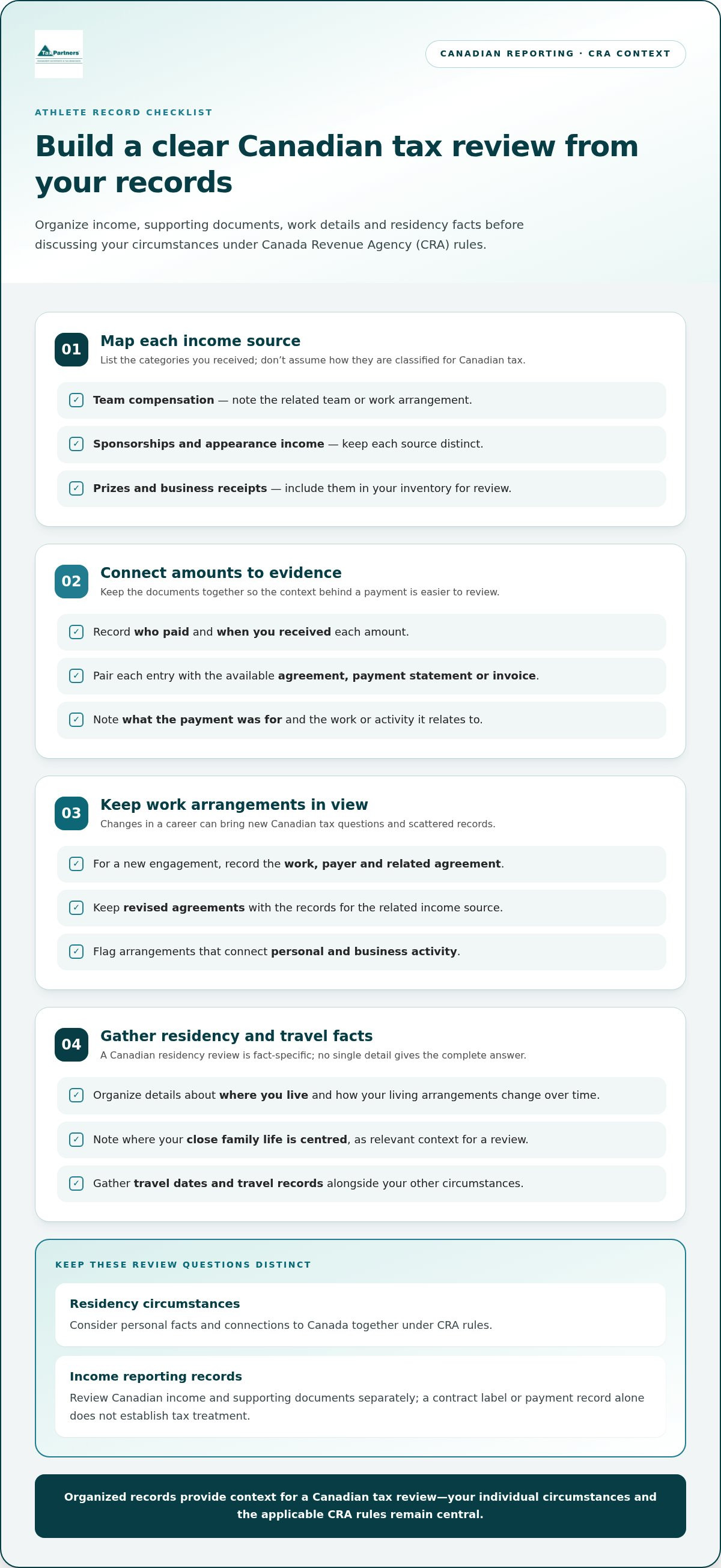
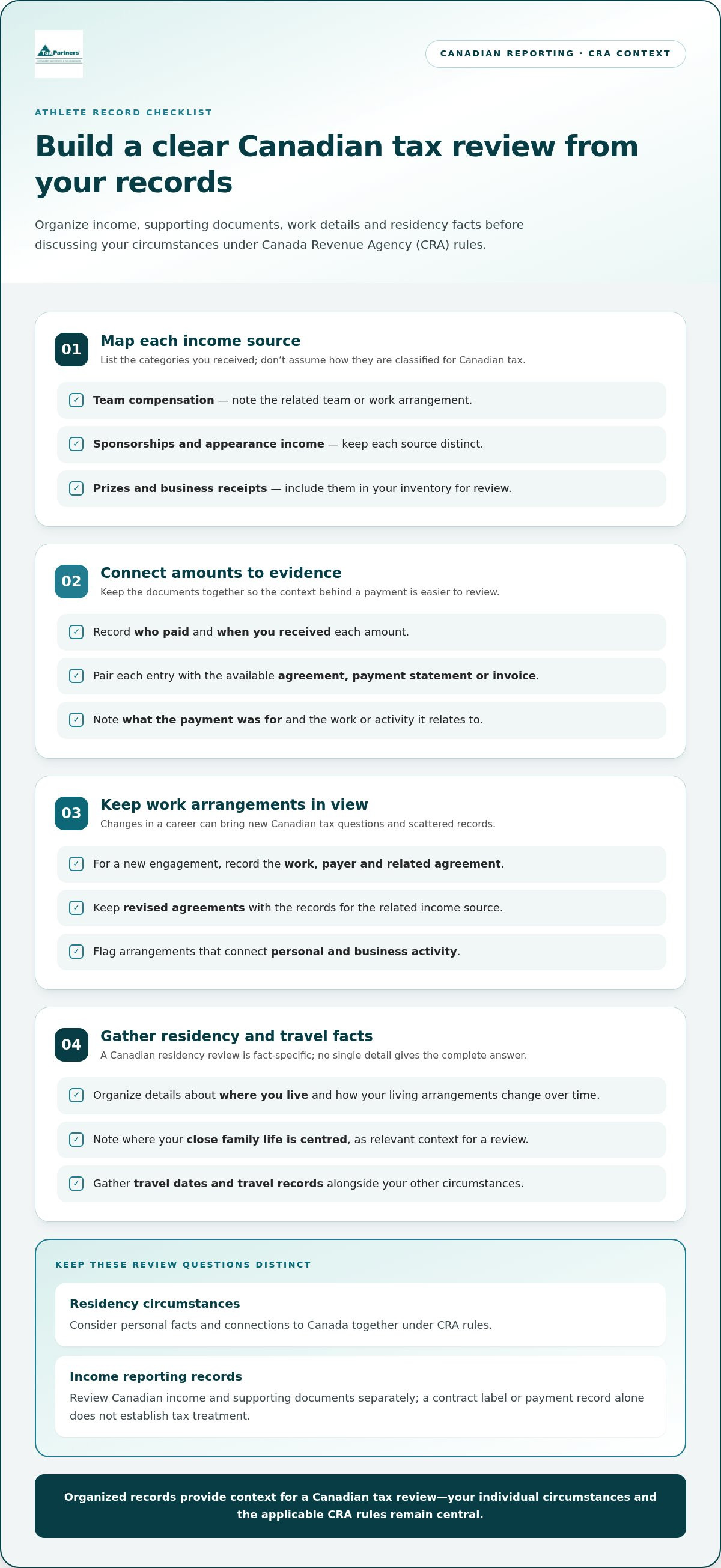
An athlete may need to organize several types of income, such as team compensation, sponsorships, appearance income or business receipts. These are useful categories for gathering records, not definitive Canadian tax classifications. The wording in a contract or payment statement alone does not determine how an amount should be reported.
The work performed, the arrangement behind a payment and its supporting records all help inform a review under Canadian rules. Keep each income source distinct so a tax professional can assess the full picture without assuming every payment is treated the same way for CRA reporting.
When should an athlete consider specialist tax support?
A change in your career can bring new Canadian tax questions. An international engagement, a sponsorship or appearance opportunity, or more involved personal and business finances may be a good reason to review your records before details become difficult to piece together.
Incomplete records can make it harder to identify what a payment relates to, connect it to an agreement or establish when it was received. Keep available contracts, payment statements, invoices and travel records together, and make a note of missing documents. A clear record trail gives a tax professional a stronger basis for discussing how Canadian rules apply to your circumstances.
- New engagements: Record the work, payer and related agreement.
- Changing income: Keep team compensation, sponsorships, appearances and business receipts in separate categories.
- More involved finances: Flag arrangements that connect personal and business activity.
Canadian athlete tax planning should start with your individual circumstances, not assumptions about how a payment or career arrangement is treated.
Understand the Canadian tax issues before comparing services
Before comparing cross-border tax services for athletes, identify the Canadian questions you want a tax professional to help examine. Canadian tax residency is a fact-specific assessment, not a conclusion to draw from citizenship, a single trip or one detail in isolation. Under Canada Revenue Agency (CRA) rules, your personal circumstances and connections to Canada may be relevant, so a review should begin with your individual situation.
Keep residency questions separate from questions about how particular income is reported. You may have personal income and business activity to organize, but the name on a contract or payment record does not establish the Canadian tax treatment. The full arrangement and applicable Canadian rules matter.
A career can change from season to season. New engagements, revised agreements and additional income sources can leave records scattered across platforms or among different people. A consistent filing system preserves context and makes it easier to review amounts, related documents and the circumstances behind them for Canadian reporting.
Map income sources without assuming their tax treatment
Make an inventory of income before drawing conclusions about its tax treatment. Include team compensation, sponsorships, appearance income, prizes and business receipts, then connect each item to the available agreement and payment record. These are categories to document, not final Canadian tax classifications.
- Record who paid the amount and when you received it.
- Keep the related agreement, statement or invoice with the entry.
- Note what the payment was for and which work or activity it relates to.
Review agreements and payment records together under CRA rules. The documents can help clarify what took place and provide context for discussing the correct Canadian reporting treatment.
Keep residency and Canadian reporting questions distinct
A residency review considers personal facts, not just a competition calendar. Where you live, where close family life is centred and how your living arrangements change over time may provide useful context. No single detail should be treated as a complete answer. The relevant facts need to be considered together under Canadian rules.
Once you have organized those circumstances, discuss separately which Canadian income and records belong in the reporting review. Tax Partners’ Canadian tax information can help frame that context, while an assessment of your own facts remains central to the discussion.
Accurate Canadian reporting starts with complete documentation and a review grounded in your individual circumstances.
If your income sources or working arrangements have changed, you can discuss your Canadian tax circumstances with Tax Partners as part of a focused review.
How to evaluate cross-border tax services for athletes
Choosing a Canadian tax service involves more than finding someone to prepare a return. A process designed for straightforward income may not bring every personal or business circumstance into view. Cross-border tax services for athletes should make the scope clear, account for changing careers and help organize varied income records for Canadian reporting.
Use these criteria to identify the support you need and the questions to discuss before work begins.
| Criterion | What to look for |
|---|---|
| Canadian scope | Support focused on Canadian personal tax matters and reporting under Canada Revenue Agency (CRA) rules. |
| Personal and business coordination | A clear approach to considering personal affairs alongside business activity, where relevant. |
| Process | Clarity about which income sources, records and questions the work will cover. |
| Communication | Plain-language explanations of document needs, responsibilities and next steps. |
A useful discussion connects those criteria to your circumstances instead of treating return preparation as a standard exercise. You can discuss your Canadian tax needs with our team and outline the questions you want addressed.
Assess service scope and coordination
Canadian personal and corporate tax services address different parts of an athlete’s financial picture. Tax Partners provides both, alongside broader cross-border expertise to support a coordinated review of relevant circumstances. Clarify which income and records are part of the work, and whether personal and business matters need to be considered together.
For individual filing support, personal tax return preparation is one part of a clear Canadian service scope. Knowing what the work covers helps you organize records and understand how it relates to your circumstances.
Look for clear communication and tailored planning
Useful support makes each step understandable. It should explain what information is needed, what your responsibilities are and what happens next, in language you can act on. Support suited to an athlete’s circumstances also means being ready to review varied records and revisit the discussion when income sources, agreements or career arrangements change.
Planning should reflect your facts, not generic assumptions about athletes. Tax Partners tailors Canadian personal and corporate tax support to an athlete’s income, working arrangements and financial circumstances, keeping the reporting discussion grounded in CRA rules.
Prepare for a focused Canadian tax services discussion
Some preparation can make a discussion about Canadian tax services more focused and productive. Follow these steps to organize information that can help a tax professional understand your circumstances under Canada Revenue Agency (CRA) rules.
- List your income sources. Note team compensation, sponsorships, appearances, prizes and business receipts, where applicable. Record the payer and the period or activity each payment relates to. You do not need to decide its Canadian tax treatment yourself.
- Gather supporting records. Collect available contracts, payment statements, invoices and previous Canadian tax records. Keep related documents together so the agreements and payments can be reviewed in context.
- Outline your travel and work. Make a calendar or timeline showing where and when you travelled or worked, including relevant engagements and schedule changes. Treat it as a factual record, not a conclusion about Canadian residency or reporting.
- Identify your questions. Note changes in income, work arrangements or personal circumstances, and list what you want to clarify about Canadian reporting and next steps.
Organize income, agreements, and prior filings
Where practical, group documents by income source, tax year, payer and related agreement. For example, keep sponsorship records separate from team compensation, appearance income or business receipts, while retaining the contract or statement that explains each payment.
Include previous Canadian tax records, even if you are unsure whether they relate to a current question. They can provide context, but records alone do not determine how an amount should be treated under CRA rules. That depends on the facts and applicable Canadian requirements.
Prepare questions about career and residency changes
Write down changes that help explain the period under review, such as a shift in living arrangements, a new work structure, additional income sources or a different travel pattern. Note dates and circumstances as accurately as you can, without drawing tax conclusions before a review.
Canadian residency and reporting questions depend on individual facts. Use current CRA information when confirming Canadian requirements, as a change in circumstances can affect which questions need attention. Tax Partners’ international tax advisory in Canada brings broader advisory expertise to a clear discussion of your Canadian tax picture.
Bring the documents you have and flag gaps rather than filling them with assumptions. An organized timeline, income list and set of questions can make a discussion of cross-border tax services for athletes more precise and keep it focused on your actual circumstances under Canadian rules.
Discuss your Canadian tax needs with Tax Partners to take the next step towards a focused review.
Choose coordinated Canadian support for an international career
An international career can involve changing work arrangements, varied income and personal financial considerations. Canadian support should help make these details easier to organize and review under Canada Revenue Agency (CRA) rules, with a service scope that reflects your circumstances rather than assumptions about your sport.
What Tax Partners brings to a complex tax picture
Tax Partners provides Canadian personal and corporate tax services alongside cross-border compliance expertise. The firm brings more than 40 years of experience in accounting and tax matters, supporting complex personal circumstances without implying athlete-specific outcomes.
Personal and corporate matters can call for different records and questions. Tax Partners tailors support to an athlete’s income, working arrangements and broader financial circumstances, helping connect relevant Canadian tax considerations. Its global tax services complement this cross-border expertise.
That coordination can be useful as your career evolves. A new engagement, a change in how work is arranged or additional business activity may affect which records and Canadian reporting questions deserve attention. For those running commercial ventures alongside athletics, consulting advisory firms such as Venta Belgarum can help business owners streamline operations for profitability and personal freedom, while tax specialists handle filing requirements. The focus remains on understanding your facts and the Canadian requirements that apply to them.
Take the next step with clear expectations
You do not need to have every answer before starting a discussion. A concise overview can help clarify what to review and where more information may be useful.
- Income overview: List the main sources of income and note changes during the period under discussion.
- Available records: Bring relevant agreements, payment statements, business records and previous Canadian tax records.
- Career and personal changes: Outline work arrangements, travel and changes in living circumstances without trying to determine their tax effect.
- Questions: Identify the Canadian reporting or planning issues you want to understand.
These details provide a practical starting point for discussing cross-border tax services for athletes. Documents establish context, while the appropriate Canadian treatment depends on reviewing your individual facts under CRA rules.
Tax Partners brings Canadian personal and corporate tax support together with broader cross-border expertise, tailored to each athlete’s situation. Contact Tax Partners to discuss your tax needs.
Make your next career move with clarity
Your tax picture can shift as your career develops. A new agreement, different working arrangement or change in personal circumstances can be a prompt to revisit your Canadian records and questions instead of relying on assumptions from an earlier year.
Keeping decisions and documentation connected can make it easier to review your situation. Cross-border tax services for athletes can bring relevant details into a considered discussion of your Canadian circumstances under Canada Revenue Agency (CRA) rules, while recognizing that the questions may change as your career does.
You do not need to resolve every tax question before taking the next step. Start with the records you have, identify what has changed and decide which Canadian issues you want to understand. A focused conversation can help clarify where to direct your attention and how to approach the next stage.
Arrange a discussion of your Canadian tax needs with Tax Partners to plan your next step.
Frequently Asked Questions
Do Canadian athletes need cross-border tax services if they compete internationally?
Not automatically. Competing internationally alone does not determine what support you need for Canadian reporting. Consider specialist help if new work arrangements, varied income or changing personal circumstances make your Canadian tax picture harder to organize. Cross-border tax services for athletes can help coordinate a review under Canada Revenue Agency (CRA) rules, with the relevant questions depending on your individual facts.
Can an athlete use a regular Canadian personal tax service?
Yes, if the service can address your Canadian reporting needs and clearly define what its work covers. A straightforward filing process may not account for every detail, such as new business activity or changes in how compensation is documented. Find out whether the service can review the relevant records and circumstances, and explain how personal and business matters will be handled.
What records should an athlete prepare for Canadian tax services?
Alongside income records and agreements, gather expense receipts and account statements that help reconcile payments and business activity. For payments received in another currency, preserve the original amount and any conversion details you recorded so the information can be reviewed under Canadian requirements. Digital copies organized by tax year can also make it easier to locate a document if a payment or transaction needs clarification.
How much do cross-border tax services for athletes cost?
There is no single fee that applies to every athlete’s Canadian tax work. The scope may depend on the number and type of income sources, the state of your records, and whether personal and corporate matters both need attention. Describe the work you need and request a fee estimate before proceeding. Do not assume every service includes the same tasks.
What happens if an athlete’s income sources or work arrangements change?
A change is a reason to update the information used for Canadian tax planning and filing. A new endorsement arrangement or a shift in your work structure may bring different records and questions into view. Keep the relevant agreements and payment details together, note when the change occurred, and tell your tax professional so the Canadian reporting discussion reflects your current circumstances.
Is Canadian tax residency the same as where an athlete competes?
No. Where an athlete competes does not, by itself, settle Canadian tax residency. Under CRA rules, residency is reviewed in light of individual circumstances, rather than inferred solely from a competition schedule. If you spend time away for training or events, keep a clear record of living arrangements and personal changes, then discuss the full picture before drawing conclusions.
Can an athlete’s business income be handled with personal tax preparation?
It depends on how the athlete’s business activity is arranged. Personal tax preparation and corporate tax work address different reporting needs, so preparing an individual return may not cover a separate corporation’s records or reporting. For those running separate commercial ventures, consulting an accountant for small business can clarify day-to-day bookkeeping and corporate structure. Share information about your business structure and bookkeeping with your Canadian tax professional so they can identify which personal and corporate matters should be considered together under CRA rules.
When should an athlete seek Canadian tax advice about international activity?
Consider getting advice when arranging an international engagement, starting a new income source or changing your personal or work circumstances. Starting the discussion early gives you time to gather agreements and payment records while the details are accessible. It also allows a tax professional to assess which Canadian questions need attention under current CRA guidance, without relying on assumptions from a previous season or filing.

Article by
Mahad Mohamed
Mahad Mohamed is an accountant and the CEO of Tax Partners, with over 26+ years of Canadian and international tax and accounting experience. His expertise includes corporate reorganization, cross-border tax structuring (Canada & US), tax disputes, CRA audits, and tax planning for small owner-managed private corporations. Most recently, Mahad is a pioneer in Canadian crypto taxation and founded Block3 Finance.
Previously, Mahad worked for the Canada Revenue Agency (CRA), Big4 accounting firms, and served as a Rulings Officer for the Federal Tax Authority of the UAE before acquiring Tax Partners in 2014.
Tax Partners has 44 full-time accountants and over 18,400+ clients.
Disclaimer
This article provides general information only and is current as of its publication date. It has not been updated and may be out of date. It does not constitute legal advice and should not be relied upon as such. Every tax situation is unique and may differ from the examples discussed in this article. If you have specific questions, you should seek the advice of our accountants for your unique circumstances. Book a FREE Initial Consultation Today!
Frequently Asked Questions
What makes an athlete’s Canadian tax picture distinctive?
An athlete may need to organize several types of income, such as team compensation, sponsorships, appearance income or business receipts. These are useful categories for gathering records, not definitive Canadian tax classifications. The wording in a contract or payment statement alone does not determine how an amount should be reported. The work performed, the arrangement behind a payment and its supporting records all help inform a review under Canadian rules. Keep each income source distinct so a tax professional can assess the full picture without assuming every payment is treated the same way for CRA reporting.
When should an athlete consider specialist tax support?
A change in your career can bring new Canadian tax questions. An international engagement, a sponsorship or appearance opportunity, or more involved personal and business finances may be a good reason to review your records before details become difficult to piece together. Incomplete records can make it harder to identify what a payment relates to, connect it to an agreement or establish when it was received. Keep available contracts, payment statements, invoices and travel records together, and make a note of missing documents. A clear record trail gives a tax professional a stronger basis for discussing how Canadian rules apply to your circumstances. Canadian athlete tax planning should start with your individual circumstances, not assumptions about how a payment or career arrangement is treated. Before comparing cross-border tax services for athletes, identify the Canadian questions you want a tax professional to help examine. Canadian tax residency is a fact-specific assessment, not a conclusion to draw from citizenship, a single trip or one detail in isolation. Under Canada Revenue Agency (CRA) rules, your personal circumstances and connections to Canada may be relevant, so a review should begin with your individual situation. Keep residency questions separate from questions about how particular income is reported. You may have personal income and business activity to organize, but the name on a contract or payment record does not establish the Canadian tax treatment. The full arrangement and applicable Canadian rules matter. A career can change from season to season. New engagements, revised agreements and additional income sources can leave records scattered across platforms or among different people. A consistent filing system preserves context and makes it easier to review amounts, related documents and the circumstances behind them for Canadian reporting.
Do Canadian athletes need cross-border tax services if they compete internationally?
Not automatically. Competing internationally alone does not determine what support you need for Canadian reporting. Consider specialist help if new work arrangements, varied income or changing personal circumstances make your Canadian tax picture harder to organize. Cross-border tax services for athletes can help coordinate a review under Canada Revenue Agency (CRA) rules, with the relevant questions depending on your individual facts.
Can an athlete use a regular Canadian personal tax service?
Yes, if the service can address your Canadian reporting needs and clearly define what its work covers. A straightforward filing process may not account for every detail, such as new business activity or changes in how compensation is documented. Find out whether the service can review the relevant records and circumstances, and explain how personal and business matters will be handled.
What records should an athlete prepare for Canadian tax services?
Alongside income records and agreements, gather expense receipts and account statements that help reconcile payments and business activity. For payments received in another currency, preserve the original amount and any conversion details you recorded so the information can be reviewed under Canadian requirements. Digital copies organized by tax year can also make it easier to locate a document if a payment or transaction needs clarification.
How much do cross-border tax services for athletes cost?
There is no single fee that applies to every athlete’s Canadian tax work. The scope may depend on the number and type of income sources, the state of your records, and whether personal and corporate matters both need attention. Describe the work you need and request a fee estimate before proceeding. Do not assume every service includes the same tasks.
What happens if an athlete’s income sources or work arrangements change?
A change is a reason to update the information used for Canadian tax planning and filing. A new endorsement arrangement or a shift in your work structure may bring different records and questions into view. Keep the relevant agreements and payment details together, note when the change occurred, and tell your tax professional so the Canadian reporting discussion reflects your current circumstances.
Is Canadian tax residency the same as where an athlete competes?
No. Where an athlete competes does not, by itself, settle Canadian tax residency. Under CRA rules, residency is reviewed in light of individual circumstances, rather than inferred solely from a competition schedule. If you spend time away for training or events, keep a clear record of living arrangements and personal changes, then discuss the full picture before drawing conclusions.
Can an athlete’s business income be handled with personal tax preparation?
It depends on how the athlete’s business activity is arranged. Personal tax preparation and corporate tax work address different reporting needs, so preparing an individual return may not cover a separate corporation’s records or reporting. Share information about your business structure and bookkeeping with your Canadian tax professional so they can identify which personal and corporate matters should be considered together under CRA rules.
When should an athlete seek Canadian tax advice about international activity?
Consider getting advice when arranging an international engagement, starting a new income source or changing your personal or work circumstances. Starting the discussion early gives you time to gather agreements and payment records while the details are accessible. It also allows a tax professional to assess which Canadian questions need attention under current CRA guidance, without relying on assumptions from a previous season or filing.