Canadian Cross-Border Estate Planning Checklist for 2026

Could your estate records tell the same story about who owns each asset and how it connects to Canada? A cross border estate planning checklist can help you find gaps before they complicate Canadian tax planning, especially when financial accounts, property, or estate documents involve more than one country.
It can be hard to know where to begin. Foreign assets may raise Canadian tax questions, while ownership records and estate documents may not line up. Keeping the Canadian tax review separate from legal rules in other jurisdictions makes the planning process clearer.
This checklist helps you organize assets, ownership details, and cross-border connections, identify Canadian tax questions for individual review, and gather records for informed planning decisions. It also helps you see how Canadian tax considerations fit into longer-term wealth and estate planning. A general checklist is a starting point, not advice tailored to your circumstances.
Key Takeaways
- Use a cross border estate planning checklist to define what you’re organizing and keep the review focused on Canadian tax considerations.
- Inventory property, investments, business interests, and relevant accounts. Note who legally owns each asset and who benefits from it.
- Gather ownership records and estate documents to spot missing details or inconsistencies for review.
- List unresolved Canadian tax questions, including whether deemed disposition may be relevant to your circumstances.
- Mark each item complete, incomplete, or requiring professional analysis. Use the organized records to guide Canadian tax and wealth-planning discussions.
Start your Canadian cross-border estate planning checklist with a clear scope
A cross border estate planning checklist is an organizing tool, not a complete estate plan or a conclusion about tax you owe. Use it to gather the facts behind your Canadian tax and estate-planning questions, identify gaps, and decide which issues need individual review.
Cross-border connections can include foreign property or accounts, a business interest linked to another country, time spent living outside Canada, or close family ties abroad. Record these details as context, but don’t treat any one of them as proof of a particular Canadian tax result.
What counts as a cross-border connection in a Canadian estate?
Note any property, financial accounts, investments, or business interests outside Canada, as well as relevant family connections and your history of living in different countries. For each asset, record where it is held and where the underlying property is located, if those are different.
Keep asset location separate from your tax-residency history. The location of an account or property describes the asset. Tax residence concerns your circumstances over time and may need a separate Canadian review. A general Estate Planning Overview can introduce common planning concepts, but it doesn’t determine how Canadian tax rules apply to you.
Set the Canadian tax-planning scope before reviewing details
Focus this review on questions to assess under current Canada Revenue Agency (CRA) guidance. For example, note where you need to clarify ownership, confirm which records support an asset’s value, or understand how a change in circumstances could affect Canadian reporting. Treat each point as a question for review, not a settled tax outcome.
Don’t bring another country’s tax labels or assumptions into a Canadian analysis. Similar terms can refer to different rules, and a conclusion under another jurisdiction’s law may not answer a Canadian tax question. Keeping the jurisdictions distinct helps you organize the facts without making unsupported comparisons.
Tax planning and legal work serve different purposes. This checklist helps you prepare Canadian tax questions and coordinate them with broader estate planning, but it doesn’t provide legal advice or draft estate documents. For an initial organizing tool, see Tax Partners’ planning checklist. The questions you identify can help focus a personalized Canadian tax review.
Before moving on, write down the scope: the Canadian tax questions to investigate, the cross-border facts that may be relevant, and any matters that need legal advice. This boundary keeps the checklist practical and makes the asset and records review more focused.
Inventory assets, ownership, and records for Canadian estate planning
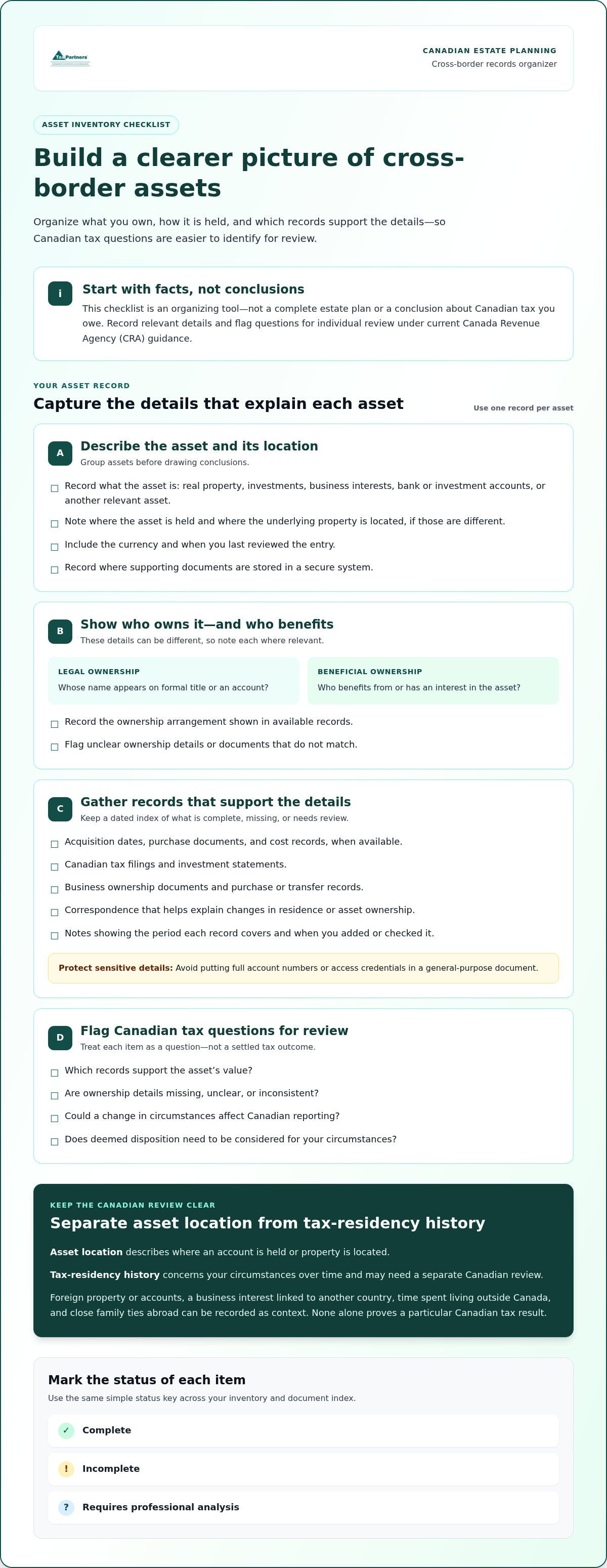
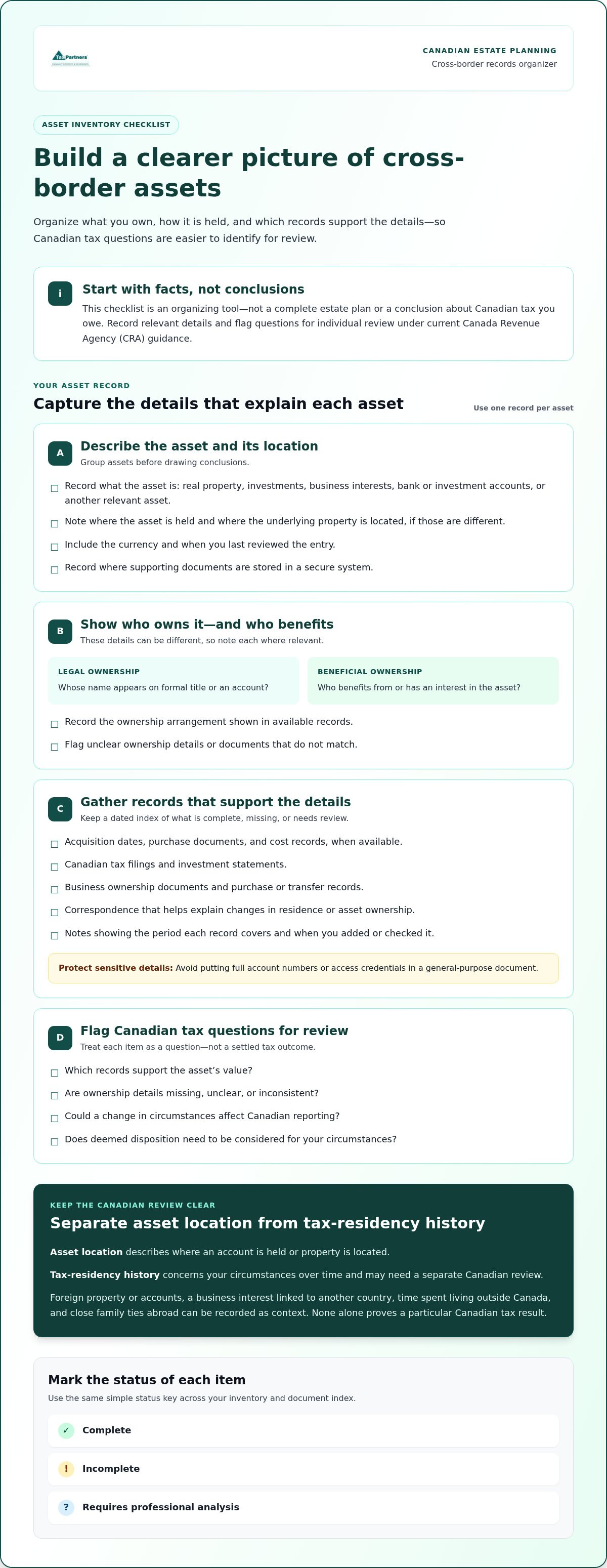
With the scope set, create a private inventory showing what you own, how each asset is held, and which documents support the details. A useful cross border estate planning checklist records facts for Canadian tax review without labelling assets as taxable, exempt, or subject to a particular outcome.
Keep the inventory secure and practical. Record where each asset is located, its currency, when you last reviewed the entry, and where supporting documents are stored. Avoid putting full account numbers, access credentials, or other sensitive details in a general-purpose document. Use a secure system for information needed to identify an account.
Create an asset inventory that is useful for Canadian tax planning
Group assets before drawing conclusions. Include real property, investments, business interests, bank and investment accounts, and other assets relevant to your estate. For each entry, note the asset’s location and ownership structure, then flag missing or inconsistent records for follow-up.
Ownership has two useful meanings. Legal ownership identifies whose name appears on formal title or an account. Beneficial ownership describes who benefits from or has an interest in the asset. They may not be the same, so record both where relevant instead of assuming the name on a statement tells the whole story.
- Describe the asset and where it is held or located.
- Record the legal owner and any known beneficial owner.
- Note the currency and the ownership arrangement shown in available records.
- Capture acquisition dates, purchase documents, and cost records when available.
- Flag unclear details or missing documents for review.
These are inventory fields, not conclusions about Canadian tax treatment. A purchase record or ownership document can help explain an asset’s history, but its significance depends on the facts and the applicable Canadian tax analysis.
Gather records without assuming every item has the same tax treatment
Bring together documents that explain your assets and changes in your circumstances. A dated index can show what you have, the period each record covers, and whether it is complete, missing, or needs review.
Consider organizing Canadian tax filings, investment statements, purchase or transfer records, business ownership documents, and correspondence that helps explain changes in residence or asset ownership. Keep original documents or secure copies. Note when you added or checked each item so the file stays useful as information changes.
For context on personal filings, Tax Partners’ Canadian individual tax return preparation page relates to the filing side of personal tax matters. STEP Canada provides background on the trust and estate profession through its trust and estate professional community.
Once the inventory and document index are in place, you can bring the facts and outstanding questions into a personalized Canadian tax review. Tax Partners provides Canadian tax support for that review.
Review Canadian tax questions before deciding how to structure the estate
An inventory is a starting point, not a verdict. Use it to identify Canadian tax questions for review before changing ownership arrangements or assuming a particular structure is right for your estate.
Keep the analysis within the Canadian tax context. Record questions about assets, income, ownership, and estate documents, then assess them under current Canada Revenue Agency (CRA) guidance and your circumstances. Don’t treat a planning comparison as a recommendation or a prediction of the tax result.
Identify Canadian tax concepts that may need individualized review
One concept to flag is deemed disposition. For Canadian tax purposes, deemed disposition means an asset may be treated as if it were sold at fair market value even though no actual sale occurred. Confirm how it applies to your circumstances under current CRA guidance.
Separate income earned during your lifetime from questions that may arise at death. Ask whether income records are complete, whether ownership details are clear, and whether a potential deemed disposition needs analysis. These are prompts for review, not conclusions about whether tax will apply.
- Could the recorded owner differ from the person who benefits from or controls an asset?
- Are income records and supporting documents available for assets in the inventory?
- Could Canadian tax treatment need review because ownership or circumstances changed?
- Do estate documents refer to assets or ownership arrangements that no longer match current records?
Compare planning questions without mixing tax jurisdictions
Compare the facts that shape a Canadian review, not competing tax systems or presumed outcomes. The same asset can raise different questions depending on its ownership, income history, available records, and how it is addressed in estate documents.
Use the comparison below to identify gaps and discussion points. It doesn’t establish a universally best structure or provide legal advice about drafting or changing estate documents.
Asset ownership: Record who holds legal title and who may benefit from the asset. Ask whether the arrangement is clearly documented and aligns with the facts relevant to Canadian tax review.
Income and records: Note which income records exist and whether they can be connected to the relevant asset and owner. Missing statements or unclear histories are follow-up items, not proof of a particular tax treatment.
Estate-document alignment: Identify whether the documents refer to current assets and ownership details. Record inconsistencies for appropriate review rather than assuming a document changes the tax result.
Keep each question connected to the relevant asset and supporting record. This makes it easier to distinguish an issue about income earned during life, a possible tax event at death, incomplete information, or document alignment. Confirm applicable Canadian tax treatment against current CRA guidance before relying on it.
Tax questions can also connect with longer-term wealth decisions. Coordinating a Canadian tax review with wealth management and financial planning can put estate-related questions in the context of broader financial planning, without assuming one structure suits everyone.
Use this checklist to organize documents and Canadian planning decisions
Turn your notes into a working file you can update, rather than a one-time snapshot. This cross border estate planning checklist should show what you’ve documented, what remains unclear, and which questions need professional analysis under current Canadian tax guidance.
Use the same status for each entry so gaps stand out: complete means the relevant information and supporting record are together; incomplete means something is missing; requires professional analysis means the facts are gathered but need individual review.
Turn the checklist into a practical working file
Set up secure folders for asset records, Canadian tax documents, and estate-planning questions. Add the date and source to each record, such as the statement period or the document supporting an ownership detail, so you can trace where the information came from.
A structured planning checklist resource can help you organize information consistently. Keep sensitive account details in a secure location, not in a general summary you may share for discussion.
Work through the file in order:
- Inventory: List relevant assets and note their location, currency, and last review date.
- Ownership: Record legal and beneficial ownership separately where relevant, and flag unclear or conflicting details.
- Records: Gather supporting statements, purchase or transfer records, and relevant Canadian tax documents. Note gaps and the periods they cover.
- Unresolved questions: Write each question beside the asset or document it concerns, and mark whether it needs fact-finding or professional analysis.
- Review: Revisit the file in the appropriate Canadian tax and planning context before relying on it to inform decisions.
Prioritize unresolved Canadian tax and planning questions
Not every open item has the same effect on planning. First flag questions that could influence a pending decision, then rank the rest by their potential effect and how much information is still needed. Mark any tax point that requires verification against current Canada Revenue Agency guidance.
Add a short context note covering your Canadian tax-residency history, the assets in the inventory, and changes in ownership or family circumstances that may help explain the records. Keep it factual; don’t treat the summary as a conclusion about your tax position.
Separate Canadian tax questions from decisions about legal documents and executor appointments. Record document-related concerns in a distinct section for legal review, and keep tax questions with the relevant records and facts. This helps prevent an unanswered tax issue from being mistaken for a legal decision, or vice versa.
Refresh the file after a significant change to your assets, ownership, or family circumstances. With your records and questions organized, a personalized Canadian tax review with Tax Partners can help you assess the next steps.
Plan your next steps with Canadian cross-border tax support
An organized asset inventory and focused question list give your planning discussion a stronger starting point. They connect the documents you’ve gathered with Canadian tax issues that need individual analysis, rather than relying on assumptions about how an asset or ownership arrangement will be treated.
Tax Partners provides Canadian and cross-border tax planning support for complex financial matters. That support can help you assess Canadian tax questions in light of your circumstances and broader financial plans, without promising a particular result. Tax planning is distinct from legal representation and the drafting or revision of estate documents.
Prepare for a focused estate-planning discussion
Bring a current asset inventory, records that clarify ownership, and a concise list of open questions. A brief summary of your Canadian tax-residency history and relevant changes in your circumstances can provide context. Include only information that helps explain the tax questions, and keep sensitive details secure.
Group questions by decision. For example, note which Canadian tax issues need analysis before you consider changing asset ownership, which records need completion, and which matters relate to legal documents or executor appointments. International tax considerations can add complexity, and Tax Partners’ international tax advisory information provides related context.
Choose a clear next step for your Canadian tax questions
Use your notes to identify decisions that depend on current Canadian tax analysis. These might include how an asset’s ownership history should be understood, what information is needed to assess a tax question, or how tax considerations fit alongside longer-term wealth planning. The relevant questions depend on the assets, records, and circumstances you’ve documented.
Personalized planning starts with the facts, not a template. A tailored review can clarify which Canadian tax questions are ready for analysis, what information remains outstanding, and how those issues relate to your financial goals. Confirm applicable tax treatment using current Canada Revenue Agency guidance.
Your cross border estate planning checklist is most useful when it leads to clear, practical next steps. It can organize the conversation, but it doesn’t replace individualized advice or legal guidance about estate documents.
To discuss your Canadian cross-border tax-planning circumstances with Tax Partners, get in touch about Canadian cross-border tax planning.
Move from organized records to informed decisions
A thoughtful estate plan should reflect more than the assets you hold. It should support the people and priorities that matter to you, while giving you a clear basis for weighing future choices.
Use your cross border estate planning checklist to consider what you want your planning to accomplish. Personalized Canadian tax guidance can help you assess relevant tax questions alongside those goals, while legal advice and estate-document drafting remain separate matters.
You can take the next step with questions rather than a finished plan. Discuss your Canadian tax planning with Tax Partners and explore a path forward that fits your circumstances.
Frequently Asked Questions
What is a cross-border estate planning checklist for Canadians?
A cross border estate planning checklist for Canadians organizes estate-related assets, ownership details, supporting records, and Canadian tax questions. For example, it can connect an investment account with its owner, relevant statements, and questions for Canadian review. This checklist focuses on Canadian tax considerations, not another country’s rules. It helps prepare you for planning discussions, but it doesn’t determine legal rights or tax outcomes.
Do Canadians pay tax on foreign assets when an estate is settled?
Not automatically. The Canadian tax implications depend on the asset, its ownership, your circumstances, and the Canadian rules that apply. Canada doesn’t have an inheritance tax, but tax questions may arise in connection with a deceased person’s assets and final Canadian tax reporting. Record the asset type, location, ownership history, and available valuation information, then identify what needs review under current CRA guidance instead of assuming it’s taxable or tax-free.
Can a Canadian will cover assets located in another country?
Whether a Canadian will can effectively address an asset held elsewhere is a legal-document question that tax facts alone can’t settle. Note where the asset is held and whether your existing estate documents identify it or describe how it is to be handled. Keep that observation separate from your Canadian tax questions. This checklist doesn’t interpret or draft wills, so treat questions about a will’s scope as matters for legal advice.
How does Canadian tax residency affect estate planning?
Canadian tax residency is a fact-specific concept that can affect which Canadian tax questions need review. Prepare a timeline of where you lived and when, with supporting records such as dated housing, employment, or travel documents where relevant. Citizenship alone doesn’t establish the answer to a Canadian tax-residency question. Use your timeline to support analysis under current CRA guidance rather than applying a general assumption to your circumstances.
What records should I gather for Canadian cross-border estate planning?
Gather records that show what you own and how relevant details have changed. Useful documents include investment statements, prior Canadian tax filings, purchase or transfer paperwork, business ownership records, and current estate documents. Add valuation records where available. Store digital copies securely and limit access to sensitive account information. Note missing periods or documents so they can be followed up during Canadian tax planning.
When should I review my Canadian cross-border estate plan?
Review your information after a material change, such as acquiring or selling an asset, changing ownership, a family change, or a move that affects your residence history. Event-based reviews can help keep the file current. Date each update, preserve earlier versions where useful, and flag new tax questions for confirmation under current CRA guidance so planning discussions reflect your circumstances.

Article by
Mahad Mohamed
Mahad Mohamed is an accountant and the CEO of Tax Partners, with over 26+ years of Canadian and international tax and accounting experience. His expertise includes corporate reorganization, cross-border tax structuring (Canada & US), tax disputes, CRA audits, and tax planning for small owner-managed private corporations. Most recently, Mahad is a pioneer in Canadian crypto taxation and founded Block3 Finance.
Previously, Mahad worked for the Canada Revenue Agency (CRA), Big4 accounting firms, and served as a Rulings Officer for the Federal Tax Authority of the UAE before acquiring Tax Partners in 2014.
Tax Partners has 44 full-time accountants and over 18,400+ clients.
Disclaimer
This article provides general information only and is current as of its publication date. It has not been updated and may be out of date. It does not constitute legal advice and should not be relied upon as such. Every tax situation is unique and may differ from the examples discussed in this article. If you have specific questions, you should seek the advice of our accountants for your unique circumstances. Book a FREE Initial Consultation Today!
Frequently Asked Questions
What counts as a cross-border connection in a Canadian estate?
Note any property, financial accounts, investments, or business interests outside Canada, as well as relevant family connections and your history of living in different countries. For each asset, record where it is held and where the underlying property is located, if those are different. Keep asset location separate from your tax-residency history. The location of an account or property describes the asset. Tax residence concerns your circumstances over time and may need a separate Canadian review. A general Estate Planning Overview can introduce common planning concepts, but it doesn’t determine how Canadian tax rules apply to you.
What is a cross-border estate planning checklist for Canadians?
A cross border estate planning checklist for Canadians organizes estate-related assets, ownership details, supporting records, and Canadian tax questions. For example, it can connect an investment account with its owner, relevant statements, and questions for Canadian review. This checklist focuses on Canadian tax considerations, not another country’s rules. It helps prepare you for planning discussions, but it doesn’t determine legal rights or tax outcomes.
Do Canadians pay tax on foreign assets when an estate is settled?
Not automatically. The Canadian tax implications depend on the asset, its ownership, your circumstances, and the Canadian rules that apply. Canada doesn’t have an inheritance tax, but tax questions may arise in connection with a deceased person’s assets and final Canadian tax reporting. Record the asset type, location, ownership history, and available valuation information, then identify what needs review under current CRA guidance instead of assuming it’s taxable or tax-free.
Can a Canadian will cover assets located in another country?
Whether a Canadian will can effectively address an asset held elsewhere is a legal-document question that tax facts alone can’t settle. Note where the asset is held and whether your existing estate documents identify it or describe how it is to be handled. Keep that observation separate from your Canadian tax questions. This checklist doesn’t interpret or draft wills, so treat questions about a will’s scope as matters for legal advice.
How does Canadian tax residency affect estate planning?
Canadian tax residency is a fact-specific concept that can affect which Canadian tax questions need review. Prepare a timeline of where you lived and when, with supporting records such as dated housing, employment, or travel documents where relevant. Citizenship alone doesn’t establish the answer to a Canadian tax-residency question. Use your timeline to support analysis under current CRA guidance rather than applying a general assumption to your circumstances.
What records should I gather for Canadian cross-border estate planning?
Gather records that show what you own and how relevant details have changed. Useful documents include investment statements, prior Canadian tax filings, purchase or transfer paperwork, business ownership records, and current estate documents. Add valuation records where available. Store digital copies securely and limit access to sensitive account information. Note missing periods or documents so they can be followed up during Canadian tax planning.
When should I review my Canadian cross-border estate plan?
Review your information after a material change, such as acquiring or selling an asset, changing ownership, a family change, or a move that affects your residence history. Event-based reviews can help keep the file current. Date each update, preserve earlier versions where useful, and flag new tax questions for confirmation under current CRA guidance so planning discussions reflect your circumstances.