Payroll Management for Canadian SMEs: A 2026 Guide

A payroll setup works best when it fits your team, pay arrangements and compliance responsibilities, not simply when it offers the most automation. A reliable payroll management SME Canada process gives each pay run a clear path from approved information to payment and organized records. For owners, payroll can compete with customers and core operations, while manual calculations and scattered files make errors and missed steps harder to catch.
In Canada, employers need to consider current Canada Revenue Agency (CRA) requirements and applicable provincial or territorial rules. As your team, pay arrangements or operations change, a process that once felt manageable may need clearer responsibilities or a different level of support.
This guide covers the main parts of an organized payroll process and how to choose an operating model that suits your SME. You’ll also find practical ways to assign responsibilities, review pay runs and keep records connected to your accounting.
Key Takeaways
- See how a Canadian payroll cycle connects approved pay inputs, review, payment and organized records.
- Compare spreadsheets, payroll software and outsourced support to find a model that fits your SME’s capacity and process complexity.
- Build clear ownership, approval and review steps into your payroll management SME Canada process.
- Recognize when business growth or changes to pay arrangements call for a review of your payroll approach.
- Learn how payroll and bookkeeping support can connect pay records with your broader accounting picture.
Canadian SME payroll management: what it covers and why it matters
Employees need to know when they’ll be paid and how to raise a question about their pay. For an SME owner, delivering that consistency means having a repeatable routine, assigning someone to review the work and keeping records that explain how each pay amount was prepared.
Payroll management is the connected work of preparing, reviewing, paying and recording employee compensation. A practical payroll management SME Canada process brings these steps together, so information is handled consistently instead of being assembled at the last minute.
Canadian payroll obligations depend on the employer’s circumstances and applicable jurisdiction. Follow current CRA guidance and consider the provincial or territorial rules that apply to your operations. For current Canadian tax information, consult the Canadian tax guidance and the appropriate government authority.
What does payroll management include?
Payroll begins with dependable inputs, such as employee details, approved hours, salary or other compensation information, and authorized changes that affect pay. The process then covers calculating compensation, handling applicable deductions and employer processes, arranging payment, and organizing supporting records.
The general Payroll overview describes common parts of the function. For Canadian SMEs, current CRA guidance and relevant provincial or territorial direction are the reference points for deciding which deductions and processes apply. A generic template may not reflect your circumstances.
Payroll administration focuses on the information and steps required to pay employees and maintain payroll records. Broader human resources work can include recruitment, performance management and workplace policies. Payroll may rely on information from those activities without taking responsibility for all of them.
Why payroll accuracy matters to a growing business
Consistent pay routines help employees understand when they’ll be paid and whom to approach with a question. Clear inputs and a defined review process also let an owner oversee payroll without rechecking every detail from scratch.
Organized payroll records are useful beyond payday. They connect compensation information with bookkeeping and financial reporting, giving the business a clearer view of payroll activity and a more usable record when figures need review.
For example, keeping approved hours, compensation changes, payment records and related documentation together makes it easier to trace how a pay amount was prepared. SMEs looking to strengthen that connection can explore accounting support for organized SME bookkeeping.
Accuracy depends on a process people can follow, not just careful calculations. A written routine, understandable records and clear responsibility for preparation and review give an SME a stronger foundation as its payroll needs evolve.
How a Canadian payroll cycle works from inputs to records
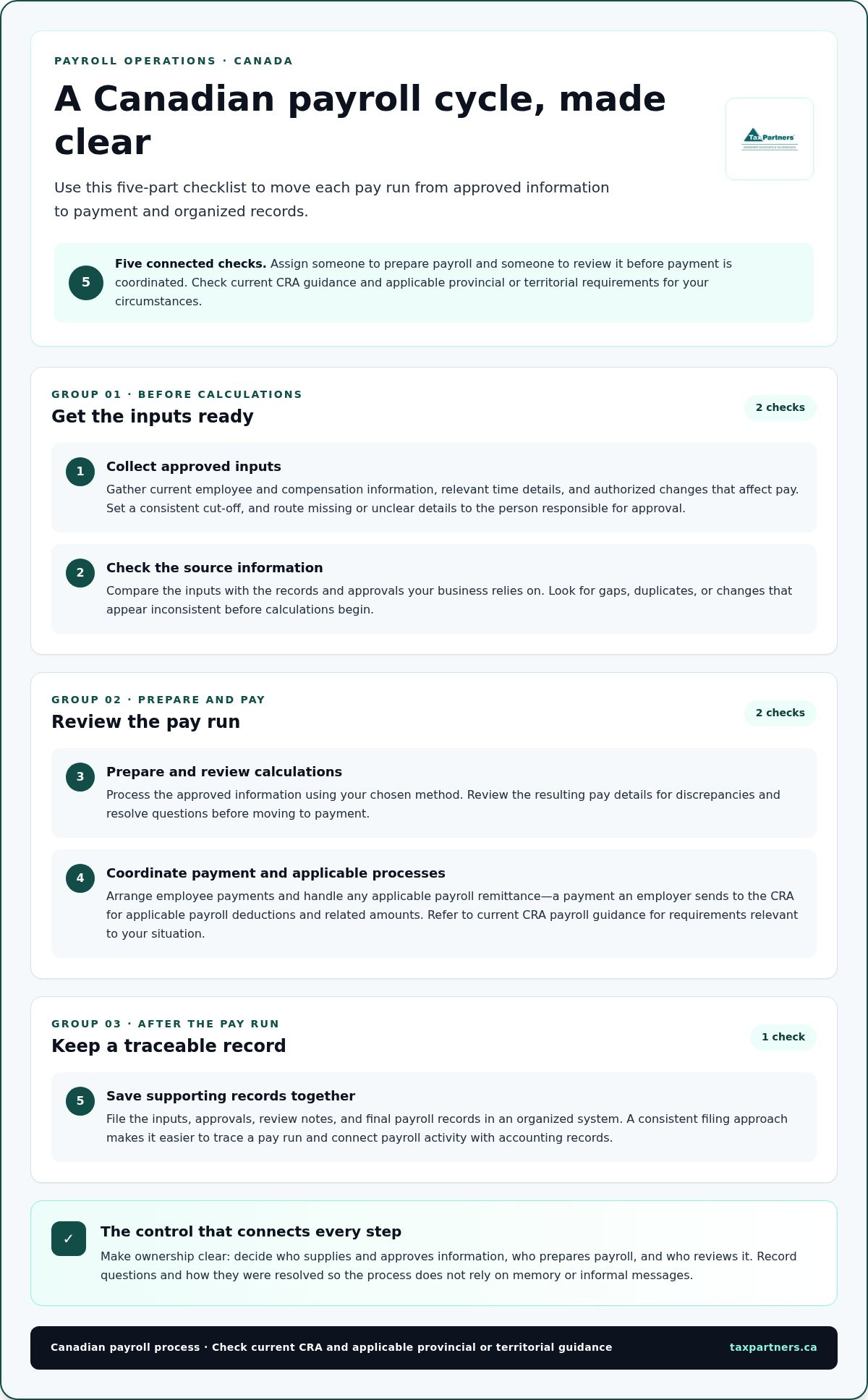
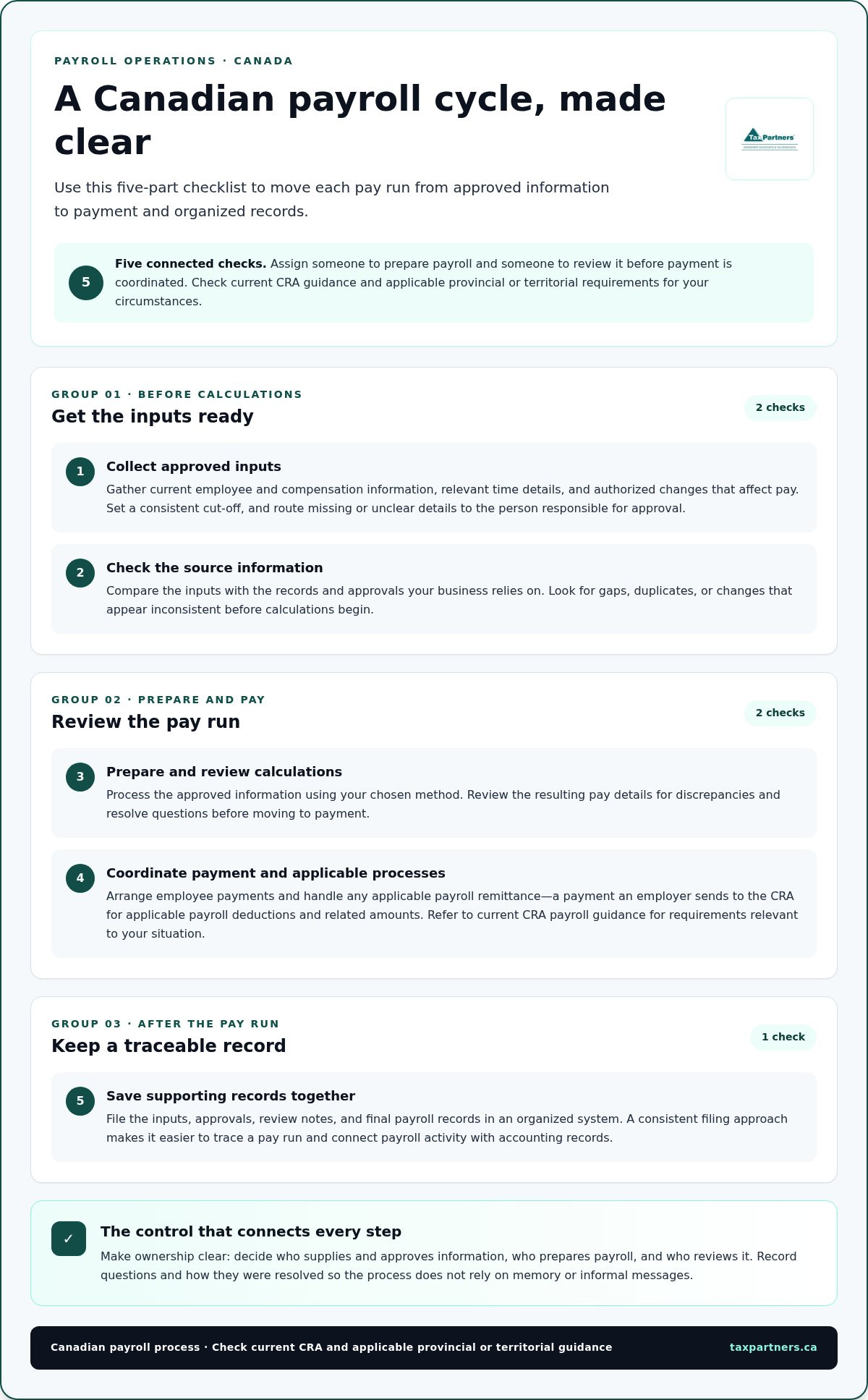
A repeatable pay cycle gives each task a clear handoff, from the information employees and managers provide to the records the business keeps. For payroll management SME Canada, define who prepares the pay run and who reviews it before payment is coordinated.
Consistent processing and documented review make each pay run easier to follow, check and understand later. The workflow below is a practical operating model, not a complete statement of legal requirements. Canadian employers should check current CRA guidance and applicable provincial or territorial requirements for their circumstances.
- Collect approved inputs. Gather current employee and compensation information, relevant time details, and authorized changes that affect the pay run. Set a consistent cut-off, and send missing or unclear information to the person responsible for approving it.
- Check the source information. Compare inputs with the records and approvals your business relies on. Before calculations begin, look for gaps, duplicates or changes that appear inconsistent.
- Prepare and review calculations. Process the approved information using your chosen method. Review the resulting pay details for discrepancies, and resolve questions before moving to payment.
- Coordinate payment and related processes. Arrange employee payments and handle any applicable payroll remittance, a payment an employer sends to the CRA for applicable payroll deductions and related amounts. Consult the Canada Revenue Agency (CRA) payroll guidelines for current Canadian requirements relevant to your situation.
- Save the supporting records. Keep the inputs, approvals, review notes and final payroll records together in an organized system. A consistent filing approach makes it easier to trace a pay run and connect payroll activity with accounting records.
Prepare and review payroll inputs
Decide who supplies each type of information and how approvals reach the person preparing payroll. For example, a manager might approve time information while an owner authorizes a compensation change. The specific roles depend on your SME’s structure.
Before processing, have the reviewer look for missing approvals, conflicting details or unexpected changes from the previous cycle. Record questions and how they were resolved, so the team has a useful reference instead of relying on memory or informal messages.
Complete the pay run and keep records organized
Once the pay details have been reviewed, coordinate payment and file the final records with their supporting information. Use the same filing approach each pay period, so someone with appropriate responsibility can find the relevant details without searching through unrelated documents.
Payroll records are part of the broader business recordkeeping process. Connect them with your corporate tax compliance guidance, and confirm current payroll-specific requirements with the CRA and relevant Canadian authorities.
In a small team, one person may prepare payroll and another may review it. If one person handles both tasks, use a defined review step suited to the business, such as a separate approval of inputs or a documented check of the completed pay details. If coordinating payroll is becoming difficult to manage internally, discuss payroll support with Tax Partners.
In-house, payroll software, or outsourced support: compare SME options
The right payroll model depends on more than the size of your team. Consider how much administrative time you can commit, how closely you want to oversee the work, whether your process is repeatable, and whether changes in pay or operations are adding complexity. Payroll management SME Canada works best when the approach fits the business and can adapt as it changes.
Use this comparison to weigh the trade-offs. These are operating models, not a ranking. Any approach needs clear responsibilities, review steps and recordkeeping.
| Approach | Internal effort | Control | Process consistency | As complexity changes |
|---|---|---|---|---|
| In-house spreadsheets | The team enters and maintains information manually. | Direct oversight, with responsibility resting on internal staff. | Depends on careful templates, updates and documented checks. | May require more administration as inputs or arrangements become harder to track. |
| Payroll software | Can reduce repetitive data handling, while still requiring staff time for inputs and review. | The business manages access, approvals and oversight of the process. | Can support repeatable workflows when information and procedures are kept current. | May help manage a changing process, but the business still needs to assess its needs and responsibilities. |
| Outsourced payroll support | Moves payroll processing work outside the internal team, while the business supplies information and maintains oversight. | Control is shared through clear handoffs, approvals and review arrangements. | Can provide a defined process, with the business still responsible for clear inputs and communication. | Can be useful when internal capacity or process complexity becomes a constraint. |
If you’re weighing how much payroll work to keep in-house, a conversation about payroll support for your SME can help clarify which responsibilities should remain visible to your team.
When internal payroll management may fit
Managing payroll internally may suit a business with stable processes, a clear owner and enough administrative capacity to prepare and review each pay run. Spreadsheets can be familiar and flexible, but they depend on accurate source information and consistent use of current files.
Keep a documented review step even when one person handles most of the work. The right fit depends on the work involved and the capacity available, not on a single employee-count threshold.
When software or outsourced payroll support may help
Software can support recurring tasks and reduce repetitive handling, but it doesn’t decide who approves changes, checks results or follows up on exceptions. Assign those responsibilities explicitly, so automation supports the process without replacing business oversight.
Outsourced support may be worth considering when payroll regularly competes with other priorities or has become difficult for the internal team to manage. For growing companies evaluating outside assistance, specialized resources such as financialfoothold.com provide outsourced accounting operations and payroll administration to maintain continuity. Whichever model you choose, connect payroll information with your broader business records through coordinated accounting services for SMEs.
Review your arrangement when responsibilities or operations change. The goal isn’t to adopt the most elaborate system; it’s to choose a sustainable balance of effort, control and review.
Build reliable payroll controls as your Canadian SME grows
Payroll controls make a process easier to oversee, especially as responsibilities shift or the business changes how it pays employees. For payroll management SME Canada, clarify each handoff: who provides information, who approves changes, who processes payroll and who checks the result.
These are practical process controls, not a substitute for checking current Canadian requirements. CRA guidance and applicable provincial or territorial rules may depend on your circumstances, so review the relevant sources when your payroll situation changes.
Assign ownership, approvals, and review
Write down who owns each step and where approvals are recorded. When capacity allows, separating preparation from review gives another person a chance to catch an overlooked change. In a smaller team, document a review step that fits the roles available.
A simple exception log can record a correction or unusual pay-period change, who approved it, what was adjusted and how it was resolved. This creates a useful trail for follow-up without relying on memory.
Build controls around your actual workflow. For example, an employee may submit a change, a manager may approve it, and the payroll owner may update the records and note the approval before processing. Make sure the person reviewing completed payroll can see the information and decisions behind it.
- Ownership: Name the person responsible for coordinating each stage and following up on missing information.
- Approvals: Record who can authorize changes to compensation or other payroll inputs.
- Review: Define what gets checked before payment and how questions are resolved.
- Records: Store source information, approvals, review notes and final payroll records in an organized, appropriately protected location.
Keep payroll information and reporting consistent
Use consistent names, categories and filing practices so payroll information is understandable to the people who need it. Organized payroll summaries can support bookkeeping and management reporting by connecting compensation activity with the business’s wider financial records.
Review the process after a material change, such as introducing a new compensation arrangement, changing how work is scheduled or shifting payroll responsibilities. Check whether your approvals, records and review steps still reflect how the business operates, then update the process where needed.
A process review can reveal where payroll information is difficult to reconcile or where handoffs depend too heavily on one person. Connecting payroll records with bookkeeping and accounting support can help keep operational records aligned with the business’s financial picture.
If growth has made payroll ownership or review harder to manage, discuss payroll support for your business with Tax Partners.
Bring payroll management and accounting together with Tax Partners
The right payroll arrangement reflects your SME’s capacity and the complexity of its pay process. You might keep preparation in-house, use software to support recurring work or bring in professional help. Whichever approach you choose, retain clear business oversight and connect payroll information with your broader accounting records.
A reliable payroll management SME Canada framework makes clear who handles each step, where review happens and how payroll records support financial information. If demands on your internal team are growing, professional support can reduce administrative work while keeping the business informed.
What professional payroll support can contribute
Tax Partners provides full-cycle payroll management and bookkeeping support for small-to-midsize enterprises. Considering payroll and bookkeeping alongside broader accounting needs can help keep related financial information connected while maintaining visibility over the process and responsibilities.
Tax Partners brings more than 40 years of experience serving clients across accounting and related services. That experience supports payroll work alongside the records and reporting that inform business decisions, rather than treating payroll as a stand-alone task.
Plan a practical next step for your SME
Before changing your approach, map your current workflow. Note who supplies and approves information, where the process slows down, which tasks take the most owner or staff time, and how closely you want to stay involved in day-to-day processing.
This overview can focus a discussion on your payroll and bookkeeping requirements, the level of support that fits your capacity and how payroll information connects with Canadian accounting needs. For related corporate reporting considerations, explore corporate tax services.
Consider bringing these points to a discussion:
- Current workflow: How information moves from approval through processing and recordkeeping.
- Recurring bottlenecks: Tasks that regularly compete with your team’s other responsibilities.
- Preferred involvement: The work you want to keep internal and the support that could ease the administrative load.
- Records and reporting: How payroll information fits with bookkeeping and the business’s broader financial records.
A focused conversation can help you identify a workable way to manage payroll without losing sight of oversight or accounting context. Discuss payroll management for your business.
Set your payroll process up for what comes next
Your payroll approach should support the business as it operates now and remain workable as circumstances change. In your next review, consider where you want hands-on oversight, which responsibilities could be easier to manage and what would make the process sustainable for your team.
For payroll management SME Canada, progress doesn’t require a sweeping change. A focused discussion about your workflow, recurring pressure points and preferred level of involvement can help you choose a practical next step while keeping Canadian payroll responsibilities in view.
Before that discussion, decide what you most want to improve: the time payroll takes, clarity around internal responsibilities or how payroll information fits into your business records. Clear priorities make it easier to shape an approach that suits your capacity today and can be revisited as your needs evolve.
Start a conversation about your SME’s payroll needs. With a considered plan and the right support, you can make payroll more manageable as part of the way your business runs.
Frequently Asked Questions
What is payroll management for a Canadian SME?
For a Canadian SME, payroll management is the process of preparing, reviewing, paying and recording employee compensation. A practical test is whether an authorized reviewer can explain why a pay amount differs from an earlier period and find the approval or information behind the change. For questions about Canadian requirements, consult current Canada Revenue Agency (CRA) guidance.
Does a Canadian small business need payroll software?
No, a Canadian small business doesn’t automatically need payroll software. First identify the problem you want a tool to solve, such as repeated data entry or difficulty finding past pay information. Then assess whether the workflow suits your business and whether staff can understand how information moves through it. For payroll management SME Canada, the tool should fit the process, not dictate it.
Should a Canadian SME outsource payroll management?
Outsourcing may be worth considering if payroll takes attention away from other business priorities. Before deciding, clarify the work you want support with, the information your team can provide and what you want to see in regular updates. This helps set expectations and keeps the owner informed. The right scope depends on your needs and preferred level of involvement.
What information is needed to process payroll in Canada?
The information needed depends on the employee’s arrangement and applicable Canadian requirements. Establish how your business will collect the details relevant to each situation, rather than treating a generic intake form as universal. For a new hire or a change in employment terms, identify what the payroll process needs before the change takes effect, then consult current CRA guidance about specific requirements.
How can a Canadian SME reduce payroll errors?
Look for patterns in payroll corrections, not just individual mistakes. If the same type of adjustment keeps recurring, trace it back to where the information was recorded or approved. A simple record of the issue and its cause can help you decide whether instructions, responsibilities or the process need attention. Confirm specific Canadian filing or remittance requirements with the CRA.
How often should an SME review its payroll process?
There isn’t one review interval that suits every SME as a legal rule. As an internal management practice, review the process when repeated corrections, unclear handoffs or changes in operations suggest it may no longer fit. A regular management meeting can also help you assess whether payroll questions are being resolved promptly. Verify specific Canadian deadlines or obligations with the CRA.
Can payroll management support better SME bookkeeping?
Yes. Use consistent categories for payroll-related costs in the accounting records, then compare recorded amounts with the payroll information used to prepare them. This can make differences easier to identify and give owners a clearer view of labour costs in financial reports. The categories and reporting approach should suit the business’s accounting practices and be applied consistently.

Article by
Mahad Mohamed
Mahad Mohamed is an accountant and the CEO of Tax Partners, with over 26+ years of Canadian and international tax and accounting experience. His expertise includes corporate reorganization, cross-border tax structuring (Canada & US), tax disputes, CRA audits, and tax planning for small owner-managed private corporations. Most recently, Mahad is a pioneer in Canadian crypto taxation and founded Block3 Finance.
Previously, Mahad worked for the Canada Revenue Agency (CRA), Big4 accounting firms, and served as a Rulings Officer for the Federal Tax Authority of the UAE before acquiring Tax Partners in 2014.
Tax Partners has 44 full-time accountants and over 18,400+ clients.
Disclaimer
This article provides general information only and is current as of its publication date. It has not been updated and may be out of date. It does not constitute legal advice and should not be relied upon as such. Every tax situation is unique and may differ from the examples discussed in this article. If you have specific questions, you should seek the advice of our accountants for your unique circumstances. Book a FREE Initial Consultation Today!
Frequently Asked Questions
What does payroll management include?
Payroll begins with dependable inputs, such as employee details, approved hours, salary or other compensation information, and authorized changes that affect pay. The process then covers calculating compensation, handling applicable deductions and employer processes, arranging payment, and organizing supporting records. The general Payroll overview describes common parts of the function. For Canadian SMEs, current CRA guidance and relevant provincial or territorial direction are the reference points for deciding which deductions and processes apply. A generic template may not reflect your circumstances. Payroll administration focuses on the information and steps required to pay employees and maintain payroll records. Broader human resources work can include recruitment, performance management and workplace policies. Payroll may rely on information from those activities without taking responsibility for all of them.
What is payroll management for a Canadian SME?
For a Canadian SME, payroll management is the process of preparing, reviewing, paying and recording employee compensation. A practical test is whether an authorized reviewer can explain why a pay amount differs from an earlier period and find the approval or information behind the change. For questions about Canadian requirements, consult current Canada Revenue Agency (CRA) guidance.
Does a Canadian small business need payroll software?
No, a Canadian small business doesn’t automatically need payroll software. First identify the problem you want a tool to solve, such as repeated data entry or difficulty finding past pay information. Then assess whether the workflow suits your business and whether staff can understand how information moves through it. For payroll management SME Canada, the tool should fit the process, not dictate it.
Should a Canadian SME outsource payroll management?
Outsourcing may be worth considering if payroll takes attention away from other business priorities. Before deciding, clarify the work you want support with, the information your team can provide and what you want to see in regular updates. This helps set expectations and keeps the owner informed. The right scope depends on your needs and preferred level of involvement.
What information is needed to process payroll in Canada?
The information needed depends on the employee’s arrangement and applicable Canadian requirements. Establish how your business will collect the details relevant to each situation, rather than treating a generic intake form as universal. For a new hire or a change in employment terms, identify what the payroll process needs before the change takes effect, then consult current CRA guidance about specific requirements.
How can a Canadian SME reduce payroll errors?
Look for patterns in payroll corrections, not just individual mistakes. If the same type of adjustment keeps recurring, trace it back to where the information was recorded or approved. A simple record of the issue and its cause can help you decide whether instructions, responsibilities or the process need attention. Confirm specific Canadian filing or remittance requirements with the CRA.
How often should an SME review its payroll process?
There isn’t one review interval that suits every SME as a legal rule. As an internal management practice, review the process when repeated corrections, unclear handoffs or changes in operations suggest it may no longer fit. A regular management meeting can also help you assess whether payroll questions are being resolved promptly. Verify specific Canadian deadlines or obligations with the CRA.
Can payroll management support better SME bookkeeping?
Yes. Use consistent categories for payroll-related costs in the accounting records, then compare recorded amounts with the payroll information used to prepare them. This can make differences easier to identify and give owners a clearer view of labour costs in financial reports. The categories and reporting approach should suit the business’s accounting practices and be applied consistently.