Full-Cycle Bookkeeping in Ontario: A Clear Guide

What if your books could do more than record what’s already happened? Full-cycle bookkeeping helps Canadian businesses connect everyday transactions to financial information that’s organized, timely, and useful for decisions.
Receipts can pile up, account records can become difficult to reconcile, and bookkeeping can take time away from running your enterprise. Reports that arrive late or don’t feel reliable make it harder to plan with confidence. A complete bookkeeping process brings these tasks together, from capturing transactions to preparing clear financial reports.
This guide explains what full-cycle bookkeeping covers, how each stage works, and which responsibilities you may want to keep in-house or delegate. You’ll also learn how organized Canadian business records support accounting and CRA tax work. For small and midsize businesses, coordinated bookkeeping and accounting can create a clearer hand-off and a steadier view of finances.
Key Takeaways
- See how full cycle bookkeeping Ontario businesses use connects source documents, recorded transactions, reconciliations, and reports.
- Follow a practical sequence for moving from collected records to reviewed reports and resolved discrepancies.
- Compare full-cycle, selected-task, and in-house support to identify an approach that fits your capacity and reporting needs.
- Prepare for a smoother bookkeeping transition by gathering records, listing accounts, and outlining current workflows.
- Learn how coordinated bookkeeping, payroll, accounting, and Canadian tax support can give business owners a clearer hand-off.
What Full-Cycle Bookkeeping in Ontario Covers
Full-cycle bookkeeping in Ontario is the recurring process of capturing business transactions, organizing and checking records, reconciling accounts, and preparing useful financial reports. Each stage connects to the next: source documents support recorded entries, reconciliations help identify differences, and reports summarize the activity. As new transactions occur, the cycle begins again.
“Full-cycle” describes the workflow’s scope, not a universal checklist. The tasks depend on how the business operates. They may include organizing sales and expenses, managing accounts receivable and payable, maintaining payroll records, or tracking GST/HST activity. Defining these responsibilities clearly helps prevent gaps or duplicated work.
Where the bookkeeping cycle begins and ends
The cycle starts with evidence of business activity. Invoices, receipts, bills, and business account records provide details such as the transaction date, amount, and purpose. These details are organized in the appropriate records so income, expenses, and other activity can be reviewed consistently. For a foundational overview, see What is Bookkeeping?
Next, the records are checked against account activity. Reconciliation means comparing recorded transactions with statements or other account records and investigating differences, such as a missing receipt or a transaction entered twice. Once reviewed, the information can be summarized in reports showing how the business performed during a chosen period.
The cycle is continuous, not a one-time tidy-up. New sales, purchases, payments, and deposits create new records to capture and review. Keeping each stage connected makes it easier to trace a reported figure back to the transaction and supporting document behind it.
How bookkeeping differs from accounting
Bookkeeping focuses on the organized recording and review of business transactions. Accounting takes a broader view of the resulting financial information, using it for reporting, interpretation, and advice. The roles are closely connected but not interchangeable: dependable accounting work relies on records that are organized and traceable to their source.
Consider a business that issues customer invoices, pays suppliers, and receives deposits. Bookkeeping organizes those transactions and checks whether the recorded activity aligns with account records. Accounting can then use the information to explain performance or inform planning. The hand-off works best when questions and discrepancies are resolved rather than carried forward into reports.
Understanding this distinction helps owners identify the support they need. Full cycle bookkeeping Ontario businesses use can describe a connected sequence of recordkeeping tasks, while accounting may add analysis and advice based on those records. Set the scope around your actual workflow instead of assuming every business needs the same package.
How the Full-Cycle Bookkeeping Process Works
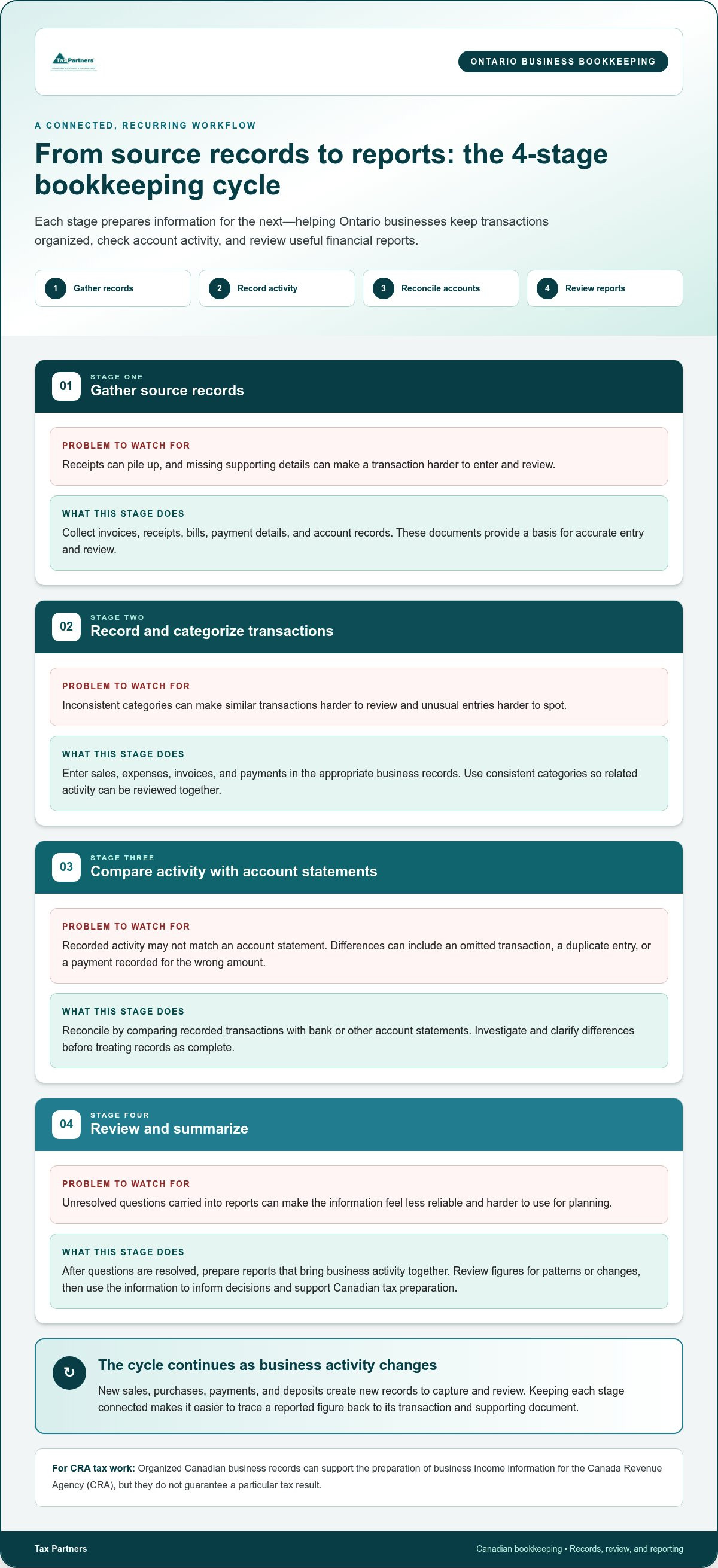
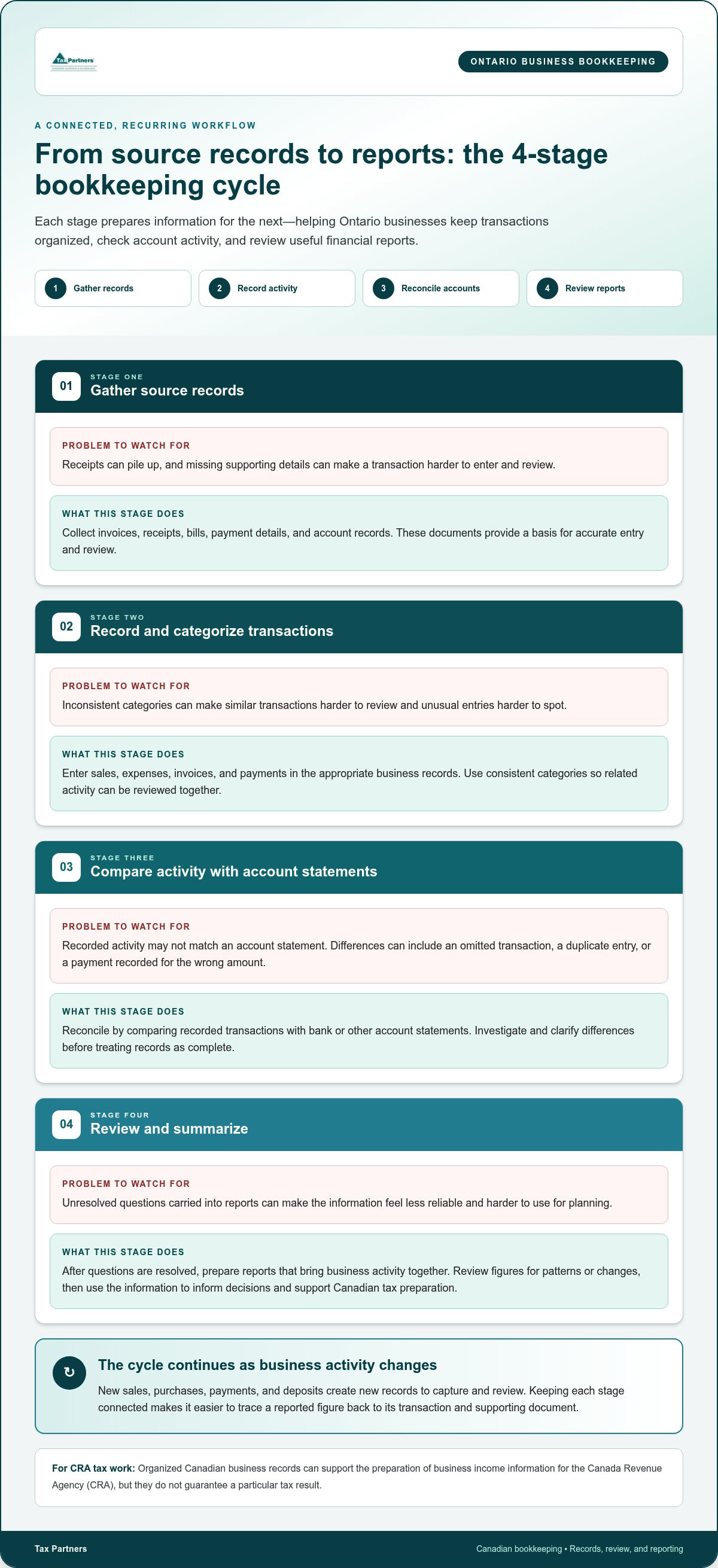
From source records to reviewed reports, the bookkeeping cycle captures transactions, organizes supporting details, checks account balances, resolves discrepancies, and summarizes business activity. Each stage prepares information for the next, so a report can be traced back through the records that support it.
For an Ontario business, this workflow can make Canadian tax preparation more manageable by keeping financial information orderly and easier to review. Organized records support the preparation of business income information for the Canada Revenue Agency (CRA), but they don’t guarantee a particular tax result. The CRA’s Canadian Business Income Tax Reporting guidance explains how businesses report income.
- Gather source records. Collect the invoices, receipts, bills, payment details, and account records that document business activity. A consistent record-gathering routine gives each transaction a basis for accurate entry and review.
- Record and categorize transactions. Enter sales, expenses, invoices, and payments in the appropriate business records. Use consistent categories so similar transactions can be reviewed together and unusual entries are easier to spot.
- Compare activity with account statements. Reconcile recorded transactions against bank or other account statements. Investigate differences, such as an omitted transaction, duplicate entry, or payment recorded for the wrong amount, before treating the records as complete.
- Review and summarize. Once questions are resolved, prepare reports that bring the activity together. Review the figures for patterns or changes, then use the information to inform business decisions and support Canadian tax preparation.
Record transactions and organize supporting documents
Good organization means more than storing documents in one place. Connecting each transaction to its supporting record helps explain what it represents and makes later review more straightforward. Consistent categories also give owners a clearer view of where money comes in and goes out, while making entries that need clarification easier to identify.
Shape the workflow around the business. A business with frequent customer invoices may need records organized around sales and incoming payments, while another may focus more on supplier bills and expenses.
Reconcile accounts and prepare reports
Reconciliation checks whether recorded activity agrees with account statements. It doesn’t simply mean marking transactions as complete. Investigate and clarify mismatches before summarizing the information. Reports built from reviewed records can then help owners understand activity and make informed choices.
Transaction frequency and reporting cadence depend on business needs and the agreed scope of bookkeeping support. Coordinating recordkeeping with accounting services can also create a clearer hand-off from organized records to financial reporting and advice.
If you’re assessing what support would fit your workflow, discuss your bookkeeping needs with Tax Partners. A tailored approach can account for how your records are organized and the reporting rhythm that works for your business.
Full-Cycle Bookkeeping vs. Partial or In-House Support
Full-cycle support describes broad coverage across connected bookkeeping tasks, not a fixed checklist every Ontario business must adopt. The right division of work depends on transaction volume, internal capacity, reporting needs, and how involved the owner wants to remain.
Some businesses manage routine entries internally and delegate specific tasks. Others prefer broader support when keeping records current takes time away from operations or reporting needs have become harder to meet. Compare the work assigned with the oversight you want to retain:
| Support model | Work performed | Owner oversight and useful considerations |
|---|---|---|
| Full-cycle support | A bookkeeping provider handles an agreed range of recurring tasks, potentially from organizing transactions through reconciliations and reports. | The owner supplies business information, answers questions, and reviews agreed outputs. This can suit a business seeking broad coverage while retaining visibility. |
| Selected-task support | A provider takes on defined tasks, such as reconciliations or organizing particular records, while other bookkeeping stays internal. | The owner or staff continue to manage the remaining work and coordinate hand-offs. This can fit businesses with some internal capacity or a specific bottleneck. |
| In-house bookkeeping | An owner or employee manages the bookkeeping within the business, according to the internal workflow. | The business retains direct involvement and responsibility for organizing the work. Consider whether available time and skills match the volume and reporting needs. |
When a business may need broader bookkeeping coverage
Growing transaction volume, multiple revenue streams, or more complex day-to-day recordkeeping can make an existing approach harder to maintain. Reconciliations that repeatedly fall behind, or reports that arrive too late to inform decisions, are practical prompts to review the workflow. They’re signals to assess, not proof that a particular support model is necessary.
Keep visibility while delegating bookkeeping
Delegation doesn’t mean giving up oversight. Agree on which reports you’ll receive, how often you’ll review them, who supplies records, and who follows up on questions. Clear responsibilities help the person handling the work while keeping the owner connected to the information used to run the business.
Before settling on full cycle bookkeeping Ontario businesses can map which tasks take the most time, where hand-offs occur, and what information they need for decisions. Revisit the arrangement as transaction volume, staffing, or reporting requirements change. A model that fits today can be adjusted as the business evolves, without assuming every task must move outside the business.
Prepare Your Ontario Business for Full-Cycle Bookkeeping
A smooth transition starts with a clear picture of the records you have and how your business currently handles them. You don’t need to make every file perfect first. A practical hand-off helps identify what’s ready, what needs organizing, and how bookkeeping responsibilities can fit your operations.
- Gather available records. Bring together invoices, receipts, payment records, and account statements. Grouping documents by type or period can make gaps easier to spot without delaying the review until everything is fully sorted.
- Identify the accounts and activity. List the business accounts used for deposits, payments, purchases, and other transactions. Note separate revenue streams or recurring activity that should be reflected in the records.
- Map the current workflow. Write down who records transactions, shares documents, handles questions, and reviews reports. Include informal steps, such as forwarding receipts or tracking customer payments.
- Flag open questions. Note missing documents, unclear entries, or records that don’t appear to match account activity. A clear list of known issues gives the transition a useful starting point.
- Agree on the working arrangement. Clarify which tasks will be handled internally and which will be part of bookkeeping support. Set expectations for sharing records, resolving questions, and reviewing reports.
Gather records and clarify bookkeeping responsibilities
Start with what you have, even if documents are spread across folders, email, or paper files. Identify who currently records transactions and who reviews financial reports. These may be different people, or both roles may sit with the owner. This simple map helps establish a practical hand-off.
Existing records can be reviewed and organized as part of a tailored transition. If past entries need clarification, flag them rather than guessing at their meaning. This gives the bookkeeping process a more reliable foundation and helps separate routine work from items that need further attention.
Set useful reporting and review expectations
Decide which reports help you oversee the business and how often you want to review them. The right rhythm depends on your operations, decision-making needs, and agreed scope. Also establish who will provide updated records and who will respond when a transaction or document needs clarification.
Organized books can support Canadian corporate tax work by making underlying business activity clearer to review. Consider how your bookkeeping records will connect with Canadian accounting and tax preparation.
Preparing for full cycle bookkeeping Ontario businesses need doesn’t require a perfect starting point. Tax Partners can help review your current records and shape a practical transition around your workflow. Discuss your bookkeeping needs with Tax Partners.
Work with Tax Partners for Canadian Bookkeeping Support
Bookkeeping works best when it reflects the way a business actually operates. Tax Partners provides bookkeeping and payroll support for small-to-midsize enterprises, alongside accounting, Canadian tax, and advisory services. Coordinating these services can help owners connect their records with the broader financial work that depends on them, without treating every business as if it needs the same tasks or workflow.
A connected bookkeeping and accounting relationship
Organized bookkeeping gives accounting and advisory work a clearer starting point. When business records are consistently maintained, owners and their professional team can follow information through each hand-off, identify questions that need attention, and discuss the financial picture with better context. Payroll support can also sit alongside bookkeeping, helping business owners coordinate related financial responsibilities.
The scope can be tailored to the business. One owner may need support across recurring recordkeeping, while another may value help with a particular part of the process and retain other tasks internally. Define responsibilities and reporting needs clearly so the work supports the owner’s operations and provides a coherent foundation for Canadian accounting and tax work. Organized records can inform that work, but they don’t guarantee a specific tax outcome.
Tax Partners brings 40+ years of trusted service to its work with Canadian businesses. The firm takes an attentive approach to understanding how records are managed and where a clearer hand-off between bookkeeping and accounting could be useful.
Discuss the right scope for your business
A useful first conversation can begin with an overview of your business activities, how transactions are currently recorded, and which reports matter most to your decisions. You can also describe where bookkeeping tends to stall, which tasks you prefer to keep in-house, and what you’d like to delegate. These details help shape a practical discussion around the support that fits your circumstances.
Tax Partners offers a free initial consultation to discuss your bookkeeping needs and how the work may connect with accounting, Canadian tax, and advisory support. You don’t need to arrive with every record perfectly organized. Sharing what’s available and explaining your current process can help establish a sensible starting point.
For business owners considering full cycle bookkeeping Ontario support, the goal is a clear working relationship: well-defined responsibilities, useful communication, and records that support informed decisions. Discuss your bookkeeping needs with Tax Partners.
Make Your Next Bookkeeping Decision with Confidence
Your next step doesn’t need to be a complete overhaul. Start by deciding what you want clearer records to make possible, whether that’s more confidence reviewing business activity, a more manageable hand-off, or better information for planning. That priority can help shape a bookkeeping arrangement that fits how your business works.
For Canadian owners considering full cycle bookkeeping Ontario support, Tax Partners brings bookkeeping into the wider context of business needs. The firm’s client base reflects that focus: 82% of our clients are self-employed and small business corporations. A clear conversation about your activities, records, and priorities can help identify a sensible starting point without assuming every task needs to change.
Start a conversation about your bookkeeping priorities and take a practical next step towards records that serve your business. With the right approach, clearer financial information can become a steady part of how you plan and move forward.
Frequently Asked Questions
Can a business switch bookkeepers in the middle of its financial year?
Yes, a business can change bookkeepers mid-year with a clear hand-off. Agree on a transition date and identify which transactions have already been entered, which accounts have been reconciled, and what customer invoices or supplier bills remain outstanding. Providing this context helps prevent duplicated entries or gaps and clarifies how the records reached their current state.
What happens if a business has missing or incomplete bookkeeping records?
Missing records can be identified and investigated rather than guessed at. Start by listing what’s absent, then look for supporting information such as account statements, invoice copies, or payment confirmations. Keep unresolved items distinct from verified transactions and record what is still needed. This gives the bookkeeper a transparent starting point and helps avoid treating uncertain details as established facts.
Can full-cycle bookkeeping support a Canadian CRA review?
Organized bookkeeping can make it easier to locate records and explain how figures were recorded if the Canada Revenue Agency (CRA) reviews business information. It doesn’t guarantee a particular CRA review outcome or replace responding to the agency’s specific requests. Keep supporting documents connected to the entries they explain, and consider Canadian accounting or tax support if you need help interpreting the review request.
Is full-cycle bookkeeping suitable for a self-employed business owner?
Yes, full cycle bookkeeping Ontario support can suit a self-employed owner whose business transactions are taking time to manage or whose records need a consistent process. The scope can reflect the owner’s activity and capacity rather than assume a larger company’s workflow. For example, an owner with customer payments and operating purchases may benefit from clarifying how each type of activity is recorded and reviewed.
How should an owner review bookkeeping reports between reporting periods?
Use each review to look for changes that may need a closer look, not just to scan the final balance. Check whether expected customer payments have arrived, whether supplier bills appear outstanding, and whether unfamiliar or unusually large entries need context. Write down questions as they arise, then follow up while the transaction is still easy to identify. This turns report review into a practical management habit.
Does bookkeeping software replace the need to review financial records?
No. Software can help organize entries and automate parts of routine data capture, but it relies on the information entered and how transactions are categorized. A payment assigned to the wrong account or a missing transaction can still affect reports. Owners should review unusual entries, confirm that activity makes sense, and raise unclear items instead of assuming software-generated reports are automatically correct.

Article by
Mahad Mohamed
Mahad Mohamed is an accountant and the CEO of Tax Partners, with over 26+ years of Canadian and international tax and accounting experience. His expertise includes corporate reorganization, cross-border tax structuring (Canada & US), tax disputes, CRA audits, and tax planning for small owner-managed private corporations. Most recently, Mahad is a pioneer in Canadian crypto taxation and founded Block3 Finance.
Previously, Mahad worked for the Canada Revenue Agency (CRA), Big4 accounting firms, and served as a Rulings Officer for the Federal Tax Authority of the UAE before acquiring Tax Partners in 2014.
Tax Partners has 44 full-time accountants and over 18,400+ clients.
Disclaimer
This article provides general information only and is current as of its publication date. It has not been updated and may be out of date. It does not constitute legal advice and should not be relied upon as such. Every tax situation is unique and may differ from the examples discussed in this article. If you have specific questions, you should seek the advice of our accountants for your unique circumstances. Book a FREE Initial Consultation Today!
Frequently Asked Questions
Can a business switch bookkeepers in the middle of its financial year?
Yes, a business can change bookkeepers mid-year with a clear hand-off. Agree on a transition date and identify which transactions have already been entered, which accounts have been reconciled, and what customer invoices or supplier bills remain outstanding. Providing this context helps prevent duplicated entries or gaps and clarifies how the records reached their current state.
What happens if a business has missing or incomplete bookkeeping records?
Missing records can be identified and investigated rather than guessed at. Start by listing what’s absent, then look for supporting information such as account statements, invoice copies, or payment confirmations. Keep unresolved items distinct from verified transactions and record what is still needed. This gives the bookkeeper a transparent starting point and helps avoid treating uncertain details as established facts.
Can full-cycle bookkeeping support a Canadian CRA review?
Organized bookkeeping can make it easier to locate records and explain how figures were recorded if the Canada Revenue Agency (CRA) reviews business information. It doesn’t guarantee a particular CRA review outcome or replace responding to the agency’s specific requests. Keep supporting documents connected to the entries they explain, and consider Canadian accounting or tax support if you need help interpreting the review request.
Is full-cycle bookkeeping suitable for a self-employed business owner?
Yes, full cycle bookkeeping Ontario support can suit a self-employed owner whose business transactions are taking time to manage or whose records need a consistent process. The scope can reflect the owner’s activity and capacity rather than assume a larger company’s workflow. For example, an owner with customer payments and operating purchases may benefit from clarifying how each type of activity is recorded and reviewed.
How should an owner review bookkeeping reports between reporting periods?
Use each review to look for changes that may need a closer look, not just to scan the final balance. Check whether expected customer payments have arrived, whether supplier bills appear outstanding, and whether unfamiliar or unusually large entries need context. Write down questions as they arise, then follow up while the transaction is still easy to identify. This turns report review into a practical management habit.
Does bookkeeping software replace the need to review financial records?
No. Software can help organize entries and automate parts of routine data capture, but it relies on the information entered and how transactions are categorized. A payment assigned to the wrong account or a missing transaction can still affect reports. Owners should review unusual entries, confirm that activity makes sense, and raise unclear items instead of assuming software-generated reports are automatically correct.