International Tax Advisory in Canada: Navigating Global Complexity with Precision

Could a single overlooked clause in a tax treaty be the difference between a successful global expansion and a devastating CRA audit? For many, the fear of losing hard-earned revenue to double taxation, which occurs when two different jurisdictions tax the same income, is enough to stall international ambitions entirely. It's natural to feel frustrated by the complexity of offshore reporting or anxious about the ever-shifting expectations of the tax authorities. You've worked hard to build your business, and the last thing you want is for regulatory confusion to erode your global wealth.
By securing the right international tax advisory Canada provides, you can transform these risks into a clear roadmap for growth. This article shows you how to master cross-border compliance using a proactive strategy designed for the modern global economy. We'll examine how to organize your corporate structure to ensure total certainty in your filings and realize a tax-efficient model that protects your interests both at home and abroad.
Key Takeaways
- Understand how the shift toward global transparency affects your Canadian residency status and reporting obligations under CRA rules.
- Discover how professional international tax advisory Canada helps you organize a multi-jurisdictional corporate structure to realize maximum tax efficiency.
- Learn to identify and manage the unique tax implications for Canadian entities expanding into foreign markets or foreign investors entering the local market.
- Gain clarity on complex tax treaty provisions, such as "Tie-Breaker" rules, to avoid double taxation and ensure all global reporting requirements are met.
- Shift from reactive filing to a proactive strategy that leverages institutional wisdom to protect your global wealth against regulatory volatility.
The Evolving Landscape of International Tax Advisory in Canada
The era of isolated tax planning has ended. Today, the Canada Revenue Agency (CRA) operates within a web of global cooperation that makes transparency the default setting. This shift demands a more sophisticated approach to international tax advisory Canada, one that moves beyond the mere submission of annual returns. In the current environment, your tax strategy must be a living document that accounts for real-time data sharing and shifting geopolitical priorities. It's no longer enough to react to changes after they happen; you need a guardian who anticipates them.
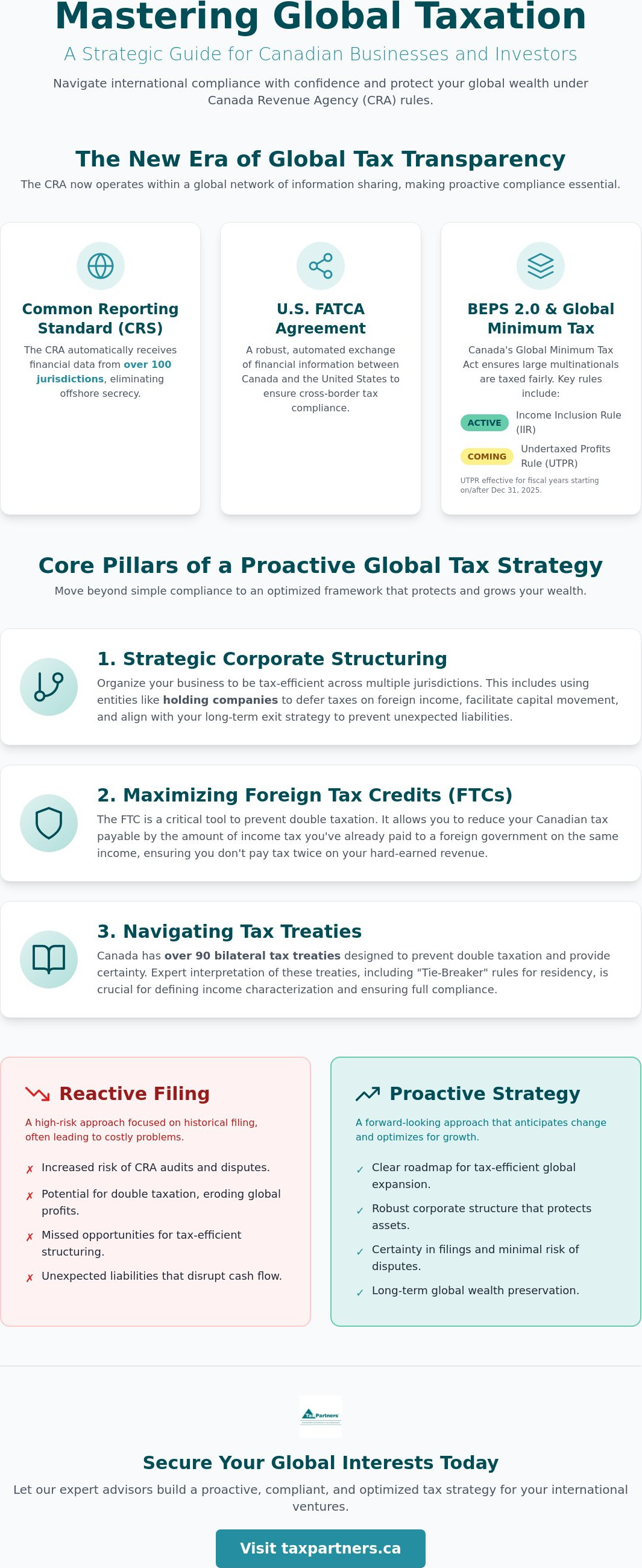
Globalization has fundamentally changed how we define Canadian residency. It's no longer a simple matter of counting days spent on Canadian soil. The CRA now looks closer at the "mind and management" of a corporation and the "centre of vital interests" for an individual. As we move through 2026, the implementation of BEPS 2.0 (Base Erosion and Profit Shifting) has reached a critical phase. Canada has moved forward with the Global Minimum Tax Act, ensuring that large multinational enterprises pay a minimum level of tax regardless of where they operate. Specifically, the Income Inclusion Rule (IIR) is already active, and the Undertaxed Profits Rule (UTPR) is scheduled to take effect for fiscal years beginning on or after December 31, 2025.
Defining the Scope of Modern International Advisory
Modern advisory sits at the complex intersection of the Canadian Income Tax Act and over 90 bilateral tax treaties. It requires a precise characterization of income, whether it's classified as active business income, passive investment returns, or capital gains. Standard accounting often fails here because it treats international transactions as mere extensions of domestic operations. A global strategy must realize that a single transaction can trigger vastly different reporting requirements under CRA rules compared to foreign jurisdictions. Precision in these early stages prevents the double taxation that often erodes global revenue.
The Impact of Global Transparency Standards
The Common Reporting Standard (CRS) has effectively eliminated the concept of "offshore" secrecy. Under these rules, the CRA automatically receives financial account information from over 100 participating jurisdictions. This level of oversight is mirrored in the U.S. FATCA Agreement with Canada, which facilitates a robust exchange of data to ensure tax compliance across the border. This shift toward real-time compliance means that errors are identified much faster than in previous decades. Proactive management is the only way to avoid the stress of unexpected audits. By viewing your tax advisor as a guardian rather than a bookkeeper, you can secure a structure that is both compliant and optimized for long-term wealth preservation.
Core Pillars of Global Tax Strategy: From Compliance to Optimization
Building a global business requires more than just following the rules; it requires a structural foundation that supports growth without leaking capital. Effective international tax advisory Canada focuses on moving your operations from simple compliance to a state of total optimization. This means looking at how every dollar flows across borders to ensure you aren't paying more than your fair share under CRA rules. By establishing a robust framework early, you protect your global wealth and create a clear path for expansion.
Strategic Corporate Structuring
A holding company, which is a corporation established to own shares in other companies rather than for day-to-day operations, often serves as the cornerstone of a global strategy. For Canadian business owners, these structures can help defer taxes on foreign income or facilitate smoother capital movement. It's also vital to consider how hybrid entities or specific elections in foreign jurisdictions might impact your Canadian reporting. These choices must align with your long-term exit strategy to ensure that when you eventually sell, you aren't hit with unexpected tax liabilities that could have been avoided with foresight.
Maximizing Foreign Tax Credits and Deductions
Double taxation is a primary concern for any global entity. To combat this, CRA filers can utilize the Foreign Tax Credit (FTC), a mechanism that reduces your Canadian tax bill by the amount of tax already paid to a foreign government on that same income. Navigating the specific limitations of Canada's International Tax Treaties is essential for calculating these credits accurately. If you find yourself with unused credits in a given year, you may be able to carry them forward to future tax years, though the rules surrounding these carry-forwards are strict. If you need assistance with these complex calculations, our team at Tax Partners can help you navigate the requirements.
Transfer Pricing and Documentation
Transfer pricing refers to the rules and methods for pricing transactions between enterprises under common ownership. It's no longer a concern reserved only for massive corporations. The CRA requires that these intercompany transactions happen at "arm's length," meaning the price must be the same as it would be between two unrelated parties. Failing to maintain contemporaneous documentation, which are records created at the time the transaction occurs, can lead to significant CRA penalties. Keeping precise records ensures your global operations remain beyond reproach and minimizes the stress of potential audits.
Strategic Inbound and Outbound Planning for Canadian Entities
Expanding a business across borders isn't a one-size-fits-all journey. For CRA filers, the tax implications change dramatically depending on whether capital is moving out of Canada or into it. Effective international tax advisory Canada requires a dual-lens approach that balances the aggressive growth of outbound expansion with the protective compliance of inbound investment. By understanding these distinct paths, you can leverage Canada's extensive treaty network to minimize tax leakage and maximize your global reach.
Outbound Expansion: Growing Beyond Canadian Borders
When a Canadian business grows abroad, it must navigate the "Foreign Affiliate" rules. A foreign affiliate is generally a non-resident corporation where a Canadian resident holds a significant equity interest. One of the most critical concepts here is FAPI, or Foreign Accrual Property Income. FAPI refers to passive income, such as interest or rent, earned by a controlled foreign affiliate. Under CRA rules, this income is often taxed in Canada in the year it's earned, even if the cash hasn't been sent back home yet. Managing this, along with the risk of creating a "permanent establishment," which is a fixed place of business that grants a foreign country taxing rights, is essential for tax-efficient repatriation of earnings.
Inbound Investment: Capitalizing on the Canadian Market
Foreign investors looking to capitalize on the Canadian market face a different set of hurdles. Establishing a Canadian subsidiary allows for a clear separation of liabilities, but it also triggers "Thin Capitalization" rules. These rules prevent foreign owners from stripping profits out of Canada through excessive interest payments by limiting interest deductibility if debt-to-equity ratios exceed certain thresholds. Additionally, non-residents disposing of Canadian taxable property must comply with strict notification requirements to obtain a certificate of compliance. For a detailed overview of these obligations, the CRA International and Non-Resident Tax Guide provides a comprehensive starting point for staying compliant.
Maximizing Treaty Benefits
Central to both strategies is the management of withholding taxes on dividends, interest, and royalties. While the Canadian Income Tax Act sets a statutory withholding rate of 25% on many payments to non-residents, Canada's vast network of tax treaties often reduces these rates significantly, sometimes to as low as 5% or even 0%. Realizing these benefits requires precise documentation and a proactive guardian who ensures every treaty benefit is claimed correctly. This foresight protects your global interests from day one and ensures that your expansion remains a source of wealth rather than a regulatory burden.
Mitigating Risk: Navigating Treaty Interpretations and Reporting
Precision is the only effective shield against the rising tide of global regulatory scrutiny. At its core, international tax advisory Canada is the specialized practice of aligning global financial operations with multi-country legal frameworks to ensure compliance and minimize tax leakage. It's a discipline that transforms complex obligations into a structured defense for your wealth. Without this level of detail, even well-intentioned global moves can result in significant financial penalties or double taxation.
The T1135 and Other Essential Canadian Filings
For CRA filers, transparency begins with Form T1135, the Foreign Income Verification Statement. If the total cost amount of your foreign specified property exceeded $100,000 CAD at any point during the tax year, you must file this return. Many taxpayers mistakenly believe this threshold only applies to cash in bank accounts. In reality, it covers a broad range of assets, including shares in foreign corporations, interests in foreign trusts, and real estate situated outside Canada that isn't for personal use. Overlooking foreign stocks held within a Canadian brokerage account is another frequent error that triggers CRA interest. The penalties for late filing or inaccurate reporting can be severe, often reaching thousands of dollars per form, so accuracy is non-negotiable.
Navigating Tax Treaty Nuances
Tax treaties are powerful tools because they generally override domestic law in specific cross-border scenarios. However, interpreting them requires a deep understanding of "Tie-Breaker" rules. These rules are used to determine a single country of residence when both Canada and another nation claim taxing rights over an individual. Beyond residency, modern treaties now include the Principal Purpose Test (PPT). Under this rule, the CRA can deny treaty benefits, such as reduced withholding tax rates, if it determines that the main purpose of a transaction was simply to access those benefits. If a dispute arises between two countries regarding how a treaty should be applied, we can often resolve the issue through the Mutual Agreement Procedure (MAP), which involves direct negotiation between the tax authorities to prevent double taxation.
The best way to manage these risks is through proactive disclosure. Addressing past non-compliance or reporting errors before the CRA intervenes can significantly reduce your exposure to penalties and interest. If you are concerned about your current reporting status or need to resolve a complex treaty interpretation, our Global Accounting & Tax Services team can provide the authoritative guidance needed to secure your standing. Moving from a state of uncertainty to one of total control is the hallmark of a successful global strategy.
Securing Your Global Interests with Tax Partners
Securing your global interests requires more than technical knowledge; it demands a partner who views your financial landscape as a cohesive whole. With over 40 years of institutional wisdom, Tax Partners provides the stability and foresight necessary to navigate a volatile global market. We don't just react to CRA updates. We act as a proactive guardian, looking ahead to identify potential shifts in international tax advisory Canada before they impact your bottom line. This forward-thinking approach ensures that your corporate efficiency and personal wealth preservation are always in sync.
Integration is where true optimization happens. Many firms treat international tax as a siloed compliance task, but we realize that cross-border decisions deeply affect your broader financial goals. By combining our specialized tax knowledge with comprehensive Wealth Management & Financial Planning, we create a bespoke structure that protects your global assets. For CRA filers, this means ensuring that every international move aligns with your long-term vision for wealth accumulation and legacy. We look past the immediate filing deadline to secure your future for decades to come.
The Advantage of a Seasoned Mentor
Personalized, agile advisory offers a distinct alternative to the rigid models often found in larger institutions. Our team provides the attentive care that dual citizens and Canadian expats need to manage their unique obligations without feeling like just another number. We maintain a strict commitment to ethical steadfastness, ensuring that every filing is transparent and robust. Our specialized knowledge allows us to handle the nuances of multi-jurisdictional reporting with a level of precision that protects you from the stress of regulatory uncertainty. It's about providing a steady hand at the helm while you focus on growing your global footprint.
Your Journey Toward Global Financial Clarity
Every partnership begins with a thorough initial assessment. We identify hidden risks in your current structure and uncover untapped opportunities for tax optimization under CRA regulations. As global rules evolve, our ongoing support adapts your strategy to keep you in total control of your financial narrative. This isn't a one-time project; it's a long-term partnership designed to provide peace of mind in an increasingly complex world. You deserve a mentor who is as invested in your success as you are. Secure your global financial future with a tailored international tax consultation and move forward with the certainty that your global wealth is protected.
Master Your Global Financial Future
The complexities of cross-border compliance don't have to be a barrier to your success. By shifting from a reactive approach to a proactive guardian model, you can ensure that every global transaction remains compliant with CRA rules while protecting your long-term wealth. You've learned how strategic corporate structuring and precise treaty interpretation can eliminate double taxation and provide a clear roadmap for international expansion.
With over 40 years of cross-border experience, our team has filed more than 495,000 returns and realized over $87 million in savings for our clients. These results, backed by over 1,390 five-star Google reviews, demonstrate our commitment to providing the highest level of international tax advisory Canada offers. We are here to help you navigate the modern regulatory landscape with total confidence.
Book a Comprehensive International Tax Consultation today to secure your standing and optimize your global footprint. Your international ambitions deserve a steady hand at the helm; let's build a tax-efficient future together.
Frequently Asked Questions
What is the difference between a tax accountant and an international tax advisor?
An international tax advisor specializes in the intersection of multi-jurisdictional legal frameworks and tax treaties, whereas a general tax accountant typically focuses on domestic compliance. While both handle filings, international tax advisory Canada involves aligning global operations to minimize tax leakage across different countries. This specialized role acts as a proactive guardian, looking ahead at global regulatory shifts rather than just reacting to annual domestic deadlines.
How does the Canada-US tax treaty protect me from double taxation?
The Canada-US tax treaty protects you by establishing specific rules that determine which country has the primary right to tax certain types of income. For CRA filers, it provides mechanisms like reduced withholding rates on dividends and interest, often lowering the statutory 25% rate to 15% or 5%. It also allows for foreign tax credits, ensuring that tax paid in one country reduces the tax owed in the other on that same income.
Do I need to report my foreign assets if they don’t generate any income?
Yes, you must report foreign specified property if the total cost amount exceeded the $100,000 CAD threshold at any time during the year, even if the assets produced no income. This requirement applies to CRA filers and includes assets like foreign bank accounts, shares in non-resident corporations, and foreign real estate not held for personal use. Reporting is about transparency regarding the existence of the assets, not just the income they earn.
What are the penalties for failing to file a T1135 form in Canada?
The penalties for failing to file Form T1135 under CRA rules start at $25 per day for up to 100 days, reaching a maximum of $2,500 per year for simple non-compliance. If the failure to file is determined to be gross negligence, the penalties can increase significantly, potentially reaching $1,000 per month for up to 24 months. These fines accumulate quickly for each year the form is missed, making timely disclosure essential.
Can a Canadian corporation own a foreign subsidiary without being taxed on all its income?
Yes, a Canadian corporation can own a foreign subsidiary, but it must navigate "Foreign Affiliate" and FAPI (Foreign Accrual Property Income) rules. While active business income earned by a foreign affiliate is generally not taxed in Canada until it's repatriated, passive income like interest or rent is often taxed in the year it's earned. Professional international tax advisory Canada ensures your corporate structure is optimized to defer taxes where possible under current CRA guidelines.
What happens if I become a non-resident of Canada for tax purposes?
When you become a non-resident for tax purposes, you are subject to a "departure tax" on the deemed disposition of most of your property at fair market value. This means the CRA treats you as if you sold your assets on the day you left, potentially triggering capital gains taxes. After departure, you are generally only taxed in Canada on income from Canadian sources, such as rental income or certain business activities.
How does transfer pricing affect my small business if I sell products internationally?
Transfer pricing requires that any transactions between your Canadian business and an international entity you control occur at "arm's length" prices. This means you must charge the same price you would to an unrelated third party. The CRA requires contemporaneous documentation to prove your pricing is fair. Even for small businesses, failing to document these intercompany transactions can lead to significant penalties and adjustments during a CRA audit.
How can I catch up on missed foreign asset reporting without facing massive penalties?
You can often catch up on missed filings through the CRA's Voluntary Disclosures Program (VDP). This program allows taxpayers to come forward and correct previous errors or omissions in exchange for relief from prosecution and, in many cases, a reduction in penalties and interest. To qualify, your disclosure must be voluntary, meaning you must submit it before the CRA begins any audit or enforcement action against you.

Article by
Mahad Mohamed
Mahad Mohamed is an accountant and the CEO of Tax Partners, with over 26+ years of Canadian and international tax and accounting experience. His expertise includes corporate reorganization, cross-border tax structuring (Canada & US), tax disputes, CRA audits, and tax planning for small owner-managed private corporations. Most recently, Mahad is a pioneer in Canadian crypto taxation and founded Block3 Finance.
Previously, Mahad worked for the Canada Revenue Agency (CRA), Big4 accounting firms, and served as a Rulings Officer for the Federal Tax Authority of the UAE before acquiring Tax Partners in 2014.
Tax Partners has 44 full-time accountants and over 18,400+ clients.
Disclaimer
This article provides general information only and is current as of its publication date. It has not been updated and may be out of date. It does not constitute legal advice and should not be relied upon as such. Every tax situation is unique and may differ from the examples discussed in this article. If you have specific questions, you should seek the advice of our accountants for your unique circumstances. Book a FREE Initial Consultation Today!
Frequently Asked Questions
Defining the Scope of Modern International Advisory
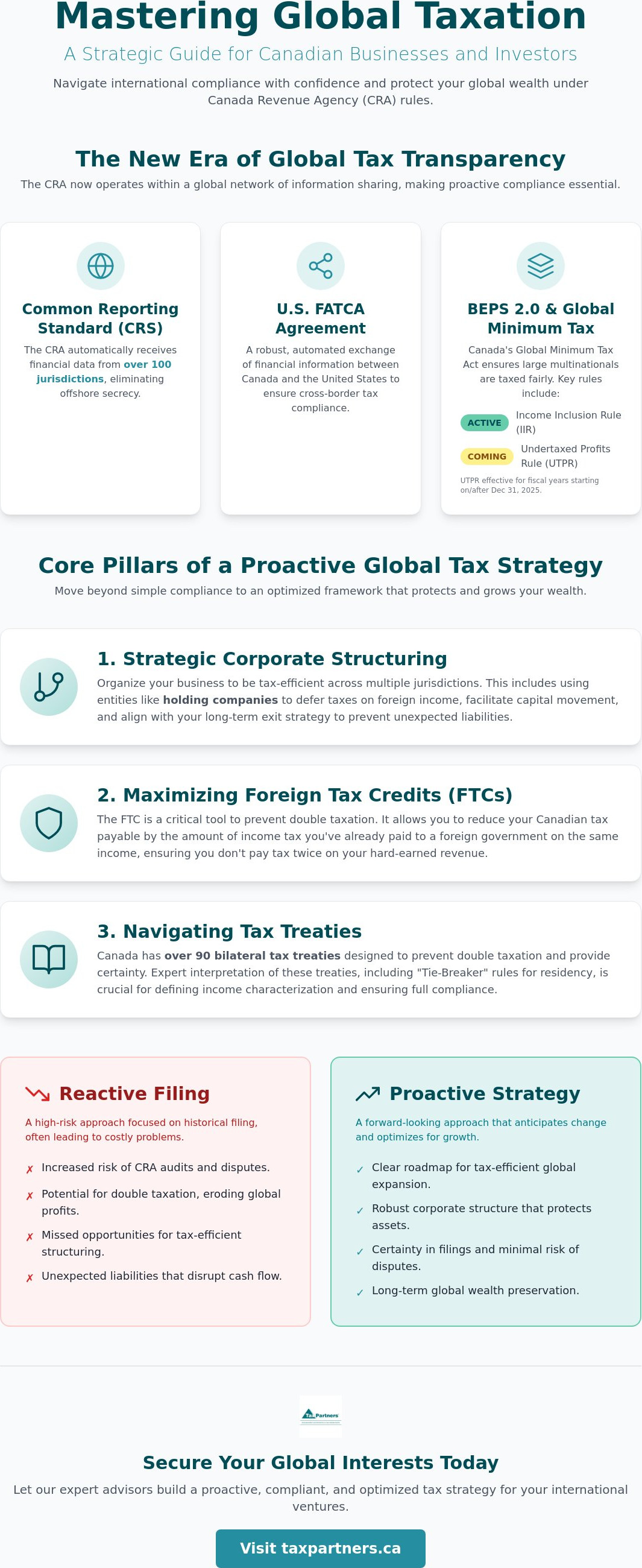
Modern advisory sits at the complex intersection of the Canadian Income Tax Act and over 90 bilateral tax treaties. It requires a precise characterization of income, whether it's classified as active business income, passive investment returns, or capital gains. Standard accounting often fails here because it treats international transactions as mere extensions of domestic operations. A global strategy must realize that a single transaction can trigger vastly different reporting requirements under CRA rules compared to foreign jurisdictions. Precision in these early stages prevents the double taxation that often erodes global revenue.
The Impact of Global Transparency Standards
The Common Reporting Standard (CRS) has effectively eliminated the concept of "offshore" secrecy. Under these rules, the CRA automatically receives financial account information from over 100 participating jurisdictions. This level of oversight is mirrored in the U.S. FATCA Agreement with Canada, which facilitates a robust exchange of data to ensure tax compliance across the border. This shift toward real-time compliance means that errors are identified much faster than in previous decades. Proactive management is the only way to avoid the stress of unexpected audits. By viewing your tax advisor as a guardian rather than a bookkeeper, you can secure a structure that is both compliant and optimized for long-term wealth preservation. Building a global business requires more than just following the rules; it requires a structural foundation that supports growth without leaking capital. Effective international tax advisory Canada focuses on moving your operations from simple compliance to a state of total optimization. This means looking at how every dollar flows across borders to ensure you aren't paying more than your fair share under CRA rules. By establishing a robust framework early, you protect your global wealth and create a clear path for expansion.
Strategic Corporate Structuring
A holding company, which is a corporation established to own shares in other companies rather than for day-to-day operations, often serves as the cornerstone of a global strategy. For Canadian business owners, these structures can help defer taxes on foreign income or facilitate smoother capital movement. It's also vital to consider how hybrid entities or specific elections in foreign jurisdictions might impact your Canadian reporting. These choices must align with your long-term exit strategy to ensure that when you eventually sell, you aren't hit with unexpected tax liabilities that could have been avoided with foresight.
Maximizing Foreign Tax Credits and Deductions
Double taxation is a primary concern for any global entity. To combat this, CRA filers can utilize the Foreign Tax Credit (FTC), a mechanism that reduces your Canadian tax bill by the amount of tax already paid to a foreign government on that same income. Navigating the specific limitations of Canada's International Tax Treaties is essential for calculating these credits accurately. If you find yourself with unused credits in a given year, you may be able to carry them forward to future tax years, though the rules surrounding these carry-forwards are strict. If you need assistance with these complex calculations, our team at Tax Partners can help you navigate the requirements.
Transfer Pricing and Documentation
Transfer pricing refers to the rules and methods for pricing transactions between enterprises under common ownership. It's no longer a concern reserved only for massive corporations. The CRA requires that these intercompany transactions happen at "arm's length," meaning the price must be the same as it would be between two unrelated parties. Failing to maintain contemporaneous documentation, which are records created at the time the transaction occurs, can lead to significant CRA penalties. Keeping precise records ensures your global operations remain beyond reproach and minimizes the stress of potential audits. Expanding a business across borders isn't a one-size-fits-all journey. For CRA filers, the tax implications change dramatically depending on whether capital is moving out of Canada or into it. Effective international tax advisory Canada requires a dual-lens approach that balances the aggressive growth of outbound expansion with the protective compliance of inbound investment. By understanding these distinct paths, you can leverage Canada's extensive treaty network to minimize tax leakage and maximize your global reach.
Outbound Expansion: Growing Beyond Canadian Borders
When a Canadian business grows abroad, it must navigate the "Foreign Affiliate" rules. A foreign affiliate is generally a non-resident corporation where a Canadian resident holds a significant equity interest. One of the most critical concepts here is FAPI, or Foreign Accrual Property Income. FAPI refers to passive income, such as interest or rent, earned by a controlled foreign affiliate. Under CRA rules, this income is often taxed in Canada in the year it's earned, even if the cash hasn't been sent back home yet. Managing this, along with the risk of creating a "permanent establishment," which is a fixed place of business that grants a foreign country taxing rights, is essential for tax-efficient repatriation of earnings.
Inbound Investment: Capitalizing on the Canadian Market
Foreign investors looking to capitalize on the Canadian market face a different set of hurdles. Establishing a Canadian subsidiary allows for a clear separation of liabilities, but it also triggers "Thin Capitalization" rules. These rules prevent foreign owners from stripping profits out of Canada through excessive interest payments by limiting interest deductibility if debt-to-equity ratios exceed certain thresholds. Additionally, non-residents disposing of Canadian taxable property must comply with strict notification requirements to obtain a certificate of compliance. For a detailed overview of these obligations, the CRA International and Non-Resident Tax Guide provides a comprehensive starting point for staying compliant.
Maximizing Treaty Benefits
Central to both strategies is the management of withholding taxes on dividends, interest, and royalties. While the Canadian Income Tax Act sets a statutory withholding rate of 25% on many payments to non-residents, Canada's vast network of tax treaties often reduces these rates significantly, sometimes to as low as 5% or even 0%. Realizing these benefits requires precise documentation and a proactive guardian who ensures every treaty benefit is claimed correctly. This foresight protects your global interests from day one and ensures that your expansion remains a source of wealth rather than a regulatory burden. Precision is the only effective shield against the rising tide of global regulatory scrutiny. At its core, international tax advisory Canada is the specialized practice of aligning global financial operations with multi-country legal frameworks to ensure compliance and minimize tax leakage. It's a discipline that transforms complex obligations into a structured defense for your wealth. Without this level of detail, even well-intentioned global moves can result in significant financial penalties or double taxation.
The T1135 and Other Essential Canadian Filings
For CRA filers, transparency begins with Form T1135, the Foreign Income Verification Statement. If the total cost amount of your foreign specified property exceeded $100,000 CAD at any point during the tax year, you must file this return. Many taxpayers mistakenly believe this threshold only applies to cash in bank accounts. In reality, it covers a broad range of assets, including shares in foreign corporations, interests in foreign trusts, and real estate situated outside Canada that isn't for personal use. Overlooking foreign stocks held within a Canadian brokerage account is another frequent error that triggers CRA interest. The penalties for late filing or inaccurate reporting can be severe, often reaching thousands of dollars per form, so accuracy is non-negotiable.
Navigating Tax Treaty Nuances
Tax treaties are powerful tools because they generally override domestic law in specific cross-border scenarios. However, interpreting them requires a deep understanding of "Tie-Breaker" rules. These rules are used to determine a single country of residence when both Canada and another nation claim taxing rights over an individual. Beyond residency, modern treaties now include the Principal Purpose Test (PPT). Under this rule, the CRA can deny treaty benefits, such as reduced withholding tax rates, if it determines that the main purpose of a transaction was simply to access those benefits. If a dispute arises between two countries regarding how a treaty should be applied, we can often resolve the issue through the Mutual Agreement Procedure (MAP), which involves direct negotiation between the tax authorities to prevent double taxation. The best way to manage these risks is through proactive disclosure. Addressing past non-compliance or reporting errors before the CRA intervenes can significantly reduce your exposure to penalties and interest. If you are concerned about your current reporting status or need to resolve a complex treaty interpretation, our Global Accounting & Tax Services team can provide the authoritative guidance needed to secure your standing. Moving from a state of uncertainty to one of total control is the hallmark of a successful global strategy. Securing your global interests requires more than technical knowledge; it demands a partner who views your financial landscape as a cohesive whole. With over 40 years of institutional wisdom, Tax Partners provides the stability and foresight necessary to navigate a volatile global market. We don't just react to CRA updates. We act as a proactive guardian, looking ahead to identify potential shifts in international tax advisory Canada before they impact your bottom line. This forward-thinking approach ensures that your corporate efficiency and personal wealth preservation are always in sync. Integration is where true optimization happens. Many firms treat international tax as a siloed compliance task, but we realize that cross-border decisions deeply affect your broader financial goals. By combining our specialized tax knowledge with comprehensive Wealth Management & Financial Planning, we create a bespoke structure that protects your global assets. For CRA filers, this means ensuring that every international move aligns with your long-term vision for wealth accumulation and legacy. We look past the immediate filing deadline to secure your future for decades to come.
The Advantage of a Seasoned Mentor
Personalized, agile advisory offers a distinct alternative to the rigid models often found in larger institutions. Our team provides the attentive care that dual citizens and Canadian expats need to manage their unique obligations without feeling like just another number. We maintain a strict commitment to ethical steadfastness, ensuring that every filing is transparent and robust. Our specialized knowledge allows us to handle the nuances of multi-jurisdictional reporting with a level of precision that protects you from the stress of regulatory uncertainty. It's about providing a steady hand at the helm while you focus on growing your global footprint.
Your Journey Toward Global Financial Clarity
Every partnership begins with a thorough initial assessment. We identify hidden risks in your current structure and uncover untapped opportunities for tax optimization under CRA regulations. As global rules evolve, our ongoing support adapts your strategy to keep you in total control of your financial narrative. This isn't a one-time project; it's a long-term partnership designed to provide peace of mind in an increasingly complex world. You deserve a mentor who is as invested in your success as you are. Secure your global financial future with a tailored international tax consultation and move forward with the certainty that your global wealth is protected. The complexities of cross-border compliance don't have to be a barrier to your success. By shifting from a reactive approach to a proactive guardian model, you can ensure that every global transaction remains compliant with CRA rules while protecting your long-term wealth. You've learned how strategic corporate structuring and precise treaty interpretation can eliminate double taxation and provide a clear roadmap for international expansion. With over 40 years of cross-border experience, our team has filed more than 495,000 returns and realized over $87 million in savings for our clients. These results, backed by over 1,390 five-star Google reviews, demonstrate our commitment to providing the highest level of international tax advisory Canada offers. We are here to help you navigate the modern regulatory landscape with total confidence. Book a Comprehensive International Tax Consultation today to secure your standing and optimize your global footprint. Your international ambitions deserve a steady hand at the helm; let's build a tax-efficient future together.
What is the difference between a tax accountant and an international tax advisor?
An international tax advisor specializes in the intersection of multi-jurisdictional legal frameworks and tax treaties, whereas a general tax accountant typically focuses on domestic compliance. While both handle filings, international tax advisory Canada involves aligning global operations to minimize tax leakage across different countries. This specialized role acts as a proactive guardian, looking ahead at global regulatory shifts rather than just reacting to annual domestic deadlines.
How does the Canada-US tax treaty protect me from double taxation?
The Canada-US tax treaty protects you by establishing specific rules that determine which country has the primary right to tax certain types of income. For CRA filers, it provides mechanisms like reduced withholding rates on dividends and interest, often lowering the statutory 25% rate to 15% or 5%. It also allows for foreign tax credits, ensuring that tax paid in one country reduces the tax owed in the other on that same income.
Do I need to report my foreign assets if they don’t generate any income?
Yes, you must report foreign specified property if the total cost amount exceeded the $100,000 CAD threshold at any time during the year, even if the assets produced no income. This requirement applies to CRA filers and includes assets like foreign bank accounts, shares in non-resident corporations, and foreign real estate not held for personal use. Reporting is about transparency regarding the existence of the assets, not just the income they earn.
What are the penalties for failing to file a T1135 form in Canada?
The penalties for failing to file Form T1135 under CRA rules start at $25 per day for up to 100 days, reaching a maximum of $2,500 per year for simple non-compliance. If the failure to file is determined to be gross negligence, the penalties can increase significantly, potentially reaching $1,000 per month for up to 24 months. These fines accumulate quickly for each year the form is missed, making timely disclosure essential.
Can a Canadian corporation own a foreign subsidiary without being taxed on all its income?
Yes, a Canadian corporation can own a foreign subsidiary, but it must navigate "Foreign Affiliate" and FAPI (Foreign Accrual Property Income) rules. While active business income earned by a foreign affiliate is generally not taxed in Canada until it's repatriated, passive income like interest or rent is often taxed in the year it's earned. Professional international tax advisory Canada ensures your corporate structure is optimized to defer taxes where possible under current CRA guidelines.
What happens if I become a non-resident of Canada for tax purposes?
When you become a non-resident for tax purposes, you are subject to a "departure tax" on the deemed disposition of most of your property at fair market value. This means the CRA treats you as if you sold your assets on the day you left, potentially triggering capital gains taxes. After departure, you are generally only taxed in Canada on income from Canadian sources, such as rental income or certain business activities.
How does transfer pricing affect my small business if I sell products internationally?
Transfer pricing requires that any transactions between your Canadian business and an international entity you control occur at "arm's length" prices. This means you must charge the same price you would to an unrelated third party. The CRA requires contemporaneous documentation to prove your pricing is fair. Even for small businesses, failing to document these intercompany transactions can lead to significant penalties and adjustments during a CRA audit.
How can I catch up on missed foreign asset reporting without facing massive penalties?
You can often catch up on missed filings through the CRA's Voluntary Disclosures Program (VDP). This program allows taxpayers to come forward and correct previous errors or omissions in exchange for relief from prosecution and, in many cases, a reduction in penalties and interest. To qualify, your disclosure must be voluntary, meaning you must submit it before the CRA begins any audit or enforcement action against you.