Audit Proofing Your Small Business for CRA Compliance

What if a notice from the Canada Revenue Agency (CRA) arrived in your mailbox tomorrow, and instead of panic, you felt a sense of absolute calm? For many Canadian entrepreneurs, the mere thought of a tax review triggers immediate stress regarding disorganized receipts or accidental non-compliance. Mastering the art of audit proofing your small business transforms this anxiety into a position of strength, ensuring you're prepared long before a letter ever arrives.
We recognize that managing daily operations often leaves little room for meticulous tax documentation. It's natural to feel concerned about the complexity of CRA regulations or the weight of potential interest charges. This article provides a clear roadmap to building a resilient financial foundation that protects your hard work and restores your peace of mind.
You'll learn the essential standards required for CRA compliance and how to organize your records to meet them with total confidence. We'll also explore proactive strategies that reduce the risk of being selected for a review, keeping your focus where it belongs: on your business growth.
Key Takeaways
- Learn how a proactive approach to financial organization serves as your primary defence, transforming tax compliance from a reactive chore into a strategic advantage.
- Identify the automated triggers and income fluctuations the CRA uses to flag returns so you can mitigate risks before you ever file your return.
- Discover the essential standards for audit proofing your small business, including the proper way to maintain a digital paper trail for the required six-year period.
- Understand how professional oversight and internal controls act as a proactive guardian for your finances, ensuring your records remain transparent, accurate, and reliable under CRA scrutiny.
Understanding Audit Proofing Under CRA Rules
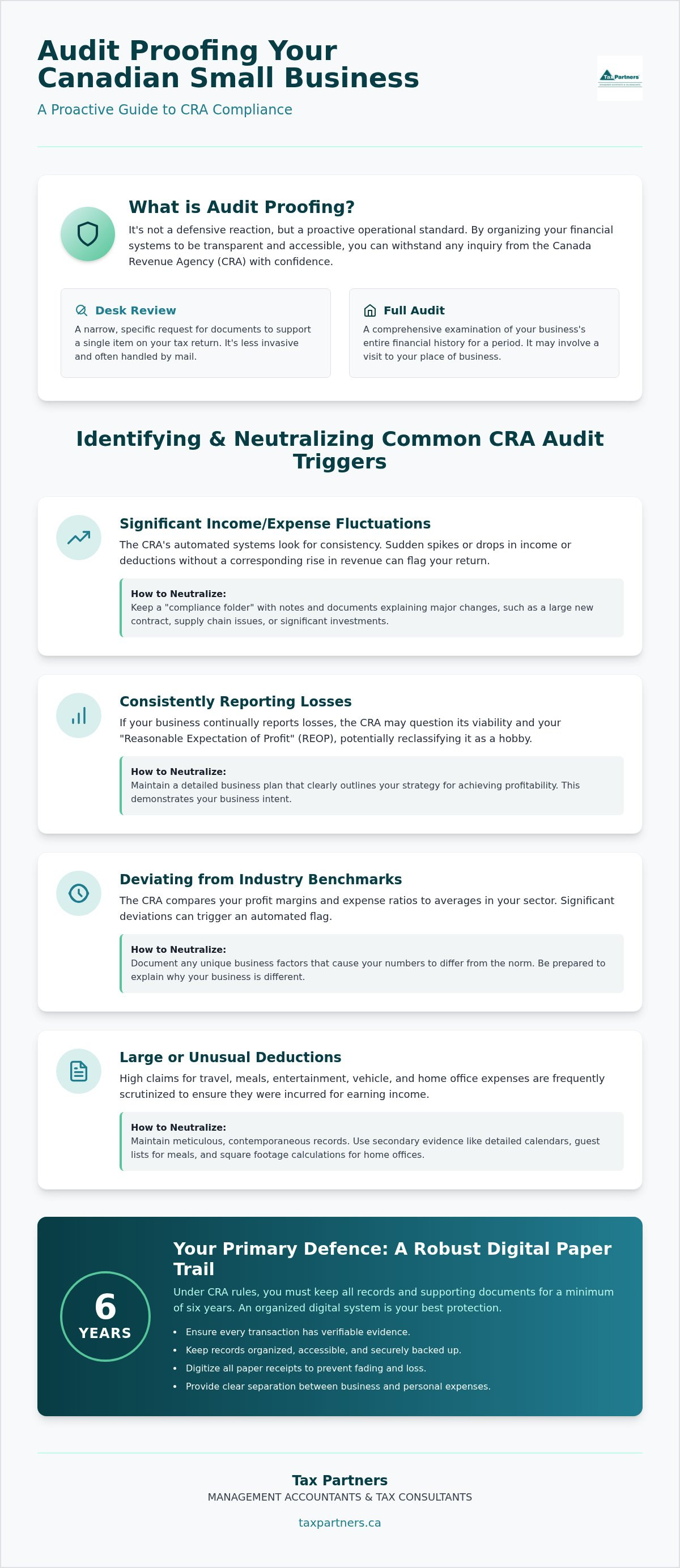
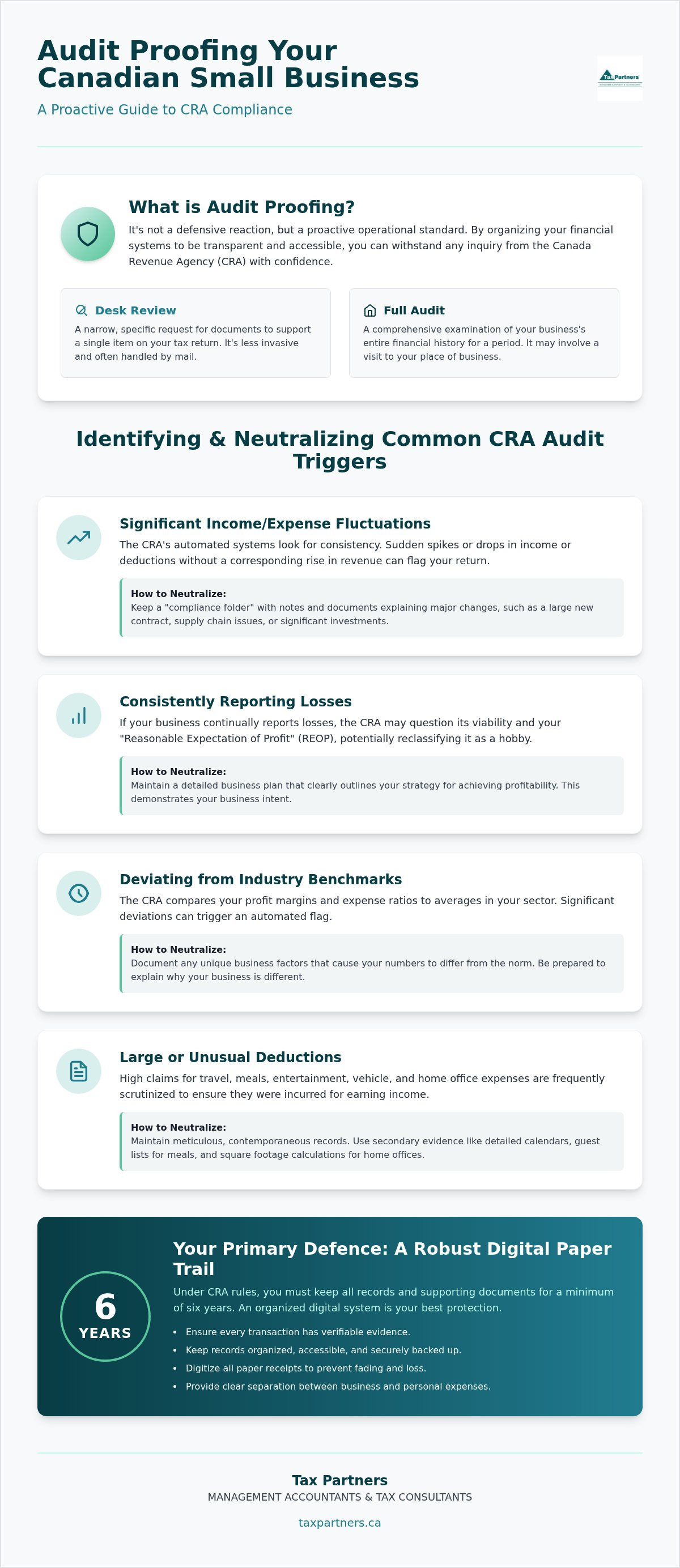
Audit proofing is not a defensive reaction to a problem. It is a proactive operational standard where you organize your financial systems to withstand any inquiry from the Canada Revenue Agency (CRA). For CRA filers, an audit is a formal examination of business records to ensure that all tax obligations are met according to Canadian law. It's a process that requires precision and clarity.
When you focus on audit proofing your small business, you prioritize the transparency and accessibility of your information. You ensure that every transaction is backed by verifiable evidence long before the agency ever requests it. This strategy is essential for all Canadian small businesses, whether you are a local contractor or a growing e-commerce firm. It turns your accounting records into a shield rather than a source of stress.
The Difference Between a Review and an Audit
The CRA often initiates contact through a "desk review." This is a narrow request where an officer asks for specific receipts or documents to support a single line item on your tax return. It is usually handled through the mail or a digital portal. While it feels formal, it is less invasive than a full audit.
A full audit is a comprehensive examination of your business's entire financial history for a specific period. An auditor may visit your place of business to inspect your books, records, and internal processes. Audit proofing your small business prepares you for both levels of scrutiny by ensuring your records are always "audit-ready." You won't need to scramble for documents because they are already organized and accessible.
Why Proactive Compliance Matters for SMEs
Organized records significantly reduce the time and professional costs associated with responding to the CRA. When your files are in order, your accountant can resolve inquiries quickly, preventing billable hours from mounting during a long investigation. Efficiency is the natural byproduct of a well-maintained system.
There is also a profound psychological benefit to being prepared. You gain a sense of total control over your regulatory standing, which allows you to lead your company without the weight of "what if" hanging over your head. This proactive stance often leads to financial gains as well. As you refine your records, you may discover unclaimed tax credits or deductions that were previously overlooked. Proper documentation doesn't just protect your money; it helps you keep more of it.
Identifying and Neutralizing Common CRA Audit Triggers
The CRA doesn't pick returns at random. They use automated systems to compare your data against industry standards and historical patterns. If your return deviates significantly from these norms, it may be flagged for a closer look.
Audit proofing your small business involves understanding these digital filters. Significant fluctuations in your year-over-year income or expenses often serve as a primary trigger. The CRA looks for consistency; sudden spikes in deductions without a corresponding rise in revenue can lead to questions.
We also see "lifestyle audits" where reported business income doesn't seem to support a taxpayer's standard of living. Similarly, reporting consistent losses might lead the agency to question if you have a "Reasonable Expectation of Profit" (REOP). Without a clear path to profitability, the CRA may reclassify your business as a hobby and deny your expense claims under CRA rules.
Industry Benchmarking and Your Tax Return
The CRA maintains extensive data on profit margins and expense ratios across different Canadian sectors. If your advertising costs are double the industry average, their system identifies the anomaly. Understanding common CRA audit triggers helps you prepare for these comparisons.
You should document unique industry factors that cause your business to deviate from these averages. For example, a sudden supply chain disruption might inflate your costs temporarily. Keeping a "compliance folder" allows you to explain these anomalies with contemporaneous evidence if an officer ever asks.
Managing Large or Unusual Deductions
High travel, meal, and home office expenses are frequent targets for CRA filers. The agency is particularly vigilant about ensuring these costs are incurred for the purpose of earning income. Secondary evidence, such as detailed calendars, guest lists for business meals, or square footage logs for home offices, is vital.
Consistency in your reporting remains your best defence against automated flags. If you're unsure how to categorize a large, one-time expense, you can speak with a tax professional to ensure it's recorded correctly. This proactive oversight ensures your return reflects the true nature of your business operations while minimizing risk.
Maintaining a Robust Digital Paper Trail for CRA Filers
Compliance begins with consistency. Under CRA rules, Canadian businesses must maintain their financial records for a minimum of six years from the end of the tax year to which they relate. This retention period ensures that you can justify every deduction if an officer requests a formal review. Audit proofing your small business requires a commitment to this timeline, as missing documents often lead to denied claims and unnecessary interest charges.
A truly robust paper trail includes more than just a list of expenses. You must keep original invoices, bank statements, and clear proof of payment, such as digital transfer confirmations or cancelled cheques. For Canadian corporations, this obligation also includes corporate minute books and shareholder records. These documents provide the legal context for your business decisions and are frequently the first items a CRA auditor will examine.
Accessibility is just as vital as retention. If the CRA requests information, they expect it to be provided in a readable and organized format. Scrambling to find a five-year-old receipt creates a negative impression of your internal controls. Keeping your records ready at all times demonstrates that you're a reliable and transparent taxpayer.
Standards for Electronic Record Keeping
Digital record-keeping is now the standard for modern SMEs. The CRA accepts digital images of receipts, but they must be clear, complete, and high-resolution. You should ensure that the date, vendor name, and GST/HST details are all perfectly legible. Simply saving a credit card statement is rarely enough. The CRA requires the original itemized receipt to confirm exactly what was purchased and whether it was a legitimate business expense.
Data integrity is your responsibility. You must maintain secure backups of your digital records to prevent loss due to hardware failure or cyber threats. A redundant system, such as combining cloud storage with a physical backup, provides the best protection. This level of foresight is a hallmark of a business that is truly prepared for scrutiny.
Organizing Your Books for Maximum Transparency
Efficiency saves you money. We suggest a filing system that mirrors the specific lines on your T2 Corporate Income Tax return. When your records align with your tax filings, responding to a CRA inquiry becomes a simple task rather than a week-long project. This level of organization is central to audit proofing your small business effectively.
Cloud-based accounting tools offer a significant advantage here. Many platforms allow you to attach digital receipts directly to individual transactions in real-time. This creates a seamless link between your books and your supporting evidence. If you need assistance setting up these systems, our accounting experts can help you implement a workflow that ensures every entry is backed by a verifiable digital trail.
Implementing Internal Controls to Secure Your Business
Internal controls are the specific policies and procedures you implement to ensure financial accuracy and prevent fraud. They act as the backbone of a resilient operation. When the CRA reviews a business, they view strong internal controls as a primary indicator of a reliable taxpayer. Audit proofing your small business starts with these systemic checks, which catch errors long before they ever reach a tax return.
Regular reconciliations are a vital part of this process. By matching your internal records against bank and credit card statements every month, you identify discrepancies in real-time. This practice ensures that your financial reporting remains precise and provides a clear audit trail if an officer ever requests clarification. It's about maintaining a steady hand on your business's financial pulse.
The Perils of Commingling Funds
Mixing personal and business expenses is one of the most significant red flags during a CRA audit. For Canadian SMEs, the separation of these finances must be absolute. Using dedicated business credit cards and bank accounts for all corporate activity simplifies your bookkeeping and protects your professional integrity. It prevents the blurred lines that often lead to deeper scrutiny during a review.
Properly documenting shareholder loans is equally critical. If you withdraw funds or pay personal expenses from the business without a clear agreement, the CRA may reclassify those amounts as taxable income. Maintaining formal loan agreements and repayment schedules ensures these transactions are viewed correctly under CRA rules. Transparency here is your best defence against unexpected tax assessments.
Payroll and GST/HST Compliance Systems
Many business owners are surprised to learn that payroll and GST/HST accounts are often audited more frequently than corporate income tax. The CRA prioritizes these areas because they involve trust funds held on behalf of the government. Implementing a rigorous system for calculating source deductions and tracking sales tax is non-negotiable for audit proofing your small business.
Timely filings are the first line of defence against interest and penalties. You must ensure that your GST/HST returns and payroll remittances meet all regulatory deadlines to avoid automated flags. For a deeper look at specific filing requirements, you can review our guide on Canadian Corporate Tax Compliance to keep your records on track.
If you're ready to strengthen your internal systems and secure your business's future, you can reach out to our advisors for personalized support. We help you build the procedures that turn complex compliance into a source of confidence and clarity.
Strategic Professional Oversight for Canadian Small Businesses
Professional oversight serves as the final layer of your business's defence. A seasoned CPA firm acts as a proactive guardian, identifying potential risks long before the Canada Revenue Agency (CRA) flags a return for review. This level of scrutiny ensures that audit proofing your small business remains an ongoing operational standard rather than a frantic year-end scramble.
A Compilation Engagement, historically referred to as a "Notice to Reader" in Canada, adds significant credibility to your financial statements. While it doesn't provide the same level of assurance as a full audit, it demonstrates that a qualified professional has organized your records. This professional touch is often appreciated by lenders and sets a transparent, reliable tone for any future interactions with the CRA.
Professional tax preparation also ensures that every claim you make adheres to the most current CRA rules and regulations. Tax laws in Canada are subject to frequent updates, and missing a single change can lead to accidental non-compliance or missed opportunities. Having an expert representative during a review protects your rights and ensures that all communication with the agency remains technically precise and accurate.
The Role of a Seasoned Tax Mentor
At Tax Partners, we leverage over 40 years of institutional wisdom to guide our clients through complex regulatory environments. We provide foresight into emerging CRA trends, such as increased scrutiny on digital assets or home office claims. This experience allows us to offer customized tax planning that aligns with your long-term wealth preservation goals and business objectives.
We encourage you to view professional accounting and tax services not as an overhead cost, but as a strategic investment in your business's stability. A steady hand at the helm prevents costly errors and builds a foundation that supports sustainable growth. Our role is to look ahead, securing better outcomes by anticipating requirements before they become urgent problems.
Responding to a CRA Inquiry with Confidence
If you've committed to audit proofing your small business, receiving a letter from the CRA becomes a routine matter rather than a financial crisis. You can respond with absolute calm, knowing that your digital paper trail is complete and your internal controls are sound. The stress of the unknown is replaced by the certainty of thorough preparation.
We recommend having your CPA act as the primary point of contact for the CRA during any inquiry or review. This ensures that the information provided is technically precise and prevents the accidental disclosure of irrelevant or confusing data. It allows you to stay focused on running your company while we handle the technical dialogue with the agency.
To begin building your resilient financial foundation, Contact Tax Partners to begin audit proofing your business today.
Secure Your Financial Future with Precision
Building a resilient business requires moving beyond reactive habits toward a standard of excellence. By mastering the digital paper trail and neutralizing common triggers, you ensure your records always meet the highest standards for CRA filers. Audit proofing your small business is about creating a transparent system that stands firm under any level of scrutiny under CRA rules.
You don't have to navigate these complex regulatory waters alone. With over 40 years of Canadian tax expertise and more than 1,390 five-star Google reviews, we've helped our clients save over $87M. Our team serves as your proactive guardian, ensuring your financial foundation remains unshakable through every stage of your growth.
Secure your business with expert CRA audit support from Tax Partners and regain total control over your finances today. You've worked hard to build your company; let us help you protect it with the foresight and precision you deserve.
Frequently Asked Questions
How long should I keep my business records under CRA rules?
Under CRA rules, you must generally keep all supporting documents and financial records for six years from the end of the last tax year they relate to. For example, records for the 2025 tax year should be retained until the end of 2031. This rule applies to both paper and electronic formats. Maintaining these files is a cornerstone of audit proofing your small business, as it ensures you can justify every claim made on your return.
Can the CRA audit my personal bank accounts if I own a small business?
Yes, the CRA has the authority to examine your personal bank statements if they believe business and personal finances are commingled. This often occurs during a lifestyle audit where reported business income doesn't align with your personal spending patterns. To protect yourself, maintain absolute separation between your corporate and personal accounts. This transparency demonstrates that your business operates as a distinct legal entity with accurate financial reporting and internal controls.
What are the most common triggers for a small business audit in Canada?
Common triggers include significant year-over-year fluctuations in income and expenses that deviate from Canadian industry averages. The CRA also prioritizes reviews for businesses with high travel and meal deductions or those reporting consistent losses. Inconsistencies between your GST/HST filings and your corporate income tax returns are another frequent red flag. Automated systems flag these anomalies, making it vital to document any unique circumstances that affect your profit margins in real-time.
Is a digital copy of a receipt enough for a CRA audit?
A digital copy of a receipt is acceptable to the CRA provided the image is clear, complete, and legible. The digital record must show the date of purchase, the vendor's name, and a breakdown of any GST/HST paid. Simply keeping a credit card statement isn't enough because it doesn't provide an itemized list of what was bought. Using cloud-based software to attach receipts to transactions is a highly effective way of audit proofing your small business.
What happens if I cannot find a receipt during a CRA review?
If you cannot produce a receipt, the CRA will likely disallow the specific expense, which can lead to additional taxes and interest charges. While secondary evidence like bank statements or calendars might provide context, they aren't a formal substitute for an original invoice. This highlights why meticulous record-keeping is so important. If you find yourself in this situation, a professional accountant can help you present the best possible documentation to mitigate potential penalties.
How much does it cost to hire a professional for CRA audit help?
The cost of hiring a professional for audit assistance varies based on the complexity of your records and the depth of the CRA's inquiry. Fees are typically determined by the time required to organize documents and communicate with the auditor. You should view this service as an investment in protecting your business from larger reassessments. Professional oversight ensures your rights are protected and that the dialogue with the agency remains technical and precise.
What is the difference between a desk audit and a field audit?
A desk audit is a narrow review conducted through correspondence where an officer requests specific documents to verify a line item on your return. In contrast, a field audit is a comprehensive, in-person examination of your entire financial history, often conducted at your place of business. Field audits are more invasive and require a higher level of preparation. Both levels of scrutiny require organized records to ensure the process moves quickly and without complications.
Can I appeal a CRA audit decision if I disagree with the results?
You have the right to appeal a CRA audit decision if you believe the assessment is incorrect. The first step involves filing a formal Notice of Objection within specific timeframes set by the agency. This starts an independent review process where a different officer examines the facts of your case. It's a formal legal procedure, so having professional guidance is essential to ensure your arguments are presented clearly and meet all regulatory requirements for CRA filers.

Article by
Mahad Mohamed
Mahad Mohamed is an accountant and the CEO of Tax Partners, with over 26+ years of Canadian and international tax and accounting experience. His expertise includes corporate reorganization, cross-border tax structuring (Canada & US), tax disputes, CRA audits, and tax planning for small owner-managed private corporations. Most recently, Mahad is a pioneer in Canadian crypto taxation and founded Block3 Finance.
Previously, Mahad worked for the Canada Revenue Agency (CRA), Big4 accounting firms, and served as a Rulings Officer for the Federal Tax Authority of the UAE before acquiring Tax Partners in 2014.
Tax Partners has 44 full-time accountants and over 18,400+ clients.
Disclaimer
This article provides general information only and is current as of its publication date. It has not been updated and may be out of date. It does not constitute legal advice and should not be relied upon as such. Every tax situation is unique and may differ from the examples discussed in this article. If you have specific questions, you should seek the advice of our accountants for your unique circumstances. Book a FREE Initial Consultation Today!
Frequently Asked Questions
How long should I keep my business records under CRA rules?
Under CRA rules, you must generally keep all supporting documents and financial records for six years from the end of the last tax year they relate to. For example, records for the 2025 tax year should be retained until the end of 2031. This rule applies to both paper and electronic formats. Maintaining these files is a cornerstone of audit proofing your small business, as it ensures you can justify every claim made on your return.
Can the CRA audit my personal bank accounts if I own a small business?
Yes, the CRA has the authority to examine your personal bank statements if they believe business and personal finances are commingled. This often occurs during a lifestyle audit where reported business income doesn't align with your personal spending patterns. To protect yourself, maintain absolute separation between your corporate and personal accounts. This transparency demonstrates that your business operates as a distinct legal entity with accurate financial reporting and internal controls.
What are the most common triggers for a small business audit in Canada?
Common triggers include significant year-over-year fluctuations in income and expenses that deviate from Canadian industry averages. The CRA also prioritizes reviews for businesses with high travel and meal deductions or those reporting consistent losses. Inconsistencies between your GST/HST filings and your corporate income tax returns are another frequent red flag. Automated systems flag these anomalies, making it vital to document any unique circumstances that affect your profit margins in real-time.
Is a digital copy of a receipt enough for a CRA audit?
A digital copy of a receipt is acceptable to the CRA provided the image is clear, complete, and legible. The digital record must show the date of purchase, the vendor's name, and a breakdown of any GST/HST paid. Simply keeping a credit card statement isn't enough because it doesn't provide an itemized list of what was bought. Using cloud-based software to attach receipts to transactions is a highly effective way of audit proofing your small business.
What happens if I cannot find a receipt during a CRA review?
If you cannot produce a receipt, the CRA will likely disallow the specific expense, which can lead to additional taxes and interest charges. While secondary evidence like bank statements or calendars might provide context, they aren't a formal substitute for an original invoice. This highlights why meticulous record-keeping is so important. If you find yourself in this situation, a professional accountant can help you present the best possible documentation to mitigate potential penalties.
How much does it cost to hire a professional for CRA audit help?
The cost of hiring a professional for audit assistance varies based on the complexity of your records and the depth of the CRA's inquiry. Fees are typically determined by the time required to organize documents and communicate with the auditor. You should view this service as an investment in protecting your business from larger reassessments. Professional oversight ensures your rights are protected and that the dialogue with the agency remains technical and precise.
What is the difference between a desk audit and a field audit?
A desk audit is a narrow review conducted through correspondence where an officer requests specific documents to verify a line item on your return. In contrast, a field audit is a comprehensive, in-person examination of your entire financial history, often conducted at your place of business. Field audits are more invasive and require a higher level of preparation. Both levels of scrutiny require organized records to ensure the process moves quickly and without complications.
Can I appeal a CRA audit decision if I disagree with the results?
You have the right to appeal a CRA audit decision if you believe the assessment is incorrect. The first step involves filing a formal Notice of Objection within specific timeframes set by the agency. This starts an independent review process where a different officer examines the facts of your case. It's a formal legal procedure, so having professional guidance is essential to ensure your arguments are presented clearly and meet all regulatory requirements for CRA filers.