Asset Protection Strategies for Business Owners in Canada

If a single lawsuit or unexpected tax bill could wipe out years of your hard work, is your wealth truly secure? For many entrepreneurs, the line between personal security and corporate risk feels dangerously thin. Implementing robust asset protection strategies for business owners Canada is the only way to ensure your family's future isn't tied to a single bad quarter or a legal dispute.
You've spent years building your legacy, and it's natural to worry about how creditors or heavy taxation might erode those retained earnings. These concerns are valid, especially when navigating the complex landscape of Canada Revenue Agency (CRA) regulations. We understand that you need more than just general advice; you need a proactive shield for your life's work.
We'll show you how to build a "moat and castle" around your wealth using proven, CRA-compliant methods that stand up to scrutiny. This guide explores how to utilize a holding company (Holdco), which is a corporation that exists to own assets rather than conduct active business. We also examine creditor-proof investment vehicles and provide a clear roadmap for long-term wealth preservation.
Key Takeaways
- Learn how a Holding Company structure creates a legal barrier between your business liabilities and your hard-earned wealth.
- Discover specific asset protection strategies for business owners Canada that allow you to move retained earnings tax-efficiently under CRA rules.
- Identify the benefits of holding intellectual property in a separate corporation to safeguard your brand from operational risks.
- Understand how Family Trusts can help you manage succession planning and minimize future estate taxes for your heirs.
- Recognize why proactive planning is essential to ensure your structure is legally sound and avoids fraudulent conveyance issues.
Understanding Asset Protection for Canadian Business Owners
Asset protection is a legal framework designed to insulate your wealth from potential claims. It isn't about evasion or secrecy; it's about using the law to ensure your family's future stays intact. For those seeking Understanding Asset Protection, it's vital to recognize that this involves both legal structures and tax-efficient planning.
In Canada, effective creditor proofing relies on federal and provincial statutes that define how and when assets can be reached. This includes the Bankruptcy and Insolvency Act and provincial Fraudulent Conveyances Acts. You must implement asset protection strategies for business owners Canada before any legal threat emerges. If you wait until a creditor knocks, moving assets might be ruled a fraudulent transfer by a court.
We view these asset protection strategies for business owners Canada as a two-part system. First, you protect against third-party liabilities like lawsuits or business debts. Second, you protect against the gradual erosion of wealth caused by excessive taxation. Both are equally dangerous to your long-term success.
The Legal Moat: Liability vs. Ownership
Holding business assets in your own name is a significant risk. If your business is sued, your personal home, bank accounts, and investments could be seized to satisfy a judgment. This is why most Canadian entrepreneurs choose to incorporate their ventures.
Incorporation creates a separate legal entity, often called the "corporate veil." This veil separates the company's liabilities from the shareholders' personal assets. However, this protection isn't absolute and can be pierced if you don't maintain proper corporate formalities. Common triggers for asset seizure include personal guarantees on loans, unpaid HST, or source deductions (taxes withheld from employee paycheques) owed to the CRA.
The Tax Castle: Preservation of Capital
While creditors represent a sudden threat, tax erosion is a constant, slow-moving risk. Without proper planning, a large portion of your retained earnings could be lost to high corporate or personal tax rates. Wealth management serves as your "tax castle," keeping more capital within your control.
Proactive guardianship is at the heart of our proactive mission to secure your financial future. We help you navigate CRA rules to ensure your capital grows in a protected environment. By reducing your tax exposure, you increase the longevity and resilience of your business. This approach allows you to focus on growth while we handle the complexities of preservation.
Structural Strategies: Incorporating and Using Holding Companies
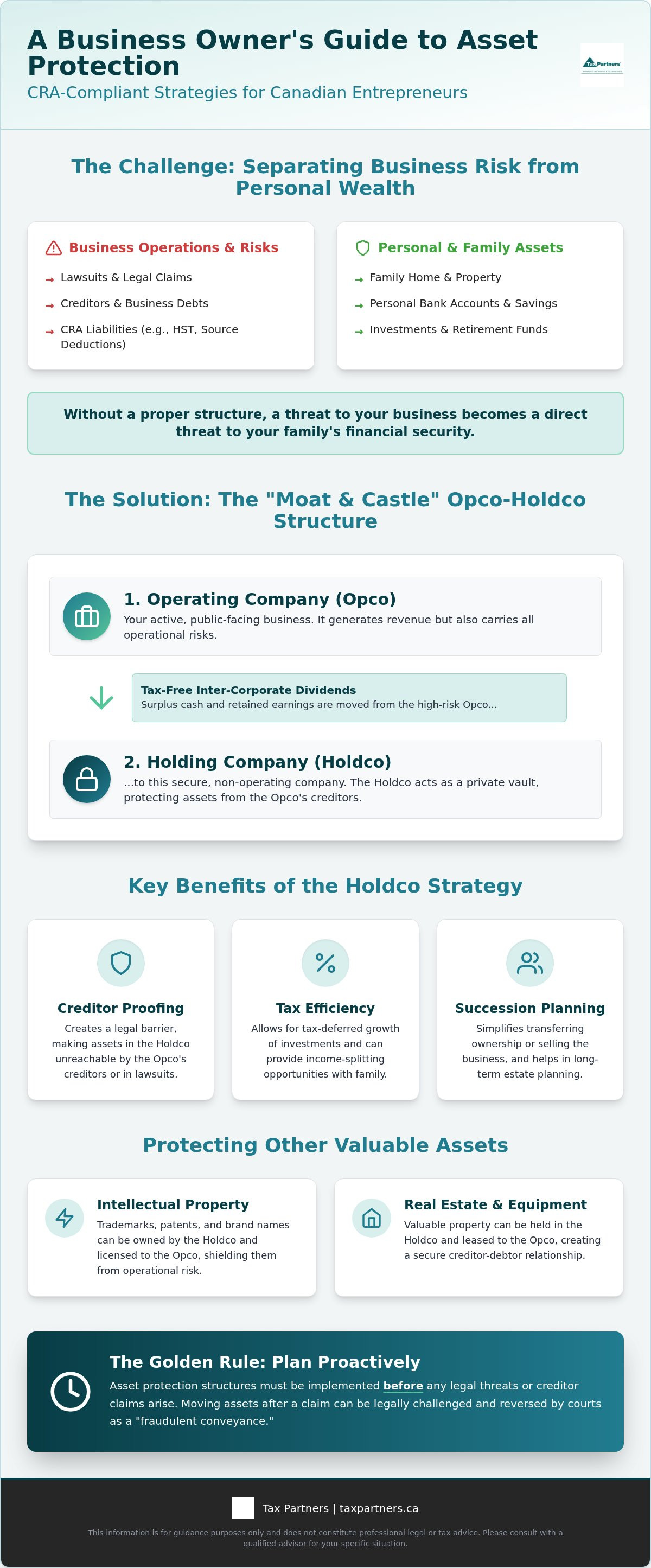
Building a single corporation is a great first step, but it's rarely enough for long-term security. Advanced asset protection strategies for business owners Canada often involve a multi-layered corporate architecture. This approach separates the part of your business that takes risks from the part that holds your wealth.
The core of this strategy is the separation of your active business and your accumulated assets. By using two or more corporations, you create a physical and legal barrier that protects your capital. This structure is designed to keep your hard-earned profits away from the daily risks of running a business.
The Opco-Holdco Relationship
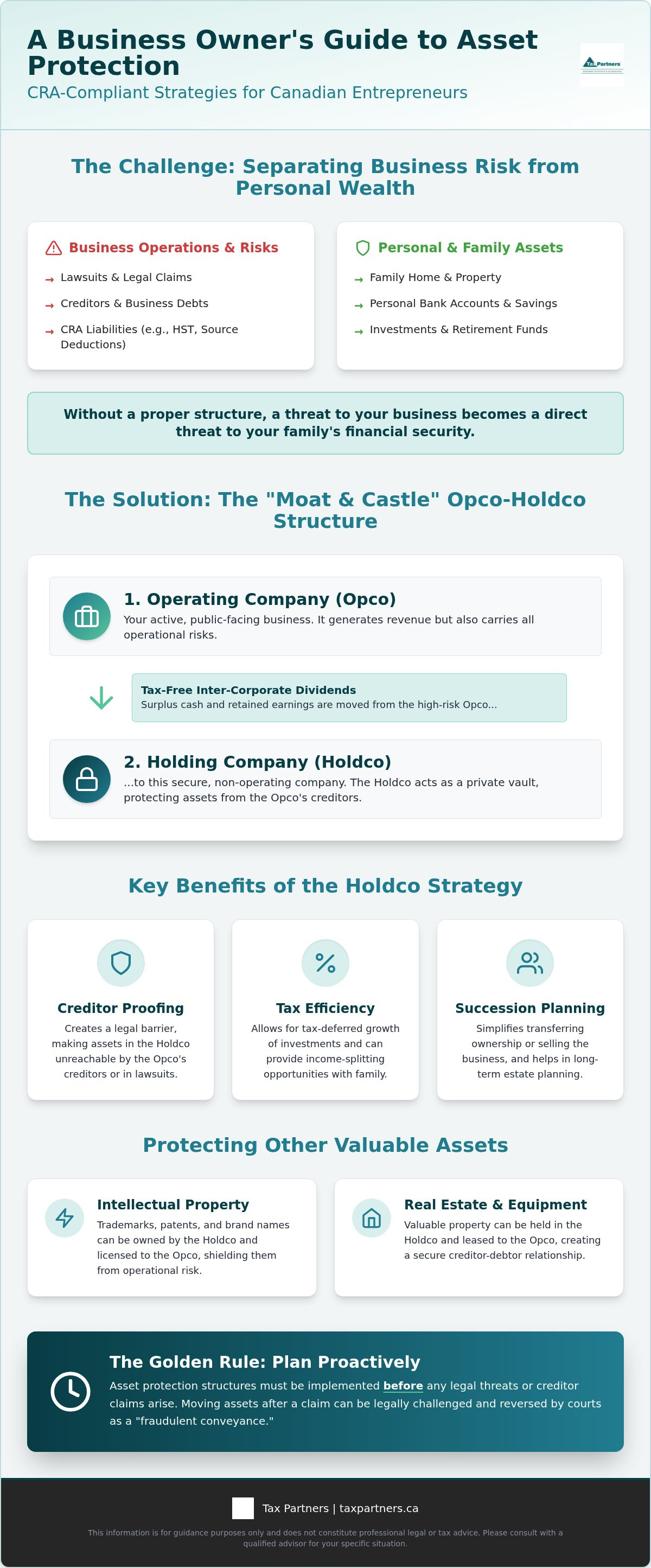
An Operating Company (Opco) is the entity that deals with the public, signs contracts, and employs staff. Because it's active, it's the entity most likely to face lawsuits or debts. A Holding Company (Holdco), which is a corporation that exists primarily to own assets rather than conduct active business, acts as your private vault.
For CRA filers, the magic happens through inter-corporate dividends. You can move surplus cash from the Opco to the Holdco, often on a tax-free basis under the Income Tax Act. This process ensures that if the Opco is ever sued, the bulk of your profits are already safe within the Holdco.
Leaving large sums of cash in an Opco is a significant risk. If a creditor obtains a judgment against the Opco, they can seize any cash or assets held within that specific entity. Moving that wealth to a Holdco effectively puts it out of reach of the Opco's creditors.
Securing Assets Through Inter-Corporate Loans
Sometimes your Opco might need that cash back to fund new projects or cover seasonal expenses. Instead of just giving the money back, the Holdco should loan it to the Opco. This creates a formal debtor-creditor relationship between your two companies.
To make this effective, the Holdco must become a secured creditor by registering a security interest under provincial law. In a Canadian bankruptcy or insolvency, secured creditors are paid before unsecured creditors, such as vendors or legal claimants. This ensures your Holdco stays at the front of the line to recover its funds.
A valid inter-corporate loan strategy requires several key components:
- A written promissory note or loan agreement.
- A specified interest rate and repayment terms.
- A registered security interest, such as a PPSA filing in your province.
Proper documentation is non-negotiable for this strategy to hold up under legal scrutiny. You need formal agreements and registered filings to prove the arrangement is legitimate. You can consult with our specialists to ensure your corporate documentation meets these rigorous standards.
Protecting Intellectual Property and Retained Earnings
Your business wealth isn't just found in your bank account or equipment. Intellectual property (IP), such as trademarks, patents, and proprietary software, often represents the true value of a Canadian enterprise. Without proactive asset protection strategies for business owners Canada, these intangible assets remain vulnerable to operational risks.
We believe in securing every layer of your success. This involves moving high-value IP into a separate legal environment where it's insulated from the daily liabilities of your main business. By doing so, you ensure that your brand and innovations remain under your control, regardless of what happens in the marketplace.
Separating Intellectual Property from Operations
Keeping your trademarks or patents within your Operating Company (Opco) is a common mistake. If the Opco faces a significant legal claim, your brand identity and proprietary technology could be seized as corporate assets. To prevent this, you can establish a "sister corporation" specifically to hold your IP.
A sister corporation is a separate entity owned by the same shareholders but legally independent from the Opco. The IP-Holdco then grants a licence to the Opco to use these assets in exchange for a fee. This licensing model creates a formal barrier that keeps the ownership of your most valuable tools safe from the Opco's creditors.
This structure offers several advantages for long-term stability:
- Ensures your brand survives even if the operational entity faces insolvency.
- Creates a tax-deductible expense for the Opco through licensing fees.
- Allows for easier management of IP across multiple subsidiaries or franchises.
Creditor-Proof Investment Vehicles
For CRA filers, protecting personal retirement savings is a top priority. While many owners rely on Registered Retirement Savings Plans (RRSPs), these accounts offer limited protection from creditors outside of a formal bankruptcy. A more robust alternative is the Individual Pension Plan (IPP).
An IPP is a defined benefit pension plan established by a corporation for a business owner or key executive. Under CRA rules, IPPs allow for significantly higher contribution limits than traditional RRSPs. Because they are registered pension plans, the assets within an IPP are generally exempt from seizure by creditors under provincial pension legislation.
This level of security makes the IPP a cornerstone of Wealth Management & Financial Planning for successful entrepreneurs. Additionally, certain life insurance policies with named beneficiaries, such as a spouse or child, can provide an extra layer of protection. These assets often bypass the estate and remain out of reach for business-related claimants, providing peace of mind for your family's future.
Estate Planning and Wealth Preservation for CRA Filers
Estate planning is far more than just drafting a will. It is a critical component of current asset protection strategies for business owners Canada. By looking ahead, you can shield your family's future from current risks while optimizing your overall tax position under Canadian law.
We approach estate planning as a way to build a multi-generational legacy. This requires a steady hand to navigate complex CRA regulations and ensure your assets remain within your family's control. Our goal is to move you from a state of uncertainty toward a feeling of total control over your financial destiny.
Utilizing Family Trusts
A Family Trust acts as a separate legal entity that can hold shares of your corporation or other valuable assets. Because the trust owns these assets, they are generally protected from the personal creditors of the beneficiaries. This structure provides a robust layer of security that personal ownership simply cannot match.
Trusts also offer significant flexibility for income splitting among family members. While you must follow specific CRA guidelines regarding tax on split income, a well-structured trust remains a powerful tool. It allows you to distribute wealth in a way that aligns with your family's needs and tax brackets.
You should also be aware of the "21-year rule" for CRA filers. This rule generally triggers a deemed disposition of trust assets every 21 years, potentially resulting in a significant tax bill. We integrate this timeline into your broader wealth management & financial planning strategy to avoid any sudden financial shocks.
Succession and the Capital Gains Exemption
The Lifetime Capital Gains Exemption (LCGE) is one of the most valuable tax benefits available to Canadian entrepreneurs. It allows you to shield a substantial portion of the profit from the sale of shares in a Qualified Small Business Corporation (QSBC). To qualify, your company must meet specific asset tests set by the CRA.
Maintaining QSBC status often requires "purifying" or "cleaning" the Opco of redundant assets like excess cash or passive investments. If these assets represent too large a percentage of the company's value, you could lose your eligibility for the exemption. Moving these assets to a Holdco, as we discussed earlier, serves the dual purpose of creditor protection and tax optimization.
Planning for an exit requires foresight and a bespoke strategy. For detailed transition advice, we recommend exploring Succession Planning for Your Family Business. If you are ready to secure your legacy, contact our expert team to build a customized preservation plan that protects your life's work.
Navigating Compliance and Implementing Your Protection Plan
Timing is everything when securing your legacy. You can't put on a seatbelt after the crash, and the same logic applies to your wealth. Effective asset protection strategies for business owners Canada must be in place long before a creditor or a legal challenge appears on the horizon.
Moving assets once a threat is known is called "fraudulent conveyance." Canadian courts have the power to reverse these transfers, leaving your wealth exposed and your professional reputation damaged. We focus on ethical, transparent planning that follows all federal and provincial laws to ensure your structure stands up to legal scrutiny.
The Danger of DIY Structuring
Trying to build these complex structures without expert guidance often leads to expensive mistakes. Improper asset transfers can trigger immediate tax liabilities under the Income Tax Act for CRA filers. You might think you're saving money by handling it yourself, but a single misstep can result in a massive, unexpected tax bill.
There's also the significant risk of the CRA re-characterizing your inter-corporate movements. If they view a transfer as a personal benefit rather than a legitimate business transaction, the tax consequences are severe. A CPA-led approach ensures every move is documented, justified, and compliant with current Canadian regulations.
Our team brings over 40 years of experience to this process, providing the steady hand you need. We've helped thousands of clients navigate these complexities, ensuring their structures are both resilient and efficient. This proactive guardianship is what separates a truly secure business from one that is merely lucky.
Your Implementation Roadmap
Securing your life's work is a methodical process that requires precision and foresight. It involves a clear transition from a state of potential risk toward a feeling of total control. We follow a specific roadmap to ensure no detail is overlooked in your asset protection strategies for business owners Canada.
- Step 1: Conduct a comprehensive audit of all personal and business assets and liabilities to identify vulnerabilities.
- Step 2: Design a bespoke corporate structure that may include an Opco, Holdco, or a Family Trust tailored to your goals.
- Step 3: Execute all legal and accounting documentation to formalize the new structure and transfer assets correctly.
- Step 4: Maintain annual filings and update corporate minute books to ensure ongoing CRA compliance and legal validity.
Annual maintenance is just as important as the initial setup of your plan. Your business and the legal landscape in Canada will change over time, so your strategy must evolve too. Regular reviews ensure your protection remains robust and your tax position stays optimized for the years ahead.
Secure Your Financial Future Today
Building a successful business is a monumental achievement, but keeping that wealth requires a different set of skills. You've learned how structural separation and the strategic use of Family Trusts can create a resilient barrier against risk. These asset protection strategies for business owners Canada are not just about legal safety; they're about ensuring your hard work benefits your family for generations to come.
Navigating CRA complexities alone is a risk you don't have to take. Tax Partners is a firm with a broad national reach, bringing over 40 years of Canadian tax expertise to your corner. We've saved our clients more than $87M through meticulous, bespoke planning that prioritizes both security and transparency. Our team acts as your proactive guardian, looking ahead to identify threats before they impact your bottom line.
Don't leave your legacy to chance or outdated structures. You deserve a partner who is as invested in your success as you are. Secure your legacy with Tax Partners today and take the first step toward lasting financial peace of mind. Your future self will thank you for the foresight you show today.
Frequently Asked Questions
Is asset protection legal in Canada under CRA rules?
Yes, asset protection is entirely legal in Canada when you use established corporate and trust structures. It's about organizing your affairs to minimize risk and tax exposure under CRA rules. This proactive planning is a standard part of wealth management. You must ensure all transfers are made at fair market value and documented correctly. If you move assets to evade taxes or known creditors, you risk legal penalties and the reversal of those transactions.
What is the difference between a holding company and an operating company?
An operating company (Opco) handles the daily activities of your business, such as hiring staff and signing contracts. This entity is the "front line" and carries the most risk. A holding company (Holdco) is a separate corporation that exists solely to own assets like cash, real estate, or shares. By moving profits from the Opco to the Holdco through dividends, you shield that wealth from the Opco's potential creditors and legal claims.
Are my personal assets at risk if my Canadian corporation is sued?
Your personal assets are generally protected by the "corporate veil," which treats the corporation as a separate legal entity. However, this protection isn't absolute for Canadian business owners. You remain personally liable for unpaid HST, employee source deductions, and wages if the company cannot pay. Additionally, if you've signed personal guarantees for business loans or leases, your personal home and bank accounts remain vulnerable to those specific creditors.
How does a Family Trust help with asset protection?
A Family Trust acts as a legal barrier because the trust, not the individual, owns the assets. Since the assets aren't personally owned by the beneficiaries, they're typically out of reach for their personal creditors. This is a common part of asset protection strategies for business owners Canada. It also allows for flexible income splitting and succession planning while maintaining a high level of control over how and when wealth is distributed to your family members.
Can I protect my business assets after I have been served with a lawsuit?
No, attempting to move assets after you've been served with a lawsuit is often considered a "fraudulent conveyance." Under provincial laws, Canadian courts can reverse these transfers to satisfy a creditor's claim. Effective protection must be implemented while your "financial seas are calm." If you wait until trouble starts, your options for legal asset movement are extremely limited. Proactive planning is the only reliable way to ensure your wealth stays secure.
What is creditor proofing for small business owners?
Creditor proofing is the process of arranging your business and personal affairs to make assets legally inaccessible to future creditors. For small business owners, this involves using specific asset protection strategies for business owners Canada like inter-corporate loans and secured interests. By becoming a secured creditor of your own operating company, you ensure your holding company is paid first in the event of insolvency. It's a strategic way to prioritize your family's financial security.
Does an RRSP provide the same protection as an Individual Pension Plan?
No, an Individual Pension Plan (IPP) generally offers superior protection compared to a Registered Retirement Savings Plan (RRSP). While RRSPs are protected during a formal bankruptcy, they're often vulnerable to other legal judgments in many provinces. An IPP is a registered pension plan, and these are typically exempt from seizure by creditors under provincial pension legislation. This makes the IPP a much more robust vehicle for long-term wealth preservation and retirement security.
How often should I review my asset protection strategy?
You should review your strategy at least once a year or whenever your business undergoes a significant change. Major events like a sharp increase in retained earnings, the acquisition of new property, or changes in family status require a professional assessment. CRA regulations also evolve, and a structure that worked five years ago might not be optimal today. Regular maintenance ensures your "legal moat" remains strong and your tax planning stays fully compliant.

Article by
Mahad Mohamed
Mahad Mohamed is an accountant and the CEO of Tax Partners, with over 26+ years of Canadian and international tax and accounting experience. His expertise includes corporate reorganization, cross-border tax structuring (Canada & US), tax disputes, CRA audits, and tax planning for small owner-managed private corporations. Most recently, Mahad is a pioneer in Canadian crypto taxation and founded Block3 Finance.
Previously, Mahad worked for the Canada Revenue Agency (CRA), Big4 accounting firms, and served as a Rulings Officer for the Federal Tax Authority of the UAE before acquiring Tax Partners in 2014.
Tax Partners has 44 full-time accountants and over 18,400+ clients.
Disclaimer
This article provides general information only and is current as of its publication date. It has not been updated and may be out of date. It does not constitute legal advice and should not be relied upon as such. Every tax situation is unique and may differ from the examples discussed in this article. If you have specific questions, you should seek the advice of our accountants for your unique circumstances. Book a FREE Initial Consultation Today!
Frequently Asked Questions
Is asset protection legal in Canada under CRA rules?
Yes, asset protection is entirely legal in Canada when you use established corporate and trust structures. It's about organizing your affairs to minimize risk and tax exposure under CRA rules. This proactive planning is a standard part of wealth management. You must ensure all transfers are made at fair market value and documented correctly. If you move assets to evade taxes or known creditors, you risk legal penalties and the reversal of those transactions.
What is the difference between a holding company and an operating company?
An operating company (Opco) handles the daily activities of your business, such as hiring staff and signing contracts. This entity is the "front line" and carries the most risk. A holding company (Holdco) is a separate corporation that exists solely to own assets like cash, real estate, or shares. By moving profits from the Opco to the Holdco through dividends, you shield that wealth from the Opco's potential creditors and legal claims.
Are my personal assets at risk if my Canadian corporation is sued?
Your personal assets are generally protected by the "corporate veil," which treats the corporation as a separate legal entity. However, this protection isn't absolute for Canadian business owners. You remain personally liable for unpaid HST, employee source deductions, and wages if the company cannot pay. Additionally, if you've signed personal guarantees for business loans or leases, your personal home and bank accounts remain vulnerable to those specific creditors.
How does a Family Trust help with asset protection?
A Family Trust acts as a legal barrier because the trust, not the individual, owns the assets. Since the assets aren't personally owned by the beneficiaries, they're typically out of reach for their personal creditors. This is a common part of asset protection strategies for business owners Canada. It also allows for flexible income splitting and succession planning while maintaining a high level of control over how and when wealth is distributed to your family members.
Can I protect my business assets after I have been served with a lawsuit?
No, attempting to move assets after you've been served with a lawsuit is often considered a "fraudulent conveyance." Under provincial laws, Canadian courts can reverse these transfers to satisfy a creditor's claim. Effective protection must be implemented while your "financial seas are calm." If you wait until trouble starts, your options for legal asset movement are extremely limited. Proactive planning is the only reliable way to ensure your wealth stays secure.
What is creditor proofing for small business owners?
Creditor proofing is the process of arranging your business and personal affairs to make assets legally inaccessible to future creditors. For small business owners, this involves using specific asset protection strategies for business owners Canada like inter-corporate loans and secured interests. By becoming a secured creditor of your own operating company, you ensure your holding company is paid first in the event of insolvency. It's a strategic way to prioritize your family's financial security.
Does an RRSP provide the same protection as an Individual Pension Plan?
No, an Individual Pension Plan (IPP) generally offers superior protection compared to a Registered Retirement Savings Plan (RRSP). While RRSPs are protected during a formal bankruptcy, they're often vulnerable to other legal judgments in many provinces. An IPP is a registered pension plan, and these are typically exempt from seizure by creditors under provincial pension legislation. This makes the IPP a much more robust vehicle for long-term wealth preservation and retirement security.
How often should I review my asset protection strategy?
You should review your strategy at least once a year or whenever your business undergoes a significant change. Major events like a sharp increase in retained earnings, the acquisition of new property, or changes in family status require a professional assessment. CRA regulations also evolve, and a structure that worked five years ago might not be optimal today. Regular maintenance ensures your "legal moat" remains strong and your tax planning stays fully compliant.