FBAR Penalties for Canadians: 2026 IRS Compliance Guide

What if the IRS viewed your Canadian retirement savings not as a secure nest egg, but as an undisclosed foreign asset subject to severe financial sanctions? For many Canadians with US filing obligations, the fear of losing a lifetime of savings to fbar penalties for canadians is a constant source of anxiety. It's difficult to keep track of which accounts require disclosure under IRS rules, especially when the Report of Foreign Bank and Financial Accounts (FBAR) covers common Canadian vehicles like the Tax-Free Savings Account (TFSA).
We understand that the evolving regulatory landscape often feels like a moving target. You deserve a clear path to security that protects your wealth while ensuring you remain in good standing with the tax authorities. This guide will help you master IRS penalties and provide a strategy to safeguard your Canadian assets from non-compliance fines.
We'll examine the crucial distinctions between willful and non-willful violations under IRS guidelines. You'll also discover how to use the Streamlined Filing Compliance Procedures, an IRS amnesty program, to catch up on delinquent reports without the stress of excessive penalties. This guide provides a definitive roadmap for 2026 compliance that puts you back in total control of your financial future.
Key Takeaways
- Identify your status as a "US Person" under IRS rules to determine if you must disclose Canadian financial accounts through FinCEN Form 114.
- Learn how to distinguish between willful and non-willful violations to effectively mitigate the risk of severe fbar penalties for canadians.
- Recognize which common Canadian assets, such as TFSAs and RRSPs, require reporting under IRS regulations to avoid unintentional non-compliance.
- Explore how the IRS Streamlined Foreign Offshore Procedures provide a path for Canadian residents to resolve past errors and potentially secure a full penalty waiver.
Understanding IRS FBAR Penalties for Canadian Residents
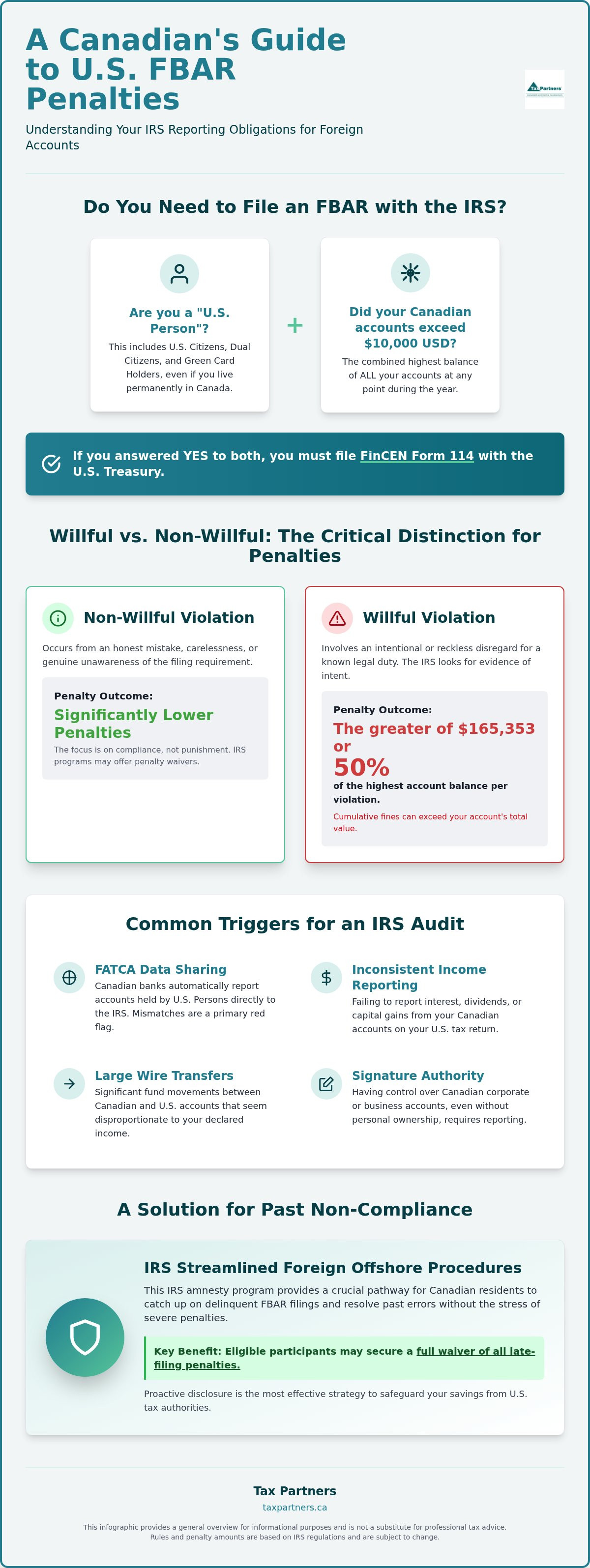
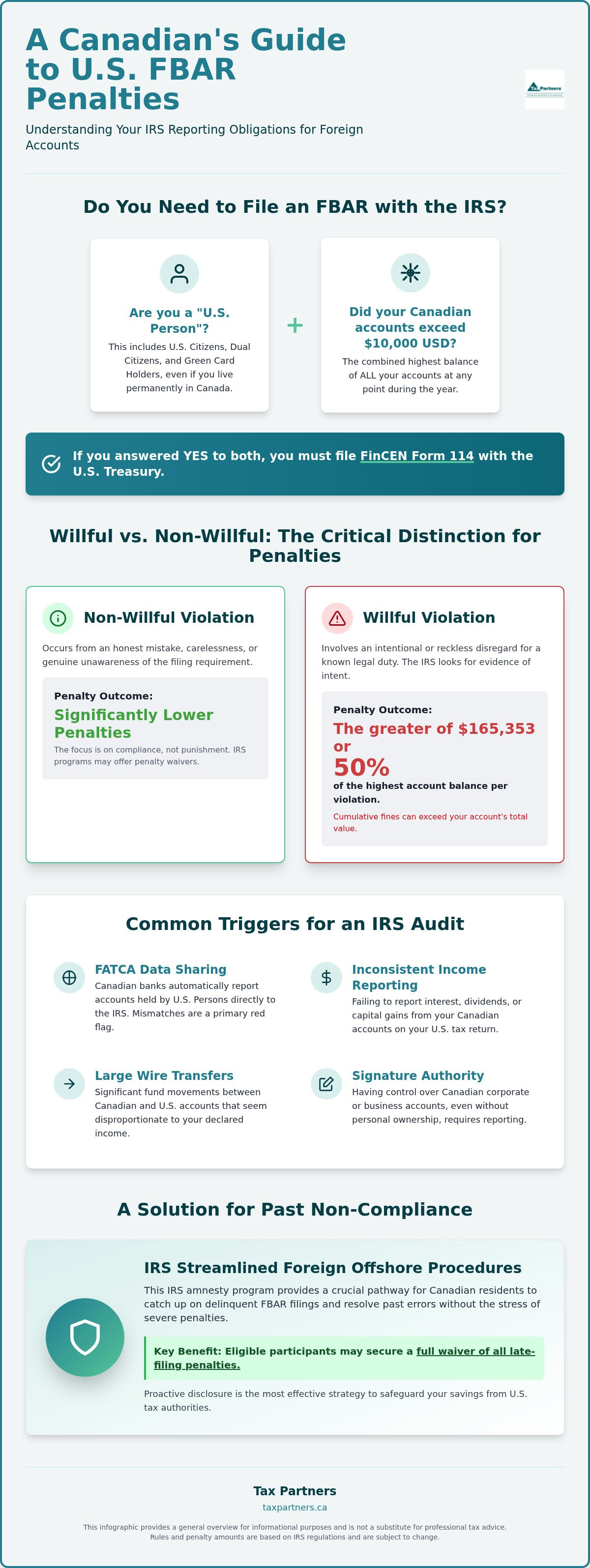
The Report of Foreign Bank and Financial Accounts, formally known as FinCEN Form 114, is a mandatory annual disclosure under IRS rules. This requirement applies to any "US person" residing in Canada, a category that includes US citizens, dual citizens, and green card holders. If you've lived in Canada for decades but were born in the US, you likely still have these reporting obligations to the US Treasury department.
The trigger for this filing is an aggregate value of more than $10,000 USD in foreign accounts at any time during the calendar year. You must calculate this by adding the highest balance of every account you own or control, even if those funds were only in the account for a single day. Overlooking a small savings account could lead to significant fbar penalties for canadians if your total combined balances cross that threshold.
It's critical to understand that the FBAR is not a tax return, nor is it filed with the Canada Revenue Agency (CRA). This is a separate federal requirement for the US government to track offshore wealth and ensure US tax compliance. While you may be fully compliant with your Canadian tax obligations, the IRS maintains its own strict standards for transparency that you must meet independently.
The Purpose of the Bank Secrecy Act
The legal foundation for these disclosures is the Bank Secrecy Act, which aims to curb tax evasion and money laundering. This legislation requires taxpayers to report financial interests in foreign countries to the US Treasury. By creating a paper trail for offshore assets, the US government can more effectively monitor global financial activity and cross-reference your reported income levels.
The IRS uses FBAR data to identify potential discrepancies in your annual filings. If your Canadian bank accounts show significant growth that isn't reflected in your reported income, it may prompt a closer look at your finances. This transparency is a cornerstone of the US government's effort to maintain tax integrity across international borders.
Common Triggers for FBAR Audits
The IRS frequently identifies unreported accounts through the Foreign Account Tax Compliance Act (FATCA) data-sharing agreement with Canada. Under this arrangement, Canadian banks report account details for US persons directly to the IRS. If these bank records don't match your US tax filings, it often triggers an inquiry or a full audit of your foreign assets.
Several factors can increase your risk of an IRS audit regarding your Canadian accounts:
- Inconsistent reporting of interest, dividends, or capital gains on US tax returns.
- Holding signature authority over Canadian corporate or business accounts without personal ownership.
- Large wire transfers between Canadian and US bank accounts that seem out of proportion to your income.
- Maintaining dormant or zero-balance accounts that were previously part of a high-value portfolio.
Even if an account is currently empty, you must still report it under IRS rules if your aggregate balances met the $10,000 USD threshold during the year. Proactive disclosure is the most effective way to protect your savings from the reach of US tax authorities.
Differentiating Willful and Non-Willful Violations Under IRS Rules
The IRS distinguishes between two types of reporting failures: willful and non-willful. This distinction is the single most important factor in determining the severity of fbar penalties for canadians. Non-willful violations occur when a taxpayer is unaware of the filing requirement or makes an honest mistake, while willful violations involve an intentional or reckless disregard for the rules.
The IRS carries the burden of proof when asserting that a violation was willful. They look for evidence that the taxpayer knew about the FBAR requirement but chose to ignore it. This evidence might include checking "No" on Schedule B of a US tax return when asked about foreign accounts or failing to disclose accounts to a professional tax preparer.
According to the IRS FBAR Penalty Manual, agents must examine the "totality of the circumstances" to determine intent. Penalties for willful non-compliance are devastating and can reach the greater of $165,353 or 50% of the maximum balance in the unreported accounts. Over several years, these cumulative fines can actually exceed the total amount of money held in your Canadian bank accounts.
The Non-Willful Penalty Framework
For those who simply didn't realize they had a US filing obligation, the IRS applies a non-willful penalty structure. Following the 2023 Supreme Court ruling in Bittner, these fines are generally assessed per annual report rather than per account. For penalties assessed in 2026, the maximum fine for a non-willful failure is $16,536 per report under IRS rules.
It's vital to organize your financial records meticulously to support a "Reasonable Cause" defense. If you can prove that your failure was due to an honest oversight or reliance on poor advice, the IRS has the discretion to waive the penalty entirely. This process requires a detailed written statement explaining why you were unaware of the requirement to report your Canadian assets.
Consequences of Willful Non-Compliance
Willful evasion carries much more than just high financial costs under IRS guidelines. The US government may pursue criminal charges in extreme cases where they suspect tax fraud or active concealment of assets. Because the line between negligence and recklessness is often thin, you should speak with a cross-border specialist to assess your specific situation.
Expert guidance ensures you don't inadvertently provide evidence that the IRS could use to characterize your actions as willful. As the IRS increases its focus on offshore compliance in 2026, having a proactive guardian to manage your disclosure is essential. We can help you navigate these complexities and find the safest path toward full compliance without losing your life savings.
Calculating Potential Exposure for Unreported Canadian Accounts
Calculating the risk of fbar penalties for canadians begins with a precise inventory of all financial holdings. You must identify the highest balance of each account at any point during the calendar year, not just the balance on December 31st. Once you've gathered these figures, you must convert the Canadian dollar amounts into US dollars using the official year-end exchange rate published by the US Treasury Bureau of the Fiscal Service.
Joint accounts present a unique reporting requirement under IRS rules. If you hold an account with a spouse who is not a US person, you must still report the full maximum value of that account on your FBAR. The IRS doesn't permit you to split the balance in half for reporting purposes, even if you only own a portion of the funds.
Accurate valuation is the first step toward utilizing the Streamlined Filing Compliance Procedures to rectify past errors. This program allows you to come forward voluntarily before the IRS discovers any omission. Failing to report even a single account can jeopardize your eligibility for penalty relief programs later on.
Registered Accounts and Insurance Policies
Many Canadians mistakenly believe that tax-advantaged accounts are exempt from IRS disclosure. However, under IRS rules, you must report the following common Canadian vehicles:
- Tax-Free Savings Accounts (TFSAs)
- Registered Retirement Savings Plans (RRSPs) and RRIFs
- Registered Education Savings Plans (RESPs)
- Registered Disability Savings Plans (RDSPs)
Canadian life insurance policies with a "cash value" or surrender value are also considered reportable financial accounts. While these plans may be deferred or tax-free for CRA filers, the US Treasury requires full transparency regarding their value. Excluding these assets from your annual filing is a frequent cause of non-willful fbar penalties for canadians.
Business Accounts and Signature Authority
Your reporting obligations extend beyond personal savings to include accounts where you have "signature authority." This means if you can direct the disposition of funds in a Canadian business account, you must disclose it under IRS rules. This requirement applies even if you have no personal financial interest in the money itself.
For Canadian business owners, the rules are even more stringent. If you own more than 50% of a Canadian corporation, the corporation's bank accounts are generally reportable on your personal FBAR. We recommend that you carefully organize your corporate records to realize the full extent of your US reporting footprint.
Strategies to Mitigate Penalties for Late FBAR Filings
Discovering that you've missed years of filings can be an overwhelming experience. However, the IRS provides specific pathways to reduce or eliminate potential fbar penalties for canadians who act proactively. It's vital to address these omissions before the US government initiates an inquiry into your Canadian accounts.
The most effective strategy involves establishing "Reasonable Cause" for the failure to file. This legal standard allows the IRS to waive fines if you can demonstrate that you acted in good faith but were unaware of your disclosure obligations. For many Canadians, this is the primary path to total penalty abatement.
Establishing Reasonable Cause
The IRS evaluates whether you exercised ordinary business care and prudence in meeting your tax duties. For Canadian residents, a lack of awareness is often a valid defense, especially if you've never lived in the US or received professional advice regarding cross-border rules. The IRS considers several factors when evaluating these statements, including:
- Your level of education and previous experience with US tax law.
- Whether you relied on the advice of a qualified tax professional who failed to mention the FBAR.
- The specific complexity of the Canadian accounts, such as TFSAs or RESPs, that you own.
You must provide a detailed, written explanation that outlines the specific facts of your situation. A cross-border tax accountant plays a critical role here, as they help you organize your narrative to meet the precise criteria the IRS looks for. We'll help you realize which details are most relevant to secure a favourable outcome.
We strongly advise against "Quiet Disclosure," which involves filing late FBARs without participating in an official IRS program. This approach often triggers an audit because the IRS system flags late-filed forms that aren't accompanied by a formal explanation. Quiet disclosures don't provide the legal protections found in structured amnesty programs.
The Dangers of Incomplete Disclosures
You must report every single account that meets the disclosure criteria under IRS rules. Selective reporting, where you only disclose some Canadian accounts while hiding others, is a major red flag. This behaviour often leads the IRS to suspect willful evasion rather than a non-willful oversight.
Incomplete filings suggest you were aware of the rules but chose which ones to follow. This perception can quickly shift your case toward significantly higher fines and more aggressive enforcement actions. Learn more about our US & Cross-Border Tax Services to ensure your disclosure is comprehensive and accurate.
True compliance also requires catching up on all related forms, such as IRS Form 8938 for specified foreign financial assets. If you're ready to resolve your status and protect your savings from the reach of the US Treasury, contact our team of experts for a confidential assessment of your filing history.
Resolving Past Non-Compliance with Streamlined Procedures
The IRS Streamlined Foreign Offshore Procedures represent the most effective way to resolve past omissions and avoid fbar penalties for canadians. This program is specifically designed for taxpayers residing abroad, including those in Canada, who failed to report foreign accounts due to non-willful conduct. By coming forward voluntarily, you can eliminate the threat of standard IRS penalties that would otherwise apply to delinquent filings.
Eligibility for this program requires a clear demonstration that your failure to file was not intentional. You must be able to prove that your conduct resulted from negligence, inadvertence, or a simple misunderstanding of the law. Under IRS rules, this program is only available if the US Treasury has not already initiated a civil or criminal investigation into your tax history.
The catch-up process involves submitting three years of amended or original US income tax returns and six years of delinquent FBAR reports. You must also pay any tax due on previously unreported income, along with interest, though the program typically waives the 5% miscellaneous offshore penalty for those living outside the US. This comprehensive approach ensures you realize total compliance across all required IRS forms.
The Certification of Non-Willfulness
A successful submission hinges on IRS Form 14653, the Certification by US Person Residing Outside of the United States. This document requires a detailed narrative explaining the specific reasons why you failed to report your Canadian assets. Read our complete guide to IRS Streamlined Procedures to understand how to structure this critical statement.
You must be precise when drafting this narrative, as the IRS uses it to determine if your actions were truly non-willful. Omitting key facts or providing vague explanations can lead to the rejection of your application and potential exposure to full penalties. It's the single most important part of a penalty-free resolution under current IRS guidelines.
Taking the First Step Toward Compliance
Acting before the IRS contacts you is the best way to protect your savings and your future. Once an audit begins, you lose the ability to participate in the Streamlined Procedures, leaving you vulnerable to the maximum fbar penalties for canadians. Proactive disclosure shifts the dynamic from a position of risk to one of total control.
Achieving full compliance in both the US and Canada provides an invaluable level of peace of mind. You can manage your Canadian wealth without the constant fear of an unexpected IRS notification or bank account freeze. Our team acts as a proactive guardian, guiding you through every step of the disclosure process.
Don't let complexity prevent you from securing your financial legacy. We offer the expertise needed to navigate these sophisticated IRS requirements and ensure your Canadian assets remain protected. Reach out to us today to begin your journey toward a secure and compliant future.
Protect Your Wealth and Achieve Compliance
Managing cross-border obligations doesn't have to be a source of constant stress. By understanding how the IRS distinguishes between honest mistakes and intentional neglect, you can effectively minimize the risk of fbar penalties for canadians. Whether you need to catch up through the Streamlined Filing Compliance Procedures or establish a "Reasonable Cause" defense, taking proactive steps today under IRS rules ensures your Canadian retirement accounts remain secure.
With over 40 years of cross-border tax experience and more than 1,390 five-star Google reviews, we specialize in helping Canadians navigate complex IRS penalty abatement and disclosure programs. Our team acts as a dedicated guardian for your assets, providing the precision and foresight needed to resolve past non-compliance once and for all. Book a Consultation with Our Cross-Border Tax Experts to reclaim your peace of mind and secure your financial legacy.
You've worked hard to build your life in Canada, and we're here to help you protect it. Full compliance is within your reach, and the right guidance makes all the difference.
Frequently Asked Questions
What is the penalty for not filing an FBAR as a Canadian resident?
Under IRS rules, penalties depend on whether the failure was willful or non-willful. For non-willful errors assessed in 2026, the maximum penalty is $16,536 per annual report. If the IRS determines the failure was willful, the fine can reach the greater of $165,353 or 50% of the total account balance. These civil penalties are assessed by the US Treasury, not the CRA, and can accumulate over multiple years of non-compliance.
Can the IRS really find my Canadian bank accounts?
Yes, the IRS has high visibility into your Canadian financial life through the Foreign Account Tax Compliance Act (FATCA). Under this international agreement, Canadian financial institutions identify accounts held by US persons and report that data to the CRA. The CRA then shares this information with the IRS under existing tax treaties. This digital transparency makes it highly likely that unreported accounts will eventually be identified during a routine IRS compliance review or audit.
What is the difference between a willful and non-willful FBAR violation?
The distinction lies in your intent and knowledge of the disclosure requirements. A non-willful violation occurs under IRS rules when a taxpayer fails to file due to negligence, an honest mistake, or a simple lack of awareness. Conversely, the IRS defines a willful violation as an intentional or reckless disregard for the reporting obligation. This often involves taking active steps to hide accounts or ignoring specific advice regarding your US federal filing duties.
Do I have to report my RRSP or TFSA on an FBAR under IRS rules?
Yes, both Registered Retirement Savings Plans (RRSPs) and Tax-Free Savings Accounts (TFSAs) are considered reportable foreign financial accounts under IRS rules. While these vehicles offer tax advantages for CRA filers, the US government requires their disclosure on FinCEN Form 114 if your aggregate foreign account balances exceed $10,000 USD. Failing to include these common Canadian assets is one of the most frequent causes of non-willful fbar penalties for canadians.
What should I do if I missed the FBAR filing deadline for 2026?
If you missed the April 15 deadline, you should take advantage of the automatic extension to October 15 provided under IRS rules. If you've missed both deadlines, it's critical to file as soon as possible through a formal disclosure program. You should prepare a "Reasonable Cause" statement explaining why the filing is late. Avoid "quiet disclosures," as filing late without a formal explanation can increase the risk of an IRS audit and potential fines.
Is there a way to avoid FBAR penalties if I didn't know I had to file?
You may be able to avoid penalties by establishing "Reasonable Cause" for your failure to file. Under IRS guidelines, this involves proving that you acted in good faith and had a legitimate reason for being unaware of the requirement. Many Canadian residents successfully use this defence by highlighting their reliance on professional advice or a lack of previous contact with the US tax system. Consulting a specialist is essential to drafting a persuasive statement.
Does the CRA share my bank account information with the IRS?
Yes, the CRA shares specific financial data with the IRS through the Intergovernmental Agreement related to FATCA. Canadian banks are required by law to provide the CRA with information on accounts held by US citizens and residents. The CRA then transmits this data to the US Treasury to ensure compliance with US federal laws. This automated exchange means the IRS receives annual updates on your Canadian balances, interest income, and any dividends earned.
What are the IRS Streamlined Foreign Offshore Procedures?
The Streamlined Foreign Offshore Procedures are an IRS amnesty program for non-willful taxpayers living outside the United States. This program allows eligible Canadians to catch up by filing three years of tax returns and six years of FBARs. The primary benefit is the potential for a complete waiver of fbar penalties for canadians. It provides a secure, predictable path to full compliance and helps protect your savings from aggressive IRS enforcement actions in 2026.

Article by
Mahad Mohamed
Mahad Mohamed is an accountant and the CEO of Tax Partners, with over 26+ years of Canadian and international tax and accounting experience. His expertise includes corporate reorganization, cross-border tax structuring (Canada & US), tax disputes, CRA audits, and tax planning for small owner-managed private corporations. Most recently, Mahad is a pioneer in Canadian crypto taxation and founded Block3 Finance.
Previously, Mahad worked for the Canada Revenue Agency (CRA), Big4 accounting firms, and served as a Rulings Officer for the Federal Tax Authority of the UAE before acquiring Tax Partners in 2014.
Tax Partners has 44 full-time accountants and over 18,400+ clients.
Disclaimer
This article provides general information only and is current as of its publication date. It has not been updated and may be out of date. It does not constitute legal advice and should not be relied upon as such. Every tax situation is unique and may differ from the examples discussed in this article. If you have specific questions, you should seek the advice of our accountants for your unique circumstances. Book a FREE Initial Consultation Today!
Frequently Asked Questions
What is the penalty for not filing an FBAR as a Canadian resident?
Under IRS rules, penalties depend on whether the failure was willful or non-willful. For non-willful errors assessed in 2026, the maximum penalty is $16,536 per annual report. If the IRS determines the failure was willful, the fine can reach the greater of $165,353 or 50% of the total account balance. These civil penalties are assessed by the US Treasury, not the CRA, and can accumulate over multiple years of non-compliance.
Can the IRS really find my Canadian bank accounts?
Yes, the IRS has high visibility into your Canadian financial life through the Foreign Account Tax Compliance Act (FATCA). Under this international agreement, Canadian financial institutions identify accounts held by US persons and report that data to the CRA. The CRA then shares this information with the IRS under existing tax treaties. This digital transparency makes it highly likely that unreported accounts will eventually be identified during a routine IRS compliance review or audit.
What is the difference between a willful and non-willful FBAR violation?
The distinction lies in your intent and knowledge of the disclosure requirements. A non-willful violation occurs under IRS rules when a taxpayer fails to file due to negligence, an honest mistake, or a simple lack of awareness. Conversely, the IRS defines a willful violation as an intentional or reckless disregard for the reporting obligation. This often involves taking active steps to hide accounts or ignoring specific advice regarding your US federal filing duties.
Do I have to report my RRSP or TFSA on an FBAR under IRS rules?
Yes, both Registered Retirement Savings Plans (RRSPs) and Tax-Free Savings Accounts (TFSAs) are considered reportable foreign financial accounts under IRS rules. While these vehicles offer tax advantages for CRA filers, the US government requires their disclosure on FinCEN Form 114 if your aggregate foreign account balances exceed $10,000 USD. Failing to include these common Canadian assets is one of the most frequent causes of non-willful fbar penalties for canadians.
What should I do if I missed the FBAR filing deadline for 2026?
If you missed the April 15 deadline, you should take advantage of the automatic extension to October 15 provided under IRS rules. If you've missed both deadlines, it's critical to file as soon as possible through a formal disclosure program. You should prepare a "Reasonable Cause" statement explaining why the filing is late. Avoid "quiet disclosures," as filing late without a formal explanation can increase the risk of an IRS audit and potential fines.
Is there a way to avoid FBAR penalties if I didn't know I had to file?
You may be able to avoid penalties by establishing "Reasonable Cause" for your failure to file. Under IRS guidelines, this involves proving that you acted in good faith and had a legitimate reason for being unaware of the requirement. Many Canadian residents successfully use this defence by highlighting their reliance on professional advice or a lack of previous contact with the US tax system. Consulting a specialist is essential to drafting a persuasive statement.
Does the CRA share my bank account information with the IRS?
Yes, the CRA shares specific financial data with the IRS through the Intergovernmental Agreement related to FATCA. Canadian banks are required by law to provide the CRA with information on accounts held by US citizens and residents. The CRA then transmits this data to the US Treasury to ensure compliance with US federal laws. This automated exchange means the IRS receives annual updates on your Canadian balances, interest income, and any dividends earned.
What are the IRS Streamlined Foreign Offshore Procedures?
The Streamlined Foreign Offshore Procedures are an IRS amnesty program for non-willful taxpayers living outside the United States. This program allows eligible Canadians to catch up by filing three years of tax returns and six years of FBARs. The primary benefit is the potential for a complete waiver of fbar penalties for canadians. It provides a secure, predictable path to full compliance and helps protect your savings from aggressive IRS enforcement actions in 2026.