Bookkeeping for Real Estate Investors in Canada

What if bookkeeping for real estate investors Canada could be less about sorting receipts at tax time and more about understanding how each property performs? When rent, repairs, financing transactions and personal spending run through the same accounts, it’s harder to see the full picture or prepare organized records for Canada Revenue Agency (CRA) reporting.
If you’re finding it difficult to track income and expenses consistently, you’re not alone. Reliable bookkeeping creates a clear record for each property, helping you review performance and giving your accountant a stronger foundation for financial reporting and Canadian tax preparation.
This guide explains which records to keep, how to build a practical bookkeeping routine and why separating personal and investment transactions matters. You’ll also learn how bookkeeping differs from accounting and tax preparation, and how professional support can help you manage your portfolio’s records.
Key Takeaways
- See how bookkeeping for real estate investors Canada can support clear property-level records and make financial activity easier to review.
- Build a repeatable way to record transactions with dates, amounts, property details and supporting documents.
- Compare spreadsheets, accounting software and outsourced bookkeeping to find an approach that suits your portfolio and available time.
- Use a monthly routine to organize records, review property summaries and flag entries that need follow-up.
- Learn how tailored bookkeeping can connect with financial reporting and Canadian tax preparation as your portfolio needs evolve.
Bookkeeping for real estate investors in Canada: what it tracks
Real estate investor bookkeeping is the process of recording and organizing the financial transactions connected to each investment property. It creates a practical history of money coming in and going out, with enough detail to show what each transaction relates to.
For an investor, the value is in the pattern. When rental receipts and property costs are recorded consistently, a property-level summary can show cash flow over time and make it easier to spot changes, such as rising maintenance spending or a gap in rent receipts.
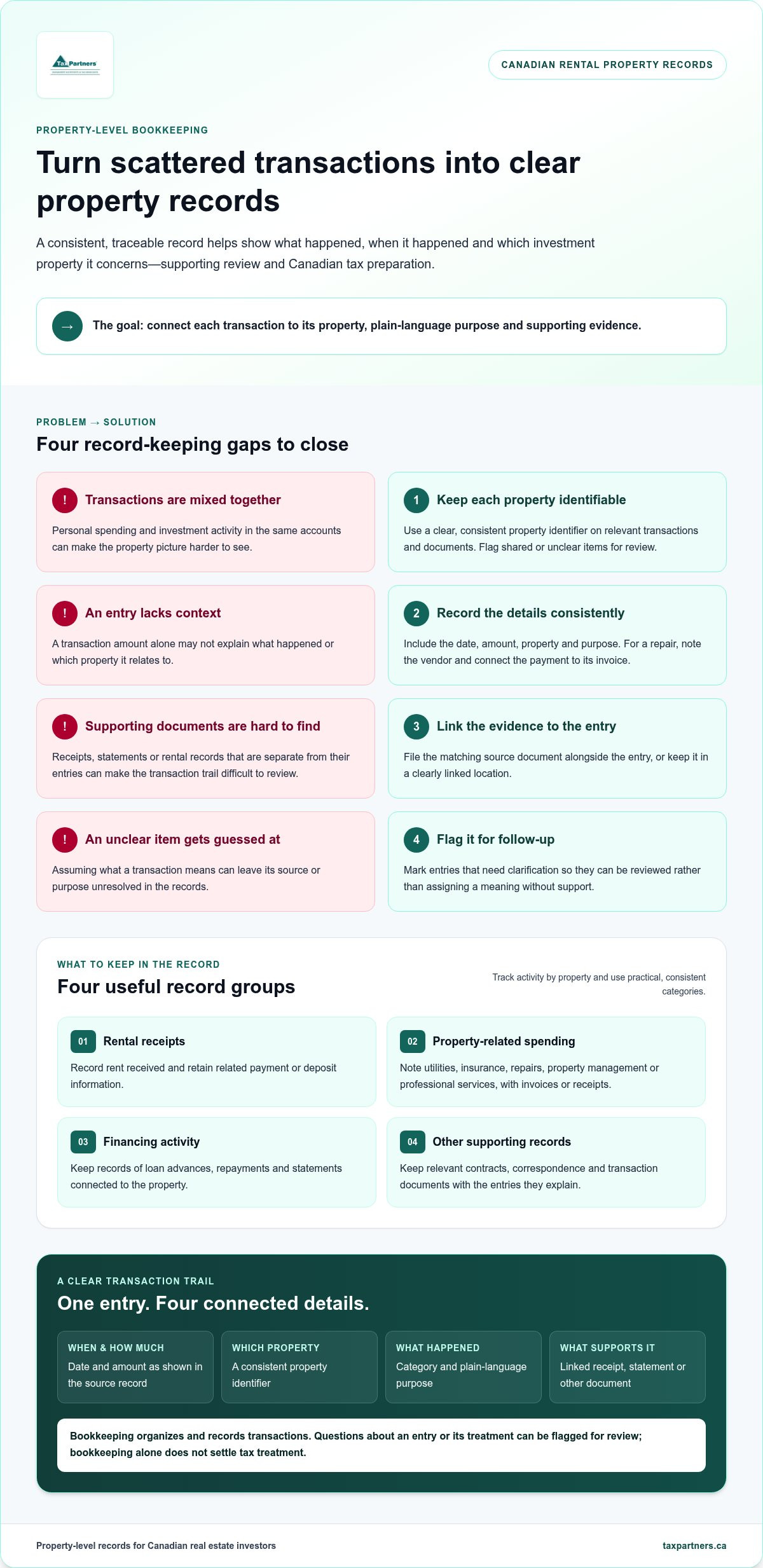
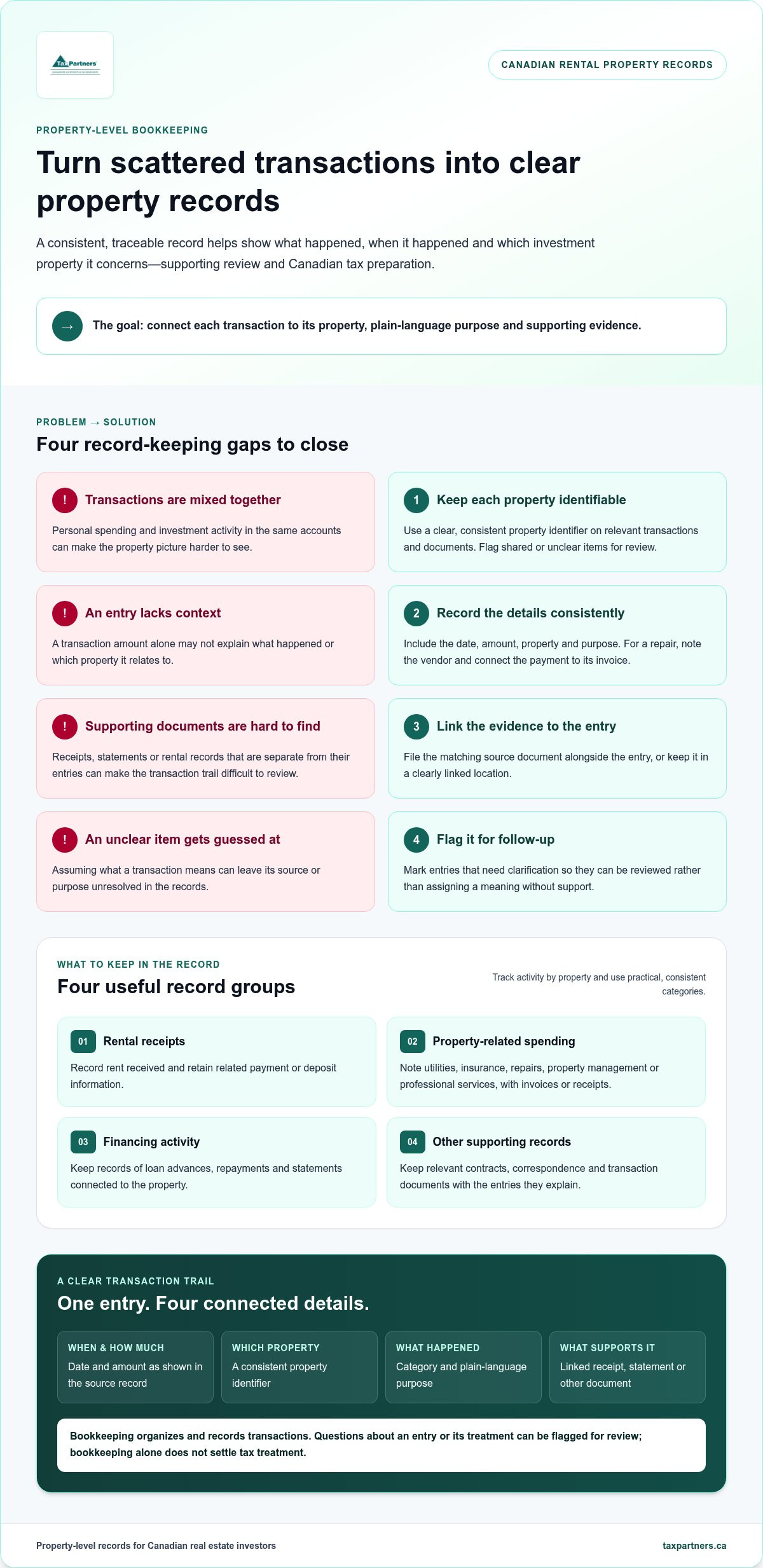
Keep investment activity distinguishable from personal spending, regardless of the ownership structure you use. Give each property a clear identifier in your records, and flag shared or unclear transactions so their source and purpose can be reviewed rather than assumed.
A useful record connects each transaction to its supporting evidence. For example, an entry can identify the date, amount, property and purpose, while the related invoice, receipt, bank record or financing statement provides more detail. This makes the records easier to understand and review later.
That’s the working idea behind bookkeeping for real estate investors Canada: a consistent, traceable record of property-level financial activity, not a tax conclusion about how each item should be treated.
What belongs in an investor’s bookkeeping records?
Track each property separately and use practical categories to make entries easier to review. Categories describe activity; they don’t determine whether a cost qualifies for a particular tax treatment.
- Rental receipts: Record rent received and retain the related payment or deposit information.
- Property-related spending: Note items such as utilities, insurance, repairs, property management or professional services, with invoices or receipts.
- Financing activity: Keep records of loan advances, repayments and statements connected to the property.
- Other supporting records: File relevant contracts, correspondence and transaction documents alongside the entries they explain.
These bookkeeping principles help make a transaction trail understandable: a reviewer should be able to see what happened, when it happened and which property it concerns.
How bookkeeping differs from accounting
Bookkeeping organizes and records transactions. Accounting goes further by reviewing and interpreting financial information, preparing reports and supporting decisions.
Clear bookkeeping gives that later work a more dependable starting point. Organized property records can support financial reporting and Canadian tax preparation, while questions about an entry or its treatment can be flagged for review rather than settled through bookkeeping alone.
For an overview of Canadian tax guidance, consider how property records fit into the broader Canadian tax picture. Keeping records orderly makes the review more focused, while the appropriate reporting depends on the investor’s circumstances.
Build a clear record of property income and expenses
A useful bookkeeping entry tells a clear story: what happened, when it happened, how much was involved, which property it relates to and where the supporting evidence is kept. Apply the same approach to rental receipts, property spending and financing activity so entries are easier to trace and review.
For example, record a rent deposit with its date, amount, property identifier and payment reference. For a repair payment, note the vendor and purpose, then connect the entry to its invoice and proof of payment. If a transaction is unclear, flag it for follow-up instead of guessing at its meaning.
Property-level labels turn a list of transactions into a record you can use to understand and compare each investment. This discipline is central to bookkeeping for real estate investors Canada because it keeps details attached to the property rather than buried in a general account total.
Track each property without losing the portfolio view
Assign a consistent identifier to every property and use it on relevant transactions and documents. Pair that identifier with a stable set of categories, such as rent received, utilities, maintenance, insurance or financing activity. Consistent labels make it easier to compare similar activity across properties and notice missing entries or items that need clarification.
A portfolio summary can bring together high-level totals or comparisons. Keep the underlying property records available: a combined figure is useful for an overview, but it can’t explain which property generated a transaction or what source document supports it.
Keep supporting documents connected to transactions
Save source documents alongside the matching bookkeeping entry, or in a clearly linked location. These might include rent deposit records, receipts, invoices, bank or lender statements, and documents related to buying a property or arranging financing.
Keep acquisition documents distinct from routine operating records, and group financing records so their purpose remains apparent. The aim is an orderly file trail, not a decision about how a transaction should be treated for tax purposes.
A practical entry can follow a consistent pattern:
- Date and amount: Record the transaction as shown in the source record.
- Property and category: Identify the property and describe the activity in plain language.
- Supporting evidence: Link or file the receipt, statement, rental record or other document.
- Follow-up note: Mark missing details or questions for review without making a tax conclusion.
Over time, this structure creates a clearer handoff from transaction recording to financial review and Canadian tax preparation. Tax Partners provides bookkeeping support for businesses, including clients in the real estate industry. Learn more about Tax Partners’ bookkeeping services.
Choose a bookkeeping approach that fits your property portfolio
The right system is the one you can maintain consistently and review with confidence. A spreadsheet may be manageable for a straightforward portfolio, while accounting software or outsourced bookkeeping may suit investors with more transactions, more properties or less time to keep records current.
Compare the options by the work they require, how consistently they support your process and how easily you can review the results. Bookkeeping organizes records; accounting and tax professionals review financial information and consider its treatment in context.
| Approach | Effort and consistency | May suit investors who… |
|---|---|---|
| Spreadsheet tracking | Requires regular manual entry and careful version control; consistency depends on your routine. | Have a manageable transaction flow and prefer direct oversight. |
| Accounting software | Provides a structured place to record activity, but still needs accurate inputs and regular review. | Want a repeatable process as transactions or properties increase. |
| Outsourced bookkeeping | Moves routine record organization to a bookkeeping professional; you still provide information and review questions or summaries. | Need help keeping records and financial reporting organized. |
When a simple system may be enough
A spreadsheet or basic process may remain practical when transactions are manageable, each property can be tracked distinctly and you have time to update entries as activity occurs. Prioritize timely recording, consistent categories and an orderly place for source documents over building an elaborate system you won’t maintain.
As bookkeeping for real estate investors Canada becomes more involved, review whether your current process still supports clear and accurate records. A simple method can organize information, but it doesn’t guarantee compliance or a particular tax result.
When professional bookkeeping support may help
More properties, a growing number of transactions or recurring delays in organizing records can make bookkeeping harder to maintain. Professional support can help structure financial operations and reporting, while tax interpretation and accounting review remain distinct parts of the wider process.
Investors with broader recordkeeping needs may find professional bookkeeping services for Canadian SMEs relevant to their situation. The right fit depends on portfolio complexity, transaction volume and the time you can reliably devote to the work.
Review your current process: are entries current, are property records easy to separate, and can you locate the documents behind a transaction? Tax Partners offers bookkeeping services for businesses, including those in real estate. Find details through Tax Partners’ contact page.
Create a monthly bookkeeping routine for Canadian rental properties
A regular monthly review turns bookkeeping from a year-end scramble into a manageable process. Work through each property, keep unresolved questions visible and carry forward only items that need follow-up.
A repeatable monthly close for each property
Use the same sequence each month so records are easier to complete and review. Adapt the steps to your portfolio, but keep the order consistent:
- Collect the records. Gather bank and financing statements, rental receipt information, invoices, receipts and other transaction records for the period. Separate documents by property where practical.
- Enter the activity. Record each transaction with its date, amount, property identifier and a clear category. Keep notes factual, such as “contractor invoice received” or “rent deposit recorded.”
- Match the documents. Attach or reference the source document for each entry. If something is missing, mark the transaction for follow-up instead of treating an estimate or assumption as confirmed.
- Review each property summary. Look for entries that appear duplicated, unexplained activity, gaps in records or transactions assigned to the wrong property. Compare the summary with the available records and note what still needs attention.
Close the review by keeping a short follow-up list with the transaction, the missing detail and the next action. This makes questions easier to revisit and helps prevent an unresolved item from disappearing into the next month’s records.
Prepare records for Canadian tax and accounting review
Bookkeeping captures what the documents show; it shouldn’t turn an uncertain entry into a decision about tax classification or eligibility. Flag unclear items for accounting or tax review, and consult current CRA guidance when you need to confirm a filing requirement.
Periodic reviews can also reveal patterns that deserve attention, such as repeatedly missing documents or changes in property-level activity. A clear summary can inform portfolio decisions, but it’s a starting point for consideration, not a substitute for understanding the full context.
Well-organized records can also make it easier to locate relevant documents if the CRA asks questions about reported information. Keep the supporting material connected to the entries it explains, so you can follow the transaction trail and prepare a clear response.
If a property is held through a corporation, the bookkeeping may need to support corporate financial and tax work as well as property-level review. The relevant considerations differ by situation, and Canadian corporate tax compliance guidance can be useful alongside organized records.
A consistent routine gives bookkeeping for real estate investors Canada a practical rhythm: collect, record, match and review. Tax Partners provides bookkeeping and accounting services for businesses, including those in the real estate industry. Details are available on the Tax Partners contact page.
Get real estate bookkeeping support tailored to your needs
As a real estate portfolio grows, keeping every transaction organized can take attention away from reviewing operations and planning next steps. Tax Partners provides bookkeeping and accounting support for real estate clients, helping organize financial records and connect day-to-day bookkeeping with financial reporting and Canadian tax preparation.
These activities work together, but they serve different purposes. Bookkeeping maintains the transaction records; accounting reviews and organizes financial information for reporting; tax preparation uses relevant information to prepare Canadian tax filings. A connected process can make it easier to identify missing details and bring useful context into later review, without guaranteeing a particular tax result.
Tax Partners brings 40+ years of trusted service and has filed 495,000+ tax returns. For investors, the focus is practical: understand how records are currently maintained, where organizing them feels difficult and what kind of financial clarity would be useful.
What to bring to an initial bookkeeping discussion
You don’t need to have every record perfectly organized before discussing your process. A few useful materials can make the conversation more specific:
- A list of your investment properties and a brief description of the activity associated with each.
- Existing bookkeeping records, such as a spreadsheet, accounting reports or transaction summaries.
- Examples of supporting documents and how you currently store or connect them to entries.
- Questions about recurring challenges, unclear transactions or the property-level reporting you’d like to review.
Explain what takes the most time and where you’d like a clearer view. For example, you might want to understand how your records are organized across properties or how bookkeeping information can be prepared for financial reporting and Canadian tax work.
Connect bookkeeping with broader Canadian accounting support
Bookkeeping for real estate investors Canada can be one part of a broader accounting and tax support relationship. Organized records give financial reporting and Canadian tax preparation a more structured starting point, while accounting review helps interpret the information and identify questions that need attention.
Tax Partners serves the real estate industry and tailors bookkeeping support to client needs. The right scope depends on your portfolio, current recordkeeping process and the kind of reporting clarity you’re seeking. An initial discussion can help you explain those needs and consider how bookkeeping fits alongside accounting and tax preparation.
Tax Partners offers a free initial consultation. Learn more through the bookkeeping consultation page.
Make your next bookkeeping step count
Your recordkeeping process should keep pace with your portfolio. As your properties or day-to-day responsibilities change, consider whether your current approach still gives you the information you need to make informed decisions and prepare for Canadian tax work.
Choose one practical next step: set a date to review your bookkeeping process, identify a recurring challenge or clarify what you’d like your property records to show. A focused conversation can help you consider how bookkeeping for real estate investors Canada fits into your broader accounting and tax needs.
Request a free initial consultation with Tax Partners to discuss bookkeeping for your real estate investments.
Frequently Asked Questions
What records should real estate investors keep in Canada?
Keep records that help you reconstruct what happened with each property, including rental agreements, payment records, invoices, receipts, financing documents and relevant correspondence. Use consistent file names that include the property identifier, document type and date, so you can locate a specific record without opening every file. Keep a note of any correction made to a bookkeeping entry.
Is bookkeeping the same as accounting for real estate investors?
No. Bookkeeping records transactions, while accounting reviews and interprets the resulting financial information. For example, a bookkeeping record might show a payment and its supporting invoice; an accounting review can consider how that information fits into financial reporting. Keeping those roles distinct helps you know which questions your records can answer and which need professional interpretation, particularly when preparing Canadian tax information.
How often should I update my real estate bookkeeping?
Enter transactions regularly as records become available, then review the books monthly so unrecorded activity or unclear entries don’t linger. You might also review the records after an unusual event, such as a major repair or a change in how a property is used, to make sure relevant documents and notes are together. Choose a rhythm you can sustain across the full portfolio.
Can I manage bookkeeping for rental properties in a spreadsheet?
Yes, a spreadsheet can work if you can keep entries current, distinguish properties and connect transactions to their supporting records. Use consistent columns for date, description, property, category, amount and document reference. As the records grow, check that totals can be reviewed without overwriting source information. If updates fall behind or errors are difficult to trace, consider whether another approach would be easier to maintain.
Should I keep separate bookkeeping records for each property?
Yes, property-level records make it easier to understand activity connected to each investment, even when you also keep a combined portfolio view. If one invoice relates to more than one property, retain the original document and record how you divided the amount, along with details that explain the allocation. Don’t let a portfolio total replace the records that show the underlying activity.
Can a bookkeeper decide which rental expenses are deductible in Canada?
A deductible expense is a cost that may be claimed to reduce income subject to tax if it meets the applicable CRA rules. A bookkeeper can record and organize transactions, but bookkeeping alone doesn’t determine whether a particular cost qualifies. Keep the invoice and a clear description of the expense, then raise uncertain items for accounting or tax review, since eligibility depends on the circumstances.
When should a real estate investor outsource bookkeeping?
Consider support when transaction entry regularly falls behind, property records are hard to distinguish or preparing financial information takes time away from managing your investments. Outsourcing can help organize routine bookkeeping and reporting, while you remain involved in supplying records and clarifying transactions. The decision depends on portfolio complexity, transaction volume and the time you can devote to maintaining a reliable process.

Article by
Mahad Mohamed
Mahad Mohamed is an accountant and the CEO of Tax Partners, with over 26+ years of Canadian and international tax and accounting experience. His expertise includes corporate reorganization, cross-border tax structuring (Canada & US), tax disputes, CRA audits, and tax planning for small owner-managed private corporations. Most recently, Mahad is a pioneer in Canadian crypto taxation and founded Block3 Finance.
Previously, Mahad worked for the Canada Revenue Agency (CRA), Big4 accounting firms, and served as a Rulings Officer for the Federal Tax Authority of the UAE before acquiring Tax Partners in 2014.
Tax Partners has 44 full-time accountants and over 18,400+ clients.
Disclaimer
This article provides general information only and is current as of its publication date. It has not been updated and may be out of date. It does not constitute legal advice and should not be relied upon as such. Every tax situation is unique and may differ from the examples discussed in this article. If you have specific questions, you should seek the advice of our accountants for your unique circumstances. Book a FREE Initial Consultation Today!
Frequently Asked Questions
What belongs in an investor’s bookkeeping records?
Track each property separately and use practical categories to make entries easier to review. Categories describe activity; they don’t determine whether a cost qualifies for a particular tax treatment. These bookkeeping principles help make a transaction trail understandable: a reviewer should be able to see what happened, when it happened and which property it concerns.
What records should real estate investors keep in Canada?
Keep records that help you reconstruct what happened with each property, including rental agreements, payment records, invoices, receipts, financing documents and relevant correspondence. Use consistent file names that include the property identifier, document type and date, so you can locate a specific record without opening every file. Keep a note of any correction made to a bookkeeping entry.
Is bookkeeping the same as accounting for real estate investors?
No. Bookkeeping records transactions, while accounting reviews and interprets the resulting financial information. For example, a bookkeeping record might show a payment and its supporting invoice; an accounting review can consider how that information fits into financial reporting. Keeping those roles distinct helps you know which questions your records can answer and which need professional interpretation, particularly when preparing Canadian tax information.
How often should I update my real estate bookkeeping?
Enter transactions regularly as records become available, then review the books monthly so unrecorded activity or unclear entries don’t linger. You might also review the records after an unusual event, such as a major repair or a change in how a property is used, to make sure relevant documents and notes are together. Choose a rhythm you can sustain across the full portfolio.
Can I manage bookkeeping for rental properties in a spreadsheet?
Yes, a spreadsheet can work if you can keep entries current, distinguish properties and connect transactions to their supporting records. Use consistent columns for date, description, property, category, amount and document reference. As the records grow, check that totals can be reviewed without overwriting source information. If updates fall behind or errors are difficult to trace, consider whether another approach would be easier to maintain.
Should I keep separate bookkeeping records for each property?
Yes, property-level records make it easier to understand activity connected to each investment, even when you also keep a combined portfolio view. If one invoice relates to more than one property, retain the original document and record how you divided the amount, along with details that explain the allocation. Don’t let a portfolio total replace the records that show the underlying activity.
Can a bookkeeper decide which rental expenses are deductible in Canada?
A deductible expense is a cost that may be claimed to reduce income subject to tax if it meets the applicable CRA rules. A bookkeeper can record and organize transactions, but bookkeeping alone doesn’t determine whether a particular cost qualifies. Keep the invoice and a clear description of the expense, then raise uncertain items for accounting or tax review, since eligibility depends on the circumstances.
When should a real estate investor outsource bookkeeping?
Consider support when transaction entry regularly falls behind, property records are hard to distinguish or preparing financial information takes time away from managing your investments. Outsourcing can help organize routine bookkeeping and reporting, while you remain involved in supplying records and clarifying transactions. The decision depends on portfolio complexity, transaction volume and the time you can devote to maintaining a reliable process.