How to Report Crypto Gains to the CRA: A 2026 Guide

Did you know that the CRA can reclassify your casual trades as business income, potentially doubling your tax liability without warning? It's a sobering thought for the 25 per cent of Canadians who now hold digital assets. Proactive tax planning for crypto investors Canada starts with the realization that the CRA views these transactions as property rather than currency.
You likely feel the weight of tracking every transaction while worrying about accidental misreporting. We understand that calculating your Adjusted Cost Base (ACB), which represents the total cost of your investment plus any acquisition fees, can feel overwhelming. This guide empowers you to master these complexities to ensure full compliance and optimize your tax position for the 2026 season.
We'll provide a clear, step-by-step framework for your tax filing. You'll gain confidence in your reporting accuracy and learn exactly which records to maintain for the mandatory six-year period. Let's transform your tax season from a source of stress into a structured path toward financial clarity.
Key Takeaways
- Understand why the CRA treats digital assets as commodities and how this classification impacts the tax treatment of every trade you make.
- Differentiate between capital gains and business income to ensure you apply the correct 50 per cent inclusion rate to your profits.
- Use a structured approach to calculate your Adjusted Cost Base (ACB), ensuring all acquisition costs and fees are accurately captured.
- Identify the specific CRA forms required for your activity, such as Schedule 3 for capital gains or Form T2125 for business-related income.
- Leverage proactive tax planning for crypto investors Canada to safeguard your portfolio against sophisticated CRA data analytics and potential audits.
Understanding Crypto-Assets Under CRA Rules
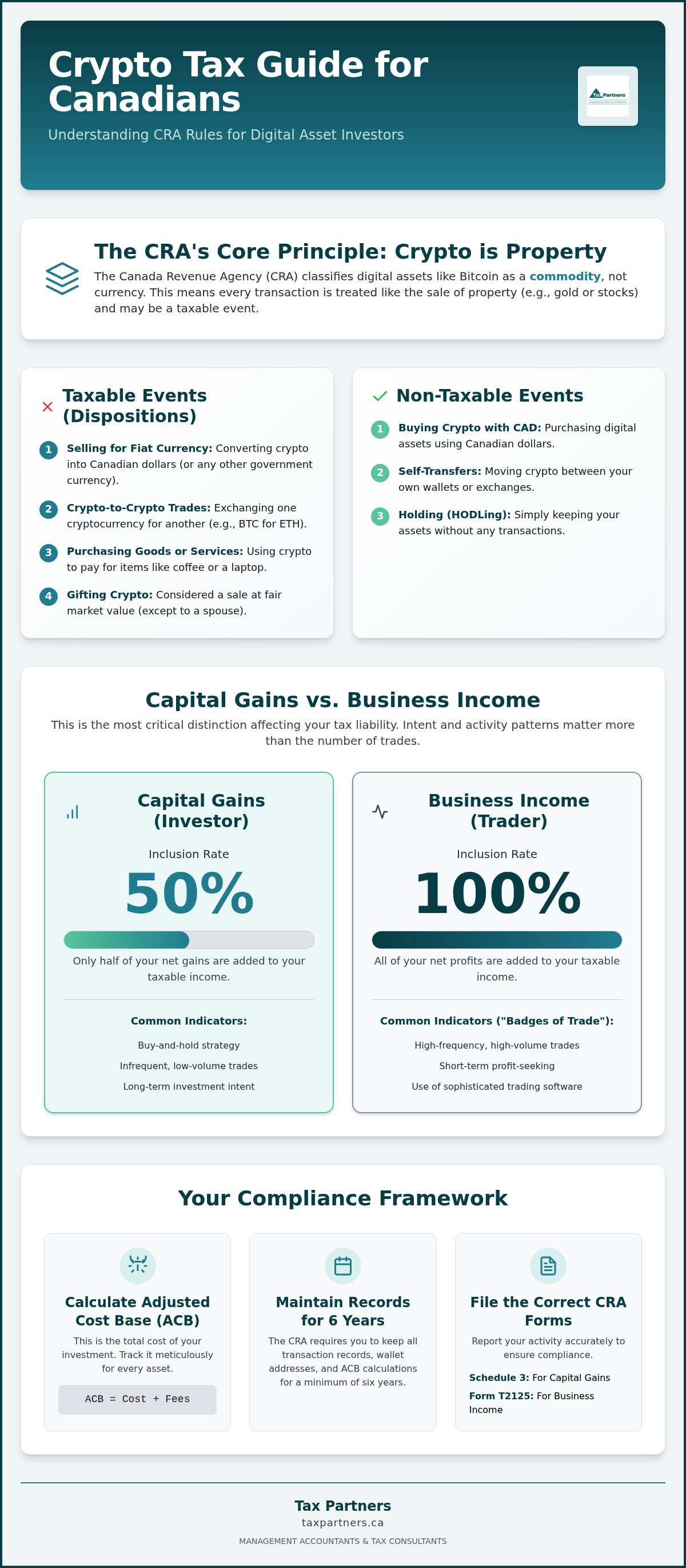
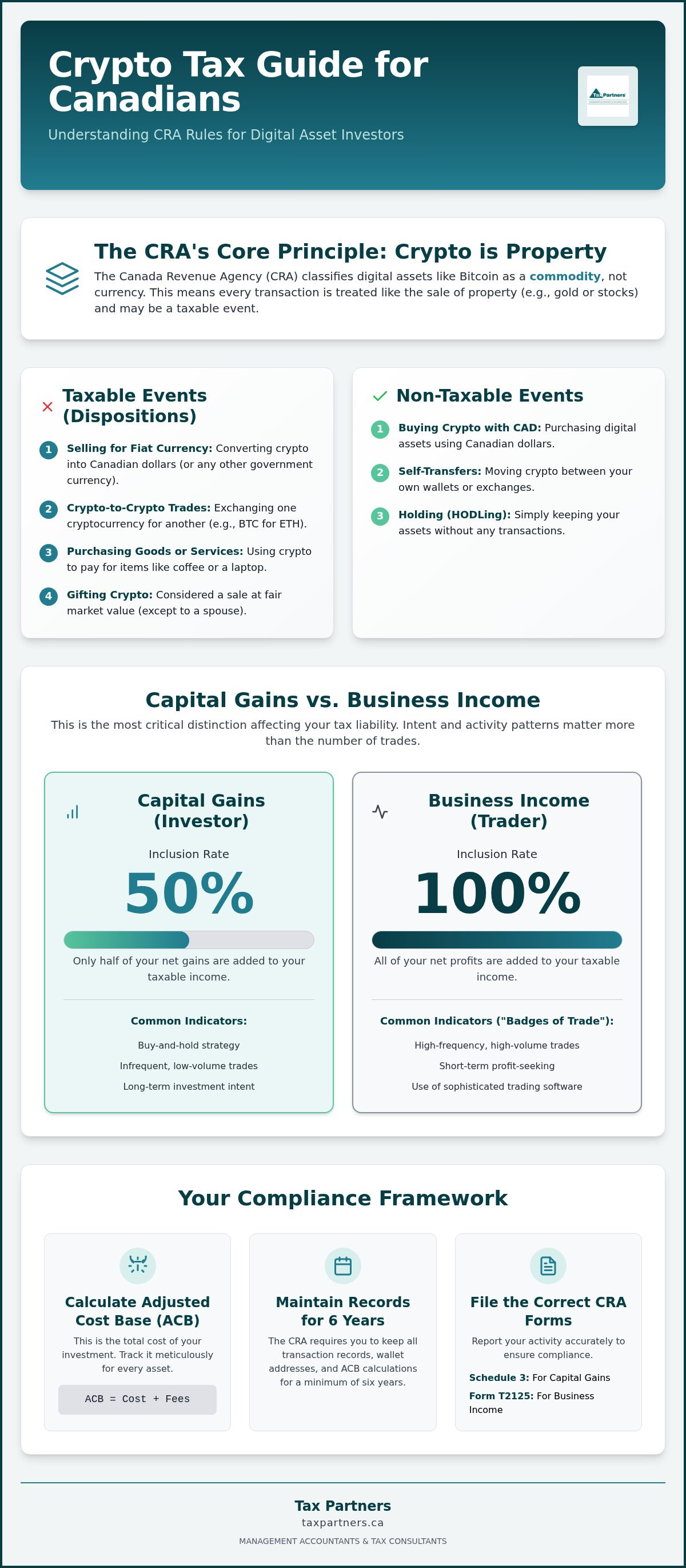
The Canada Revenue Agency (CRA) does not recognize cryptocurrency as legal tender. Instead, the agency classifies digital assets as a commodity. This means your Bitcoin or Ethereum holdings are treated similarly to physical goods like gold or timber for tax purposes.
This distinction is the cornerstone of Understanding Crypto-Assets Under CRA Rules. Every time you use or trade these assets, you may be triggering a taxable event that requires careful documentation. These rules apply to all CRA filers, regardless of the platform or wallet used.
Effective tax planning for crypto investors Canada relies on recognizing that the CRA expects you to report all gains. You must do this even if your exchange does not issue a formal tax slip. Relying on the absence of a T-form is a common mistake that can lead to significant penalties during an audit.
What Qualifies as a Taxable Disposition?
In the eyes of the CRA, a disposition occurs whenever there is a change in ownership or a realization of value. This is the moment your "paper profit" becomes a taxable reality. Understanding these triggers is essential for maintaining a compliant portfolio.
- Selling for Fiat: Converting your cryptocurrency into Canadian dollars or any other government-issued currency.
- Crypto-to-Crypto Trades: Exchanging one digital asset for another, such as trading Bitcoin for Solana.
- Purchasing Goods: Using digital assets to pay for a coffee, a laptop, or any service from a merchant.
- Gifting Assets: Giving cryptocurrency to someone other than a spouse or common-law partner is considered a sale at fair market value.
Non-Taxable Crypto Events in Canada
Not every interaction with your digital wallet attracts the tax man's attention. Understanding these exceptions helps you move assets strategically without incurring immediate costs. These events are generally considered tax-neutral movements of your own property.
- Self-Transfers: Moving your crypto between different wallets or exchanges that you personally own.
- CAD Purchases: Buying cryptocurrency using Canadian dollars from a registered exchange or broker.
- HODLing: Simply holding your assets in a wallet without selling, trading, or using them for transactions.
While these actions don't trigger taxes today, they still require meticulous record-keeping. You must track the original purchase price to establish your cost basis for future reporting. This foresight ensures you don't overpay when you eventually decide to realize your gains.
Capital Gains vs. Business Income for CRA Filers
The distinction between capital gains and business income is the most critical factor in your tax return. The CRA does not provide a fixed number of trades that triggers a business classification. Instead, they look at the nature of your activity and your intent at the time of purchase.
For the 2026 tax year, 50 per cent of your net capital gains are included in your taxable income. This means half of your profit remains tax-free. In contrast, business income requires you to report 100 per cent of your profits as taxable income.
This difference can move you into a much higher federal tax bracket, such as the 33 per cent bracket for income over C$258,482. Effective tax planning for crypto investors Canada requires a proactive approach to these classifications. If the CRA recharacterizes your gains as business income during an audit, you could face massive back-tax bills and interest.
Signs You Are Realizing Capital Gains
Investors typically follow a buy and hold strategy. You are likely realizing capital gains if you hold assets for long-term price appreciation. This activity is usually characterized by a low volume of trades and a lack of professional trading infrastructure.
The CRA examines whether the crypto-assets were acquired for personal enjoyment or as a long-term investment for future growth. If your trading is infrequent and you don't have specialized market knowledge, your profits should qualify for the 50 per cent inclusion rate. This allows you to grow your wealth more efficiently over time.
When the CRA Considers You a Crypto Business
The CRA identifies business activity by looking for specific patterns often called badges of trade. High frequency and a high volume of trades performed over short periods suggest you are operating a business. If your primary intent is to profit from short-term price fluctuations, the CRA will likely tax your profits as business income.
Other factors that suggest business activity include:
- Using sophisticated software or trading platforms similar to professional dealers.
- Actively promoting a product or service related to the cryptocurrency market.
- Extensive knowledge of the markets and significant time spent on trading activities daily.
Identifying these patterns early helps you prepare for potential inquiries from the agency. If you are concerned about how your trading volume might be perceived by the CRA, reaching out for a professional review can help secure your financial position.
Calculating Taxable Crypto Gains in Canada
Precise mathematics forms the foundation of a successful tax return. To report your gains accurately, you must understand the relationship between your proceeds and your costs. For most CRA filers, the goal is to determine the exact profit realized at the moment of disposition.
The core formula involves subtracting your Adjusted Cost Base (ACB) and any associated outlays from your total proceeds. Outlays represent the costs you incurred specifically to sell the asset, such as exchange commissions or transfer fees. Integrating these deductions into your tax planning for crypto investors Canada ensures you don't pay more than your fair share.
Determining Your Adjusted Cost Base (ACB)
Your Adjusted Cost Base is the weighted average cost of your digital assets. It includes the original purchase price plus any fees paid to acquire the coins. You calculate the ACB by taking the cumulative cost of all identical assets and dividing it by the total quantity currently held.
Under CRA rules, you must follow the identical property rule. This means you cannot use "First-In, First-Out" (FIFO) or "Last-In, First-Out" (LIFO) methods common in other jurisdictions. Every time you buy more of a specific coin, such as Bitcoin, you must recalculate the average cost for your entire pool of that asset. This weighted average remains your cost basis until your next purchase or sale.
Fair Market Value and Proceeds
Proceeds of disposition refers to the value you receive when you trade or sell your crypto. The CRA requires you to use the Fair Market Value (FMV) at the time of the transaction. FMV is defined as the highest price available in an open and unrestricted market between informed parties.
Valuing crypto-to-crypto trades requires extra diligence. If you swap Litecoin for Cardano, you must determine the Canadian dollar equivalent of the Litecoin at that exact moment. That CAD value represents your proceeds for the sale of Litecoin and simultaneously sets the new ACB for your Cardano. Maintaining a steady record of these CAD valuations is the only way to ensure your filing stands up to CRA scrutiny.
Remember to subtract your outlays from these proceeds before finalizing your gain. If it cost you C$15 in network fees to move the asset to an exchange for sale, that C$15 directly reduces your taxable profit. Small deductions like these can significantly impact your final balance when trading at high volumes.
Filing Requirements and Record-Keeping Standards
Organizing your annual return requires more than just tallying profits. You must translate your digital activity into the specific language of the CRA. Proper tax planning for crypto investors Canada hinges on selecting the correct forms to match your activity classification.
Failing to report your transactions can lead to severe penalties and compounding interest charges. The CRA has significantly increased its enforcement, using blockchain analytics to identify unreported gains. Utilizing a professional cryptocurrency accounting service ensures that your data is handled with the precision required to withstand an audit.
Essential Forms for CRA Reporting
For most individual filers, capital gains are reported on Schedule 3 of the T1 Income Tax and Benefit Return. If your activity is classified as business income, you must instead complete Form T2125, Statement of Business or Professional Activities. This form allows you to deduct relevant business expenses but subjects 100 per cent of your profit to taxation.
You must also file Form T1135 if you hold specified foreign property with a total cost of more than C$100,000 at any time during the year. This often includes cryptocurrency held on foreign exchanges or in wallets outside of Canada. For high-net-worth individuals, transitioning to a crypto corporation structure may offer strategic advantages for asset protection and tax deferral.
Maintaining Audit-Ready Documentation
The CRA requires you to maintain detailed records for a minimum of six years. This period begins at the end of the tax year to which the records relate. If you are audited, the agency will expect to see a clear trail from the initial purchase to the final disposition.
Your documentation must include transaction dates, wallet addresses, and the specific types of assets traded. You should also save all exchange statements and digital receipts for every trade. This level of detail is necessary to prove your Adjusted Cost Base and the fair market value of your proceeds. If you find your transaction history is fragmented across multiple platforms, contact our team today to help reconcile your data and secure your filing accuracy.
Managing CRA Compliance and Audit Risks
The CRA uses sophisticated data analytics to track unreported crypto transactions through information sharing with exchanges and blockchain monitoring. With 25 per cent of Canadians now owning digital assets as of early 2026, the agency has significantly increased its specialized audit teams to monitor compliance. Effective tax planning for crypto investors Canada involves not just current filing, but also rectifying past oversights before the agency initiates contact.
Professional mediation can often resolve disputes before they escalate to a full audit. If you find yourself in the agency's sights, seeking expert help with cryptocurrency audits is the most reliable way to protect your financial interests. A seasoned professional acts as your proactive guardian, ensuring the CRA's requests are handled with precision and legal adherence.
Correcting Past Errors with Voluntary Disclosure
The Voluntary Disclosure Program (VDP) allows CRA filers to correct previous omissions in their tax returns. If you missed reporting crypto gains in prior years, this program offers a path to compliance without the threat of criminal prosecution. A successful application can provide significant relief from certain penalties and interest that would otherwise apply.
Your disclosure must be entirely voluntary. This means you must submit your application before the CRA starts any audit or investigation into your tax affairs. If the agency has already contacted you regarding your crypto activity, the VDP is no longer an available option. Taking this step early demonstrates a commitment to transparency and can secure a much more favourable outcome.
Navigating a CRA Cryptocurrency Audit
CRA audits for digital assets typically focus on your transaction history and the accuracy of your cost base calculations. The auditor will scrutinize wallet addresses and exchange records to ensure every disposition was reported at fair market value. This process is often stressful and complex for individual investors to handle alone.
Having a CPA manage all correspondence with the CRA ensures your rights are protected throughout the investigation. We provide a steady hand at the helm, translating complex blockchain data into the regulatory format the agency requires. Professional CRA mediation can help reach a fair resolution during an audit, preventing unnecessary escalation. This strategic support transforms a potential crisis into a manageable, guided journey toward resolution.
Secure Your Digital Assets and Tax Compliance
Managing your digital portfolio requires more than just picking the right assets. It demands a rigorous approach to tax planning for crypto investors Canada to ensure you don't overpay or attract unwanted CRA attention. By mastering your Adjusted Cost Base and maintaining detailed records for the mandatory six-year period, you establish a foundation of financial security and long-term stability.
You don't have to navigate these intricate CRA regulations alone. Our CPA-led blockchain experts bring over 40 years of specialized CRA mediation experience to your side. Having filed over 495,000 returns successfully, we act as your proactive guardian in this rapidly evolving regulatory landscape. We understand the nuances of the 2026 tax year and how to protect your interests.
Take the next step toward total filing confidence and professional clarity. Contact Tax Partners for a professional crypto tax consultation today to ensure your 2026 reporting is accurate and fully optimized. We're here to help you realize your financial goals with the support of a steady, experienced hand at the helm.
Frequently Asked Questions
Do I have to pay tax if I trade one cryptocurrency for another in Canada?
Yes, swapping one digital asset for another is a taxable disposition under CRA rules. You must calculate the fair market value of the asset you traded away in Canadian dollars at the time of the transaction. This value represents your proceeds for the trade. If those proceeds exceed your original cost basis, you have a taxable gain to report on your annual tax return.
What happens if I lost money on my crypto investments this year?
You can use capital losses to offset capital gains realized in the same year. If your total losses exceed your gains, you have a net capital loss. You can carry this loss back to reduce taxes paid in the previous three years or carry it forward indefinitely. This strategy is a vital part of tax planning for crypto investors Canada to minimize future liabilities.
How does the CRA track my cryptocurrency transactions?
The CRA employs sophisticated blockchain analytics software to link digital wallets to specific individuals. They also receive data from Canadian exchanges and Money Services Businesses for transactions exceeding C$10,000. Additionally, international information sharing agreements allow them to monitor activity on foreign platforms. You should assume the agency has visibility into your major trading activities and maintain impeccable records to ensure your filing remains accurate and defensible.
Can I use the same tax rules for my personal crypto and my business crypto?
No, the tax treatment depends entirely on the nature of the activity. Personal investments typically qualify for capital gains treatment, where only 50 per cent of the profit is taxable. If you trade frequently or with professional intent, the CRA may classify the profit as business income. In that case, 100 per cent of the gain is taxable and must be reported on Form T2125, Statement of Business or Professional Activities.
What is the T1135 form and do I need it for my crypto assets?
Form T1135 is the Foreign Income Verification Statement required for CRA filers holding foreign property with a total cost over C$100,000. Cryptocurrency held on exchanges located outside of Canada generally counts toward this threshold. If you meet this limit at any point during the tax year, you must file this form. Failing to do so can result in penalties of C$25 per day up to a C$2,500 maximum for each year missed.
Is crypto mining considered business income or a capital gain?
The CRA almost always treats mining activity as business income rather than a capital gain. If you operate hardware with the intention of making a profit, you're carrying on a business. This means 100 per cent of the value of the coins at the time they are received is taxable income. You can, however, deduct legitimate business expenses like electricity and hardware depreciation to reduce your net taxable income for the year.
What should I do if I forgot to report crypto gains in previous years?
You should apply for the Voluntary Disclosure Program to correct your past omissions. This program allows you to fix errors and pay the tax owed before the CRA initiates an audit. If your application is accepted, the agency may waive gross negligence penalties and provide relief from criminal prosecution. Proactive tax planning for crypto investors Canada includes cleaning up historical data to prevent future legal complications and ensure total compliance.
How much are the penalties for not reporting crypto to the CRA?
Penalties for non-compliance can be substantial and include interest that compounds daily. A late-filing penalty is typically 5 per cent of your balance owing plus 1 per cent for each full month you're late. If the CRA determines you were willfully negligent, they can apply a gross negligence penalty. This penalty often equals 50 per cent of the tax you tried to avoid paying, which can significantly damage your overall investment returns.

Article by
Mahad Mohamed
Mahad Mohamed is an accountant and the CEO of Tax Partners, with over 26+ years of Canadian and international tax and accounting experience. His expertise includes corporate reorganization, cross-border tax structuring (Canada & US), tax disputes, CRA audits, and tax planning for small owner-managed private corporations. Most recently, Mahad is a pioneer in Canadian crypto taxation and founded Block3 Finance.
Previously, Mahad worked for the Canada Revenue Agency (CRA), Big4 accounting firms, and served as a Rulings Officer for the Federal Tax Authority of the UAE before acquiring Tax Partners in 2014.
Tax Partners has 44 full-time accountants and over 18,400+ clients.
Disclaimer
This article provides general information only and is current as of its publication date. It has not been updated and may be out of date. It does not constitute legal advice and should not be relied upon as such. Every tax situation is unique and may differ from the examples discussed in this article. If you have specific questions, you should seek the advice of our accountants for your unique circumstances. Book a FREE Initial Consultation Today!
Frequently Asked Questions
What Qualifies as a Taxable Disposition?
In the eyes of the CRA, a disposition occurs whenever there is a change in ownership or a realization of value. This is the moment your "paper profit" becomes a taxable reality. Understanding these triggers is essential for maintaining a compliant portfolio.
Do I have to pay tax if I trade one cryptocurrency for another in Canada?
Yes, swapping one digital asset for another is a taxable disposition under CRA rules. You must calculate the fair market value of the asset you traded away in Canadian dollars at the time of the transaction. This value represents your proceeds for the trade. If those proceeds exceed your original cost basis, you have a taxable gain to report on your annual tax return.
What happens if I lost money on my crypto investments this year?
You can use capital losses to offset capital gains realized in the same year. If your total losses exceed your gains, you have a net capital loss. You can carry this loss back to reduce taxes paid in the previous three years or carry it forward indefinitely. This strategy is a vital part of tax planning for crypto investors Canada to minimize future liabilities.
How does the CRA track my cryptocurrency transactions?
The CRA employs sophisticated blockchain analytics software to link digital wallets to specific individuals. They also receive data from Canadian exchanges and Money Services Businesses for transactions exceeding C$10,000. Additionally, international information sharing agreements allow them to monitor activity on foreign platforms. You should assume the agency has visibility into your major trading activities and maintain impeccable records to ensure your filing remains accurate and defensible.
Can I use the same tax rules for my personal crypto and my business crypto?
No, the tax treatment depends entirely on the nature of the activity. Personal investments typically qualify for capital gains treatment, where only 50 per cent of the profit is taxable. If you trade frequently or with professional intent, the CRA may classify the profit as business income. In that case, 100 per cent of the gain is taxable and must be reported on Form T2125, Statement of Business or Professional Activities.
What is the T1135 form and do I need it for my crypto assets?
Form T1135 is the Foreign Income Verification Statement required for CRA filers holding foreign property with a total cost over C$100,000. Cryptocurrency held on exchanges located outside of Canada generally counts toward this threshold. If you meet this limit at any point during the tax year, you must file this form. Failing to do so can result in penalties of C$25 per day up to a C$2,500 maximum for each year missed.
Is crypto mining considered business income or a capital gain?
The CRA almost always treats mining activity as business income rather than a capital gain. If you operate hardware with the intention of making a profit, you're carrying on a business. This means 100 per cent of the value of the coins at the time they are received is taxable income. You can, however, deduct legitimate business expenses like electricity and hardware depreciation to reduce your net taxable income for the year.
What should I do if I forgot to report crypto gains in previous years?
You should apply for the Voluntary Disclosure Program to correct your past omissions. This program allows you to fix errors and pay the tax owed before the CRA initiates an audit. If your application is accepted, the agency may waive gross negligence penalties and provide relief from criminal prosecution. Proactive tax planning for crypto investors Canada includes cleaning up historical data to prevent future legal complications and ensure total compliance.
How much are the penalties for not reporting crypto to the CRA?
Penalties for non-compliance can be substantial and include interest that compounds daily. A late-filing penalty is typically 5 per cent of your balance owing plus 1 per cent for each full month you're late. If the CRA determines you were willfully negligent, they can apply a gross negligence penalty. This penalty often equals 50 per cent of the tax you tried to avoid paying, which can significantly damage your overall investment returns.