1040-NR Filing for Canadians: 2026 IRS Compliance Guide

You shouldn't have to choose between compliance and your financial well-being. This guide will help you master the complexities of the US tax system to protect your assets under IRS rules. Secure your peace of mind by leveraging the Canada-US Tax Treaty to ensure you keep more of what you earn.
We've organized a methodical plan covering everything from the Substantial Presence Test to the 2026 filing deadlines. You'll learn how to navigate the ITIN application process and understand the federal tax brackets that apply to your non-resident status. This is your journey from cross-border uncertainty to total control.
Key Takeaways
- Understand how to apply the Substantial Presence Test under IRS rules to determine your tax residency status with precision.
- Master the essential steps for 1040-NR filing for Canadians to report US-sourced income while ensuring you meet all federal obligations.
- Discover how the Canada-US Tax Treaty can significantly reduce withholding rates on rental or investment income to prevent double taxation.
- Identify the specific forms and ITIN requirements needed to complete your IRS non-resident return and avoid potential processing delays.
- Learn why bespoke professional oversight provides the foresight necessary to protect your long-term wealth from complex regulatory shifts.
Determining Your Filing Requirement Under IRS Rules
Form 1040-NR is the cornerstone of US tax compliance for individuals who aren't US citizens or Green Card holders. Most Canadians fall into the category of non-resident aliens under IRS rules. While the standard US tax return is Form 1040, the IRS provides several Form 1040 Variants specifically tailored to different residency statuses. The 1040-NR exists specifically for non-residents to report income derived from US sources.
The primary purpose of this filing is to ensure you pay the correct amount of tax on US earnings while maintaining your status as a Canadian resident. It's a precise exercise in identifying which parts of your income the US government has the right to tax. For many, this process is the first step in a broader strategy to organize cross-border assets and realize significant tax savings.
Who Must File a 1040-NR?
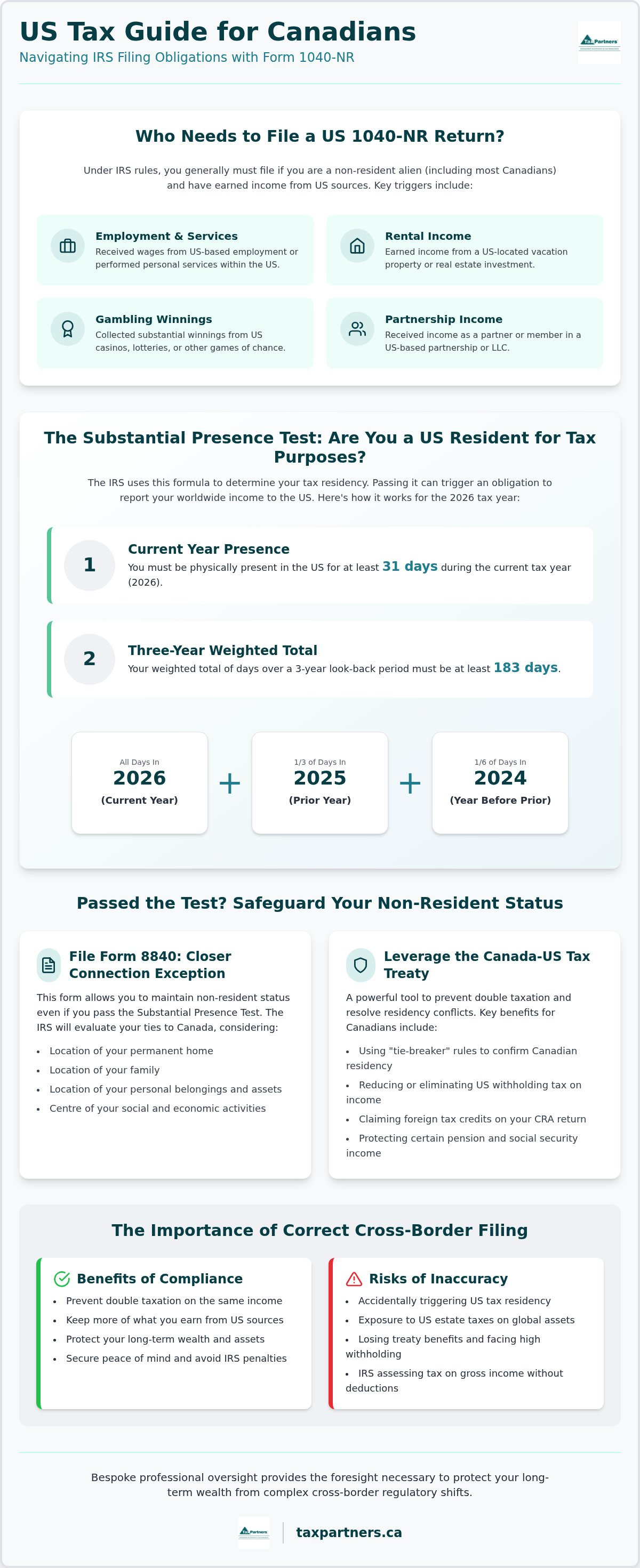
You generally need to file if you've earned income from a US trade or business during the calendar year. This requirement applies even if you don't have a physical office in the United States. Common scenarios that trigger a filing requirement include:
- Receiving wages from US-based employment or performing services in the US.
- Earning rental income from a vacation property or real estate investment located in the US.
- Collecting substantial gambling winnings from US casinos or lotteries.
- Receiving income as a partner in a US partnership.
Even if you don't owe any tax, completing a 1040-NR filing for Canadians is often necessary to claim benefits under the Canada-US Tax Treaty. These treaty claims can reduce or eliminate withholding taxes that would otherwise apply to your income. Failing to file can lead to the IRS assessing tax on your gross income without allowing for any deductions or treaty-based exemptions.
IRS vs. CRA: Navigating Two Jurisdictions
It's vital to maintain a clear boundary between your obligations to the IRS and your responsibilities to the CRA. Under IRS rules, your 1040-NR only reports income that has a US source. You don't report your Canadian salary or global investment dividends on this specific form.
For those managing complex cross-border assets, US & Cross-Border Accounting & Tax Services ensure that every dollar is accounted for correctly in both countries. For CRA filers, your worldwide income remains the domain of the Canadian government. The US filing serves as a prerequisite for claiming foreign tax credits in Canada, which prevents you from paying tax twice on the same dollar.
The Substantial Presence Test: Defining Your Tax Residency
The IRS uses a mathematical formula known as the Substantial Presence Test to determine your tax residency status. If you meet this threshold, the US government considers you a resident for tax purposes, even if you don't hold a Green Card. This shift in status changes your reporting obligations from a limited 1040-NR filing for Canadians to a requirement to report your worldwide income to the IRS.
Under IRS rules, the test uses a three-year look-back period to calculate your total days of presence. To pass the test in 2026, you must be physically present in the US for at least 31 days during the current year. Additionally, you must reach a total of 183 days by adding all your days in 2026, one-third of your days in 2025, and one-sixth of your days in 2024.
Accidentally triggering US residency can lead to severe financial consequences and unexpected tax liabilities. You could find yourself subject to US estate taxes or complex reporting requirements for your Canadian bank accounts and investments. To stay informed about these nuances, you can review the official IRS requirements for Form 1040-NR to ensure your counting is accurate.
The Closer Connection Exception (Form 8840)
Many Canadian snowbirds find that their weighted day count exceeds the 183-day threshold. Form 8840, the Closer Connection Exception Statement, allows you to maintain your non-resident status despite passing the Substantial Presence Test. This form is your primary shield against accidental US residency.
The IRS evaluates several factors, including the location of your permanent home, your family, and your personal belongings. For CRA filers, submitting this form annually is a proactive way to safeguard your Canadian residency and avoid US taxation on your global assets. If you're unsure how your travel schedule affects your status, you can speak with our team to clarify your position.
Treaty Tie-Breaker Rules
When both the IRS and the CRA claim you as a resident, the US-Canada Tax Treaty provides a secondary layer of protection. The "tie-breaker" rules establish a hierarchy to determine which country has the primary right to tax your income. These rules prioritize factors like where you have a permanent home or where your centre of vital interests is located.
Resolving these residency disputes requires a deep understanding of international law and tax treaty protocols. Consulting a cross border tax accountant is often the most reliable way to navigate these conflicts. They can help you apply these tie-breaker provisions to protect your wealth and ensure you remain compliant in both jurisdictions.
US-Sourced Income Types and Treaty-Based Disclosures
Effectively Connected Income (ECI) typically relates to a US trade or business and is taxed at graduated rates. Fixed, Determinable, Annual, Periodical (FDAP) income includes passive earnings like dividends or interest, usually taxed at a flat 30% under IRS rules. Distinguishing between these two is critical for a successful 1040-NR filing for Canadians.
The US-Canada Tax Treaty is your primary tool for reducing these flat rates on FDAP income. To claim these benefits, you must include Form 8833 with your return to disclose your treaty-based position. This disclosure ensures the IRS recognizes your right to pay a lower rate or exempt certain income entirely.
Before finalizing your filing, you must confirm your status hasn't shifted to US residency. The Substantial Presence Test calculation is the first step in determining if you qualify for these non-resident treaty benefits. Accuracy here prevents the CRA from denying foreign tax credits due to improper US reporting.
US Rental Property and Net Income Elections
By default, the IRS imposes a 30% withholding tax on the gross rental income Canadians receive from US property. This means you pay tax on the total rent collected before deducting any costs or expenses. For most property owners, this leads to a significantly higher tax bill than is actually required.
You can choose to make a Section 871(d) election on your tax return. This allows you to treat rental income as ECI, meaning you're taxed on net income instead of gross receipts. It enables you to deduct mortgage interest, property taxes, and maintenance expenses, often reducing the US tax liability to a much lower amount. For those managing such assets, י.ג עציון רואי חשבון offers specialized expertise in US real estate investment taxation.
If you've had a lucky streak at a US casino, you likely noticed a 30% withholding tax on your winnings. The IRS requires this for non-residents, but it doesn't account for the money you lost during your trip. A 1040-NR filing for Canadians allows you to report your losses to offset those winnings and recover overpaid tax.
Recovering these funds requires careful documentation of both your wins and losses throughout the year. You can find more specific guidance on this process in our lottery and gambling tax FAQ. Properly managing these claims ensures you only pay tax on your actual net gain rather than every individual win.
Navigating the 1040-NR Filing Process and ITIN Requirements
A successful 1040-NR filing for Canadians begins with gathering all US-sourced income documents. You'll need to collect specific IRS forms such as W-2s for employment, 1042-S forms for dividends, and 1099s for other income types. These records serve as the foundation for an accurate return under IRS rules.
Meeting IRS deadlines is vital to avoid late-filing penalties and interest charges. For the 2026 tax year, Canadians generally have until June 15, 2027, to file Form 1040-NR, though any tax owed must be paid by April 15, 2027. Once filed, you must report these US taxes as foreign tax credits on your Canadian return for CRA filers to eliminate double taxation.
Applying for an ITIN in Canada
An Individual Taxpayer Identification Number (ITIN) is essential for Canadians who don't have a US Social Security Number but need to file an IRS return. You apply for this using Form W-7, which you must typically submit alongside your first 1040-NR filing. This number allows the IRS to process your return and issue any eligible tax refunds.
The standard processing time for an ITIN application is 7-11 weeks. To avoid mailing your original passport to the IRS, you can work with a Certifying Acceptance Agent in Canada. This proactive step ensures your application meets all IRS standards while you keep your documents safe at home.
Common Errors and IRS Penalties
One of the most frequent mistakes is using the standard Form 1040 instead of the non-resident 1040-NR. Filing the wrong form can lead the IRS to tax your worldwide income as if you were a US resident. Additionally, failing to disclose treaty-based positions or specific foreign assets can trigger significant penalties under IRS rules.
If you've missed previous years of filing, don't panic. You can often use IRS streamlined procedures to catch up on your obligations without facing heavy penalties. These programs are designed for taxpayers whose failure to file was non-willful and provide a path back to full compliance.
If you're feeling overwhelmed by these technical requirements, contact our cross-border specialists for a guided filing plan.

Ensuring Cross-Border Accuracy with Professional Oversight
While generic tax software handles standard domestic returns well, it often lacks the nuance required for a 1040-NR filing for Canadians. These platforms frequently fail to account for the intricate interplay between IRS rules and Canadian tax obligations. Relying on automated systems can lead to missed treaty benefits or improper income classification, which increases the risk of an audit.
A boutique CPA firm provides the foresight needed to navigate these complexities with precision. We act as a proactive guardian for your interests, identifying potential issues before they become costly liabilities. This professional oversight ensures that your cross-border strategy supports your long-term financial goals rather than just checking a compliance box.
The Tax Partners Advantage
With over 40 years of experience and more than 495,000 returns filed, we bring deep-seated reliability to every client engagement. Our team specializes in both IRS and CRA regulations, ensuring that your filings are accurate in both jurisdictions. We're committed to helping you keep more of what you earn through bespoke strategic planning.
Our reputation is built on ethical steadfastness and a modern, forward-thinking outlook. You can learn more about our commitment to transparency and personalized care by visiting our mission and vision page. We prioritize stability and long-term partnership, positioning ourselves as a steady hand at the helm of your financial affairs.
Next Steps for Your 2026 Filing
Preparation is the key to a stress-free tax season. We recommend gathering your US-sourced income documents and travel records as early as possible to ensure a smooth filing process. Having these details ready allows for a more thorough analysis of your residency status and treaty eligibility under IRS rules.
To help you organize your records, we provide a comprehensive checklist on our website. Once you have your documents in order, you can contact Tax Partners for a personalized consultation. We'll review your 2026 filings to ensure full compliance for CRA filers and maximize your cross-border wealth preservation.
Master Your Cross-Border Wealth Strategy
Success with your 1040-NR filing for Canadians is about more than just meeting a deadline under IRS rules. It's a strategic effort to protect your hard-earned income and ensure full compliance across two jurisdictions. By accurately applying the Substantial Presence Test and leveraging treaty benefits, you effectively eliminate the risk of double taxation for CRA filers.
Tax Partners brings over 40 years of institutional wisdom and specialized expertise in both IRS and CRA compliance to your side. With more than 1,390 five-star Google reviews, we've proven our commitment to providing the bespoke care your financial situation deserves. We act as your proactive guardian, looking ahead to secure the best possible outcomes for your cross-border interests.
Take the first step toward a worry-free tax season and total financial clarity. Secure your cross-border financial future with Tax Partners today. We're ready to guide you with the precision and foresight needed for long-term stability.
Frequently Asked Questions
Do Canadians have to file a US tax return for rental income?
Yes, Canadians must report US rental income on Form 1040-NR under IRS rules. By default, the IRS imposes a flat 30% withholding tax on the gross rent you collect. However, you can make a Section 871(d) election to be taxed on net income instead. This allows you to deduct expenses like property taxes and mortgage interest, which often results in a lower tax liability for CRA filers.
What is the deadline for Canadians to file a 1040-NR in 2026?
The filing deadline for non-residents to submit Form 1040-NR for the 2026 tax year is June 15, 2027. It's vital to note that any tax owed must be paid to the IRS by April 15, 2027, to avoid interest penalties. If you need more time to prepare your 1040-NR filing for Canadians, you can request an extension until October 15, 2027, through the appropriate IRS channels.
Can I claim the standard deduction on a 1040-NR as a Canadian?
Generally, Canadians filing as non-resident aliens cannot claim the standard deduction under IRS rules. While US residents can claim a standard deduction, which is $16,100 for single filers in 2026, non-residents are typically restricted to itemized deductions. These may include state and local taxes or certain casualty losses. You should consult the current IRS instructions or a cross-border specialist to verify which specific deductions apply to your unique situation.
How does the US-Canada Tax Treaty prevent double taxation?
The US-Canada Tax Treaty prevents double taxation by allowing you to claim credits for taxes paid in one country against the tax owed in the other. For CRA filers, the treaty ensures that US-sourced income isn't taxed at the full rate in both jurisdictions. It also provides for reduced withholding rates on passive income like dividends or royalties. This coordination between the IRS and CRA helps preserve your global wealth.
What happens if I pass the Substantial Presence Test but live in Canada?
If you pass the Substantial Presence Test, the IRS considers you a US resident for tax purposes by default. To avoid being taxed on your worldwide income in the US, you must file Form 8840 to claim a Closer Connection to Canada. This form demonstrates that your social, economic, and family ties remain in Canada. Filing this statement annually is essential for Canadians who spend significant time across the border.
Do I need an ITIN to file a 1040-NR, and how do I get one?
Yes, an Individual Taxpayer Identification Number (ITIN) is required for those without a Social Security Number who need to file a US return. You can obtain one by submitting Form W-7 to the IRS along with your tax return. A valid Canadian passport is the primary document used to prove your status. Using a Certifying Acceptance Agent can simplify the process and prevent the need to mail your original documents.
Can I recover US withholding tax on gambling winnings?
You can recover overpaid US withholding tax on gambling winnings by submitting a 1040-NR filing for Canadians. While casinos usually withhold a flat 30% on winnings, the IRS allows you to offset these gains with documented gambling losses. This process requires you to keep an accurate log of your activity throughout the year. Successfully claiming these losses can lead to a refund of a significant portion of the withheld tax.
Is a 1040-NR required if I only have US bank interest?
In many cases, a 1040-NR is not required if your only US income is interest from a bank or financial institution. This type of portfolio interest is generally exempt from US tax for non-resident aliens under IRS rules. However, you must provide Form W-8BEN to your US bank to certify your foreign status. If other types of income are involved, or if tax was withheld, a filing may still be necessary.

Article by
Mahad Mohamed
Mahad Mohamed is an accountant and the CEO of Tax Partners, with over 26+ years of Canadian and international tax and accounting experience. His expertise includes corporate reorganization, cross-border tax structuring (Canada & US), tax disputes, CRA audits, and tax planning for small owner-managed private corporations. Most recently, Mahad is a pioneer in Canadian crypto taxation and founded Block3 Finance.
Previously, Mahad worked for the Canada Revenue Agency (CRA), Big4 accounting firms, and served as a Rulings Officer for the Federal Tax Authority of the UAE before acquiring Tax Partners in 2014.
Tax Partners has 44 full-time accountants and over 18,400+ clients.
Disclaimer
This article provides general information only and is current as of its publication date. It has not been updated and may be out of date. It does not constitute legal advice and should not be relied upon as such. Every tax situation is unique and may differ from the examples discussed in this article. If you have specific questions, you should seek the advice of our accountants for your unique circumstances. Book a FREE Initial Consultation Today!
Frequently Asked Questions
Do Canadians have to file a US tax return for rental income?
Yes, Canadians must report US rental income on Form 1040-NR under IRS rules. By default, the IRS imposes a flat 30% withholding tax on the gross rent you collect. However, you can make a Section 871(d) election to be taxed on net income instead. This allows you to deduct expenses like property taxes and mortgage interest, which often results in a lower tax liability for CRA filers.
What is the deadline for Canadians to file a 1040-NR in 2026?
The filing deadline for non-residents to submit Form 1040-NR for the 2026 tax year is June 15, 2027. It's vital to note that any tax owed must be paid to the IRS by April 15, 2027, to avoid interest penalties. If you need more time to prepare your 1040-NR filing for Canadians, you can request an extension until October 15, 2027, through the appropriate IRS channels.
Can I claim the standard deduction on a 1040-NR as a Canadian?
Generally, Canadians filing as non-resident aliens cannot claim the standard deduction under IRS rules. While US residents can claim a standard deduction, which is $16,100 for single filers in 2026, non-residents are typically restricted to itemized deductions. These may include state and local taxes or certain casualty losses. You should consult the current IRS instructions or a cross-border specialist to verify which specific deductions apply to your unique situation.
How does the US-Canada Tax Treaty prevent double taxation?
The US-Canada Tax Treaty prevents double taxation by allowing you to claim credits for taxes paid in one country against the tax owed in the other. For CRA filers, the treaty ensures that US-sourced income isn't taxed at the full rate in both jurisdictions. It also provides for reduced withholding rates on passive income like dividends or royalties. This coordination between the IRS and CRA helps preserve your global wealth.
What happens if I pass the Substantial Presence Test but live in Canada?
If you pass the Substantial Presence Test, the IRS considers you a US resident for tax purposes by default. To avoid being taxed on your worldwide income in the US, you must file Form 8840 to claim a Closer Connection to Canada. This form demonstrates that your social, economic, and family ties remain in Canada. Filing this statement annually is essential for Canadians who spend significant time across the border.
Do I need an ITIN to file a 1040-NR, and how do I get one?
Yes, an Individual Taxpayer Identification Number (ITIN) is required for those without a Social Security Number who need to file a US return. You can obtain one by submitting Form W-7 to the IRS along with your tax return. A valid Canadian passport is the primary document used to prove your status. Using a Certifying Acceptance Agent can simplify the process and prevent the need to mail your original documents.
Can I recover US withholding tax on gambling winnings?
You can recover overpaid US withholding tax on gambling winnings by submitting a 1040-NR filing for Canadians. While casinos usually withhold a flat 30% on winnings, the IRS allows you to offset these gains with documented gambling losses. This process requires you to keep an accurate log of your activity throughout the year. Successfully claiming these losses can lead to a refund of a significant portion of the withheld tax.
Is a 1040-NR required if I only have US bank interest?
In many cases, a 1040-NR is not required if your only US income is interest from a bank or financial institution. This type of portfolio interest is generally exempt from US tax for non-resident aliens under IRS rules. However, you must provide Form W-8BEN to your US bank to certify your foreign status. If other types of income are involved, or if tax was withheld, a filing may still be necessary.