Avoiding Common Payroll Mistakes in Canada: A 2026 Guide

You likely started your business to build something meaningful, not to lose sleep over complex remittance schedules, the deadlines for sending tax withholdings, or the fear of a surprise audit. It's natural to feel stressed by worker classification or the shifting thresholds of the Canada Pension Plan (CPP), a mandatory social insurance program. We understand that you want to protect your reputation and your bottom line.
This guide provides a steady hand to help you rectify frequent compliance errors and safeguard your enterprise from heavy penalties. You'll gain total clarity on 2026 regulations and learn how to reduce your administrative burden. We'll cover Employment Insurance (EI) rates, a program for temporary worker assistance, explain the enhanced Canada Pension Plan (CPP2) for higher earnings, and outline the steps to keep your records audit-ready.
Key Takeaways
- Learn the specific factors the CRA uses to distinguish employees from independent contractors to prevent costly retroactive assessments and penalties.
- Understand how your remittance schedule is determined by the CRA based on your average monthly withholding to ensure you never miss a deadline.
- Discover the essential internal controls, including the "four-eyes" review principle, for avoiding common payroll mistakes Canada businesses often face.
- Master the calculation of employer contributions for CPP and EI to maintain your statutory trust, which is the legal obligation to hold deducted funds for the Crown.
- Identify the mandatory record-keeping requirements for CRA filers to ensure total peace of mind and visibility during an audit.
The High Stakes of Payroll Compliance for CRA Filers
Managing a team is a significant milestone for any growing business. However, it also fundamentally changes your relationship with the Canada Revenue Agency (CRA). You are no longer just a taxpayer; you have become a collection agent for the federal government.
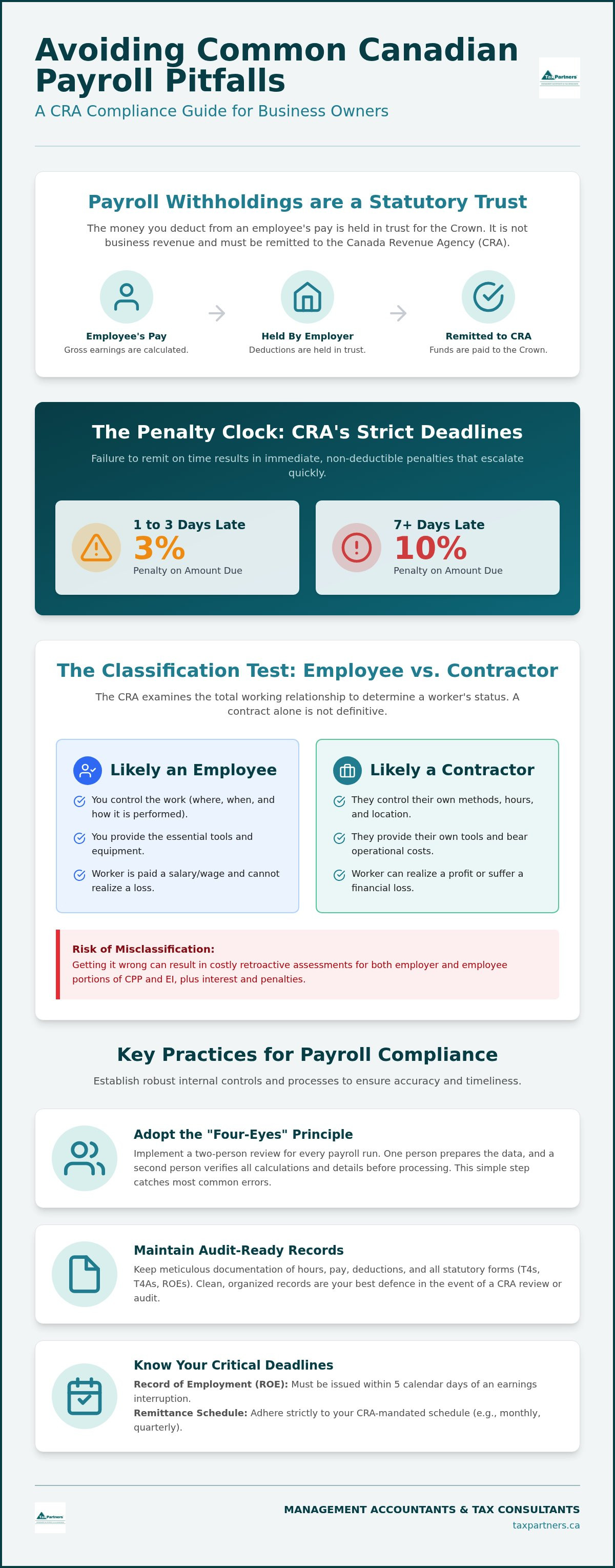
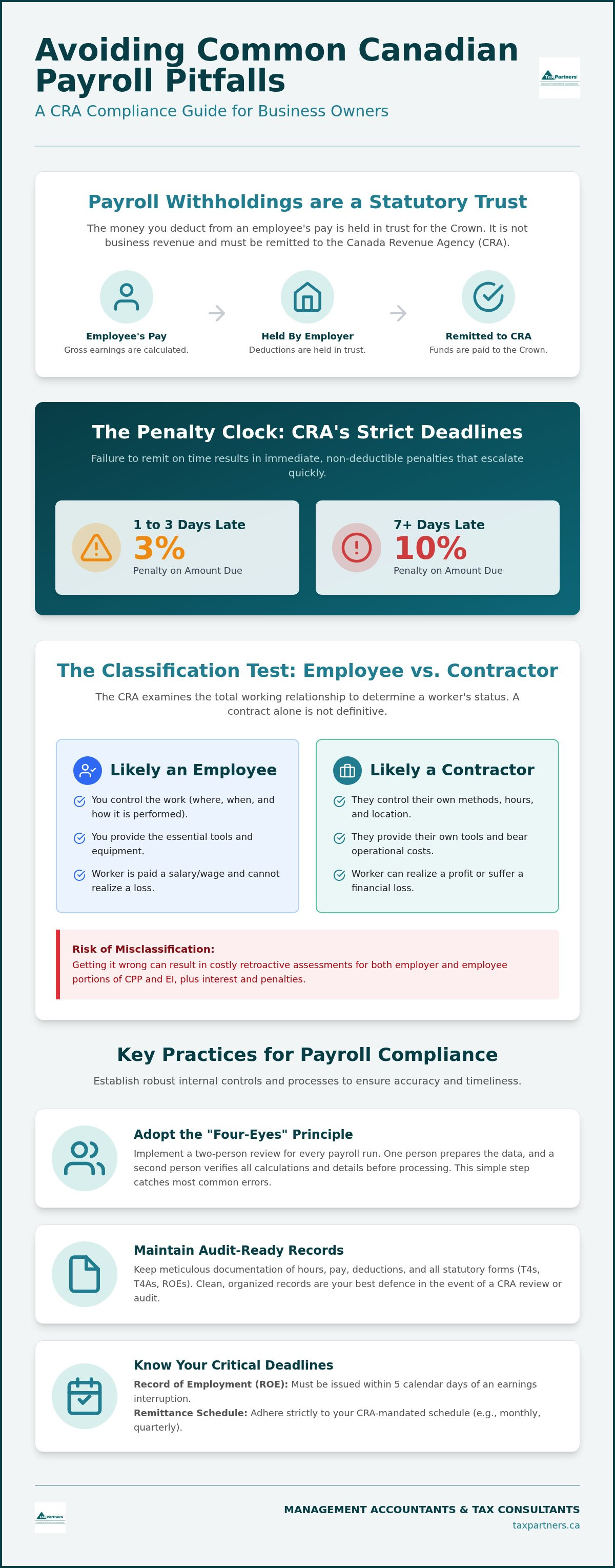
The money you withhold from an employee's paycheque is legally considered a statutory trust. This means the funds are held in trust for the Crown and do not belong to your business at any point. Understanding Payroll Basics is essential for recognizing that these funds must be kept separate from your operating capital.
The CRA views payroll non-compliance with much greater severity than simple income tax errors. Because these are trust funds, failure to remit them is seen as a breach of that trust. Avoiding common payroll mistakes Canada employers face requires a proactive approach to these sacred obligations.
Defining Your Obligations as a Canadian Employer
Your journey begins by opening a payroll program account with the CRA. This account allows you to manage statutory deductions, which are amounts mandated by law to be taken from an employee's pay. These include federal and provincial income tax, Canada Pension Plan (CPP) contributions, and Employment Insurance (EI) premiums.
It's vital to distinguish between gross pay and net pay. Gross pay is the total amount an employee earns before any deductions are made. Net pay is the actual amount the employee receives after you have subtracted all required withholdings. You are responsible for calculating both the employee's portion and the employer's matching contributions where applicable.
Precision is your best defence. Our business solutions emphasize that even small rounding errors can compound over time. Consistent accuracy ensures that your filings remain beyond reproach during a review.
Why the CRA Prioritizes Payroll Audits
The CRA prioritizes payroll audits because they involve money that is already "owed" to the government. Since you are holding these funds in a statutory trust, the CRA expects immediate and full remittance according to your specific schedule. There is very little leniency for delays or administrative oversights.
Penalties for late or missing remittances under CRA rules are immediate and progressive. For example, being just one to three days late can trigger a 3% penalty, which climbs to 10% if the delay exceeds seven days. These costs are non-deductible and can quickly erode your company's profitability.
Errors in payroll often serve as a "red flag" for the CRA. A single mistake in worker classification or a late T4 filing frequently triggers a broader compliance review of your entire business. Maintaining a clean payroll record is the most effective way to keep your business off the auditor's radar.
Common Pitfalls in Employee Classification and Documentation
Misclassifying a worker is one of the most expensive errors a Canadian business can make. Many owners believe that signing a contract labelled "Independent Contractor" protects them from payroll obligations. However, the CRA looks past the label to the actual nature of the work relationship.
If the CRA determines a contractor is actually an employee, you may face retroactive assessments for both the employee and employer portions of CPP and EI. You could also be liable for unpaid interest and penalties. This is a critical step in avoiding common payroll mistakes Canada firms frequently encounter.
Employee vs. Independent Contractor: The Control Test
The CRA uses a multi-factor test to determine status, with the "Control Test" being the most significant. This test examines who has the right to decide where, when, and how the work is performed. If you control these details, the worker is likely an employee under CRA rules.
Other factors include the ownership of tools and the worker's chance of profit or risk of loss. Independent contractors typically provide their own equipment and bear the financial risk of their operations. If you are uncertain about a worker's status, you can request a formal ruling from the CRA to gain certainty. Beyond determining worker status, it is equally important to ensure your business is protected against workplace liabilities; you can learn more about Hako Risk Advisors for comprehensive commercial insurance coverage.
Managing Records of Employment and Statutory Forms
A Record of Employment (ROE) is a mandatory document that provides a worker's employment history, which Service Canada uses to determine eligibility for benefits. You must issue an ROE within five calendar days of the end of the pay period in which a worker experiences an interruption of earnings. Failing to do so can lead to fines and significant distress for employees.
Accuracy is equally vital for year-end forms like the T4 (Statement of Remuneration Paid) and T4A (Statement of Pension, Retirement, Annuity, and Other Income). Common errors include incorrect social insurance numbers or misallocated taxable benefits. Our accounting services help ensure your documentation is precise and filed on time.
Maintaining these records is a core part of CRA Payroll Compliance and Enforcement. If you feel overwhelmed by the complexity of worker classification, speak with our team to secure your compliance strategy and gain total visibility.
Navigating CRA Remittance Deadlines and Calculation Errors
Remittance is the process of transferring the statutory deductions you have withheld to the Canada Revenue Agency. Your specific schedule is not a choice but a requirement dictated by your Average Monthly Withholding Amount (AMWA). This calculation looks at the total of your employees' income tax, CPP, and EI premiums from two calendar years ago.
Errors often occur when employers forget their own side of the ledger. While you deduct the employee's portion, you must also contribute the employer's share. For 2026, the employer matches the CPP contribution of 5.95% and pays 1.4 times the employee's EI premium, which is $2.28 per $100 of insurable earnings under CRA rules.
Precision in these calculations is the primary way of avoiding common payroll mistakes Canada businesses often regret during audit season. Even small discrepancies in matching contributions can lead to significant retroactive assessments and interest charges.
Understanding Your Prescribed Remittance Schedule
Most small businesses start as regular remitters, with payments due by the 15th day of the month following the payroll month. If your AMWA exceeds $25,000, the CRA may reclassify you as an accelerated remitter. These schedules require more frequent payments, sometimes within three working days after the pay period ends for the largest employers.
Check your CRA "My Business Account" regularly to confirm your current status and any schedule changes. Missing a deadline by just one day triggers an immediate 3% penalty for 2026. This penalty grows to 10% if the payment is delayed by eight or more days, making punctuality a financial necessity.
Taxable Benefits and Hidden Payroll Costs
Taxable benefits are the value of a service or property you provide to an employee, such as group life insurance premiums or health premiums. These are often overlooked because no cash changes hands during the pay period. However, the value of these benefits must be added to the employee's income before you calculate statutory deductions.
Failing to track these non-cash benefits, including automobile allowances, leads to under-remitting income tax and CPP. The CRA applies prescribed interest rates to any late or missing amounts, which are compounded daily. Staying organized with our accounting services ensures these hidden costs are accounted for in every pay cycle.
The "cost of convenience" in ignoring these benefits is never worth the risk of an audit. Accurate tracking protects your business from the daily compounding interest that the CRA applies to arrears. We recommend a proactive review of all employee perks to ensure they are correctly classified and taxed.
Establishing Robust Internal Controls for Payroll Management
Automation helps manage the heavy lifting of calculations, but human oversight remains the bedrock of true compliance. Relying solely on software can lead to systemic errors that go unnoticed until a formal review. Implementing rigorous internal controls is the most effective strategy for avoiding common payroll mistakes Canada businesses face.
We advocate for the "four-eyes" principle in every payroll cycle. This means one person prepares the payroll data while a second, independent person reviews and authorizes the final figures. This simple check reduces the risk of clerical errors and internal fraud significantly.
For many SMEs, integrating professional bookkeeping services provides an extra layer of professional scrutiny. It ensures that your payroll figures align perfectly with your broader financial records. This holistic view prevents discrepancies that often lead to CRA inquiries.
The Role of Reconciliation in Error Detection
You should perform a monthly reconciliation between your payroll reports and your general ledger, which are your primary accounting books. Reconciliation is the process of ensuring that the amounts recorded in your books match the actual payments made from your bank account. Look for "red flags" like variances in statutory deduction totals or unexpected changes in net pay amounts.
Understanding these patterns early can prevent a minor discrepancy from becoming a major liability. Our CRA audit help guide provides deeper insights into what auditors look for when examining your records. Catching an error in month two is far better than discovering it during a multi-year audit.
Remember that under CRA rules, you must keep all payroll records for a minimum of six years after the end of the tax year they relate to. This includes time sheets, proof of remittance, and copies of T4 slips. Organized record-keeping is your best defence if the CRA requests a review of your filings.
Safeguarding Data and Ensuring Privacy Compliance
Payroll systems house highly sensitive information, including Social Insurance Numbers (SIN) and employee bank details. A SIN is a nine-digit number used in Canada to identify individuals for government programs and tax purposes. Protecting this data is both a legal requirement and a matter of maintaining employee trust.
Restrict access to payroll systems only to those who absolutely need it for their specific roles. Use secure, encrypted backup systems to ensure your records are never lost to hardware failure or cyber threats. Digital security is a core component of modern payroll guardianship.
Proactive guardianship of your data and your processes ensures long-term stability and peace of mind. If you want to strengthen your internal controls and protect your business, contact our team today to discuss a bespoke compliance plan.
Strategic Payroll Solutions with Tax Partners
Managing payroll is a high-stakes obligation that requires more than just reactive software. We position ourselves as a proactive guardian, looking ahead to secure better outcomes for your business. Our team brings over 40 years of Canadian tax experience to every client partnership.
Based in the Greater Toronto Area (GTA), our team serves entities across Canada with a high degree of responsiveness. Integrating our business solutions ensures that your payroll functions as a core component of your broader tax strategy. This holistic approach provides the visibility you need to grow with confidence.
Avoiding common payroll mistakes Canada employers often face is simpler with a partner who understands the nuances of CRA enforcement. We focus on long-term stability and ethical steadfastness to protect your reputation and your bottom line. You can rely on us to be the steady hand at the helm of your regulatory compliance.
Why Professional Oversight Trumps DIY Software
Payroll software is a helpful tool for calculations, but it cannot replace the strategic insight of a Chartered Professional Accountant (CPA). A CPA is a licensed professional who has met high standards of education and experience in accounting. They provide the human judgment necessary to handle unique employee situations or complex benefits.
We interpret complex CRA changes in real-time to identify risks that automated systems might miss. Precision of this nature has helped us save our clients over $87M by preventing costly errors and optimizing remittance strategies. Our expertise ensures that you are not just compliant, but strategically positioned for efficiency.
Our role is to act as a proactive shield during audit season. We provide the institutional wisdom needed to navigate shifting regulatory landscapes with total clarity. This level of support allows you to focus on your core business while we manage the complexities of the CRA.
Getting Started with a Payroll Health Check
Our process begins with a comprehensive payroll compliance review to identify existing gaps in your documentation or remittances. We examine your worker classifications, taxable benefits, and filing history to ensure everything aligns with current CRA requirements. This review provides an immediate sense of resolution and a clear path forward.
Moving to our managed services is a methodical and highly organized journey. We guide you from a state of potential uncertainty toward a feeling of total control over your administrative burden. Our transition team ensures that your historical data is accurately captured and your future filings are seamless.
Securing your financial health starts with a conversation about your unique business needs. We invite you to visit our contact page to request a bespoke proposal tailored to your industry and scale. Let us help you transform payroll from a source of stress into a streamlined part of your success.
Securing Your Business Legacy
Maintaining a compliant payroll system is about more than just avoiding common payroll mistakes Canada businesses often make. It's about building a foundation of trust with your employees and the Crown. By mastering the Control Test for worker classification and adhering to your prescribed remittance schedule, you protect your enterprise from the stress of surprise audits and heavy penalties.
Establishing robust internal controls, such as the "four-eyes" review principle, ensures that your financial records remain precise and transparent. Our GTA-based experts serve clients across Canada with over 40 years of institutional wisdom and a commitment to ethical steadfastness. With 1,390+ five-star Google reviews, we've proven our ability to act as a proactive guardian for your payroll and tax needs.
Secure your payroll compliance with Tax Partners today to gain total clarity and peace of mind. You've worked hard to build your business; let us provide the steady hand at the helm to ensure its long-term stability.
Frequently Asked Questions
What is the penalty for late payroll remittances to the CRA?
The CRA applies immediate penalties for late remittances based on how many days past the due date the payment is received. For 2026, being one to three days late triggers a 3% penalty. This increases to 5% for four to five days, 7% for six to seven days, and 10% if the payment is eight or more days late. These penalties are non-deductible and are applied to the total amount you failed to remit on time.
How long must I keep payroll records for my Canadian business?
Under CRA rules, Canadian employers must keep all payroll records for a minimum of six years from the end of the last tax year they relate to. This requirement includes time sheets, proof of remittances, and copies of issued T4 slips. Maintaining organized records is a critical strategy for avoiding common payroll mistakes Canada businesses face during audits. If your business closes, you must still keep these records for the full six-year period.
Does the CRA consider independent contractors to be employees?
The CRA does not automatically accept a worker's status as an independent contractor simply because a contract exists. Instead, they apply a multi-factor test to determine if a relationship is actually one of employment. The most important factor is the Control Test, which assesses who decides where, when, and how the work is done. Other factors include the ownership of tools and the worker's personal chance of profit or risk of loss.
What are the mandatory statutory deductions for Canadian employees?
Mandatory statutory deductions for Canadian employees include federal and provincial income tax, Canada Pension Plan (CPP) contributions, and Employment Insurance (EI) premiums. As an employer, you are responsible for withholding these amounts from each paycheque and remitting them to the CRA. You must also calculate and remit the employer's portion of CPP and EI. These funds are held in a statutory trust and must be handled with extreme precision to ensure compliance.
When is the deadline for filing T4 slips each year under CRA rules?
Under CRA rules, the deadline for filing T4 slips is the last day of February following the calendar year to which the information applies. For the 2026 tax year, you must provide T4 slips to your employees and file the return with the CRA by February 2027. If the last day of February falls on a weekend, the deadline is typically extended to the next business day. Late filing results in progressive penalties based on the number of slips.
Can I use personal funds to pay for business payroll remittances?
While the CRA primarily cares that the remittance is paid, using personal funds for business payroll obligations is highly discouraged. Payroll deductions are considered a statutory trust held for the Crown and should be managed through a dedicated business payroll account. Mixing personal and business finances complicates your bookkeeping and can create significant challenges during a CRA audit. It is best to maintain clear separation to demonstrate transparent financial management and proactive guardianship of trust funds.
What happens if I forget to issue a Record of Employment (ROE)?
Failing to issue a Record of Employment (ROE) can lead to administrative penalties from Service Canada and significant delays in an employee's ability to claim benefits. You must issue an ROE within five calendar days of the end of the pay period in which an interruption of earnings occurs. This document is essential for the government to determine benefit eligibility. Consistency in issuing ROEs is a vital part of avoiding common payroll mistakes Canada employers often overlook.
How do I report taxable benefits on an employee's pay cheque?
To report taxable benefits, you must first determine the fair market value of the benefit provided to the employee. This value is added to the employee's gross income for the pay period before you calculate statutory deductions like income tax and CPP. While the benefit itself is non-cash, the deductions are taken from the employee's regular pay. Accurate reporting ensures that the employee's total compensation is taxed correctly according to current CRA regulations and thresholds.

Article by
Mahad Mohamed
Mahad Mohamed is an accountant and the CEO of Tax Partners, with over 26+ years of Canadian and international tax and accounting experience. His expertise includes corporate reorganization, cross-border tax structuring (Canada & US), tax disputes, CRA audits, and tax planning for small owner-managed private corporations. Most recently, Mahad is a pioneer in Canadian crypto taxation and founded Block3 Finance.
Previously, Mahad worked for the Canada Revenue Agency (CRA), Big4 accounting firms, and served as a Rulings Officer for the Federal Tax Authority of the UAE before acquiring Tax Partners in 2014.
Tax Partners has 44 full-time accountants and over 18,400+ clients.
Disclaimer
This article provides general information only and is current as of its publication date. It has not been updated and may be out of date. It does not constitute legal advice and should not be relied upon as such. Every tax situation is unique and may differ from the examples discussed in this article. If you have specific questions, you should seek the advice of our accountants for your unique circumstances. Book a FREE Initial Consultation Today!
Frequently Asked Questions
What is the penalty for late payroll remittances to the CRA?
The CRA applies immediate penalties for late remittances based on how many days past the due date the payment is received. For 2026, being one to three days late triggers a 3% penalty. This increases to 5% for four to five days, 7% for six to seven days, and 10% if the payment is eight or more days late. These penalties are non-deductible and are applied to the total amount you failed to remit on time.
How long must I keep payroll records for my Canadian business?
Under CRA rules, Canadian employers must keep all payroll records for a minimum of six years from the end of the last tax year they relate to. This requirement includes time sheets, proof of remittances, and copies of issued T4 slips. Maintaining organized records is a critical strategy for avoiding common payroll mistakes Canada businesses face during audits. If your business closes, you must still keep these records for the full six-year period.
Does the CRA consider independent contractors to be employees?
The CRA does not automatically accept a worker's status as an independent contractor simply because a contract exists. Instead, they apply a multi-factor test to determine if a relationship is actually one of employment. The most important factor is the Control Test, which assesses who decides where, when, and how the work is done. Other factors include the ownership of tools and the worker's personal chance of profit or risk of loss.
What are the mandatory statutory deductions for Canadian employees?
Mandatory statutory deductions for Canadian employees include federal and provincial income tax, Canada Pension Plan (CPP) contributions, and Employment Insurance (EI) premiums. As an employer, you are responsible for withholding these amounts from each paycheque and remitting them to the CRA. You must also calculate and remit the employer's portion of CPP and EI. These funds are held in a statutory trust and must be handled with extreme precision to ensure compliance.
When is the deadline for filing T4 slips each year under CRA rules?
Under CRA rules, the deadline for filing T4 slips is the last day of February following the calendar year to which the information applies. For the 2026 tax year, you must provide T4 slips to your employees and file the return with the CRA by February 2027. If the last day of February falls on a weekend, the deadline is typically extended to the next business day. Late filing results in progressive penalties based on the number of slips.
Can I use personal funds to pay for business payroll remittances?
While the CRA primarily cares that the remittance is paid, using personal funds for business payroll obligations is highly discouraged. Payroll deductions are considered a statutory trust held for the Crown and should be managed through a dedicated business payroll account. Mixing personal and business finances complicates your bookkeeping and can create significant challenges during a CRA audit. It is best to maintain clear separation to demonstrate transparent financial management and proactive guardianship of trust funds.
What happens if I forget to issue a Record of Employment (ROE)?
Failing to issue a Record of Employment (ROE) can lead to administrative penalties from Service Canada and significant delays in an employee's ability to claim benefits. You must issue an ROE within five calendar days of the end of the pay period in which an interruption of earnings occurs. This document is essential for the government to determine benefit eligibility. Consistency in issuing ROEs is a vital part of avoiding common payroll mistakes Canada employers often overlook.
How do I report taxable benefits on an employee's pay cheque?
To report taxable benefits, you must first determine the fair market value of the benefit provided to the employee. This value is added to the employee's gross income for the pay period before you calculate statutory deductions like income tax and CPP. While the benefit itself is non-cash, the deductions are taken from the employee's regular pay. Accurate reporting ensures that the employee's total compensation is taxed correctly according to current CRA regulations and thresholds.