Are Wealth Management Fees Tax Deductible in Canada? (2026 Guide)

You might be unintentionally handing back a significant portion of your investment returns to the government simply because you haven't optimized your tax filings. Many investors frequently ask, are wealth management fees tax deductible in Canada, only to find conflicting answers that leave money on the table. It's frustrating to watch management fees chip away at your hard-earned growth, especially when the rules for Canada Revenue Agency (CRA) filers feel like a moving target.
You deserve to keep as much of your wealth as possible while staying firmly on the right side of tax regulations. We've designed this guide to help you discover exactly which investment fees you can claim on your Canadian tax return to maximize your wealth preservation. We'll show you how to navigate these complexities with the precision and foresight of a seasoned professional.
This article provides a clear breakdown of what can be claimed on Line 22100 and the strict differences between registered and non-registered account rules. You'll gain the knowledge needed to distinguish between deductible advice and non-deductible commissions. By the end, you'll have the confidence to file a compliant return that ensures you aren't paying a penny more than necessary.
Key Takeaways
- Identify exactly which investment expenses qualify as carrying charges on Line 22100 of your T1 General return for CRA filers.
- Clear up the confusion regarding account types to see if your specific wealth management fees are tax deductible in Canada based on your non-registered holdings.
- Learn the CRA criteria for advisor eligibility and why the advice must focus on specific securities to remain compliant.
- Differentiate between direct management fees and embedded costs like MERs or trading commissions that are handled differently under Canadian tax law.
- See how proactive tax planning can protect your investment returns from being eroded by unnecessary tax liabilities.
Understanding Investment Fees and CRA Deductibility Rules
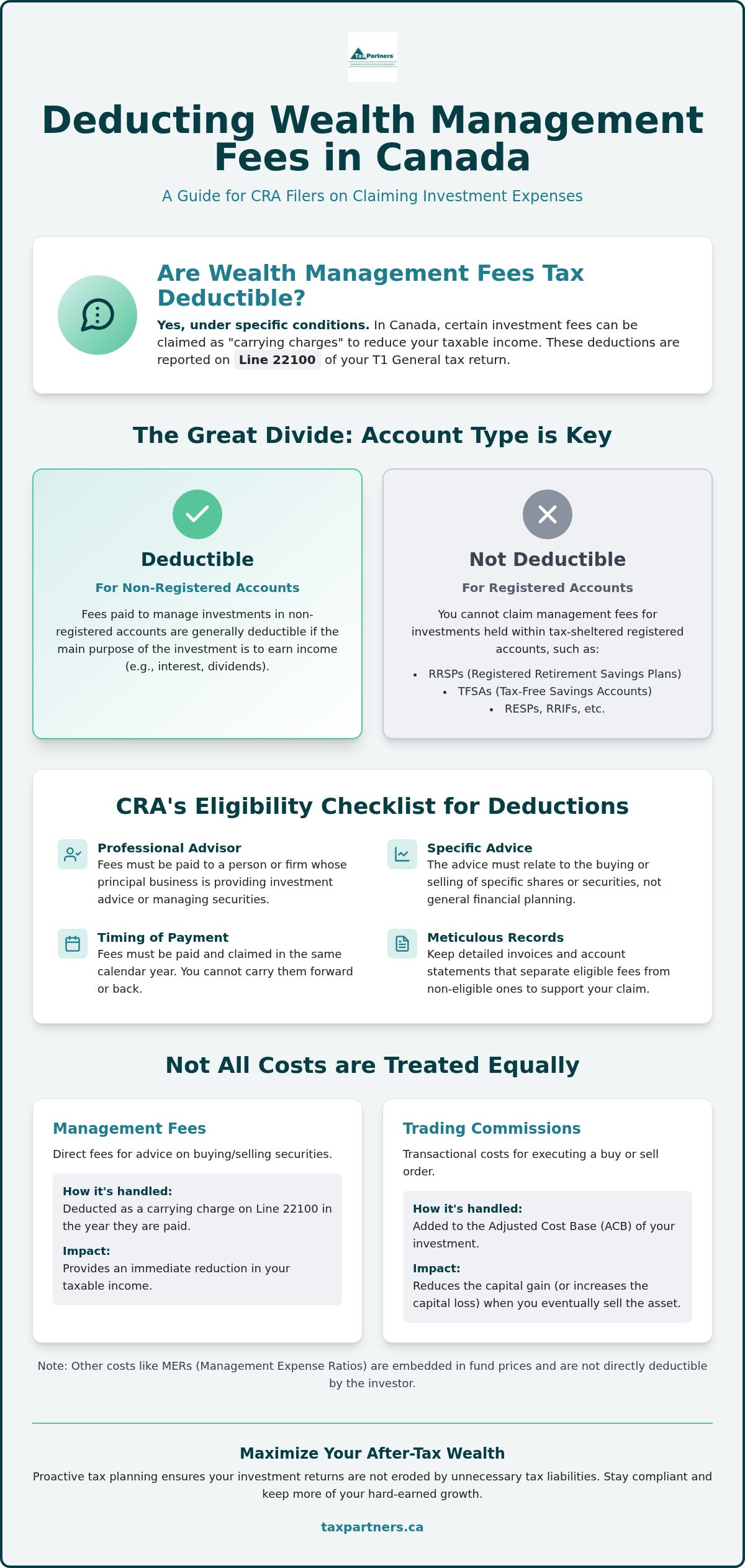
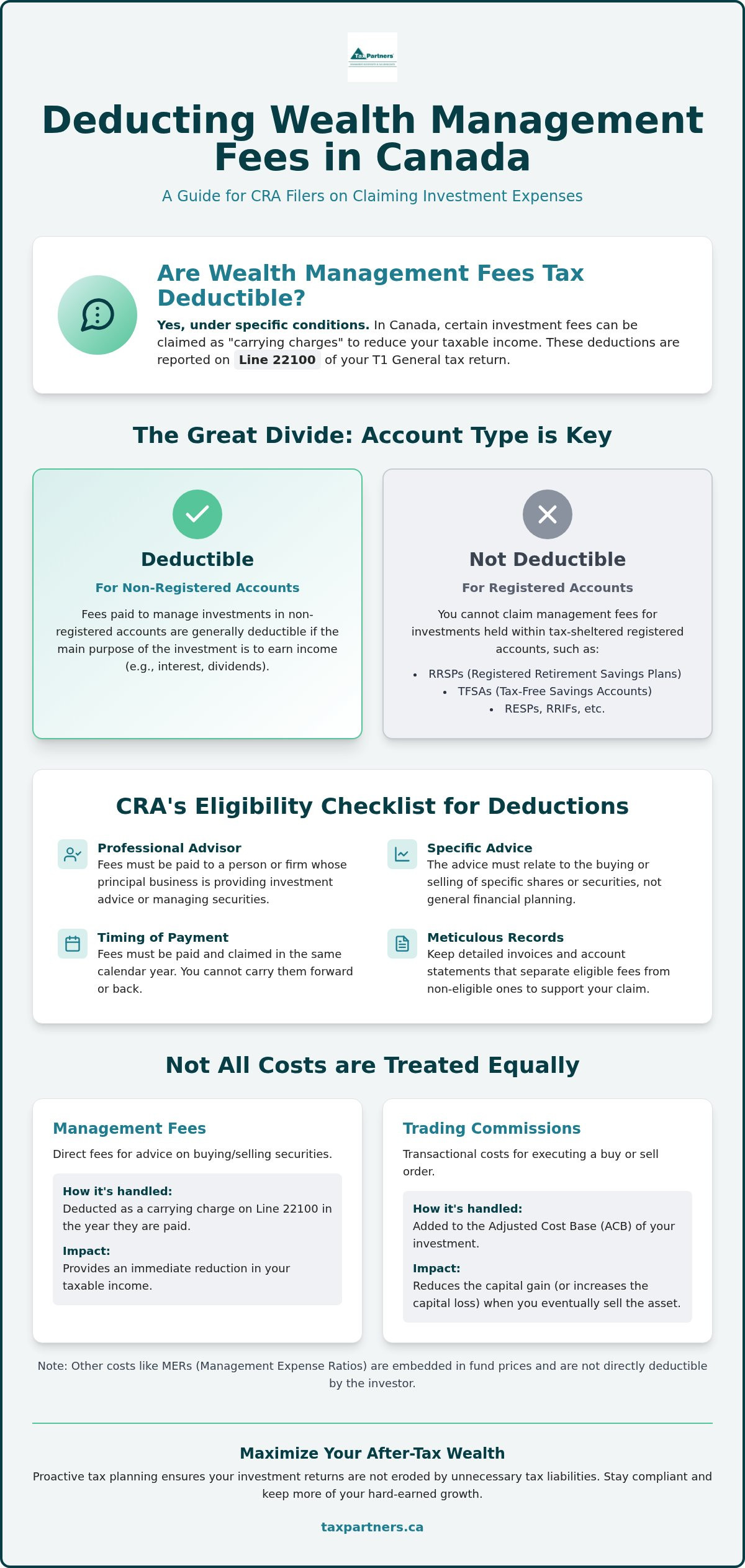
The Canada Revenue Agency (CRA) provides specific avenues for investors to recover some of their costs through tax deductions. If you're asking, are wealth management fees tax deductible in Canada, the answer begins with the category of carrying charges. These expenses represent the costs you incur to earn income from your investments.
You claim these on Line 22100 of your T1 General tax return, which directly reduces your Taxable Income in Canada. This reduction happens at your marginal tax rate, meaning the deduction is most effective for those in higher tax brackets. It's a proactive way to ensure your management costs don't unnecessarily erode your portfolio's performance.
The CRA allows you to deduct fees paid to manage or administer your investments, provided those assets are held in non-registered accounts. To qualify, the primary objective of your investment must be to earn income, such as interest or dividends. We help you determine if are wealth management fees tax deductible in Canada for your specific investment portfolio by looking at the income-producing potential of each asset.
The Purpose of Line 22100
Line 22100 serves as the designated area for filers to report interest expenses and carrying charges. Every dollar you successfully claim here lowers your total taxable income, which can lead to significant savings. This deduction is especially powerful because it applies against your income before your final tax is calculated.
You must maintain meticulous records, including detailed invoices and account statements, to support these claims during a potential CRA review. The CRA often scrutinizes carrying charges to ensure they aren't being claimed for registered accounts like TFSAs or RRSPs. Keeping clear, separate records for each account type is the best way to survive a review without stress.
At Tax Partners, we act as a proactive guardian to help you organize these documents long before the filing deadline. Our experience helps ensure that every eligible expense is captured while maintaining total compliance with current regulations. We turn a complex administrative requirement into a seamless part of your wealth preservation strategy.
Technical Terms: Carrying Charges Explained
Carrying charges encompass the ongoing costs required to own and manage your securities effectively. This category specifically includes wealth management fees paid to professionals who provide advice on the advisability of buying or selling specific shares. You should not confuse these with trading commissions, which are transactional costs.
Commissions are added to the adjusted cost base (ACB) of your investment, which reduces your capital gain when you eventually sell the asset. In contrast, management fees are deducted in the year they are paid. Proper categorization ensures you receive the tax benefit immediately rather than waiting years for a sale.
Carrying charges are the annual professional fees and interest expenses paid to earn income from taxable investment accounts.
CRA Criteria for Deducting Wealth Management Fees
The Canada Revenue Agency (CRA) maintains rigorous standards for what qualifies as a deductible expense. To determine if are wealth management fees tax deductible in Canada for your specific situation, you must evaluate the provider and the nature of the advice given. The CRA requires that fees be paid to a person or entity whose principal business is providing investment advice or managing securities.
Use this checklist to verify your eligibility for CRA filers:
- The fee was paid to a professional advisor or management firm.
- The advice specifically related to the buying or selling of shares or securities.
- You paid the fees in the same calendar year you're claiming them.
- The investments are held in a non-registered account.
These CRA guidelines on deducting investment fees ensure that only direct costs for wealth production are subsidized through tax relief. If your advisor provides a mix of services, only the portion dedicated to security management is typically eligible. Our team acts as a proactive guardian to help you separate these costs and maximize your return.
The Role of the Investment Advisor
Your advisor must be in the business of managing or administering securities to satisfy CRA requirements. Fees paid for general financial planning, such as retirement projections or estate mapping, often fall outside this scope. While these services are valuable, they don't always relate directly to the "advisability of purchasing or selling" specific securities.
We recommend asking your advisor for a "fee for service" breakdown on your annual statement. This document should clearly separate security management from general planning or insurance advice. Having this level of detail ready is a proactive way to protect your return during a review. If you're unsure how to interpret your current fee structure, you can speak with our tax specialists for a professional review.
What Makes a Fee Reasonable?
The CRA expects all claimed expenses to be "reasonable," which usually means they align with current industry standards. If your fees are significantly higher than the typical market rate for assets under management, it could trigger an audit. Most professional wealth management firms charge percentage-based fees that the CRA considers standard and acceptable.
You can also typically deduct the GST, HST, or QST you paid on these eligible management fees. This often-overlooked detail adds another layer of savings to your wealth preservation strategy. Ensuring these taxes are included in your Line 22100 claim is a simple way to maximize your total deduction.
When asking are wealth management fees tax deductible in Canada, remember that timing is everything. You cannot claim fees that were billed but remain unpaid at the end of the year. Always ensure your payments are processed before December 31 to secure the deduction for that tax year.
Registered vs. Non-Registered Accounts: The Great Divide
The distinction between account types represents the most significant hurdle for investors trying to minimize their tax burden. When asking are wealth management fees tax deductible in Canada, you must first look at where your assets are held. The CRA maintains a strict wall between registered plans and taxable accounts.
Only fees associated with non-registered (taxable) investment accounts are eligible for deduction. These accounts don't enjoy the built-in tax shielding of their registered counterparts, so the CRA allows carrying charges to offset the income they generate. This creates a clear strategic advantage for investors with substantial taxable portfolios.
Conversely, fees paid for the management of RRSPs, TFSAs, RRIFs, and FHSAs are not tax-deductible for CRA filers. The tax-sheltered nature of these accounts is the primary reason for this exclusion. The government views the tax-free growth or tax-deferred status as a sufficient benefit, which negates the need for additional fee deductions.
The Registered Account Restriction
The CRA views registered accounts as already providing a substantial tax subsidy to the taxpayer. Because you don't pay tax on the annual growth within a TFSA or RRSP, you can't claim the costs of managing that growth. Attempting to claim these fees is a common error that can lead to reassessments and interest charges.
One dangerous tax trap involves paying fees for a non-registered account using funds withdrawn from a registered plan. This action triggers a taxable withdrawal, permanently burns your contribution room, and often results in a higher tax bill than the deduction is worth. For a truly integrated approach to your portfolio, visit our Wealth Management & Financial Planning page to see how we structure fee payments for maximum efficiency.
Optimizing Your Fee Payments
You should always ensure your wealth management firm provides a clear breakdown of fees between registered and non-registered assets. Keeping these costs separate for accounting purposes is vital for clean tax reporting. We suggest paying your non-registered fees from your taxable cash flow to preserve the integrity of your registered savings.
Investors often realize a better after-tax return by focusing their deductions on their non-registered portfolios where the relief is most immediate. Our team at Tax Partners can help audit your fee statements to ensure you're only claiming what is permissible. We act as your proactive guardian, looking ahead to prevent errors before they reach your tax return.
Identifying Non-Deductible Costs and Carrying Charges
Understanding what you cannot claim is just as vital as knowing what you can. When asking are wealth management fees tax deductible in Canada, you must look beyond the surface of your portfolio statements to find embedded costs. The CRA maintains strict boundaries around which expenses qualify as carrying charges and which do not.
Management Expense Ratios (MERs) represent one of the most common non-deductible costs for Canadian investors. These fees are subtracted from a mutual fund's or ETF's return before the profit is distributed to you. Because they are never paid directly out of pocket as a separate line item, they cannot be claimed on Line 22100.
Trading commissions also fall into the non-deductible category for CRA filers. Instead of an immediate deduction, these costs are added to the Adjusted Cost Base (ACB) of the security. The ACB represents the total cost of an investment, including the purchase price and any commissions paid to acquire or sell it; this eventually reduces your taxable capital gain upon sale.
The MER vs. Fee-Based Model
Transparency is the primary advantage of a fee-based management model. In these arrangements, the management fee is billed as a separate transaction rather than being hidden within the fund's performance. This separation often allows the fee to be fully deductible in non-registered accounts, unlike the opaque, "pre-tax" nature of MERs.
You should also be aware that interest on money borrowed to contribute to an RRSP, TFSA, or FHSA is not deductible. The CRA views these registered plans as already providing significant tax relief, so they don't allow the interest on contribution loans to be written off. This rule applies even if the investments within the registered account are high-yield securities.
Borrowing to Invest
Interest on loans used to purchase investments in taxable accounts is generally deductible, a concept often utilized in strategies like the Smith Manoeuvre. To qualify, the investment must have a reasonable expectation of profit, such as stocks that pay dividends or bonds that pay interest. If the asset only has the potential for capital gains, the interest expense may be denied by the CRA.
Legal fees also require careful scrutiny before you attempt to claim them. Only legal costs specifically incurred to earn investment income are eligible for deduction. Fees for general estate planning or personal legal matters are strictly non-deductible and could trigger an audit if included on your return. For a proactive review of your portfolio's tax efficiency, you can contact us today to ensure every claim is compliant.
We invite you to explore our comprehensive guide on tax-efficient wealth management for CRA filers to further optimize your strategy. Our team acts as a proactive guardian, ensuring your investment structure aligns with the latest regulatory requirements. We focus on securing a better outcome for your long-term wealth preservation.
Maximizing After-Tax Wealth with Tax Partners
Navigating the intersection of investment growth and tax compliance requires more than just reactive filing. If you're still wondering are wealth management fees tax deductible in Canada for your unique portfolio, you need a partner who sees the full picture. Our team at Tax Partners acts as a proactive guardian, ensuring that your wealth management strategy is fully aligned with CRA requirements to protect your bottom line.
We provide a sophisticated blend of professional authority and approachable warmth to alleviate the stress of complex financial matters. By integrating tax preparation with long-term wealth preservation, we help you realize the full potential of your investment deductions. This methodical approach moves you quickly from a state of uncertainty toward a feeling of total control over your financial future.
Why a CPA-Led Wealth Strategy Matters
We believe in looking ahead to secure better outcomes rather than simply reacting to tax deadlines. With experience managing over 495,000 returns for Canadian taxpayers, we understand the nuances that generic software or inexperienced filers often miss. This deep-seated reliability allows us to integrate your tax preparation with long-term wealth preservation strategies seamlessly.
Our firm provides a bespoke service that focuses on precision and foresight for every client. We don't just fill out forms; we act as a seasoned mentor invested in your long-term success. You can Contact Us for a personalized consultation to see how we can optimize your specific situation and capture every eligible deduction.
Ensuring Audit Readiness
The CRA frequently reviews claims on Line 22100, making professional record organization a necessity rather than a luxury. We meticulously review your investment statements to ensure every carrying charge is documented and defensible under current regulations. This proactive approach provides a clear path to resolution if you feel overwhelmed by the technicalities of are wealth management fees tax deductible in Canada.
Our mission is to provide a steady hand at the helm of your financial health, combining decades of institutional wisdom with a modern outlook. We ensure your records are audit-ready long before the CRA ever asks a question. You can learn more about our commitment to ethical steadfastness and transparency on our About Us page.
Choosing a professional firm to manage your tax strategy ensures that no detail is overlooked in your wealth preservation journey. We pride ourselves on being an accessible expert, providing the reassurance you need to invest with confidence. Let us help you navigate the complexities of the Canadian tax system with integrity and personalized care.
Secure Your Financial Future Through Strategic Tax Planning
Mastering the nuances of Line 22100 ensures you don't lose your investment gains to avoidable tax liabilities. You now understand that while registered accounts offer growth shielding, only non-registered portfolios provide the opportunity to recover management costs. Distinguishing between deductible advice and embedded fees like MERs is the final step in protecting your portfolio.
If you're still questioning exactly are wealth management fees tax deductible in Canada for your specific holdings, professional guidance is your best defence. Our firm acts as a proactive guardian, leveraging 40+ years of Canadian tax and accounting expertise to secure the best outcomes for our clients. We combine this institutional wisdom with a modern approach to proactive wealth preservation and estate planning.
With over 1,390 five-star Google reviews, we've built a reputation for deep-seated reliability and personalized care. Maximize your investment deductions with a professional tax review from Tax Partners. We're here to provide the steady hand you need to navigate CRA regulations with total confidence.
Frequently Asked Questions
Are financial advisor fees tax deductible in Canada for RRSPs?
Financial advisor fees for RRSPs are not tax deductible in Canada. The CRA specifically excludes these because the account already provides tax-deferred growth. This restriction applies even if the fees are paid from a taxable account outside the plan. You should ensure your management firm bills these accounts separately to avoid accidental claims on your tax return.
Can I deduct the interest on a loan used to buy stocks?
You can typically deduct interest on money borrowed to buy stocks for CRA filers. The primary condition is that the investments must have the potential to earn income, such as dividends or interest. If you invest solely in securities that only produce capital gains, the interest expense is generally not deductible. It's a strategic way to leverage your portfolio while reducing your overall taxable income.
What is the difference between a commission and a management fee for taxes?
A management fee is an ongoing cost for professional advice, while a commission is a one-time transaction charge for buying or selling. Management fees are claimed as carrying charges on Line 22100 in the year they are paid. Commissions are instead added to the Adjusted Cost Base (ACB) of your investment. This eventually reduces your taxable capital gain when you decide to sell the asset.
Are safety deposit box fees still deductible in Canada?
Safety deposit box fees are no longer tax deductible in Canada. The federal government removed this deduction several years ago for all CRA filers. Previously, investors used this claim for the cost of storing stock certificates or other important financial documents. Today, these costs are considered personal expenses and cannot be used to offset your investment income or reduce your tax bill.
How do I claim investment fees on my T1 tax return?
To claim these expenses, you must enter the total amount of eligible carrying charges on Line 22100 of your T1 return. This is where you report wealth management fees for non-registered accounts and interest on investment loans. You don't need to submit your receipts with your filing. However, you must keep all invoices and statements for at least six years in case of a review.
Are accounting fees for tax preparation deductible for individuals?
Accounting fees for personal tax preparation are generally not deductible for individuals with only employment income. However, the CRA allows deductions for fees paid for advice on earning investment income or for preparing returns with business or property income. If you're asking are wealth management fees tax deductible in Canada, it's worth checking if your tax preparation costs also qualify under these specific professional advice rules.
Can I deduct fees paid for a Tax-Free Savings Account (TFSA)?
Fees paid for a Tax-Free Savings Account (TFSA) are not deductible under CRA rules. Since the income and gains earned within a TFSA are not taxable, the expenses incurred to earn that income are also not eligible for tax relief. The same logic applies to other tax-free or tax-sheltered accounts. It's most efficient to pay these fees directly from the TFSA to preserve your outside taxable cash.
What happens if the CRA audits my investment fee deductions?
If the CRA audits your investment fee deductions, they will likely ask for detailed statements that separate registered and non-registered costs. They want to ensure are wealth management fees tax deductible in Canada only for your taxable accounts. Having a CPA firm manage your filings ensures your records are organized and defensible. This proactive approach provides a steady hand at the helm during any regulatory inquiry or review.

Article by
Mahad Mohamed
Mahad Mohamed is an accountant and the CEO of Tax Partners, with over 26+ years of Canadian and international tax and accounting experience. His expertise includes corporate reorganization, cross-border tax structuring (Canada & US), tax disputes, CRA audits, and tax planning for small owner-managed private corporations. Most recently, Mahad is a pioneer in Canadian crypto taxation and founded Block3 Finance.
Previously, Mahad worked for the Canada Revenue Agency (CRA), Big4 accounting firms, and served as a Rulings Officer for the Federal Tax Authority of the UAE before acquiring Tax Partners in 2014.
Tax Partners has 44 full-time accountants and over 18,400+ clients.
Disclaimer
This article provides general information only and is current as of its publication date. It has not been updated and may be out of date. It does not constitute legal advice and should not be relied upon as such. Every tax situation is unique and may differ from the examples discussed in this article. If you have specific questions, you should seek the advice of our accountants for your unique circumstances. Book a FREE Initial Consultation Today!
Frequently Asked Questions
What Makes a Fee Reasonable?
The CRA expects all claimed expenses to be "reasonable," which usually means they align with current industry standards. If your fees are significantly higher than the typical market rate for assets under management, it could trigger an audit. Most professional wealth management firms charge percentage-based fees that the CRA considers standard and acceptable. You can also typically deduct the GST, HST, or QST you paid on these eligible management fees. This often-overlooked detail adds another layer of savings to your wealth preservation strategy. Ensuring these taxes are included in your Line 22100 claim is a simple way to maximize your total deduction. When asking are wealth management fees tax deductible in Canada, remember that timing is everything. You cannot claim fees that were billed but remain unpaid at the end of the year. Always ensure your payments are processed before December 31 to secure the deduction for that tax year. The distinction between account types represents the most significant hurdle for investors trying to minimize their tax burden. When asking are wealth management fees tax deductible in Canada, you must first look at where your assets are held. The CRA maintains a strict wall between registered plans and taxable accounts. Only fees associated with non-registered (taxable) investment accounts are eligible for deduction. These accounts don't enjoy the built-in tax shielding of their registered counterparts, so the CRA allows carrying charges to offset the income they generate. This creates a clear strategic advantage for investors with substantial taxable portfolios. Conversely, fees paid for the management of RRSPs, TFSAs, RRIFs, and FHSAs are not tax-deductible for CRA filers. The tax-sheltered nature of these accounts is the primary reason for this exclusion. The government views the tax-free growth or tax-deferred status as a sufficient benefit, which negates the need for additional fee deductions.
Are financial advisor fees tax deductible in Canada for RRSPs?
Financial advisor fees for RRSPs are not tax deductible in Canada. The CRA specifically excludes these because the account already provides tax-deferred growth. This restriction applies even if the fees are paid from a taxable account outside the plan. You should ensure your management firm bills these accounts separately to avoid accidental claims on your tax return.
Can I deduct the interest on a loan used to buy stocks?
You can typically deduct interest on money borrowed to buy stocks for CRA filers. The primary condition is that the investments must have the potential to earn income, such as dividends or interest. If you invest solely in securities that only produce capital gains, the interest expense is generally not deductible. It's a strategic way to leverage your portfolio while reducing your overall taxable income.
What is the difference between a commission and a management fee for taxes?
A management fee is an ongoing cost for professional advice, while a commission is a one-time transaction charge for buying or selling. Management fees are claimed as carrying charges on Line 22100 in the year they are paid. Commissions are instead added to the Adjusted Cost Base (ACB) of your investment. This eventually reduces your taxable capital gain when you decide to sell the asset.
Are safety deposit box fees still deductible in Canada?
Safety deposit box fees are no longer tax deductible in Canada. The federal government removed this deduction several years ago for all CRA filers. Previously, investors used this claim for the cost of storing stock certificates or other important financial documents. Today, these costs are considered personal expenses and cannot be used to offset your investment income or reduce your tax bill.
How do I claim investment fees on my T1 tax return?
To claim these expenses, you must enter the total amount of eligible carrying charges on Line 22100 of your T1 return. This is where you report wealth management fees for non-registered accounts and interest on investment loans. You don't need to submit your receipts with your filing. However, you must keep all invoices and statements for at least six years in case of a review.
Are accounting fees for tax preparation deductible for individuals?
Accounting fees for personal tax preparation are generally not deductible for individuals with only employment income. However, the CRA allows deductions for fees paid for advice on earning investment income or for preparing returns with business or property income. If you're asking are wealth management fees tax deductible in Canada, it's worth checking if your tax preparation costs also qualify under these specific professional advice rules.
Can I deduct fees paid for a Tax-Free Savings Account (TFSA)?
Fees paid for a Tax-Free Savings Account (TFSA) are not deductible under CRA rules. Since the income and gains earned within a TFSA are not taxable, the expenses incurred to earn that income are also not eligible for tax relief. The same logic applies to other tax-free or tax-sheltered accounts. It's most efficient to pay these fees directly from the TFSA to preserve your outside taxable cash.
What happens if the CRA audits my investment fee deductions?
If the CRA audits your investment fee deductions, they will likely ask for detailed statements that separate registered and non-registered costs. They want to ensure are wealth management fees tax deductible in Canada only for your taxable accounts. Having a CPA firm manage your filings ensures your records are organized and defensible. This proactive approach provides a steady hand at the helm during any regulatory inquiry or review.