Accounting Services for Consultants in Canada: 2026 Guide

What if your most productive billable hour this year wasn't spent on a client project, but on restructuring how you pay yourself? Many Canadian professionals find that specialized accounting services for consultants Canada are the missing link between working hard and actually building lasting wealth. It's common to feel a sense of unease when personal and business expenses start to blur, especially as the Canada Revenue Agency (CRA) moves toward a fully digital tax system.
We understand that the complexity of GST/HST filings and the uncertainty of when to incorporate can create significant mental clutter. This 2026 guide shows you how to transform those administrative burdens into a streamlined engine for growth. You'll discover how to legally minimize your tax liabilities while building a robust, audit-ready framework that secures your professional future.
We'll explore the 2026 federal tax rate changes and the strategic benefits of forming a Canadian-Controlled Private Corporation (CCPC), which is a private company eligible for lower tax rates. This guide covers everything from managing the new Canada Groceries and Essentials Benefit to mastering compliance in a digital-first economy. You'll gain a clear roadmap for scaling your consultancy with the confidence that your financial foundation is rock solid.
Key Takeaways
- Understand how specialized accounting services for consultants Canada go beyond simple bookkeeping to offer proactive advisory that safeguards your professional wealth.
- Establish clear financial boundaries by organizing separate accounts to keep your business records clean and ready for potential CRA reviews.
- Evaluate the strategic advantages of incorporation, including the Small Business Deduction, to decide which structure best supports your growth in 2026.
- Master the nuances of GST/HST compliance and deductible expenses to ensure you maximize your returns while following CRA guidelines.
- Learn to bridge the gap between business profitability and personal financial security through integrated wealth-management strategies.
Why Consultants Require Specialized Accounting Services
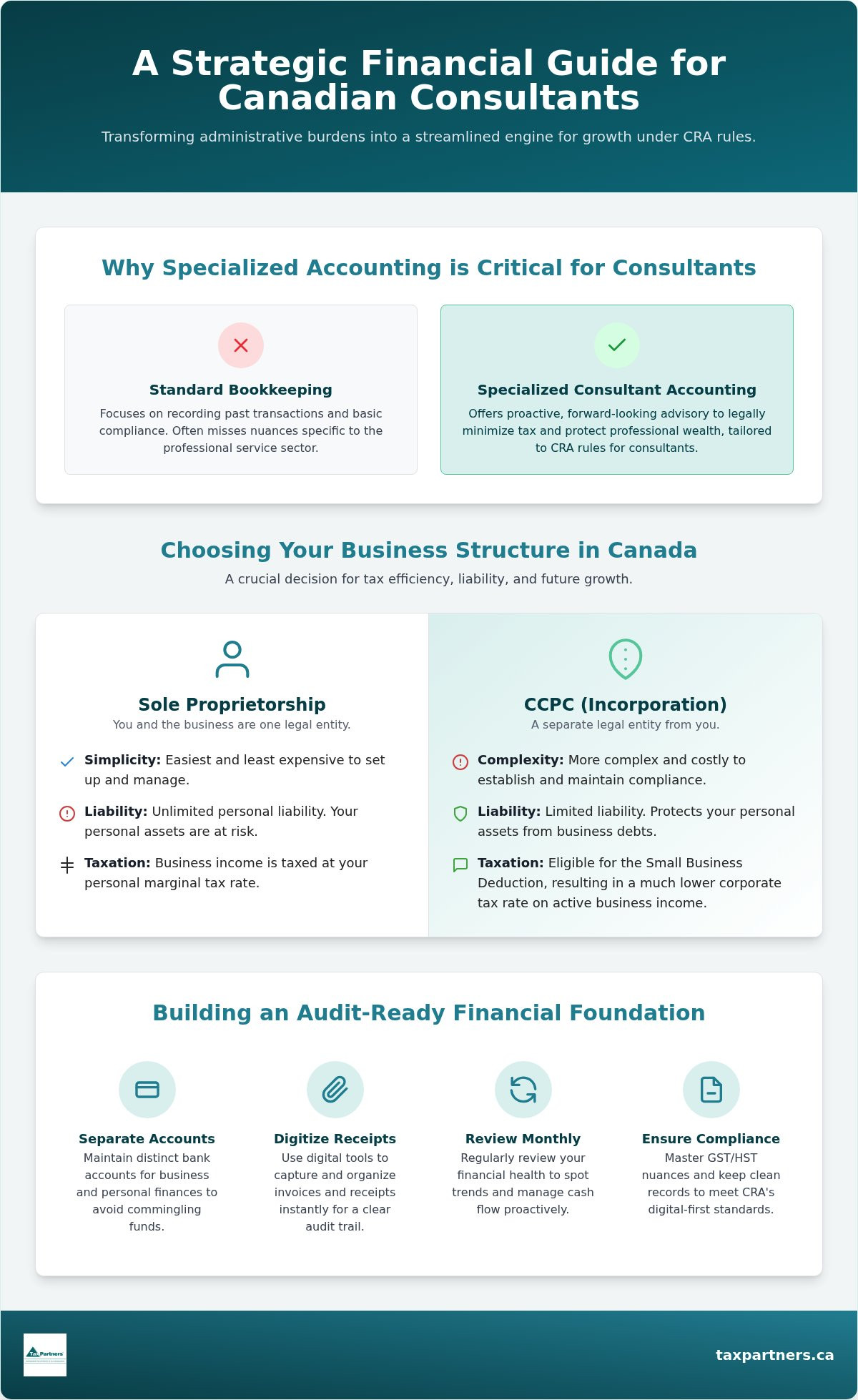
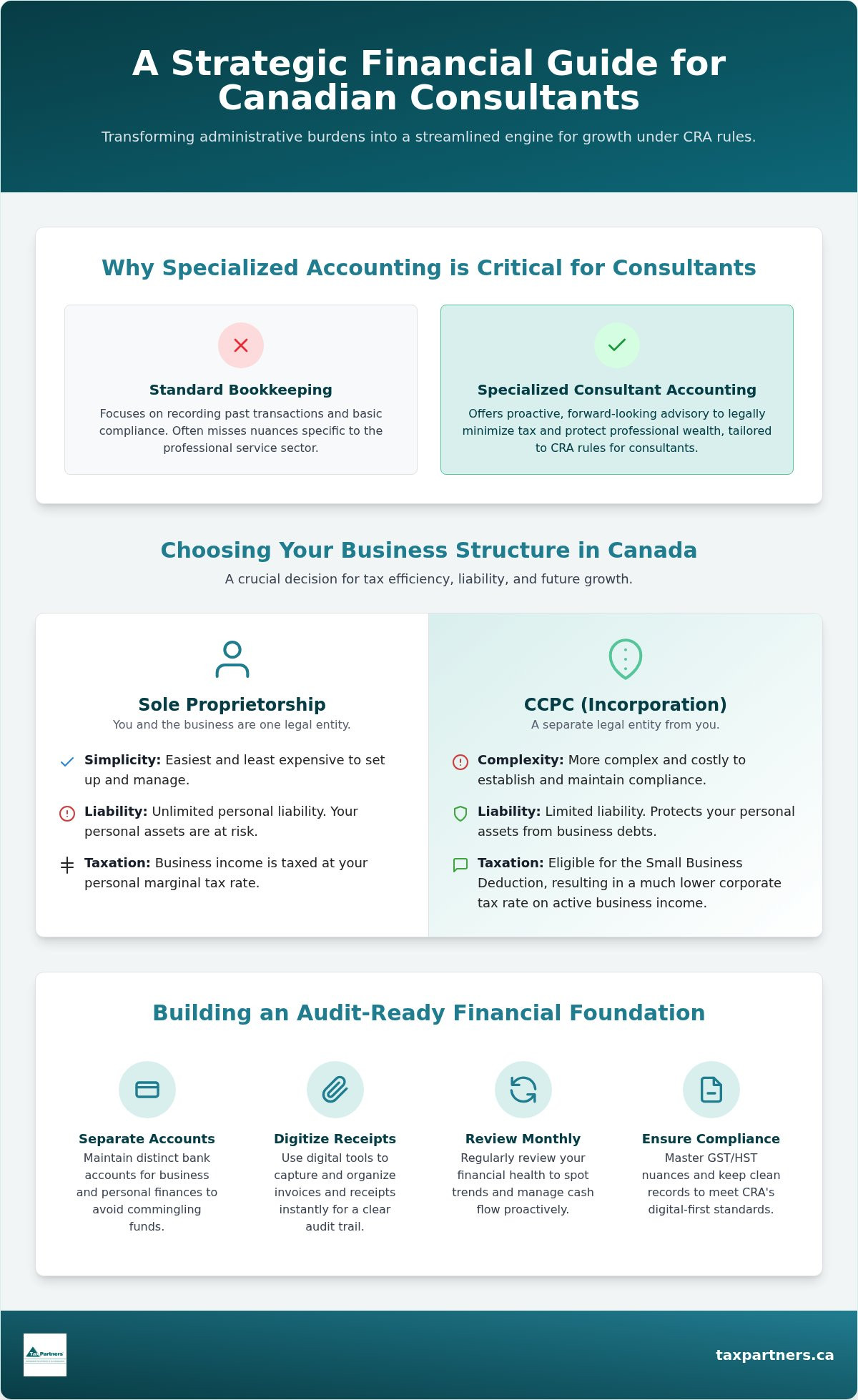
Accounting services for consultants Canada represent more than just a ledger of income and expenses. It's a sophisticated blend of strict regulatory compliance and high-level strategic advisory designed to protect your professional wealth. While a general bookkeeper focuses on recording past transactions, a specialized professional accountant looks forward to identify tax-saving opportunities unique to the service sector.
Standard retail accounting often misses the nuances of a consultant's business model. This includes complex travel deductions, home office allocations, or the specific timing of revenue recognition under CRA rules. Establishing a dedicated business entity isn't just about paperwork; it's a critical move for professional liability protection and long-term tax efficiency. Professionals who leverage specialized accounting gain a mentor who understands the intricacies of their specific industry.
Working with a firm that understands the Canadian tax system ensures you aren't just following the rules, but using them to your advantage. You need a partner who can distinguish between simple record-keeping and the strategic preservation of capital. This distinction often determines whether a consultancy merely survives or truly thrives as the market grows.
Navigating CRA Compliance for Professionals
The Canada Revenue Agency (CRA) serves as the primary regulator for professional income across the country. For CRA filers, compliance means much more than just paying taxes on time. It involves a precise adherence to reporting standards and filing deadlines for personal and corporate returns. Professional oversight acts as a proactive shield for your business, significantly reducing the risk of costly assessments or penalties.
By maintaining audit-ready records throughout the year, you project a sense of stability and ethical steadfastness to regulatory bodies. This is particularly important as the government's Digital Ambition 2026 initiative pushes more federal services online. Having a professional guardian ensures your digital record-keeping meets the highest standards of accuracy and transparency.
To complement professional accounting, many firms look to reisinformatica.com for the digital tools and infrastructure required to maintain these high standards in an increasingly online regulatory environment.
The Value of Proactive Financial Oversight
Accessing real-time financial data allows you to make informed decisions about scaling your operations. This is especially vital for cash flow management, which is the process of tracking and optimizing the timing of money entering and leaving your business. Many consultants face irregular income cycles, making it essential to have a clear view of liquidity at all times. In 2026, the demand for high-quality accounting services for consultants Canada has shifted toward this type of strategic wealth preservation.
Moving away from reactive filing allows you to focus on your core expertise. You can stop worrying about the "what-ifs" of tax season and start looking ahead to secure a better outcome. This proactive stance is the hallmark of a mature, well-managed consulting practice in a competitive landscape.
To further enhance this competitive edge, many mid-size firms integrate specialized business advisory and fractional executive services from Carter Strategies to drive their long-term growth and revenue goals.
Essential Bookkeeping and Financial Reporting for Consultants
A robust bookkeeping system acts as the heartbeat of any successful consulting practice. Implementing professional accounting services for consultants Canada ensures that every transaction is tracked with precision from the moment it occurs. One of the most critical steps you can take is maintaining strictly separate bank accounts for your business and personal finances to avoid the commingling of funds.
Commingling creates unnecessary complexity during tax season and can raise significant red flags for CRA filers. By utilizing modern digital tools to capture receipts and organize invoices immediately, you build a transparent and verifiable trail of deductible business expenses. Reviewing your financial health on a monthly basis allows you to spot trends or cash flow gaps before they become significant hurdles.
Clean records provide the peace of mind that comes from knowing your firm is audit-ready at any time. This disciplined approach to financial reporting doesn't just satisfy regulatory requirements; it empowers you to lead with confidence. When your books are in order, you can focus entirely on delivering value to your clients.
Organizing Your Professional Records
Effective record-keeping doesn't have to be overwhelming if you follow a methodical workflow. You can establish a clear system by following a five-step process: capture every receipt digitally, categorize expenses by their specific type, reconcile bank statements monthly, review for accuracy, and archive files securely. Digital record-keeping is now the preferred standard for the CRA, as it ensures data integrity and provides a clear audit trail.
In Canada, you're generally required to retain your business records for six years from the end of the last tax year they relate to. This requirement includes all supporting documents such as invoices, receipts, and bank statements. If you're feeling unsure about whether your current filing system meets these standards, reaching out for professional guidance can provide the clarity you need to remain compliant.
Understanding Financial Statements
Your financial statements are more than just a year-end requirement; they're a diagnostic tool for your business. The Income Statement, often called a Profit and Loss statement, tracks your revenue and expenses over a specific period to reveal your net profit. This report is essential for understanding which client projects are truly profitable and where you might need to adjust your pricing or expenses.
The Balance Sheet provides a snapshot of your professional assets and liabilities at a single point in time. It shows exactly what your business owns versus what it owes, which is vital for long-term wealth preservation. Lenders and creditors rely heavily on these reports to assess your creditworthiness when you apply for business financing or credit. Mastering these documents gives you total control over your consultancy's financial trajectory.
Comparing Tax Structures: Incorporation vs. Sole Proprietorship
Deciding on the right business structure is one of the most impactful choices you'll make for your practice. Many professionals initially start as sole proprietors but soon realize that specialized accounting services for consultants Canada can unlock significant advantages through incorporation. This transition is less about the immediate paperwork and more about how you intend to manage and protect your future wealth.
When evaluating a sole proprietorship vs. corporation, you must consider both your current income and your long-term growth goals. In 2026, the Canadian federal personal tax rate reaches 33% for income over $258,482 under CRA rules, which can significantly impact your ability to reinvest in your business. High-earning consultants often find themselves pushed into these top brackets, making the corporate alternative increasingly attractive.
Incorporation offers a strategic alternative by allowing you to separate your personal and professional finances completely. This structure provides a clear framework for tax deferral, as you only pay personal income tax on the funds you withdraw from the company. If you don't need your entire income to cover personal living expenses, the remaining capital can stay within the corporation to be reinvested or saved at a lower corporate rate.
The Sole Proprietorship Model
For CRA filers, the sole proprietorship is the most straightforward way to operate. You report your business income and expenses using form T2125 as part of your personal T1 tax return under Canadian rules. While this avoids the costs associated with setting up a separate legal entity, it means you're personally liable for all business obligations. As your consultancy grows, the lack of liability protection and the impact of rising personal tax brackets often make this model less efficient for wealth preservation.
The Corporate Advantage for Consultants
Transitioning to a Canadian corporation introduces several sophisticated tax-planning opportunities. As a Canadian-Controlled Private Corporation (CCPC), which is a specific type of private company, you may qualify for the Small Business Deduction. This Canadian tax rule reduces the federal corporate tax rate to 9% on the first $500,000 of active business income for eligible CCPCs.
Operating as a corporation also gives you the flexibility to pay yourself through a combination of salary and dividends. While a salary is a deductible expense for the corporation and requires Canada Pension Plan (CPP) contributions under federal law, dividends are paid from after-tax profits and may offer a different tax profile. Managing these options requires a T2 corporate tax return filed with the CRA and careful adherence to corporate compliance, but the potential for significant tax savings often outweighs the additional administrative costs.
Maximizing Deductible Expenses and GST/HST Compliance
Optimizing your tax position requires a deep understanding of what the Canada Revenue Agency (CRA) considers a legitimate business cost. Utilizing professional accounting services for consultants Canada helps you identify every available deduction while ensuring your claims meet the "reasonable expectation of profit" standard. This Canadian tax rule means your business must be operated in a sufficiently commercial manner to justify the expenses you're reporting.
Failing to document your expenses properly is a common pitfall that can lead to denied claims during a regulatory review. By working with a seasoned mentor, you can establish a proactive system for tracking costs that directly contribute to your consultancy's revenue. This precision protects your wealth and ensures you aren't leaving money on the table when filing your Canadian tax return.
Common Professional Deductions for Consultants
Consultants can often deduct a wide range of costs associated with their professional activities under CRA guidelines. These typically include travel expenses for client meetings, professional development courses, software subscriptions, and fees paid for legal or accounting advice. Each of these must be directly related to earning your business income to be eligible for a deduction in Canada.
The Home Office Deduction is particularly valuable for independent professionals who work from a dedicated space in their residence. You calculate this business-use portion by determining the square footage of your office relative to the total finished area of your home. You must maintain detailed records of your utilities, rent or mortgage interest, and insurance to support these claims during a potential CRA review.
Navigating Sales Tax Requirements
In Canada, you must register for a GST/HST account once your worldwide taxable revenue exceeds $30,000 within a single calendar quarter or over four consecutive quarters under CRA rules. Until you reach this $30,000 threshold, you're considered a "small supplier" and aren't required to collect or remit sales tax. However, many consultants choose to register voluntarily to claim Input Tax Credits (ITCs), which are credits that allow businesses to recover the GST/HST they pay on business-related purchases.
The Quick Method of Accounting is a simplified way to calculate your sales tax remittance that can often save you both time and money. Instead of tracking every individual ITC, you remit a set percentage of your GST/HST-inclusive sales to the CRA. If you're looking to streamline your reporting, our GST/HST filing services can help you determine if this method is right for your practice.
Ensuring your sales tax filings are accurate and timely is a cornerstone of professional reliability for Canadian consultants. If you have questions about your specific registration requirements or deduction eligibility, book a consultation with our tax experts today to secure your financial standing.
Strategic Wealth Management and Professional Support
Professional success isn't just about annual revenue; it's about converting that income into lasting security. Specialized accounting services for consultants Canada create a bridge between your business profits and your personal financial independence. Your accountant acts as a proactive guardian, ensuring your corporate structure serves your life goals under CRA rules.
This partnership looks beyond the current tax year to anticipate future milestones like retirement or a potential business exit. Aligning your business accounting with your personal trajectory creates a seamless path for wealth accumulation. A seasoned mentor helps you transition from an active earner to a strategic investor with precision and foresight.
Maintaining clean records also makes your consultancy much more attractive if you ever decide to sell the practice. A well-organized business with a clear history of compliance often commands a higher valuation. This long-term perspective distinguishes a simple service provider from a true professional partner who is invested in your outcome.
Wealth Preservation for Professionals
Effective wealth management and financial planning requires a synchronized view of your business and personal assets. If you've incorporated under Canadian rules, your corporate retained earnings can become a powerful vehicle for investment. This strategy allows you to grow capital within the lower corporate tax environment before eventually withdrawing it in a tax-efficient manner.
You might choose to maximize your Registered Retirement Savings Plan (RRSP), which is a tax-deferred account designed to help Canadians save for their later years. For 2026, the RRSP contribution limit is 18% of the previous year's income up to $33,810. You can also utilize the Tax-Free Savings Account (TFSA), a flexible arrangement where investment earnings and withdrawals are not taxed for Canadian residents, with a 2026 limit of $7,000.
Choosing the Right Accounting Partner
Finding the right firm involves more than finding someone to file your annual returns. You need a partner who understands the unique nuances of the consulting industry and is genuinely invested in your success. In addition to local tax compliance, firms like SD Mayer offer specialized Client Accounting Advisory Services (CAAS) that help you manage your business more efficiently, allowing you to focus on proactive growth rather than just reactive filing.
A firm that offers CRA audit help provides an essential layer of security for your peace of mind. This professional support ensures you can face any regulatory review with total control and understanding. Seek a long-term partnership that offers steady, reassuring guidance as your consultancy grows.
Secure Your Professional Legacy
Transitioning from a reactive tax strategy to a proactive wealth-building framework is the hallmark of a successful Canadian consultant. You have explored how choosing between a sole proprietorship and a corporation can fundamentally change your tax trajectory under CRA rules. By mastering GST/HST compliance and identifying every legitimate deduction, you protect the income you work so hard to earn.
Expert accounting services for consultants Canada provide more than just balance sheets; they offer a steady hand to guide your long-term growth. With over 40 years of Canadian tax expertise and 1,390 five-star Google reviews, our team serves as a proactive guardian for your professional future. We provide dedicated support for CRA compliance and audits so you can lead your practice with total peace of mind.
Don't let complex regulations hinder your progress or cause unnecessary anxiety. Contact Tax Partners for specialized accounting services for consultants and take the first step toward a more secure financial outcome. You've built a valuable practice, and we're here to help you protect it for years to come.
Frequently Asked Questions
Do I need to register for GST/HST as a consultant in Canada?
Registration becomes mandatory once your worldwide taxable revenue exceeds $30,000 within a single calendar quarter or over four consecutive quarters. Under CRA rules, you're then no longer considered a small supplier and must collect tax on your services. Many consultants choose to register voluntarily before reaching this threshold to claim Input Tax Credits on their business purchases.
What are the most common tax deductions for independent consultants?
Common deductions for CRA filers include professional development courses, software subscriptions, and travel costs incurred for client meetings. You can also claim professional association dues and fees paid for legal or accounting advice. These expenses must be reasonable and directly related to earning your business income to be eligible for deduction on your tax return.
Is it better to be a sole proprietor or incorporated as a consultant?
Incorporation is often the superior choice for high-earning consultants who don't require their entire income for personal living expenses. This structure provides access to the Small Business Deduction and allows for significant tax deferral under CRA rules. While a sole proprietorship is simpler to set up, it lacks professional liability protection and subjects all profit to personal tax brackets.
How much should I set aside for taxes as a freelancer or consultant?
You should generally set aside 25% to 30% of your gross income to cover personal income tax and Canada Pension Plan (CPP) contributions. As a self-employed professional, you're responsible for both the employer and employee portions of CPP. Specialized accounting services for consultants Canada can help you calculate more precise instalment payments based on your specific provincial tax rates.
Can I deduct my home office expenses if I work from home?
You can deduct a portion of your home expenses if your work space is your principal place of business or used exclusively for earning income. Under CRA rules, you calculate the deductible amount based on the square footage of your office relative to the total finished area of your home. This includes a proportional share of utilities, property taxes, and rent or mortgage interest.
What happens if the CRA decides to audit my consulting business?
The CRA will examine your financial records to ensure your reported income and expenses are accurate and supported by documentation. If you have professional accounting services for consultants Canada, your accountant can act as your representative to manage all communications with the agency. They ensure that the necessary receipts and ledgers are presented in a clear, organized manner to resolve the review efficiently.
How can a professional accountant help me save money on taxes?
An accountant identifies strategic opportunities such as the optimal mix of salary and dividends or the use of corporate retained earnings for investments. They ensure you're utilizing every available deduction while staying compliant with evolving CRA reporting standards. This proactive oversight prevents costly interest charges and penalties while minimizing your overall tax liability through legal optimization.
What records do I need to keep for my consulting business?
You must retain all supporting documents, including sales invoices, expense receipts, bank statements, and client contracts, for a period of six years. For CRA filers, digital records are perfectly acceptable as long as they are legible and easily accessible during a review. Maintaining a disciplined filing system is the best way to protect your business and verify your claims if questioned.

Article by
Mahad Mohamed
Mahad Mohamed is an accountant and the CEO of Tax Partners, with over 26+ years of Canadian and international tax and accounting experience. His expertise includes corporate reorganization, cross-border tax structuring (Canada & US), tax disputes, CRA audits, and tax planning for small owner-managed private corporations. Most recently, Mahad is a pioneer in Canadian crypto taxation and founded Block3 Finance.
Previously, Mahad worked for the Canada Revenue Agency (CRA), Big4 accounting firms, and served as a Rulings Officer for the Federal Tax Authority of the UAE before acquiring Tax Partners in 2014.
Tax Partners has 44 full-time accountants and over 18,400+ clients.
Disclaimer
This article provides general information only and is current as of its publication date. It has not been updated and may be out of date. It does not constitute legal advice and should not be relied upon as such. Every tax situation is unique and may differ from the examples discussed in this article. If you have specific questions, you should seek the advice of our accountants for your unique circumstances. Book a FREE Initial Consultation Today!
Frequently Asked Questions
Do I need to register for GST/HST as a consultant in Canada?
Registration becomes mandatory once your worldwide taxable revenue exceeds $30,000 within a single calendar quarter or over four consecutive quarters. Under CRA rules, you're then no longer considered a small supplier and must collect tax on your services. Many consultants choose to register voluntarily before reaching this threshold to claim Input Tax Credits on their business purchases.
What are the most common tax deductions for independent consultants?
Common deductions for CRA filers include professional development courses, software subscriptions, and travel costs incurred for client meetings. You can also claim professional association dues and fees paid for legal or accounting advice. These expenses must be reasonable and directly related to earning your business income to be eligible for deduction on your tax return.
Is it better to be a sole proprietor or incorporated as a consultant?
Incorporation is often the superior choice for high-earning consultants who don't require their entire income for personal living expenses. This structure provides access to the Small Business Deduction and allows for significant tax deferral under CRA rules. While a sole proprietorship is simpler to set up, it lacks professional liability protection and subjects all profit to personal tax brackets.
How much should I set aside for taxes as a freelancer or consultant?
You should generally set aside 25% to 30% of your gross income to cover personal income tax and Canada Pension Plan (CPP) contributions. As a self-employed professional, you're responsible for both the employer and employee portions of CPP. Specialized accounting services for consultants Canada can help you calculate more precise instalment payments based on your specific provincial tax rates.
Can I deduct my home office expenses if I work from home?
You can deduct a portion of your home expenses if your work space is your principal place of business or used exclusively for earning income. Under CRA rules, you calculate the deductible amount based on the square footage of your office relative to the total finished area of your home. This includes a proportional share of utilities, property taxes, and rent or mortgage interest.
What happens if the CRA decides to audit my consulting business?
The CRA will examine your financial records to ensure your reported income and expenses are accurate and supported by documentation. If you have professional accounting services for consultants Canada, your accountant can act as your representative to manage all communications with the agency. They ensure that the necessary receipts and ledgers are presented in a clear, organized manner to resolve the review efficiently.
How can a professional accountant help me save money on taxes?
An accountant identifies strategic opportunities such as the optimal mix of salary and dividends or the use of corporate retained earnings for investments. They ensure you're utilizing every available deduction while staying compliant with evolving CRA reporting standards. This proactive oversight prevents costly interest charges and penalties while minimizing your overall tax liability through legal optimization.
What records do I need to keep for my consulting business?
You must retain all supporting documents, including sales invoices, expense receipts, bank statements, and client contracts, for a period of six years. For CRA filers, digital records are perfectly acceptable as long as they are legible and easily accessible during a review. Maintaining a disciplined filing system is the best way to protect your business and verify your claims if questioned.