Which Tax Firm to Hire: A 2026 Guide for Canadian Filers

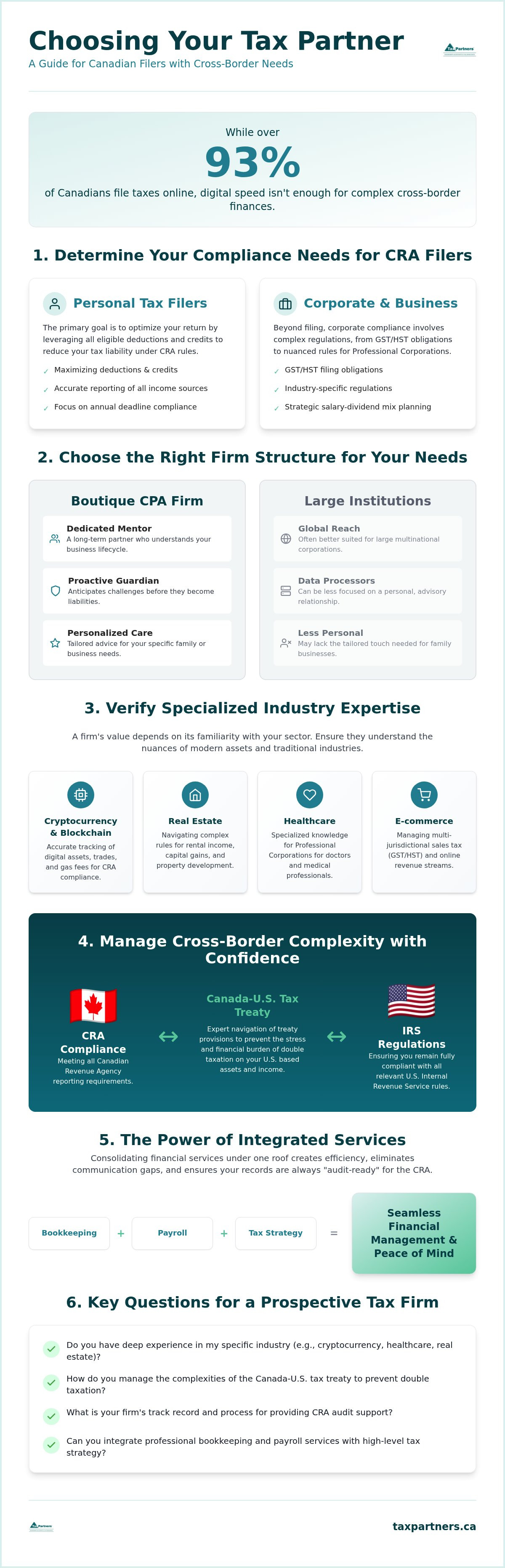
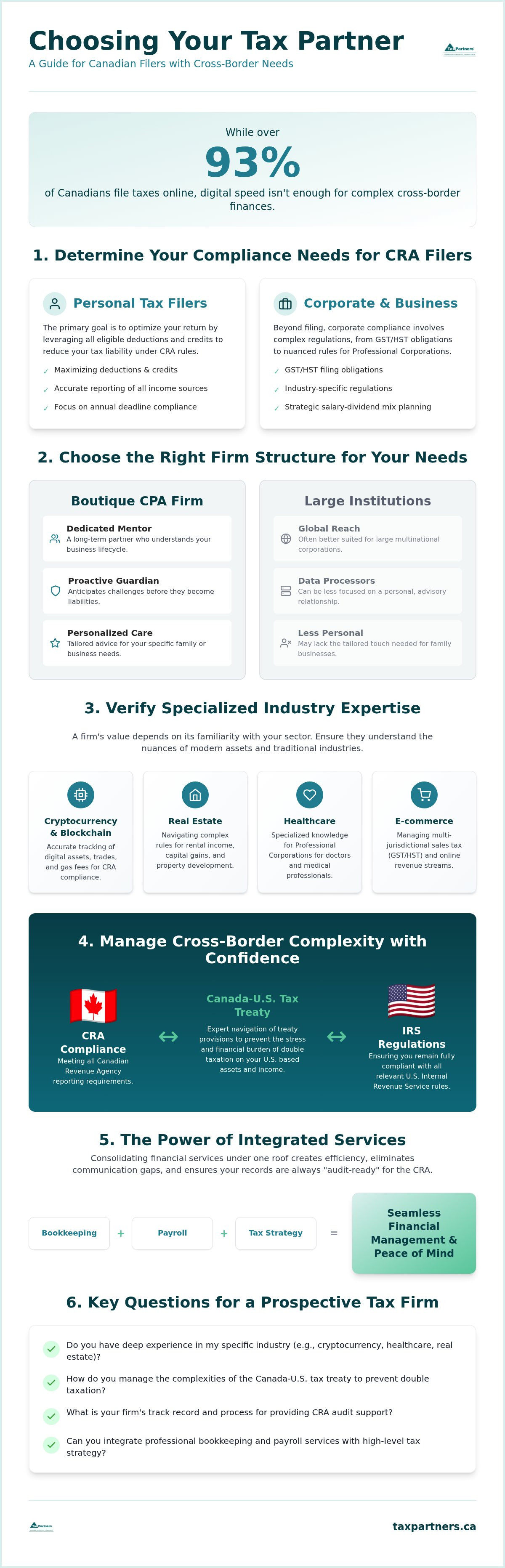
Over 93% of Canadians now file their taxes online, but digital speed doesn't always equal accuracy when your financial life crosses borders. Deciding which tax firm to trust with your 2026 filings is a choice that impacts your long-term wealth and peace of mind. You deserve a partner who sees beyond the forms to protect your assets from unnecessary scrutiny.
It's completely natural to feel a sense of unease regarding the threat of a CRA audit or the weight of double taxation on your U.S. based assets. We understand that you're looking for more than just a data entry service. You'll discover how to evaluate professional expertise to find the right tax firm for your Canadian compliance and cross-border needs.
This guide provides a clear roadmap for selecting a proactive guardian who understands your unique situation. We'll help you realize the importance of deep expertise in niche areas like cryptocurrency and the value of building a lasting, mentor-like relationship with your accountant.
Key Takeaways
- Identify whether you require personal tax assistance or corporate compliance under CRA rules to ensure your filing aligns with your professional structure.
- Compare boutique CPA firms with larger institutions to find a dedicated mentor who understands the specific needs of a Canadian family business.
- Prepare technical questions to determine which tax firm has the specialized experience to manage your unique jurisdictional requirements.
- Navigate the complexities of the Canada-U.S. tax treaty to remain compliant with IRS regulations and avoid the stress of double taxation.
- Leverage decades of institutional wisdom to move from a state of regulatory uncertainty toward a feeling of total control over your financial outcomes.
Determining Your Compliance Needs for CRA Filers
Deciding which tax firm to hire begins with a clear assessment of your specific obligations under Canada Revenue Agency (CRA) rules. Many filers mistake tax preparation for tax planning, though they serve very different purposes. Tax preparation is the accurate recording of past financial data to meet annual deadlines.
Strategic tax planning is a proactive process that focuses on future wealth preservation and minimizing long-term liability. Understanding the foundations of Taxation in Canada is the first step in recognizing how these functions work together. A seasoned mentor will help you realize that preparation is historical, while planning is visionary.
Individual vs. Corporate Requirements
For individual CRA filers, the priority often lies in maximizing eligible deductions and credits to reduce the amount of tax owed. Corporate tax preparation is significantly more complex. It requires a firm that understands GST/HST (Goods and Services Tax / Harmonized Sales Tax) filing obligations and industry-specific regulations.
If you operate as a Professional Corporation, which is a business entity for licensed professionals like doctors or lawyers, your reporting standards differ from those of a standard SME (Small to Medium-Sized Enterprise). These entities face unique rules regarding passive income and salary-dividend mixes. You can find more detail on these specific steps through our Canadian Accounting & Tax Services.
Specialized Industry Expertise
A firm's value often depends on its familiarity with your particular sector. It's vital to confirm if they have experience in real estate, healthcare, or e-commerce. When you are deciding which tax firm is right for you, look for a team that acts as a proactive guardian for your specific business model.
Modern investors also need a partner who understands blockchain and cryptocurrency accounting. This is the process of tracking digital asset transactions to ensure accuracy across multiple exchanges. If you hold digital assets, ask if the firm provides cryptocurrency accounting and tax services.
Reporting digital assets correctly to the CRA requires precision. You must account for every trade and even "gas fees," which are the payments required to conduct a transaction on a blockchain. A firm with specialized expertise will ensure you remain compliant while minimizing the risk of a costly audit.
Comparing Firm Specializations for Canadian Businesses
Choosing which tax firm to partner with involves weighing the scale of the organization against the depth of the personal relationship. While "Big Four" institutions offer global reach, they often lack the personalized care essential for local Canadian enterprises. Boutique CPA firms provide a dedicated mentor who stays with you through the entire lifecycle of your family business.
This relationship-first model ensures your accountant acts as a proactive guardian rather than just a distant processor. You gain a partner who anticipates challenges before they become liabilities. A firm with over 40 years of experience brings a level of institutional wisdom that provides a steady hand at the helm during economic shifts.
You should also verify a firm's track record with CRA audit support, which is the technical assistance provided during a government review of financial records. This expertise is vital for maintaining your peace of mind. If you are unsure which tax firm aligns with your goals, look for one that has successfully defended thousands of filings before the Canada Revenue Agency.
Many legacy firms still avoid emerging sectors, but your choice must reflect the modern economy. If you hold digital assets, ensure your firm understands the nuances of blockchain reporting. This specialized knowledge prevents costly errors and ensures your cryptocurrency holdings are as compliant as your traditional investments.
The Value of a Multi-Service Firm
Efficiency often comes from the consolidation of financial data. Look for firms that integrate Professional Bookkeeping Services and payroll management with high-level tax strategy. Consolidating these functions ensures that your financial records are always "audit-ready" for the CRA, reducing the stress of year-end filings.
When bookkeeping and tax planning happen under one roof, the flow of information is seamless. This integration allows for real-time adjustments to your strategy as your revenue changes. It eliminates the communication gaps that often occur when using multiple separate providers.
Wealth Management Integration
Tax planning shouldn't exist in a vacuum. The most effective advisors view tax as a core component of wealth management and financial planning. This holistic approach helps protect your financial legacy through estate planning and robust succession strategies.
A succession strategy is a formal plan for transferring business ownership to a new leader or family member. It's about more than just numbers; it's about securing your future and ensuring a smooth transition. If you want to see how an integrated approach can benefit your business, reach out to a seasoned advisor today to discuss your long-term goals.
Managing Cross-Border Complexity under IRS Rules
Navigating the financial border requires a complete shift in perspective. If you're a dual citizen or a Canadian expat, you must adhere to Internal Revenue Service (IRS) rules regardless of where you live. This global taxation model often catches those accustomed to the residency-based system of the CRA off guard.
A major concern for cross-border filers is double taxation, which is the levying of tax by two different jurisdictions on the same income or asset. To prevent this, your advisor must skillfully navigate the tax treaty between Canada and the United States. Deciding which tax firm to trust hinges on their ability to apply treaty benefits that protect your hard-earned wealth.
Proficiency in specific IRS forms is a non-negotiable requirement for your peace of mind. You should ensure the firm has deep experience with Form 1040 for residents and Form 1040-NR for non-residents. These documents are the primary tools for maintaining compliance under IRS rules while living in Canada.
Essential IRS Filing Requirements
Beyond standard income reporting, expats must understand FBAR (Foreign Bank and Financial Accounts Report) filing requirements for accounts held outside the US. These reports are mandatory if your aggregate foreign account balances exceed specific thresholds at any point in the year. You must also remain vigilant regarding FATCA (Foreign Account Tax Compliance Act) compliance if you're a Canadian resident with US citizenship.
A proactive guardian will help you track these requirements to avoid the steep penalties associated with non-disclosure. For more specific guidance on navigating these forms, refer to our resource on 1040-NR Filing for Canadians. This ensures your global assets remain transparent and protected from regulatory friction.
IRS Streamlined Procedures and ITINs
If you've fallen behind on your US obligations, don't panic. Ask if the firm can assist with the IRS streamlined procedure, which is a program for expats who need to catch up on unfiled returns. This path allows you to resolve past omissions without the stress of heavy penalties, provided the failure to file was non-willful.
Many individuals also require an ITIN (Individual Taxpayer Identification Number) to file US returns if they don't have a Social Security Number. A qualified firm should provide ITIN application services to facilitate this process. Selecting which tax firm to handle these applications ensures you meet all requirements under IRS rules quickly and accurately.
Key Questions to Ask a Prospective Tax Firm
Choosing which tax firm to hire is about more than just finding someone to fill out forms. You are looking for a mentor who acts as a proactive guardian for your assets. The interview process should reveal if a firm is merely a reactive "number cruncher" who records history or a strategist who helps you shape your future.
A reactive approach often leads to missed opportunities for savings under CRA rules or unexpected penalties from the IRS. You deserve an advisor who can explain technical tax matters in plain language. If they cannot describe a concept without relying on dense jargon, they may not have the depth of understanding you require.
The Professional Interview Checklist
Prepare a specific list of questions to gauge a firm’s responsiveness and technical depth. This helps you identify which tax firm has the actual capacity to handle your unique jurisdictional needs. Consider asking the following during your initial meeting:
- How many years of experience do you have with Canadian corporate tax compliance? Ensure they understand the specific reporting standards for Professional Corporations and standard SMEs under CRA rules.
- Do you have dedicated specialists for US cross-border filings under IRS rules? Blending jurisdictions is a common mistake; you need experts who know the nuances of the Canada-U.S. tax treaty.
- How do you handle communication during the peak tax season? Timely filings are essential to avoid interest charges from the CRA or the IRS, so ask about their turnaround times.
Evaluating Transparency and Trust
Integrity is the foundation of any long-term partnership. Ask about their fee structure and how they realize value for their clients beyond simple data entry. A reliable firm will be transparent about costs and the specific outcomes they aim to achieve for your business.
Look for a partner that provides a clear checklist of required documents before you even begin the filing process. This organization demonstrates a methodical approach to your compliance. You should also review their Google ratings to confirm a history of ethical steadfastness; our firm, for instance, maintains over 1,390 five-star reviews.
Finally, confirm how they stay ahead of regulatory changes to protect your financial legacy. If you're ready to find out how a proactive guardian can secure your outcomes, book a consultation with our senior advisors today. We are here to lead you toward a state of total control over your financial world.
The Tax Partners Advantage for Canadian Filers
Choosing which tax firm to trust with your financial future is a decision that defines your long-term stability. At Tax Partners, we bring over 40 years of institutional wisdom to every file we handle. We have successfully filed more than 495,000 returns, establishing a level of precision that few boutique firms can match.
We act as a proactive guardian for your wealth. To date, our strategic planning has saved our clients more than $87 million through careful adherence to the law. Our team bridges the gap between CRA compliance for Canadian residents and complex IRS requirements for those with U.S. interests.
This seamless, end-to-end support ensures that no detail is overlooked. We provide the foresight necessary to navigate the shifting sands of regulatory change before they impact your bottom line. When you decide which tax firm is right for you, consider the value of a partner who is invested in your growth.
A Legacy of Client Success
Our reputation is built on a sophisticated blend of approachable warmth and professional authority. With over 1,390 five-star Google reviews, our clients consistently recognize our commitment to ethical steadfastness. We serve over 20 industries, including healthcare and real estate, ensuring your specific business challenges are met with seasoned expertise.
We believe in building relationships that last decades rather than just a single tax season. Our accountants act as mentors who remain deeply invested in your success. You can read more about our mission and vision to see how we prioritize these long-term partnerships.
Next Steps for Your Tax Security
Transition from a state of uncertainty to total control by partnering with a firm that understands your global footprint. Whether you are navigating requirements under IRS rules or seeking optimization for CRA filers, we provide the steady hand you need. We help you realize your financial goals while maintaining absolute compliance.
For business owners, we provide specialized resources on Canadian corporate tax compliance to help you manage your obligations. Our approach integrates wealth management with tax strategy to protect your financial legacy. Contact our team today to secure a better outcome for your personal or corporate tax situation.
Secure Your Financial Legacy
Identifying your specific needs under CRA rules or IRS regulations is the essential first step toward achieving long-term stability. You've learned that a proactive guardian does more than just record your financial history; they actively look ahead to protect your global assets. Deciding which tax firm to partner with ensures your family business or personal wealth remains shielded from unnecessary regulatory risk.
Our team combines 40 years of Canadian tax expertise with the institutional wisdom gained from filing over 495,000 returns successfully. With more than 1,390 five-star Google reviews, we pride ourselves on being the steady hand at the helm of your financial journey. Precision matters. We bridge the gap between complex jurisdictions so you can focus on building your legacy with absolute confidence.
It's time to move from a state of uncertainty toward total control over your compliance and savings. Book a consultation with Tax Partners to secure your financial future and realize the peace of mind that comes with expert mentorship. We look forward to helping you achieve lasting prosperity through precision, transparency, and dedicated care.
Frequently Asked Questions
How do I know if a tax firm specializes in CRA or IRS rules?
Check the credentials of the practitioners and the specific services listed on their website. A firm specializing in Canada Revenue Agency (CRA) rules will typically feature Chartered Professional Accountants (CPAs). For Internal Revenue Service (IRS) rules, look for Enrolled Agents or U.S. CPAs. A qualified firm should explicitly separate these two jurisdictions in their marketing materials and service descriptions.
What is the difference between a CPA and a general tax preparer in Canada?
A Chartered Professional Accountant (CPA) is a regulated professional who has completed rigorous education and adheres to a strict code of ethics. General tax preparers may not have a formal designation or the same level of professional accountability. CPAs are trained to handle complex corporate structures and strategic planning, while general preparers often focus on basic data entry for simple returns.
Can one firm handle both my Canadian and US tax returns?
Yes, a specialized cross-border firm can manage your filings for both the CRA and the IRS. This integrated approach is the best way to prevent double taxation, which occurs when two different countries tax the same income. When deciding which tax firm to hire, ensure they have internal specialists for both jurisdictions to maintain a seamless flow of financial information.
What should I look for in a tax firm if I own cryptocurrency?
Look for a firm with proven experience in blockchain accounting, which is the technical process of reconciling digital asset trades across multiple exchanges. They must understand how the CRA distinguishes between capital gains and business income for digital assets. Ensure they can track "gas fees," which are the transaction costs required to conduct operations on a blockchain, to ensure your reporting is accurate.
How much does it typically cost to hire a professional tax firm?
Professional fees vary based on the complexity of your financial situation and whether you require corporate or personal compliance. Cross-border returns and niche industry filings involve more technical depth than a basic return. You should confirm the current fee structure directly with the firm to understand how they realize value for your specific needs. Most reputable firms provide a clear engagement letter before starting.
Will a tax firm represent me if I am audited by the CRA?
Most professional CPA firms provide audit support, which involves managing all technical communication with the Canada Revenue Agency during a review. This service ensures that your records are presented correctly and your rights are protected. When choosing which tax firm to trust, ask if they act as a proactive guardian by handling all correspondence and documentation requests on your behalf.
What is a cross-border tax accountant and do I need one?
A cross-border tax accountant is a specialist who understands the interaction between the tax laws of two different countries. You likely need one if you are a dual citizen, a Canadian expat, or hold significant assets in the United States. They navigate the tax treaty to ensure you remain compliant with both CRA and IRS rules while minimizing your overall global tax liability.
How often should I meet with my tax firm for planning?
You should meet with your advisor at least once per year for a strategy session, though quarterly meetings are recommended for business owners. Regular check-ins allow your mentor to adjust your plan as your revenue or asset structure changes. This proactive approach ensures you stay ahead of new regulations and never miss a deadline. It helps move you from a state of uncertainty toward total control.

Article by
Mahad Mohamed
Mahad Mohamed is an accountant and the CEO of Tax Partners, with over 26+ years of Canadian and international tax and accounting experience. His expertise includes corporate reorganization, cross-border tax structuring (Canada & US), tax disputes, CRA audits, and tax planning for small owner-managed private corporations. Most recently, Mahad is a pioneer in Canadian crypto taxation and founded Block3 Finance.
Previously, Mahad worked for the Canada Revenue Agency (CRA), Big4 accounting firms, and served as a Rulings Officer for the Federal Tax Authority of the UAE before acquiring Tax Partners in 2014.
Tax Partners has 44 full-time accountants and over 18,400+ clients.
Disclaimer
This article provides general information only and is current as of its publication date. It has not been updated and may be out of date. It does not constitute legal advice and should not be relied upon as such. Every tax situation is unique and may differ from the examples discussed in this article. If you have specific questions, you should seek the advice of our accountants for your unique circumstances. Book a FREE Initial Consultation Today!
Frequently Asked Questions
How do I know if a tax firm specializes in CRA or IRS rules?
Check the credentials of the practitioners and the specific services listed on their website. A firm specializing in Canada Revenue Agency (CRA) rules will typically feature Chartered Professional Accountants (CPAs). For Internal Revenue Service (IRS) rules, look for Enrolled Agents or U.S. CPAs. A qualified firm should explicitly separate these two jurisdictions in their marketing materials and service descriptions.
What is the difference between a CPA and a general tax preparer in Canada?
A Chartered Professional Accountant (CPA) is a regulated professional who has completed rigorous education and adheres to a strict code of ethics. General tax preparers may not have a formal designation or the same level of professional accountability. CPAs are trained to handle complex corporate structures and strategic planning, while general preparers often focus on basic data entry for simple returns.
Can one firm handle both my Canadian and US tax returns?
Yes, a specialized cross-border firm can manage your filings for both the CRA and the IRS. This integrated approach is the best way to prevent double taxation, which occurs when two different countries tax the same income. When deciding which tax firm to hire, ensure they have internal specialists for both jurisdictions to maintain a seamless flow of financial information.
What should I look for in a tax firm if I own cryptocurrency?
Look for a firm with proven experience in blockchain accounting, which is the technical process of reconciling digital asset trades across multiple exchanges. They must understand how the CRA distinguishes between capital gains and business income for digital assets. Ensure they can track "gas fees," which are the transaction costs required to conduct operations on a blockchain, to ensure your reporting is accurate.
How much does it typically cost to hire a professional tax firm?
Professional fees vary based on the complexity of your financial situation and whether you require corporate or personal compliance. Cross-border returns and niche industry filings involve more technical depth than a basic return. You should confirm the current fee structure directly with the firm to understand how they realize value for your specific needs. Most reputable firms provide a clear engagement letter before starting.
Will a tax firm represent me if I am audited by the CRA?
Most professional CPA firms provide audit support, which involves managing all technical communication with the Canada Revenue Agency during a review. This service ensures that your records are presented correctly and your rights are protected. When choosing which tax firm to trust, ask if they act as a proactive guardian by handling all correspondence and documentation requests on your behalf.
What is a cross-border tax accountant and do I need one?
A cross-border tax accountant is a specialist who understands the interaction between the tax laws of two different countries. You likely need one if you are a dual citizen, a Canadian expat, or hold significant assets in the United States. They navigate the tax treaty to ensure you remain compliant with both CRA and IRS rules while minimizing your overall global tax liability.
How often should I meet with my tax firm for planning?
You should meet with your advisor at least once per year for a strategy session, though quarterly meetings are recommended for business owners. Regular check-ins allow your mentor to adjust your plan as your revenue or asset structure changes. This proactive approach ensures you stay ahead of new regulations and never miss a deadline. It helps move you from a state of uncertainty toward total control.